Welcome to my blog!

News from a wargamer with a special interest in the military history of the Balkans. It mainly covers my current reading and wargaming projects. For more detail you can visit the web sites I edit - Balkan Military History and Glasgow & District Wargaming Society. Or follow me on Twitter @Balkan_Dave
or on Mastodon @balkandave@mastodon.scot, or Threads @davewatson1683

Tuesday, 6 June 2017

Italian Wars

I have clearly been watching too many Netflix boxed sets recently. The Borgias and Medici: Masters of Florence cover the period of the Italian Wars. Even if the history is largely a backdrop to the sex, murder and intrigue of these lavish productions. My recent visit to Italy added to my interest in the period, with some very fine castles.

The Italian Wars refer to a period of some 65 years, from 1494 to 1559, that saw eight different conflicts on the Italian peninsular. Italy was a patchwork of states, often warring amongst themselves.

These conflicts went up a notch when the great powers of the period involved themselves. Firstly the French, who marched through Italy to capture Naples, before being forced into a fighting withdrawal. French involvement encouraged the Spanish to support Naples. Later the Holy Roman Emperor became involved in northern Italy. Even the Ottoman Empire dabbled in the conflict and Henry VIII got involved on the fringes.

The armies the period were in transition from the medieval to the renaissance. The fully armoured knight was still dominant, but became less effective as the pike replaced the spear and the arquebus replaced the crossbow. All armies made extensive use artillery, in the field and in siege warfare.

Mercenaries played an important role in most armies. Infamously, the Swiss and the German Landsknechts. The Italian states relied heavily on the Condottieri contractors, who singularly failed to adapt to the new methods of warfare.

For the wargamer, the Italian Wars offer a glorious mix of troop types and colourful armies. I have a limited number of figures in 28mm and 15mm, suitable for the period. As a toe in the water, I have started with my current favourite set of rules, Pikeman's Lament. They are designed for a slightly later period, but easily adapted.

My first action was an Italian state against an Imperial force, 24 points a side. Using 15mm figures.


Some photos of the first game, there will be more.


Sunday, 4 June 2017

The Dacian War (Veteran of Rome Book 6)

My holiday fiction reading included William Kelso's 'The Dacian War'. This is the sixth volume in his Veteran of Rome series. I haven't read any of the others, but was attracted to this one because it covered a Balkan subject, Trajan's invasion of Dacia.


The format is pretty similar to the many historical fiction books on Imperial Rome. In this case, we have two heroes - Marcus the retired veteran of an auxiliary cohort, and his son Fergus, who serves in a legionary cohort as an Optio.

I felt a little cheated after reading the first half of the book. All the action involves Marcus who lives in Brittanica. He has a little local difficulty with a better connected neighbour and makes a somewhat unlikely trip to Rome, in order to save a Christian slave who poisoned the said rival. He then gets involved in some high level Roman political plotting. Again, even for historical fiction, this is stretching matters a little far.

The second half of the book moves on to the invasion of Dacia. Here the book picks up, with Fergus in the thick of the action against the Dacian's and their allies. The description of various battles, are some of the best I have read - you really do get a flavour of the campaign. I particularly liked the emphasis on the importance of Roman engineers in traversing the difficult terrain and in sieges. Having walked a bit in the Carpathian Mountains, I can imagine the challenges facing the Roman army of the period.

You probably need to read the whole book, but for a second read I would skip the first half.

If you want to read more about the Dacian Wars, I highly recommend the beautifully illustrated book by Radu Oltean, available from Karwansary, the publishers of Ancient Warfare magazine. And by the way, they now do a very good podcast as well.

Some tabletop Dacian War action. 28mm figures from my collection.


Friday, 2 June 2017

Genoa 'La Superba'

My recent visit to Liguria caused me to do a bit of background reading into the history of Genoa, based on Nicolas Walton's book 'Genoa 'La Superba' - The Rise and fall of a Merchant Pirate Superpower'.


Visiting the region with its harsh mountainous geography that hugs the coast, you can easily see why the sea would be the natural outlet. The story of medieval Genoa is none the less a remarkable one. They traded across the known world, supported the crusades and led the fight against the Barbary pirates. Less happily, they also introduced the Black Death to Europe.

I was familiar with the conflict with Venice, but not aware of the 200 year war with their west coast maritime rival, Pisa. While I didn't get up to Genoa, I did visit a number of the formidable castles, built by both sides in this war that Genoa won.

They very nearly conquered Venice in the medieval period, but arguably came out second best in the long term. Despite this failure, it was the Genoese Admiral, Andrea Doria, who led the Christian fleet at Lepanto, and achieved much more besides. The author describes him as 'The Steve Jobs of the Mediterranean', reflecting the city's commercial approach to war and trade. Other luminaries included Christopher Columbus, so there is a certain poetic justice that so many Ligurians emigrated to the USA.

Today, we think of Italy as a nation state like any other. However, it wasn't until the mid 19th century that the often warring states and their big power allies were unified. The brains behind the Risorgimento was the Genoese born Giuseppe Mazzini. Metternich said 'But nothing and no one has created greater difficulties for me than a devil of an Italian'. If Mazzini was the brains, the muscle was  fellow Ligurian (although born in Nice), Giuseppe Garibaldi. Together they were the idealistic cutting edge of unification, often several steps ahead of the the pragmatic Piedmont leaders.

The Second World War was not kind to the region. There is model in the naval museum at La Spezia of the naval base in 1945, which clearly shows the damage allied bombing did, and Genoa suffered in similar fashion. After the overthrow of Mussolini, they also had a particularly ruthless SS Commander in Friedrich Engel, known as the Butcher of Genoa. There is therefore a certain irony that many prominent Nazis escaped to South America through Genoa. Even more ironically many Jews escaped to Palestine from La Spezia.

Walton has written a book that is part history, part travelogue. While Venice may be the better known naval superpower of the medieval and early modern period. The fascinating history of Genoa deserves to be better known. This book does just that.


The Pisan castle at Lerici captured by Genoa.


Wednesday, 31 May 2017

The Assassins

No, not the Ismaili medieval sect, for that you need James Waterson's book. This is Alan Bardos's fictional account of the assassination of the Archduke Ferdinand in Sarajevo - the spark that started the First World War.


The author sticks pretty closely to the events that led up to the assassination - plumping for the middle ground between the differing theories on Serbian involvement. In short, a group of young Bosnian Serbs are funded and equipped by elements of the Serbian intelligence service, who help them to get into Bosnia and carry out the assassination of the heir to the Hapsburg throne.

He shows very clearly the poor organisation and the equally negligent Hapsburg response. Even the actual shooting was almost accidental.

The one big difference is the insertion of young British diplomatic clerk into the story. Sent off into the Balkans by his boss, who's wife he was carrying on with, to write a report, or more likely get himself killed. The hapless clerk is recruited by a Hapsburg official and infiltrates the assassins group. To say this is somewhat far fetched, is something of an understatement!

However, if you suspend credulity for a few hours, this is an entertaining read.


My photo of the street in modern Sarajevo where the Archduke was shot. And there is a small museum that is worth a look. 


Monday, 29 May 2017

Lake Trasimene 217BC

This month, in 217BC, Hannibal pulled off one of his greatest victories over the Romans at Lake Trasimene in the modern day Umbria region of Italy. A family holiday this week brought me within range of the battlefield.

Hannibal is the ancient general I most admire. Others may have been more victorious, but few had his leadership challenges, commanding a largely mercenary army in a campaign that took his army over the Alps and onto Rome's own territory. It was also my very first wargame army.

The previous year 218BC, Hannibal had consolidated his position amongst the Gauls and defeated a Roman army on the Trebbia. He wintered north of the Appenines and chose a particularly difficult pass south, which meant the two Roman armies waiting for him could not combine. The route took him through the marshy Arnus river basin, where he lost an eye to infection and made the journey on the remaining elephant.
He passed close to the camp of the Roman Consul Caius Flaminius at Arretium (Arrezo), ravaging Roman property to provoke him. However, Flaminius resisted the temptation and followed Hannibal down to Lake Trasimene, hoping to catch him between his and the other Roman army.

A view of the hills surrounding the northern end of the lake.

Hannibal spotted the opportunity the ground north of the lake offered him. He positioned his veteran foot on a hill, the site of the modern village of Turo, tempting Flaminius to attack. As the Roman army began to deploy from march columns, Hannibal signalled the flank attacks using Gaulish foot and the combined Punic cavalry. His light horse sealed the trap.

Some 15,000 Roman troops were killed (including Flaminius) and probably another 15,000 were taken prisoner. Hannibal released Rome's allied troops as part of his strategy to encourage them to break away from Rome. Hannibal lost around 1500 men, mostly Gauls.

There is some contention over the exact site of the battlefield, but the modern consensus favours the Sanguineto basin as the killing ground. There are 12 information boards at various stages of what is called the Hannibalic Path. They are very well done, with descriptions of the troops and key stages of the battle. The signposting could be better, but you can walk or drive around the route.

One of the twelve information boards

This picture is taken from what is thought to be Hannibal's command post, from where he signalled the attack. Yes, my 'world tour' Hannibal T-Shirt got some proper use!


No statue of Hannibal, but there is one of Flaminius. He comes in for a lot of criticism, but it's hard to see what else he could have done but attack. His failings and that of most Roman commanders of the period was poor reconnaissance.


This is an excellent battlefield to visit, as it's fairly easy to visualise and the local authorities have done a good job of presenting it to the visitor. Just south of the battlefield, is the lovely medieval town of Castiglione del Lago. A good place for some lunch and a fine medieval castle to visit as well.


Saturday, 27 May 2017

La Spezia Naval Museum

The Italian naval base at La Spezia houses a small, but very fine museum that focuses on special forces and other technical aspects of naval warfare. 


The main exhibition hall has one of the two man human torpedoes that were so effective in WW2.


It also has some wonderful ship models, from Roman galleys, to Renaissance galleys and later 18th and 19th century sailing ships.


Upstairs there is a fabulous collection of ship figureheads, including several British ones.


In another exhibition hall there are a range of gun turrets and other weaponry.


And finally, outside there are various ships cannon and other equipment.


There are very few signs in English, so you have to make do. Nonetheless, well worth a visit.

You can also see the modern naval base, with old and new frigates on show.


The surrounding area has a fine array of medieval castles, reflecting the 200 year conflict between Genoa and Pisa. This one at Lerichi, is particularly impressive. 


Sunday, 21 May 2017

Bolt Action - Campaign Sea Lion

Operation Seelowe is one of my favourite WW2 campaigns, so purchasing the new Bolt Action supplement was a no brainer.

And very good it is too. It starts and finishes with an explanation of the German plans and how it might have turned out. There is much of the 'What if' in this supplement, which won't please the purists, but the rest of us will love it.


There are lots of new British units, including the Royal Navy, Local Defence Volunteers and of course Captain Mainwaring and the Home Guard.  Longbow armed rural patrols, may be stretching it a little, but apparently they did exist. There are lots of auxiliary units, strange artillery and armoured vehicles. Not forgetting an armoured train, minefields and an array of fortifications.

For the Germans we have Brandenburger units, Abwehr agents and the British Union of Fascists. Their new equipment includes various invasion barges, amphibious tanks and gliders. Finally there are ten scenarios and a campaign.

Fans of the Very British Civil War genre will find lots to like in this supplement and many of the figures will come in useful. I would also recommend Andy Johnson's book, Seelowe Nord, which is a fictional account of landings in Yorkshire.

I haven't played much Bolt Action recently, but this supplement will certainly get me back into the fold.


One of my Seelowe Nord games in 15mm


Vickers light tank in 28mm


The Duchess's Hussars - why not!


Sunday, 14 May 2017

Carronade 2017

Thanks to the Falkirk club for organising another great show - Carronade 2017.

Carronade is one of the two big shows in Scotland held each year - helpfully a few months apart. The venue is a large secondary school that has several halls and canteen facilities. This accommodated 35 games and 40 plus traders.

This year seemed busier than normal and the organisers confirmed that with the numbers coming through the door - a positive sign for the hobby in Scotland. Our participation game was certainly non-stop, with hardly a gap between games and even squeezing in a quick version before closing. Usually you can start breaking down before 4pm, but not this year.

This means I didn't get much time to look at the other games and only bought a few bits and pieces. But what I did see was first class.

Starting with our GDWS game that required players to rescue the princess from the castle using Conan and his war band. The rules were a cut down version of Dan Mersey's 'Dragon Rampant'. It worked really well, with players picking up the essentials very quickly. The Princess got rescued six times, but a few were close run things.


The Princess rescued again - with the priest of Set getting his just deserts


We spared no expense with the prizes!


Here are some others that caught my eye.


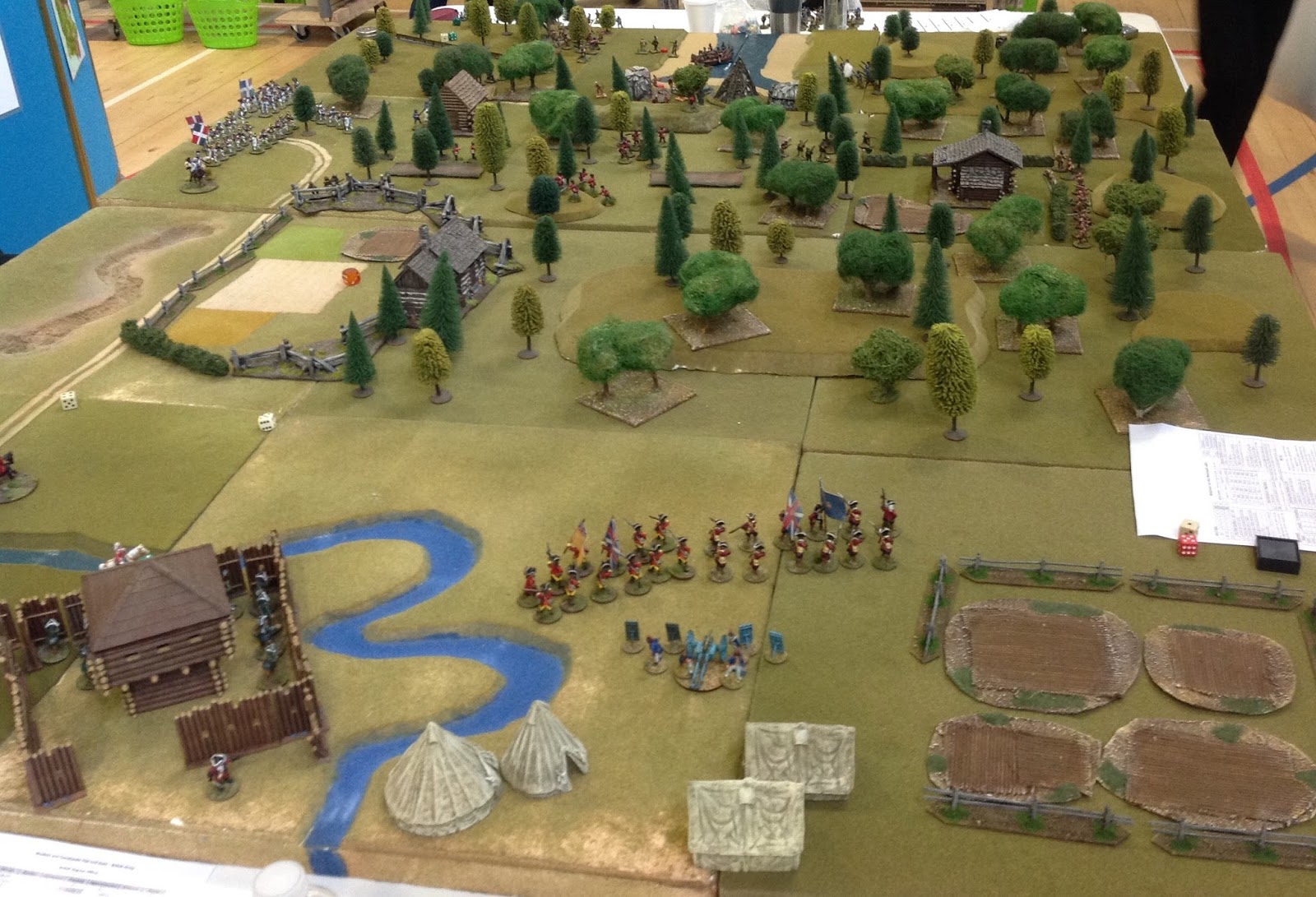
French Indian War, if I recall using Muskets and Tomahawk rules


The Men Who Would be Kings - great rules, we will be using these for our game at Claymore


The Aegean 1941 - I have always wanted to try some games based on this campaign


Old school 30mm Seven Years War from the Tyneside visitors


I'm not a big sci-fi fan but this Dropzone Commander game was visually impressive


Spanish Civil War - No Passaran comrades!


No idea how Antares plays - but it certainly has colourful foliage


The Grahams are a raiding in the Border Reivers game. Lovely tower model


Great Northern War from the League of Augsburg


Hundred Years War - with some Scots fighting for the French


Ramilles, showing how small scales do big battles well.


Sunday, 7 May 2017

Soviet Naval Infantry

My Soviet infantry for the Caucasus 1942 project needed some reinforcements. I couldn't face painting another pile of brown Soviets, so I turned to the naval infantry who played a significant role in the campaign. The Osprey campaign book has a great colour plate featuring them defending the Proletary cement factory.

The Soviet Navy contributed almost 100,000 sailors to roughly 30 infantry brigades fighting on land. As the war progressed, these naval infantrymen were assimilated into regular Red Army formations. However, in the Caucasus in 1942 they were primarily naval personnel transferred into land formations. Often with minimal training, they learned on the job. They also had fewer support units, particularly artillery, than normal rifle brigades.

My figures are from the Battlefront range. The basic uniform was black, although many also had blue shirts. A nice quick paint job for these four squads. There is enough in the pack for four more and some sub-machine gun squads.


And onto the tabletop. I haven't tried the new Flames of War rules, but they are a set that need a lot of playing and I don't do much 15mm WW2 these days. So I returned to Iron Cross, a much simpler fast play set of rules for the period. There are some gaps, but a bit of common sense can plug those.


The German mountain troops with tank support struggled to make progress up this river valley, particularly after the Soviet ATGs quickly knocked out the tanks - hurra!


Friday, 5 May 2017

Rebellion's Forge

This is the third in the 'Blood of Kings' series by K.M.Ashman. The setting is Wales in 1109, a country divided into a number of independent Welsh kingdoms and a substantial English presence. There is a truce between the English King Henry and the Welsh kingdoms, but revolts and unrest are commonplace.

A number of characters in the second book continue to play a role, most notably Prince Nesta who was married off to an English knight, and her brothers who organise different rebellions. The Welsh kings are torn between the realpolitik of protecting their kingdoms and moral support for rebellion.


The story appears to follow very broadly what we know of the period, which is not a great deal. It has small scale actions, rather than big battles - coupled with intrigue and treachery. The story is told well by an accomplished and fairly prolific author. I will keep reading this series.

For the wargamer this is definitely Lion Rampant territory. The rules fit this type of warfare really well.