Welcome to my blog!

News from a wargamer with a special interest in the military history of the Balkans. It mainly covers my current reading and wargaming projects. For more detail you can visit the web sites I edit - Balkan Military History and Glasgow & District Wargaming Society. Or follow me on Twitter @Balkan_Dave
or on Mastodon @balkandave@mastodon.scot, or Threads @davewatson1683
Showing posts with label Dark Ages. Show all posts

Monday, 15 December 2025

Armies of Justinian the Great

 This new Osprey MAA by Raffaele D'Amato is an overview of the Byzantine (arguably Late Roman) armies of Justinian the Great, 527-565 AD. He led a Roman recovery, including ambitious reconquests of lost Western territories, with outstanding generals such as Belisarius, Narses and Iohannes Troglita. This is a popular subject at present, with Helion publishing a two-volume study. 


He inherited an army structure that had changed little since the time of Constantine the Great. The Comitatenses was the field army, providing a defence in depth and for expeditionary forces. The Limitanei defended the borders, although Justinian turned it into a semi-regular force of soldier-settlers. The author describes the different troop types. While the heavily armoured cavalry is the iconic picture of his armies, the infantry remained important. Heavy infantry supported by light troops and archers could defeat cavalry charges. The cavalry included horse archers, increasingly hired, and heavy lancers. The elite Imperial Guard was based in Constantinople and organised into nine units. 

The recruitment of individual soldiers, along with their equipment and weapons, is covered in some detail. The types of scale and lamellar armour have been the subject of some debate, and the author takes us through the most recent archaeological evidence, including some remarkably well-preserved examples found in Türkiye. The old oval shield was still used by the infantry. This is all covered in fine colour plates, as you would expect in this series. The variety of troop types makes this a popular tabletop army to paint.

For the wargamer, this MAA has all you need to collect and paint these armies. You will need another book on the campaigns, of which there are several. The main primary source is The Wars of Justinian by Prokopios, and there is a modern translation. It has been many years since I painted my 15mm army of the period, in the days when Ian Heath's book was just about all that was available.

Some of my early Byzantine cavalry in 15mm


Sunday, 7 December 2025

State Builders from the Steppe

This book about the First Bulgarian Empire is by Eric Halsey, who hosts the excellent Bulgarian History Podcast. It is the first English-language book on the subject since Runciman's classic, first published in the 1930s.


Unlike most of the Steppe tribes that burst into the Balkans, the Bulgarians did something different - they built a state that has survived until today. The long-standing assumption was that they first dominated the Slavs who had infiltrated the Byzantine Empire in the Balkans and then assimilated with them. While that happened, the author points to recent studies that have found greater commonalities between Thracians and Proto-Bulgarians than between Thracians and Slavs, based on DNA comparisons of archaeological samples with contemporary Bulgarians. Nonetheless, Slavs did integrate into Bulgarian society, and the Bulgarians gradually allowed them into the elite strata.

The Byzantines, while often distracted, resisted the attempts to build this Bulgarian state. The Battle of Ongal in 680 became the first of 45 named battles between the Bulgarians and the Byzantines. The final one would only come 652 years later. The first state was created between the Danube and the Balkan Mountains with its capital at Pliska. With his victory at Ongal, Khan Asparukh now had a Byzantine-recognised state and the legitimacy which came with it.

The Bulgarians struggled to defeat Byzantine armies on the plains, so they developed a battle tactic which would serve Bulgaria well for centuries: ambush in the passes of the Balkan Mountains. These mountains will long serve as a border between the empires and make for perfect places to funnel invading armies before attacking them in areas where they cannot escape. The sources are limited for significant periods of the story, or rely on less than objective Byzantine chronicles. The author examines these and makes some best estimates, which is a reasonable approach. 

The Bulgarians broke out of the mountains and at different times occupied large swathes of the Balkans. They even threatened Constantinople on several occasions, but lacked the siegecraft to capture it. The Byzantines relied on paying tribute and stirring up trouble on the Bulgarian flanks to keep them at bay. Bulgarian Khans had some great names, my favourite being Krum. He killed a Byzantine Emperor and forced the abdication of another. He achieved this with few resources, rarely commanding more than a few thousand soldiers.

The adoption of Orthodox Christianity was less of a religious conversion than an exercise in state-building. Under Boris, Bulgarian monarchs became Tsars, marking the completion of Bulgaria’s gradual transformation from a pagan steppe empire to a European power. Cyril and Methodius took the Slavic language and added Greek words and grammar to form Old Church Slavonic. This was later converted into modern Cyrillic. Tsar Simeon was so successful that he was almost a co-emperor with the Byzantine Empire. However, pressure from the Kievan Rus and a rejuvenated Byzantine state weakened them. The empire was pinned back to a small area and defeated by Basil the Bulgar Slayer at the Battle of Kleidon (1014). The up to 15,000 Bulgarians who had been captured at Kleidon were divided into groups of 100 and blinded, with the 100th man left with a single eye with which to lead his brothers in arms back home.

Bulgaria would make a comeback, but that is another story. This is a fascinating history, well told by an author emersed in the history of his adopted country.

Some of my Bulgarian light horse in 15mm.


Monday, 9 June 2025

The Goths AD 200-700

 This is a new Osprey Elite series book by Raffaele D'Amato on the Goths. Very welcome, as there are not many readable histories of these people who caused the Romans so much trouble. Simon MacDowall has written a couple and contributed some excellent articles for the Society of Ancients journal, Slingshot. Michael Kulikowski's "Rome's Gothic Wars" is also very readable.


The origins of the Goths have been the subject of many myths, but a location around the Baltic Sea seems likely. They moved south and, during the era of mass migrations (c. 300–700 AD), initially raided Roman territory, then provided Roman armies with mercenary contingents, and later consolidated the relationship through treaties of alliance. Having settled near modern eastern Germany, they were overwhelmed by the Huns in the 4th century.  The Romans allowed them to settle south of the Danube, but then broke the treaty, which led to the famous Gothic victory at Adrianople in AD 378. Then, subsequent wars in Asia Minor, the Balkans, and Italy led to Alaric’s Visigoths looting Rome itself in AD 410. They established kingdoms in France, Spain, and Italy.

The mid-6th century Roman historian Jordanes draws a distinction between the barbarian peoples and the Goths. He argues that they were the most advanced of these, able to successfully combine their own traditions with those of the Romans. His exemplar was Theodoric the Great, an Ostrogoth who successfully adapted to Roman culture and rose to become a king of both the Goths and the Romans.

The author provides a fairly lengthy timeline of events, followed by a historical summary. This includes the different stages of their development based on the primary sources and archaeology. I wasn't familiar with their history in the Crimea, which has its own fabulous colour plate. Very tempting!

The military organisation of the Goths was based on the tribes in the early period. More formal structures developed as the Ostrogoths and Visigoths established their own kingdoms. Every male was a potential warrior, and the Gothic forces were structured similarly to the Roman ones, comprising heavy cavalry, heavy infantry, light infantry, and archers. The formidable spear-armed heavy cavalry, called militondas, was formed around a core of Gothic aristocrats and their retinues. However, infantry still made up the most significant element.

The equipment was a mixture of Germanic and Roman. One of the distinctive types was the Spangenhelm, a metallic helmet with a framed and segmented construction, featuring attached cheekpieces and sometimes a fitting for a crest. Armour was reserved for leaders and their elite followers, and even among these, it seems to have been rare in the 3rd and 4th centuries. Weapons included axes, spears, swords and javelins. Unlike the Huns and the Romans, the Goths did not have skilled mounted archers, and their bowmen usually went into battle on foot.

As you would expect, there are illustrations, photographs and lovely colour plates. An excellent introduction to arguably the most successful of the 'barbarian' invaders of Rome.

I have a 15mm Gothic army. One of my favourites as it is simple to use. A decent infantry base, and then let loose the charging cavalry!


Friday, 27 December 2024

Shadows of the Slain

 This is the tenth book in Matthew Harffy's Bernicia Chronicles, which follows our hero Beobrand and his warband around 7th-century Britain and then Europe. Whilst fiction, it uses the limited sources we have on the period as the basis for a plot.


In the last book, our hero was escorting a group of priests, including the actual Wilfred (later St Wilfred), on a pilgrimage to Rome when they got involved in Frankish politics. In this book, they arrive in Rome, not without a few adventures en route. In the 7th century, Rome was not the imperial capital it once was, as the once great buildings fell into ruin, and local warlords fought for power. Multiple sacks and sieges, floods, earthquakes and plagues had seen an incredible decline in the city’s population. Rome went from over a million inhabitants in AD 300 to fewer than 50,000 in the seventh century. The Pope attempted to run the church during this period, but this pre-dated the Vatican and the temporal power the church gained in medieval Italy.

In the author's retelling, St Wilfred turns out to be less than saintly, a point backed up by our sources. The religious conflicts of the period were as confusing as Italian politics, but Beobrand fought through it all with his customary vigour. 

Ten books about Northumbria during this period might have been a push. So, this European excursion has been an excellent storyline. The Franks and the Lombards make an interesting backdrop to the journey. Our hero is now returning to Northumbria for the next book. I am looking forward to that.

There are no big battles in this book, but plenty of skirmish action. This made an ideal quick post-dinner game on Christmas Day. The priests were tasked with bringing relics back to England, which formed the basis for a skirmish with local warbands. Open Combat is a nice, simple system players can pick up quickly.


Friday, 5 April 2024

The Faded Map

 My library pick this month was Alistair Moffat's look at the lost kingdoms of Scotland during the late Roman, Dark Ages, and early medieval periods. They are 'lost' because we know very little about them. What we do know is based on a handful of unreliable written sources and archaeology. 


The problem with writing about lost kingdoms is that without sources, you either have to give extensive context or speculate extensively. Moffat mainly goes for the former. This book was written in 2010, and there have been some developments since then. The History Hit podcast 'Gone Medieval' recently covered these.

The main lost kingdom in the east of Scotland is Bernicia. The Kingdom of Bernicia emerged in the early 6th century in the region that roughly corresponds to present-day Northumberland and County Durham in England. Moffat argues that it also covered much of lowland Scotland and for a period further north. Bernicia's history is closely intertwined with that of its southern neighbour, the Kingdom of Deira. Together, they formed the powerful kingdom of Northumbria when they were united in the late 7th century. 

One of the most notable rulers of Bernicia was King Æthelfrith, who reigned from around 593 to 616. Æthelfrith was known for his military prowess and expansionist policies. He was responsible for defeating the British kingdom of Gododdin at the Battle of Degsastan in 603 and the subsequent annexation of the region known as the Old North. After the death of Æthelfrith, Bernicia was briefly ruled by Edwin of Deira (killed at the Battle of Hatfield Chase 633) but later reverted to independent rule under Æthelfrith's sons. Eventually, the kingdoms of Bernicia and Deira were united under King Oswiu in 654, forming the Kingdom of Northumbria. Bernicia's influence continued throughout the Northumbrian period, which lasted until the Viking invasions of the 9th century.

In the west, Strathclyde existed as an independent kingdom for several centuries, coexisting alongside Northumbria, Dalriada and Rheged. During its height, Strathclyde played a significant role in the politics and warfare of northern Britain. It was often a buffer state between the expanding kingdoms of the Angles and the Scots, and its kings were involved in conflicts with both. However, with the rise of the Kingdom of Scotland under Kenneth MacAlpin and his successors, Strathclyde gradually came under increasing pressure. By the 11th century, it had effectively been absorbed into Scotland, although remnants of its distinct culture and identity persisted for some time. Tim Clarkson's 'Strathclyde and the Anglo-Saxons in the Viking Age' covers this later period well.

The benefit of this study is that it's focused on the lost kingdoms of Scotland. The problem is that just narrows down what we don't know. New archaeological findings certainly help, but the absence of historical sources will always limit our understanding of this period. Still, it gives free rein to excellent historical fiction writers like Matthew Harffy!

One of my 28mm Saxon command stands

Thursday, 15 June 2023

Byzantine Cavalryman v Vandal Warriors

 I fear the Vandals have got the worst of historical reputations when their name is now widely used to describe anti-social behaviour. After all, the list of ancient armies vandalising their enemies' territory is a pretty long one. I suspect it is another example of history being written by the Romans.

Murray Dahm has written a more balanced book for Osprey that compares the typical mounted Vandal warrior against one of their main opponents, the Byzantine cavalryman. This takes place during the early Byzantine period, so unlike some others in this series, it isn't duplicating other books on either warrior type.


The high point of the Vandals was the invasion of North Africa from Spain in 429, taking Carthage in 439 and establishing an empire. They sacked Rome in 455, plundering it for 14 days (we don't call the Gauls or the Goths vandals!) and repulsed a previous Roman invasion in 468. They were also active at sea, although primarily as pirates, which probably added to the reputation.

Murray gives us a broad outline of the history and the opposing sides, focusing on the Vandalic War (533-36) when Belasarius defeated them. While we don't know the exact composition of the Byzantine armies, it seems likely most were cavalry. A mixture of heavy cavalry, armed as cataphractarii or clibanarii, and light cavalry from the Balkans, including Huns. Vandal armies probably consisted entirely of cavalry. Our primary source, Procopius, never refers to the infantry of the Vandals as he does for the Romans. Unlike the Byzantines, the Vandals operated on a tribal system in which every able-bodied warrior served in the army when necessary. As usual with this series, there are lovely colour plates,  both front and rear, so helpful for the wargamer and modeller who often are left guessing what their models look like from the back. He also outlines the organisation and tactics of both types.

To illustrate how these forces were used in practice, Murray takes the Battles of Ad Decimum near Carthage in 533. I have visited this area, and there is surprisingly still much to see. He then takes the better-known Battle of Tricamarum, later in 533, interestingly for a cavalry battle fought over a stream. This was about 30km from Carthage, possibly in the suburbs of modern Tunis. The Byzantines won, and the Vandals retreated into Algeria and others into the mountains. Finally, the Battle of Bagradas in 536 was essentially a battle against Vandal mutineers that had been incorporated into the Byzantine army.

The final chapter gives us an analysis of both armies, which I often wish was longer in this series. He concludes that 'The most remarkable aspect of the Vandalic War in terms of battle tactics, however, is not the war of rapid manoeuvre that was clearly part of Belisarius’ success, but the fact that all of the military victories were achieved by cavalry charges.' The Vandal warriors were capable troops, and their allies, the Berbers, were effective. However, their commanders made fundamental mistakes.

This book will give you most of the tools if you plan to deploy either of these armies on the tabletop, other than the Byzantine infantry. Concise, well-argued text, well illustrated and comprehensive colour plates.

I have a Belasarius army in 15mm, which is currently in a box at the bottom of a big pile. I fear that reflects how long it is since I used it!


Thursday, 12 January 2023

Post-Roman Kingdoms

This new book by Raffaele D'Amato in the Osprey Elite series covers the Dark Ages kingdoms in Gaul and Britain between 450 and 800. This is a challenging subject to write about, given the limited contemporary sources and archaeology. Particularly in Britain, where the later romantic fantasies about King Arthur can muddy the waters.

This is really two books in one, covering Gaul and Britain. There were solid links, but the narrative is quite different. The first two chapters cover the historical background, the kingdoms that developed when the Roman state left and the military organisation. On Arthur, the author goes with what he argues is the general consensus that, after Ambrosius, a leader named Artorius or 'Arthur' fought against the Saxons in the first part of the 6th century. Modern studies suggest that he was a Romano-Celtic warlord, probably bearing the title Dux Bellorum (war-leader), who led armoured cavalry against the invading Saxons; Collingwood compares him to a Late Roman cavalry commander. I can go with that!

I am less familiar with post-Roman Gaul, which split into different kingdoms as well, including Brittany and Armorica, which also appear in Arthurian tales.

The chapters on equipment and dress thankfully reflect my wargame armies of the period. Spear, sword and shield troops dominate, dressed in long-sleeved tunics, with puttees and a long cloak. Helmets were difficult to make and were probably limited in rank and file units. Better troops had scale or ringmail armour. Gallo-Roman nobles were often splendidly dressed, with more than a few painting challenges. A passage in The Dream of Rhonawby from the Mabinogion describes three horsemen wearing on their heads: 'A golden helmet with precious... stones in it, on top of the helmet an image of a yellow-red leopard, with two crimson-red stones in its head.' The colour plates are excellent, in a crisp painting style by Andrei Negin. 

There is very little on battlefield tactics. Mainly because we know very little. More complex Roman manoeuvres probably lasted only a short time, although disciplined cavalry charges are mentioned in the sources. 

This is a period that is popular with warmers. At GDWS, we played a fun campaign based on the WAB Age of Arthur supplement. Late Roman armies mostly work as well with some additions. There is a lovely colour plate of a Strathclyde crossbowman based on archaeological findings near me, which I might have a go at. Overall, a handy book, which wargamers will find particularly helpful. But be prepared for arguments if you use them in public!


Some of my 28mm infantry of the period

Thursday, 22 December 2022

Forest of Foes

 This is the ninth book in Matthew Harffy's historical fiction series, The Bernicia Chronicles, set in 7th-century Britain. Specifically in Northumbria and what is today southern Scotland. In the last of the series, our hero Beobrand and his Warband of Black Shields were about to set off on a mission to escort a novice monk called Wilfrid to Rome. This sounded like an intelligent venue shift for the series, as Northumbria was beginning to lose its appeal after eight books. The result is a brilliant story, one of the best in the series.


To get to Rome, they have to cross Frankia. They quickly get into a fight helping a convoy ambushed by what looks like bandits. It turns out that the convoy includes the pregnant Frankish Queen Balthild. Needless to say, she is very grateful, and they escort her to Paris. Here they meet Dalfinus, the Lord of Lyon, and his brother, the bishop, and they agree to stop off at Lyon en route to Rome. Most of the action takes place in Lyon. I won't spoil the story, but it involves a plot to unseat King Clovis and his Queen.

The author keeps to the broad historical story, or what we know of the Frankish Merovingian realms at this time. Wilfrid later became a saint, which given his actions in the book, will come as something of a surprise. His story is told in the Life of St Wilfrid. Queen Balthild appears to have been a special character in her own right. What we today know as France was split into smaller kingdoms: Austrasia, Neustria, Burgundia, Aquitaine and Septimania. Aquitaine was ruled independently and was often quite detached from its Frankish overlords. Septimania was allied to the Visigothic kingdom that stretched across the Iberian Peninsula.

This is historical fiction in the Bernard Cornwell mode. Plenty of violent action and strong characters, but with an underlying morality tale. The bad guys usually get their comeuppance, typically at the point of Beobrand's sword. Great stuff, and I am looking forward to the next book when they resume their trip to Rome.

I have yet to get any Franks, but these later Saxons and Vikings are not far off.


Friday, 18 November 2022

Military History of Late Rome 395-425

 This appears to be the third volume in Ilkka Syvänne's epic military history of late Rome. Eight volumes so far. This volume covers 395-425AD, which may only be 30 years, but it was a turbulent period. It starts with the permanent division of the Empire into eastern and western parts and ends with the demise of John the Usurper. A somewhat unfair name, as there was no shortage of usurpers in late Rome!


Rome started this period with a military weakened by corruption, undermining its relationship with the civilian population. As the author puts it, 'The officers in general can be considered to have been greedy criminals.' Don't hold back! This didn't stop the Romans from supplying quite large armies. We are generally taught to regard most ancient authors' claims for army size with some scepticism. However, the Romans had a farming surplus, which the author argues could support armies of similar size to the Napoleonic era.

In 397-8, Stilicho launched a major campaign in Scotland. This could have included naval expeditions as far north as the Orkneys. The author argues that the Stracathro-type forts can be dated to this period. He defeated the Saxon, Pict and Irish invaders in a late attempt to defend Roman Britain. We know very little about this period, so getting a new take on these campaigns is interesting. It didn't last long, and he argues that the locals started to organise themselves politically during this period. 

Back in Italy, Stilicho faced the Goths, whose main weakness was an inability to besiege towns. Blockades would work if they had time, but it meant the Romans could defend towns with low-grade levies. Stilicho was not just a capable military commander but a skilled diplomat who managed a delicate balancing act when dealing with the various barbarian forces. When he died, the Goths, led by Alaric, brought about the fall of the Western Empire. The decision of Honorius not to pay for their services and to kill barbarian cavalry commanders fatally weakened the field armies. Rome fell in 410, with the Goths gaining entrance by treachery.

The Eastern Empire took a pragmatic line and even managed to largely keep the peace with the Persians. This was the period when the Theodosian Walls were finally completed, making Constantinople almost unassailable. The weak point was the sea walls because the Romans didn't expect a naval attack. I revisited the walls on my visit earlier this year, and I understand the local authority has been doing a cleanup recently. Türkiye has done some excellent work on Ottoman sites, but they are not always as diligent when it comes to the earlier periods. 

While the west was crumbling, the East Romans had a large army and a strong navy, which delivered military success. Built on the stone walls of Constantinople and the wooden walls of the navy. 

This is a heavyweight military history with a relatively relentless series of campaign narratives. The general reader might find this hard work, but if you are interested in the period, there are many new insights. However, there are plenty of colour plates and organisational detail for the wargamer. Late Roman armies are popular on the tabletop, so this is a likely audience for this book. It's a weighty tome, but the ebook options are good value for money.

Late Roman Barbarian cavalry from my 28mm army.

Saturday, 2 April 2022

Viking Warrior v Frankish warrior

 If I was pairing an opponent with a Viking, my first thought would be Anglo-Saxon. Mainly as I am a few episodes into the new series of the Last Kingdom on Netflix. However, Noah Tetzer has chosen Franks for this matchup in the Osprey Combat series, an often forgotten contemporary of the Vikings. However, another TV series, Vikings, does the siege of Paris and Rollo being granted Normandy very well.


As with others in this series, after some introductory context, the opening chapter gives an outline of both sides. The Vikings have been covered extensively elsewhere, so I was more interested in the Franks. The author covers how the Franks responded to the early Viking raids in the context of their own internal and external struggles. The Carolingians split the empire among the sons of the Emperor, which was a recipe for conflict. Viking and Frankish warriors were similarly armed, but they had a very different ways of fighting. The Vikings did shield walls, but they favoured looser lines against the Frankish close-order battle tactics. They also had some distinct uniform features, which will help distinguish them on the tabletop.

The Franks had regional and royal armies, unlike the Vikings, who generally came together as groups of brotherhoods (sodalidates) for a specific campaign. I didn't realise that these brotherhoods often shared a common tattoo or even engraved their teeth with horizontal file marks. My dentist would disapprove! The Frankish levy was called the lantweri and could include men normally forbidden to bear arms. I suspect their military effectiveness would have been limited.

Battles and sieges were rare, which makes this period suitable for skirmish games, Saga and Lion Rampant for me. However, some Viking fleets could be as large as 120 longships with Ragnar along the Seine. We often think of Viking archers as being on the fringe of their armies, but they were particularly important in sieges. A Norwegian law stated that a bow should be provided for every two warriors on the ship levies. The Franks tried fortifications on the rivers, but they were not that effective. Those who watched Vikings will recall how Ragnar bypassed them.

The final chapters cover the main campaigns, including the Great Assault, of Ragnar and Rollo fame. Paris was sacked twice, with much gold paid to the Vikings to buy them off. The later failures in Britain at the hands of Alfred meant a return to Francia in the wake of Charles the Bald's death and the inevitable power struggles. The suffixes of Frankish kings were not very complimentary - Charles the Fat, the Bald, the Simple. You do wonder if these were used when they were ruling! These later campaigns included attacks by mounted Vikings, which will add to the debate about Viking cavalry in army lists.

The final chapter includes a short analysis of both warrior types. I have clearly read too much Saxon monkish propaganda because the author argues that the Vikings’ pagan beliefs did not spur them to attack Christian religious centres. Although individual monks did die at the hands of the raiders, the majority appear to have escaped, leaving only those determined to sacrifice their lives. While settlement was not the aim of the early Viking raids, the only way for Frankish rulers to secure a long-term solution to the Viking menace was to offer the Northmen lordship of lands within the Frankish realm – hence Normandy.

As you would expect from Osprey, this book comes with excellent maps, colour plates and plenty of illustrations. I used to have a 15mm Carolingian Army, Mikes Models, if I recall. However, I must have sold them, so a decent 28mm range might tempt me back.

I do have Vikings!


Wednesday, 13 October 2021

For Lord and Land

 This is the eighth book in Matthew Harffy's historical fiction series The Bernicia Chronicles, set in 7th century Britain. More specifically, in Northumbria and what is today southern Scotland, which at the time of this book was split between Bernicia in the north and Deira in the south.


Our hero is Beobrand, Lord of Ubbanford and his Warband the Black Shields. He is oath sworn to Oswiu of Bernicia, who is pursuing a campaign again Oswine of Deira. There are, in effect, two stories in this book. One of Beobrand's men (Cynan) goes off to Reghed to assist a character from a previous book whose family is being dispossessed of a lead mine by the local lord. The other is various campaigns into Deira which Beobrand himself plays a key role. Not to mention an excursion to Kent, which leads to a clash with the Mercians.

While we don't know a great deal about the actual history of the period, the author sticks pretty broadly to the historical record, simply inserting characters and stretching events to fit the narrative. For example, the final clash at Wilfaresdun was probably near Catterick, ironically now a major army base. I won't spoil the story, but it doesn't end there.

I have really enjoyed this series. It is very reminiscent of the Berard Cornwall style of historical fiction, and for those who enjoyed The Last Kingdom, the Bernicia capital is the fortress of Bebbenburg. There is plenty of shieldwall action and skirmishing, coupled with political sub-plots and romantic interest as well.

I did think the series was perhaps running out of steam, as there is only so much you can extract from this period. However, it looks like the next book will involve a trip to Rome, which should generate a fresh storyline. This style of historical fiction is my choice of bedtime reading, and I suspect I will pick up the next volume. I should have nightmares given the level of violence!

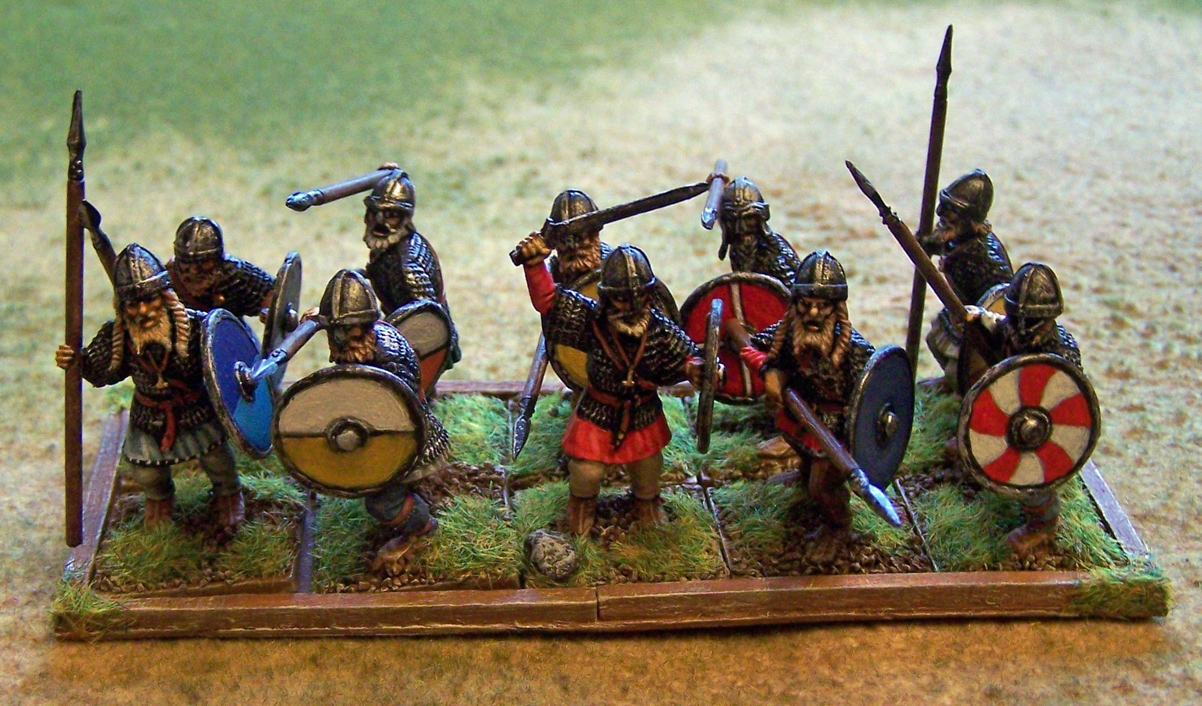
There are lots of scenarios for the wargamer. Armies were relatively small, usually made up of the warbands of the kingdom, supplemented by the Fyrd. It works particularly well for skirmish and small battle games like Saga. My 28mm Saxon figures work fine for both sides.


Thursday, 5 August 2021

The King in the North

 The King in the North is Max Adams' study of 7th century Britain, focusing on the Northumbrian kings Oswald and Oswiu.  This is a period of British history where the written sources are limited or unreliable. Nevertheless, the author does his best to explain what we know and what we don't, as well as his own view on the likely turn of events. The Game of Thrones allusion is entertaining, but this is what many still call the Dark Ages, and there were no dragons, even in Wales! However, Oswald was the model for Tolkien’s Aragorn in The Lord of the Rings.

For those visiting Northumbria today, the most visible reminder of Oswald is the Holy Island of Lindisfarne. Oswald Iding ruled Northumbria for eight years, from ad 634 to 642. He was the famed warrior, the ‘Whiteblade’ or ‘Blessed arm’ of legend, created by the monkish chroniclers as he was a Christian king, under pressure from pagan rulers, not least Penda of Mercia. Even by the standards of the day, his was a short and bloody rule. In death, his severed head and arms were displayed on stakes at a place which came to be known as Oswald’s Tree or Oswestry and his skull, a sacred possession of Durham Cathedral, exhibits a sword-cut wide enough to accommodate three fingers.

The author discusses the sites of the major battles of the period. There are many competitors, and the debate can get very lively on social media. I was listening to a History Extra podcast on the somewhat later (937) Battle of Brunanburh, and the author of a recent book championing the Wirral site for this battle was getting regular hate mail. Adams argues that most battles took place on or near Roman roads, especially where they crossed major rivers. Fast-moving armies used them as highways, and there is some evidence that parts of the network were maintained by royal edict. He also emphasises the importance of sea travel. The sea was a highway in Dark Age Britain, not a barrier.

Skirmish games like SAGA are popular for this period with good cause. The warbands of a king might never actually have consisted of as many as fifteen hundred men and often much smaller. For example, Oswald recovered the throne of Bernicia as a consequence of one fairly small skirmish in which he probably caught his enemies forces off guard. However, it was equally easy to lose the crown similarly. Kingship was personal, based on leadership in war. Administrative structures were fairly basic, and there were few towns. Kings rarely constructed the framework of a state that might survive him; that was not the way of the warrior.

Equally, invading armies, particularly from overseas, did not displace the local population. They just got on with their lives when the ruler regularly changed. Genetic studies have shown that, contrary to what chroniclers like Bede and generations of historians and archaeologists believed, most of the modern British population have been here since the dimmest days of prehistory. Adams offers a recent example, the adoption of and enthusiasm for cricket in India (topical with today's test match). Western dress and the English law code ought not to be seen as evidence of India's mass invasion by the British in the nineteenth century.

When Penda killed Oswald at the Battle of Maserfield, his brother Oswiu took over his realms. Oswui was also a warrior king, but he appears to have been a canny, ruthless politician of great sophistication. In addition to war, a Dark Age king had to build alliances with the many kingdoms that made up Britain. Thus, he was the first, the only, Northumbrian king of the seventh century to die in his bed.

Inevitably with a book like this based on limited sources, there is considerable context or padding. However, you cannot understand Northumberland in this period without understanding the kingdoms in the rest of the country and Ireland. The role of the church is also important. No doubt some will contest the author's interpretations, but that is fine. In my view, he argues his case cogently without drifting into fantasy. There has been a flood of books recently on the slightly earlier Arthurian period. Neil Rennoldson reviewing them in the journal Hobilar summed them up well, "as a general rule of thumb, if a book puts King Arthur in the title, then it is probably best avoided."

A clash of shieldwalls in 28mm


Monday, 21 June 2021

Macbeth: in literature and in history

 You get two for one in this review. The latest in my Nigel Tranter reread is Macbeth The King, Tranter's take on the 11th century King of Scots. Then because I wanted to understand the historical figure, Fiona Watson's Macbeth: A True Story.


For most people, the story of Macbeth is understood through Shakespeare's 'Scottish play', which my generation often studied as part of English literature at school. While it's a fine story, it is historical nonsense. The real Macbeth was born around 1005, and while we know little about his early life, he became Mormaer (sub-king) of Moray in 1032. Moray is in the north of Scotland, a much wider area than the current local authority district. King Duncan I invaded Moray in 1040 and was killed by Macbeth, who then became the High King of Scots in his place. The Mormaers elected the King of Scots in those days, and Macbeth had a legitimate claim.  The name Macbeth means 'son of life'.

He wasn't a usurper as portrayed by Shakespeare, although, in fairness to the Bard, his reputation had been traduced by medieval historical sources before he took up the story. Shakespeare's depiction of Macbeth was influenced by the fact that King James VI (Scotland) and I (England) was descended from Malcolm III, whereas Macbeth's line died out with the death of his stepson Lulach. Shakespeare knew how to curry favour with the current monarch!

The historical sources for this period are limited, but even Tranter seems to drift some way from the facts. A key theme in his book is a close relationship with Thorfinn 'The Mighty' Earl of Orkney, described as a half-brother who supports him militarily. What we know about Thorfinn largely comes from the Norse sagas, but Watson says he was mostly an enemy of Macbeth. 

They both made pilgrimages to Rome, a rare event for Scottish leaders of the period. Tranter has them sailing there together in a fleet of longships when they both made their separate journeys there overland. This was not simply a pilgrimage; there were ecclesiastical territorial disputes as the Columbian church in Scotland did not form part of the Catholic church, although parts of Scotland were claimed by the Archbishop of York.

Macbeth married the wife (Lady Gruoch) of his predecessor mormaer, who he probably killed (Tranter has him killed by King Malcolm II), and recognised her son (Lulach) as his successor. 

Duncan's family fled to England after his death, where Earl Siward of Northumbria used them to stir up revolts against Macbeth. He also invaded Scotland on several occasions. Despite this, Macbeth's rule appears to have been largely peaceful and effective. The fact he felt secure enough to leave Scotland and travel to Rome is evidence enough. He was also the first to introduce Norman knights to Scotland. He probably met some of these during his travels, and they came to Scotland after being exiled from the English court. 

Macbeth was killed by the future Malcolm III after another invasion from England in 1057. He was succeeded by Lulach, who was assassinated six months later by Malcolm. 

Macbeth's armies would mostly have been the typical spear-armed infantry of the period, often mounted on garrons (small horses) but dismounting to fight. However, he did deploy more light cavalry and the Norman knights. 

28mm Scots infantry figures from my collection

You get one small unit of Normans in a Macbeth army.


Monday, 7 June 2021

The Galloway Hoard

 The Galloway Hoard was discovered in 2014 at Balmaghie, Kirkcudbrightshire, which is in southwest Scotland. Deposited around 900AD, it is Scotland's earliest and one of the largest Viking-age hoards with over five kilos of silver bullion. It is the subject of a new exhibition at the National Museum of Scotland that I visited on Friday. What a joy to be able to visit places again!

What makes this hoard particularly special is the wide range of materials found and how they highlight the trade routes of the period - from Samarkhand to Skye. Martin Goldberg and Mary Davis have written a book that explains the items and their context and why the hoard gives us valuable insights into the period.

Hoards are typically wealth concealed to preserve it with the intention of recovering it later. The 10th century was a turbulent period, and Galloway was the subject of Viking raids and settlement. 

The items in the hoard include arm rings, often given as gifts by leaders, as rewards for loyalty. This will be familiar to fans of Bernard Cornwell's 'Last Kingdom' books and TV series.

There are also silver ingots and hacksilver used as currency. Some of these have rune carvings, including the Anglo-Saxon name Eggbrect (Egbert). Silver could be brought from as far away as Samarkand to pay for furs and amber, although the most profitable purchases were slaves.


Perhaps the most striking piece is this silver cross. It is decorated in a distinctive Late Anglo-Saxon art style called Trewhiddle. 


The ongoing analysis hopes to reveal more about the connections these items highlight across the Viking world. The exhibition goes on tour to Galloway in October and then Aberdeen. Well worth a look.

Thursday, 27 May 2021

High Kings and Vikings

 The latest Nigel Tranter novel in my bedtime reading project is 'High Kings and Vikings', which covers Scotland at the end of the 10th century.


This was a particularly violent period, both internally and externally. Scotland had an unusual succession system for its monarchs known as Tanistry. This meant all the male descendants of previous monarchs were eligible for the throne and were elected from the seven Mormaers or sub-kings. The advantage of the system was that, in theory, the best candidate was chosen, and the kingdom was never left with a child King. The downside was that the losing competitor was unlikely to be happy.

This happened at the end of the 10th century when two monarchs were killed, Constantine III and Kenneth III, in fairly quick succession. This leads to Malcolm II (the Destroyer) gaining the throne in 1005. He reigned for 29 years. 

The external challenges came from the Vikings who attacked Scotland in the usual raids and a large scale invasion from Norway. The Saxons also challenged the southern border in the Lothians. This was the period when Strathclyde became part of the kingdom. 

Tranter often uses a fictional character to tell the story. It has to be someone close to the action, and in this book, he invents Cormac mac Farquhar, Thane of Glamis. Glamis is better known today for its Victorian 'castle', family home to the Queen Mother before her death. In the 11th century, there was a royal hunting lodge, but the first real castle wasn't built there until the 14th century. A Thane held his lands directly from the King rather than the local Mormaer.

Cormac manages to capture some Viking longships and uses these to attack Viking raiding parties. The Vikings left their ships weakly guarded while they raided inland, leaving them open to this sort of attack. Cormac eventually builds up a significant fleet using the local fishermen to crew them on a part-time basis. This takes him up and down the coast, and he gets involved in most of the major events of the period. He befriends Macbeth, who becomes the Mormaer of Moray and Ross, although somewhat earlier than the real Macbeth in this telling. The next book chronologically covers Macbeth. Spoiler alert, it isn't like the Shakespeare play!

The book ends with his son becoming the local Mormaer. This followed a campaign in Northumbria, led by Malcolm II, which ended badly at the siege of Durham in 1016. Despite this setback, Malcolm held onto Lothian, which was later settled in Scotland's favour at the Battle of Carham in 1018. The Northumbrians were led by Earl Uhtred, a name familiar to Bernard Cornwell fans, although this one is somewhat later chronologically.

As an aside, Tranter was pretty scathing about history teaching in schools. Last night Muriel Gray tweeted a copy of a 1944 Scottish history exam paper, which includes Carham. I suspect few pupils today would be able to answer that question.


Getting this onto the tabletop, I decided to go for the campaigns against the Northumbrians as I did the Vikings last time. I used figures from my 28mm collection and ADLG rules.


The heavier Saxon Northumbrians have more staying power in ADLG but no more combat punch. The lighter Scots tried to work around the flanks to little effect. In a shieldwall battle of attrition, the Saxons just nicked victory.


Saturday, 8 May 2021

Kenneth

 Chronologically the next book in my Nigel Tranter rereading project was Kenneth. This is the 9th-century story of King Kenneth MacAlpin, the first king of Scotland.

At the start of the 9th-century, Scotland was divided between the Picts (Alba) covering the east and north, Strathclyde, Galloway and the Scots Irish kingdom of Dal Riata. These kingdoms and their Irish cousins were under pressure from The Angles to the south and the Vikings on every coast. Kenneth was the son of the King of Dal Riata and succeeded him to the throne, including Galloway. 

The book starts with his early campaigns against the Angles and their Saxon allies. Moving on to many campaigns against the Vikings who established themselves in Ireland and consolidated their bases in the Hebrides and Orkney. His vision of a Celtic alliance was achieved on occasion to fight off Viking incursions. Tranter calls him Kenneth the Norse Slayer.

As Alba falls into internal strife, Kenneth is elected High King of Alba while retaining his other kingship. This is Tranter's take on history, although the limited sources talk about an invasion of Alba in 842 or 843. He died in 858. He certainly created the dynasty that went on to unify Scotland in the centuries to come. 

Unlike the previous book, Columba, this is all action historical fiction. Plenty of battle scenes and plots to keep the reader entertained.

I finished this book just after the new edition of L'Art de la Guerre (ADLG) arrived. With excellent timing, one of the new lists is Later Scots Irish. I have suitable 28mm figures for the Scots and the Vikings.

The Vikings have heavier infantry than the medium Scots, balanced by the extra light troops and a unit of horse, which the Scots used to harass the flanks.

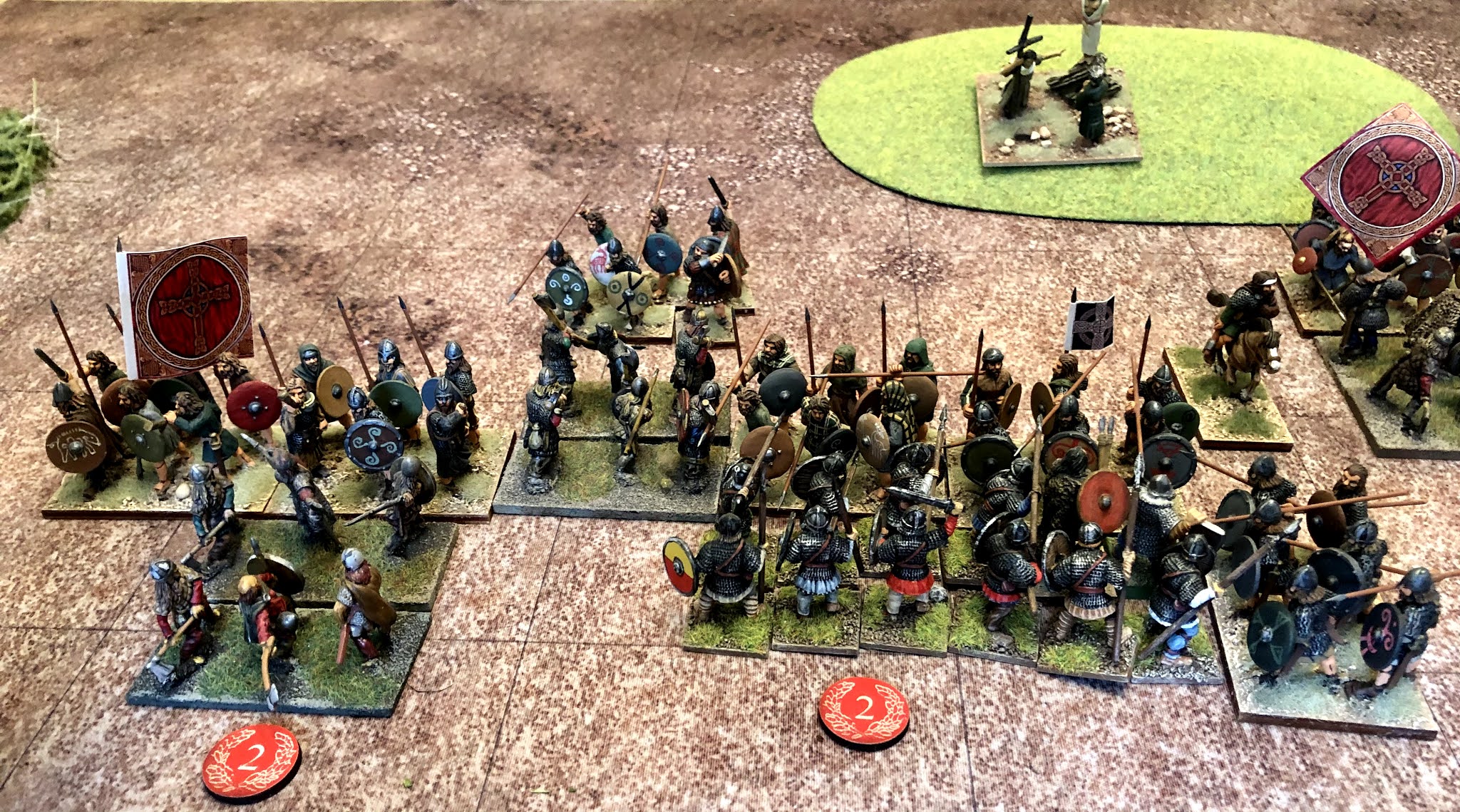
After that, it was a shieldwall slugfest, which the Scots just about got the better of.


However, if the Vikings had survived one more move, they would have captured the sacred camp and broken the Scots. An ADLG lesson is that if you take sacred camps, defend them!


Monday, 19 April 2021

Columba

 My re-reading of Nigel Tranter's historical fiction books continues with the second book chronologically, Columba. The story of St Columba and the high heroic days of the early Celtic church.


His proper Irish name was Colum mac Felim, and he is known in his native Ireland as Columcille. He was born in AD521 and is credited with spreading Christianity to what is today Scotland. He was trained in Ireland and got involved in a religious controversy that may have led to the Battle of Cúl Dreimhne or the Battle of the Book. This conflict forms the opening chapters of Tranter's story. Consequently, Columba decides to lead a mission to the Scots Irish kingdom of Dalriada (Dal Riata) on Scotland's west coast.

This was a nominally Christian state bordering on the Pictish state of Alba, which was pagan. Columba was given the island of Iona as a base from which he expanded his missionary activities to the many islands off Scotland's west coast. Tranter describes the scenery on his many journeys brilliantly. You can almost smell the sea air. I'm biased because this is one of my favourite places on earth. 

This is the later medieval abbey at Iona as seen today.

One of Columba's many achievements was to link the coronation of kings to a Christian service. This led to many kings being buried at Iona. In 1549 an inventory of 48 Scottish, 8 Norwegian and 4 Irish kings was recorded.

He then decides to launch a mission into Alba and persuades the Pictish King in the capital Inverness to allow missionary activity. Helped by the story of him seeing off the water monster. This is at least one of the stories that underpins the legend of the Loch Ness monster, which draws many thousands of tourists to the shores of the Loch today. En route he also helps the family of the chieftain at Urquhart, now a well known medieval castle.

He continued to establish many churches and monasteries across Scotland and acted in a diplomatic role to bring the various kingdoms together in an alliance against the encroching Angles. He died in 593 or 597, the sources differ. He was buried in Iona but his relics are purported to have been carried by Scottish armies in battle. Something he would not have approved of. This includes Bannockburn in 1314.

I haven't any Picts or early Scots, so here are some Islesmen I painted for a Bannockburn display.

The book is classic Tranter. Fleshing out what we know of his life with narrative and evocative descriptions of his journeys. Great read, although if you like your historical fiction with plenty of battlefield action, you might want to skip this one. Sex and violence is in short supply!


Wednesday, 18 November 2020

Fortress of Fury

This is the latest (No.7) in Matthew Harffy's Bernicia Chronicles series set in 7th century Britain. This is a good setting for historical fiction as our written sources of the period are limited. It truly is the Dark Ages, even if historians these days don't like the label.


The action takes place in the year 647, mostly in Northumbria, which at the time was split between Bernicia, north of Hadrians Wall and Deira to the south. These were Saxon kingdoms, although as always they would have incorporated earlier populations. Mostly Christian, although the church was not as yet fully established. The power to the south of the Humber was Mercia, which was a pagan kingdom dominating central England.

Our hero is Beobrand, a thegn and modest landowner in Bernicia, sworn to King Oswiu, and a famed warrior with his personal band of warriors called the Blackshields. Most of this story focuses on the invasion of Bernicia by the Mercian King Penda and his Gwynedd (Welsh) allies. The Mercians besiege the fortress of Bebbenburg (on the site of Bamburgh Castle today), yes, the same one as Bernard Cornwell's Last Kingdom series, although that is set in a later period.

I won't ruin the story, but the Mercians try a variety of ways to get into the fortress. After the siege, King Oswiu returns (he was away dallying with a mistress) and events move south to Deira.

This book has all the elements fans of Bernard Cornwell will expect to see in historical fiction. Plenty of action, interesting characters, treachery, and a bit of love interest. As with the other books in the series, it is well written and an excellent light read.

The time spent on my recent War of 1812 project has somewhat dulled my painting mojo, but I have a few Saxons left to paint, which have at least got past the priming stage. Here are some of my Saxon Fyrd efforts as inspiration for the small battles of the period, which are very playable on the wargames table.