Welcome to my blog!

News from a wargamer with a special interest in the military history of the Balkans. It mainly covers my current reading and wargaming projects. For more detail you can visit the web sites I edit - Balkan Military History and Glasgow & District Wargaming Society. Or follow me on Twitter @Balkan_Dave
or on Mastodon @balkandave@mastodon.scot, or Threads @davewatson1683

Wednesday, 23 May 2018

The fortresses of Nafplio

The port of Nafplio in the Peloponnese is an absolute must see for the military history buff. It has three castles and a very pretty town to keep the rest of the family entertained.

In ancient times the town was under the control of Argos as its main port, until the the Byzantines used it as a base for their anti-piracy operation. Then the Franks held it for around 180 years before giving way to the Venetians. In 1540 it fell to the Turks after a three year siege, although the Venetians briefly grabbed it back between 1686 and 1715. It was the first capital of independent Greece in 1827.

The main castle is the Palimidi which towers above the town. When you enter the main gate the Venetian lion immediately tells you who built it. It has five substantial bastions and is a huge site, so allocate a bit of time. If you are feeling fit there is a 999 step staircase from the town, but mere mortals like me drove up to the main gate on a surprisingly good road. 


The Akronafplia castle defends the eastern approaches to the town. This was the Byzantine and then Frankish castle although improved by the Venetians. You can drive right through the site, or use a lift from the east end of the town.


Finally, we have the small island fort of Bourtzi, which defends the harbour. It was built by the Venetians at the end of the 15th century. A boat trip will take you out to the castle, but it is currently being renovated - very slowly!


Sparta and Mystras

One of my bucket list trips ticked off yesterday, with a visit to Sparta.

Modern Sparta isn't much of a destination, although they have put up a very fine statue of King Leonidas. I wore my '300' t-shirt especially for the occasion!


There are a few remains on the Acropolis, but most are later Roman or Byzantine additions. Including a theatre and a church.


A few miles outside Sparta is the Byzantine hill town and Frankish castle at Mystras. The ever busy William of Villehardouin built the castle in 1249. It's a bit of a climb, even from the higher fortress gate, but worth the effort. The castle is quite small, but you get a great view over the plain of Sparta.


The Byzantine town dates from 1262 and is filled with monasteries, churches, mansions and palaces. Many are in good condition and others are being repaired. In the 14th century, members of the imperial family ruled from here and it became an important cultural centre.


Monday, 21 May 2018

Ancient Corinth

The ancient city of Corinth is just few miles south of the modern Corinth Canal and the narrow Isthmus that separates the Peloponnese from the rest of mainland Greece. After landing at Athens this was our first stop on this year's Balkan tour.

The 6th century ancient city was one of the most powerful states in Greece, largely due to its strategic position and trading links. It had two ports on either side of the Isthmus and walls connected the city to these ports. The ruins of the city have been excavated and offer a clear picture of the layout. The columns of the Temple of Apollo, built in the 5th century is the most prominent ruin. There is a medium sized museum on site that tells the history of Corinth and has statues and other items recovered from the excavations. 


The city held an astonishingly large population of over 300,000, plus at least as many slaves. They did enjoy themselves, paying homage to the goddess of love, Aphrodite. This meant rollicking with the Temple's prostitutes, male and female. St Paul famously tried to divert them to Christianity - a pretty tough pitch in the circumstances!


You can drive up to the star attraction, which is the citadel Acrocorinth. This is situated 575 metres above the city, with walls over 2,000 metres in length. The view is stunning and possibly one of the strongest fortresses I have visited. The ruins are well preserved and were built on by the Romans, Byzantines, Franks, Venetians and Turks.


There is another fortress on hill south-west of Acrocorinth. I am not sure, but this may be the Frankish castle of Pendeskouphi, built in 1205 by Boniface of Monferrat, or possibly by Geoffrey of Villehardouin. The Greeks renovated the castle in 1825 and there are apparently signs of Venetian and Turkish improvements.


Sunday, 13 May 2018

Saga 2

I used to play Saga regularly, but the advent of Lion Rampant caused something of a drift away from the rule system. Saga 2 has sparked renewed interest and I have been trying it out this weekend.

If you want to fully understand the changes, I would recommend Dom Sore's article in the March 2018 edition of Wargames Illustrated.

The main rules are in a softback booklet, which includes the main rules and an introductory scenario. Warbands are organised in pretty much the same way with the simple one point for 4 Hearthguards, 8 Warriors or 12 Levies. There are also heroes and other extra characters in the supplements, or universes as they are called.

Movement is in straight lines, which seems a bit strange at first, but doesn't make a lot of difference on the table. If you have the measuring sticks they still work. Shooting and combat is done following activation and can be in any order, although tactically you are still likely to want to shoot first then charge. I still think shooting is too effective, but I may just be smarting from being shot up by Saracens! Attackers roll to beat the target's armour and then the defender rolls for saves. Fatigue is now limited to 3 for every unit, which makes Levies useful as they now also get an order dice.

The big changes are in the special abilities created by the Saga dice and battle boards. These have all changed quite a bit and will take some learning for each army you use. Warlords are also treated as a unit on their own and can pass off hits to nearby Hearthguards.

To play the game you will need one of the supplements or universes. There are two so far. One for the Age of Vikings and the other for the Crusades. Both have twelve armies and the associated battle boards. These are not cheap at £30, but the production quality is superb and you get the boards. There are six different sets of Saga dice for each universe at another £12 each, but you can use ordinary D6 to mimic them. Each army has a description, army list and legendary units, together with a very useful commentary.

I played three games this weekend. A quick four point game between Anglo-Saxons and Scots. This is my preferred period for Saga and I look forward to trying some more warbands, particularly those in Eastern Europe.


At the club today we moved up to the Age of Crusades. I dusted down my Teutonic Knights who did reasonably well against the Milities Christi, had it not been for some pretty dire defending dice. For the second game they faced Saracens. I won the initiative and got across the table quickly to pin some units, but still got shot to bits. 


The general consensus amongst my playing pals is that Saga 2 is an improvement. The rules are generally a bit tighter and better explained. It still gives a fun couple of games in a club session. After getting used to Osprey rules, the big downside is cost. After buying all the books and a couple of new dice sets, there wasn't much change out of £100. And that's before I am tempted into some new figures. I am not saying it isn't value for what you get, but I suspect it will put off many from trying it out.


Saturday, 12 May 2018

Carronade 2018

Another excellent Carronade show today and thanks to the Falkirk club. It felt very busy with plenty going on and the car park was certainly jam packed.

I picked up some more buildings from Caliver, SAGA dice, some trees and roads from Last Valley and a couple of books.

The GDWS participation game 3.10 to Yuma was busy all day, with George doing a great job of keeping it going.


a couple of entries in the painting competition.


and some very fine display games.


Thursday, 10 May 2018

Flashpoint Trieste

Flashpoint Trieste by Christian Jennings is the story of a contested city at the end of World War Two that can reasonably be described as the first battle of the Cold War.


Trieste is part of modern day Italy, tucked away in an enclave that borders onto Slovenia and Croatia. The population was largely a mix of Italians and Slovenes and had formally been part of the Austro-Hungarian Empire, before being ceded to Italy after WW1. It was an important port and with nearby Montfalcone, a shipbuilding centre.

In 1945, the allies were slogging their way up Italy past Venice, while the Yugoslavian partisans and the Red Army were coming from the other direction. 

The book describes the race for Trieste as leading elements of the allied armies, a New Zealand battalion, arrived in Trieste just as the partisans were occupying it. A line across the city was drawn, known as the Morgan Line, which split the city in two. 

The city then became a hotbed of intrigue with the rival intelligence forces operating on both sides of the line. Wartime scores were settled and war crime suspects executed. There were numerous incidents between the two armies, which after the initial liberation turned hostile. In one incident a Gurkha decapitated a partisan with his Kukhri knife! The actions of an intelligence sergeant arguably stopped a shooting war.

At a political level, the British and US governments were seeking to contain communist expansion, while Tito wanted the whole region, without Yugoslavia being swallowed up by the Soviet Union. This led to his split with Stalin, who abandoned Tito and his territorial claims. 

This is a really interesting story that reads a bit like a Cold War thriller, with the difference that it actually happened. Plenty of scope for an interesting 'What if' game for the wargamer as well.

Partisan 120mm mortar team

British Commandos

Saturday, 5 May 2018

What a Tanker!

What A Tanker! is the latest rule set from Too Fat Lardies and covers WW2 tank combat. This is a skirmish scale game with one to three tanks a side, more with multiple players.


You can play with any scale, although as its a skirmish game, I suspect all those 28mm tanks painted up for Bolt Action and similar rule sets will be an obvious choice. Other than quite a lot of different coloured D6, you will need some tokens, a dashboard and some chance cards all of which can be downloaded or bought from the Lardies. There are already some helpful quick reference sheets and alternative dashboards on the forum or at Boardgames Geek.

Once you have chosen your tanks, you can set up the table in accordance with the scenarios or as you want. You dice for initiative each turn, getting in that all important first shot, although with these rules it isn't that vital.

Then you activate your tank using six command dice. These enable you to drive, acquire your target, aim, shoot and reload. A six is a wild dice that can be used for anything. Very useful because not having the whole sequence of dice is very frustrating. Unless you are having a stationary firefight, in which case the acquire and aim status remains. You keep a record of all this using dice and tokens on the dashboard, ensuring a nice clean table.

I assumed the game would be over quite quickly, but at least in my early war game, it was quite difficult to land critical hits that cause permanent damage. The acquire rules do encourage manoeuvre  and cover is very important. Plenty of buildings, hills and woods makes for an interesting game.

The rules are pretty straightforward and I found I was onto the quick reference sheet after a couple of turns, only occasionally referring back to the full set. It was a fun game, something a bit different from the normal WW2 game and a new use for those tanks. No pesky infantry and ATGs to bother about!

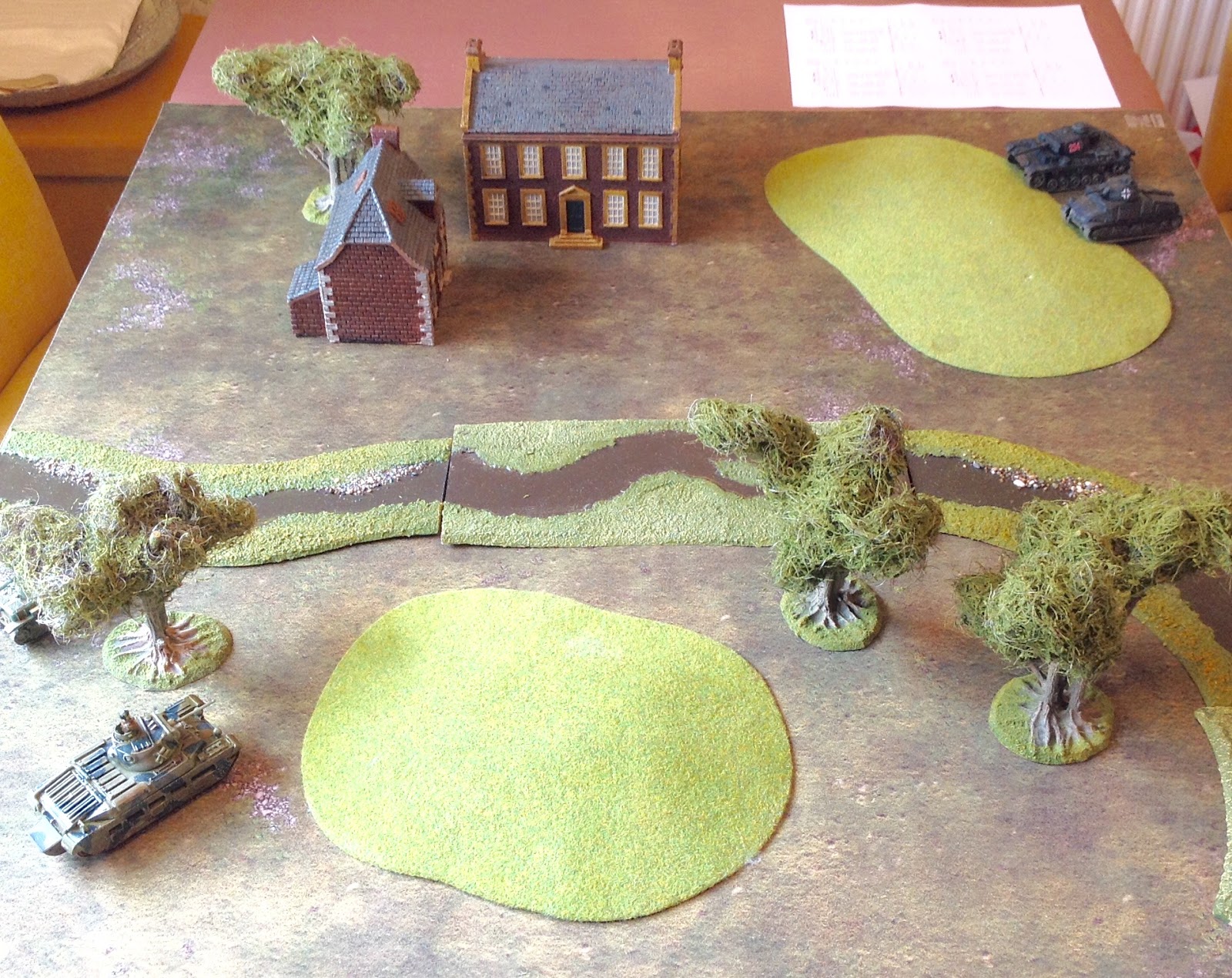
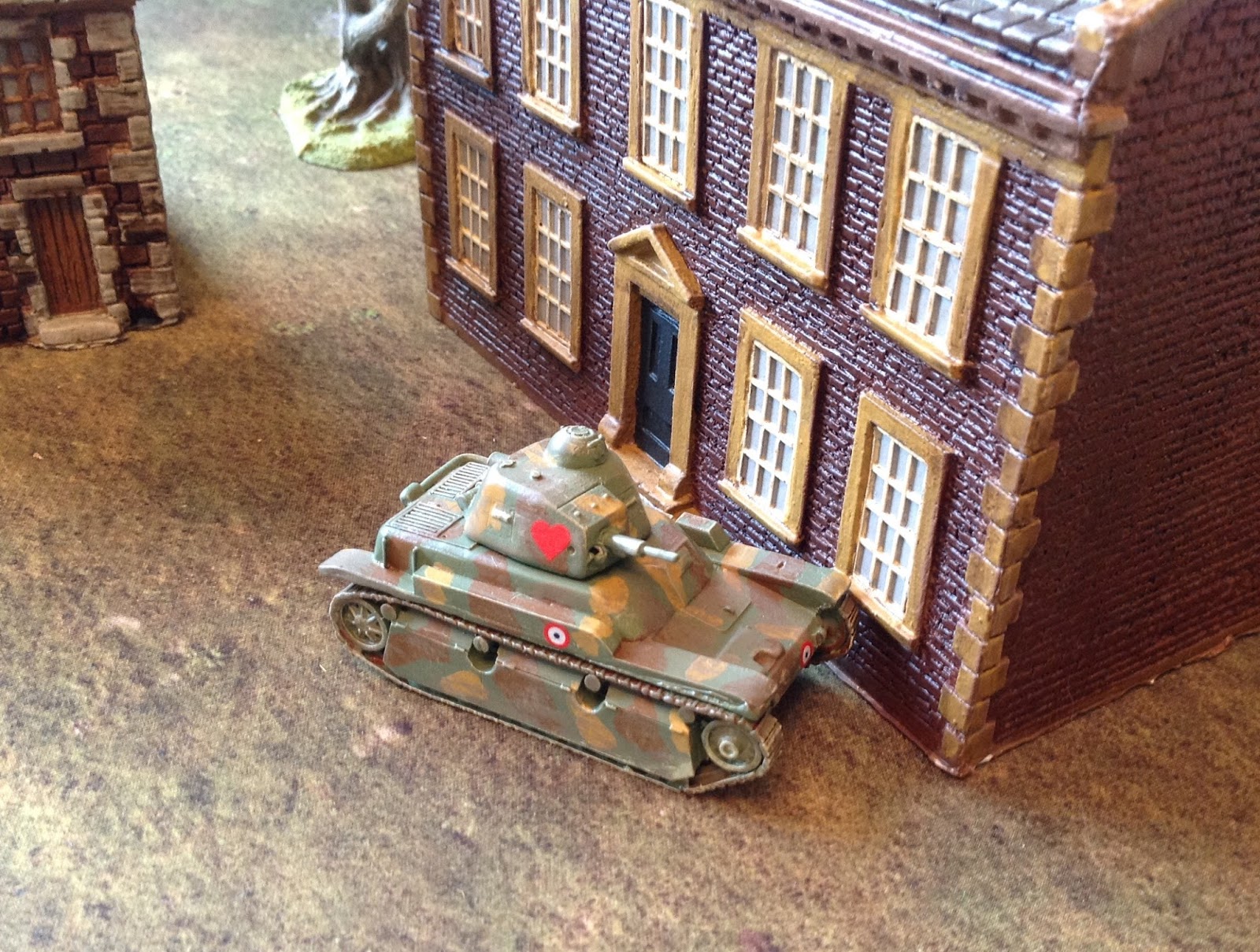
My test game involved a Matilda and an R40 taking on a Pkw III with a captured Somua.


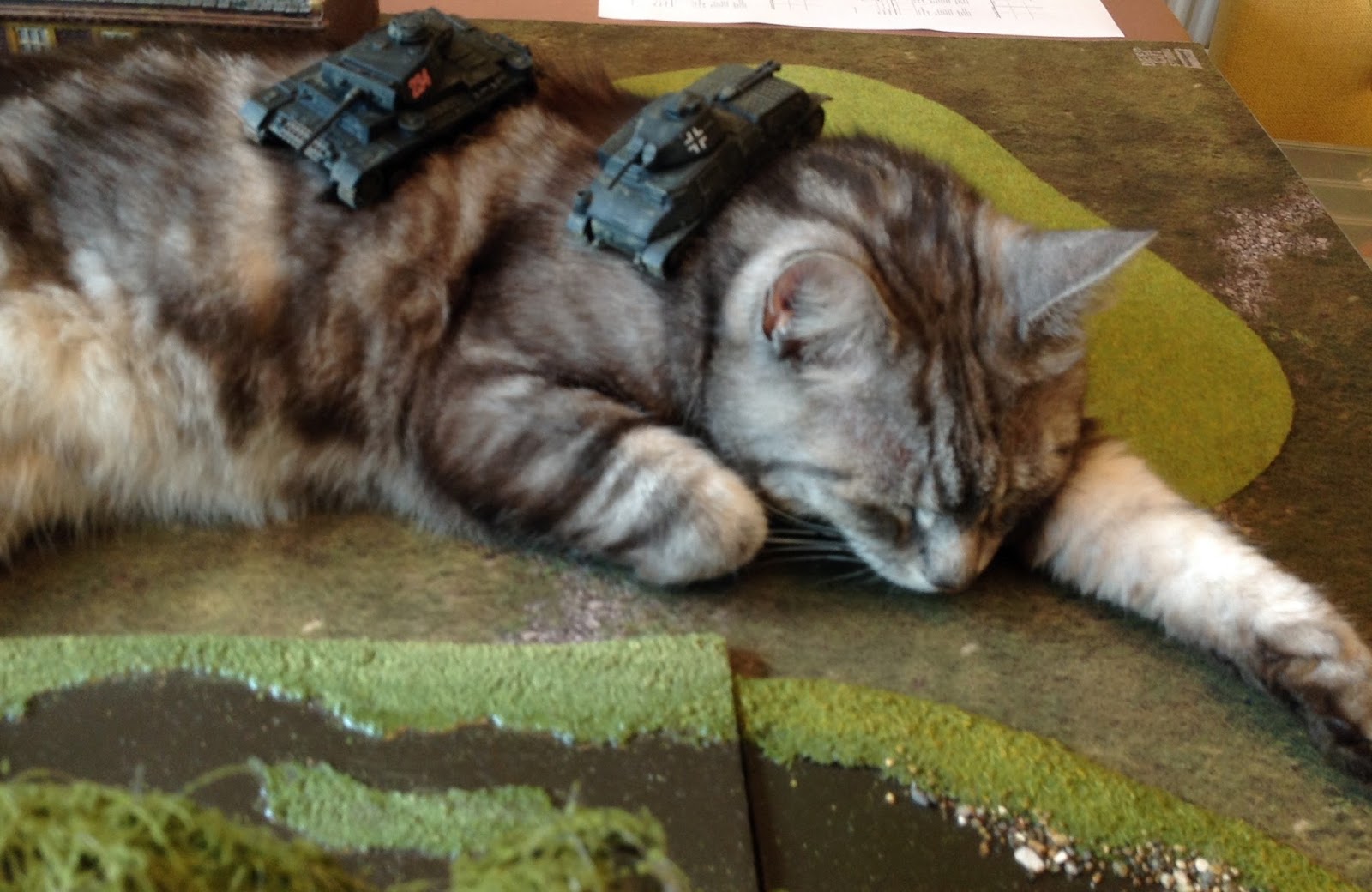
And Razzy joined in, not too enthusiastically, even when the Germans used him for a bit of cover!