Welcome to my blog!

News from a wargamer with a special interest in the military history of the Balkans. It mainly covers my current reading and wargaming projects. For more detail you can visit the web sites I edit - Balkan Military History and Glasgow & District Wargaming Society. Or follow me on Twitter @Balkan_Dave
or on Mastodon @balkandave@mastodon.scot, or Threads @davewatson1683

Saturday, 29 July 2023

The Young Alexander

This book is Alex Rowson's examination of the early life of Alexander the Great, from his birth to the invasion of the Persian Empire. Most studies of Alexander focus on the great events in the East, so it was interesting to read about his formative years.


Alexander was born around 20 July 356 BC in Pella, which became the new centre of Macedon towards the end of the fifth century BC. I have visited the excavated site, which is a fair way from the coast, so it's hard to imagine the waterfront city it once was. The mosaics are impressive though.

The book is a narrative history, although the author discusses the sources and the archaeology as he goes. I thought this might irritate me, but it doesn't. He goes off on a few other tangents, but again they all add to the story. There is a lot about Macedonian religious rites as they applied to Alexander, remembering that infant mortality was shockingly high by modern standards.

It is impossible to understand Alexander's early years without discussing his father, Phillip. I have always thought he didn't get enough credit for creating the Macedonian army that he used to dominate Greece and much of the Balkans. Alexander reminds me of Napoleon, who didn't create the French military system, but he did develop and use it brilliantly. This book is, in some ways, a history of Phillip as much as Alexander, and none the worse for that. However, Nicholas Hammond's, Phillip of Macedon, is my go-to study of Phillip. Alexander was also tutored by Aristotle, so his intellectual development was not ignored.

There are a few fascinating stories about the relationship between father and son. How Alexander tamed his famous horse, Boukephalas is particularly good. He noticed what others had missed. The horse was spooked by his shadow, so he turned the horse to face the sun. After dismounting to the cheers of the court, Phillip said, 'My boy, you must find a kingdom which is your equal. Macedonia is too small for you.' They later fell out before Phillip's death, forcing Alexander and his mother into self-imposed exile. She was another important influence on him, and fascinating character in her own right. However, they were later reconciled before Phillip's assassination.

Alexander's early campaigns are interesting, particularly those in the Balkans. This was where he honed his military skills under the guidance of his father and other experienced generals. The Thracians were a particularly tough opponent and became an important part of his later armies.

He was at some of the later battles that cemented Macedonian control of Greece, commanding the cavalry wing at Chaironeia. He also had to deal with a rebellion when he took the throne, led by Thebes with Athenian encouragement. He also had to return to the Balkans before he was ready to cross the Hellespont for the campaign against Persia.

While this is not a quick read, it is well-written. It covers the latest archaeology and discusses conflicting sources without a heavy academic style. Well worth a read.

Got to have a picture of the Macedonian phalanx


Sunday, 23 July 2023

The Frontier Sea

 I am delighted that my new book, The Frontier Sea: The Napoleonic Wars in the Adriatic, is now on sale. It can be ordered through your local bookshop, Amazon in paperback or Kindle editions, or the Balkan Military History website. There are links to these on the website, along with extracts from the book. 


I have presented the book on the BMH YouTube channel, which explains what the book covers and picks out some of the personalities that add colour to the story.

The book examines the campaigns, armies, navies and personalities that fought in the region between 1797 and 1815. Campaigns rarely mentioned in the history of the period. Austrian, French, Russian, British, and their foreign regiments fought up and down the coast. Sometimes with or against local leaders like Peter I of Montenegro and Ali Pasha of Ioannina. Many commanders were far from home, with orders taking weeks to reach them. This meant even junior officers could take military and diplomatic decisions usually reserved for more senior officers. 

Most of the great powers contested the lands around the Adriatic Sea during the Napoleonic wars. While never a major theatre of operations, it was part of the overall strategy of most of the combatants. It had an essential role in the conflict, influencing alliances and diverting troops and ships, which all contributed to the defeat of Napoleon. It was also a period of significant change, with the French and British intervening in a region that had long been a battleground reserved for the Austrian, Russian and Ottoman empires.

For wargamers, the book has a chapter on the armies and navies that fought in the Adriatic and a wargaming appendix. There are a couple of outline scenarios in the book to get you started, and there is more material on the dedicated page on this blog. 

Locally raised French troops facing Ali Pasha


Several folks have commented on what appears to be my prolific output, with two books in almost as many months. This is deceptive as it has more to do with publishing time and schedules. I wrote the first draft of Chasing the Soft Underbelly in 2021 and this book in 2022. This year's output should be published later this year. No AI is involved!

I still have more painting to finish all the armies. The last army is the Austrians, which are a bit of a nuisance as they changed their uniforms over the period more than most. However, I have made a start this week with the first batch of Jagers off the painting bench. They are from the Perry range.


Wednesday, 19 July 2023

Hellfire

 Hellfire is the latest in my bedtime reading of James Holland's Jack Tanner series. After Crete, Jack ends up Cairo, and the Yorks Rangers find themselves withdrawing to the El Alamein position. They are then sent back to the Pyramids to retrain as a motorised battalion with significant anti-tank elements.


Jack is wounded and takes up with a military nurse. At the same time, he bumps into Major Vaughan, one of the Crete story characters working for SIME, MI5's unit in the Middle East. Jack gets temporarily seconded to them in the hunt for a German spy ring linked to Egyptian Nationalists. This builds on the story told in Ken Follett's, The Key to Rebecca, and Samuel Marquis's, Lions of the Desert, which I reviewed last year. I won't spoil the plot, but this also extends to a couple of SBS-style raids behind enemy lines. Our Jack is a busy boy!

The story ends at the battle of El Alamein when the newly commissioned Jack Tanner is involved in holding back Rommel's counterattack. As usual, the battle scenes are brilliantly described. You can taste the sand, smoke and confusion.

One of the interesting intelligence stories picked up in the story is the shooting down by the Luftwaffe of the newly appointed 8th Army commander General Gott. Was it just a coincidence, or was the interception based on intelligence. The pilot flying the Bombay transport aircraft subsequently met one of the German pilots Herr Claude, who told him that when they touched down again a short while later, they were met by a senior officer who said, ‘Congratulations. You have just killed the new commander of the British Eighth Army.’ There are some possible explanations, but my money is on intelligence. It is an intriguing 'what-if' of history if Gott had survived and led the 8th Army instead of Montgomery.

This is the sort of historical fiction I enjoy the most. It sticks closely to historical facts, includes several sub-plots, and plenty of action. It also has some interesting social commentary on the British officer class. Attitudes that had primarily stayed the same since Sharpe's time. Overall highly recommended.

Some of my 10mm British for the Western Desert campaigns.


Tuesday, 18 July 2023

North Korean's onto the tabletop

 The second part of my Korean War project has made progress with the painting of my North Korean and Chinese forces. Or at least enough to get some tabletop action. I was drawn into this project after researching the Turkish Brigade, and I wasn't looking forward to painting large numbers of similar figures. However, in 10mm, it wasn't too bad.

The North Korean armed forces had a fair amount of combat experience before the Korean War. Korean communists, including their leader, Kim Il-Sung, fought against the Japanese invasion of China in 1932. He returned with the Soviets in 1945 and took power backed by his 150,000-strong People's Militia. North Korean troops also assisted the Chinese communists in their struggle with the Nationalists. By 1950, the Korean People's Army was 223,000 strong organised into ten infantry divisions. They also had an armoured brigade equipped with T34/85 tanks.  

The figures are from the Pendraken range. As with the Turks, I struggled a bit with the uniform shade. It apparently developed a yellowish hue with wear and tear. I started with a desert yellow primer for depth and a light wash mix of pale sand and yellow. There aren't too many details to pick out, thank goodness, in 10mm! The exception is the distinct shoulder boards that retained their original olive green colour. I finished with a brown wash that sinks well into the fantastic detail that Pendraken achieves with these diminutive warriors.

The Chinese had a slightly different uniform shade. For these, I primed with a light sand rattle can I picked up at an art shop. Then painted the details and gave them a brown wash. I finished these in a few hours, although they needed the hairdryer treatment to dry the bases for Sunday's game. 

Armour and artillery came from my WW2 Soviets, a big time saver.

For the first tabletop outing at the club, I adapted Scenario 3 from the Blitzkrieg Commander, Korean War supplement. The Battle of Wawon, 27-29th November 1950. This was fought over very hilly terrain, so I dusted down my old Spearhead hills that define height well without the bases sliding down the hills.

The Turkish Brigade is on the right, hastily dug in around the village of Wawon, which covered a vital road junction. The North Korean and Chinese forces had to capture the village. They sent their tank regiment down the centre, pushing infantry attacks on both flanks. The historical battle didn't include armour, but I gave the Turks a supporting US tank company to balance the game. 

The special rules in the supplement make North Korean infantry pretty devastating if they get into hand-to-hand combat. They bounce back if knocked out rather than being destroyed. A bit like fighting zombies! Balanced in this scenario by the Turks getting the 'tough' rule. Correctly in my view, given their historical performance. However, on the left, the North Koreans were destroyed by gunfire. They did better on the right, only stopped by the Turkish reserve, plugging the gap. Always keep a reserve!

By this stage, both forces had lost half their points, and although the North Korean armour had reached the village, they needed infantry to take the handful of Turkish units left inside. Technically a Turkish victory, but I conceded it was probably a draw.

An excellent game, which has whetted my appetite for more Korean War action. My WW2 British can go straight onto the table. I'll just need to paint up some more Chinese.

Thursday, 13 July 2023

Dracula's Wars

 This is James Waterson's take on Vlad the Impaler and the wars in the Balkans during and after his lifetime. I must have missed this when it was published in 2016 and only noticed it when he was one of the experts in the recent Netflix series. 


The author gives us a broad history of the period, with Vlad popping into the story regularly. I'm unsure if that is deliberate or just because he thought the sources are a bit thin for an entire book. He starts with a lengthy overview of the period dominated by Ottoman expansion into the Balkans. Vlad's father, Vlad II Dracul, who ruled between 1408 and 1418, starts the story properly, and that is on page 78. Hunyadi was the primary opponent of the Ottomans during this period, and his wars are also covered.

Vlad spent his early years as a hostage in the Ottoman court and was released on his father's death. Alliances during this period were flexible and local lords focused on protecting their own interests. As Waterson puts it, 'Higher politics and ideologies were largely forgotten'. Vlad's first reign maintained good relations with the Ottomans, who had lent him an army. The second battle of Kosovo strengthened Ottoman rule, but Hunyadi still had the resources to support Vladislav II's power grab when Vlad refused to meet him. 

It was back to Edirne for Vlad, but he quickly found his way back to the region via Moldavia. The death of Hunyadi and his son Matthias coming to the Hungarian throne gave Vlad another opportunity. However, he didn't always pick the winning side in internal strife. Even family ties were not sacrosanct, with Vlad fighting against his half-brother, the wonderfully named Vlad the Monk.

His second reign came in 1456 with Hungarian backing. He violently put down Saxon revolts in Transylvania and then fought his most famous war against the Ottomans. Afterwards, the Boyars abandoned him, and the Hungarians betrayed him despite taking papal cash for the war. This allowed his brother Radu to grab the throne. The 15th-century Balkans was a rollercoaster ride! He was back with another army but probably died in a skirmish in 1477.

Waterson is not a big fan of Vlad's. He doesn't buy the nationalist revisionism, which was popular in the 19th century and even under communism. He favourably quotes the poet Ion Bogdan's view that 'he was a man with a diseased mind who killed and tortured for sadistic pleasure.' Even the softer defence that he was a man of his time is dismissed. The book ends with the usual look at how he is remembered, Bram Stoker and all.

Given that ruling anywhere in the 15th-century Balkans was a tough gig, I have always taken a somewhat more sympathetic view. However, you have to accept that even by the standards of the period, Vlad was more ruthless than most. It is a great period for wargamers, and there was an excellent WAB supplement on these wars written by John Bianchi in 2006. I helped a bit with this, and we provided some figures for the eye candy. The 2004 GDWS display game The Real Dracula was based on Vlad's most famous battle, the Night Attack.


This probably won't be my go-to book on Vlad the Impaler. There are more focused studies. However, it is a decent overview of the Balkans in the 15th century.


Every Vlad army has to have a camp impalement! 15mm from Essex, if I remember correctly.


Saturday, 8 July 2023

War in Ukraine 2

This is the second volume in Helion's study of the war in Ukraine. It is challenging to write about an ongoing conflict, not least because of the amount of disinformation. However, this volume covers the first two weeks of the Russian invasion of Ukraine in 2022, for which the narrative is clearer, although details remain obscure. This is also a vitally important conflict for so many reasons. If you want a taster, you can watch an interesting online book launch here in which the authors described the writing challenges and sources. 


The first chapter covers the weakness of the Ukrainian armed forces during the Crimean debacle of 2014 and the Donbas fighting. Then how they rebuilt into the effective armed forces we see in action today. This included refurbishing their Soviet-era weapons systems and then incorporating NATO equipment. This was initially primarily defensive, but as the conflict developed, more lethal weapons have been delivered, including cluster bombs this week. Just as important has been the reorganisation of the army, away from the ragtag collection of volunteer units to an integrated all-arms structure capable of mounting offensive operations, as well as home defence.


Technology has been a feature of the conflict, along with establishing an integrated air defence system capable of protecting cities against Russian missiles and drones. The Ukrainian Air Force gets less media attention but still plays an important role.


The second chapter looks at the development of Russian forces, covering some of the ground addressed in more detail in Mark Galeotti's excellent Putin's Wars. The graphics and orbats of the Battalion Tactical Groups (BTGs) are particularly good. The use of private armies is not ignored, even if this was before the recent events. While the numbers looked impressive, the analysis in this chapter highlights the poor state of much Russian equipment and training. There is also a short chapter on Russian efforts to reorganise the Donbas People’s Militia. This involved pulling the numerous ‘battalions’ into a formalised structure under a unified chain of command and ‘removing’, by any means necessary, several violent and unruly commanders.


The chapters on the 'Special Military Operation' looks at Putin's planning and motivation for the invasion, how it was prepared under cover of the Zapad military exercise and his personal involvement in the operational aspects of the invasion. Documents show that it was intended to start on 20 February and end on 6 March. Putin was micromanaging the entire campaign in Ukraine by bypassing the established chain of command and issuing orders directly to commanders of BTGs, sometimes even below that level.


While strategic strikes took place using missiles and cyber to attack air bases and the strategic communications systems, the attack on Kyiv became the best-known part of the invasion. The Battle of Hostomel Airport was facilitated by a Ukrainian traitor who enabled the Russians to take down the air defences. As the Russian attack on Kyiv stalled, Putin pushed more units towards the city. This meant advancing through built-up areas, ideal for Ukrainian ambushes. We saw Russian armour moving through these areas unsupported by infantry. With even armchair wargamers worldwide screaming at their TVs, don't do that!


The final chapters are devoted to the assaults outside Kyiv, some advanced with little resistance, but others ground to a halt, particularly in the cities. In addition, the poorly maintained Russian vehicles started to break down, causing traffic jams that were easily ambushed. The war in the Donetsk and Luhansk so-called republics was reignited with the support of regular Russian forces. However, conscripts from these regions were thrown into battle against some of the best Ukrainian units, with predictable consequences. 


The most successful Russian advance was in the south, helped by the sparsely populated terrain and the failure to fortify the border with Crimea. Southern Ukraine is a vast and flat plateau, with large distances but no major obstacles between the urban centres except for the rivers Dnipro and Buh in its west. The Ukrainian armed forces rushed to the region, and after fierce fighting at Voznesensk, the advance on Odesa was halted.


As the authors conclude, 'Contrary to all expectations, a combination of massive resistance by the population, the stubbornness of the government in Kyiv, and much more effective operations of the ZSU in the north, north-east, and east than ever expected, effected a quick collapse of what can be described as ‘Putin’s Plan A’: a coup in Kyiv and a quick conquest of about half of Ukraine.' 


There has been a lot written about this conflict already. Personally, I have been impressed by The Economist's coverage. This volume should appeal to wargamers and modellers in particular, given the superb colour plates, orbats and the detailed descriptions of the critical actions.


A photo of some of my 20mm Russian troops advancing in a 2021 wargame that turned out to be a little too close to reality.


Thursday, 6 July 2023

Eight Years Overseas 1939-1947

 I was in the Lake District two weeks ago on our annual family holiday there. There is little historical interest, but I visit a few second-hand bookshops. I was delighted to find a copy of Jumbo Wilson's WW2 memoirs in one at a reasonable price. I had only dipped into this in the British Library for my book, Chasing the Soft Underbelly, because Wilson was a key figure in British aid to Turkey during WW2.


Henry Maitland (Jumbo) Wilson started WW2 as General Officer Commanding-in-Chief British Troops in Egypt, launching Operation Compass in December 1940, which destroyed the Italian army. He had less success with the ill-fated expeditionary force to Greece in April 1941 and returned to be General Officer Commanding British Forces in Palestine and Trans-Jordan in May 1941, which included the Iraq and Syria operations. He became GOC Persia and Iraq Command in August 1942 when it looked like the Germans would break through the Caucasus. After that threat went away he became GOC Middle East Command in February 1943 and then Supreme Allied Commander in the Mediterranean from January 1944. He ended the war as Chief of the British Joint Staff Mission in Washington D. C. from January 1945 until 1947.

It is obvious from the above that Wilson was a central player in the Middle East and Mediterranean campaigns of WW2. However, he is a far less familiar public figure than say Montgomery or Alexander. This is probably because he was primarily the organiser of victory, ensuring that troops and equipment were there for the fighting armies. In this regard, he had to have the political skills a coalition commander needs, so it is no surprise that Eisenhower wrote the forward to this book, paying fulsome tribute to his wartime comrade.

This book is primarily a narrative history of his wartime service. It was written in 1948, arguably too soon for a more candid memoir. For example, there are few revelations of the sort we read in Alan Brooke's diaries. Wilson remained a careful political operator even in his memoirs. I was particularly disappointed that he offered no new insights into relations with Turkey in WW2, although there is a lovely story about British and German missions being housed in the same Ankara hotel. I suspect because he wrote this book when Turkey was being considered for membership of NATO, a sensitive negotiation that the British supported, so candid references to the challenges in equipping the Turkish armed forces would have been unhelpful.

Churchill did not make Wilson's job easy during WW2. The apparent tensions are the Greek campaign, support for Turkey, Syria, Iraq, and the Dodecanese campaign. However, Wilson is again diplomatic about his disagreements with Churchill, who in fairness rarely criticised Wilson when things went wrong, and obviously rated him highly. The only time they fell out seriously was when Churchill felt Wilson wasn't supporting his position over Operation Anvil. Wilson explains that his credibility as a coalition commander would have been destroyed if he took Churchill's line.

There are several interesting what-if campaigns arising from Wilson's comments in the book. He describes the possibility that the Turks might have given in to German pressure during the Syrian campaign and allowed the passage of German troops along the railroad that was in fact built by the Germans before WW1. He explains that he would have had to withdraw from northern Syria to the mountains of Lebanon if that happened. 

Another is the Iran (the British still called it Persia, wrongly) campaign. I hadn't appreciated how seriously the Allies took the risk of the Germans coming at Iran, with its crucial oil, through the Caucasus. Wilson commanded two whole army corps and prepared detailed defence plans to defend the country. This would also have resulted in Soviet troops fighting alongside the British and Commonwealth divisions. I am itching to do this on the tabletop!

Wilson was also closely involved in establishing the Allied base on Vis as a base for raiding the Adriatic coast. He kept it under his responsibility, establishing a command at Bari, as Alexander was too busy with the Italian campaign. He confirms the intelligence assessments of Mihajlovic's inactivity, hence the shift in support to Tito.

This book probably won't be on many folk's reading lists as copies are not cheap. But if you can get one in the library, it is worth a read and has some wartime photos I had yet to see.

Some WW2 Australians in 28mm. Wilson speaks highly of them.


Saturday, 1 July 2023

What a Cowboy!

 I gave in to these rules at Salute, even though I am not a big fan of Westerns, but I only got around to playing them today. I admire the Lardies work, even if I sometimes think they overdo the friction element.


The complete bundle is usually £51 (although currently on sale at £48.60), and you get the softback rulebook, the cards and tokens. A cheaper option is the PDF version, although you still need the cards, if not the tokens, at £29 in total.

The rulebook is high-quality full colour, which looks robust because you will be doing a lot of flicking through it. There isn't a QRF, which initially irritated me, but it probably wouldn't have helped much after playing a game. I will probably create one for some of the most frequently used tables. The rules are set out logically. You need to make record sheets for each character and populate them with buckets of action dice (D6). I copied these from the book, but I see Warbases is doing an MDF version.

The cards include the game deck, which decides the order of activation and Desperado cards for random extra abilities. The Bonanza tokens allow interruptions and some rerolling of action dice. There is a chapter on creating your gang, with a points system and random traits, all adding colour to the period. There are also townsfolk who marginally interact with the game.

The key mechanism is the six action dice allocated to each character, or groups called henchmen. You roll and use the outcome to move, spot, aim or shoot. A six (Aces High) can be turned into any dice number you need. You can lose dice as the game goes on to shock and wounds. Some can be recovered, but others can be lost permanently. If you run out of action dice your character flees. This happened more often than getting killed in our games. There are rules for mounted figures, hand-to-hand fighting (brawling), buildings, and obstacles. These are all straightforward, and once you have played a few turns, quick. As usual with Lardies rules, many detailed rules are spread around the rulebook. Easy to forget, which I am not a fan of. A flow chart is one way of dealing with this, and I hope someone does one.

There are several scenarios to get you started for a one-off game and a complete campaign system. This allows your characters to develop as they progress through the campaign scenarios. This looks comprehensive and a lot of fun.

For the playtest, we started with three characters per side. One gunslinger and two shootists. These are the middle two levels. I bought some cowboys at Partisan, but they have yet to get past the priming stage. Playmobil was an option (-:), but instead, I dusted down my Mexican revolution figures.

You need a bit of terrain for an interesting game, primarily for obstacles and cover. Getting high is an advantage, so buildings with different levels work well. I used a three-foot square table, but they recommend a four-foot square for larger games than this. Pistols are effective under 12", and rifles typically double that.

Pancho and his gang had a bad habit (pun intended) of using the priest and the cross for cover, which should keep them busy in confession. 

However, in the end, Lt. Diego was a bit too rash and got gunned down. You need to think carefully about finding cover to reload, as it can take some time. Also, to recover action dice.

Razzy arrived a little too late to help them!

Unsurprisingly, my mind switched to other uses for the rules. So, we switched to the Russo-Turkish War of 1877 for the second game. Lt. Mustafa and his men were protecting a camel train when they were attacked by the Bulgarian Legion. 

This looked like a swift game when Lt. Mustafa was martyred in the third move. However, the Ottomans rallied and drove the Bulgarians off.

Overall, despite a few niggles, this is a fun set of rules, which give a good flavour of the period. It is an investment if you are not into the Wild West, but you don't need many figures for a decent game.


Tuesday, 27 June 2023

Turkish 'North Star' Brigade in the Korean War

 My latest wargame project is the Turkish force that fought in the Korean War. I would prefer to do this in 28mm using the Warlord figures. However, painting vast numbers of North Korean and Chinese opponents was just too dull to contemplate. So, I have gone for 10mm, primarily using Pendraken figures with armour from Skytrex. This has the advantage of using some of my WW2 figures as well.

Three infantry platoons and a mortar platoon

The Korean War started on 25 June 1950 when North Korean forces invaded South Korea. They drove South Korean and US troops back into the Pusan perimeter before a US landing at Inchon forced a withdrawal. The US pushed into North Korea, which brought the Chinese into the conflict, pushing them back to the 38th Parallel. This ended the mobile phase of the war, and both sides dug in for a static war of attrition.

Turkey had been refused membership of NATO but was invited to provide troops. The first Turkish contingent arrived on 19 October 1950 and, in varying strengths, remained until the summer of 1954. The First Turkish Brigade (code name 'North Star'), 5,455 strong, was commanded by Brigadier General Tahsin Yazic. He was a veteran of Gallipoli in the First World War and commanded the first Turkish tank battalion in 1937. The Brigade was drawn mainly from the 28th Division and consisted of three infantry battalions from the 241st Infantry regiment, the 2nd Armoured Brigade Artillery Battalion, Light AA Battalion and support units. 

They advanced into North Korea with the 25th US Division. The Turkish Brigade was attacked by superior enemy forces in Wawon, Kaechon, Kunu-ri, and the Sunchon Pass regions. They fought for three days and were encircled several times, each time breaking out successfully. What was left of the Turkish Brigade was moved south to recover and reorganise. They then participated in Operation Thunderbolt in January 1951, attached to IX Corps. This led to another fierce battle around Hill 151. The Second Turkish Brigade (Brigadier General Namik Argue) relieved them in July 1951. In turn, they were relieved by the Third Brigade in July 1952 and then by the Fourth Brigade in September 1953. The replacement brigades saw less action and fewer casualties as the war had moved to the military stalemate phase. 

14,936 Turkish troops served in Korea, suffering 3,506 casualties (23% of troops committed), including 741 killed. They were generally considered the best of the smaller UN contingents, particularly in defence and close combat, when they drew long knives. Max Hastings explains, ‘Among the most prominent contributors, the Turks sent a much-respected infantry brigade, whose men were evidently uninterested in higher tactics or sophisticated military skills, but possessed much rugged courage and willingness to endure.’ Turkey's contribution helped their application to join NATO, which was approved in 1952.

The Turkish Brigade arrived in Korea wearing their British-supplied WW2 battledress and helmets. However, after the early battles, their uniforms, helmets and equipment were entirely American, with their own brigade device (red spearhead with white stars) on the right side of the helmet and a national badge (red circle with a white star and crescent) on the top of the right sleeve. This means you can use US models. The helmet and sleeve flashes could only be seen with a magnifying glass at this scale!

105mm Howitzers

The Turks sent no tanks with the Brigade to Korea. So armour would be attached from US units. Here are two Pershings and two Chafee tanks with a jeep-mounted MG for recon.


I will use Blitzkrieg Commander rules for this conflict. Pendraken has published a supplement for the Korean War, The Forgotten War, with some rule additions to reflect the actions and doctrine unique to this war. The field hospital option (MASH TV style) is going to be a must have! It includes a scenario for the Battle of Wawon (27-29 Nov. 1950) and army lists. I would also recommend The Wargamer's Guide to the Korean War 1950-53 by Tom Nutt, published by Reiver Castings. I bought these from the guys running a lovely game at Salute, which inspired me to get on with this project.

There are two quite old (1980s) Osprey's. The Korean War 1950-53 by Nigel Thomas (I now have a spare if anyone needs it) and Armour of the Korean war 1950-53 by Simon Dunstan. The colour plates are useful, and I experimented with many shades of green/grey to get something close to the faded US combat dress. For further reading on the Turkish brigade I consulted the following:

A.Tetik, North Star: Turkish Brigade in Korea, (Turkish Military History, No.87, 2007)

A.Fanning, Turkish Military in the Korean War, (Texas Tech University, 1993)

M.Hastings, The Korean War: An Epic Conflict 1950-1953 (Pan Macmillan, Kindle edition)

H.Danisman, Situation Negative: Korea 1952. An Account of Service with the Turkish Brigade, (Denizler Kitabevi, Istanbul, 2002)

A large bag of North Korean and Chinese figures is now staring at me! 

Friday, 23 June 2023

Blood of Honour

 This book is another in James Holland's fictional WW2 series, featuring Jack Tanner, the Wiltshire NCO serving in the Yorkshire Rangers. This instalment is set in Crete during the German invasion in 1941.

As with others in this series, you get an overview of the campaign by occasionally shifting the focus to General Fryberg's HQ. He faced several challenges in defending the island, not least poor communication due to the shortage of radios. However, Fryberg's fatal error was not counterattacking when the Fallschirmjager landed, particularly at Maleme. The chances of the Germans reinforcing by sea were slim, and the lightly armed and outnumbered Fallschirmjager were allowed to consolidate. 

This is reflected in Jack Tanner's battalion based in Heraklion. The Fallschirmjager attack the town but are repulsed, and then they simply sit behind the walls in defensive positions. There are some entertaining subplots involving a new officer and the Cretan Andartes. Even some love interest for the bold Jack. The running theme is a tussle with a Fallschirmjager officer. Holland sticks closely to the actual history, although there are gaps in our knowledge of the campaign. British war diaries were written up later, and as Holland puts it, 'Paratroopers carried little with them into battle – typewriters, paper and pencils were not a top priority.'

Along with the rest of the Empire forces, the Yorkshire rangers are evacuated by sea, only to have their boat sunk. This means a march across the island to be evacuated on the southern coast, with the Germans doing their best to catch them and the Andartes. I won't spoil the story, but the focus is on small unit actions, which are well-researched and described. 

I really enjoyed this book, and I have already started the next in the series, which is set in the Western Desert.

The German cemetery at Maleme. Most units suffered between 50% and 70% casualties.

German Gebirgsjager in 15mm were flown in to reinforce the Fallschirmjager.


Tuesday, 20 June 2023

The Greatest Escape

 This is Neil Churches' book covering his father Ralph's extraordinary WW2 escape from a PoW camp in Slovenia. I don't usually go for WW2 escape stories; there are too many British officer stereotypes. However, this is an escape from an other-ranks camp, and it's in the Balkans. While PoW officers struggled to find ways of amusing themselves, the other-ranks were put to work, often in demanding jobs.

Ralph Churches was an Australian soldier sent to Greece as part of Operation Lustre. He had been attached to Corps HQ, initially correcting maps. When the campaign went wrong, being a clerk, he wasn't flown out, so they tried to escape by boat to Crete with some other men. However, they got captured on the coast. 

I didn't realise that the Geneva Convention required PoW camps to be in the homeland of the army that captured you. They were allowed to use basic transit camps, which involved long marches with little food and water. Eventually, they arrived in a permanent camp at Maribor, which had been annexed into the Reich and therefore met this requirement.

Ralph learned some German and became the camp leader. Conditions improved as Red Cross parcels arrived, along with replacement uniforms. This allowed them to organise trade with the locals as items such as coffee and chocolate fetched a high price. The German camp commander collaborated with this system in return for a cut. Ralph had not fully recovered from the march and was nursed back to health on one assignment to a local farm by a kind local family. Working on a farm was a popular duty, but they also had to work in quarries and cement works. Even worse was burying the bodies of Soviet prisoners in what amounted to an extermination camp.

After the Italian collapse, the book outlines the development of the Partisan movement in Slovenia, supported by SOE. They fought German units and the Slovenian collaborators, the White Guards (Slovensko domobranstvo). Ralph and some of the prisoners made contact with the Partisans when the Allies began considering the possibility of mass escapes.

Eventually, they managed to escape from a work detail and, along with 100 other prisoners, were escorted by the Partisans some 100 miles over occupied mountainous terrain to a temporary airfield, where they boarded Dakotas for a flight to Italy. Ralph played a key leadership role, as not all the prisoners were convinced the escape was feasible. When he arrived in Italy, he was interrogated by a Colonel Blimp type who pointed to a map and said, 'what you have done isn't very remarkable... barely covered 100 miles as the crow flies.' Ralph responded, 'it's because they're not bloody crows!'

He was sent back to Australia to recover, but they all had to sign a secrecy declaration. Many years later, he was able to return to Slovenia and meet some of the surviving Partisans who helped them escape. 6.5% of all Slovenians died during the war, including 30,000 Partisan casualties. They tied down some 80,000 German troops. As the author concludes, 'The Partisans gave my father his freedom. To his dying day, he was grateful.'

This is a very different WW2 PoW escape story, and it's well told. It weaves the broader story about the resistance to German rule and the Partisans' role in that conflict. I was in Croatia last month, and seeing how many monuments have been allowed to fall into disrepair or even removed was disappointing. Historical revisionism should not be allowed to forget those who died liberating their country.

Some of my better uniformed Partisans in 28mm

Thursday, 15 June 2023

Byzantine Cavalryman v Vandal Warriors

 I fear the Vandals have got the worst of historical reputations when their name is now widely used to describe anti-social behaviour. After all, the list of ancient armies vandalising their enemies' territory is a pretty long one. I suspect it is another example of history being written by the Romans.

Murray Dahm has written a more balanced book for Osprey that compares the typical mounted Vandal warrior against one of their main opponents, the Byzantine cavalryman. This takes place during the early Byzantine period, so unlike some others in this series, it isn't duplicating other books on either warrior type.


The high point of the Vandals was the invasion of North Africa from Spain in 429, taking Carthage in 439 and establishing an empire. They sacked Rome in 455, plundering it for 14 days (we don't call the Gauls or the Goths vandals!) and repulsed a previous Roman invasion in 468. They were also active at sea, although primarily as pirates, which probably added to the reputation.

Murray gives us a broad outline of the history and the opposing sides, focusing on the Vandalic War (533-36) when Belasarius defeated them. While we don't know the exact composition of the Byzantine armies, it seems likely most were cavalry. A mixture of heavy cavalry, armed as cataphractarii or clibanarii, and light cavalry from the Balkans, including Huns. Vandal armies probably consisted entirely of cavalry. Our primary source, Procopius, never refers to the infantry of the Vandals as he does for the Romans. Unlike the Byzantines, the Vandals operated on a tribal system in which every able-bodied warrior served in the army when necessary. As usual with this series, there are lovely colour plates,  both front and rear, so helpful for the wargamer and modeller who often are left guessing what their models look like from the back. He also outlines the organisation and tactics of both types.

To illustrate how these forces were used in practice, Murray takes the Battles of Ad Decimum near Carthage in 533. I have visited this area, and there is surprisingly still much to see. He then takes the better-known Battle of Tricamarum, later in 533, interestingly for a cavalry battle fought over a stream. This was about 30km from Carthage, possibly in the suburbs of modern Tunis. The Byzantines won, and the Vandals retreated into Algeria and others into the mountains. Finally, the Battle of Bagradas in 536 was essentially a battle against Vandal mutineers that had been incorporated into the Byzantine army.

The final chapter gives us an analysis of both armies, which I often wish was longer in this series. He concludes that 'The most remarkable aspect of the Vandalic War in terms of battle tactics, however, is not the war of rapid manoeuvre that was clearly part of Belisarius’ success, but the fact that all of the military victories were achieved by cavalry charges.' The Vandal warriors were capable troops, and their allies, the Berbers, were effective. However, their commanders made fundamental mistakes.

This book will give you most of the tools if you plan to deploy either of these armies on the tabletop, other than the Byzantine infantry. Concise, well-argued text, well illustrated and comprehensive colour plates.

I have a Belasarius army in 15mm, which is currently in a box at the bottom of a big pile. I fear that reflects how long it is since I used it!


Wednesday, 7 June 2023

Putin's Wars

 This is Mark Galeotti's detailed look at the development of the Russian army in the Putin era and the wars they have fought. Mark has written several excellent Osprey's on this subject, which have everything the wargamer could want. However, if you are looking for a deep dive into the topic, this is the book you want.


Part One covers the period before Putin. If you think the Russian army's performance in Ukraine has been poor, this section describes the shambles of the First Chechen War and the post-Soviet military crisis. Just one of many side stories Mark covers in the book highlights this. "In 1994, investigative journalist Dmitry Kholodov wrote, ‘our Russian army is sliding down into a world of organized crime’. Amongst other stories, he was digging into claims that commandos from the elite 16th Spetsnaz Brigade were working as hitmen for the mafia, or even running training programmes for their gunmen."

In the First Chechen War, one officer reminisced, ‘honestly, it was a wonder we could even move, we ended up having to cannibalize about a third of our trucks to get the rest on the road.’ A position eerily similar to more recent problems in Ukraine. As was the experience of the then-new T-80s of the 3rd and 133rd Tank Battalions, prey to the inherent vulnerabilities of tanks in built-up environments, with infantry buttoned up in their APCs.

Part Two covers the arrival of Putin and efforts to reform the armed forces to deliver his nationalist agenda. The aim was a smaller army with a higher proportion of contract soldiers. However, conscription remained largely because it was cheap. The irony is that even though he presided over the rearmament of his country and for all the photo opportunities in the cockpit of a fighter or driving tanks, Vladimir Putin never really served in the military. Defence ministers came and went, but fundamental reform remained challenging. 

In Part Three, we get the latest round of Putin's wars in Crimea, Donbas and Syria. Here the new-look armed forces were tested against modest opponents. Largely successfully, although without a real test, and for all the resources devoted to the military, fundamental problems remained. The efforts at promoting the military have been massive, but demographic and cultural change means conscription remains unpopular. This led to the use of irregular proxy forces and the infamous Wagner Group. They may be relatively cheap, but you get what you pay for, "while they may be individually brave and sometimes effective on the battlefield, much of the time they are thuggish opportunists who are unimpressive in battle and undisciplined off it."

Part four covers in detail the different parts of the new armed forces. How they are organised and equipped. While the budget doesn't look huge, Mark points to how the real costs are hidden in other budgets. The real level is probably three or four times its paper value.

Finally, he looks at the future, including new ways of waging war such as cyber warfare. He finished writing just as the Ukraine invasion began, so this is touched upon as far as demonstrating how Russia overrated its own capabilities and underestimated Ukraine. Again, this chapter is full of stories that illustrate the problems. Like the soldier who, while drunk, thought he would borrow a BMP-2 infantry fighting vehicle to go and buy cigarettes. He managed to drive it into a ditch, and so he returned to the training ground to liberate another BMP-2 in order to tow it out. However, he had neglected to power the first vehicle down properly, and so in the meantime, it caught fire. He ended up causing more than 1.8 million rubles in damage.

He concludes that the story of Putin’s presidency has been one of two halves. "His first two presidential terms in the 2000s were strikingly successful, but so many of the gains made were wasted or embezzled away in the 2010s and beyond... Its military, of course, but also its economy and its society will long bear the deep, painful scars of Putin’s wars."

Some of my 20mm Russian armour.

P.S.

On Tuesday 13th June at 7.00 p.m. GMT, I will be talking to @War Series Editors Tom Cooper and Andy Miles about my new book, Chasing the Soft Underbelly, which examines the role of Turkey during the Second World War. The talk will be followed by a moderated Q&A session and all those who attend will get access to an exclusive discount code to get money off the book. This event will be hosted using the web-based Demio platform, for which no special downloads are required. You can register here.


Friday, 2 June 2023

Fort Nelson

 On my way out of Portsmouth last week, I called into the Royal Armouries Museum of Artillery at Fort Nelson. The fort is built on a ridge overlooking Portsmouth and was one of a string of forts constructed in the 1860s to protect the naval base from a French invasion. They were called Palmerston Follies because the invasion never came, which is a bit harsh on the then PM given the classic Napoleon III quote, 'It is easy to govern the French, you just have to give them a war every four years or so.' 


It is one of the best-preserved Victorian forts in the country and an excellent setting for an artillery museum. 

The artillery pieces range from the earliest weapons to the present day. My eye immediately landed on the Ottoman bombard, a gift from the Sultan to Queen Victoria. I have seen these in the Istanbul Army Museum, and they are quite a sight. However, I wonder if my wife is entirely convinced by the tea towel I brought back with the ornate design!

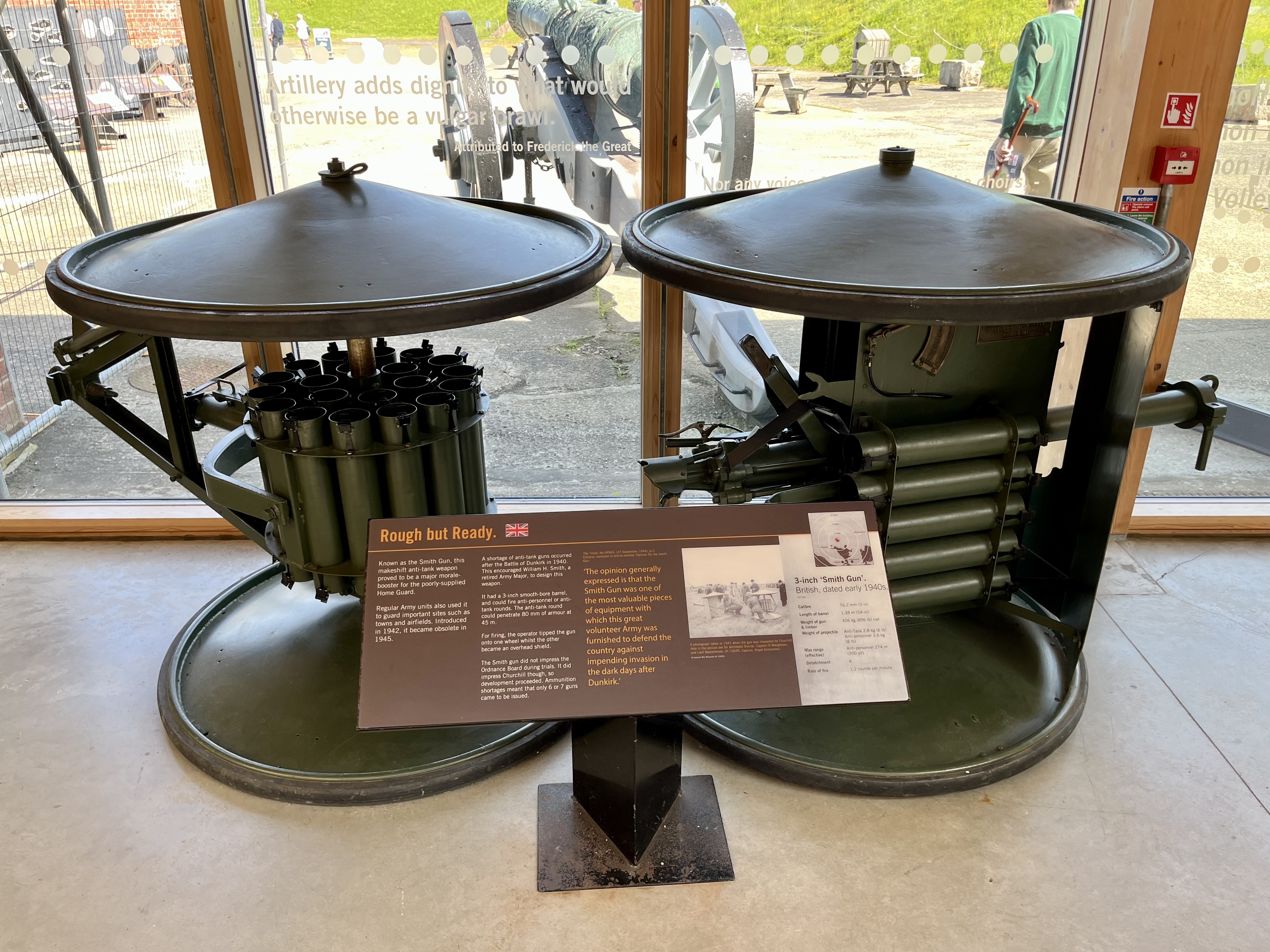
They have a collection of strange guns, particularly the early machine guns and WW2 improvised weapons.

Smith Gun an improvised WW2 ATG.

Hotchkiss 37mm, 1879.

My absolute favourite was the 18-inch rail gun. Just massive. Built in 1918, just too late for WW1, although one was based near Dover in WW2.


That is the first exhibit in a shed full of mostly 20th-century artillery from all over the world. Here are just a few.

120mm British RCL.

Soviet 45mm ATG

Soviet 76mm

Soviet 152mm
Spanish 75mm Mountain Gun.

They also have a good collection of Napoleonic and 18th-century guns. With our Waterloo Day event coming up, I paid particular attention to these.

French 6-pounder

1794 Sikh 7-pounder

You can't have an artillery museum without an 88mm.


Finally, a collection of the guns that worked the fort itself.


Excellent museum and free admission. The guidebook is worth a purchase as you are getting in for nothing. It tells the story of the fort and artillery generally.