Welcome to my blog!

News from a wargamer with a special interest in the military history of the Balkans. It mainly covers my current reading and wargaming projects. For more detail you can visit the web sites I edit - Balkan Military History and Glasgow & District Wargaming Society. Or follow me on Twitter @Balkan_Dave
or on Mastodon @balkandave@mastodon.scot, or Threads @davewatson1683
Showing posts with label Pancho Villa. Show all posts

Sunday, 31 July 2016

Pancho Villa and the Gold Train

Less than a week to go before Claymore and it's time to test the game. Well a cut down version.

The scenario puts the participants in command of a force of Villistas on the outskirts of a small town in Northern Mexico. The locals say a train carrying a valuable cargo, thought to be gold bullion, has derailed in the town. A small force of Federales have arrived to defend it before a repair team and reinforcements arrive.

So, time is of the essence, the Villistas can't hang around bombarding the town they need to find the bast way into the town with the least risk. Or perhaps the traditional Pancho Villa frontal charge is the best tactic!


The Federales sandbag the town perimeter.


Advancing Villistas making best use of cover, while another squad works it way around the flank


The Villistas launch an air attack - and miss! Throwing 75mm shells out of the cockpit is a tricky exercise!

The rules are a cut down version of Bolt Action and work well for the period. Simple to grasp, with just enough command uncertainty to keep the game interesting.

On the painting front another unit of Villista cavalry is being based. That just leaves a few odds and sods for the 'traditional' eve of show painting. The nice new battle mat is from the Tiny Wargames range - rubber backed 'Arid'.


Monday, 25 July 2016

Aircraft in the Mexican Revolution

The use of aircraft was one of a number of military innovations in the Mexican revolution.

Soon after the revolution broke out, US based exhibition pilots were persuaded to use their aircraft in reconnaissance roles, including, the soon to become famous Frenchman, Roland Garros. The first serious application of airpower was by the Huerta regime, who sent 31 officers to France in 1913 and ordered 20 new Bleriot monoplanes.

Pancho Villa's army used a variety of obsolete types including three Wright Model Bs and two other Wright types. Needless to say models of these are a bit of a challenge and even if they exist, I certainly didn't fancy building them - all those struts! So the compromise is a 1/72 scale die cast model of the Wright Flyer, from the Postage Stamp range.


A Villista innovation was a mobile aerodrome train. It could carry planes on flat cars, together with workshop vans and coaches for ground crew and pilots. They also used planes as bombers, throwing 75mm shells with fins to the ground. I doubt this was particularly effective, but too good not to use in our game!

Finally, some more conventional weaponry for the Federales, in the form of a 75mm gun. I don't think they will need AA guns!


Saturday, 23 July 2016

Pancho Villa - man and myth

The start of my summer break is an opportunity to finish the Pancho Villa project. More a gallop to the finish line for Claymore, rather than the leisurely stroll I had planned.

The latest additions are the commanders. I have used the Old Glory personality pack, but I have painted them as generic command figures. 

First up is of course Pancho Villa. “Pancho Villa,” people whispered at the beginning of the 20th century, "can march 100 miles without stopping, live 100 days without food, go 100 nights without sleep, and kill 100 men without remorse."

Was he a revolutionary or just a bandit? Probably a bit of both, but I will give him the benefit of the doubt and plump for mostly revolutionary. In his best revolutionary rhetoric he said:

“My sole ambition is to rid Mexico of the class that has oppressed her and given the people a chance to know what real liberty means. And if I could bring that about today by giving up my life, I would do it gladly.”

He was born around 1878, as Doroteo Arango Arámbula, into abject poverty in Rancho de la Coyotada, an insignificant village of no more than six houses, inside the hacienda of Santa Isabel de Berros, in the state of Durango. Mexico at the time was a hugely unequal country with large landowners supported by an almost feudal peasant class. Foreign companies dominated the economy. While the stories vary, he probably killed his sister's potential rapist and fled to the mountains where he became a successful bandit leader - adopting the name Pancho Villa.

He was persuaded by a supporter of Madero to join the revolution. Madero became president but was later killed in a coup that brought Huerta to power. During this period Villa organised his Division of the North, which by 1914 had grown to 50,000 men. By December 1914, allied with Zapata, they entered Mexico City and installed their own president. 

The subsequent Carranza government repeatedly defeated him on open battles and Villa was forced to return to his northern mountains. He lost the support of the USA, which led to the famous raid on Columbus, New Mexico in 1916 - the last successful invasion of the USA. The subsequent punitive expedition failed to capture Villa. 

In 1920 Carranza was killed bringing another Huerta (Adolf) to power. He agreed that Villa could retire to a farm with his remaining men. The Mexican Revolution was over. However, in 1923 he was assassinated in his local town of Parral, probably on the orders of the new President Obregon, because he thought Villa was planning a political return.

Like all popular heroes, Pancho Villa continues to live in hundreds of corridos, songs, books, movies, legends and even ghost stories about him. The truth is more prosaic, but everyone likes a good story!

Of course, every good story needs a bad guy. So here is my wicked Federales commander.


For further reading a good short history is, Pancho Villa: The Life and Legacy of the Famous Mexican Revolutionary by Gustavo Vázquez Lozano. The American journalist John Reed wrote a book about his time in Mexico, Insurgent Mexico, that included his time with Villa. It's a bit of a ramble, but does give a real flavour of the period. Both are available very cheaply as e-books.


Saturday, 2 July 2016

Mexican Revolution and trains

I have always had a soft spot for trains, so an opportunity to mix them in with wargaming is too good to miss. Our GDWS participation game at Claymore this year revolves around a derailed gold train that the Villistas have to capture.

Railroads played an important role in the Mexican Revolution. They were vital to logistics and much of the fighting took place close to the lines. Trains with sandbagged flat cars would move ahead of the freight trains and cavalry would provide flank guards. 

Federal armies were particularly tied to railroads and they could be outmanoeuvred by more mobile opponents. However, in 1914, Pancho Villa moved his whole 16,000 strong Division del Norte south by rail. He also had a well provisioned hospital train that could deal with 1400 casualties. 

I am on a bit of a roll with the painting with 90mins a night allocated to the task. So, the latest addition is another squad of Federales. These are from the Old Glory range.


Then a squad of Villistas, again from Old Glory, this time in the US brown khaki that many wore.


And finally the box car that holds the gold. After much searching I found a reasonably priced O Gauge US van that looks close enough to the pictures I have. A bit of dry brushing and there it is. I am sure there will be a train spotter at the show who will tell me there is a rivet out of place!


Wednesday, 22 June 2016

More Villistas

Back from my Balkan travels and it's time to get down to some serious painting. When a show is months away, you think, plenty of time to paint up the armies. But then time moves on and before you know it the lead mountain is as high as ever and Claymore is less than two months away.

So, first off Pancho needs his bodyguard, the Dorados or 'Golden Ones'. He had three squadrons of 100 men each in this unit. Famed for their wild cavalry charges, they had a rifle, two pistols and two horses each. These are from the Outpost Miniatures  range.


Then some more foot figures. These are irregulars attached to Villa's, Division del Norte. They are mostly from the Foundry range. A little early for this conflict, but they look a suitably villainous bunch!


Saturday, 14 May 2016

Mexican Revolution - support weapons

Back to some painting this week and the Mexican Revolution project.

First up, some machine guns for the Federales. Machine guns played an important part in the revolution. The Federales and later Constitutionalist forces made great use of them in their defensive battles. These were mostly medium machine guns as light machine guns were rare. The main types were French Hotchkiss M1896 and Colt 'potato-digger' M1895 weapons. The models below come from the Old Glory range.


The Villistas were stronger in artillery, even though they obtained most of them by capturing government weapons. The French manufactured 75mm gun was the most common as well as a number of smaller mountain and 37mm guns. The model below comes from the Outpost range.


Cavalry next.


Thursday, 14 April 2016

Viva Villa!

The Pancho Villa project has got off the starting blocks. Well the first two units painted at least!

The plan is to paint up two armies in 28mm (Villistas and Federales), suitable for Bolt Action. At present that is looking like at least 3 infantry squads, a cavalry squad, artillery and HMGs for each side - although it will probably grow! I'll need a target, so we are going to do this as the GDWS participation game at the Claymore show in August. That should be plenty of time - he says boldly!

After much internet research, I also have a railroad van that, with a bit of conversion, should do as a game objective. Also a model of a Wright biplane - the Villistas converted 75mm shells for rudimentary bombing runs. I suspect we will need some house rules for this one!

Below are the first two units. On the left we have a dismounted squad of Pancho Villa's elite unit (don't wargamers always paint elite units first!), the 'Golden Ones'. They wore a distinctive olive green uniform, so at least they will be easy to spot on the tabletop. On the right we have some Federales, in the later khaki uniform.


These are from the Old Glory range. The sculpts are a bit basic, but there is nothing intricate about these troops. A block paint job, followed by an ink wash, gives a suitably grubby appearance. I also have some slightly larger and chunkier Outpost figures that will need to populate different units.

I'm off to Salute on Saturday, so I am hoping to pick up some more suitable figures for irregular units. Really looking forward to this one. I get a bit more time at the show because Fulham are playing the night before in Brighton. Possibly the furthest away game a Scottish based Fulham could possibly travel. I'm not as confident of a result on Friday as I am on Saturday!

Monday, 25 January 2016

Pancho Villa and the Mexican Revolution

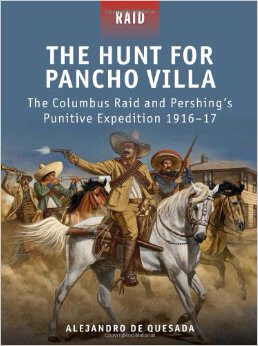
This year is the centenary of Pancho Villa's raid on Columbus, New Mexico, the last invasion of the USA by foreign troops. It sparked a punitive expedition by US troops led by General Pershing, with actions at Parral and a larger battle at Carrizal on June 21 1916. The American forces failed to capture Villa, but they did keep him out of trouble and gained some useful, if not exactly comparable, combat experience before they shipped out to Europe.
Osprey do the attack on Columbus and the consequences in their Raid series.
This title gives you a brief background to the raid, the action itself and the details of Pershing's expedition. Villa was a hero and military genius to some and a common criminal to others. The author's view is that he was somewhere between the two.
This action led me on to a more detailed look at the Mexican Revolution. Again Osprey provides the basics with their Elite series ' The Mexican Revolution 1910-20'.
The Mexican Revolution began as a movement of middle-class protest against the long-standing dictatorship of Porfirio Diaz (1876-1911). The first uprising was led by Francisco Madero who was elected President in October 1911. After that there is a complex series of rebellions and coups. There is a good summary by Alan Knoght at History Today.
Villa became a serious player in the conflict because his Division of the North was an effective military unit, at times closer to an army than a division. In 1914, allied with another faction, the Zapatista, he captured Mexico City. However, in the end the Constitutionalists, led by Alvaro Obregon, triumphed using modern tactics and equipment. Villa insisted on frontal cavalry charges against entrenched opposition, who by 1915 had learned the lessons of the Western Front. The raid on the USA was something of an afterthought, probably aimed at securing weapons and supplies. Villa accepted an honourable retirement in 1920, but was assassinated on Obregon's orders in July 1923.
The attractions of the period are colourful characters like Villa and Zapata and exotic troop types. Think westerns with machine guns, artillery, a few armoured vehicles and aircraft. My favourite is the tactic of loading a train with dynamite and percussion caps and sending it unmanned in a town to cause chaos before the attack. Railroads were absolutely key to the conflict.
For the US forces, Osprey also do 'The US Army 1890-1920' in the MAA series.
This does appeal to me - just a decision as to scale. Bolt Action in 28mm was my first thought, but perhaps a few more figures in 15mm.
Must finish those Napoleonics first though. Inspired by a very good weekend of gaming at our club's Open Day. We refought the Battle of Fuentes de Onoro in 28mm using Black Powder. Another option for the Mexican Revolution - Viva Villa!