Welcome to my blog!

News from a wargamer with a special interest in the military history of the Balkans. It mainly covers my current reading and wargaming projects. For more detail you can visit the web sites I edit - Balkan Military History and Glasgow & District Wargaming Society. Or follow me on Twitter @Balkan_Dave
or on Mastodon @balkandave@mastodon.scot, or Threads @davewatson1683
Showing posts with label Modern. Show all posts

Wednesday, 22 April 2026

If Russia Wins

 This is a 2028 scenario book written by Carlo Masala, which I read for my day job writing a defence analysis for a European think tank. However, it is also a credible scenario for modern warfare and wargamers.


The book is set in March 2028. It assumes that the USA has sold out Ukraine and forced it into a land-for-peace deal with Russia. Zelensky loses the subsequent election, Ukraine descends into chaos, and Putin stands down as Russian president. The West is trying to work out if this signals a new direction in Russian foreign policy, or another Putin puppet.

In Brussels, NATO is split, with the US focusing on the Pacific and European nations unwilling to increase defence expenditure to levels required to seriously deter Russian expansionism. In Moscow, they have learned the lessons from the optimistic 'Special Military Operation' analysis and have adopted the 1936 Rhineland model to target Russian-speaking areas outside the Russian border. In effect, this means just take action, tell everyone your objectives are limited, and rely on a weak reaction.

On this basis, Russian troops capture the Estonian town of Narva and the island of Hiiumaa in the Baltic Sea. Europe’s slow rearmament and its compromised military and intelligence capabilities are now clear for its enemies to exploit. Does Article 5 of NATO apply? What will the alliance decide? Will they risk nuclear war?

The author takes the reader through the various meetings that take place to decide on a reaction. The Russians use hybrid warfare to distract NATO from Estonia. A defence contracor is killed in Germany and bombs go off at Faslane. The Chinese helped by capturing an island in the South China Sea. The bottom line is that the USA is not going to risk WW3 over a small town in Estonia. They are supported by Hungary and other of Putin's useful idiots in Europe. So they effectively do nothing.

If this sounds fanciful, last week the Russian Duma passed a law letting Putin deploy troops anywhere on Earth to 'protect Russian citizens'. The author argues that the only way to prevent this scenario is to ensure Moscow believes NATO will respond to a regional escalation.

This is a short, very readable book with a well-argued scenario. Not a cheery prospect, but one we ought to take seriously.

Some of my modern Russians in 20mm, in a game of Corps Commander.


Saturday, 21 March 2026

1956: The Year That Changed Britain

 1956, The Year That Changed Britain by Francis Beckett and Tony Russell was my library pick for the month. A bit self-indulgent, as it is the year of my birth, but as I understandably recall nothing, I thought it might be interesting. 


In the first chapter, there was something I did recall, albeit from later childhood. The most-watched TV series in January 1956 (78% audience share) was ITV's The Adventures of Robin Hood, starring Richard Greene, the very best in the genre. The song "Robin Hood, Robin Hood, riding through the glen, Robin Hood, Robin Hood, with his band of men," stuck with me all these years. Was there a political message about the redistribution of wealth to undermine McCarthyism in the USA? At the other extreme, 1956 was the end of communist idealism for a generation with the Soviet invasion of Hungary. A historical event that the current pro-Putin Hungarian leader has forgotten. And on the subject of great political causes, the last Prime Minister of Republican Spain died in Paris in 1956.

On a more practical note, it was the year that double yellow lines appeared on our streets. Cursed by us all sometimes, but essential to keep our roads clear with ever-increasing car use. And on the subject of law enforcement, it was the first year that no life was taken by the judicial system. Parliament voted in favour of abolishing the death penalty in a motion, but it wasn't abolished in legislation until 1965. The Clean Air Act was passed as a response to the 1952 London smog, which killed 4,000 people. A reminder for climate change deniers that environmental legislation is both necessary and not new.

A special interest of mine, Cyprus, kicked off in 1956 with a bomb discovered under the bed of the governor, and Makarios was arrested for fostering terrorism. Shootings and other acts followed, led by EOKA. However, the big military event of 1956 was the Suez Crisis. Very topical today, given that it had to be abandoned because of US pressure. Trump doesn't read anything, certainly not history, but he has been reminded of it today. At the time 100 Tory MPs tabled a motion, 'deploring the attitude of the United states', hard to imagine that today either. When Eden resigned, and Macmillan took over, he was supposed to have telegraphed Ike saying, 'Over to you!', by which he meant the Middle East was now the US's responsibility.

The Lancaster bomber made its last operational flight in 1956. Britain also took its first steps toward energy security in 1956, another topical issue, when Calder Hall nuclear power station was switched on.

In culture, 1956 was the year when the theatre moved out of its comfortable middle-class blanket with plays like Look Back in Anger. Theatre critics like Kenneth Tynan (an obscure relative of mine) reflected the new mood of radical theatre productions. Granada TV was the first ITV franchise in northern England, and I can remember its distinctive logo from growing up in Liverpool. Tommy Trinder got sacked for offensive jokes, which were pretty inoffensive by later standards, and many were about my football team, Fulham, which he part-owned and later chaired.

In sport, this was the year of Jim Laker's still-standing record wicket tally: 19 wickets for 90 runs against Australia. Oh, for another Jim Laker today! Premium Bonds were launched in 1956, and I do remember being given one for my birthday. Not impressed, as I would rather have had the cash for comics. However, some £47 billion has been invested in them. 

I am now convinced that I was born in the year that changed Britain 😆. The author concluded that the lasting legacy of 1956 is the decline of deference. He may be right about that at least.

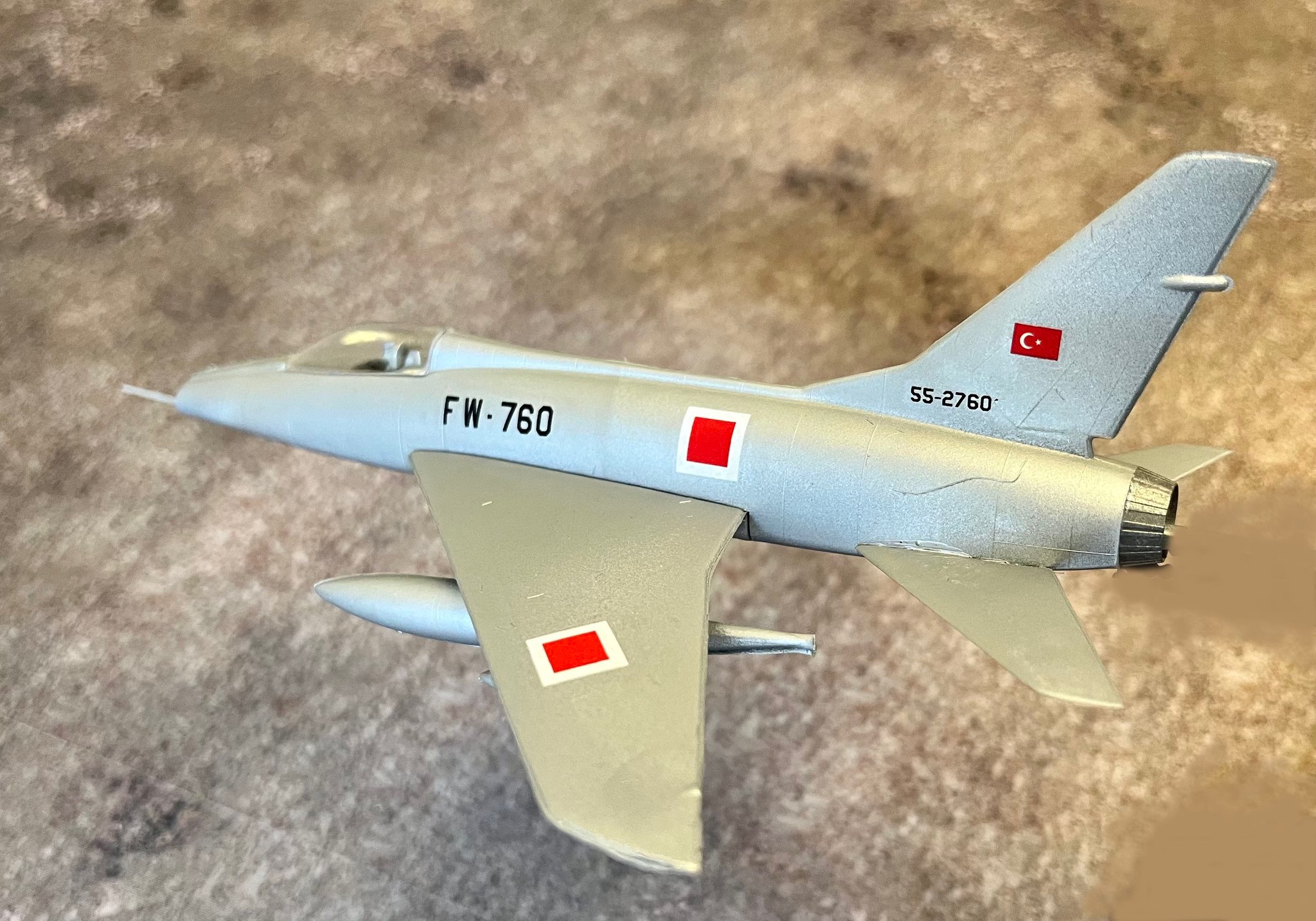
I have never gamed Suez, but here is an early Turkish intervention in the Cyprus conflict. My favourite jet aircraft is the F-100 Super Sabre.


Sunday, 15 March 2026

Putin's Mercenaries

 This is the story of Russian private security companies that gave Putin a flexible and deniable military arm as he began to intervene, not just in states on Russia's borders, but further afield in Syria and Africa. These most famously included the Wagner Group and its leader, Yevgeny Prigozhin, who launched a botched mutiny against Putin's regime in 2023. It is written by the prolific Mark Galeotti, who is always worth reading on Russia.


He starts by reminding us that mercenaries are nothing new in Russian military history. The Cossacks are probably the most famous, but Russia recruited from tribes like the Kalmyks to help fight their wars in the 18th and 19th centuries. British, including many Scots, also found their way into Russian service. I suspect soldiers like Lacy, Gordon and Grieg would bristle at the mercenary tag. Soldier of fortune, or for the Jacobites, necessity, may be more accurate.

As serving as a mercenary or establishing such an organisation is banned under the Russian constitution and Criminal Code, Putin came up with a new concept, a commercial company with close links to his regime. The 'Little green men' were a key element of the invasion of Crimea and the Donbas. They were judged more reliable than the various militia warlords that sprang up during these and earlier conflicts. The author takes us through the development of these companies and the key players. In the Donbas, they all proved unable to achieve the breakthrough Putin sought, so regular Russian troops and their heavy equipment were deployed to the battle. After the 2022 invasion of Ukraine, they returned to the battlefield as Putin desperately needed more troops as his 'special operation' ground to a halt. Wagner recruited criminals, neo-Nazis, and pagans, amongst others, to send into the meat grinder.

In Syria, they were sent to prop up the regime of Bashar al-Assad, which, despite the support of Hezbollah and lots of Russian equipment, was losing the civil war. By 2016, Wagner had more than 1500 troops on the ground with support weapons. They fought against ISIS in the strategically important Palmyra area, scouting and then leading the attack, supported by Russian air power. This didn't come cheap. The Russians provided Wagner with some of the latest equipment, including T90 tanks. Wagner received around $170m dollars from the Russian state budget alone in 2016. This was unsustainable, so Wagner established a range of money-making schemes to defray costs. The first sign of tensions between Putin and Prigozhin came at Kasham, when the US brought enormous firepower down on Wagner forces (with up to 300 casualties) after being told by the Russians that none of their troops was involved.

Wagner had largely left Syria in 2018, but had already established itself in Africa, including Sudan, Libya, and the Central African Republic. They found a string of dictators, happy to pay for troops and other political services in return for gold and diamond concessions.

It all came to a sticky end when Prigozhin and his arch-enemy, Defence Minister Shoigu, clashed again in June 2023. Shoigu persuaded Putin to call up 300,000 conscripts, thereby making Wagner no longer essential and allowing its contracts to be ended. This led to a botched coup of sorts, with around 12,000 Wagner troops marching on Moscow (March of Justice). A sort of deal was negotiated, but Putin later decided to eliminate Prigozhin and incorporate the remnants of his forces into the Russian military. Prigozhin must have wisely kept away from windows, so his business jet was shot down and he was killed.

This is an interesting, if grim, story, well told, with lovely colour plates by Johnny Shumate. 

Some of my 20mm Russians


Thursday, 20 November 2025

Korean War - US forces

I got interested in the Korean War when researching the Turkish units that fought there for my books on the Cyprus conflict. Two new Ospreys focus on US forces, and while I probably won't expand by tabletop forces in this direction (famous last words), the Turks were largely equipped from US stocks.

The first is MAA 561, which examines the US Army and US Marine Corps in Korea.


This is really a book for modellers, as it goes into great detail about the uniforms worn by the army and marines. I am doing this in 10mm, so the differences between the army and the Marines are almost irrelevant. When they arrived in Korea, most were equipped in WW2 uniforms, the standard herringbone twill. Cold-weather attire soon became vital, particularly the iconic caps and pile liners, although, as before, these were mainly WW2 issue. Later, the heavy-lined parka was issued. Insignia and specialist equipment are also covered.

The Turks converted from British equipment. They welcomed the US helmet as an improvement on the Brodie rim that made grenade throwing a risky business. However, they were less impressed by the boots, which took too long to lace up in emergencies.

As you would expect, there are plenty of photos and excellent colour plates. Sadly, no Corporal Klinger or Radar lookalikes!

I haven't yet considered the naval aspects of the Korean war, but Corbin Williamson's US Seventh Fleet, Korea 1950-53, has it all. 


At the end of WW2, the Seventh Fleet in the Pacific had over 200 ships and was still involved in post-war operations, including the war in China. As North Korea didn't have much of a navy, the Seventh Fleet was mainly engaged in shore bombardment and air combat, primarily using its Essex-class carriers. The huge Iowa-class battleships were brought out of reserve to add naval firepower. 70,000 naval personnel (excluding marines) served in the fleet by 1951.

The author covers all the primary ship classes and the aircraft that flew off the carriers. This information is widely published, so I found the chapter on command and control more interesting. The task force organisation is covered in detail, as is liaison with other UN member nations that contributed naval forces, including the Royal Navy. A fleet of this size required extensive shore facilities in Japan and replenishment at sea.

North Korea did have MTBs and other small boats. The combat operations chapter covers their attempts to attack UN ships and the threat posed by shore batteries. The North Koreans also made extensive use of mines, which kept the US minesweepers busy. Other than that, operations were mainly bombardment and amphibious landings.

I can't see much in the way of tabletop operations here, although naval and air bombardment have to be factored into land battles. I also play Blood Red Skies for the Korean air war. It is still an interesting read, well illustrated and plenty of data for the naval buffs.

My Turkish brigade facing North Korean and Chinese troops. Yes it can be hilly in Korea!


Tuesday, 21 October 2025

The Bosnian Serb Army at War

 This is Bojan Dimitrijevic's account of the Bosnian Serb Army during the 1992-95 conflict. Many books have been written on the conflict, but few focus on the fighting units. While the author attempts to write an objective military history, his objectivity slips several times. It is best described as a sympathetic view of an army that fought well under challenging circumstances but was also responsible for atrocities, not least the massacre at Srebrenica.


The author starts with a brief background and description of the army's (VRS) establishment. It mainly constituted the Yugoslav Army (JNA) units in the Serb areas of Bosnia and quickly incorporated paramilitary and militia units. It followed JNA ranks and organisation and was commanded by General Ratko Mladic, who was later convicted at The Hague for war crimes. The author describes a 'complicated relationship' with the civilian leadership, led by Radovan Karadzic, another convicted war criminal. While this was a predominantly ethic Serb army, there were a few Croat and Muslim officers.

The book is profusely illustrated with pictures and colour plates of the army's wide variety of equipment. In May 1994, this included 358 tanks (T-34, T-55, and M-84s) and 197 APCs. They also had a huge range of artillery, AA and tactical missile systems. Modellers will enjoy the variety of camouflage and additional armour used. 

The bulk of the book covers the main campaigns of the conflict. They had notable successes in 1992 and 1993, including Operation Corridor, Operation Vrbas, and Operation Lukavac. However, by 1994, their Croat and Muslim opponents were beginning to cooperate, and the army was increasingly forced back onto the defensive. NATO intervention meant they no longer had control of the skies, and their positions around Sarajevo came under ground attack. The US Congress also lifted the embargo on weapons deliveries to the Muslim forces. Pressure on the political front was a key feature of the final two years of the conflict. When the Contact Group's peace plan was rejected, NATO military intervention became more frequent. 

There were particular tensions around the capture of UN peacekeepers and their use as human shields against air attack. This was heightened when Serb forces captured the Muslim enclave of Srebrenica. I'm afraid the author lost the plot here, with the implication that the worst atrocity in Europe since WW2 was somehow the responsibility of a captain. The idea that 8,372 men and boys could be executed without the knowledge of the commanders is absurd. 

The VRS heavily outgunned its opponents in the early stages of the conflict and had the organisational advantage of building on already established armed forces. However, they had a lot of territory to defend, and the terrain was challenging. I have driven around Bosnia several times, and the defensive advantages are apparent. Putting objectivity aside, this book has all the factual information the wargamer and modeller needs on the VRS. 

Some of my 15mm JNA infantry of the period.


Thursday, 3 July 2025

Weapons of the Falklands Conflict

 This is Bryan Perrett's book on the weapons systems deployed by both sides in the Falklands War. It was written just after the conflict in 1982, and I picked it up in my local Oxfam bookshop. Not because I don't have a mountain of books on the subject, having written my own book on HMS Ambuscade, but because I was interested in comparing his initial reactions to later studies that have the benefit of data released since the conflict.


After a brief introduction to the conflict, the author divides the weapon systems into three dimensions: naval, air (including helicopters and fixed-wing aircraft), and land. He begins each section with a list of the equipment used, followed by a section on the action.

The sinking of the Belgrano outside the exclusion zone was something of a cause célèbre at the time. Whatever the moral and legal issues, he makes a valid point that, although the Belgrano was an old ship, it had Exocet missiles that could have reached the task force. The sinking also drew the Argentine Navy's attention to the presence of at least one Royal Navy hunter-killer submarine. This resulted in the Argentine Navy remaining in port for the remainder of the conflict. 

His comments on the design of Royal Navy frigates with aluminium upper works are interesting, as HMS Ambuscade was one of those. Aluminium has a lower melting point than steel, but a direct hit from a missile would destroy steel as well. The real lessons centred on electronic warfare (in the absence of AWACS) and the merits of various anti-missile systems. The Gannet could not fly off the smaller carriers. This was the first three-dimensional missile war in naval history, and many lessons have been learned since.

While helicopters were not a new weapon system in 1982, they were crucial to the naval and land battles. One of the roles of the naval Lynx helicopter was to act as a missile decoy. This involved the hair-raising manoeuvre of drawing the missile away from the ship and climbing sharply at the last second. The loss of the Atlantic Conveyor and its heavy Chinook helicopters was a big setback, as they could carry 44 infantrymen in one lift.  

In the air battle, the Argentine aircraft were operating at the limit of their operational radius. This meant limited time over the islands. Perrett draws an interesting analogy with the Luftwaffe during the Battle of Britain. The Harrier performed exceptionally well in a role for which it was not originally designed. The Argentine Air Force concentrated on the two carriers, while Perrett argues they would have been better concentrating on the landing ships. He might be right, but we now know more about the problems they had with bomb fuses.

Overall, this is an excellent little book, which hasn't dated as much as I expected. I had the benefit of later research, interviews with sailors who were there, and access to the Ministry of Defence files.


Saturday, 8 March 2025

South Atlantic 1982

 This is a new title from the Osprey Air Campaign series by Angus Konstam, which examines the carrier campaign in the Falklands War. While there are lots of books on this conflict, many were written shortly after the war, so a new examination is always worthwhile. My interest in the Falklands resulted from my book on HMS Ambuscade, which took part in the campaign.


After a brief introduction, we get a breakdown of the Argentinian and British air capabilities. The Argentine Air Force had numbers and bases. However, it was equipped to fight a war against Chile rather than a carrier strike force. It only had two refuelling tankers, which seriously limited the capabilities of its short-range aircraft, like the A4 Skyhawk. The main strike aircraft included Mirage IIIs, Daggers and the Skyhawks. More modern aircraft were on order, including the Super-Etendard with the Exocet anti-ship missile, but only four were operational and had one missile each. The effectiveness of this system was demonstrated by a 50% hit ratio. Most attacks were with bombs, and only a few naval pilots were trained to attack ships.

The British strike force was built around two small carriers, Hermes and Invincible. They had 20 sea Harriers, and RAF pilots supplemented the Fleet Air Arm crews. 14 RAF GR3 Harriers would join the task force, primarily for ground attack roles. The Sea Harriers were vital as the Royal Navy warship's air defence missile systems (Sea Cat and Sea Slug) were obsolete. The replacement Sea Wolf and Sea Dart were installed on some ships, but the Sea Dart was less effective against low-flying targets.

The main chapters cover the campaign objectives and the air battles. The Argentinian armed forces did not expect the British response, and their defence plan can best be described as improvised. The main air battles are explained with diagrams, maps and colour plates. 

Forty-plus years on allows an objective analysis of an air campaign neither side planned to fight. The air campaign was officially dubbed a ‘conflict’, but for those who took part, it was a war in every sense. While the Argentinians could operate from established airfields, the Royal Navy had to operate from two relatively small carriers. The fighting was characterized by several other unusual factors. These included the geographical constraints of the distance between Argentina and the Falklands and the radius of action of the British Harriers. Both imposed limits on flying time in the operational area. The real star was the Sea Harrier. Its high success rate in air-to-air combat made it the stand-out aircraft of the campaign. In all, 22 Argentinian planes were shot down by Sea Harriers, 18 of these using Sidewinders. No Sea Harriers were lost in air-to-air combat. Despite this, the Argentinian pilots displayed great courage and still managed to sink British warships.

If you are interested in modern air warfare, you will learn a lot about the mechanics, even if it was a long way from the conflict the pilots were trained for.


Saturday, 28 December 2024

Ground Forces in the Korean War (1)

 This is a new Osprey MAA on the North Korean and Chinese ground forces in the Korean War by Benjamin Lai and Zhao Guoxing. There is an old 1980s Osprey on this conflict, but the subject deserves a more up-to-date and detailed series. I got drawn into this as a project when researching the Turkish troops for my book on the Cyprus crisis of 1963. I restricted myself to 10mm, and the air war, as lovely as the Warlord figures are, it was just too much repetitive painting in 28mm.


The authors start with some helpful historical background, reminding us that the Chinese have always seen Korea as the back door to China, which MacArthur might have recognised if he had read more history. Chinese intervention was not simply ideological. The origins of the North Korean Army (KPA) predated WW2 and included service in Chinese and Soviet forces. Kim Il-sung learned his trade in these conflicts, and the Soviets brought him back when they arrived in Korea in 1945 after the Japanese collapse.

We then get chapters on the KPA structure and doctrine. Initially equipped with captured Japanese weapons, they received modern Soviet weapons before manufacturing their own versions. Equipment included 150 T34/85 tanks and 32 SPGs. Organisation was on the Soviet model, although they were short of radios. A brief chapter on the Korean War actions focuses on how the KPA was forced to reorganise after being pushed back from South Korea. For more on this, there is a good Osprey essential histories study of the war.

This approach is replicated for the Chinese People's Volunteer Army (PVA). Mao and Stalin did not want to get involved in the war, viewing it as a Korean squabble. Kim did not share his invasion plans and thought he could win without Chinese or Russian help. However, when US forces moved to the border, the age-old fear of invasion kicked in, and troops were diverted to shore up the North Korean position. It was a rushed job with summer uniforms and a mixture of weapons. The classic padded uniform came later. PVA tactics were based on the infiltration system they had learned during their civil war, and UN troops often described being surrounded. Effective use of terrain and camouflage was a key element. Again, the shortage of radios meant relying on horns and whistles, a practical measure not designed to intimidate. They were also short of support weapons, including machine guns and mortars.

As you would expect from this series, there are plenty of photographs and excellent colour plates—everything the wargamer needs. I use Blitzkrieg Commander rules for the Korean War, which is just an extension of WW2. There is an excellent supplement which I highly recommend.


Wednesday, 18 December 2024

Bulgaria and Turkey in the Cold War

 A new and an older book has scratched an itch for a side project on a what-if clash between Bulgaria and Turkey during the early Cold War period.

The new book is Hot Skies of the Cold War by Alexander Mladenov and Evgeni Andonov, published by Helion.
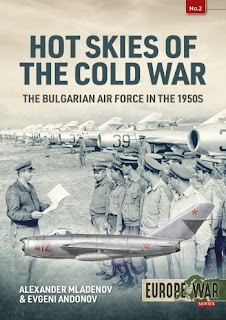

The Bulgarian Air Force was Sovietised after WW2 and started to receive the latest Soviet aircraft, including the early jet fighters the Yak-23 and Mig-15. The first 23 Mig-15s arrived in 1951, boxed in crates. More arrived each year after that, totalling more than 100, plus trainers. While there were no open hostilities, the CIA organised incursion flights from Greece. Bulgarian air defences were limited, but Mig-15s made 130 launches in 1954 alone. These incursions had tragic consequences when two Mig-15 pilots shot down an Israeli airliner (Flight LY402) on 27 July 1955, which had strayed into Bulgarian air space. 58 passengers and crew died. This incident takes up most of the book, which, while tragic, is a bit too much. The Mig-17 was a significant improvement because of its all-weather capability. These started arriving in 1955, totalling around 74 by the decade's end. Later versions had radar. The Mig-19 was the first supersonic fighter, ideal for air defence. 84 of these arrived between 1957 and 1959. The book has lots of photos and some excellent colour plates.

The second book, Turkey Between East and West, edited by Vojtech Mastny and Craig Nation, looks at the other side of the hill. It is a series of essays examining different aspects of Turkey's development during this period and later. The book was written in 1996, so the forward-looking chapters are interesting for what they got right and wrong!


Stalin’s attempt to acquire the Straits after WW2 framed Turkey’s relations with the Soviet Union in the 1950s. It brought them firmly into the US sphere of influence through the Truman Doctrine, which brought the US Sixth Fleet to Turkish ports and a steady equipment flow when Turkey joined NATO. This relationship cooled with the Cuban missile crisis and the loss of Jupiter missiles on Turkish soil, followed by the Cyprus crisis of 1963-64. 

I also dusted down a few more books on this subject from my shelves for this project. Unlike other Warsaw Pact nations, the Soviets didn't station troops on Bulgarian soil. They relied on advisors, trainers and the KGB, which, coupled with historical links, made Bulgaria a reliable ally. Bulgaria sent advisors and equipment to communist regimes across the world, although they did not participate in combat operations like the Cubans in Angola. There is some evidence that Bulgaria supplied weapons to Kurdish separatists, which is always a sensitive issue in Turkey.

The Bulgarian People’s Army (Bulgarska Narodna Armiya – BNA) consisted of Ground Forces, Air Force, Navy and Border Troops. It is estimated that Bulgaria had 180,000 regular troops in 1951. At its peak in 1955, it had 12 rifle and two tank divisions, falling to six rifle and two tank divisions by the start of the 1960s. The structure was similar to the Soviet organisation, just on a smaller scale. The country was divided into three military districts (Sofia, Plovdiv and Sliven). Conscripts served two years from age 19 (three in the Navy) and then went into the reserve. While part of the Warsaw Pact, the BNA played a limited role, reflecting the lower strategic position and the armed forces' limited combat value. It received older equipment than other Warsaw Pact nations, and most rifle divisions were still foot infantry. The T34 tank was still the primary MBT when other Warsaw Pact armies received or made the T54/55. The 1936 uniform and helmet was still in service until the 1970s. In a conflict between NATO and the Warsaw Pact, the Bulgarians could expect support from Romania and the Soviet Odesa and Kyiv Military Districts.

Turkey had to face the Soviet Union directly on its northern border, a frontier some 620km long. Facing Bulgaria in Thrace was the Turkish 1st Army. A 15-20km deep border zone with Turkey along the 279km long border made intelligence estimates difficult to verify. However, there are obvious invasion routes across the border, and amphibious units were based at Ahtopol, close to the border, which could launch attacks on the Straits. There were extensive fortifications on both sides of the border zone, but once breached, the terrain in Turkish Thrace is primarily open plains. However, access was more manageable from the Greek side over the Evros River, which made it difficult to separate Greece from any conflict. The Turkish Corps based at Corlu would have faced the brunt of any attack from Bulgaria. While there are some defensive positions around Edirne and the wooded Yildiz Daglari, the Turkish strategy would likely follow the historical plan of a fighting withdrawal to the 20km wide Catalea position in front of Istanbul. Additional fortifications were defending the Thracian beaches near the Straits from amphibious assault.

The Turkish armed forces gained some warfighting experience in Korea and joined NATO in 1952. US military equipment arrived in modest numbers, including the M47 MBT. The armed forces implemented some reforms, slimming down the largely infantry army and the number of officers. However, progress was slow, with centralised training only introduced in 1954, and literacy was well below NATO standards. The Navy received US and British WW2-era destroyers and submarines in the 1950s. This was adequate when facing the small Bulgarian Navy, but would be reliant on assistance from the US Sixth Fleet in a conflict with the Soviet Union. Air bases were quickly upgraded after 1952 with modern early warning systems and communications. The Air Force received modern jet fighters, including the F84 Thunderjet in 1953/54, and refurbished Canadair Sabres in 1954/56. The first supersonic F-100 Super Sabres started to arrive in 1958. The first female fighter jet pilot to operate under a NATO flag was Leman Bozkurt Altınçekiç, from the Turkish Air Force, in the early 1950s.

The military had a special position in Turkish society and regularly intervened in politics, including a military coup in 1960. The NATO archives include a period film on Turkey and NATO, which shows Turkish soldiers in their WW2-style British battledress. The helmet was still used as late as the Cyprus intervention in 1974.

https://youtu.be/QyeLGnaaMpg

Even before the Cyprus conflict, Greece and Turkey were unstable allies, and Bulgarian planning would have taken this into account. Ethnic Turkish groups in Bulgaria (11-15% of the Bulgarian population) were regarded as suspect, although full-scale assimilation campaigns didn't begin until the 1970s and 1980s. In the 1980s, friction between Turkey and Bulgaria over this issue brought both countries close to war, although the US and Soviets would have intervened to stop it.

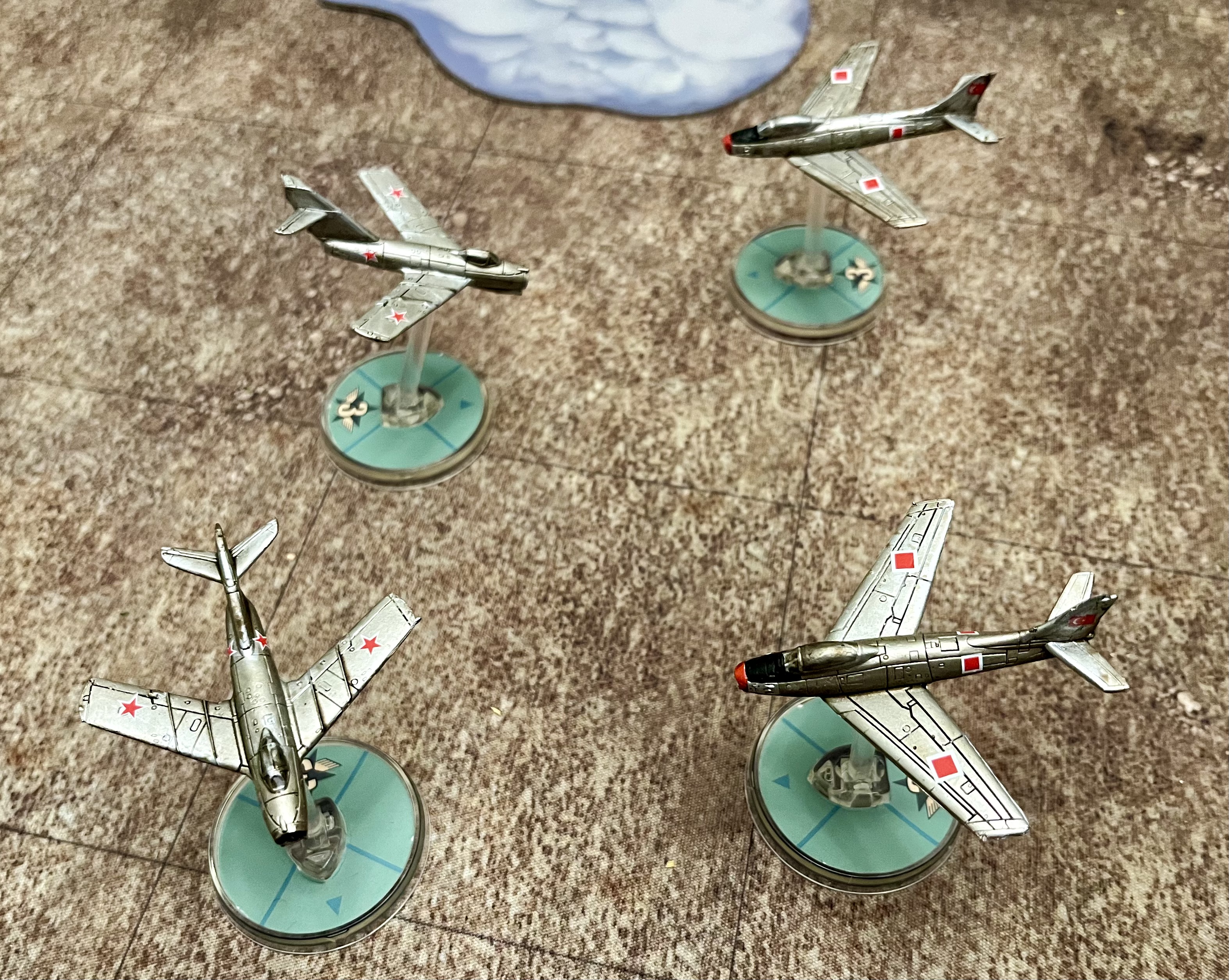
My first tabletop dabble was a game of Blood Red Skies, with Sabres and Mig-15s dogfighting over Thrace. I haven't found any Bulgarian decals in 1/200th yet, so I had to settle for Soviet ones. Turkish ones are available from Pendraken.


The midweek game this evening will be an armoured clash with a Turkish armoured brigade fighting a rear-guard action on the Thracian plains. This will be in 6mm using Cold War Commander rules.


Wednesday, 11 December 2024

North American F-100 Super Sabre

 One aspect of researching the first volume in our book for Helion on the Cyprus crisis of 1963/64 was reading all I could find on the F-100 Super Sabre, my favourite modern fighter aircraft. I found David Anderton's long-out-of-print Osprey very useful, although, for the Turkish F-100s, Levent Basara's F-100 Super Sabre in Turkish Air Force was a must-read. Peter Davies's book (same title) also has a good chapter on the type in Turkish service. I read these in the National Library of Scotland, so I was delighted to pick up my own copy in the secondhand bookshop in Alnwick this year.


The F-100 Super Sabre (nicknamed the Hun) was the first supersonic jet fighter to enter service with the United States Air Force (USAF). It was developed by North American Aviation and was part of the Century Series of aircraft. The aircraft's first flight was on 25 May 1953 and entered service in 1954. The day after my birthday and just a wee bit older than me may explain my enthusiasm for this aircraft!

The F-100 featured a swept-wing design for high-speed performance. Its fuselage was designed to minimize drag, and it had an all-moving tailplane for improved control at supersonic speeds. This gave it a top speed of over Mach 1.3 (860 mph or 1,380 km/h), a service ceiling of 50,000 feet (15,240 meters), and a range of approximately 1,000 miles (1,600 km) without refuelling. Its main armament was four 20mm M39 cannons and various bombs and rockets.

Initially designed as a high-performance air superiority fighter, it was later adapted for ground-attack missions. It played a significant role in the Vietnam War, primarily in close air support and strike missions. NATO and allied nations also used it under the Military Assistance Program (MAP). This is how Turkey received 87 F-100s starting in 1959, C, D, and F ( two-seat trainer) models. Pilots were initially trained by USAF pilots. The Turkish Air Force received over 200 Super Sabres, some from USAF surplus and from Denmark. At least nine Filo (Squadron) operated the type, which saw extensive service in all stages of the Cyprus conflict. The Turks called it the Baba (Father), and if you read the memoirs of Turkish pilots, it was very popular. 

The Osprey book is double the length of a regular Osprey book. It is profusely illustrated and takes the reader through the stages of development and its service with the USAF. 

The French Air Force leased over 100 F-100s, and when they were returned, a significant number ended up at RAF Sculthorpe for scrapping. This is why several can be seen in UK aircraft museums. More than 100 are preserved worldwide.

Newark Air Museum

Dumfries Air Museum


Sunderland Air Museum

Türkiye has a good record of preserving military equipment for museums. Two F-100s in early and later colour schemes are at the Istanbul Air Museum. 


I have two 1/72nd scale Baba models from the PM Models range. This Turkish manufacturer makes a simple kit that suits my inadequate kit-building skills and has Turkish decals for both periods. They have seen a lot of tabletop action, often saving the Turks from near defeat.


I would also recommend the Facebook group, which has many photos shared by veterans and their families—a testimony to the Super Sabre's enduring attraction.


Sunday, 8 December 2024

Cyprus 1974: A Wargamers Guide

 I have a new book out today, Cyprus 1974: A Wargamers Guide. The subject will be familiar given the number of scenario play tests I have covered in this blog, not to mention books and visits.


While I am co-writing a complete military history of the conflict for Helion Books, I didn't want the 50th anniversary to pass without providing something for all the wargamers who have played the games that appear as scenarios in the book. So, this is an Osprey-length teaser on the history, but it has everything the wargamer needs to refight the conflict on the tabletop.

This book explores the background of the conflict. It details the armed forces involved, including regular units from Turkey and Greece, the Greek Cypriot National Guard, and Turkish Cypriot militia units. British and UN forces were also present on the island, and I mention them as well because they could easily have been drawn in. It outlines the military operations conducted on land, at sea, and in the air, drawing on interviews with veterans and published memoirs.

It also offers modelling suggestions for the various forces involved and presents eight scenarios to re-enact key actions on the tabletop. These scenarios are illustrated with wargames, maps, and orders of battle that can be adapted to popular wargame rules.

This conflict has probably been overlooked because the major powers were not involved, and it doesn't fit with the Cold War narrative that dominated the period. This is my modest attempt to rectify that.

And if you are looking for that late Christmas present - here are a few more titles to consider! 


Saturday, 14 September 2024

Air Campaign - Yom Kippur War

 This is a new title in the Osprey Air Campaign series covering the Yom Kippur War by Shlomo Aloni. The Arab-Israeli conflict was my first dabble into modern wargaming; this war has all the critical elements of that conflict. However, I haven't read much about the air campaign, so this title looks interesting.


The Yom Kippur War, also known as the October War, was fought between a coalition of Arab states led by Egypt and Syria against Israel from October 6 to October 25, 1973. The war began on Yom Kippur, the holiest day in Judaism when Egypt and Syria launched a surprise attack on Israeli forces in the Sinai Peninsula and the Golan Heights, territories Israel had captured in the 1967 Six-Day War. Egypt aimed to reclaim the Sinai, while Syria aimed to retake the Golan Heights.

Initially, the Arab forces made significant gains, catching Israel off guard. However, after several days of fighting, Israel regrouped and launched counteroffensives. By the end of the war, Israel had pushed deep into Egyptian and Syrian territories, but a ceasefire brokered by the United States and the Soviet Union brought the fighting to an end. Despite Israel's eventual military success, the war was seen as a psychological and strategic blow, leading to significant changes in its defence policies.

I had assumed that Israeli airpower was all-pervading. However, the author points out that after the war, Israel’s Deputy Chief of Staff stated that the ILAF had destroyed less than 100 tanks. Years later, a claim emerged that out of the 1,500 tanks examined postwar to ascertain the cause of damage/destruction, not one was hit from the air. Likewise, the Israeli prewar plans to completely destroy the enemy’s air forces and air defence forces had failed.

While the Israeli Air Force was outnumbered on paper, they had a qualitative advantage, particularly with the F4 Phantom called Kurnasse in Israeli service. However, air warfare had moved on considerably since the 1967 War, and the Arabs had hardened bunkers and surface-to-air missile systems. This required a different approach and a significant change in plans. 

The author concludes, "The ILAF may not have produced images of victory as it did in the June 1967 War. The ILAF may not have performed as well as may have been expected from prewar investments and promises. Nevertheless, the ILAF shaped the October 1973 War. The ILAF drove Egypt and Syria to develop their air defenses into formidable forces, therefore diverting funding from offensive ground forces."

The book provides all you would expect from this series: a breakdown of each side's capabilities, objectives, and campaign—well illustrated with quality maps and artwork. However, it was the analysis that I found most interesting and new—to me, at least.

I have a few 1/200-scale aircraft to complement the ground forces. I'm not quite ready to invest in the air war, but if you are, this book has everything you need.

Wednesday, 28 August 2024

The Changing face of the World's Navies

 Writing the HMS Ambuscade book interested me in the broader development of navies since the Second World War. This book by Bruce Watson chronologically takes the reader through the period, examining the events that shaped changes to the organisation of navies and warship design. It was written in the early 1990s, just as the Cold War ended.


For each period, the author highlights the influential factors and political and military events before looking at how the major and later minor navies of the world responded.

The Cold War began in the post-war period from 1945-50, but the Soviet Union had not developed a blue sea navy, so the USA and, to a lesser extent, Britain still ruled the waves. The aircraft carrier was the physical embodiment of that power projection. The Korean War was a turning point, and the USA developed nuclear-powered warships capable of staying at sea for extended periods. The Soviet Union started to re-evaluate its naval strategy after 1953, recognising that defending Soviet interests required something more than a coastal navy.

The Suez Crisis caused a reconsideration of sea power needs, not least in Britain with its withdrawal from Asia (East of Suez policy). Battleships and heavy cruisers were becoming obsolete, and general-purpose ships displaced specialist warships. Between 1967 and 1979, the British made the questionable decision to go in for Polaris submarines and a ballistic nuclear missile force. This was at the cost of other warship programmes, with the author arguing that 'British leaders had lost the understanding of the true value of naval power'. This was also the period of growing tension between Greece and Turkey, as Greece, in particular, came to believe that the Soviet threat against them was exaggerated. After the 1964 and 1967 Cyprus crises, Turkey started to look elsewhere than the USA for its warships and began the development of its own warship-building capacity.  

Meanwhile, the Soviet Union experienced its golden era based on Admiral Gorshkov's doctrine, as set out in 'Sea Power of the State.' New Soviet designs came off the slipways while the USA suffered from its post-Vietnam hangover, which wasn't reversed until the Reagan years. Britain's naval cuts were ruthlessly exposed by the Falklands War, where only good training and leadership plugged the gaps in the Royal Navy's capacity to recapture the islands. 

The Cold War ended because the Soviet economy could not keep up with the USA's rebuilding of its fleets, bringing the Superpower era to an end. The author's forward-looking conclusions highlight the role of smaller navies enabled by small-boat missile technology. He also recognised China's growing role in the Pacific, although he could not have foreseen the scale of Chinese shipbuilding or the impact of drone warfare.

This is a really well-argued and structured book, which is essential reading if you are interested in this period. It is out of print, but secondhand copies can be picked up cheaply.

I have been using Naval Command rules for modern naval actions on the tabletop. I found other systems far too complex. So far, I have used them for Cyprus conflict what-ifs and a brief dabble in the Falklands. However, writing about the Pakistan Navy in the Ambuscade book reignited my interest in the Indo-Pakistan wars.

Hellenic Air Force attacks on a Turkish convoy heading to Cyprus.


Sunday, 21 July 2024

Buffavento Castle - Cyprus 1974

 This weekend (20/21 July) is the 50th anniversary of the Turkish military intervention on the island of Cyprus in July 1974. 

The 1960 agreement on independence for Cyprus included a Treaty of Guarantee that formally engaged Turkey, Greece and Britain in the island’s future security. Article I of that treaty bans Cyprus from participating in any political union or economic union with any other state, effectively blocking Enosis. This union with Greece was the main aim of the coup plotters who overthrew President Makarios, kicking off the latest stage of the Cyprus conflict.

Article II requires the other parties to guarantee Cyprus' independence, territorial integrity, and security. Article IV reserves the right of the guarantor powers to take action to re-establish the current state of affairs in Cyprus. It also entitled these powers to take multilateral action among them or, as a last resort if no concerted action seemed possible, each guarantor to unilateral actions confined to restoring its status according to the treaty as a democratic, bicommunal, single, sovereign independent state. It was this last clause that the Turkish Government used to justify the 1974 intervention.

I have posted background materials, maps, orbats, etc., on the military plans on the website

The original Turkish plan was to land in the south near Famagusta. But when a defecting Turkish Captain revealed the plan, the landings shifted to the north near Kyrenia. Airborne troops would land north of Nicosia and link up. The landings were successful, and a Greek counterattack was repulsed. The airborne link-up was fiercely resisted and wasn't achieved until the following day. However, overall, the Turkish intervention went well. They put an amphibious regt. & infantry regt. ashore, dropped an airborne brigade, and air-landed a commando brigade. The first successful corps-size opposed landing since the Suez crisis.

We have gamed the initial landings and the crucial battle for the Agirda Pass, which enabled the airborne landings to join up with the beachhead. This was the GDWS display game at Carronade in May.


So, this weekend, we decided to refight one of the consolidation actions that took place after the initial UN ceasefire, or more accurately, an operational pause. The ceasefire meant the Turkish VI Army Corps were pinned into a relatively small area within range of Greek artillery and a growing minefield belt that would be difficult to break through. In this phase, they aimed to remove Greek salients and strengthen their position if further large-scale fighting was required. 

One such salient was around Buffavento Castle, originally Byzantine, built to guard the mountain passage from Kythrea to the north coast. It was once captured by Richard the Lionheart in 1191. Turkish paras (3rd Para) launched their attack on Buffavento Castle on 25 July at 08:00, which was held by the National Guard 361st Infantry Battalion. In a strong position (945 metres high) the defenders fought off the initial attack and the Turks regrouped. At 03:00 the following day, the 3rd Airborne Battalion attacked again with two platoons climbing the slopes supported by machine guns emplaced in the Buffavento woods. At 1215, the paratroopers had control of the castle.

The refight was done using 20mm figures and Modern Bolt Action rules. The initial Turkish assault went well after the Greeks were plastered with air and artillery bombardment. However, a Greek counterattack pushed back the paras. A second squad of paras also successfully assaulted, but the Greek reserve pushed them back. All looked lost for the Greeks as a third squad of paras captured the front line, and the Greeks failed their activation. However, a devastating artillery strike from a 25pdr gun destroyed the Turks. So, the Greeks held on, just as they did in the first attack in 1974. 


It was an excellent game and would make a good participation game at a show.

Thursday, 11 April 2024

The Pakistan Navy

 I have reached the last stage of my research into HMS Ambuscade for the book that should be out this summer. My summary of the ships is on the Clyde Naval Heritage website, which plans to bring the Type 21 frigate back to the Clyde. The book's final section covers the period when Ambuscade was sold to Pakistan in 1993 and renamed PNS Tariq. This name comes from Tariq bin Ziyad, the commander who led the Umayyad conquest of Visigothic Spain in 711–718 A.D.

I have read and reviewed several books on the Indo-Pakistan conflicts, but these include very little about the Pakistan Navy. There were very few naval operations in the 1965 war, more in 1971. Files in the National Archives gave me the sale details and a few journal articles helped. Commodore Ranjit Rai's book Warring Navies: India and Pakistan is pretty good on naval operations, although the focus is on the Indian Navy and lacks complete objectivity.


There is a very entertaining book of Pakistan Navy naval anecdotes written by Rear Admiral Mian Zahir Shah, Bubbles of Water. I was greatly helped because the first commander of PNS Tariq, Captain Muhammad Anwar, wrote his memoirs. He is also a Trustee of Clyde Naval Heritage and generously gave me some of his time. I usually write about long-dead people, so interviewing a veteran was an honour and a new experience. The book is an excellent read, covering his extensive naval service and also, sadly, how he became the victim of internal navy politics.


The Pakistan Navy inherited a small number of ships at Partition, supplemented in the early years by former Royal Navy warships. As Britain withdrew from the East, the USA became the primary provider of vessels. The French supplied four Daphne-class submarines, later augmented by two Agosta-class submarines. They also provided the Dassault Mirage 5 and the maritime variant of the Exocet missile. 

In 1986, the Pakistan Navy expressed an interest in buying new Type 21 frigates from Britain. This came to nothing, but the discussions were reopened in 1992 when the Pakistan Navy sought replacements for their eight leased US frigates. The US refused to extend the lease because the Pakistani government was unwilling to sign up to the Nuclear Non-Proliferation Treaty. They went on to buy all six remaining Type 21 frigates, including HMS Ambuscade, which were scheduled for decommissioning by the Royal Navy. 

The naval base in Karachi refitted the ships, and PNS Tariq became the squadron's flagship. She served in the Gulf and the Mediterranean and was deployed on a search-and-rescue mission to the Maldives, where she rescued 377 tourists. PNS Tariq was decommissioned on 5 August 2023 after 30 years of service.

For wargaming purposes, I have plans to expand my land forces to the sea and land battles of the Indo-Pakistan wars. Just too many projects and not enough time at present.

Clyde Naval Heritage has launched its fundraising campaign to bring PNS Tariq back to the Clyde. You can support the project in various ways. Details are on this webpage.

Thursday, 7 March 2024

The Falklands Naval Campaign 1982

 Last week, I spent the final day of my visit to the National Archives looking at the HMS Ambuscade ship's logs for the Falklands campaign of 1982 and related files. The ship's logs only provide the most limited information, even less than the equivalent war diary for a land unit. Therefore, it helps to have a good overview of the campaign before going through them. I used Edward Hampshire's The Falklands Naval Campaign 1982 in the Osprey campaign series for that.


Lots of books were published quickly after the conflict. I also have the three-part Osprey MAA series published in 1982. However, this was published in 2021 and benefits from subsequent research and access to archives. 

While my interest is in the naval campaign, the book gives an overview of the campaign's origins. This was the first war in my adult lifetime, yet I had forgotten some of the background. The author follows the usual Osprey format in this series by covering the commanders and the opposing forces. The Argentinians had a small and relatively obsolete navy. At the same time, the Royal Navy had reduced in size and faced many challenges just getting an adequate fleet so far from home bases. In particular, civilian ships, cargo, and passenger liners had to be converted to provide the necessary logistics. The fleet included seven Type 21 frigates, including HMS Ambuscade. Frigates and destroyers primarily acted as radar pickets and AA cover for the fleet, which would be exposed to superior numbers of Argentinian aircraft.

The description of the various naval actions includes excellent maps and plenty of illustrations. The Argentinian Navy split into two main groups coming at the islands from north and south. The sinking of the cruiser General Belgrano just outside the Total Exclusion Zone was controversial but effectively kept the Navy in their bases for the rest of the campaign. This left the job to the Air Force with a mix of Skyhawks, Super Etendards and IAI Daggers to attack the Task Force. Argentina only had a handful of airborne Exocet missiles, so they had to rely mainly on conventional bombs, attacking at low levels. Many of these did hit their targets but failed to explode. Royal Navy losses started to mount as the Task Force landed troops on the island and, consequently, were easier to find.

Frigates like HMS Ambuscade provided fire support to the landings and a subsequent assault on Stanley. The ship's log outlines how they operated in a gun line off the coast, an essential role as the army had only modest artillery support. Those who argued that ships didn't need guns in the missile age were proved wrong. 

How HMS Ambuscade reported the capture of Port Stanley in the ship's log.

The conflict also highlighted the vulnerability of warships without air cover and better airborne early warning systems. Many Argentinian attacks were made under the radar. In defence policy terms, it highlights what is known as the 'Quinlan Paradox' - the unexpected is more likely to occur.

I am still considering how to do this on the tabletop. I bought a lovely 1/700 3D print of a Type 21 frigate from the Dorset Print Man. However, if I want to cover more ships and aircraft, this becomes an expensive project. I suspect I will return to Navwar.


Saturday, 6 January 2024

Hot Skies of the Cold War

This a study by Alexander Mladenov and Evgeni Andonov of the Bulgarian Air Force in the 1950s, in the Helion Books Europe@War series. 


Primarily because it didn't join the invasion of the Soviet Union, the Bulgarian Air Force didn't get a lot of German aircraft during WW2  That changed somewhat when the Allies started flying over Bulgaria to bomb the Romanian oilfields, but they were still the poor relations  Post-war in the Soviet sphere of influence, Bulgaria was on the Cold War frontline, facing NATO, including Greece and Turkey.

The first Bulgarian jet fighter was the Yak-23, a plane I have to admit never having heard of. 120 were delivered, along with 16 twin-seat trainers  I have visited the Bulgarian Air Museum at Plovdiv, but I don't recall seeing the Bulgarian version of this aircraft there. Bulgarian pilots liked this aircraft finding it efficient and safe.


In 1951 the first Mig-15s arrived. More difficult to master but a much higher combat potential. 160 of these fighters joined the Bulgarian Air For e and was the backbone of the force in the 1950s. It was followed by the Mig-17 which equipped about half the fighter squadrons between 1955 and 1960. 

The operations described in the book are a little thin. The Greek border was particularly sensitive even after the Greek Civil War. For example, in 1949 there were 107 incursions by Greek aircraft. This was followed by CIA intrusions carrying out projects aimed at destablising the Bulgarian and Romanian regimes. Although the Turkish government eventually refused to allow bases on their territory. Later in the period the CIA sent spy balloons which at least provided a target for pilots to shoot down!

Perhaps better known was the downing of El Al flight L-149 in 1955 by a Bulgarian plane with 58 people aboard. The airliner had crossed into Bulgarian airspace, although the length of the incursion was contested. The authors had access to classified papers and attempt to reconstruct the sequence of events. Even today several serious questions remain unanswered. Why did experienced Israeli pilots in predictable weather conditions deviate so far from their route? The young and inexperienced Bulgarian pilots had little understanding of commercial airlines, but the markings on the plane were easily identified.

Writing about military history is challenging when there was little actual fighting, and the operations were limited.  However, I am a growing fan of early jet fighters, drawn in by my book on the Cyprus conflict and the Korean War. This book is primarily aimed at plane enthusiasts, but I can also see some interesting what-ifs gracing my wargames table.

This Blood Red Skies Korean War box could be converted with different decals.