Welcome to my blog!

News from a wargamer with a special interest in the military history of the Balkans. It mainly covers my current reading and wargaming projects. For more detail you can visit the web sites I edit - Balkan Military History and Glasgow & District Wargaming Society. Or follow me on Twitter @Balkan_Dave
or on Mastodon @balkandave@mastodon.scot, or Threads @davewatson1683
Showing posts with label Medieval. Show all posts

Sunday, 5 July 2026

1453: The Conquest and Tragedy of Constantinople

 This is Anthony Kaldellis's new look at the Siege of Constantinople. I thought I had this subject well covered, but, like the author, I realised that my copy of Sir Steven Runciman's book dates back to 1965 and doesn't cover much about the siege itself.


The basic story is well known and has become the defining date of the end of the Middle Ages, at least for those of us focusing on Eastern Europe. The 1453 siege of Constantinople began on 6 April when the forces of the Ottoman Empire, led by Mehmed II, surrounded the city, the capital of the Byzantine (or Roman) Empire. Defended by approximately 7,000–8,000 soldiers under Constantine XI Palaiologos, the city withstood relentless artillery bombardment, including attacks from massive cannons designed to breach its formidable land walls. The Ottomans also bypassed the defensive chain across the Golden Horn by transporting ships overland, allowing them to pressure the city from multiple directions. After nearly two months of continuous assaults, mining operations, and bombardment, the Ottomans launched a final coordinated attack on 29 May. Exhausted defenders were overwhelmed after a breach near the Gate of St. Romanus, and Constantine XI was killed while fighting. The city's capture marked the end of Byzantine resistance and secured Ottoman control of Constantinople.

The ruined walls today, on one of my visits

The key point of this new book is that the fall of Constantinople in 1453 was not inevitable, as most people think. This common perception suited both the West, which failed to save the City and the East, which wanted to start a new period.

The Romans (Byzantines) actually believed they could hold out, and Kaldellis argues that they could have. They were successful in resisting a wide range of methods that Mehmed used to besiege the city, including large cannons, the portage into the harbour, and mining. In the end, it took a massive infantry attack through the partial breach to get in, and then, probably, because of the Genoese commander Giustiniani's wounding. Much of the blame was placed on him because he escaped, only to die on Chios weeks later. However, we know little about what actually happened, and without him and his armoured defenders, the walls would certainly have fallen earlier. We should remember that there was no help from Byzantine territories in the Peloponese, or elsewhere in the Balkans. In fact, it was Serbian miners who worked for the Ottomans.

Much of the story of the breach was told by Italian sources that virtually ignore the role of the Romans, few of whom escaped. The City's population was not large, and certainly not big enough to properly defend six kilometres of wall, but they still outnumbered the Italians, mainly Genoese and Venetians. The total defence was about 9,000 men. There were also around 27 ships in the harbour, with an iron chain guarding the entrance, although the one in the Archaeological Museum is probably from Rhodes.

As for the attackers, there may have been this huge gun, but it is much more likely that there were several, and they were not something new. They also fired stone shot rather than the iron balls being used in Western Europe. The Ottoman army was large, but not nearly as big as usually claimed. Probably no greater than around 50,000, and 145 ships. The ships were also too small to take on the larger Genoese ships that managed to get into the harbour with modest relief forces.

After the Ottomans broke into the City, it didn't take long to capture the city and round up the captives, mostly for safety. Probably no longer than three hours. Certainly shorter than when the 'Crusaders' broke in during 1204. There was a debate within the Ottoman system over whether to elevate it to a centralised administrative capital. They are usually identified with the semi-independent frontier warlords who had a looser conception of the Ottoman expansion project. They loved the idea that Hagia Sophia had been turned into a mosque and that Muslim dreams were realised, but they hated the City. Constantinople changed the Ottomans as much as they changed it. It catalysed and accelerated their conversion from nomadic warriors expanding the frontiers of Islam to a centralised state with a sedentary capital. Mehmed also decided to run the city himself, rather than have a Roman official do it.

This is an excellent take on the siege, with lots of details that debunk, or at least challenge, much of what we are usually told. Highly recommended.

This is from the diorama inside the museum of the siege in modern Istanbul. A bit touristy, but worth a look.

Another take from the Harbiye Museum.

And this fine model from the Hisart Museum.


Saturday, 4 July 2026

Saladin

My current Turkish TV addiction is 'Saladin: The Conqueror of Jerusalem'. Another very long TV series, this one was co-produced in Pakistan. The producers asserted that the main target of the series is non-Muslims who are unaware of Muslim history. 

A good start, however, anyone who has read any history will quickly spot that this isn't the case. This clicked with me when the series starts with Saladin Yusuf ibn Ayub being secretly adopted by Nur ad-Din, who wasn't even the 'Sultan' at the time, and it didn't happen. They also forgot to mention that Saladin was a Kurd 😅. There are all sorts of other historical imaginations, including the Jews financing the Crusades, in a pretty awful bit of anti-semitism. Impoverished Crusaders often funded their military expeditions by looting and plundering wealthy Jewish communities. In this series, the Crusaders are bossed around by the Jews, whose plan is to secretly create a Jewish state. It is frankly inconceivable that Crusader kingdoms would have tolerated anything even close to being bossed about by Jews, anywhere. Everyone also travels around the region as if Damascus, Jerusalem, and Ashkelon are a couple of miles away!


However, once you get past the fact that this is not anything close to being historically accurate, it has all the best bits of a Turkish TV series. You always know who the baddy is, and when one dies, another quickly arrives.  The uniforms are not bad in this one, although horse archers dismounting is always an irritation. Given that horse archers were trained from birth, I accept the challenges here. There are also strong roles for women, perhaps a little overdone, including their amazing sword-fighting abilities, but great fun. I suspect the Turkish producers won on this one because it reflects other historical TV series.

It reminded me that I had read the first in Jack Height's Saladin Trilogy. This is historical fiction, but a lot closer to the history. This mostly covers his period as Vizier of Egypt, a really interesting period in his life that is often forgotten in Britain, as we focus on his time fighting Richard the Lionheart. Richard appears in the final book. This is excellent historical fiction and highly recommended.


This inevitably led to the tabletop. Most of my Crusaders tend to come from Spain and the Balkans, but the Spanish are mostly fine. I have a mix of Seljuks and others that also work fine. For last week's midweek game, we played a game using the Midgard rules. We hadn't played with them for a while, so the game went slower than planned, but I do like them.


I was playing the Crusaders, and while my knights stormed across the table, my infantry was a bit slow getting forward, hanging onto a hill in front of them. They outnumbered the enemy, so this was a mistake. Anyway, my cavalry charged up the hill on the left, taking a few casualties, but still got pushed back. On the right, they did better but got flanked by the Turcomen horse. There was a bit of recovery on the left, but the wicked Ayyubids got onto my flank there as well. The infantry eventually reached the enemy but then got flanked as well. Game over. 


Still, a good game, and we must play more.

Friday, 8 May 2026

The Wolf Cub

This is the first in David Pilling's Soldier of Fortune series. I enjoyed the second, The Heretic, so I thought I would go back for this one. It covers the life of an English mercenary during the reign of Henry V.


Our hero, John Page, is the bastard son of minor gentry in England. He gets into a fight with his cousin, who wants the manor, and kills him. He flees with the intention of joining the English army in Normandy. However, he is captured and then joins a band of outlaws in Sussex, taking part in their raids on local manors. He escapes that life and eventually arrives in Normandy.

This is the post-Agincourt campaign, in which Henry V is still seeking the French throne. This involves a long, drawn-out campaign to capture and hold Normandy, culminating in the epic Siege of Rouen (1418-19). Our hero catches the king's eye for his valour in a previous siege and for his flattering poems about the siege. He is captured and tortured by a French baron, but is awarded the landholding when he escapes and captures it. Holding it is another challenge. 

While I enjoyed The Heretic, yet another Hundred Years' War tale didn't quite catch my imagination like the Hussite Wars. In fairness, the author has made an effort to pitch a different story, not least by making our hero a man-at-arms rather than the ubiquitous archer. The poetry is historical, although we know little about the real poet, John Page. The outlaws in Sussex were real as well.

I couldn't quite grasp what was different about the writing style until I realised he was writing in the first person. There is nothing wrong with this, although it means you cannot describe events happening in another room or reveal the secret thoughts of other characters. It can make the story one-dimensional, and that is a problem here. Just OK for me, but I might return to the series if he heads off somewhere interesting after the Hussite Wars.

Some of my 15mm figures of the period.


Thursday, 9 April 2026

The Heretic

 My latest bedtime reading is The Heretic by David Pilling. It is another grim story, and after Vlad, I really must review my choice of bedtime reading! This is a fictional account of an English mercenary who ends up in Bohemia during the Hussite wars.


The Hussite Wars (1419–1436) were a series of religious and political conflicts in the Kingdom of Bohemia that followed the execution of the Czech reformer Jan Hus in 1415. His teachings, which criticised corruption in the Catholic Church and called for reform, inspired a strong movement among his followers known as the Hussites. After Hus’s death, tensions between reformers and Catholic authorities escalated into open warfare. The Hussites successfully resisted several crusades launched against them by forces loyal to the Holy Roman Empire and the papacy, using innovative tactics such as war wagons and disciplined infantry formations. They were led in the first stage by the outstanding tactician Jan Zizka, who was blinded in combat. The wars ended with a compromise that allowed moderate Hussite practices in Bohemia, marking one of the earliest major challenges to the authority of the medieval Catholic Church and foreshadowing later movements like the Protestant Reformation.

The story is told through an English mercenary, John Page. His narrative covers the years 1421-24. This is book two in the series, and he arrives in Bohemia after serving in the English army in France under Henry V. He witnesses the blinding of Zizka and takes part in some of the most famous battles, such as Kutná Hora and Malesov. His tale provides a brief snapshot of conditions in Bohemia at this time: the ever-present threat of war and invasion, the relentless fanaticism of splinter groups such as the Táborites, and the desperate battles, in which armies of peasants roared hymns as they drove the flower of European knighthood from the field. Above all, Page highlights the military genius of one man, Jan Zizka, still celebrated in the Czech Republic today as a national hero.

I didn't know much about the Hussite Wars, so this is a good introduction. It is fast-paced and well-written, with a hero that is just flawed enough to be credible. It readily served as inspiration for our midweek game. I found enough war wagons and generic 15mm figures to field a Hussite and German army in a game of DBA. The German army was led by Sigismund, the Holy Roman Emperor. This is a character I am familiar with, as in 1396, Sigismund led the Crusade of Nicopolis but was decisively defeated by the Ottoman Empire. Pilling is pretty dismissive of him as a ruler and battlefield commander, which may be justified. However, his major failures (such as his handling of the Hussite movement) are now generally considered by most scholars to be the result of a lack of financial resources and other constraints, rather than personal failings.

I was playing the Hussites, and I had little idea of how to use war wagons, which make up half the army. So, I chose the best available terrain and formed them into a line, as they appear to have done historically. I used the remaining troops on the flanks or in reserve.


My opponent shifted his main strike force of German knights to attack my left flank and brought a bombard forward to shoot at the war wagons.


As you can see from the above, his bombard blew a hole in my line. In fact, he destroyed all five war wagons with just five shots. I did reinforce the left flank and succeeded in killing Sigismund and all his knights, but it wasn't enough. Even allowing for the dice, I should have got out and attacked the bombard. It outranged the war wagons, and artillery destroys them fairly easily under DBA rules. I think it is known as a learning experience!


Thursday, 26 March 2026

Vlad

 This is C.C. Humphreys' fictional take on the life of Vlad Tepes, better known as 'The Impaler' or Dracula. This was my bedtime reading, although perhaps not the wisest choice for that time of night.


Vlad was a 15th-century ruler of Wallachia (in present-day Romania). Born in 1431 into the noble DrăculeÈ™ti family, he spent part of his youth as a hostage in the Ottoman Empire, an experience that shaped his later hostility toward Ottoman expansion and, in particular, Mehmet the Conqueror. Vlad ruled Wallachia during several turbulent reigns, most notably from 1456 to 1462, when he sought to consolidate power, enforce strict order, and defend his territory against the Ottomans. He became infamous for his preferred method of punishment, impalement, which he used on enemies, criminals, and political rivals, earning a fearsome reputation across Europe. Despite his cruelty, which was far from unique, he was an effective ruler who brought stability and resisted foreign domination. Wallachia suffered throughout its history under a nobility (boyars) who rarely looked beyond their own self-interest. His reputation also suffered as a result of a medieval spin doctor campaign against him. 

When I first visited Romania, as a Brit brought up reading Bram Stoker's fictional vampire Count Dracula, I was surprised to discover that Vlad was a national hero. Stoker did very little research on the real Dracula; it was more a case of finding a suitable character and setting. You can ignore the tourist attraction of Dracula's Castle, which he almost certainly didn't even visit. But his birthplace and other sites in Transylvania are worth a visit.


Humphreys broadly follows what we know of Vlad's life, although his being present at the death of Mehmet the Conqueror is a bit of a stretch! He largely adds the dialogue you would expect to see in historical fiction. He uses the format of a historical look back, in the form of an inquisition interrogating those closest to him. It is a reasonably sympathetic view of his life, which I think is justified. It is also a great read, one of those examples of how history can be stranger and often better than fiction. It was a truly remarkable life, well told.

I visited his alleged burial place last year. Probably a myth, but a lovely spot.


And some of my 15mm Wallachian army of the period, with a tasteless but unavoidable camp!


Tuesday, 3 March 2026

Ottoman

 My bedtime reading has been another historical fiction book I saved from my wife's paperback bookshelf cull on the understanding I would reread and donate. This is Alan Savage's take on the Ottomans from Mehmed the Conqueror to Lepanto.

The vehicle he uses is the Hawkwood family. This is a clever hook because most of us will know of Sir John Hawkwood (1320 – 1394), an English soldier who served as a mercenary leader or condottiero in Italy. He did have an illegitimate son named John, but sadly, he didn't arrive in Constantinople before the great siege. Savage has Hawkwood as a gunner, who comes to Constantinople to serve the Byzantines. However, he falls out with a powerful faction and has to flee the capital, with another of his sons being executed. His ship is forced to beach in Ottoman territory, and he is taken into Ottoman service. 

There is a tenuous link to history here, as the Ottomans had a renegade gunner who had originally offered his services to the Byzantines. He was a Hungarian (possibly Wallachian) named Orban. The sultan provided him with funds and materials to build a giant gun. He built it within three months at Adrianople, using sixty oxen to drag it to Constantinople. Orban also produced other, smaller cannons used by the Ottoman siege forces. It played an important, but not decisive role, in the successful 1453 siege. Orban died soon after and didn't create a dynasty.

Savage develops the Hawkwood family into an important Ottoman dynasty, leading armies on land and later on sea. They have a palace in Galata, and can benefit and fall foul of Ottoman politics across four generations of sultans. I won't spoil the story because, although it was first published in 1991, you can get a copy at a reasonable price. And I recommend you do because this is a cracking read. Historical fiction at its very best.

My 1453 renegade gunner in 28mm


Sunday, 1 March 2026

Byzantine Soldier v Seljuk Warrior

 This is a timely new Osprey for me by Si Sheppard, as my current Turkish TV addiction is Alp Arslan - The Great Seljuks. I have mixed views on the 'Combat' series, as they often cover armies that already have a dedicated title. However, for wargamers who often build both armies for a conflict, the series is helpful, and in this case, while there are several titles covering the Byzantines, there is little on the Seljuks. They tend to get forgotten in favour of the latter Ottomans.


This book covers the period just after the TV series, from the battles of Manzikert to Myriokephalon, 1071–1176. The TV series, a mere 82 one-hour episodes (you need stamina for Turkish historical drama), covers Alp Arslan before he becomes Sultan. The history is a bit dodgy, although in fairness, it's a drama, not a documentary, and the producers only claim it is based on history. And cracking drama it is too, with plenty of action and intrigue in every episode. Turkish historical dramas remind me of British WW2 or American Cold War films. You are left in no doubt about who the good guys are, and even the Turkish traitors can be spotted from the outset. That said, it wouldn't be difficult to get the military dress correct. The Turks are generally fine, if a little underarmoured and narrowly drawn from Turkmen, but the Byzantines are hopelessly wrong. They are portrayed as 13th-century medieval knights with pot helmets, more like later crusaders than Eastern Roman warriors. The producers needed this book badly. I can forgive the fight scenes, where mounted warriors almost always dismount, because training actors to be horse archers is probably a step too far.

The actor Baris Arduç embodies the heroic Alp Arslan

The book gives us an introduction and an outline of the two armies, including their equipment and tactics. There are excellent colour plates of a Byzantine heavy infantryman and a Seljuk horse archer, neither of which is represented in the TV series, sadly. In practice, both armies consisted of a diverse range of troop types, with Turks on both sides. Byzantine military science focused on avoiding risks, seeking battle only on favourable geographical terms and anticipating ultimate victory through superior professionalism and discipline. Tactical doctrine emphasised drawing the enemy into a protracted deadlock with successive lines of Byzantine infantry, whose role was to hold the enemy in place and wear them down by attrition, with missile fire and flanking harassment contributing to the enemy’s frustration. While the Seljuks relied on classic horse archer tactics, including feigned retreat, they were more than capable of fighting hand-to-hand. The Byzantine historian Michael Attaleiates styled the Seljuks as the boldest and most aggressive of the Turks, eager to engage in hand-to-hand combat.

The core of the book covers three key battles. The first is Manzikert (1071), the encounter between Alp Arslan and Romanos IV Diogenes near Lake Van, in eastern Anatolia, modern Türkiye. Poor intelligence dragged the divided Byzantine army deeper into the newly conquered Seljuk territory. On the battlefield, they were again lured forward by feigned flight before being surrounded and destroyed. Undoubtedly aided by treachery in the Byzantine ranks. Militarily, the battle was less decisive than often claimed. The Byzantine army was largely intact, but political infighting broke out, allowing the Seljuks to establish themselves in Anatolia. Alp Arslan also died soon after the battle, and the Seljuks engaged in their own succession crisis.

The book moves on to the Battle of Philomelion 1116, fought between Emperor Alexios I Komnenos and the Seljuk Turks led by Sultan Malik Shah. Philomelion (modern AkÅŸehir) is in western Anatolia. This battle was far from decisive, although it did demonstrate a return to Byzantine military efficiency and secured their position in Anatolia. Alexios adopted a hollow square formation, which the Seljuks struggled to weaken, and the Byzantines were disciplined enough not to be drawn out.

Finally, we have Myriokephalon 1176, which pitted Emperor Manuel I Komnenos and the Seljuk Turks led by Sultan Kilij Arslan II. It took place in mountainous terrain near the fortress of Myriokephalon in southwestern Anatolia. The Byzantines were caught in the narrow Tzibritze Pass; if not destroyed, they had to withdraw and concede more territory in subsequent negotiations. The Byzantine–Seljuk conflict settled back into its regular pattern of small border skirmishes. Thus, while Manzikert had opened up the heartland of Anatolia to the Turks, and Myriokephalon had confirmed they were there to stay, the latter campaign in no way predetermined they would ultimately inherit the entire peninsula.

All three battles have colour plates and excellent maps, and the author finishes with a clear analysis of the overall conflict, strategy and fighting styles. While Manzikert is well known, the broader conflict isn't. So, this is a welcome addition to the series.

My 28mm Byzantine cavalry.


Wednesday, 19 November 2025

Russia and the Golden Horde

 This is Charles Halperin's study of the Mongol impact on medieval Russian History. When I was researching my latest book, which includes the Russian colonisation of the steppe, the background reading suggested that this long relationship with the Mongols and then the Tatars had a greater impact on Russian society than traditional Russian historiography implied. I was therefore happy to spot this 1987 book in a secondhand bookshop.


Between the 13th and 15th centuries, the northeastern Slavic principalities (future Russia) were under the political dominance of the Golden Horde, a western division of the Mongol Empire established by Batu Khan. The Golden Horde did not rule Russia directly; instead, they appointed local princes and collected tribute. Frequent Mongol military campaigns shaped Russian military organisation, fortification patterns, governance, and trade and administration. The Horde fragmented in the 14th–15th centuries, and Dmitry Donskoy’s victory at the Battle of Kulikovo (1380) weakened Mongol authority. Ivan III’s stand at the Ugra River (1480) ended tribute obligation, and is seen as the end of Mongol domination.


The author starts with a narrative of the Mongol conquest and how they managed the principalities that would become Russia. He argues that they didn't instigate direct rule as they did in China and Persia because Russia had little to offer them. Patriotic historians overplayed the role of princes who resisted, while the vast majority collaborated. This is a pattern we see in other parts of Eastern Europe as well. This shouldn't be a surprise, as the Slavic states had been trading, intermarrying and allying themselves with the steppe tribes for centuries before the Mongols arrived. 

Medieval historians, when faced with defeat by non-Christian foes, could choose to accept that the Christian god was not omnipotent, unthinkable for most, or accept that it was God's will, punishing them. Russian historians did neither; they just ignored them. Although the author identifies many examples in Russian histories where they displayed more knowledge than they cared to admit.

They later blamed the Mongols for Russia's backwardness, though there is little evidence to support that claim. Absolutism arose from domestic considerations, drawing more from Byzantium than the Mongols. Plenty of Tatar blood entered the Russian aristocracy through marriage, possibly as high as 20 per cent. Many Russian names have Tatar provenance. 

The author concludes that Russia's ideology of silence means the historical record must be interpreted with great care. Russia in this period did not live in splendid isolation; they were profoundly influenced by its Mongol overlords and near neighbours. This book succeeds in raising that curtain.

Some of my 28mm Mongols

Sunday, 21 September 2025

Rebellion Against Henry III - The Disinherited Montfortians

The Barons' Wars have been a popular period for wargamers in recent years, with playable rules and figure ranges. While I am pretty familiar with these wars and Simon de Montfort, my knowledge tends to come to a halt after the Battle of Evesham in 1265. A battlefield that is well worth a visit. David Pilling's book, Rebellion Against Henry III: The Disinherited Montfortians 1265-1274, opens up a whole new chapter of the conflict, for me at least. 


After Evesham, Henry disinherited the supporters of Simon de Montfort, rewarding his own supporters with their estates. This drove the Montfortians into guerrilla warfare, utilising large areas of woodland, such as Sherwood Forest, or fenlands like the Fens around Ely. Eventually, Henry and his son Edward were forced to compromise through the Dictum of Kenilworth. This allowed the rebels to buy back their lands. 

There wasn't always a coordinated resistance from the Disinherited. They often had different motivations and adopted other tactics. The book covers all the leading players and their actions. Many were unattractive characters, even by the standards of the era. However, their resilience and determination are worthy of remembrance. 

Some, like Sir John Deyville, came from a family with a long history of rebellion. When the Montfort base in Kenilworth was eventually captured, the resistance relocated to Ely and the Fens. The disinherited generally avoided being couped up in castles, as a long siege without the prospects of relief was not a sound option, given the Royalist superiority in numbers. When they held castles, a common tactic was to leave a small garrison while keeping the main force nearby. This copied English tactics in Gascony and Welsh revolts. For example, Kenilworth was held with a modest garrison, while the main force relocated to the isle of Axholme, from where they could attack the besiegers and plunder their lands.

Even Henry's allies on paper could quietly engage in negotiations with rebel groups. The Duke of Gloucester is just one example. All of this had a devastating impact on the English economy, with tax revenues in 1267 at less than a third of those in 1260. 1267 saw a general peace, but the conflict broke out again in 1272. While Edward was on the Crusade, old divisions reopened. When he returned after Henry's death, he defeated some of the rebels and passed the Statute of Westminster in 1275. This crackdown on abuses of local administration and royal authority helped to bring about a wider peace.

One interesting case study in the book relates to the story of Robin Hood. This is traditionally attributed to the reign of Richard I during his Crusade. However, some historians link the story to that of the Disinherited. Sherwood Forest was certainly the base for Disinherited knights like John Deyville and Roger Godberd. The stories of their actions bear a striking resemblance to those of Robin Hood.

For wargamers, this period presents numerous opportunities for games using Lion Rampant. I don't play Barons War, but that would also work.


Friday, 25 July 2025

The Douglas Bastard

 This was my homeward-bound reading on the plane back from Istanbul. It is J.R. Tomlin's take on the later Scottish-English Wars. Our hero is Archie Douglas, the bastard son of the Black Douglas, overly keen to live up to his father's reputation. 


The story starts during King David II's exile in France after the defeat at the Battle of Halidon Hill in July 1333. Archie is taken on as a squire by a Douglas relative, William Douglas, Lord of Liddesdale, and returns to Scotland to take part in the campaigns that largely freed Scotland from English rule. Edward III was distracted by the Hundred Years' War. He is knighted by King David after he also returns to Scotland.  

The Scots army had not learned the lessons of fighting against the English longbow in pitched battles. In 1346, under the terms of the Auld Alliance, David invaded England to try to draw King Edward away from the French, who had been defeated at the Battle of Crécy. After initial success at Hexham, David's army was soundly defeated at the Battle of Neville's Cross on 17 October 1346. Unlike the King, who is wounded and captured, our hero escapes to live another day in the rest of the series.

This is an ideal quick read for a holiday. The action is fast flowing and continuous. Archie is not a flawless hero, and the story captures the divisions among the Scots nobility that plagued the country for centuries after the Bruce's death.

Some of my 28mm Scottish schiltrons of the period


Wednesday, 1 January 2025

Richard the Lionheart and Cyprus

 My current bedtime reading is Cypria, a history of Cyprus by Alex Christofi. It reminded me of a little-known excursion Richard the Lionheart made to Cyprus on his way to Acre and the Third Crusade. 

The Third Crusade (1189–1192) was launched to recapture Jerusalem, which had fallen to Saladin in 1187. Richard I and Philip II of France journeyed to the Holy Land by sea. Richard had already stopped off in Sicily and dabbled in the local politics there before sailing for Acre with a fleet of 150 ships and 53 galleys. 

In April 1191, Richard’s fleet encountered a storm near Cyprus. Several ships, including one carrying his fiancée, Berengaria of Navarre, and his sister, Joan of England, were blown off course and landed on the island. Cyprus was controlled by Isaac Komnenos, a Byzantine nobleman who had declared himself Emperor of the island. Isaac seized the opportunity to capture some shipwrecked Crusaders and their supplies. Richard unsurprisingly decided to intervene and landed at Limassol on May 6, 1191. He viewed the island as a helpful resource and a strategic base for the Crusade. The English chronicler Benedict of Peterborough says, "Then in great wrath, he sent messengers to the Emperor of Cyprus, once, twice, and yet a third time, making his request with mild entreaty, that his fellow pilgrims, whom the Emperor was keeping in durance, should be restored to him together with their belongings. To whom the Emperor made answer with proud words, refusing to surrender either the prisoners or their belongings, and saying that he had no fear of the king of England or of his threats." 

Limassol Castle today

The concept of Richard making a 'mild entreaty' is unlikely! Richard's forces quickly overwhelmed the defenders at Limassol in a contested amphibious landing. Many of the local nobility and merchants, dissatisfied with Isaac's oppressive rule, submitted to Richard, bolstering his position. Isaac initially conceded defeat and even promised to join the Crusade. However, he then retreated into the interior, hoping to rally resistance. Richard sailed around to the north of the island, leaving Guy of Lusignan in command of the army to pursue Issac. It is unclear how many actions were fought, but the evidence points to at least one significant battle, and Richard did capture the main castles. This included St Hilarion Castle, which was no mean feat. Just climbing to the top was enough for me.


Isaac eventually surrendered after being promised lenient treatment. Richard honoured his word but added a twist: Isaac was imprisoned in silver chains, as he had requested not to be shackled in iron. Richard sold the island to the Knights Templar later in 1191, who then resold it to Guy of Lusignan, the deposed King of Jerusalem, establishing the Kingdom of Cyprus. A vital stronghold for Christian powers in the Eastern Mediterranean for centuries.

This story formed the basis for our midweek game of To the Strongest in 15mm. The Crusader army lists work fine for Richard's forces. We used the later Byzantine Komenean list for Issac. The chroniclers mention men at arms and Turcoples, but there must have been local spearmen.


The battle initially went well for Richard, who seized the high ground in the centre and made good progress on the left wing.


However, the Byzantines rallied and, with some impressive shooting on the right, managed to win the game with one victory point left.


A good, close game and an interesting bit of history.


Friday, 22 November 2024

Durham and the Prince Bishops

 I was in Durham today en route to Middlesborough for tomorrow's Battleground wargames show. I haven't been for many years, and its main attraction, the cathedral, isn't a typical reason for me to visit.


However, Durham is a bit different because it was the home of the Prince Bishops, who were ecclesiastical and temporal leaders of the region in medieval times. Possibly the most famous, at least in Scotland, was Anthony Bec (or Bek), who served as the Prince-Bishop of Durham from 1283 to 1311. His dual role made him one of the most influential figures in northern England during his time, as he was Edward I's right-hand man in Scotland. 

Bek was just as happy deploying the mace as the crucifix. Taking part in Edward's campaigns in Scotland, the bishop received the surrender of King John I of Scotland at Brechin in 1296 and led one division of the English army at the Battle of Falkirk in 1298.

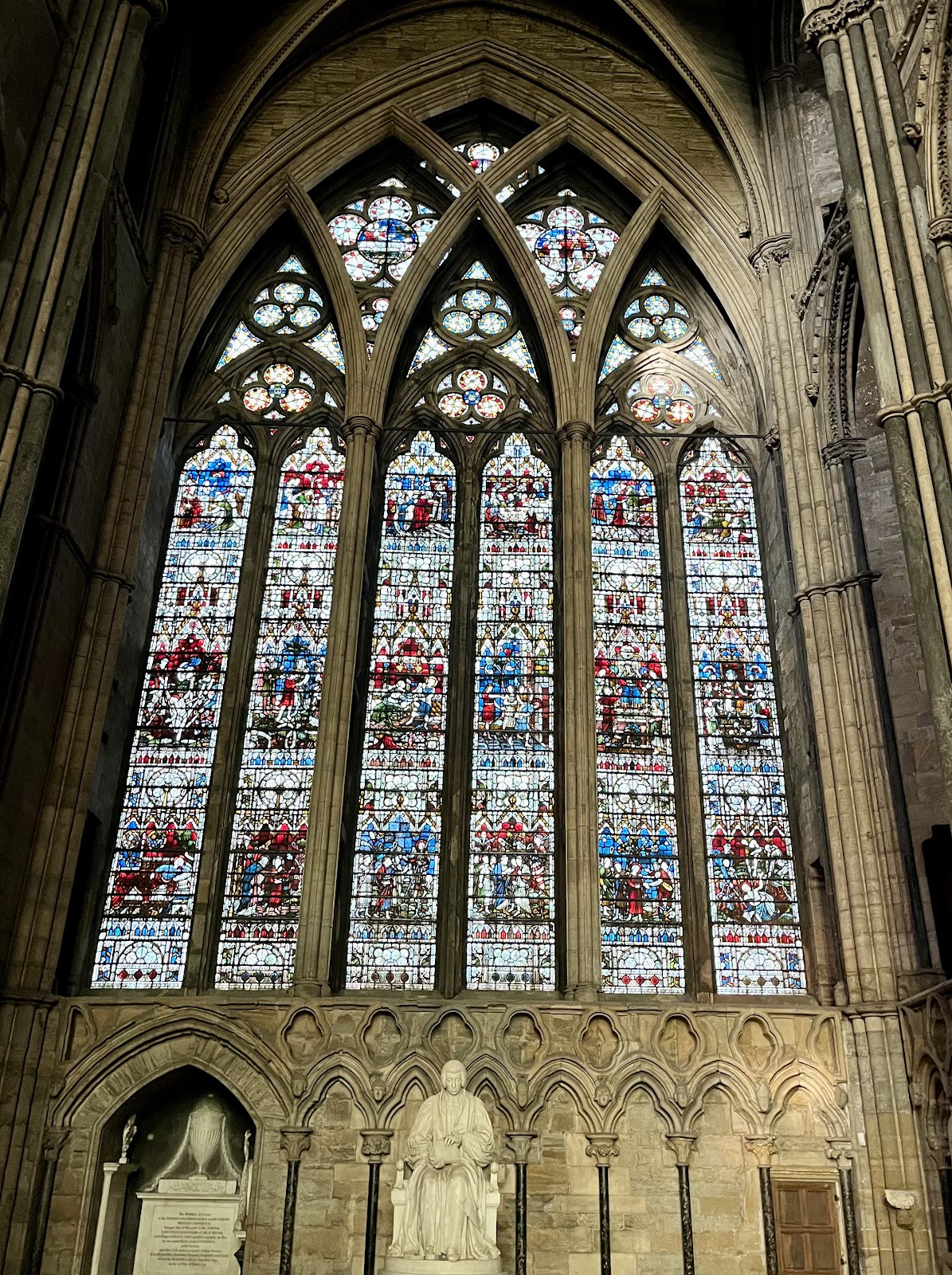
The cathedral is a magnificent example of a Norman church, particularly the ceiling and stained glass windows.


No one knew if Bek's tomb was in the cathedral, so I couldn't kick it! He is listed on the wall plaque.


The cathedral might be familiar to Harry Potter fans, as it was used in several films.


There is a fine chapel for the local regiment, the Durham Light Infantry, and a stone outside lists the VC winners.


The museum is also worth a visit. It houses a 17th-century edition of Bede's history, an important, if less-than-objective, primary source for early English history. They also have a rare falchion sword. No photos are allowed in that section, but you can read the story here.


The Norman castle has been built over, although you can see the outline. It is used by the university today and must be a great place to study history.


The market square has a giant statue of Charles William Vane, 3rd Marquess of Londonderry. As Charles William Stewart, he was a cavalry commander in the Peninsular War, both under Moore and Wellington. He didn't get on well with Wellington, which was hardly unusual. On his return, he had a diplomatic and political career. His statue is here because he later became Earl Vane and Viscount Seaham of Seaham in the County Palatine of Durham.


Durham is an attractive city to walk around, with several decent bookshops and tea rooms. I may have made a few purchases! A quick half with an old pal who now lives there and on my way. I am looking forward to Battleground tomorrow.