Welcome to my blog!

News from a wargamer with a special interest in the military history of the Balkans. It mainly covers my current reading and wargaming projects. For more detail you can visit the web sites I edit - Balkan Military History and Glasgow & District Wargaming Society. Or follow me on Twitter @Balkan_Dave
or on Mastodon @balkandave@mastodon.scot, or Threads @davewatson1683

Friday, 19 May 2023

Adriatic Naval War 1940-1945

 I picked up this book by Zvonimir Freivogel at the Croatian Maritime Museum in Split. He has written several books on Yugoslav and Austro-Hungarian naval history, some of which have been translated into English (not perfectly, but good enough). Unfortunately, however, they can be difficult to access in the UK.


There are books on specific aspects of the war in the Adriatic. There is Michael McConville's history of 43 Commando Royal Marines during WW2, Nothing Much to Lose, and more specifically, his excellent A Small War in the Balkans, along with other memoirs and war diaries of units that fought there. German and British naval actions are touched on in wider histories, and the Partisans have Sea of Blood - Partisan Movement in Yugoslavia 1941-45 by Gaj Trifkovic. However, nothing has the wealth of detail in this book.

He starts with the Italian and Yugoslav navies at the outbreak of war and the collapse of the divided Yugoslav navy. Then the introduction of Allied naval operations, initially from bases in the Mediterranean and then from Italy and Vis off the Dalmatian Coast. The Italian armistice brought German units to the Adriatic, along with the puppet Croatian state navy. The Germans had E-boats, captured Italian ships, and a motley collection of small boats and ferries.

The final half of the book covers the operations in 1944 against the islands and the coast, which includes the growing Partisan fleet, largely cobbled together from coastal shipping. 

Partisan boats like this one would have 2-pdr guns or Italian 20mm Bredas mounted.

So, you get a narrative history covering the many small-scale operations and the tactical and logistical challenges facing each navy. These are ideal for wargamers playing games like Cruel Seas. For example, the British had Vosper and Fairmile MTB/MGBs operating out of Vis. The research in this book is staggering, with just about every ship listed, along with an immense collection of wartime photos.

Finally, a valuable analysis of how each navy operated in this theatre. If you can get a copy, it isn't cheap, but at 550 pages, there is a lot of content. Highly recommended.

Two torpedos struck my transport ship in a game of Cruel Seas.

Monday, 15 May 2023

Bloody Orkney

 My holiday reading was Ken Lussey's WW2 crime thriller Bloody Orkney. Crime fiction is not my usual genre, but this is set in Orkney during WW2, probably my favourite Scottish island. It was part of my work patch for a few years, and I spent many a happy hour in-between meetings in the archivist's office looking at the naval records.


The story is based around an actual unit called Military Intelligence 11, whose task was safeguarding military security. Our hero, Group Captain Sutherland, heads up a multi-service team which looks at the security of the Orkney bases. There is some love interest in the form of an MI5 secondee.  Most people will be familiar with Scapa Flow, a base for the Home Fleet in both wars. But there were also several RAF, army and naval bases to defend the island. 

I won't spoil the story, which is a complex mix of plots, most of which come together at the end. They involve internal corruption rather than Axis intervention. There is also an interesting sub-plot related to Anthrax poisoning, which takes the team to Gruinard Bay on the west coast of Scotland. This was an actual site for testing chemical weapons, and I recall the island was still out-of-bounds when I first visited the area. It is a beautiful bay, although my Mum was less keen on a paddle when I explained the history! 

The story is well written and keeps the reader engaged throughout. I probably won't read the others in the series, but if you like crime fiction with a historical flavour, then you could do much worse than read this.

This is Scara Brae, one of many fine sites to visit on Orkney.


Sunday, 14 May 2023

Carronade 2023

 Yesterday was the annual Carronade show put on by the Falkirk Wargames Club. The show is held in a school which allows two large halls and three smaller halls with games and traders. It was certainly busy in the morning, tailing off around lunchtime. The Old Firm game starting at 12:30 didn't help, but this does seem to be a bit of a trend with shows.

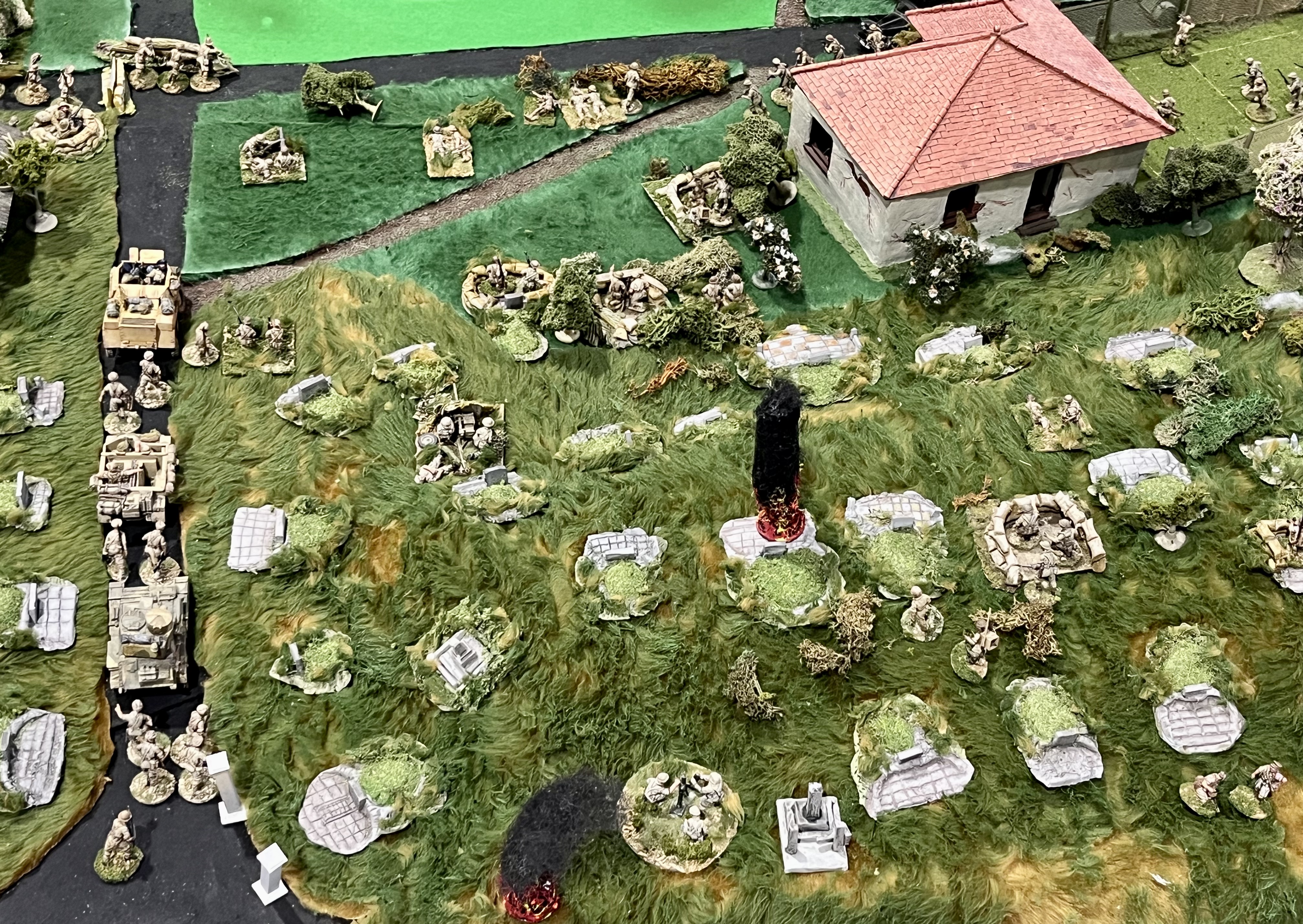
I took the latest GDWS participation game, Adriatic Bridgehead, to the show. We played it twice in the morning but only one taker in the afternoon. This was based on a British plan to capture the Albanian port of Durres as a bridgehead in the Balkans. When researching my Chasing the Soft Underbelly book, I found the plan in a War Office file. The Allies won all three games, so perhaps Churchill was right!


Running a participation game meant I had little time to look at the rest of the show and didn't buy a thing. There were some excellent games on show, many I hadn't seen before. Beach landings were a theme, as with the three games below.


This is Tarawa

This take on Pydna was visually compelling with lovely units, even if there is a limited amount of tactical interest. I visited this battlefield a few years ago, and sadly a modern road goes through it.


Another big 28mm ancients battle was Watling Street. British battering away at the Roman lines.

The Aberdeen club produced a nice terrain piece for their 16thC clan warfare game.


Another WW2 game.

I think these are Korean ships.

A clever participation game based on Singapore Golf Club with the Japanese attacking.

I need to remember what this is, but the ruined buildings are effective.

Another good show and the start of the Scottish show season. Many thanks, as usual, to Kenny and the Falkirk club for all their effort in putting the show on.

Friday, 12 May 2023

Knin Castle

 My last blog from my trip to Croatia covers the castle at Knin. This is a bit off the tourist route, situated inland near the Bosnian border. However, it's not far from the excellent Krka National Park with its stunning waterfalls, if you need to sell it to your partner!

It was started by the medieval Croatian state in the 9th century. Then extended by the Ottomans before reaching its final outline during the Venetian occupation from 1688-1797. Even then, internal buildings were added by the Austro-Hungarians. 

You can't miss the castle as you enter the town, as the hill dominates everything. The town is otherwise pretty forgettable, unless you are a railway buff, as it is an important junction with extensive sidings and a locomotive depot.


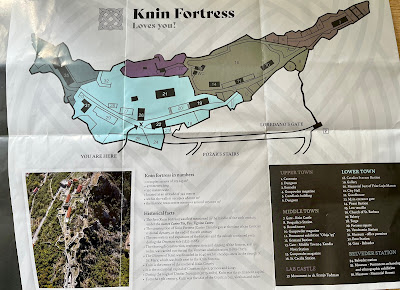
It is huge. They claim it is the second largest in Europe, covering 48,000 square metres within the walls. They are doing some restoration work to make it a little easier to walk about, but the entrance is accessible by car, although parking is limited. The map below gives an idea of the scale, and I spent an hour or so walking around. There is a restaurant at the end, which on a warm day was very welcome.


The views all around are spectacular, particular towards the mountains on the border.


Inside the castle is fairly well preserved and they have converted a number of the later barracks into display areas.


One of the barracks houses an exhibition on 'Operation Storm', the final Croatian offensive in what they call the Homeland War. This highlights a darker side to the town during the wars of 1991-95. This was the HQ of the so-called Republic of the Serbian Krajina. The military garrison commander was the convicted war criminal Ratko Mladic. He led the ethnic cleansing of Croats in the area, and when the Croats turfed him out, most of the Serbian population fled with him. The villages around the town are full of boarded-up houses, and some are ghost villages. 


The town has more Croatian flags than anywhere else I've been, including a massive one on the castle's high point, along with a statue of President Tudman, who visited the fortress the day after its capture.


Overall, this is one of the best castles in Croatia, and well worth a visit. Even if the recent past is tragic.


Tuesday, 9 May 2023

Croatian Maritime Museum

There are several historical sites in Split worth a visit. I started with the Archeological Museum. However, the upper floors were closed, and what was left wasn't worth the effort. Very poor doesn't begin to describe it. The crowds head for Diocletian's place, which is worth a look. 


The must-see museum is the Croatian Maritime Museum. Situated in a bastion of the old fortifications, which is worth a look on its own. You will need Mrs Google to find it, as it's a bit off the beaten track. If you are driving, there is a car park inside the bastion, so don't be put off by the narrow gate. Just be careful!


The inside exhibits are split into two sections. To the right, as you go in, is mainly civilian maritime history. Mostly Austro-Hungarian flags, maps, paintings and ship models.


Ragusan Sailing Ship


Austro-Hungarian Naval Flag

The other side of the museum is primarily military.


Austro-Hungarian battleship Viribus Unitis


A room is dedicated to Robert Whitehead, who developed the first effective torpedo up the coast in Rijeka. He partnered with a local engineer Giovanni Luppis, who had recently retired to Trieste from the Austrian Navy. Luppis had produced the first prototypes of a self-propelled torpedo. Whitehead's daughter married a certain Georg Von-Trapp, which may ring a Sound of Music bell!


Outside exhibits include PC22, a converted fishing boat used by the Partisan flotilla of the 3rd Maritime Coastal Sector in WW2. It was armed with two guns and two MGs. It fought in numerous engagements and was awarded the Order of Merit.


There is also a fine collection of primarily Italian naval guns.


They have a small shop with a collection of naval books in Croatian and English, some of which I hadn't seen before. I was particularly pleased to pick up a history of the Adriatic Naval War 1940-45 that covers all the combatants.

All in all, the best couple of hours I spent in Split.

Monday, 8 May 2023

Island raiding

 We took a ferry from Split to Hvar yesterday, which takes a route through the islands that have been a battleground for British forces in the Napoleonic Wars and WW2. I have written about the frigate actions in these waters in my forthcoming book, but my focus yesterday was on the raids undertaken by the British, Partisans and a small unit of US Rangers during WW2. I briefly cover these in my recently published Chasing the Soft Underbelly book.

The Allies were based on Vis, the furthest island from the coast. This was also a British base in the Napoleonic Wars when it was called Lissa. We stayed there in 2014, a holiday I highly recommend.

We left from Split, which was itself attacked in WW2. When the Italians surrendered, the Partisan 1st Division beat the Germans to the city. The SOE liaison officer Deakin describes how they were dive-bombed by Stukas in the suburb of Kastella. However, the Partisans stayed long enough to loot the Italian stores and retreated into the mountains. They returned with Allied help for raids after that.

Split's attractive waterfront where Deakin and the Partisan commanders addressed the populace.

The route to Hvar goes through a narrow channel between the islands of Solta and Brac. Both were garrisoned by some unenthusiastic German units, mostly made up of conscripts from occupied countries, including Poland and Czechoslovakia. You can see the remains of small fortifications that were watchtowers or gun positions on the Brac side.

The German garrison was ejected from Solta by a force led by Jack Churchill, including 2 Commando. 43 (RM) Commando and some US Rangers. Partisan guides were an essential resource on all the islands. They also had air support from Italy in the form of Kittyhawk fighter-bombers. However, the Germans returned with a much more professional unit, the 892 Grenadier Regiment, which was much harder to shift. Solta could also be supported by coastal batteries.

Solta from the western side

Similar attacks were on Brac, a larger island with pretty rugged terrain and a larger garrison.
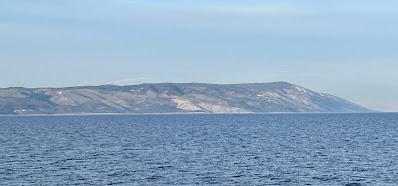
Brac from the western side.

The next stop for us was Hvar. This is a stunning Venetian-built town, understandably popular with tourists. I had been before in 2000, and it has been tastefully improved. 

Hvar town with the Spanish fortress on the left and Fort Napoleon on the the right.

Predictably I headed for the Spanish Fortress that dominates the town and the harbour. It was started in the 14thC but took its distinctive shape as a defence against the Ottomans in the 16thC. It's a bit of a climb but well worth it for the views alone.


You also get a decent view of Fort Napoleon, built during the French occupation. You can climb up there, but I passed that joy in the weather. I think I went up in 2000, but there wasn't much to see.


This is a view over the small islands that shelter the port. You can see the mountains of Vis in the distance.


The town is a typical Venetian port of the period, and the Arsenale can be seen on the harbour.


Hvar was also garrisoned by the Germans after the Italian surrender. The main garrison was at Jelsa and was attacked by 43 (RM) Commando with two Partisan 1st Dalmatia Brigade battalions. The troops on these raids were transported on landing craft escorted by MTBs. Heavy weapons also went on specially prepared landing craft. Air support was again available from Italy and sometimes from the airstrip on Vis. The attack was successful, with 50 of the garrison killed and 80 taken prisoner.

For us, it was dinner in the town square and one last look at the town and fortress on the ferry back to Split.