Welcome to my blog!
or on Mastodon @balkandave@mastodon.scot, or Threads @davewatson1683
Monday, 11 June 2018
This Untoward Event
Published in 1965, it provides a comprehensive account of the naval action that largely secured the independence of Greece from the Ottoman Empire. It was fought on 20 October 1827 between the combined Egyptian and Ottoman fleets, and the allied British, French and Russian fleets commanded by Admiral Codrington. Navarino is a bay and port on the south-west coast of the Peloponnese.
The battle was described in the King's speech to parliament on 29 January 1828 as 'this untoward event', which Prime Minister Wellington explained as meaning 'unexpected or unfortunate', to considerable criticism at the time. This is because Britain was traditionally an ally of the Ottoman Empire as a bulwark against Russian expansion. However, the cause of Greek Independence was popular in Britain and many of the Greek commanders were British, as well as significant numbers of volunteers, known as Philhellenes. The King was reported to have 'winked' as he read out the speech.
The combined fleets had instructions to enforce an armistice, at sea at least, which would force the Sultan into peace talks. They had effectively blockaded the Ottoman fleet until it broke out in an attempt to reinforce Patras. After being intercepted by the British fleet, they withdrew again to Navarino.
After this the allies decided that the only way to enforce the armistice was by a show of force. This involved sailing into the bay and anchoring within range of the Ottoman fleet. There is some dispute as to who initiated the fighting, but it is agreed that a Turkish ship fired first. This led to a full engagement in which the Ottoman fleet had a numerical advantage, but their ships were not as experienced or as competently handled as the allies. Their fleet was destroyed as a fighting force.
Turkish and Egyptian losses included three ships of the line, 17 frigates, some 40 other ships and around 4,000 dead. Allied fleets lost 182 dead. As no state of war existed, no prizes were taken.
The book is well illustrated, mostly with the many oil paintings commissioned after the battle. The book is largely based on the Codrington papers in the National Maritime Museum, supplemented by French and Russian secondary sources and Egyptian records. As is often the case, the Ottoman sources are scant. There are few copies still around on the second hand book market.
I have been clearing out some old wargame magazines in an effort to create some space on my shelves. Coincidentally, I came across a very good article on the battle by Jonathan Carruthers, for Wargames Illustrated, I think back in 1988. He suggests a more balanced game by allowing the Ottomans to contest the allied fleet at the entrance to the bay. I suspect the outcome would have been the same, but casualties would have been higher, given the shore batteries and the narrow entrance.
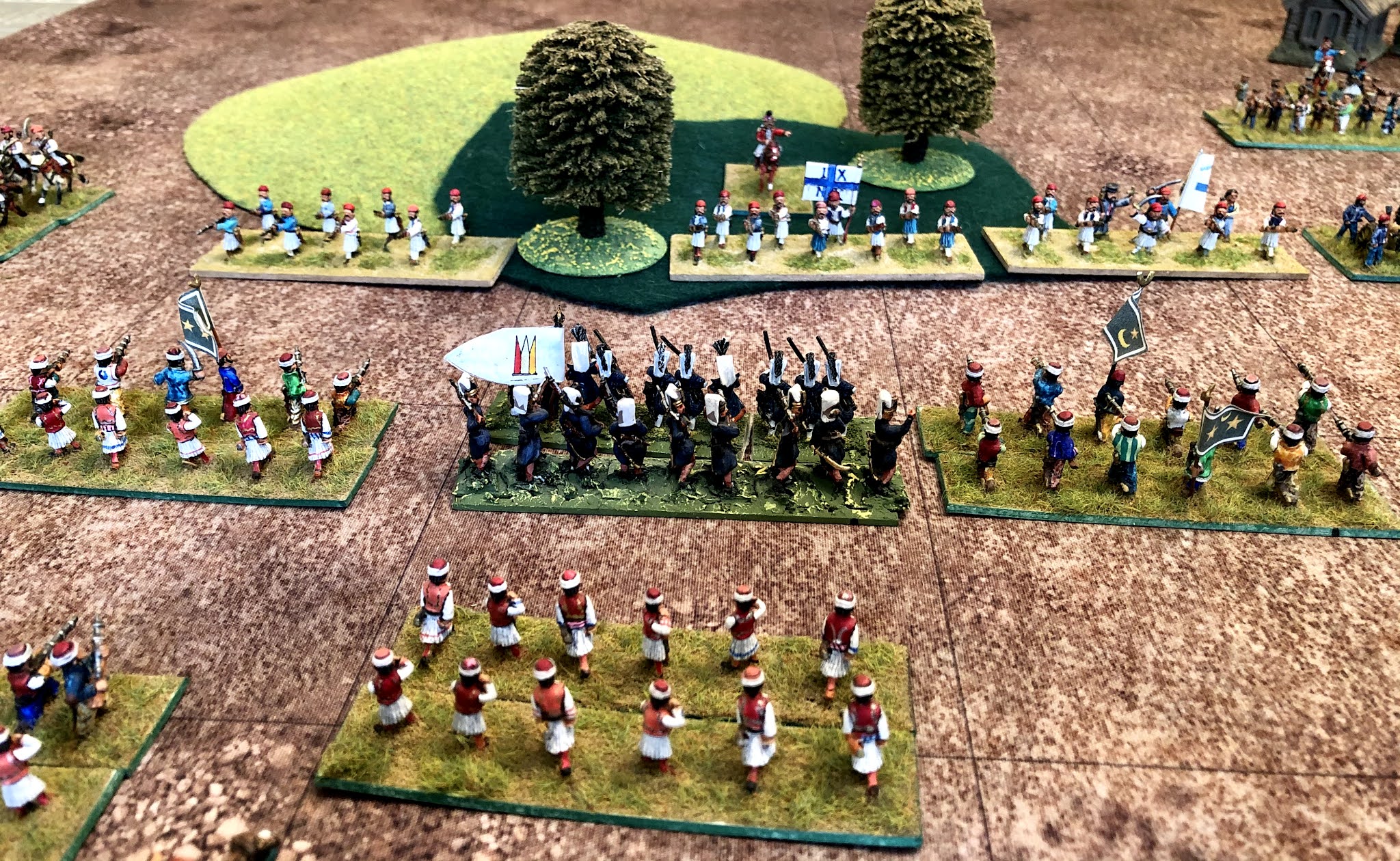
No ships, but here are a few of my 15mm Greek War of Independence figures in 15mm.
Saturday, 1 December 2018
A World on Fire
The author lives part of the year in the Peloponnese, where I spent a very pleasant holiday this year - including Napflio, the first capital of the newly independent Greece.
His take on the revolution starts in the Mani, which is the barren tip of the Peloponnese, protected to a degree by mountains. His heroine is Hara, the daughter of a Maniot chieftain, who becomes embroiled in the revolution and the Ottoman counter-attack. This was led by Ibrahim Pasha of Egypt, who had a modern army trained by French mercenaries. He burned and butchered his way through the Peloponnese with the aim of resettling the land with Egyptians.
His savagery helped the Greeks to build western sympathy for the Greek cause that eventually led to a joint British/French/Russian fleet entering the Bay of Navarino and sinking the Egyptian and Ottoman fleets.
The author stretches the historical facts a little, but the broad canvas of 1824-26 is all there. He tells a good story around the international events that led to the liberation of at least part of Greece from Ottoman rule.
Some figures of the period from my collection in 15mm.
Friday, 10 December 2021
Scotland and the Greek Revolution
The 200th anniversary of the start of the Greek Revolution hasn't been marked by many events in the UK. This is perhaps surprising given the role played by the Philhellenes, substantial loans and the decisive intervention at Navarino.
One exception is the University of Edinburgh's Leventis Exhibition, which covers the links between Scotland and the revolution. Scots played a significant role in the Philhellene movement, and Edinburgh, in particular, had strong ties to classical Greece. It was known as 'The Athens of the North', not least because of the architecture.
The exhibition comprises historic books, drawings and photographs from the University's Centre for Research Collections, complemented by loans from institutions in Greece, Scotland and England. It's only a small gallery, but it is worth a look if you are in Edinburgh.
Of course, the interest in classical Greece had its downsides, such as removing the Elgin Marbles to the British Museum. In my view, it is long past the time when these should be returned, particularly given the fine museum on the site in Athens today.
Books at the exhibition reflect the 19th century and earlier links.
19th-century passports looked very different from their modern counterparts!
I have Greek and Ottoman armies in 15mm. I struggle to resist starting in 28mm, although I have dabbled with the Steve Barber and Old Mans Creations ranges. The revolution went on for many years, so there is still time!
Saturday, 20 March 2021
Greek War of Independence
This coming week is the 200th anniversary of the start of the Greek War of Independence. The revolution was declared on 25 March 1821 by Metropolitan Germanos of Patras in the Peloponnese. While this date is questioned by some, it is clear that the revolution broke out in various places during the latter end of March 1821, and the 25th is celebrated today as a national holiday in Greece.
There are lots of books on the revolution, and there are bound to be more this year. I have several older studies, but my favourite one in print is David Brewer's 'The Flame of Freedom', although I see he has written another book on the subject since. He covers the background to the conflict and the war itself, which lasted until 1833 when French troops finally left.
I have enjoyed the Hellenic Heritage Foundation's The Idea of Greece series of podcasts, which are a really good introduction to the subject. They are pleasantly balanced, which is not always the case on a subject prone to nationalist rhetoric. I would also recommend the Facebook group, Wargaming the Greek War of Independence.
For the wargamer, Miniature Wargames did a two-part series in 1999, written by Spiros Koumoussis. It included some nice colour plates as well as a short history. Sadly, Spiros passed away at an early age. He also produced a range of figures for the war and a simple set of rules based on DBA.
My collection in 15mm largely comes from his range. They were based for the Principles of War rules. I have some of the excellent Steve Barber range in 28mm, although painted for the slightly earlier Serbian uprising. I would use Dan Mersey's Rebels and Patriots for the skirmish level actions, which were a feature of this conflict. There is a new range of 28mm figures from Old Man’s Creations, which look very nice.
Ottomans and Egyptians are readily available from several ranges, and the irregulars can often be used for either side. Ottoman forces were busy putting down other revolts and facing up to the Russians during this period. Initially, they relied heavily on Albanian troops and later the Egyptians, who had a modern army. It is worth remembering that the Auspicious Incident happened in June 1826, which resulted in the death and disbanding of the Janissary corps. So no Jannisaries after that date, and not many beforehand.
The Greeks had a history of seafaring in the Ottoman Empire, and the war at sea was an important feature of the war on the islands. It was the Great Power naval intervention at the Battle of Navarino that effectively secured the revolution for the Greeks. Black Seas works fine for these battles, and you can use your Napoleonic fleets. I have made a start on an Ottoman fleet.
![]() |
| Ground level view from the Ottoman side |
![]() |
| The Greeks got marginally the better of the firefight because of the cover, but the weak fire trait limited the fire effect |
![]() |
| Lasalle combat rules can be brutal with the Greek cavalry on both wings destroying their opponents. |
![]() |
| However, it works both ways. The Greek regulars are destroyed attacking the Egyptians on the hill. The Greek attack falters and another firefight ensues. |