Welcome to my blog!

News from a wargamer with a special interest in the military history of the Balkans. It mainly covers my current reading and wargaming projects. For more detail you can visit the web sites I edit - Balkan Military History and Glasgow & District Wargaming Society. Or follow me on Twitter @Balkan_Dave
or on Mastodon @balkandave@mastodon.scot, or Threads @davewatson1683

Friday, 30 December 2011

Dark Age skirmish

My post Christmas gaming, other than a multi-player Napoleonic Principles of War game, has  focused on Dark Age skirmishing.

Firstly, with 700pt WAB games to try out our 2011 WAB tournament rules. These appear to play well and I have selected three scenarios for the year with two games a session. My test games involved Bulgars v Vikings and provided several interesting encounters. Despite the production problems, WAB 2 plays well and the small point options give a quick and enjoyable game.

Secondly, I have been trying SAGA. For those not familiar with this new set of rules from Gripping Beast it covers the Viking Age and at present there are battle boards for Vikings, Anglo Danish, Normans and Welsh. A force can include Hearthguard or retainers, Warriors, Levies and the Warlord. You make up small 'armies' using a simple points system. No complicated army lists here.

The game mechanics are simple with just four measurements and straightforward combat and shooting mechanisms. The more skilled the troop type, the more attack dice you get and the better the armour the more difficult to kill. The subtlety comes with the battle boards that control orders and special abilities. You roll special dice and allocate them to actions (rest, move, shoot) or abilities that strengthen your attacks or defence. It requires some planning to work out what you want to do and how your opponent is likely to respond. 

Everything is clearly laid out in full colour with plenty of eye candy. Helpful summaries at the end of each section and plenty of worked examples. After just one game we were working off the quick reference sheet. But be warned, while the game mechanisms are simple, this is a lot more subtle than it at first appears and you really need to focus on the orders stage and make best use of the actions and abilities on your battleboard.

Overall I enjoyed these rules that allow a quick and fun evening game.


Normans catch a Viking raiding force!

Monday, 26 December 2011

Englishman in the Russian Ranks

This the remarkable story of John Morse, told in his own words, an Englishman caught in Germany at the outset of WW1.
An Englishman in the Russian Ranks, Ten Months' Fighting in Poland
He was on business in what was then the Eastern border of Germany (modern day Poland) when Germany was about to declare war on the Entente Powers. His story starts with him slipping through German lines during their initial crossing of the Russian border. He eventually finds the Russian army and stays on to fight the Germans. In the 19th Century he would have been described as a gentleman volunteer, although I doubt the Russian army would recognise the concept. He fought with a Cossack unit, an artillery battery and several infantry units for almost a year before being captured, then escaping, before making his way back to England.

His observations of the war in the East, while very English of the period, are fascinating. He gives great descriptions of small and large scale actions, the impact of fortifications and artillery as well as the much more fluid nature of the war in this sector. While not a professional writer, the book is still a good read and an essential source for anyone interested in the period.

Monday, 12 December 2011

Bellini Card

The Bellini Card

Crime fiction is not my usual genre, but when the setting is 19th Century Istanbul and the author is a historian of the period, I am interested. The Bellini Card is the third in Jason Goodwin's series about the Ottoman detective Yashim.

Most of this book is set in Venice 1840. Yashim and his friend the Polish Ambassador set about recovering the missing portrait of Sultan Mehmet. Venice in 1840 is no longer the great city of the Renaissance. After Napoleon captured the city, followed by Austrian occupation, trade and wealth by pass the city. But there is plenty of intrigue and local politics as they pursue the painting.

I won't spoil the story, but as you would expect from this author the tale has some basis in fact. The former British Ambassador to the Porte, who retired to Venice, acquired the painting of Mehmet II by Bellini in 1865 when it was left on his doorstep! His widow donated the painting to the National Gallery in London.

I have enjoyed this series and if you like crime fiction you won't be disappointed.

More Black Powder

We had an opportunity at the club last week to expand our understanding of the Black Powder rules using the Last Argument of Kings supplement.

This time a match up between Russians and Austrians circa 1710. Four brigades a side. On the Austrian right a cavalry brigade with a unit of cuirassiers and two units of dragoons, facing a Russian brigade with horse grenadiers and dragoons. In the centre (see picture below) two brigades of line infantry and grenadiers faced off. On the far left a brigade of Croats (foot and horse) faced a similar brigade of Cossacks.  

The battle started with the Austrian cavalry charging right across the table while the infantry, somewhat more reluctantly, plodded towards the Russian line. The Croats didn't budge an inch. The cuirassiers made short work of the horse grenadiers although the dragoon battle was more even. By the time the Austrian infantry got to effective range the cuirassiers were threatening the Russian infantry flank and started to roll up the Russian line. The Croats eventually got moving, but the Cossacks hardly moved the whole battle and some desultory skirmishing was all that happened on the left. 

I thought the rules played well. The 'first fire' special rule for foot worked well for this period and the firefight was a decent battle of attrition. The cavalry contest could have gone either way. The Croat v Cossack skirmish was just what you might of expected and the Black Powder command rules come into there own here. Overall, enjoyable and pretty good simulation of warfare in the period. More plus marks for Black Powder.


The figures above are mostly Front Rank for the Austrians and Reiver Miniatures for the Russians.


Saturday, 26 November 2011

Burning Empires

My somewhat belated copy of Burning Empires turned up this week. This is the latest Flames of War supplement covering the early war in the Med.
Burning Empires: Battle for the Mediterranean
My primary interest is that it covers the Italian invasion of Greece and the German Balkan Blitzkrieg. Nice to have some official army lists for the period. The supplement also covers the Allied invasion of the French Levant and raiding actions across the desert war area.

The format is the usual FoW style. Well laid out army lists, short history, special rules and a useful painting guide. In essence everything you need to get your army on the tabletop. And I will - sometime!


Tuesday, 22 November 2011

The Black Hole

Busy, busy at present at work so my reading and gaming schedule is slipping somewhat. However, I have just finished The Black Hole by Jan Dalley.

The Black Hole: Money, Myth and EmpireIn 1756 the Nawab of Bengal captured the East India Company's base at Calcutta. Generations of British schoolchildren have been taught that 143 people were then looked in a cell 18ft by 14ft and by the following morning only 23 survived. So the legend of the Black Hole of Calcutta was born and served as the bedrock story of British rule in India.

Thankfully it is almost certainly largely a myth. There is little doubt that some prisoners died, but no where near the numbers quoted in the unreliable and contradictory eye witness accounts. Not least because the room simply could not have held the numbers claimed.

The author does not simply debunk the myth. He explains the basis of the hugely profitable trade between Britain and India that was controlled by the East India Company. The events leading up to the siege and the battle itself. Calcutta was quickly recaptured by Clive who went on to win the Battle of Plassey. It was at this time that the British changed from an aggressive trading partner in India to a colonial master.

This is a well written tale of commercial exploitation and incompetence that none the less led to the creation of a key part of the British Empire. Another excuse to get the sepoys and Mughals on the tabletop.

Monday, 31 October 2011

The Pillars of Rome

Having really enjoyed Jack Ludlow's Conquest trilogy I decided to try his Republic trilogy, starting with The Pillars of Rome.
The Pillars of Rome
This is set in the post Punic Wars Roman Republic. Two young boys of noble birth get a glimpse into the future when they visit an oracle. Then we fast forward 30 years and the same boys are now senators. One made his name as a soldier in the Macedonian wars and the other as a wily politician. The scene moves from Rome to Spain and Illyria engaging families and their allies in the events and plots of the period.

The strength of the tale is the understanding of the power structures of Republican Rome. The factions and role of senators being different to the more familiar Imperial Rome.  This does slow the pace of the story somewhat and involves a number of sub-plots that requires some skill in knitting them together.

I didn't enjoy this as much as the Conquest trilogy, but it is still a good read and I will probably persevere with the trilogy.

Sunday, 30 October 2011

Over the Top

Just scanned the arrival of the Great War supplement 'Over the Top'. Half price at present from Warhammer Historical.
The Great War - Over The Top
This supplement primarily covers trench warfare in WW1. Not the most attractive gaming option but Alex Buchel has developed a very playable game using the excellent GW rules. He starts with an historical overview before setting out a whole batch of new rules and what he calls 'grand manoevres'. These add in heavy artillery barrages and some special troop types together with fortifications for defenders and stratagems for attackers. These are built into the points options so you can opt for bigger fortifications at the cost of troops.

There are new missions that are set in the context of actual battleground operations throughout the war. Followed by new army lists for the major combatants. All of this is generously illustrated with good figures and great scenery.

The supplement only covers the Western Front. So I will have to give some thought to how this could be applied to the Salonika campaign. Doiran is an obvious scenario choice. I also use these rules for A Very British Civil War and parts of the supplement will be useful for that.

Sunday, 23 October 2011

Polish Renaissance

First time out for my FoGR Polish army today in the GDWS competition. And very well they did too with a 25-0 win. Aided it has to be said with some early devastating artillery fire and very poor dice work from my opponent.

This was one of my favourite DBR armies utilising the war wagons and firepower infantry on one side and charging Winged Hussars on the other. FoGR puts an end to that tactic as the battle wagons (as they are now classified) are far less manoeuvrable. But they can still help block off a flank, allowing a concentration of cavalry elsewhere on the table. Winning the initiative and getting a nice empty steppe helps.

It was also a sad day for all the members of GDWS. One of our longest serving members Iain Forrest passed away suddenly yesterday. Iain was a great guy to play with and will be missed by everyone. Our thoughts are with his family at this time.

Saturday, 8 October 2011

Wars against Napoleon

The Wars Against Napoleon: Debunking the Myth of the Napoleonic Wars

This is a book for the Napoleon buff. If you think Napoleon has been harshly treated by history you will love this book. The sub title is "Debunking the Myth of the Napoleonic Wars". The authors, Michel Franceschi and Ben Weider take on the role of historical spin doctors for the great man.

They take the reader through each stage of the Napoleonic wars to show that Napoleon was a builder in love with peace and an enemy of war. His strategy was to build defensive alliances to protect France and each conflict was forced upon him. The usual culprit was Perfidious Albion.

There is no doubt that, in English speaking history at least, insufficient credit is given to the positive aspects of Napoleon's rule. The laws, infrastructure, education and economy of France were revolutionised by Napoleon and his legacy can still be seen in France today. The case for Napoleon the peacemaker is less convincing. However, he certainly wasn't the only villain in Europe and the reactionary regimes certainly conspired in most conflicts.

So on balance the authors make a good case for Napoleon, even if they stretch their case on a few occasions. A good balancing work.

Sunday, 2 October 2011

The Ismaili Assassins

Just finished James Waterson's The Ismaili Assassins. This is the story of a religious sect based in the Middle East that waged war primarily through assassination.
The Ismail: Assassins: A History of Medieval Murder
I picked the book up some months ago having heard of them, but without any real understanding of their role during the medieval era. The author explains the religious and social context before setting out their impact on the empires of the period. They were largely successful in the early period and in their conflict with the disunited Seljuk's. However, as the initial fervour declined they became less effective before finally picking an unwinnable fight with the Mongols. Interestingly, I didn't know that the sect's modern day successors include the Aga Khan.

This is not a light read by any means, but worth the effort to dispel some myths and learn more about them.

Monday, 26 September 2011

Hellfire & Back

This is the latest Flames of War supplement covering the early war battles in North Africa. Usual FoW format with high quality production values, well laid out organisational charts and some fine eye candy.

Hellfire and Back!: Early War Battles in North Africa, 1940-1941I largely bought it for the stats for my Greek campaign, only to learn that a further supplement is due out next month that will specifically cover this and other 'fringe' campaigns around the Med. Look forward to that.

Then it occurred to me that while I don't have 15mm figures for the desert, I do have lots of 1/200 figures based for Spearhead. So Italian and British tank companies duly assembled and onto the table. It made a short and sharp battle with the Italians coming out on top. I will try some Afrika Corps next. Using 1/200 opens up some other campaigns as well.

FoW has somewhat rebuilt the reputation of Italian troops in WW2, at least from a British perspective. My recent reading has been on this subject including Iron Arm, the story of the mechanisation of Mussolini's army 1920 to 1940.  Creating a mechanised army in a non mechanised society was beyond the capability of Italian industry and the army. Non the less an armoured force was developed and at one stage arguably led the world. This book takes the reader through all the stages.

Iron Arm: The Mechanization of Mussolini's Army, 1920-1940

Wellesley in India

The Black Powder supplement Last Argument of Kings got its first run out on Sunday. We did a Wellesley in India scenario using the colonial India data from the supplement.

The opposing forces:
British
Unit Size Type Weapon H to Hand Shoot Morale Stamina Special
Wellesley (9)
Dragoons Small  Reg. Cav Sword 4 1 3+ 3 Ferocious Charge, Valiant, Marauders
Sepoy Btn Small  Infantry Smoothbore Musket 6 3 4+ 3 First Fire 
1st Foot Brigade (8)
Line Regt Standard 18 Infantry Smoothbore Musket 6 3 3+ 3 First Fire, Reliable, Steady
Sepoy Regt  Standard 18 Infantry Smoothbore Musket 6 3 4+ 3 First Fire 
Artillery Smoothbore 1 3-2-1 4+ 2
2nd Foot Brigade (8)
Line Regt Standard 18 Infantry Smoothbore Musket 6 3 3+ 3 First Fire, Reliable, Steady
Sepoy Regt  Standard 18 Infantry Smoothbore Musket 6 3 4+ 3 First Fire 
Artillery Smoothbore 1 3-2-1 4+ 2
Native Prince
Unit Size Type Weapon H to Hand Shoot Morale Stamina Special
Nawab (7)
Bodyguard Small Reg. Cavalry Sword 6 3 5+ 3 Lancers
Artillery Smoothbore 1 3-2-1 4+ 2
Rockets 1 2 4+ 2
Ist Brigade (7)
French' Battalion Standard 18 Infantry Smoothbore Musket 6 3 4+ 3 Reliable
Native Infantry Standard Irr. Infantry Smoothbore Musket 6 3 5+ ? Untested, warband
Native Infantry Standard Irr. Infantry Smoothbore Musket 6 3 5+ 3 Unreliable, warband
Native skirmishers Small Irr. Infantry Smoothbore Musket 6 2 5+ 2 Skirmish
2nd Brigade (7)
Sepoy Battalion Standard 18 Infantry Smoothbore Musket 6 3 4+ 3 Reliable
Native Infantry Standard Irr. Infantry Smoothbore Musket 6 3 5+ 3 Bloodthirsty, warband
Native skirmishers Small Irr. Infantry Smoothbore Musket 6 2 5+ 2 Skirmish
Right Wing Cavalry (6)
Native Horse Standard Cavalry Sword 6 1 5+ 3 Warband, 
Native Horse Standard Cavalry Sword 6 1 5+ 3 Warband, Wavering
Right Wing Cavalry (6)
Native Horse Standard Cavalry Sword 6 1 5+ 3 Warband, 
Native Horse Standard Cavalry Sword 6 1 5+ 3 Warband, Wavering

The native cavalry started the battle with a bold sweep on the left that was eventually fought off by the dragoons. The British infantry advanced and engaged the native infantry. Superior fire power won through but it took some time. The right flank cavalry battle was less decisive.

The rules played well and gave a pretty accurate feel for the period. Artillery isn't very effective at long range, and don't bother with rockets - they killed more friendly troops than the enemy! By beefing up the dragoons with special rules they were able to disperse the native cavalry, but it wasn't a foregone conclusion. The infantry battles were more closely fought affairs.


Sunday, 18 September 2011

VBCW - The People's Armies

Picked up a nice booklet on the Very British Civil War theme called The People's Armies. This is available from Solway Miniatures.

This booklet describes the various Worker's Defence Corps, largely based on trade unions, that sprung up around the country to resist Moseley's Blackshirts.  My own Clydeside Brigade fits in with this idea very well. Plus Anarchists and the Communist People's Assault Columns.

The text covers the type of unit together with their weapons and uniforms. Poorly equipped compared with government forces some French and Russian equipment started to arrive together with some foreign volunteers. Similar to the Spanish Civil War.

The booklet has some nice photies of available models and excellent 'Osprey' style colour plates by Peter Barfield. The naval figure is particularly good and an order has been dispatched to 1st Corps who do a suitable figure. These will make a new platoon to add to the Clydeside Brigade. All very Battleship Potemkin!

Tuesday, 13 September 2011

The Last Argument of Kings

Just finished working my way through the first Black Powder supplement The Last Argument of Kings.

Pete Brown has done a lovely job with this supplement covering the main conflicts of the 18th Century, in Europe and the colonies. After a general introduction each section gives an overview of the conflict, some detail on the armies together with army lists and special rules. Finally a battle scenario together with an ORBAT.

And of course no rule set would be complete today without eye candy. This supplement has it in buckets. I know some gamers criticise this trend, but I simply don't agree. Well painted and displayed wargame figures should inspire the reader. Several members at my club are looking to try new periods based on this.

I am planning to use two sections as soon as possible.  Storm on the Danube covers the Ottoman conflicts with the Austrians. I also plan to dust down my Mughals for Plassey and other battles in India.

Sunday, 11 September 2011

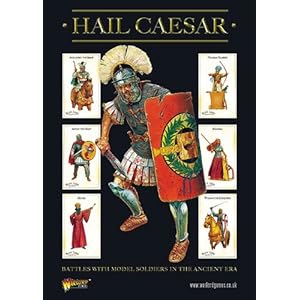
Hail Caesar

Played my first game of the new ancient rules, Hail Caesar today. We have been playing Black Powder for some time and the mechanisms are similar. So the learning curve was not too steep.

Hail Caesar (Wargaming)
I brought an Ottoman army with a foot division based on Janissaries and two flank divisions of cavalry. My opponent brought a Wallachian army. Although the rules don't have a cut off date, there aren't many troop types for the medieval period, so you need to improvise.

The game was very enjoyable and like Black Powder full of uncertainty in the movement phase. My left flank stubbornly refused to move for the whole game. Other divisions charged across the table and got into contact quickly. What we really like is the simple mechanisms and the absence of  micro measurement and other complexities that complicate other systems.

We really do have a glut of good rule systems at present. All have their strong features and I expect we will play most of them for now. 

Sunday, 4 September 2011

Sworn Sword

New historical fiction authors appear to be pouring off the shelves recently. As regular readers of this bog will know I am fascinated by the Normans, so spotting a novel based on the period is a guaranteed buy for me.
Sworn Sword
Sworn Sword is the first novel by James Aitcheson. Based on the period after 1066, it covers the northern rebellion against Norman rule. Durham is captured and York besieged, before William comes north with an army to relieve the siege.

In that historical context our hero, Tancred, not only gets involved in every battle, but also a sub plot involving the hidden body of King Harold. The battle scenes are excellent, covering the typical clash of mounted Norman knights against spear armed foot in shieldwall formation well. I enjoyed this and I hope to read more by this author.


Tuesday, 30 August 2011

Very British Civil War starts

Got the new units onto the tabletop for the first time today.

The scenario involved a Clydeside Brigade attack on a Scottish Government outpost garrisoned by a Territorial Company. The workers militia were tasked with this assault while the Communist Company advanced on the right flank to protect the attack from the expected relieving force of regulars.

The militia attack soon ground to a halt. Insufficient troops and firepower to get through the sandbag defences. The Territorial's rifle fire was pretty impressive, just wished I could roll as many 5 and 6's in competition games!  The regular company then arrived very quickly and dispatched a platoon of the Communists. However, the second platoon fought them off and the action ended in a stalemate.

I used Warhammer Great War rules and they worked very well. Once I remembered the key elements the game moved quickly. The one irritating aspect of these rules is that they are badly presented. Key rules are hidden away and the reference sheet is possibly the worst I have ever seen. Whole sections are simply missing. Must see if someone has done a decent one, if not, add to the must do list.


I don't think I have mentioned the trucks before. They come from Simon at Solway Miniatures. He does a great range of conversions.

Sunday, 28 August 2011

Rif Raf: 28mm Greeks

I have been working my way through some review packs of David Burns new range of figures for the Greek army of WW2 in 28mm. And very nice they are too. In fact too nice as the last thing I want is another scale for this conflict!

These are well proportioned figures, perhaps slightly smaller than some ranges, but will fit in. There were two types of helmet in general use, the British Mk1 pattern that was gradually being replaced by a model similar to the Italian helmet. This range has gone for the latter. The right decision in my view because the Greek army uniform was similar to the British, so other types can be represented by British ranges, at least in the smaller scales. 

Some examples from the range below. Painted examples are on the Rif Raf site done by David himself. They really do look the part. Highly recommended.

Clydeside Battalion

The next unit for my Very British Civil War project is the Clydeside Battalion.

These are better trained troops financed and organised by the Communist Party to stiffen the ranks of the workers militias. Not quite regulars, but very committed to the cause and more likely to stand up to any fascist or regular army units they may come up against. Red Clydeside rises again!