Welcome to my blog!

News from a wargamer with a special interest in the military history of the Balkans. It mainly covers my current reading and wargaming projects. For more detail you can visit the web sites I edit - Balkan Military History and Glasgow & District Wargaming Society. Or follow me on Twitter @Balkan_Dave
or on Mastodon @balkandave@mastodon.scot, or Threads @davewatson1683

Tuesday, 15 November 2022

Blue Water War

This is Brian Walter's study of the maritime war in the Mediterranean 1940-45. While the land campaigns and the broader naval struggle are there for context, the focus is a detailed look at all the naval actions in the Mediterranean during WW2.

The early naval battles, such as Cape Matapan and Taranto, are well-known and extensively written about. However, what attracted me to this book was the coverage of the more minor actions, particularly those in the eastern Mediterranean and the Adriatic and the end of WW2.

We should not forget that the Italians seriously outnumbered the Royal Navy after France surrendered. Italian warships were at least equivalent to their British counterparts in terms of basic design and construction. However, the British had the technological edge with radar, Asdic (sonar) and range-finding. They also suffered fuel shortages and a weak industrial base throughout the war. I am not entirely convinced about the author's argument over the lack of a seafaring tradition. States like Genoa and Venice dominated the Mediterranean long before the Royal Navy existed. The Royal Navy has much to be proud of in WW2, but this author does, on occasion, rather overdo it. O'Hara is more balanced.

The sizeable Italian submarine fleet certainly underperformed during the war. Some were diverted to the Atlantic War, and others had to be adapted as cargo vessels due to the shortage of merchant ships and Allied interdiction. 

The Mediterranean is not well suited for submarine warfare, and even the U-Boats performed less well. It was the Luftwaffe, particularly dive-bombers, that most threatened Allied navies. 80 Allied and neutral merchant ships worth 397,710 tons were sunk in the last seven months of 1943. Of these, aircraft accounted for the majority, with 41 ships worth 225,448 tons sunk by this means.

A running theme throughout the book was the Allied dispute over the Mediterranean strategy. This has been well-covered by Howard and others, but the Mediterranean remained a vital route to the Middle east and the far east for naval planners. The British estimated this route would free up some 2,000,000 tons of cargo space or the equivalent of about 225 merchant ships. 

Allied navies didn't just escort convoys and sink their Axis counterparts. They also provided fire support to landings, expending 23,000 shells of 4" or greater. This was particularly important in the later campaigns after the collapse of Italy. The Germans used many smaller ships but were rarely able to challenge landings from the sea. Instead, the book details many small-scale actions in which the Allies interdicted german convoys supplying bases in the Aegean and Adriatic. Plenty here for wargames playing Warlord's Cruel Seas

The final campaigns, including Operation Outing, gradually encouraged the Germans to abandon Greece, allowing the British to land quickly and install their own choice of government. The author omits that this was aided by the percentages agreement with Stalin. Of the 52 German merchant ships assembled to conduct evacuation operations in the Aegean, 29 were sunk outright (worth 19,434 tons). The Germans also lost seven torpedo boats, three U-boats, three minelayers, a large hospital ship and scores of auxiliaries and minor vessels. The Germans also abandoned 22,400 army and 4,095 naval personnel on Crete, Rhodes and some other Aegean islands, and 12,000 Fascist Italians were also left behind.

The author has four conclusions. 'First, the Allies were victorious in this endeavour. Second, the fighting was both materially and strategically consequential in advancing the overall Allied cause. Third, this was predominantly a British-run theatre in which the British Commonwealth was the ascendant power within the overall Allied effort in terms of leadership, forces employed and results attained. And fourth, sea power, and particularly British sea power, played an essential role in facilitating this victory.'

The Mediterranean strategy certainly played an essential role in defeating the Axis, even later in the war when it became a secondary theatre. However, that's not the same as saying Churchill was right in favouring it over NW Europe. There is a level of detail in this book which naval warfare buffs will enjoy, although the general reader might feel it is overdone. Nevertheless, I found it very useful and will keep it handy for reference purposes.

Convoy action using Cruel Seas rules


Saturday, 12 November 2022

Kutuzov: A Life in War and Peace

 This is Alexander Mikaberidze's new biography of the Russian commander. I have a copy of Roger Parkinson's somewhat outdated and apparently inaccurate, The Fox of the North. Kutuzov also appears in Mikaberidze's editing of official Russian histories, which I have found very useful in researching the Russo-Ottoman Wars. So, I was looking forward to this comprehensive treatment of Kutuzov, if not slightly daunted, when the massive volume arrived in the post! He is also a regular contributor to the entertaining Napoleonic Quarterly Podcast

My main takeaway from this book is the sheer breadth of Kutuzov's career. He was a military thinker, a diplomat, an administrator, as well as an outstanding soldier. While the relationship has been embellished, he indeed served under and learned from the great Suvorov, who did much to modernise the Russian army of the day. His early campaigns were against the Ottomans, who, while far from their best, were not the 'sick man' they would become in the next century. This was the period of Russian expansion under Catherine the Great to the Black Sea and then into the Balkans. Here, Kutuzov learned the art of warfare, contributing to new Russian tactics, including independent divisional squares and Jager battalions. Kutuzov also gained a reputation as a brave commander, leading his troops from the front and sustaining wounds that could easily have been fatal. One penetrated his left cheek and exited his neck, miraculously missing any vital organs.

Most references to Kutuzov, and indeed the Russian army of the period, almost exclusively focus on the 1812 campaign. However, this account covers the Russo-Ottoman wars in detail, with clear maps and battles many will not have heard of. As a side note, this is also true of wargame companies, whose ranges almost exclusively focus on later campaigns. By the time Kutuzov played a crucial role in winning the Battle of Macin in 1791, he had been fighting the Turks for 20 years.

After that war in 1792, he was appointed as the Russian ambassador to Istanbul. This appointment required a whole range of new skills. Mind you, he wasn't short of help. His diplomatic train included 600 staff, including 49 musicians and 24 singers! On his return, he was appointed to command the prestigious Land Noble Cadet Corps, the premier military school. There he instituted significant reforms, which helped train a new generation of officers.

Kutuzov's career suffered and benefited from the patronage of the Tsars that ruled during his lifetime. He survived the purges under Tsar Paul, who sacked more than 330 generals. Interestingly, possibly due to recent TV series, we tend to think of Paul as the 'Mad Tsar'. Mikaberidze argues that it is somewhat unfair, and many of his reforms were far-reaching. He appears not to have been involved in the coup that murdered Paul and put his son, Alexander, on the throne. However, Alexander may not have been entirely convinced when he later dismissed him, although Mikaberidze argues it is more complicated than that. Kutuzov was the author of his own downfall as well. 

When the Napoleonic Wars broke out, Kutuzov was recalled to the colours, proving that Alexander could be pragmatic enough to overcome his personal feelings. Kutuzov rescued the Russian army from its exposed position after the Austrian army was destroyed at Ulm. However, Alexander famously ignored his advice at Austerlitz, complaining that Kutuzov should have persisted because 'I was young and inexperienced.' This led to another sidelining of Kutuzov to Ukraine. However, by 1809 he was back on the Danube fighting the Ottomans as Prince Prozorovskii's second in command, effectively driving the campaign. Not that he was thanked for his efforts and was sent to Lithuania. Yet again, he was sent back in 1811 to tidy up the campaign as Napoleon gathered his forces on the Russian border. The Slobozia-Ruse operation during this campaign showed Kutuzov at his operational best, proving he was far from the defensive general his detractors claimed. 

Despite his success against the Ottomans, Alexander sidelined him again at the start of the 1812 campaign, recalling him in time to adopt the well-known Fabian tactics and the Battle of Borodino. By abandoning Moscow, he almost got relieved again, but his strategy proved correct as Napoleon was forced to begin the long and terrible retreat. Kutuzov was at least partly to blame for Napoleon's escape over the Berezina River and was less enthusiastic about pursuing him into Germany. However, his active life finally caught up with him on 28 April 1813, when he died at his HQ in the town of Bunzlau (now Bolesławiec in western Poland). There is a fine memorial to him today, although he was buried in Kazan Cathedral.

As is often the case, Kutuzov's reputation was enhanced after his death. Tolstoy turned him into a hero in War and Peace. His reputation survived even into the Soviet period. This study paints a picture of a complex character, often flawed but with many remarkable achievements. His campaigns against the Ottomans were probably more successful than the better-known strategic victory in the 1812 campaign. It is hard not to admire the man after reading this book. It's not a quick read nor a dry academic work. Worth every minute, and I anticipate returning to it regularly. Highly recommended. 

I have just finished the Kolyvan Musketeer Regiment in 28mm for my 1806 project. 


Wednesday, 9 November 2022

Operation Gertrud

This is my latest play test of scenarios for a wargaming supplement to my forthcoming book on Turkey in WW2. 

Operation Gertrud was the name given to a German plan to invade Turkey in 1942. It was planned to start from Greece and Bulgaria in the west, from Syria in the south and from the Caucasus. Hitler planned on establishing an Armenian state rather than supporting Turkey's concept of bringing the Turkic peoples together in a Turkish-led state, a concept known as pan-Turanism. 

The main attack would come from Greece and Bulgaria into Thrace. With the Germans in Greece, the Turkish defence of Thrace became even more challenging. The Turkish 1st Army's X Corps was based at Kirklareli with the 46th Infantry Division, 2nd Cavalry Division, Independent Armoured Brigade and 26th Infantry Brigade. The bulk of the 1st Army was in the Çatalca area outside Istanbul, deployed in the Çakmak Lines, with III Corps a little forward of that at Corlu. The 2nd Army also had its II Corps in Gallipoli and additional units on the other side of the Straits. We have no idea what units the Germans would have deployed. Still, it seems reasonable to assume it would be spearheaded by a panzer corps and supported by a couple of infantry corps with Bulgarian and Italian divisions as well.

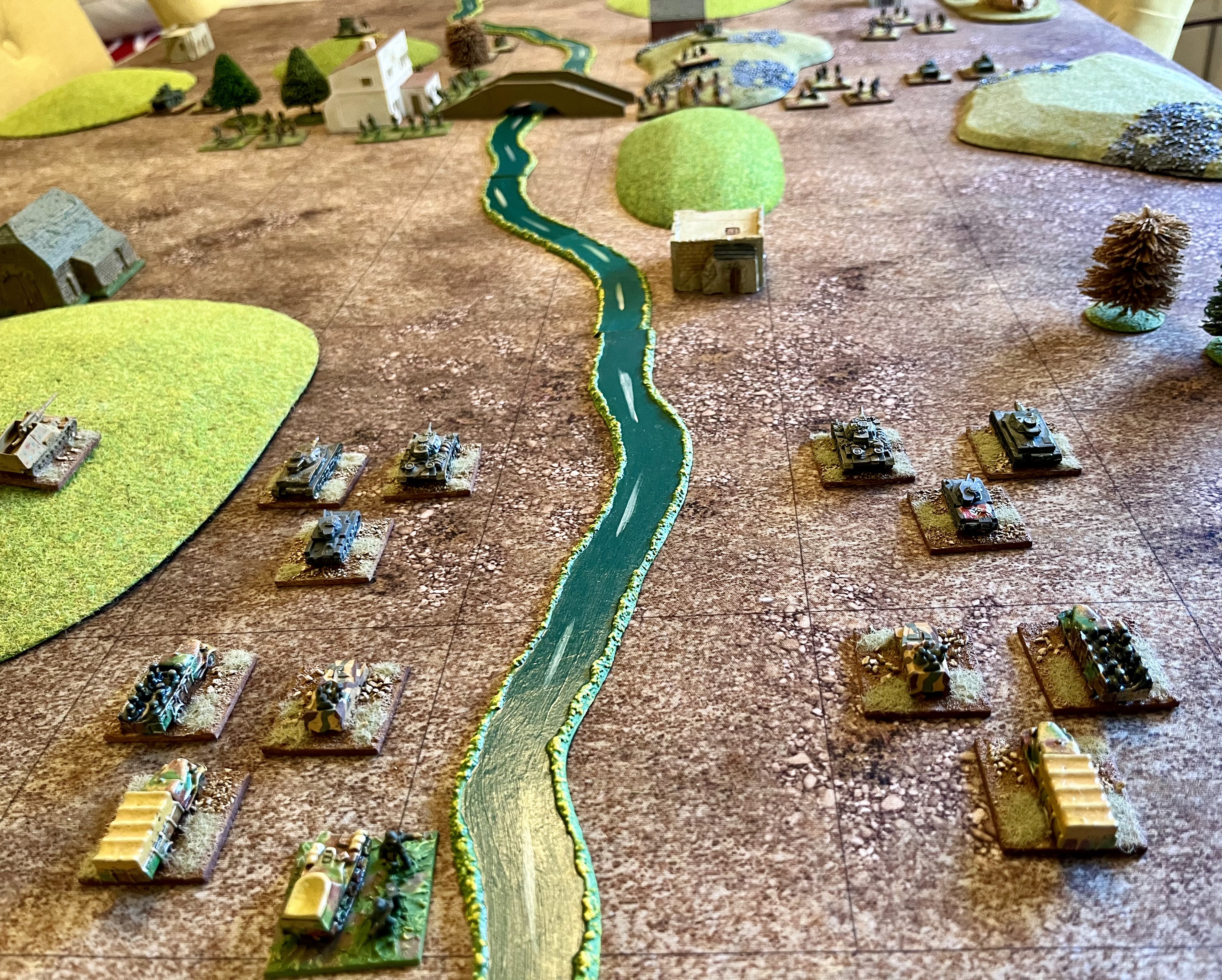
Historically, it is likely that the Turks would have quickly fallen back on their fixed defences in the Cakmak Lines. However, for this scenario, we refought the first clash between a panzer division and the Turkish covering forces. German infantry crossed the Maritsa River on the Greek border and created a bridgehead. The panzer division crosses the river and aims to cut off Turkish X Corps from Istanbul by capturing Luleburgaz. General Altay forms a battlegroup from X Corps to halt them near the town of Pehlivankoy, west of Luleburgaz.


Turkish forces on the right.

The view from the German Kampfgruppe.

We used Sam Mustafa's Rommell rules for this, as you can tell from the grid mat. The models are 10mm from several ranges. If you want to try this yourself, my Turkish battle boards are on the project page. In 10mm, Turkish armies don't require much work. The armour and artillery are readily available, and the infantry is easily adapted from other ranges.

I'm afraid the panzers made short work of the Turkish defences. The right hook was less effective, and with only one bridge over the Ergene River in this sector, the Turks could at least slow up the attack.


There are lots of other scenario possibilities with Operation Gertrud. Some Brandenburg or airborne assaults around Istanbul may be worth a go. I also fancy the British response 'Plan Wonderful', which envisaged a defence in Eastern Anatolia and then the Taurus Mountains.


Monday, 7 November 2022

True Thomas

 My bedtime reading has returned to the Nigel Tranter re-read project. The latest is True Thomas, a story about Sir Thomas Learmonth of Ercildoune, also known as Thomas the Rhymer. The setting is yet again during the reign of Alexander III (6 July 1249 – 19 March 1286), something of an obsession with Tranter as this is the third novel set during his reign. Sir Thomas' lands were also quite close to where Tranter lived.


Sir Thomas was a poet with a reputation as the author of many prophetic verses. Most famously the death of Alexander III, which led to one of the most turbulent periods of Scottish history. This being medieval Scotland, he still participated in the fighting, including the Battle of Largs and the Rout of Ronaldsay (Isle of Man). In the story, Tranter puts him close to the King and so to the other significant events of the period. As always, relations with England were important. Once the Baron's War ended and Edward I came to the throne, this relationship stepped up a gear. 

A novel about a Scottish poet may not sound very exciting, but Tranter does his best with a relatively quiet historical period. We also know relatively little about his actual life, which gave Tranter some scope beyond his poetry. As a result, I enjoyed this one more than I expected. 

Next up is Wallace and then the Bruce trilogy. I can feel the need to dust down my Bannockburn armies!

Some of my 28mm Scots infantry of the period.


Sunday, 30 October 2022

Fiasco 2022

I was at the Leeds wargame show (Fiasco) in the conference hall of the brilliant Royal Armouries Museum. So you get a wargame show and the museum; definitely worth the trip.

The hall is a reasonable size, but it has a few disadvantages. First, there isn't much room for games, so, like many shows, it is primarily a trade event. The other downside is the lighting. It is awful. I had to put the torch on my phone to see some of the labels on figure packs. I remember the days when the games were spread around the museum, which was a lot better. However, now it's free admission to the museum, I can see why that wouldn't work.

Anyway, I came away with several figure packs to top off a few projects: scenery, paint, bases, etc. Not a single book, which is pretty unusual.

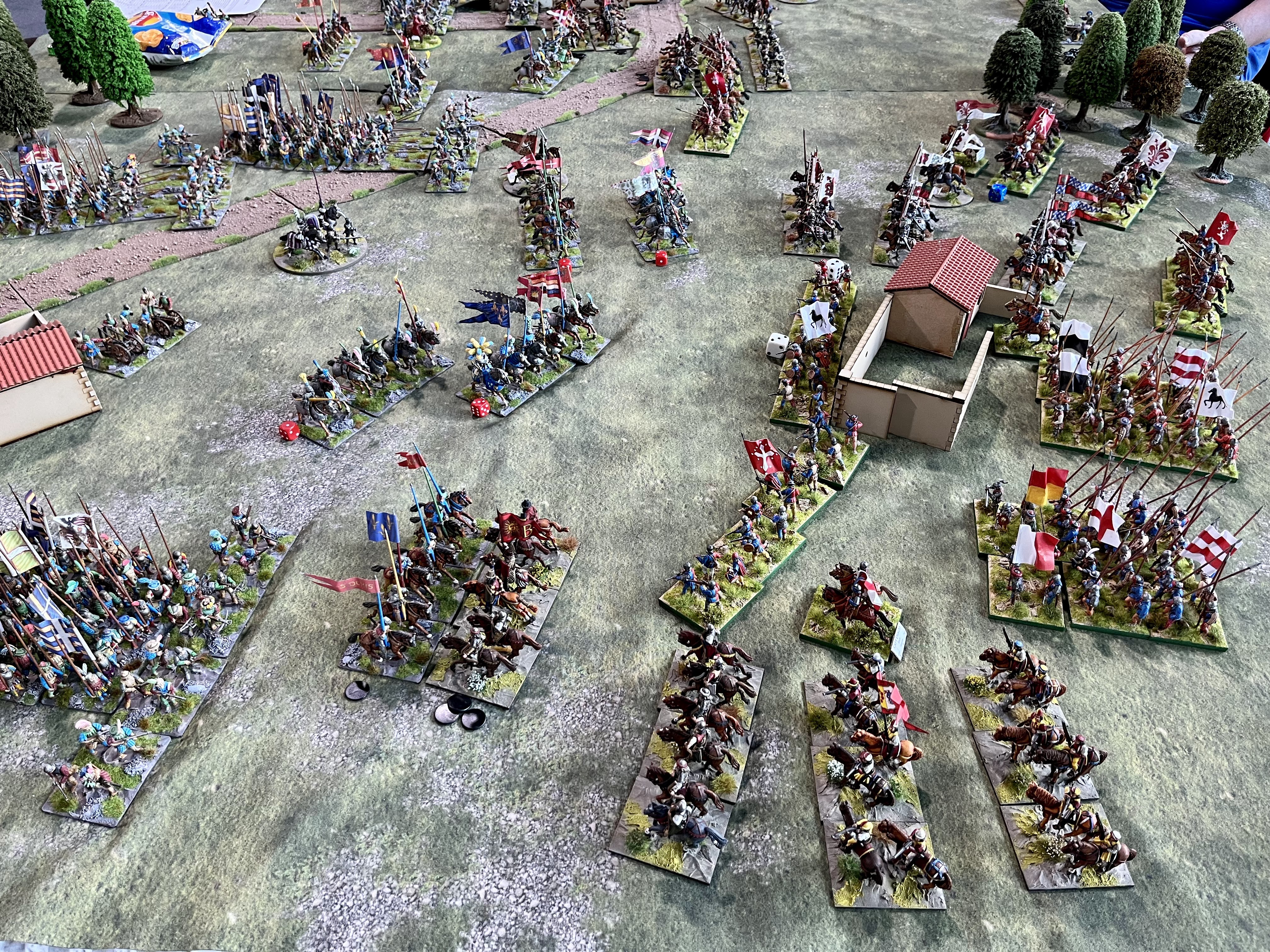
The best of the games was the Yarkshire Gamer and his Italian Wars extravaganza. Nice to see it in the flesh. With all those flags, it is visually impressive.


The other games in the main hall were small-scale but interesting. I haven't seen Tiger Miniatures at a show for a while. I resisted more of their excellent Balkan Wars figures, but the Chinese in this display game are lovely.


Yom Kippur War in 10mm 


I have seen this Korean war game before, but the terrain is terrific.


28mm ships, very tempting.


And they had a SAGA competition. So I must get my battle boards out.


I have been to the Royal Armouries several times before. But there are several displays I will never tire of. Particularly the Ottoman and Mughal armour collections.


The centrepiece of the armour floor.


And the full scale Pavia diorama.


I probably won't go every year, but it was worth the long drive.

Tuesday, 25 October 2022

Banzai at Basra – Japanese in Iraq

This is the latest Chasing the Soft Underbelly scenario testing game played at the club on Sunday. Thanks to Graeme for indulging me in this somewhat unusual setting.


The story of the Iraq revolt and the daring British response is relatively well known. Less well-known is the role played by Imperial Japan. The Tripartite Pact between Germany, Italy, and Japan had not clearly defined spheres of influence outside Europe and the Far East. The Japanese believed that Asia extended far enough to include the Middle East to reflect their economic interests in the region, not least the oil supply. They had partly financed the coup and promised military supplies. While the Germans refused to cooperate with Japanese plans, not wanting to upset the Japanese may have been a factor in the limited German and Turkish responses to the coup. The British took this seriously, with the foreign secretary Anthony Eden expecting Japanese landings in Aden, which he was doubtful the British could resist. 


In this scenario, we assume that the Japanese took their support for the Iraqi coup a stage further and provided military forces. Iran was neutral at this time, with strong economic links to Germany. This means that, unlike the Germans, they had naval options for intervening, which didn’t require the capture of RAF bases. A Japanese carrier force could have sailed up the gulf and landed at Basra. Therefore, they likely would have joined the Iraqi Army in resisting the 20th Indian Infantry Brigade, which waved had sent to secure Basra.


For this scenario, we assume the Japanese made a beach landing on the Shatt al-Arab waterway after the 20th Indian Infantry Brigade had secured the docks and airfield. The Japanese priority would have been to capture the port. To stop this advance, the 7th Gurkha Rifles are ordered to intercept them while the 11th Sikhs hold the docks against an attack from the Iraqi Army. Contact is made on the outskirts of Basra between the Gurkhas and the Japanese Special Naval Landing Forces. The Japanese would have had carrier-based air support so that they would have had effective control of the skies. The RAF had ancient Vickers Vincent ground support aircraft (244 Sqn) and around ten Wellington bombers at Shabaih.

The Japanese are on the left with the objective of seizing the Basra Road on the Gurkha baseline (right).


The Japanese and allied Iraqi Army squads assemble on the hill, while their armour covers the left flank. Another infantry squad successfully holds the right flank.


The Gurkhas (actually British as we haven't got any Gurkhas) skulk behind the mosque. Wary of the Japanese armour and Iraqi armoured car, although they had no need to worry as neither hit a thing all game!

The Japanese were lacking the banzai spirit for most of the game. The main infantry force sat on the hill, not moving until late in the game when they made some progress. Time ran out with the Gurkhas having lost more units, but the Japanese no where near their objective. 

It needs a few tweaks, but it does offer something a little different.

Saturday, 22 October 2022

Killing Patton

 My library pick this month was Killing Patton by Bill O'Reilly and Martin Dugard. I'm not a big fan of conspiracy theories, which is confirmed by reading this thin gruel.


Almost the whole book is an average overview of the last months of WW2. Particularly so after reading Peter Caddick-Adams' excellent book covering the same period. The reader is left wondering, when are we getting to the point of this book? The reason is that there is so little to say. The best the authors can say is that there is a case to be investigated. 


Apparently, O'Reilly suggested in interviews that Patton was poisoned while recovering from the automobile accident he endured on December 8, 1945, on the orders of Soviet dictator Joseph Stalin, ostensibly to prevent him from warning the United States about the imminent danger of the Soviet Union. Several historians and Patton's family found O'Reilly's theory highly implausible. Carlo D'Este, the author of Patton: A Genius for War, said, 'He was a quadriplegic, he was going to die anyway, he was totally immobilized, he couldn't move What is the point of assassinating him?' Indeed!


In fact, Patton's anti-Soviet rhetoric pissed off his own side more than the Soviets. They complained about him employing ex-SS men, which Bradley agreed with. Marshall had his phones tapped and requested a psychoanalysts report. Patton certainly was losing the plot.


There are other conspiracy theories in the book.


An RAF Spitfire fired on his army cooperation plane, the L5, which, as he concedes, bears a distinct resemblance to the German Fi-156 Storch. But, instead of this being an all too common friendly fire incident, he points to the fact that the Soviets have Spitfires - with RAF roundels?


A couple of Nazi collaborators, desperate to escape deportation back to the USSR, tell the OSS that the NKVD plans to kill Patton. I fear this comes under the heading, let's make ourselves look like a valuable source of information. 


The author says that OSS didn't act because they wanted him dead - 'He must be silenced'. This was to be done by an OSS operative Douglas Bazata, who claimed Wild Bill Donovan personally authorised it. However, he waited until 1975 to say this privately and, in 1979, in public. He claimed that he fired a low-velocity projectile into Patton's neck at the very moment of the crash. Yet no projectile was found, and neither of the other occupants noticed this. Even the author concedes that many believe his story is far-fetched. He was also later employed by the Reagan administration, which is a bit odd if he really did kill a right-wing WW2 icon.


Then we have the truck driver that crashed into Patton's car. It's unclear what the authors are claiming here, another OSS agent? He was some way from his base, but it didn't occur that he might have been dabbling in the Black Market. Such entrepreneurial activity was pretty common at the war's end. The fact that Patton's driver had a penchant for speed on his and Patton's own admission isn't even considered a contributing factor. Vehicle accidents were also common at this time. Yes, some records went missing, but again not all that unusual.


Patton's widow employed several private investors to look into her husband's death. They all drew a blank. But, of course, that might just be because he died in a motor accident, full stop.


Even by the standards of conspiracy theories, the evidence in this book is less than convincing. Not quite QAnon-level nonsense, but no doubt it sold well to that audience. It wouldn't get anywhere near the standard required even to start an investigation these days, and it didn't at the time. I am delighted I didn't waste any money on this. My recommendation is, don't waste your time. 

Thursday, 20 October 2022

Allies at War

 This is Simon Berton's book on the WW2 dealings between Churchill, Eisenhower and de Gaulle. My interest in the French and WW2 was stimulated by the book I recently read on Admiral Darlan. This book covers some of the same ground but focuses on de Gaulle and his often stormy relationships with the wartime leadership. Apparently, there was also a TV documentary linked to the book, which I don't recall.


I did appreciate that de Gaulle's relationship with Churchill blew hot and cold. However, I hadn't appreciated how much Roosevelt detested him. Partly down to his chief of staff, Admiral Leahy, formerly the American ambassador to Vichy France and his envoy in North Africa, Robert Murphy. Even after D-Day, Leahy was suggesting that Petain and Vichy were the people to do business with in France. Churchill was more supportive, but his relationship with Roosevelt was his primary concern, so he often went along with the President.

In the dark days of 1940, de Gaulle was not the automatic leadership choice for most of the French population. For example, only 7,000 of the 115,000 servicemen on British soil after Dunkirk joined de Gaulle’s movement. Even Churchill road both horses after Vichy gave assurances that it would never allow its fleet or African Empire to fall into Nazi hands and also would not seek to re-conquer de Gaulle’s territories. In return, Britain would neither physically attack Vichy territories nor verbally attack Pétain. It would also relax its blockade if France were to assist, even passively, in a British victory. 

As the true nature of the Vichy regime became apparent to Churchill, not least its anti-semitic actions, he moved closer to the Free French movement. When de Gaulle irritated him, as he often did, it was Eden who shielded de Gaulle. Churchill once sent a circular to British newspapers, expressing his concern at the apparent bias in favour of de Gaulle. He told them that de Gaulle had left ‘a trail of Anglophobia behind him’ and undoubtedly had ‘Fascist and dictatorial tendencies.’

I was amused by Berton's description of René Massigli (de Gaulle's foreign minister) as 'a calm and experienced French diplomat.' This was the same diplomat who was the French Ambassador to Turkey. His actions, known as the Massigli Affair, nearly started a war between Turkey and the Soviet Union in 1940!

Roosevelt was eventually persuaded to recognise de Gaulle and even invited him to Washington. But, despite the political smoothing, he privately still detested him. An OSS report on de Gaulle probably best sums up the position by saying, 'There is no other choice, and also he will be chosen because, by doing so, the French, in some subtle way which is hard to explain, can fulfil what is almost a psychic impulse – a soul craving – to be able to tell their children that France was never defeated, that it kept fighting on till victory.’ 

It was an extraordinarily accurate prophecy of the legacy de Gaulle would create for his people, a legacy which would prevent them, until quite recent times, from acknowledging the sordid history of collaboration.

My WW2 French force for Bolt Action

Monday, 17 October 2022

1805: Tsar Alexander's First War with Napoleon

This is the Russian official history of the 1805 campaign that culminated in the Battle of Austerlitz. As someone who struggles with foreign languages, I am always grateful to those who translate these valuable works. In this case, Peter Phillips. This is a straightforward translation, although there is an introduction by Alexander Mikaberidze. Incidentally, I am eagerly awaiting the delivery of his new biography of Kutuzov.

It was written in 1844 by Alexander Ivanovich Mikhailovsky-Danilevsky. He was present at Borodino, so he was a contemporary of the main characters in the story. Interestingly, he added Mikhailovsky to his name because he was imprisoned after being mistaken for another Danilevsky, who criticised the Tsar. As official histories go, this is a relatively concise description of events. 

The upside of official histories is that the author can access all documentation. The downside is that they can brush over embarrassing details and, in this case, include obsequious brown-nosing of the Emperor. For example, I was interested to see how he treated Tsar Alexander's overruling of Kutuzov at Austerlitz. He goes for a later quote by the Tsar, 'On the Austerlitz Campaign I was young and inexperienced. Kutuzov told me that we needed to operate differently, but he should have been more persistent in his opinions.' This has to be the weakest of excuses from an autocrat!

As for the narrative, we get an introduction to the causes of the war and Alexander's decision to support the Austrians. This became much more difficult after the disaster at Ulm, which forced Kutuzov to engage in a fighting retreat back to Austerlitz. The subsidiary campaigns in Italy, Hanover and the Tyrol all get some coverage. Although the treatment of Lacy's Italian campaign is pretty sparse.

This book will not be for everyone. However, it does add to our understanding of the campaign if read in context, and I have found the translations of other Russian campaign histories very helpful. Particularly those covering the Russo-Turkish wars. 

I have been painting Russian infantry of the 1806 campaign this week, so this was a good choice of reading. 

The first batch of musketeers of the Kolyvan Regiment. From the Brigade Games range in 28mm.


Sunday, 16 October 2022

Bother at Batumi

I am delighted that my new book has a cover and an indicative publication date of next month. Chasing the Soft Underbelly: Turkey and the Second World War (Helion 2022) is a history of Allied and Axis efforts to get Turkey to join the Second World War.


I avoid 'what-ifs' in the main text, but in the first draft, I included an appendix on wargaming the actual and potential campaigns in the book. However, space precluded its inclusion, and in any case, I felt it didn't do the subject justice. For that reason, I am writing a booklet as a wargaming supplement to the detailed history in the book. It also allows me to indulge in the many interesting campaigns that Turkey might have been engaged in at different stages of the war. Finally, it will offer the wargamer a new opponent for their already established wargame armies, particularly those with Axis and Soviet forces. 

This project involves playtesting several scenarios related to these campaigns. The first I am calling Bother at Batumi, or how the Massigli Affair went hot. 

The Soviets and Turks both had revisionist claims over their shared border in the Caucasus. This tension stepped up a gear in June 1940 when the Germans leaked a captured telegram from the French Ambassador in Ankara, René Massigli, to General Weygand of the French high command in Syria. This was Massigli's summary of a conversation with the Turkish Foreign Minister about a projected aerial bombardment of the Soviet oil fields at Baku and Batumi by the French air force. The attack aimed to halt vital oil supplies from the Soviets to the Germans. Massigli claimed the Turkish Foreign Minister, Şükrü Saracoğlu, confirmed that Turkey would object, which involved flying through Turkish airspace.

The Soviet Union mobilised troops on the Caucasian border, moving 10,000 troops to Sokhumi and then towards the Batumi border checkpoint. The Turkish ambassador to Moscow was convinced that 'a re-annexation Kars, Ardahan and Artvin was in the offing.' These were the border regions conceded to Turkey in 1921. The Turkish government dispatched reinforcements to the border, and as the Turkish and Soviet armies moved closer, shots were fired across the border on several occasions.

A quick look at Google maps (the border is unchanged) shows that the terrain along the Georgian border is mountainous and forested. Almost all the Soviet divisions here were mountain troops. The only formal border crossing point is on the coast at Sarp (Georgian Sarpi), just south of the city of Batumi. 


The scenario assumes the Soviet commander has sent a battlegroup from the 47th Georgian Mountain Rifle Division to capture the checkpoint and surrounding hills. This would allow an offensive to develop to capture the air base at Borca and the city of Artvin. I used my 15mm figures of the period and Blitzkrieg Commander rules.

The Soviets would have had a significant numerical advantage. The Transcaucasian Military District had at least six Mountain Rifle Divisions against the Turkish IX Corps peacetime establishment of two divisions. The Soviets decided on a frontal attack along the coast road through the checkpoint while infantry tried to capture the high ground.

The Soviet attack through the forested hills made no progress, despite a two-to-one advantage. However, the frontal attack, supported by artillery and tanks, did capture the checkpoint, albeit with heavy casualties. Victory to the Soviets, but at a cost.

By the way, I was recently interviewed by Henry Hyde on his Battlechat podcast (Number 89). As a health warning, our chat went on for over two hours on matters Balkan, including the book. But it might provide a backdrop to a painting session!

Thursday, 13 October 2022

Russia's Steppe Frontier

 This is Michael Khodarkovsky's study of Russia's colonial empire in the south between 1500 and 1800. This is a book that the current Russian President ought to read, as it shows how Russia colonised lands, incorporating or displacing the inhabitants, that he now claims are historically Russian. 


The book starts with a couple of academic chapters discussing the sociology and frontier concepts in Muscovy. The narrative history is divided into two chapters covering 1480 to 1600 and then 1600 to 1800. 

Russia's opportunity to expand came about as a result of the decline of the Golden Horde. The various Khanates ruled over vast swathes of what is today southern Russia. To give some idea of the distance, the border at Kulikovo was only 173 miles from Moscow, while Kharkiv in modern-day Ukraine is 531 miles away from Moscow. Crimea is even further. 

During the sixteenth century, the nomadic societies were torn by incessant civil wars. The Muscovite government was becoming increasingly autocratic and began to build fortifications to halt nomadic raiding. They also agreed on treaties and started the Russification of territories, imposing taxation and forcibly converting the Islamic tribes to Christianity. This had mixed success, but gunpowder weapons and mercantilist policies backed up the advance, although progress was very slow. The story is complex, but the similarities to the British in India are obvious. China and Persia had similar stories on the other side of the steppe. The difference between Russia and Great Britain was that the British used commercial trading companies rather than the central government.

A key element on the Russian side was the Cossack communities, ironically mainly populated by people who had escaped Russia. They raided the Khanates and later provided the military force to supplement the limited number of regular regiments based on the border. Serfdom in Russia was formally introduced just as it was disappearing from western Europe to regulate the available labour force.

Treaties had limited effectiveness in nomadic societies where the ruling Khan had only limited control. Fortification lines helped to contain the nomads, cutting off their pasturelands and cutting income from raiding. The nomads became increasingly dependent on access to Russian markets for trade. Russian colonisation was backed by a strong military, a bureaucracy and colonists looking for land. All of this didn't come cheap. In the first half of the sixteenth century, Moscow paid six million roubles in tribute to the Crimean Khanate and still lost up to 200,000 Russians as captives. This cash could have funded some 1200 small towns, a reason why Russia was slower to urbanise than its western neighbours. 

In the period covered by this book, Russian colonisation was initially driven by the need to defend its borders. It was in the nineteenth century, when Russia expanded into central Asia, that it adopted a more traditional colonial model. This period is covered in a new book by Alexander Morrison, The Russian Conquest of Central Asia: A Study in Imperial Expansion, 1814–1914. He was interviewed on the New Books Network podcast. Well worth a listen.

When this book was written in 2004, it didn't have the topicality it has today. It isn't the easiest read, but it covers a period that gets little attention in the West.

Some of my 28mm Cossacks from the excellent Foundry range.


Friday, 7 October 2022

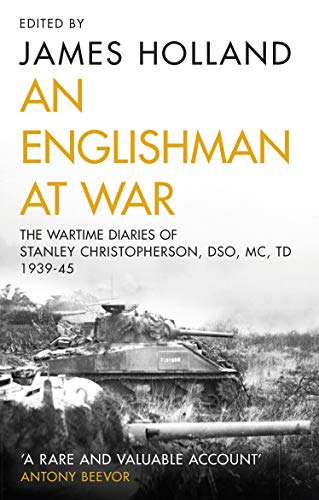
An Englishman at War

 This new book covers the edited wartime diaries of Stanley Christopherson, DSO MC TD, by James Holland. I hadn't been rushing to read this as I thought it was about the North West Europe campaign, which is not my main WW2 interest. However, I was pleasantly surprised when I tackled this on the flight home from Kos, that he served in the Middle East.


Stanley Christopherson was a relatively typical early WW2 British officer. He came from a comfortable middle-class family, privately educated, although he had seen a bit of the world, having lived in South Africa. He fought with the Sherwood Rangers Yeomanry, whose officers would traditionally be the social home of what would be called 'the county set'. As the author puts it, 'They began as little more than amateurs – horse- and sport-loving country folk with little understanding of what was about to unfold. Six years later, they finished the war as the single unit of the British Army with more battle honours than any other, having fought in the Middle East and North Africa, landed on D-Day, then led the British charge through the Low Countries and into Belgium.' Almost no member of the Rangers got through the war unscathed. Although Christopherson was wounded several times, he was one of the few to survive.

Although his diaries hide it, he wasn't altogether welcome. The colonel was not happy about having new officers assigned to the regiment. He believed it was still up to him to choose the officers for 'his' regiment. 'They worked for a living,' said another of the new officers, 'and didn't keep horses or hunt twice a week'. The British class system was probably at its worst yeomanry regiments!

They also went off to war as horsed cavalry. This sounds absurd, but we should remember that the Russians and Germans had cavalry divisions right up to the end of the war. However, it came as a shock to the Rangers on 2 July 1940 after they had arrived in Palestine. Sadly, they didn't get tanks to replace them. So, like some other yeomanry regiments, they converted to artillery duties. Stanley ended up in the siege of Tobruk. The conditions were pretty grim, and Stanley was the last of his unit to be rotated out. His diaries would have been relatively short if he had stayed much longer.

Diaries give you an insight into what people knew or were told at the time. Unlike the official history written after the event with the benefit of hindsight. Of particular interest to me was his entry that 'Turkey has made a trade agreement with Germany, which is rather distressing news.' This was unsurprising given the well-established trade links between the two countries. A later entry said, 'The colonel also told me that Turkey would probably come in against us as it appears that she is receiving more war matériel from Germany than she is from us.' This wasn't true, and German equipment supplies were modest compared to the British.

I did enjoy his entry that 'News also came through that the German and the Italian columns engaged each other! I am not surprised as we, the Germans and the Italians are all using Italian tanks!' Also, 'We have had a pamphlet sent us by the War Office on the 'extermination of rats'. With it I had a letter from the colonel appointing me RRO (regimental ratting officer), result of which has been a great deal of leg-pulling.' His entry about a 'great many' German dud shells was interesting. I will feel better about hitting nothing with mine on the wargame table in the future!

Back in Palestine, they were still low on the priority list for new tanks and had to train with a handful of them. As the desert war flowed back and forth, replacements went to serving units rather than new ones. Eventually, they got tanks and took part in the Battle of El Alamein. They then fought across Libya and throughout the Tunisian campaign. The diaries show how the British Army learned the hard lessons of the desert war, particularly the importance of combined arms tactics. He fought mainly in a Crusader tank, fast for his recce squadron but very vulnerable to German and even Italian ATGs. Of 22 officers in his regiment, 16 were battle casualties.

After North Africa, the regiment was shipped back to the UK and equipped with Shermans. They landed on D-Day and fought through Normandy. He did briefly get back on a horse to find his supporting infantry. The Rangers fought most of the NW Europe campaign parcelled out in support of infantry units. They were not in an armoured division, so they had to slog it out with few opportunities to storm through the enemy lines. He was promoted to command the regiment on 15 June 1944. Forty tank commanders had been killed or wounded since landing in Normandy. Sticking your head out of a tank was essential but deadly. Replacement officers were increasingly not from the 'county set', reflecting wider social changes in the army by the war's end.

Stanley Christopherson was undoubtedly a brave officer. He was awarded the DSO, the MC and Bar and an American Silver Star. His diaries cover most of WW2 in a level of detail you rarely see. James Holland's editing adds important context and makes the book readable. You can pick it up on Kindle for 99p at the moment. Well worth the time and money.

Reading this book reminded me that I had a 28mm late war Sherman, which I don't thnk has ever reached the table top!

Saturday, 1 October 2022

Essex Dogs

 This is Dan Jones' first go at writing historical fiction. He has written some excellent medieval history books and is an engaging TV presenter. Apparently, George R. R. Martin inspired him to have a go. The Essex Dogs are a small unit of ten infantry taking part in Edward III's invasion of France, which led to the Battle of Crecy.


Edward III's army and fleet, numbering around 15,000 men, invaded Normandy in the summer of 1346. For the next six-and-a-half weeks, they marched, burned and fought their way from the Normandy beaches to the edge of a forest beyond the Somme called Crecy. This was one of the first campaigns of the Hundred Years' War. 

Jones keeps pretty close to the historical facts and includes historical characters like the Earls of Warwick and Northampton. The Black Prince doesn't get a good write-up, although, in fairness, this was his first major campaign. I warmed to the blunt-speaking Earl of Northampton, although he should have been grateful that the Black Prince never made it to the throne!

The Essex Dogs are a fictional group of soldiers, typical of the original 'scum of the earth' who made up the English army. Their leader, Loveday FitzTalbot, commands a mixed group of infantry and archers. It was good to see non-archers get a look in, as almost all the focus in HYW fiction is on the longbow when the army still needed other types of infantry. They are often called upon to carry out special operations that Jones has gleaned from his work on the chronicles. The unit includes a somewhat stereotypical Scot. I am sure there must have been the odd Scot in the English army, but most of this character's fellow countrymen were fighting on the other side!

I would describe this as gritty historical fiction and pretty realistic. Most soldiers portray warfare as boring with short bursts of sheer terror. That is certainly reflected in this book. While realistic, it isn't always that gripping. If you like your historical fiction in the Bernard Cornwell style, this isn't it. It lacks pace. That said, I enjoyed it as something of a hybrid between historical fiction and non-fiction.   

A 28mm unit of archers from my collection.


Friday, 30 September 2022

Churchill's folly - Kos 1943

 We hired a car yesterday and did a grand tour of Kos. Well, not so grand as the island isn't that big at 45km long. However, for the Durham Light Infantry (DLI) sent to defend it in 1943, it must have seemed enormous.

This was part of the Dodecanese campaign, which has been described as 'Churchill's folly'. When the Italians signed the armistice, Churchill argued for capturing the Dodecanese Islands as a stepping stone towards the 'soft underbelly' of Europe through the Balkans. He also hoped it would bring Turkey into the war. Instead, the Americans viewed it as a distraction from the Italian campaign and Overlord.

The Germans quickly reacted to the armistice and reinforced their garrison on Rhodes, the key to the Aegean. That should have been the end to the matter, but Churchill pushed the CinC Middle East to land British troops on Kos and Leros, employing the utmost 'ingenuity and resource'. Unfortunately, without adequate naval and air support, this was outright folly. 

Kos was vital because it had an airfield (the modern airport) and a couple of improvised landing strips. The 1st Battalion DLI, a light AA detachment and a squadron of the RAF Regiment, was sent to the island. That was just about enough to guard the airfield and Kos town. The Italian 10th Infantry Regiment and artillery units were also on the island, but these were not front-line troops, and their reliability was questionable. South African Air Force Spitfires flew in, but many were shot up on the ground by the overwhelming German air superiority. The JU87 Stuka had a return to favour in this campaign.

When you visit Marmari and Tingaki, the main German landing beaches, you can see the remains of what I assume are Italian defences. There are concrete pillboxes and gun positions.

This is a typical example.

You don't shift concrete pillboxes quickly. So, here they just diverted the new road around it!

Most pillboxes are HMG positions, but this is a rare gun one.

After landing, the German Kampgruffe von Saldern (two panzergrenadier battalions and support units) advanced to cut the main road. They also captured a couple of Spitfires on the salt flats.

Salt flats.

Two Brandenburg para units landed on the island's western tip near Kefalos. They advanced and captured the airfield.

There is a small castle at Kefalos. Not much remains, but it provides a great view.


The modern airport bears little resemblance to the WW2 Antimachia airfield. However, nearby there is the Hospitaller Castle of Antimachia. This massive 14thC castle was rebuilt at the end of the 15thC after an earthquake. The walls are mostly intact, and the views are pretty special. A modern Hellenic Army base is nearby, home to what looks like a mechanised battalion.


The Durhams retreated back to Kos Town. Obviously, it was much smaller than the urban sprawl of the modern city. It is difficult to spot where the main attack came from the north. However, the attack from the east was resisted by elements of the Italian garrison at the village of Platani. Home today to some of the island's small Turkish population. One history describes a fight in olive groves, which might be here.


The Greek/Roman ancient site of Asklepion is nearby. Certainly worth a visit, if only for the view over the city with Türkiye in the background.


Another panzergrenadier battalion landed on the southern shore, which is pretty mountainous. It's not that far from our hotel, which has suitable landing beaches. The Italians obviously thought so as they built a fort next door, and the coast is dotted with pillboxes. 


This looks like it is still used by the Hellenic Army. Literally, just a stone's throw from the Turkish coast.

Leros has more WW2 sights, but the ferry times from Kos didn't allow a decent day trip. The outcome of the campaign on that island was the same. In total, 3,000 British and 5,350 Italian prisoners were marched off into captivity. Many of the Italian officers were shot. The price of Churchill's folly.