Welcome to my blog!

News from a wargamer with a special interest in the military history of the Balkans. It mainly covers my current reading and wargaming projects. For more detail you can visit the web sites I edit - Balkan Military History and Glasgow & District Wargaming Society. Or follow me on Twitter @Balkan_Dave
or on Mastodon @balkandave@mastodon.scot, or Threads @davewatson1683

Monday, 26 August 2013

Type 95 Ha-Go Tanks

Back to the Far East and the painting table, after my sojourn in the ACW.

These are the new Battlefront models of the Type 95 Ha-Go light tanks. 1250 of these useful tanks were built from 1935. It mounted a 37mm gun and a 7.7mm machine gun. While lightly armoured (6-12mm) it was an effective tank in the jungle areas such as Malaya, although seriously outgunned against the Russians.

I have been critical of Battlefront vehicles, but these fitted together well with only limited flash. Even the gun had a sort of lug to glue it into, although they could still do a lot better. I do like the tank commander with the sword. Absurd, but looks great!

The defending Russians are my latest batch from the Plastic Soldier box.


Saturday, 24 August 2013

Longstreet

My copy of Sam Mustafa's new rule set, 'Longstreet' arrived this morning. A rare opportunity to dust down my ACW armies and give these rules a go.

First a read through the rules. They are well laid out with plenty of diagrams to explain the key mechanisms. Unusually they come in A5 size, although the claim that they will open flat is a bit optimistic. Some nice eye candy as well, without overdoing it.

There is a good introduction to the rules in this month's Wargames Illustrated so I wont bother explaining the system. Those familiar with 'Maurice' will feel at home with the basics. I am not a huge fan of card driven rules, but here they don't make the game a lottery as some others do. You can fire, move and charge and the cards give an edge without dominating each turn. You do need to marshall your cards carefully as running out gives victory to your opponent.

My trial game used a basic brigade with three infantry regiments, a cavalry regiment and a battery of guns on each side. I chose 1862, as that gives a mix of eager recruits and seasoned veterans. I have one or two queries, but unlike Maurice I found these rules much easier to follow and play. A very enjoyable afternoon's play. I will certainly be giving these a go again. The campaign system would also work well in a club campaign.

My 15mm ACW collection is based for Fire and Fury and they work fine with no need to rebase - a real plus! Recommended.

The basic table, with a small settlement and a stream. Plenty of woods and of course the distinctive fencing.

The rebel right wing goes for the church although the somewhat optimistic cavalry charge came a cropper - even with a decent card. As it should.

Friday, 23 August 2013

Japan's Blitzkrieg

More background reading for my Far East projects.

First off, there is 'Japan's Blitzkrieg' by Bernard Edwards. This isn't a narrative, or even a military history of the the early stages of the Pacific War. Instead the author takes us through a series of episodes that illustrate the chaos that was the allied response. Based on eye witness evidence there are some fascinating stories. A very readable book.

That led me on to 'SOE Singapore 1941-42' by Richard Gough. This is the story of SOE operations in the Far East, before and during the invasion. It was a very small operation based in Singapore that sought to establish 'stay behind' units that would harass Japanese lines of communications. This was a very poorly resourced operation, largely scorned by the higher command, that in reality achieved limited goals. None the less there were some very brave soldiers and civilian recruits who did their best with what they had. Although the Singapore command didn't know it, they caused significant supply problems for the Japanese attacking Singapore, along lengthy supply lines.

Along with the reading I have been making some progress with the painting.

Firstly some more Japanese. This is the third Gocho or rifle squad that makes up the first Hohei infantry platoon. Together with the command team. Battlefront figures, except the HMG teams that come from Peter Pig.


Then the first, of what looks like many, Russian rifles. These are from the Plastic Soldier range.


Sunday, 18 August 2013

Varjazi & Basileus

SAGA reaches the Balkans!

There was a preview of this in a freebie in Wargames Illustrated, but this is the full monty with rules for three factions; Byzantines, Pagan Rus and Princes Rus. Three battleboards and you have the option of swords for hire with Steppe Nomads. Although again you can a full faction for these by utilising the freebie in this month's Wargames Illustrated. I can also reuse my Viking and Norman order dice as well. This supplement comes in a folder that is useful for storing the other supplements and battle boards.


I think SAGA is a very elegant games system and I haven't really played nearly enough. It's ideal for a quick game in the evening. Anyway, I managed a couple of games this weekend to refresh my memory on the rules.

In this game the Byzantines were motoring well, shooting up one flank and driving back the other. Time for the coup de grace as the Kavallaroi thundered into the RusVarjazi driving them back as well. But then it all went wrong as the Sviatoslav, Price of Rus counter attacked with the other unit of Varjazi, killed the Byzantine Comites and that was game over. Never mind, the beauty of SAGA is that there is usually time for another game.


Saturday, 17 August 2013

Nomonhan project

Stuart Goldman's book, 'Nomonhan 1939' was the inspiration for my latest project, the 1939 Russo-Japanese War. It might have been a back burner had it not been for Flames of War publishing a supplement and producing figures for the conflict.

My reading has been supplemented by Dimitar Nedialkov's 'In the Skies of Nomonhan', which covers the air war. I am not usually a big fan of air war books as the narrative can be a bit repetitive. However, this study puts the air battle into context with the ground war and as a consequence is a good read. It also has very useful data on the conflict with details of the aircraft and some very nice colour plates. It is profusely illustrated with photos, most of which appear to come from Bulgarian archives.


Onto the tabletop, I picked up the basics at Claymore. Battlefront's Hohei Chutai box provides the core infantry and I have supplemented them with support weapons from the Peter Pig range. A box of Ha Go light tanks was my other Battlefront purchase. For the Russian's you need a lot of infantry, so I decided to go with Plastic Soldier.

The first couple of Japanese rifle squads below with the attached light mortars. I don't usually use the Battlefront bases, but the new recessed ones are a good idea. The figures are nice even if there is quite a lot of flash for what must be new moulds. After painting a lot of 28mm, it takes a bit of getting used to painting 15mm, or rather my eyes are just getting older!


Sunday, 11 August 2013

Bolt Action WW1

I had to make a last minute decision on producing a game at the club today. Looking at the shelves I realised that I hadn't used the 28mm WW1 Salonika Front armies for a while. Then came the choice of rules. We had been using Great War from the Warhammer stable, but it occurred to me that Bolt Action might work just fine for the earlier period.

So, for the Central Powers we had an Austrian platoon of three squads and a HMG, plus a Bulgarian platoon of similar size. The HQ had a cavalry troop and a field gun attached. Similar size force for the Entente with a British platoon and a Greek platoon.

The scenario was skirmish on the Struma. The cavalry scouting in the Struma valley bump into each other around a small farm and both sides converge in an encounter battle. I have to say it worked very well, with no real modifications required. We might want to think up some special rules for a period feel, but you can play WW1 with Bolt Action, straight from the box.

My opponent picked up the mechanisms very quickly, as I find most players do and enjoyed it. Another convert to Bolt Action as he is off to buy the rules. He also benefited from some tutorials this morning on You Tube. I hadn't seen these before and they are very good.


Friday, 9 August 2013

Hospital skirmish

I was partially re-reading F.W.D Deakin's 'The Embattled Mountain', when I came across some inspiration for a Montengrin WW2 scenario.

Deakin was parachuted into Montenegro in May 1943 to command the first British military mission to Tito's headquarters and this is his memoir. He landed in the midst of a large scale German effort to trap Tito in the Mount Durmitor area. He describes how the partisans broke out of the encirclement. Deakin handed over to Fitzroy MacLean and his memoirs 'Eastern Approaches' are also worth a read.

The final recommendation is Michael McConville's 'A Small War in the Balkan's'. He was based on the island of Vis, off the Adriatic Coast and this was the British base for providing support to Tito. There is plenty of inspiration for coastal raids in this book.

Anyway, Deakin describes the importance of medical services to the partisans. In fact, because the British initially supported the Chetniks, medical supplies were the main support in the early years. The partisans carried their wounded because to be captured by the Germans or their allies meant almost certain death. They established a series of hospitals across Bosnia and Montenegro, camouflaged carefully and defended by special units. The German's understood the importance of these hospitals and prioritised their capture.

In the game pictured below the German's have discovered one such hospital and are mounting an attack with the Italians. There are two Italian infantry squads and one German squad supported by an armoured car. The hospital is defended by three inexperienced partisan squads with a mortar, HMG and AT rifle.

There was a tough fight for the outer perimeter but the last stand in the hospital was quickly over as Axis firepower and training prevailed. Having spent some time building and painting a Macchi 200 for air support, it failed to arrive even after 5 attempts to roll dice 4+!!


Thursday, 8 August 2013

Hitler's Jihadis

Sticking largely to the Balkan World War Two theme I have just finished reading 'Hitler's Jihadi's' by Jonathan Trigg.

The author gives the background to the recruitment of Muslims into the Waffen SS. It may seem a strange mix given that racism underpinned Nazi ideology, but their racial theorists managed to justify it - just. In reality, as the war progressed it was more a case of needs must.  For the Muslim volunteers it was also largely a question of 'my enemies enemy'.

Trigg takes the reader through the history of a wide range of units. Some small and short lived, but others substantial with credible fighting records. Probably the best known is the Bosnian 13th SS Mountain Division 'Handschar'. Most of their recruits joined up simply as a means of defending their villages from the Ustase on one side and the Chetniks on the other. There is a more detailed history of this division written and lavishly illustrated by George Lepre.

Few of these volunteers survived the war. Those who did, ended up being executed or sent to Stalin's gulags. This is not an edifying tale or one with a happy ending. However, its a valuable piece of research well told.

I have also finished some ariel support for my Italians chasing the partisans around the mountains. This is a 1/48th scale kit of the Macchi MC200 fighter. It's made by a firm I hadn't heard of before, SMER. This is a fairly simple and cheap kit (£10) that produces an adequate model for the wargames table. The parts are not always a great fit and there is a lot of flash - so sharpen your scalpel.


Sunday, 4 August 2013

Claymore 2013

Another fine Claymore show yesterday in Edinburgh. It seemed significantly busier than I remember last year, perhaps aided by the cooler day, although you might have missed that in the atrium hall!

We had lots of interesting discussions with folk at our display game, Raid on Tito. Interested not just in the scenario, but Bolt Action rules in particular. Getting a lot of people interested in WW2 in 28mm these rules. The simple mechanisms are picked up quickly and you don't need a mountain of lead to get started.


More on our website, but Drvar is in the foreground and Tito's mountain hideout is at the back. The paras got a bit bogged down in this game, capturing the church but not much else by close of play. Himmler will not be pleased!

Traders seemed busy all day and they did alright by me and most of my pals. Kicked off my FoW Nomonhan project (Russo-Japanese) with the new supplement and a mountain of plastic soldier Russians and Battlefront Japanese. Bit of a Japanese day as I also bought the Warlord supplement for Bolt Action and some reinforcements for the early war project. With next year's Bannockburn anniversary display in mind, some Scots spearmen from Old Glory and Claymore castings.

Steampunkt stuff in both scales was much in evidence on the stalls. The figures and models look very good, but don't start me!

Some photies of other games that caught my eye.

Kirriemuir's excellent Charge of the Light Brigade gets another outing

Dumfries and the VBCW

Dystopian Wars, I suspect we will see more of this

AWI and Monmouth Courthouse

RAF Leuchars popular Banzai game got another outing

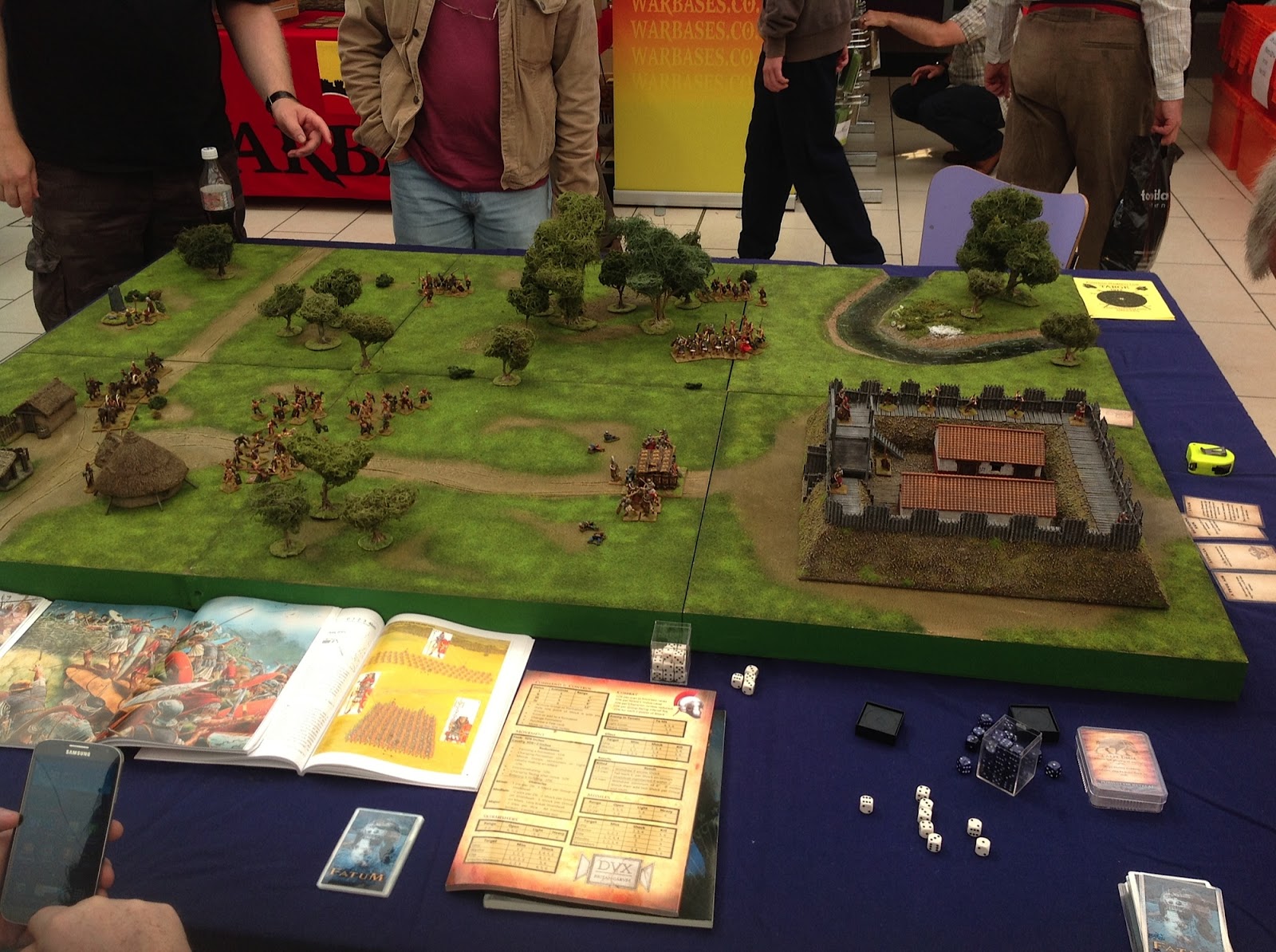
Dux Belloram I think

No idea what this is, but its a very fine castle model


and finally Tito looks out from his hideout. Not much troubled on this day!


Well done the Edinburgh club for another good show.

Friday, 2 August 2013

The Knights Move at Claymore

Off to Edinburgh tomorrow for the Claymore show. Thankfully the weather forecast is for a cooler day as it can get a bit warm in the atrium at the college. No excuses about the  weather, beach etc for anyone not attending one of the best Scottish shows.

The GDWS display game will be Raid on Tito. Our portrayal of Operation Knights Move, the German attempt to capture Tito at the Bosnian town of Drvar in May 1944.

As always some last minute painting. The Partisans were a bit short of firepower so a quick paint job on these Warlord figures including partisan LMGs and a Soviet 120mm mortar.


Also finished off this Greek (well French actually) 65mm Mountain Gun. It will make an appearance as well. My justification is that this is the Italian version of the Greek uniform and after 1943 the partisans pinched their kit in huge amounts. I have pictures of partisans who look just like Italians. Anyway, they will need something to stop the German paras given their rating in the Bolt Action rules.


So if you are going to Claymore, stop and say hello.


Friday, 26 July 2013

Montenegro

I have published an overview of my recent tour of Montenegro at Balkan Military History.

I can't recommend this country for a visit strongly enough. Plenty of historical interest and enough to keep the family happy with the weather, pool and beach. It is certainly cheaper than most European destinations when you get there, although flights, accommodation and care hire are similar.

The main military highlights included the Austrian forts built in the 19th Century to defend their main naval base at Cattaro (Kotor). The old fortified Venetian towns like Kotor, Perast and Budva. Plus, up into the mountains to the old royal capital Cetinje.

The museums are small but interesting. Here are a few of the exhibits at the excellent Kotor Maritime Museum.


and some more, this time from the National Historical Museum at Cetinje


Thursday, 25 July 2013

CornwellFest


My holiday fiction reading has been a catch up of Bernard Cornwell books. I can remember the day when I would buy hardbacks of his books as published. However, these days I have been a bit slow, not because his writing isn't still superb, but simply because there is so much good historical fiction that has followed in his wake.

My first catch up was with the ongoing saga of Thomas Hookton, the English archer in the Hundred Years War, in '1356'. Essentially this is about the Poitiers campaign, possibly the least well covered of the three great English longbow victories of the conflict. Perhaps also forgotten, that in this battle the men at arms played a big role.

Our hero starts the book commanding his Free Company on mercenary duty in France. He falls foul of the church authorities and gets involved in a search for a sacred relic, the sword of St Peter, la Malice. As always, damsels have to be rescued and great characters come and go before we reach the climax at the battle itself. This is classic Cornwell, written at great pace, strong characters and nearly impossible to put down. And I wouldn't have, had it not been for the distraction of Montenegro.

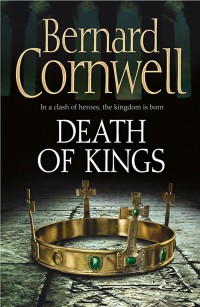
death_of_kingsMy second Cornwell book was Death of Kings. This continues the story of Uhtred, a pagan Dane, sort of in the service of King Alfred the Great at around 900AD, during the off and on conflicts with the Vikings. Again, it has all you would expect from a Cornwell book. Our hero is of course an anti-establishment figure as much at war with the church as with the Danes. More damsels to be rescued, much treachery, all culminating in a big battle scene. All inspiring me to get the SAGA boards out before my holiday ends.

My non-fiction read was 'Realm of the Black Mountain' by Elizabeth Roberts an excellent one volume history of Montenegro. My holiday companion as I toured the country. More details of that trip will be on Balkan Military History when I finish writing it up.

Sunday, 21 July 2013

Guarding the Bokar Kotorska

These are the forts built by the Austro-Hungarian Navy to defend their bases in the Bay of Kotorska, or as they would have described it Cattaro.

I spent the day climbing over several Montenegrin mountains looking at the ruins of the Austrian defences. These are undoubtably the best though. The locals have made good use of what I suspect was the naval base supporting the forts. They have turned it into a beach resort!


Some of the roads up to the forts defending the land approaches to Kotor are very interesting. My admiration of the Austrian engineers who built them knows no bounds. Mind you at 40c even my enthusiasm was starting to wilt by late afternoon. However, I have now recovered, thanks to the excellent local fish and vino!


Thursday, 18 July 2013

Kotor


I am on holiday in the Balkans, where else you might say! To be specific, Kotor in Montenegro.

The old town of Kotor (Cattaro) as shown in the picture below is recognisably the Venetian fortress it was for several centuries until the fall of the republic in the Napoleonic wars. The walls are very well preserved, although the Castle above the town is in some disrepair. There is a small but interesting maritime museum in the lovely old town with its narrow streets, churches and palaces. 

On the subject of Napoleon, his forces did briefly occupy this coast. Napoleon was keen to expand his Illyrian province and sent Marmont to negotiate with the Montenegrin ruler, Vladika Petar in August 1807. The previous year they had fought further up the coast at Herceg Novi and although the French won, Marmont remonstrated with Petar over the Montenegrin practice of cutting the heads off their enemies. Petar responded that the French had no problem chopping the heads off their King and Queen! Fair point, I would say.

There is some British interest. In 1814 Captain William Hoste besieged Kotor with Montenegrin help. Finally capturing the town by dragging cannon up the mountainside. He left the keys with the locals and sailed away without waiting for the Austrians, who by treaty were taking over. It was eventually turned into a major Austrian naval base.

Anyway, interesting history and an absolutely lovely spot for a holiday.


Thursday, 11 July 2013

Master of War


I have just finished David Gilman’s, ‘Master of War: The Blooding’, the first part of his Hundred Years’ War series. Gilman was the writer of the ‘Touch of Frost’ TV series.


He takes the story of Thomas Blackstone, an English archer forced into his Lord’s retinue for Edward III’s invasion of France. The alternative was the hangman’s noose. Our hero takes part in a number of small-scale actions and sieges before the finale at the Battle of Crecy.

This is pretty standard historical fiction in the Cornwall tradition. The writing, as you might expect from a screen writer, is very sharp. The story fairly rattles along. As I bought it for the kindle it is difficult to judge length, but it seemed quite short. As it was only 49p, I am not complaining! The next in the series is due out on 1 August, so I will certainly download that one.

Tuesday, 9 July 2013

Second Barons War

My skirmish with all things De Montfort and early medieval period continues with my latest non-fiction reading, 'The Second Barons' War' by John Sadler.

I recall a previous skirmish with this period when Foundry brought out a very nice range of figures. At their current prices I am not likely to return quickly! However, this conflict was headed by the younger Simon De Montfort, son of the De Montfort who I left suppressing the Cathar heresy in our recent display game Muret 1213.

He led the Barons' in a two year civil war against Henry III and his son Edward - beating the king at Lewes in May 1264 and then losing at Evesham in August the following year. De Montfort was killed in the battle and rebels came to terms the following year.

Sadler writes a very readable narrative history of the period. He starts with an introduction to the tactics and weaponry of the period followed by a background to the reign of Henry II and the First Barons' War 1215 -17. The meat of the book is a detailed study of the two battles based on the latest research.

I may have picked up a remaindered copy quite cheaply, if so, it is very good value for good read.

Tuesday, 2 July 2013

Fleet Air Arm Museum

I made a long overdue return visit to the Fleet Air Arm museum at Yeovilton today. This really is very well laid out. Everything you could want to know and an impressive array of exhibits. Lots of interactive displays as well. Highly recommended.


Monday, 17 June 2013

More Greeks bearing MGs

Some more 28mm WW2 Greeks off the production line for Bolt Action. Another platoon of infantry supported by a heavy machine gun. Still got a mountain gun to finish and then I need to look at some bren carriers and other support weapons.

These figures are from the Burns Miniatures range.


We have also had a major refurbishment in the study and I have a new painting table. This just might inspire me to tackle the ever growing lead mountain - but then again...

The trade off domestically was no piles of untidy paint pots, so I have invested in these really nice paint pot holders from Battle Flag. They are made of mdf and come as kits that fit together really well. Different sizes for different makes of paint.


MDF kits for buildings are really taking off at present and was sorely tempted at Triples. My only reservation is the lack of depth and texture that you get with resin. Apart from the small matter that I could build several cities with the buildings I already have!

Friday, 14 June 2013

In Pursuit of the Robber Baron

One of my favourite medieval characters is Robert Guiscard, a Norman knight who journeyed to Southern Italy to make his fortune.


It was a bit tough at the outset, although much tougher on the locals, as he made a living as a robber baron in Calabria. But by 1057 he had become Duke of Apulia and two years later Duke of Calabria. In 1081 he launched a hugely ambitious invasion of Byzantium via modern day Albania. He defeated the Emperor Alexios at Durrazzo (Dures) and conquered most of Greece, although he didn't have the resources to hold it.

This is also one of my favourite wargame armies and GDWS did a display game of the Battle of Durrazzo in 2005. I have also travelled over large parts of his route in the Balkans.

As a result I was delighted to pick up a copy in Wigtown of Finch Allibone's travelogue of her own journey in pursuit of the Guiscard. She started from his birthplace in Coutances, through Italy and on to the Balkans. She tells Guiscard's story together with her own visits to the sites of interest on the way. An entertaining read if you can find a copy.