Welcome to my blog!

News from a wargamer with a special interest in the military history of the Balkans. It mainly covers my current reading and wargaming projects. For more detail you can visit the web sites I edit - Balkan Military History and Glasgow & District Wargaming Society. Or follow me on Twitter @Balkan_Dave
or on Mastodon @balkandave@mastodon.scot, or Threads @davewatson1683

Saturday, 29 October 2016

The Madagascar Plan

My latest fiction reading has been The Madagascar Plan by Guy Saville. His first book in the series Africa Reich, was the very first book I read on Kindle and very good it was.

The setting is an alternative history of WW2. The British army is trapped and destroyed at Dunkirk and so Britain sues for peace, leaving the Germans to dominate mainland Europe. They also take over European colonies in Africa and exploit them economically. However, the British colonies are still there as well as resistance forces.


This book takes the story to 1953. It has the same core characters in Burton and Hochburg, the senior Nazi official in Africa. Burton ends up in Madagascar looking for his Jewish lover, who has been sent there by her British secret service husband when he discovers the affair. The Nazis have deported most European Jews there.

There actually was such a plan, devised by Eichmann in 1938 and revised in 1940 after the fall of France made the colony available for this purpose. However, the plan leaked out and was dropped in favour of what became the 'final solution'.

I won't spoil the story, but this volume is a little less frenetic than the first, building more of the context around the action. It is well written and a great read. Alternative history at its best - fiction, but with a credible historical basis. The author is working on the final book in the trilogy, so I will look forward to that.

I mused after reading the first volume on the wargame possibilities. This time I gave it a go, based on the conflict between British and German armoured battlegroups on the Rhodesian border. Centurions for the British and Tigers for the Germans. I used Cold War Commander rules, but you could just as easily use WW2 rules. The figures are 1/200th or 10mm.


The British moved quickly to capture the village, but came under fire from Tigers on the hill. British artillery was effective in destroying the German infantry and the game resulted in a stalemate. The next book in the series will include an open war, with the American's joining in. So that should give an opportunity to try this again.


On the subject of micro-armour, I have been painting some reinforcements for my modern Turkish army in 1/300th. These are painted to represent the Turkish ACV 15 armoured infantry fighting vehicles - recently seen on our news screens, deployed in Syria. They are a licensed version of the US AICV. The models are the nearest I could find - the Dutch YPR-765 from H&R.


Tuesday, 25 October 2016

That pile of lead

My painting has fallen behind of late. All of the usual excuses, but also I do better when I have a target like a show. My next big project is going to be 1848 Hungarian revolution, but the new figures are coming out slowly and I need something to get me back into the groove. 

So, I turned to the that huge box that every wargamer has. You know the one. Full of those half projects you never started, or finished. The odd figure you picked up at a show, thinking, 'that will come in useful', but it never does!

The first figures from this particular project have come off the painting baton. 

First up, some figures for my Game of Thrones project. A couple of Perry's late medieval's as standard bearers for historical units that can be used in a GoT setting. Plus this year's Salute give away.


On the subject of Salute giveaways. My Dragon Rampant goblins lacked a commander. Low and behold the box surrendered a goblin king figure. Just the job!


And finally, while I have only dabbled with Frostgrave, the figures are really nice. I can use this wizard and apprentice for Open Combat.


Now, what else is in the box, or in my case, many boxes!


Monday, 17 October 2016

The Norman Campaigns in the Balkans 1081-1108

Self evidently a book with the title ‘The Norman Campaigns in the Balkans 1081-1108’ is going to be on my must read list. The story of the Normans in Italy, as brilliantly told by John Julius Norwich, inspired my interest in the Normans much more than the Norman conquest. A Sicilian-Norman army served me well for many years on the wargames table.


It is one of history’s great stories. How a handful of Norman knights made their way from mercenaries to rule impressive and multicultural kingdoms.

Norwich covers the Norman conquest of Italy and Sicily, but says little about Robert Guiscard’s invasion of the Byzantine Empire in the Balkans. Georgios Theotokis in this new study (in affordable paperback) covers similar ground in his description of the events in Italy. He describes the Norman and Byzantine institutions and their respective armies. He also covers a neglected subject, the navies of both sides.

The invasion of the Balkans is covered in just two chapters, less than a quarter of the book. In fairness, he covers all the primary sources and therefore there probably isn’t much else to say. None the less, the title is a bit misleading.

The most famous battle is Dyrrhachium 1081, which GDWS did as a display game at the Glasgow Wappinshaw show in 2005. Not forgetting the role played by Guiscard’s wife Sichelgaita in rallying the Normans.


This is a solid academic study, although far removed from Norwich’s glorious narrative that reads more like a work of historical fiction. If you have read nothing about this period, I would read this book first and then move on to the story telling master that is John Julius Norwich.


Saturday, 15 October 2016

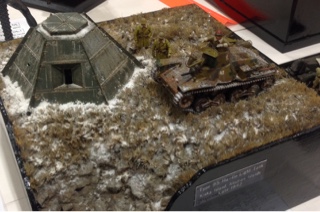
IPMS Glasgow Modelfest

I didn't have enough time today to get up to Forfar for Skelp, so I went to the Glasgow Modelfest IPMS show at Bellahouston. Some very fine modelling on display and picked up some paints and other bits and bobs. 

Here is a selection of the models that caught my eye.


Wednesday, 5 October 2016

Sharp Practice 2 - India

My latest Sharp Practice game takes us back to the 18th Century, with the British in India fighting the Mughals around the time of Plassey in 1757. Another opportunity to use my new Deep Cut desert terrain mousepad mat.

These are the army lists, 52 points a side.


The Mughals are grouped around the village with infantry in the centre and cavalry on the flanks. 'Clive' positions his best regulars on the left with his sepoys on the right.


Three units of Mughal horse storm across the table and hit the British regulars on the left flank.  However, the sturdy redcoats held firm and repulsed the charge. I found a rule I had missed in the last game that says cavalry have to rally off shock after falling back, before advancing again. This makes cavalry a bit weaker, other than in the first charge. There are lots of rules like this dotted around the book. I feel the need for a process chart coming on.

The sepoys were not so sturdy. Swept away in the first charge.


The centre exchanged fire at range to limited effect, before the left wing Mughal cavalry swung around to seriously weaken the British centre.


The game petered out after that largely because of officer wounds. Another rule I didn't play properly last time. It can very quickly reduce the initiative level of officers, making it difficult to do anything. Of course the alternative is to keep officers out of the way!

Overall, another interesting game. In comparison to 'The Men Who Would Be Kings' rules, it is a lot slower and the SP2 has quite a bit of detail that you forget when not playing regularly.

Tuesday, 27 September 2016

Waterloo - The French Perspective

My latest reading has been Andrew Field’s book ‘Waterloo: The French Perspective’.

It’s an old adage that history is written by the winners and that is certainly true for Waterloo. It is even alleged that Wellington supported a smear campaign against Siborne because his research questioned parts of the Duke’s version of events. The author of that allegation, Peter Hofschroer, also wrote a book on the Waterloo campaign, the second volume of which is called ‘The German Victory’. The Duke really would have turned in his grave at that!


Waterloo was of course a massive battle in terms of the men involved, even if the battlefield wasn’t that large. However, even walking it 200 years later, I was struck by how difficult it was see all parts of the battlefield - there was no Lion monument in 1815! Added to which you have the general’s curse on any black powder battlefield, smoke.

For this reason, even the memoirs of those present, can only cover a relatively small part of the battlefield. And that’s before any historical revisionism comes in.

Andrew Field has done a wonderful job pulling together French perspectives of the battle. It gives a very different picture of the battle and questions what those of us brought up on the classic British histories have come to believe about the battle. He doesn’t claim to have discovered radically different ‘truths’, but he does offer some very different explanations.

For example, I always understood that the action at Hougoumont, drew in greater numbers of French troops from Reille’s Corps, almost to Blenheim proportions. In this book it is argued that many more Allied troops were engaged in the vicinity of the farm, bringing each side up to similar numbers. There also appears to have been two, if not three, break ins.

Field also discusses the type of column d’Erlon used in his attack, suggesting that the wide formation was influenced by his experience of fighting the British in Spain. They certainly did not come on ‘in the same old way’. This still leaves open the wisdom of experimenting in such a crucial battle, but he does explain the problems in coordinating the classic cavalry, artillery and infantry combined arms assault. Similarly, the great cavalry charges were not entirely without precedent and may have been forced on Napoleon by the arrival of the Prussians. 

Field goes on to examine the other key elements of the battle - La Haye Sainte, the sunken road, Planchenoit and the commitment and formation of the Guard. Liberally quoting from French and Allied sources. 


This is a fascinating book and an absolute must for the Waterloo collection.

Sunday, 25 September 2016

The Men Who Would Be Kings

First try yesterday of the latest Osprey Wargames rules, 'The Men Who Would Be Kings'. These are written by Daniel Mersey, the author of Lion Rampant and have a number of design similarities.

These are quick play skirmish rules for the colonial period - roughly Sikh Wars to the Boer Wars. Skirmish in this context means 40-50 figures a side, more for the native armies, although there is 'skirmish kings' options to play with half sized units. There is also a very useful solo gaming chapter called 'Playing against Mr Babbage'.

A Field Force consists of a around five units, each of which has a leader, the competency of which is diced for in each game. A European force might consist of regular infantry and irregular auxiliaries. Infantry units have 12 figures, cavalry 8 - while tribal units are 16 for foot and 10 for horse. There are rules for artillery, but they are assumed to be light mountain guns or machine guns.

Each unit is diced for in the activation phase, needing to equal or exceed the leader's command factor. If passed, the unit can take one action - move, double, skirmish, shoot, attack etc. Some are free actions, like regulars can always fire without dicing - tribal units can always attack. Shooting and combat are straightforward rolls for each figure, having to equal or exceed the units firing factor. Cover and other factors are accounted for in the number of hits needed to kill e.g. long range and soft cover needs two hits. If a unit suffers casualties it takes a pinning test. Pinned units have to rally next move rather than take an active action.

For my trial game, I decided on a more obscure colonial conflict. The Ottomans occupied the Middle East from the 16th Century until the 20th Century. Egypt strayed in and out of the Empire, but the core lands in Palestine, Syria, Lebanon and modern Iraq had Ottoman garrisons throughout. The Arabian Peninsular was also garrisoned, although control of the interior was patchy at best. There were major wars with the Saudis and lower scale conflicts with the Kurds and Bedouins. Policing actions were commonplace, very much at the scale these rules are aimed at.

The army lists are set out below for the Ottomans and an Arab field force of the standard 24 point size.


The game was a simple encounter game around a a small village. The Ottoman regulars held off the Arabs on the left, but the Arab right wing swept around the village rolling up the Ottoman line.


The rules played very well and like Lion Rampant they are simple mechanisms, yet subtle in their application. This was perhaps an unusual game given the number of tribal cavalry on the table. Cavalry are possibly a bit strong, with infantry needing two hits per figure. I am not sure what the justification is for this and it certainly made the Bedouin and Arab cavalry very difficult to beat. Other than that, the rules provided a quick game, with plenty of colonial flavour. It's certainly faster play than Sharp Practice 2. I will be playing more of this.


Saturday, 17 September 2016

Sharp Practice 2 - Jacobite Rebellions

I do enjoy an alternative history, and my latest reading has been Year of the Prince by George Kearton. 

As he says in the introduction, for over 50 years at the beginning of the eighteenth century, thousands of Britons would not drink to the health of their regnant Royal Family. Instead, after passing an open hand surreptitiously over their glass, they would drink a toast to “The King over the Water”; a reference to the heirs of the exiled House of Stuart. The final Stuart attempt to regain the throne failed in 1745. But what if history had turned out differently?

I won't ruin the book for you, but it's a good short read and not too fanciful. Like many events in history, it only takes a small a bit of luck, bad weather etc to create a very different outcome.

As I am exploring Sharp Practice 2 at present, this was an opportunity to dust down the forces I did last year for the 300th anniversary of the battle of Sherrifmuir 1715. This was an earlier Jacobite rebellion and involved the legendary Rob Roy, an ideal character for Sharp Practice. I also fancied trying the rules out in a town setting.

We start with some preliminary baiting. A bare arsed highlander taunting the lowland Scots militia. Should they hold their first fire for a bigger target?


Rob Roy is getting a little frustrated here with these Jacobite gentlemen, who are not rushing to support his clansmen's charge. Too many tiffin breaks!


Here we have the highland charge from both angles. The tomahawk rule works well.


And finally, a celebratory drink for Rob and his men. Job done!


Sunday, 11 September 2016

Game of Thrones - The Riverlands

Time to return to other painting projects after doing little other than Pancho Villa.

For Game of Thrones, I have switched from Saga to Lion Rampant rules. That means six figure cavalry units. I had some spare Lord of the Rings figures to bulk out the Lannister's and the Stark's.

Next stop is some allies. The Riverlands went both ways and looking at the last episodes of the TV series, I was struck by how so many of the cavalry looked like Border Reivers. So I picked up some Foundry Reivers at a recent show. The pistols had to be shaved off, but otherwise fine. A (sort of) Tully flag from Battle Flags finishes them off. Next stop some infantry.


Sunday, 4 September 2016

Matters 19th Century

I was listening to one of the highly recommended History Network podcasts on my Sunday morning walk. This one covered the history of the torpedo and briefly mentioned that the first successful torpedo attack in history was during the Russo-Turkish War. The naval aspects of this conflict have largely passed me by.

On January 25, 1878, two Russian steam cutters “Chesma” and “Sinop”, successfully sank the Turkish ship “Intibach”. The steam cutters belonged to the steamboat “Grand Prince Konstantin”, the fastest Russian ship of the Black Sea Fleet. The commander of the steamboat, Lieutenant Stepan Makarov, was genuinely interested in new technologies and new weapons, having already completed a number of operations against the Turkish fleet. More on this clash here.

On the subject of 19th Century conflicts, SteveBarber Models have brought out a new range of 28mm figures for the 1848 revolutionary wars. Needless to say the Hungarian figures caught my eye, they look fabulous. Austrian's are on the way.


I was tempted to try this when Ralf Weaver brought out his book on the subject (Hungarian Army 1848-49 from Partizan Press), but couldn't settle on a figure range to convert. This new range settles that problem when you consider that it will be perfect for Sharp Practice 2.

While on this subject I should also give a mention to Outpost Miniatures, Russo-Turkish War range. They have added Romanians to the range, again very nice.


Thursday, 1 September 2016

A Wounded Realm

This is the second book in the 'Blood of Kings' series by K.M.Ashman. I reviewed the first one, 'A Land Divided', in June. The setting is post-Norman conquest Wales.


The second book takes up the story some 12 years later. The 'Hero' of the first book, Gruffydd ap Cyan still languishes in the prison of Hugh the Fat, a Norman marcher lord. An opportunistic escape, allowed him to flee to Ireland where he recovered, and in an alliance with the Vikings, captures Ynys Mon (Anglesey).

This book takes in more of the English power struggles of the time. The link is a Welsh princess who becomes the mistress of William II's brother Henry, who takes the throne on William's death in a hunting accident, or maybe not so accidental - the author unsurprisingly plumps for the latter.

We have a good siege at Pembroke, one of the castles the Normans built to consolidate their lands. And finally, the dramatic rescue of another Welsh prince, Hywel ap Rhys from the Norman castle at Hen Domen.

The storyline in this book is bittier than the epic struggles of the first, but the author captures well the complex power struggles between squabbling Welsh kingdoms, the marcher lords and the English crown. It has all you could want in historical fiction, while keeping pretty close to the historical record, such as it is.

Really enjoyed this again and looking forward the the third book when it is published.

Here is a photo of a Lion Rampant clash I played out when I finished the book with Welsh spearmen facing up to the dreaded charge of Norman knights.


Saturday, 27 August 2016

Cold War Commander - Greek/Turkish border

Recent events in Turkey reminded me to dust down my 1/300th micro armour collection of modern Turkish forces, together with the Greeks, for a fictional (I hope) clash on the border. 

Greek-Turkish rivalries are long standing, and despite both being NATO members, they maintain significant forces on the common border. There have been many attempts to resolve their outstanding differences in the Aegean and Cyprus, but with limited progress.

It has been argued (Heraclides 2011) that this lack of progress is because various incompatible conflicts are but the tip of the iceberg. The real reasons for the impasse, the essence of the rivalry, are the historical memories and traumas, real or imagined that are part and parcel of their national narratives, together with their respective collective identities which are built on slighting and demonising each other.

The next question was, what rules should I use? My rules of choice for the modern period has been Modern Spearhead. It's a good system, even if the movement mechanism is a bit clunky. A game at a pals introduced me to Cold War Commander, the modern version of Blitzkrieg Commander. I bought a PDF version of both rules, but lost them when I thought iBooks backed up on the Cloud - warning, it doesn't! You can't buy a set at present because Pendraken have bought them and are planning to update them (sadly a delayed project), but I borrowed my pals spare copy.


Cold War Commander is a fast play system, with some fairly simple mechanisms that can be picked up quickly. Each command (typically a battalion) has a command value and you can move, fire etc by rolling below that value. When you get close, an initiative stage allows one move without an order. Each base (typically representing a platoon) has movement and firing stats on army lists in the rules. You roll a number of dice for hits and armoured units have a saving throw. Lots of abstractions, but the game flows quickly and I like them.

Onto the game. This is the table with the Greek armoured battlegroup nearest and the Turkish equivalents crossing the river. The objective is the small town. 


The Turkish infantry win the race for the town, but their supporting tank units are a bit slow.


This enables the Greek infantry to capture the town supported fully by their own tanks. Both sides had artillery and air support, but they didn't dominate.


I enjoyed this game, which has rekindled my interest in the period.

Sunday, 21 August 2016

Sharp Practice 2: Austro-Turkish Wars - Peterwardein 1716

This month is the 300th anniversary of the Battle of Peterwardein in 1716. The Austrian's, led by Prince Eugene, defeated the Ottoman Turks. The Fortress of Peterwardein (Petrovaradin) is on the Danube, opposite the modern Serbian city of Novi Sad.

GDWS did a big display game of this battle at Claymore in 2006, as part of a series we called Eugene in the Balkans. With Sharp Practice 2 I thought I would dust down some of the figures and scenery.

Here is the table with part of the fortress on the left and the Ottoman siege works on the right.

Sipahis supported by light cavalry attacking an Austrian formation in the centre.


Janissaries and Arnaut skirmishers on the left engage with another Austrian infantry formation supported by Croats.


And on the right Austrian Dragoons and Croat Hussars engage more Ottoman cavalry.


The Sipahis as impact cavalry were too strong for the Austrian dragoons, although they lost too many casualties to successfully follow up into the Croats. The Jannisaries were defeated by the Austrian foot as were the Sipahis in the centre. All this seemed about right, albeit its only one game.

How to classify Ottoman units is a challenge in most Horse and Musket rules, particularly Jannisaries. I made them regular, but not controlled volleys and aggressive as well as ignoring the no bayonets rule, because of their swords.

My army lists are set out below and I would welcome any thoughts from other players. Thanks.


 This is a link to Serbian TV coverage (starts at 3:12) of the exhibition prepared for the centenary. Nice diorama as well.