Welcome to my blog!

News from a wargamer with a special interest in the military history of the Balkans. It mainly covers my current reading and wargaming projects. For more detail you can visit the web sites I edit - Balkan Military History and Glasgow & District Wargaming Society. Or follow me on Twitter @Balkan_Dave
or on Mastodon @balkandave@mastodon.scot, or Threads @davewatson1683

Thursday, 22 November 2018

RAF Museum London

Being semi-retired means a trip to London for work reasons can be extended to catch up with some hobby interests. One museum I haven't visited for many years, is the RAF Museum at Hendon in North London.

It reopened earlier this year with new exhibition halls and very impressive it is too. The school kids were clearly enjoying it as well, with plenty of interactive stuff to get them engaged.

The entrance hall gives you an overview of the 100 years of the RAF, including some very realistic cut outs of RAF personnel. I was just about to ask this one something before I realised!

The entrance hall includes the shop and cafe. Sipping a coffee under the wings of a Sunderland flying boat, reminds you of just how big these aircraft were.


Then on to the WW1 hall which has fine collection of the aircraft of the period. Getting close up gives you a feel for how exposed the pilots and other air crew were.


The next hall jumps somewhat in chronological terms to include the modern jet fighters.


The museum isn't just about aircraft. The RAF Regiment is recognised as are the naval craft used to rescue pilots from the sea.


Finally, the main halls, crammed full of WW2 and later aircraft. The US Air Force hanger at Duxford is very impressive, but this really is the business. Here are just a few, starting with the obscure - The Stranraer Flying Boat.


The Lightning because it was one of the first Airfix kits I built.


 The Falco and the Kittyhawk, just because they look great!


Can't leave out the Stuka.


The Chipmunk because it's the only RAF plane I have actually flown in and, very briefly, flown.


Finally, the Vulcan because, well it is the Vulcan!


It is hard to do justice to the range of exhibits in a short blog post, but I hope it encourages other to make the trip. You won't regret it.
  

Tuesday, 20 November 2018

Alexander and the Baltic Landeswehr

I was in the Guards Chapel in London last July and came across the memorial to Field Marshall Harold Alexander. He is best known as the Supreme Allied Commander in Italy from September 1943 until the end of the Second World War. He was commissioned into the Irish Guards and there is a very fine statue of him outside the Guards Museum.


With my usual fascination for obscure conflicts, I noticed that his list of commands included the Baltic Landeswehr 1919-20. What on earth was an Irish Guards Colonel doing commanding what sounds like a German unit in 1919?


It has to be said that details of the Latvian conflict are a little thin on the ground. The Royal Navy’s intervention is well covered and I have a decent book on the Estonian War of Independence. 

However, we do know that Alexander was part of Sir Hubert Gough’s Allied Mission to the Baltic (an interesting character in his own right) tasked with removing Germans from the region and supporting the Baltic States against Bolshevik efforts to recover this territory. Fighting in the region was very confused with German forces trying to establish territory for themselves and local Germans (known as Balts). There were also nationalist units controlled by the newly formed Baltic States and the Russian White and Red armies.

The Baltic Landeswehr was originally commanded by a German of Scottish descent, Major Alfred Fletcher, who largely replaced native Latvians with Germans. After their defeat at the Battle of Wenden in June 1919, the allied mission negotiated the Strasdenhof armistice, which saw the withdrawal of German troops. Alexander took over the Landeswehr in July 1919, which left him in the bizarre situation of commanding a brigade sized force officered by his ex-enemies on the Western front.

The most detailed account of his service I have found is in Nigel Nicolson's biography 'Alex: The Life of Field Marshall Earl Alexander of Tunis' (London 1973). He spoke good German so there was no language difficulty and he started by removing the Germans, but not the Balts. He reorganised his command into three battalions and a cavalry squadron.

By October, he was in the front line undertaking major raids against Bolshevik positions. He then persuaded the Landeswehr to stay in position when a civil war was going on behind them. This loyalty held even when he was wounded in an attack on the village of Lievenhoff and spent two weeks in the hospital.

A major offensive was launched in January 1920, which liberated most of Latvia. The Landeswehr played a key role in that campaign, advancing 100 miles in 20 days and capturing over 800 prisoners. The opposition was not strong, but the weather was appalling.

Alexander was something of a romantic - a sort of Baltic Byron. He even considered purchasing an estate and staying in Latvia. However, the peace treaty resulted in the Landeswehr becoming a regiment in the new Latvian Army and he headed for home.

There are a few photographs of Alexander in the uniform of the Baltic Landeswehr knocking around the web.

Wikipedia

Mark Collins posted these on Twitter. I doubt if those were regulation mittens!


There is a collection of mail sent by the British forces attached to the military mission. Most British troops understandably wanted to go home at the end of the First World War. There was also plenty of political opposition amongst the ranks and at home against the allied military intervention in the Russian Civil War. I did rather like this card, although perhaps not the most romantic effort to say, 'so get on with it'!


Overall, an interesting story that clearly had a big impact on Alexander. He met a number of his Balts again during the Second World War in Italy and later, when Governor General of Canada, secured visas for some of them.

Sunday, 18 November 2018

Battle of Loudoun Hill 1307

Those who have watched the new film 'Outlaw King', will be aware that the film culminates in the Bruce victory at the Battle of Loudoun Hill on 10 May 1307.

I enjoyed the film, which thankfully didn't repeat the embarrassing nonsense that was Braveheart. However, it was not without its historical inaccuracies. The film portrays Edward I's death before the battle when he actually died some two months later. We also had Edward II stomping across the battlefield, when not only was he not the king, but it is highly unlikely he was there at all.

So what do we know about the battle?

After his coronation and the disaster of Methven in June 1306, Bruce traveled around the west of Scotland, rebuilding his forces and alliances. In 1307, he conducted a guerrilla war until he had sufficient troops to take on the English occupation army and their Scots allies. It is important not to view these wars through modern nationalist eyes. This was also a civil war between the Bruce and the Comyn families, which Edward exploited for his own purposes. In the feudal world, a man owed loyalty to his family, not his country.

Bruce's forces won a victory at Glen Trool in March 1307. Over very rough ground, it is likely to have been little more than a skirmish. None the less, it caused Edward's commander in Scotland, Sir Aymer de Valence (Brother in law to the murdered Comyn) to gather a larger force and advance into the Bruce Earldom of Carrick (largely modern Ayrshire). This was a mounted force with estimates varying between 1500 and 3000 strong.

Bruce picked a strong defensive position and had around 600 spearmen. The road narrowed through boggy ground, which Bruce strengthened with ditches and stakes. Crucially, Valence had no bowmen so was forced to charge the spearmen frontally over a narrow frontage which negated his numerical superiority. The first division failed and the resulting confusion caused the rest to flee the battlefield. Bruce was unable to pursue on foot, so casualties were fairly low on both sides.

The significance of Loudoun Hill was not the scale of the victory, but rather the propaganda value. Even more important was the death of Edward I, which is resulted in his heir having to concentrate on matters in England. This allowed Bruce to win the civil war and prepare for the next proper invasion, which culminated in Bannockburn.

The battle scene in the film itself was pretty accurate, given it was filmed in a park north of Glasgow, with the distinctive Loudoun Hill superimposed. No woad, tartan, tree trunk pikes, or the missing bridge - as in Braveheart!

I live fairly near the battlefield and have passed through it many times. Usually on the start or end of a long journey south, so I have never properly explored it. Inspired by the film, I set off last Friday to rectify that. It was a suitably misty morning, very atmospheric for the task in hand.

We don't know exactly where the battle was fought, but Historic Scotland's battlefield inventory gives a decent estimate. The battlefield has had some modern development - a couple of farms, small reservoirs, a sand quarry, and a disused railway. The modern A71 largely follows the Roman Road, which is likely to be the road described in the sources. The ground around the hill is very rough going with the River Irvine cutting through it. This leaves really only one likely site near Allanton Farm and the sand quarry. Probably not exactly where it is marked on the Ordnance Survey map. As you can see from this photo, the ground is very flat in the eastern approach to the battlefield.

I decided to have a look at the likely site from different angles. Starting with Loudoun Hill itself.


This is the view of the site from the ridge below the hill or the northern view.


Then I approached the site from a spur of high ground above the river from the east.


And finally, from the road itself or the southern and western view.


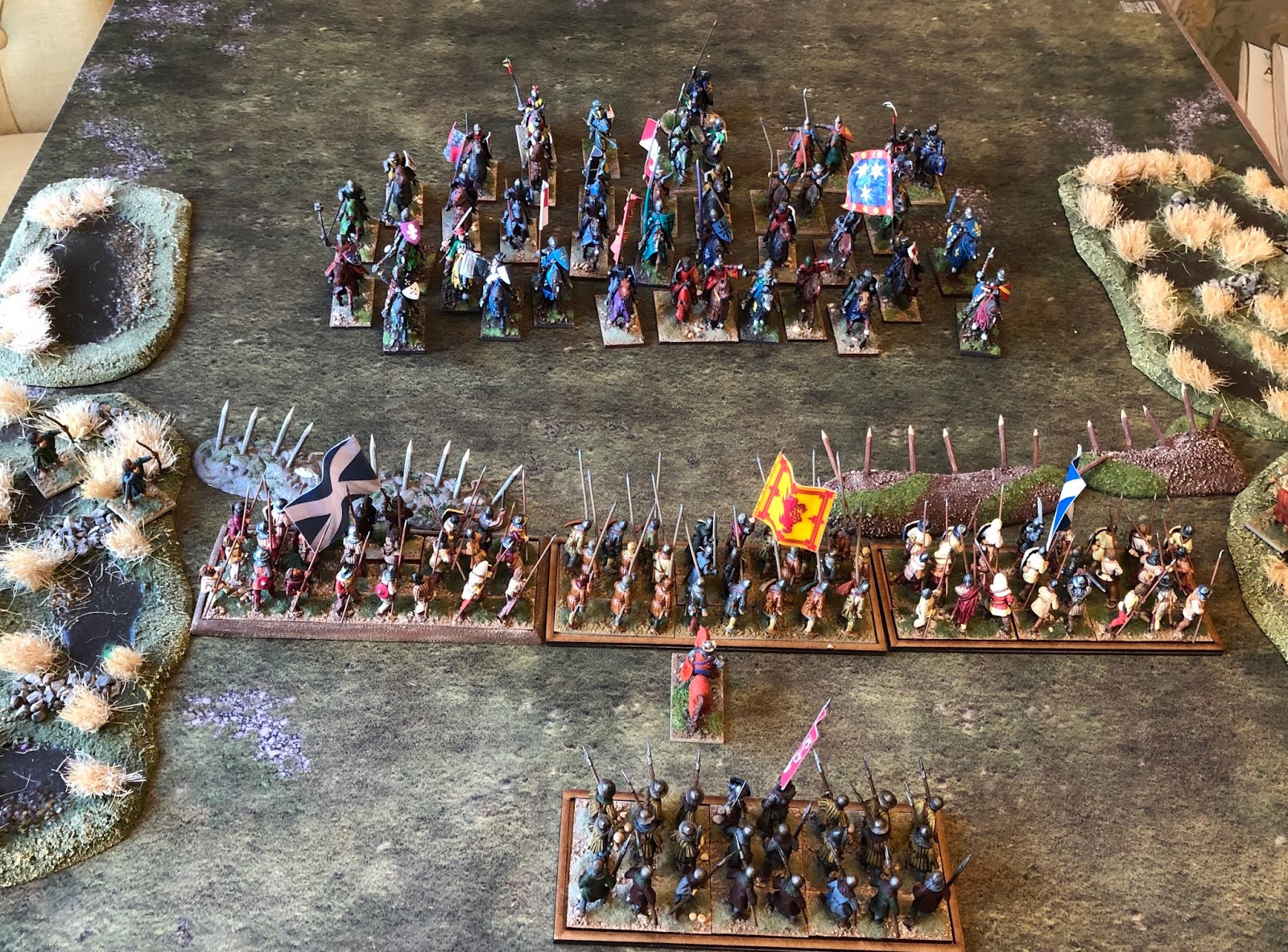
Walking a battlefield is one experience, refighting the battle on the tabletop is another. I collected a 28mm army for this period in order to complete a display game for the Bannockburn 700th anniversary in 2014.


Valence's first division advances. As our main source for the battle, the chronicler John Barbour relates: "Their basnets were all burnished bright and flamed in the rays of the sun and their shields, spears and pennons lighted up all the field."


And finally, the clash of spear and knight.


The film is a worth a watch, but as ever, it's always worth visiting the actual battlefield.

Monday, 12 November 2018

With Tegetthoff at Lissa

I picked up this slim volume at the Helion stall at Fiasco - the memoirs of a junior Austrian naval officer between 1861 and 1866.

Naval history is not usually my thing, but this is an interesting period as navies transitioned from wood to steel. The book culminates with the Battle of Lissa between the Austro-Hungarian and Italian fleets. Lissa is modern day Vis, a lovely island off the coast of Croatia, on which I spent a very pleasant and informative week a few years ago.


The author is Maximilian Rottauscher, who joined the modest Austrian navy in 1861 as a midshipman. This was, even by the standards of the time, a pretty tough life.

He was assigned to a number of ships including the frigate Novara and the schooner Saida, in which he went to Greece in 1863. His first taste of action, albeit limited, was in the North Sea during the Second Schleswig War, aboard the frigate Radetzky.

His memoirs conclude with the Battle of Lissa. Fought on 20 July 1866 during the Seven Weeks War. This was one of the first ironclad battles and the last to include ramming as a deliberate tactic.

He served on the wooden frigate Adria, albeit with some additional protection. He describes his experiences in the battle, which are inevitably as confused as any front line observer. The outnumbered Austrians under Tegetthoff heavily defeated the Italians under Carlo di Persano.

The victory was overshadowed by the defeat to the Prussians and the subsequent loss of Venice to the Italian state. Ironically, the port our author sailed to the battle from, along with a number of Venitian sailors.

The translator helps the general reader with a number of explanatory notes and has produced a very readable book.

The harbour at Vis (Lissa) today
Austrian Fort in Vis

Sunday, 11 November 2018

Commemorating the sacrifices of the First World War

This is a very special Armistice day, marking the centenary of the end of the First World War. It ends four years of anniversaries that commemorate the events of that terrible conflict.

There can be little doubt that we are more aware of the First World War as a consequence of the huge effort that has gone into events marking the centenary. Financial investment from the Lottery, Arts Council and governments have been supplemented by books, films, TV and radio programmes. But has that investment challenged some of the common myths, or done enough to recognise that the conflict didn’t just affect young white men on the western front? 

The Scottish Government’s Commemorations Programme has attempted to widen the subject with events covering the sinking of the SS Tuscania off Islay and the Quintinshill rail crash. A conference and exhibition celebrating the work of Dr. Elsie Inglis was an example of highlighting the role of women – the Serbian post office even produced commemorative stamps. However, despite these efforts, the abiding memory will be of Scots who died in the battles on the western front – important of course that those events were.


There has been an effort to acknowledge the role of the four million non-British soldiers that fought in the conflict – David Olusoga’s TV series and this week’s focus on the Indian Army are good examples. There has also been more about the home front and local histories. However, in the main, they have been drowned out - the western front, poppies and Tommies remain the most familiar iconography.

Other important fronts get very little coverage. I suspect very few people understand the role the Macedonian campaign played in ending the war, even though it involved two British Corps. With Serbian and French troops they advanced as far as Austria. Let alone the huge battles on the eastern front, Italy and the Middle East – and lesser-known campaigns in Africa and the Far East 

On many of these fronts, the war and its consequences didn’t end on Armistice Day. The crumbling of empires, the Russian Civil War and the related Polish-Soviet War went on until 1921. The Greek-Turkish War resulted in the ethnic cleansing of 1.6 million people. For many countries, November 1918 marks independence or the dismembering of their state. Hungary lost half its population and two-thirds of its territory. 

Many of these events have a bearing on the Europe we live in today. As Guardian columnist Natalie Nougayrede put it; 

“The point is not that a unified narrative should be imagined. Rather, it is that we would all gain from better awareness of the mosaic of European memories of 1918. The Europe we live in today still has its roots in that past.”

The same is true for the wider world. The British and French ended the war with even bigger empires in the Far East, Africa and the Middle East. These created the conditions for future conflicts and were certainly a poisoned chalice for Britain.

Our perspective of the First World War has changed over the years. In the 1920’s the monuments used the language of glory, honour, dominion and power. As the war poet, Wilfred Owen said: “The old lie: Dulce et decorum est; Pro patria mori”.

At the other end of the spectrum, I was brought up in the period of, ‘Oh What a Lovely War!’ and the ‘Lions led by donkeys’ view of WW1 generals. There have been some revisions of that view and lessons were learned as the war progressed and generals unlearned the lessons of the last war. The BBC ‘100 days to Victory’ series covers some of this.

The BBC History Magazine asked two historians of the conflict the question, Was it Worth It? 

As Professor Richard Evans says, it is not the job of historians to tell people in the past what they got wrong, but rather to explain how and why things happened. However, he reminds us that millions of British soldiers who fought in 1914 didn’t have the right to vote – so it wasn’t a war for democracy. He argues that it actually ended progress towards greater democracy in many countries and replaced it with brutal and corrupt dictatorships. Much of this was caused by the economic disaster that was another consequence of the war.

On the other hand, Professor Gary Sheffield argues that imperfect though the world undoubtedly was in 1919, it would have been much worse if there had been a German victory. Even if the Royal Navy kept Britain free from occupation, it would have faced the nightmare of a hostile continental Europe and the end of liberal democracies. 

Whatever view we take of the historical events, it remains the case that millions gave their lives in the conflict and afterward, for a cause that, at the time, most people supported. They made the ultimate sacrifice and it is right that we should remember them - red or white poppy, in the way we each deem to be appropriate.

Sunday, 4 November 2018

Carnevale

Carnevale is a game of fighting along the canals of Venice, published by TTCombat. I backed the basic kickstarter and it eventually arrived last week. About six months late, but I have heard of longer delays with kickstarters.

The setting is Venice in 1795, with a twist. The 'Rent in the Sky' has unleashed magic and ancient creatures alongside the usual array of characters you would expect in the 'City of Masks'. This is a gang game with a number of factions prowling the streets and canals. Just a few figures on each side will provide a basic game.

In the kickstarter two player game, you get the 240 page book. This gives the background to the setting, a description of each faction and the basic and campaign rules. The production quality is excellent and the content is well written. The rules take up less than 20 pages and there are separate card quick reference sheets.

Then you need Venice, not an easy setting to create on the tabletop. The solution used in this game is card tiles for the streets and canals. These can be moved around to create different settings and tabletop sizes. Buildings are simple card models that fold together without any further work. I was a bit sceptical about this, but they are well done and it works. Flat roofs don't look quite right but make sense in a game that involves jumping around buildings. You can purchase MDF buildings, but that will not come cheap and personally I am not a fan of any MDF buildings. They don't have the depth and texture of resin without a lot of extra work.


The starter set comes with a number of attractive figures, which are well sculpted. However, this was the biggest disappointment. There was quite a bit of flash and trimming the base flash resulted in several figures losing legs or feet. They are far too brittle. I am not sure why they chose this method rather than the hard plastic used in my other recent kickstarters, Conan and Song of Ice and Fire. Gluing to bases isn't a problem, but they don't feel nearly robust enough for playing pieces. Other models require quite a bit of assembly, not something I am looking forward to with this brittle material.


The basic rules for moving and combat are pretty straightforward. Each character has a card with more available for download from the website. They include factors and a points value which covers speed, dexterity, attacks, and protection. Certain characters can use magic and there is a pack of nicely produced magic spells.


D10s are provided and more skilled characters roll more dice with a range of weapon and protection factors. Some record keeping is required. This photo includes basic citizen figures who roll three dice when attacking, although they can use special factors to supplement the attack.


Overall, the game and terrain look pretty sound. The big failure is the figures, which was probably the biggest selling feature for me. I suspect this is one game that will stay in the box for some time before I garner the enthusiasm for assembling and painting them. On that basis, I am disappointed and can't recommend this product.


Friday, 2 November 2018

With SOE in Greece

My latest reading has covered the wartime experiences of Captain Pat Evans, written up by his son Tom. Pat Evans served with the Special Operations Executive and his main operational duties were in Greece, or to be more accurate Western Greek Macedonia or Epirus. As current events show, names matter in this part of the world!


The role of SOE was to create as much trouble as possible for the occupation forces, or in the words of Winston Churchill to, "set occupied Europe ablaze". This meant operations with his own team and supporting local resistance forces. In Greece, the most effective resistance force was the communist controlled ELAS, which was just as focused on fighting the right-wing nationalist group EDES as the Germans. Added to the mix in Macedonia, were Tito's partisans and various Macedonian groups. Political minefield does not begin to describe his role!

The author has relied on his father's papers and letters as well as the national and Liddle Hart archives. Supplemented by interviews with those still alive.

Pat Evans was based in the Mount Pindus area, which had seen heavy fighting during the Italian invasion. In the civil war that followed the liberation, the mountain villages which supported the SOE forces were largely destroyed by government forces, supported by the USA.

I have traveled a bit around this region and visited a few of the places mentioned in the book. It is ideal territory for guerrilla operations and the Germans never succeeded in destroying the SOE team. The author has done a good job knitting together the sources into a very readable story. Even by SOE standards, this was a tough posting.


Sunday, 28 October 2018

Fiasco Leeds

I travelled down to Leeds today for the Fiasco wargames show. 

Last time I was here it was held in the Royal Armouries, but now it has moved over the square to a conference hall.

The new venue isn’t any bigger than the old and this means it is largely a trade show with little room for games. I picked up books scenery and a nice Lynx helicopter for my modern Brits. 

The games were necessarily on the small size and there were a couple of gems.

My favourite was Ravenna.


I also liked this depiction of the war in Chechnya.


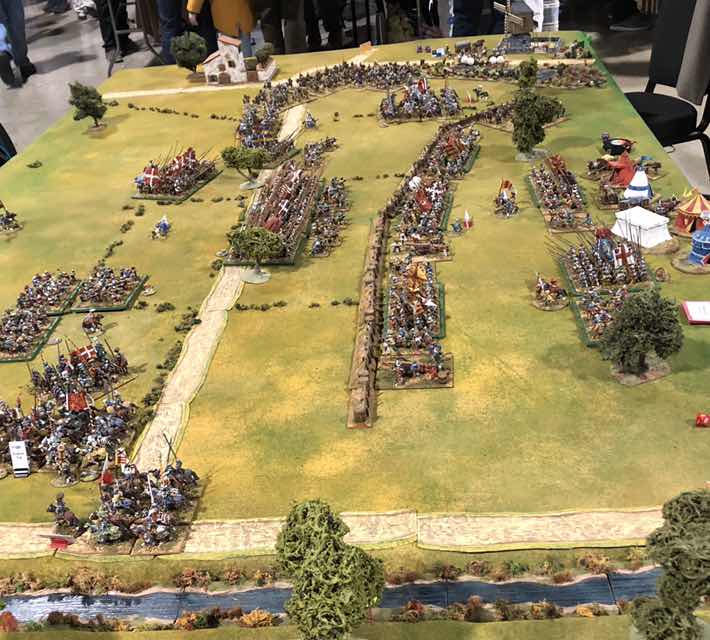
There was some Balkan interest with the Battle of Varna.


Quite a lot of Battletech which will keep some club members happy and other small scale games.


And a WAB Battle - nostalgia in action.


Finally, it is true, all wargamers really are called Dave!