Welcome to my blog!

News from a wargamer with a special interest in the military history of the Balkans. It mainly covers my current reading and wargaming projects. For more detail you can visit the web sites I edit - Balkan Military History and Glasgow & District Wargaming Society. Or follow me on Twitter @Balkan_Dave
or on Mastodon @balkandave@mastodon.scot, or Threads @davewatson1683

Thursday, 29 April 2021

Greek War of Independence in 28mm

 I wasn't going to get drawn into the Greek War of Independence in 28mm, as I have a decent collection in 15mm. I have a number of Steve Barber's excellent figures painted for the slightly earlier Serbian revolution, which I could use at a push. However, yes, you just knew there would be a 'but', a new firm, Old Man's Creations, went and produced a new range. They keep posting these fine castings on the Wargaming the Greek War of Independence Facebook page as well. Drug dealers they are!

Work is consuming most of my time this month, so a small six-figure project was just what was required. The models are cast, I think, in ultracast or similar. I am not a great fan of this medium, and they are not cheap, but this is a niche. I prefer the heft of metal, and I have found other ranges to be a bit brittle. However, no problem with these. Some assembly is required with the weapons, which I suspect would have been damaged in transit without this approach. They are a bit bigger than my Dixon Ottomans, which are small by modern standards.

The detail on the figures is superb, making them a pleasure to paint. I slightly overdid the second wash, but I hope I have the right balance after a bit of touching up. They are probably a bit grimier than others have painted them, but I find it hard to believe that they would have been able to keep white fustanella's pristine on the campaign. I love the heroic oil paintings, but they are not photo-realistic.

Time being of the essence, a skirmish game was called for. I have plenty of suitable Ottomans, so a quick game using Fistful of Lead rules. We actually played twice, fighting over a bridge.

In the first game, I'm afraid I disgraced the revolution by getting slaughtered. Despite drawing some excellent cards, I managed to miss all six shots. In the second game, matters improved, and the Ottomans were sent packing.


All my heroes survived, although a few were worse for wear. They are a fun set of rules and great for a quick game. I hadn't played with muskets before - reloading is a bit of a challenge when you haven't got a lot of cover.


Friday, 23 April 2021

Nigel Tranter - Scotland's Storyteller

 Along with my re-reading of Nigel Tranter's historical fiction, I have been reading Ray Bradfield's biography of the author.


I have always thought of Nigel Tranter as an east coast Scot, but I discover he was, in fact, born in Glasgow. Not far from where I used to live and close to Hampden Park, the home of Scottish Football. The family moved back east fairly early on, and he is rightly associated with East Lothian for most of his life.

We don't hear much in this book about his war service in the Royal Artillery. He was somewhat older than his fellow junior officers, and as a writer, he didn't share their passion for drinking, smoking and sport. However, his quiet war gave him time to write and supplement the family income. 

In the army, he developed his writing technique as he walked, as that was the only way he could get the peace and privacy he needed. After the war, he developed his daily routine of rising at 7am, and after breakfast and prayers, he set off on a walk. He lived for most of this time at Quarry House in Aberlady Bay. His walk would mostly cover the shoreline for ten or twelve miles. In the evening, he would type up his notes on an old typewriter and do some research ready for the next day. At one stage, his typewriter had a faulty 'b' key, so he would type 'o' and then convert by hand. His manuscripts were bound with old shoelaces.

His productivity was astonishing, running to 130 books. Right through the 1950s and 1960s, he was publishing three or four books a year as well as a constant stream of magazine articles. Before he settled down as a historical novelist, he was writing westerns and children's books. It was commonplace for book reviewers to say that Nigel Tranter has taught most Scots all the history they know. If true, it doesn't say much for how history is taught in schools, and Tranter was pretty critical - 'dry as dust', he would say. He would also reflect that "A nation that doesn't know its own history, has lost its memory."

He was also a campaigner, although how he found the time amazes me. After the war, Tranter was heavily involved in the Covenant Association, campaigning for what much later became known as devolution and the reestablishment of the Scottish Parliament. He lived to see it happen in 1999. He wasn't a nationalist and eventually found his political home in the Liberal Party, today the Liberal Democrats. It was while I was working at their conference that I met him. We may not have shared the same politics, but we did share a love of history.

He was drawn into the famous stunt of Ian Hamilton's to steal the Stone of Destiny from Westminster Abbey, first stolen from Scotland by Edward I. Of course, anyone who has read his books will know that he didn't believe this was the real coronation stone. Still, he recognised the symbolic value, and today it resides in Edinburgh Castle. His many other campaigns made him a regular contributor to The Scotsman. I wonder what he would have done with social media!

Film options were bought on several of his books, and stage plays were done on three. If only Braveheart had used his script, it would at least have a semblance of historical accuracy! The best seller was the Bruce trilogy, but his biographer argues that the Montrose books are the best written, and I agree. He also wrote some important non-fiction history. His The Fortified House in Scotland ran to five volumes and documents no fewer than 663 fortified houses, not castles.

The book finishes with a nice end piece which includes, "And tomorrow, he will be out again, striding along the shoreline, this man who has given us back our past, walking with Wallace and Bruce, his mind far distant from the petty concerns of everyday."

A typical page of notes from his daily writing walk


Monday, 19 April 2021

Columba

 My re-reading of Nigel Tranter's historical fiction books continues with the second book chronologically, Columba. The story of St Columba and the high heroic days of the early Celtic church.


His proper Irish name was Colum mac Felim, and he is known in his native Ireland as Columcille. He was born in AD521 and is credited with spreading Christianity to what is today Scotland. He was trained in Ireland and got involved in a religious controversy that may have led to the Battle of CĂșl Dreimhne or the Battle of the Book. This conflict forms the opening chapters of Tranter's story. Consequently, Columba decides to lead a mission to the Scots Irish kingdom of Dalriada (Dal Riata) on Scotland's west coast.

This was a nominally Christian state bordering on the Pictish state of Alba, which was pagan. Columba was given the island of Iona as a base from which he expanded his missionary activities to the many islands off Scotland's west coast. Tranter describes the scenery on his many journeys brilliantly. You can almost smell the sea air. I'm biased because this is one of my favourite places on earth. 

This is the later medieval abbey at Iona as seen today.

One of Columba's many achievements was to link the coronation of kings to a Christian service. This led to many kings being buried at Iona. In 1549 an inventory of 48 Scottish, 8 Norwegian and 4 Irish kings was recorded.

He then decides to launch a mission into Alba and persuades the Pictish King in the capital Inverness to allow missionary activity. Helped by the story of him seeing off the water monster. This is at least one of the stories that underpins the legend of the Loch Ness monster, which draws many thousands of tourists to the shores of the Loch today. En route he also helps the family of the chieftain at Urquhart, now a well known medieval castle.

He continued to establish many churches and monasteries across Scotland and acted in a diplomatic role to bring the various kingdoms together in an alliance against the encroching Angles. He died in 593 or 597, the sources differ. He was buried in Iona but his relics are purported to have been carried by Scottish armies in battle. Something he would not have approved of. This includes Bannockburn in 1314.

I haven't any Picts or early Scots, so here are some Islesmen I painted for a Bannockburn display.

The book is classic Tranter. Fleshing out what we know of his life with narrative and evocative descriptions of his journeys. Great read, although if you like your historical fiction with plenty of battlefield action, you might want to skip this one. Sex and violence is in short supply!


Sunday, 11 April 2021

Bolt Action Ukraine

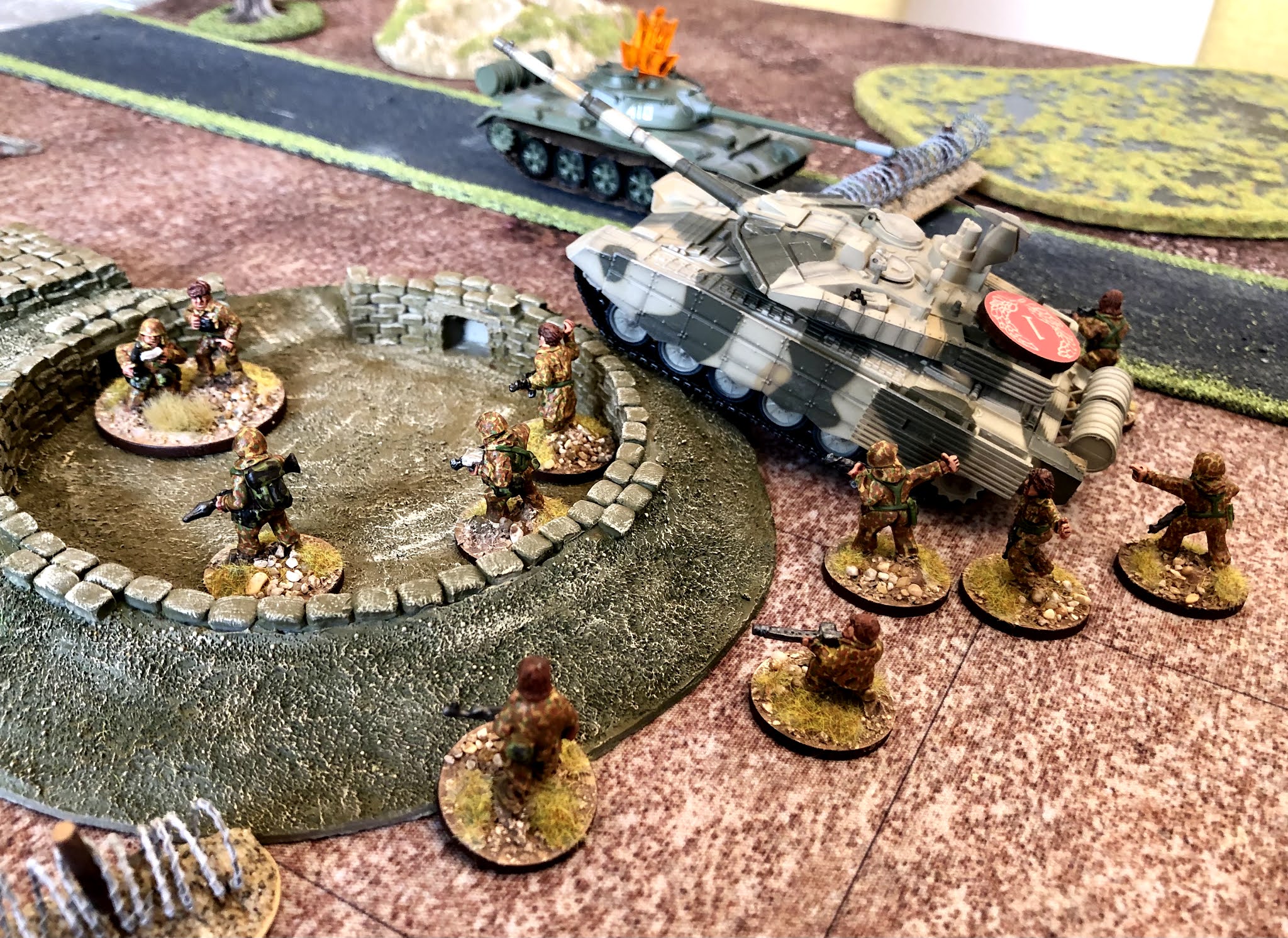
 A friend who works as an academic in Eastern Europe was in touch this week about playing a game over Zoom this weekend. He was writing an article on the current stand-off in Ukraine and wanted to play a modern game based on that conflict. He uses micro-armour, which isn't ideal over Zoom, so we decided to use my 20mm figures and the modern adaptation of Bolt Action. You can download these from Jay's Wargaming Madness.

My initial reaction was that it felt a little close to home, at least for my friend. Wargamers occasionally get this feeling, but then remember that we are only moving model soldiers across a tabletop. Having said that, the situation in Ukraine is a bit worrying, and my friend had just interviewed contacts in Russia and Ukraine. Russia has more troops on Ukraine’s eastern border than at any time since the Donbas war’s “hot phase” in 2014/15 when it annexed Crimea and backed the separatist territory seizures. They are also massing in the Rostov region, which points to a direct attack on Ukraine rather than simply supporting the Donbas' separatists. David Pratt has written a long piece in today's Herald newspaper, which is worth a read. My friend concurred with the Moscow Carnegie Centre analysis“The ostentation with which the troops are being moved confirms that Russia is sabre-rattling rather than contemplating a blitzkrieg,” 

With the US reportedly planning to send ships into the Black Sea to support Ukraine, this could have wider implications. It would only take a spark to start something. As David Pratt concludes, "Only the foolhardiest, however, would claim with any certainty to know what will happen next."

On the tabletop today, there was little comfort for Ukraine. Their troops hold a supply dump that the Russians and their separatist allies are going to attack. 


I sent my best Russian troops and armour down the centre to pin the defenders while working two further squads around the flanks. We kept it simple with no artillery or aircraft. The opening tank exchange went the Russian's way, but a Ukrainian light ATM almost knocked the T80 out. It did succeed in knocking out the BMP on the Russian right.


The Russian left wing squad with its BTR 80 in support made good progress using the woods as cover. But then got shot up badly in a firefight.


The Russian firepower's cumulative impact was beginning to tell as the Russians crashed through the Ukrainian defences. Game over.

The game was all over in five moves, and the rules played well. Let's hope this conflict remains on the tabletop.


Saturday, 10 April 2021

The Anglo-Soviet Alliance

 The Anglo-Soviet Alliance: Comrades and Allies during WW2 is a new look at Britain and the Soviet Union during the Second World War by Colin Turbett. I'll declare at the outset that I know the author, although more from his work on rural social work and his trade union activity rather than his historical writing. Coincidently, I was admiring the view of his Arran home on my walk this fine crisp morning.

As the author outlines in his introductory chapters, the alliance was an odd experience for both political leaders. Churchill had a long history of opposing the Soviet state, persevering with interventions in the Russian Civil War, long after losing popular and political support at home. Stalin, based in southern Russia during the civil war, had good cause to remember the British intervention. As Gabriel Gorodestsky argues, before Hitler's invasion, Stalin viewed Britain as a more significant threat than Germany.

It was also a challenging time for communists and Conservatives in the UK. Many in the Communist Party of Great Britain's (CPGB) initial reaction was to support the war in 1939 as an anti-fascist popular front. However, this line was quickly changed when Moscow dictated a new line following the Molotov-Ribbentrop Pact. The author has a fine collection of pamphlets and leaflets from the period, and he shows how CPGB leader, Harry Pollit's 'How to Win the War', was quickly replaced with Palme Dutt's 'Why this War?'. The idea that carving up Poland was "an extension of the boundaries of world socialism", was a challenging sell, and the CPGB lost popular support. Churchill managed to sell his new line of supporting the Soviets with classic Churchillian rhetoric, "If Hitler invaded hell I would make at least a favourable reference to the devil in the House of Commons."

The book then moves on to the wartime alliance after Operation Barbarossa, although I think he slightly overstates Hitler's war aims, which were actually quite limited. Again Gorodestsky is good on this. Stalin had equally given up on expanding communism, as the Comintern's winding up in 1943 shows. In practice, it hadn't met since 1935. Even the late war strains over Soviet expansion were more about nationalist buffers than any dream of world communism.

The alliance changed views of the Soviet Union on the home front with Soviet newsreels being played in cinemas and the government sponsoring trips to Russia. However, playing The Internationale with other Allied anthems on the BBC was a step too far for Churchill! The CPGB's Daily Worker newspaper remained banned until August 1942. Churchill's wife Clementine was the driving force behind raising funds for Russia, so much so that Churchill told the Soviet ambassador that his wife had become 'totally sovietized'. The CPGB may not have made much progress politically. Still, they were particularly well organised in the trade unions representing industrial workers and achieved important victories for workers on the home front.

While this is primarily a social history, the military aspects of the alliance are well covered. These include supplies to Russia, particularly the Arctic convoys to Murmansk, which had a British base. This resulted in a degree of fraternisation that both the British and the NKVD found challenging. Soviet aircrew were trained at Errol Airfield in Scotland on the Albermarle transport aircraft, and the Soviet female sniper Lyudmila Mikhailovna Pavlichenko (Lady Death) made a hugely successful tour in 1942. 

The story of the convoys is told in detail. We are reminded that around 27% of all serving British merchant seafarers in WW2 died, a much higher proportion than those serving in the armed forces. The crews came from all over the world and the UK, and their service has only recently been recognised.

This is an excellent study of an aspect of WW2 that hasn't received enough attention from historians, covering both the home front and operations abroad. Well worth a read. 


Nearly one-third of the total production of Matilda tanks were exported to Russia. My 28mm model.


Friday, 2 April 2021

Struggle for the Middle Sea

 This is Vincent O'Hara's study of the naval war in the Mediterranean between 1940 and 1945. Having reviewed David Hobb's excellent new book on naval air warfare, I realised there were some gaps in my knowledge of the all-important naval campaigns. This book is just what the Admiral ordered!

The author starts by dispelling some well-worn myths. Not least that the Italian navy was useless, or as one more recent American author put it, "Mussolini's lazy sailors disdained to prepare for serious warfare'. In fact, the Italian navy fought hard and well, keeping Italy's African and Balkan armies supplied for three years and largely controlling the central Mediterranean. Rommel blamed supply shortages for his defeat at El Alamein, claiming only 954 tons of fuel were delivered before his attack. In reality, deliveries amounted to 20,037 tons. In Rome, the Japanese naval attache reported that the Italian navy was sound; their problems were poor collaboration with the air force and outdated night-fighting techniques. Their submarine fleet, although large, were less deadly than their German counterparts due to unrealistic training and flawed doctrine. 

The other point that strikes the reader of this book is the sheer scale of naval action in the Mediterranean. Major Italian warships fought 34 surface actions, and these are all covered in the book, usually with helpful maps and lists of the ships engaged. More surface actions were fought in the Mediterranean by more participants than anywhere else in the war. A total of 55, compared with 49 in the Atlantic and 36 in the Pacific.

Naval warfare has always been crucial to controlling the Mediterranean and to commerce. In 1938, 86% of Italy's imports arrived by sea, and most of that came through British controlled chokepoints at Gibraltar and Suez. Convoy protection played a key role for the Italian and British fleets. In Britain's case, to reinforce Malta and its armies in North Africa and for Italy, the shorter crossing to Tunis and Tripoli.

The German contribution early in the war was primarily through airpower. Later in the war, U-Boats played a growing role with S-Boats and a wide range of small ships ferrying troops and supplies around the Aegean. They also used former Italian warships after the Armistice. 40% of all large warship losses the Germans suffered in the war occurred in the Mediterranean. They accounted for 57% of allied losses. 

The Royal Navy had some important advantages. Not least their better intelligence, having cracked the Italian and German codes, but also the use of radar on ships. This meant they knew roughly when and where convoys were going. The British were also good at night fighting, which meant they could engage without being interdicted from the air. The Royal Navy only lost three major warships, all destroyers, as a result of Italian surface action. 

In summary, the Italian navy fought well; the French were formidable when engaged; the Germans fought a remarkable rearguard action; the Americans came in great strength: and the Royal Navy were workmanlike at worst and brilliant at their best.

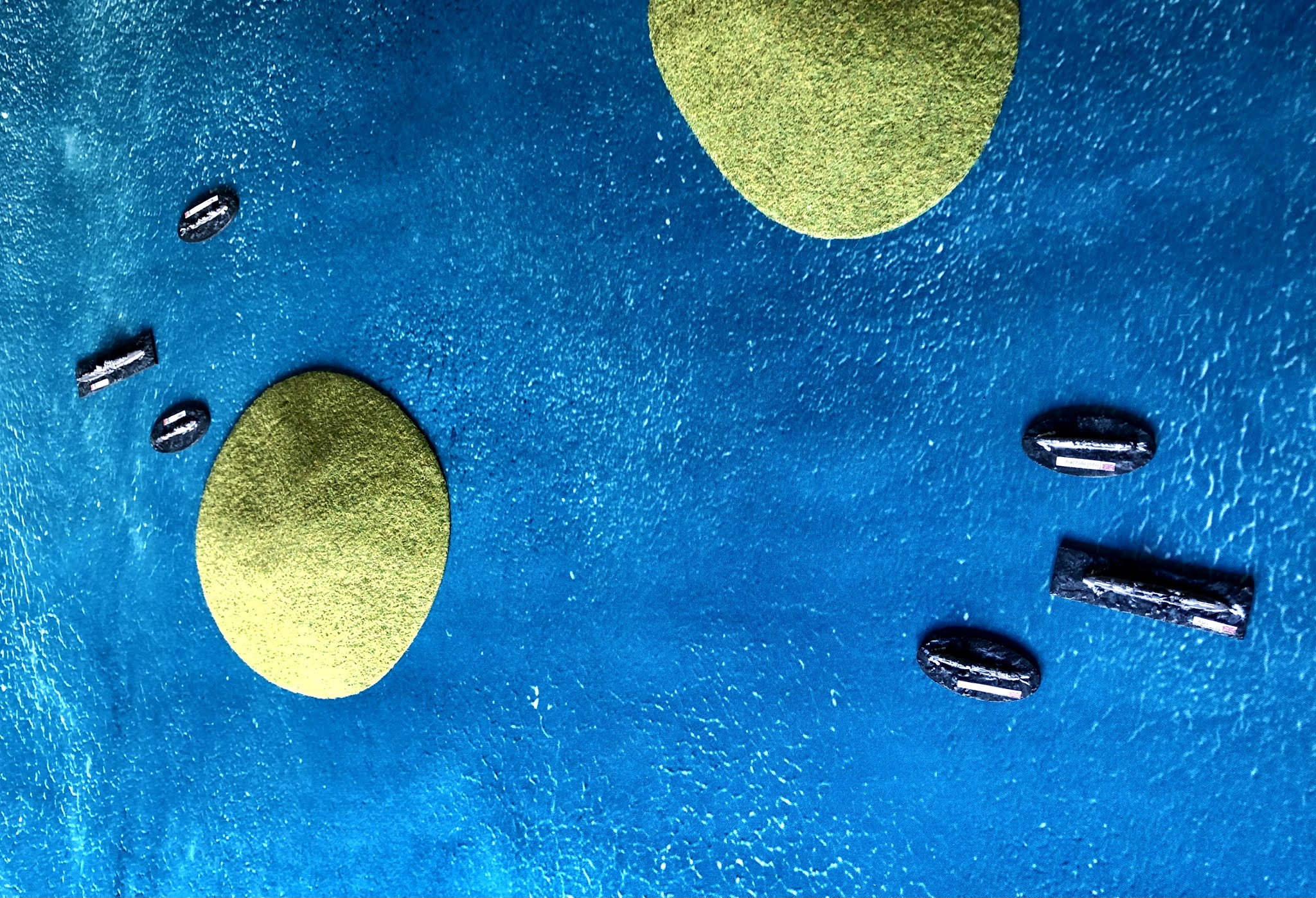
I have settled on Victory at Sea for my WW2 fleet rules, using the updated Warlord version, but without their ship models. This book is full of scenarios for large fleet and smaller actions. I decided to play one of the many smaller engagements to get used to the rules with a cruiser and a couple of destroyers per side. I struggle to think of a wargame without terrain, so I dropped a couple of Aegean small islands into the battle.

Italian Zara class cruiser with Soldati and Navagatori class destroyers take on  HMS Ajax escorted by Tribal and N class destroyer 

The Italians

The Brits.

The Zara turned out to be a bit too much to handle with her heavier guns. And I still struggle to learn how to sail a ship. Why won't they just stop!


Sunday, 28 March 2021

Nigel Tranter - Druid Sacrifice

As is obvious from this blog, I am an avid reader of historical fiction. Most nights, my bedtime reading is a historical novel. These days mostly on the Kindle, and I donated most of my extensive collection of paperbacks to Oxfam to free up some shelf space for reference books. However, I kept my extensive collection of Scottish historical novels by Nigel Tranter with the intention of re-reading them in retirement.

Nigel Tranter was perhaps best known for his deeply researched novels on Scottish history. He also wrote non-fiction books, including a fine short history of Scotland and a five-volume study of Scottish castles, 663 fortified buildings in total. Less well known were are his westerns, written under the name Nye Tredgold and 12 children's books.

Nigel Tranter was born in 1909 and trained as an accountant. He served in the Royal Artillery during WW2. After the war, he was involved in the original Scottish Convention, which campaigned for Scottish Devolution. He died in January 2000, aged 90, less than a year after the devolved Scottish Parliament was reconstituted. I met him once when I was working at a political party conference. I didn't recognise him, and when introduced, I was the gushing fanboy! He told me he wrote his books by hand often while walking near his home in East Lothian. We shared the view that to really understand history, you have to walk the places where the action happened.

His 57 novels covered many aspects of Scottish history, from the 6th to the 18th century. He told me his favourite period was the 16th century, and that is reflected in his output. Some academics were a bit sniffy about his work, but I would argue they opened up the subject for many people. He always emphasised that they are works of fiction, although based on historical research. This is more obvious in his later books as his study of Scottish history advanced. 

So, I have sorted my collection of his novels into roughly chronological order on the shelf. I think I have most of them and intend to reread them all. I will share my thoughts and the wargames they inspire on the blog and link them from a new page. I hope you enjoy them as much as I have.

The first book chronologically is Druid Sacrifice. It is set in the first half of the 6th century and tells the story of Thanea, the daughter of King Loth of Gododdin, although referred to as Lothian in the book. This kingdom probably covered most of south-east Scotland, modern Lothian and the Borders. The capital was on Traprain Law, later moving to Edinburgh. They were Britons, descended from the Votadini tribe, and King Loth is also called Lot or Leudonus, in the sources.


When she objects to her pagan father's druidical human sacrifice and refuses to marry a prince of Reghed he chooses for her, she survives an 'execution' and is cast adrift on the River Forth in a Coracle. She lands and seeks sanctuary with the monks of Saint Serf in Fife, where she brings up her infant son. He was to become St Mungo, Glasgow's patron saint, where he spent much of his life evangelising, which is covered in the story. He was driven out of the Clyde area by the King of Strathclyde and spent time in Wales, where he is known as Kentigern. He later returned and died in Glasgow, where the cathedral, and much else, is dedicated to him. 

While the sources for this period of British history are scarce, this book's basic story is referenced in a couple of annals.  Tranter goes one stage further and introduces Arthur as the High King. Many, many books have been written about the historical figure that might have been Arthur. In short, there is little concrete evidence that he existed, and even less that he was the High King. Some sort of warlord seems more likely, but everyone has a view.

I started collecting Arthurian armies when the WAB supplement The Age of Arthur was published. We ran a fun campaign at my club. 

Got to have a Druid sacrifice. 

Arthurian or late Roman infantry

And cavalry


Saturday, 27 March 2021

To the Strongest! - Wars of the Roses

 Inspired by my reading of Trevor Royle's book, I have been expanding my 15mm figures for the Wars of the Roses. My wife, who is from Yorkshire, is convinced this is just a wind-up! I thought I would just need a few elements as I already have plenty of medieval figures.

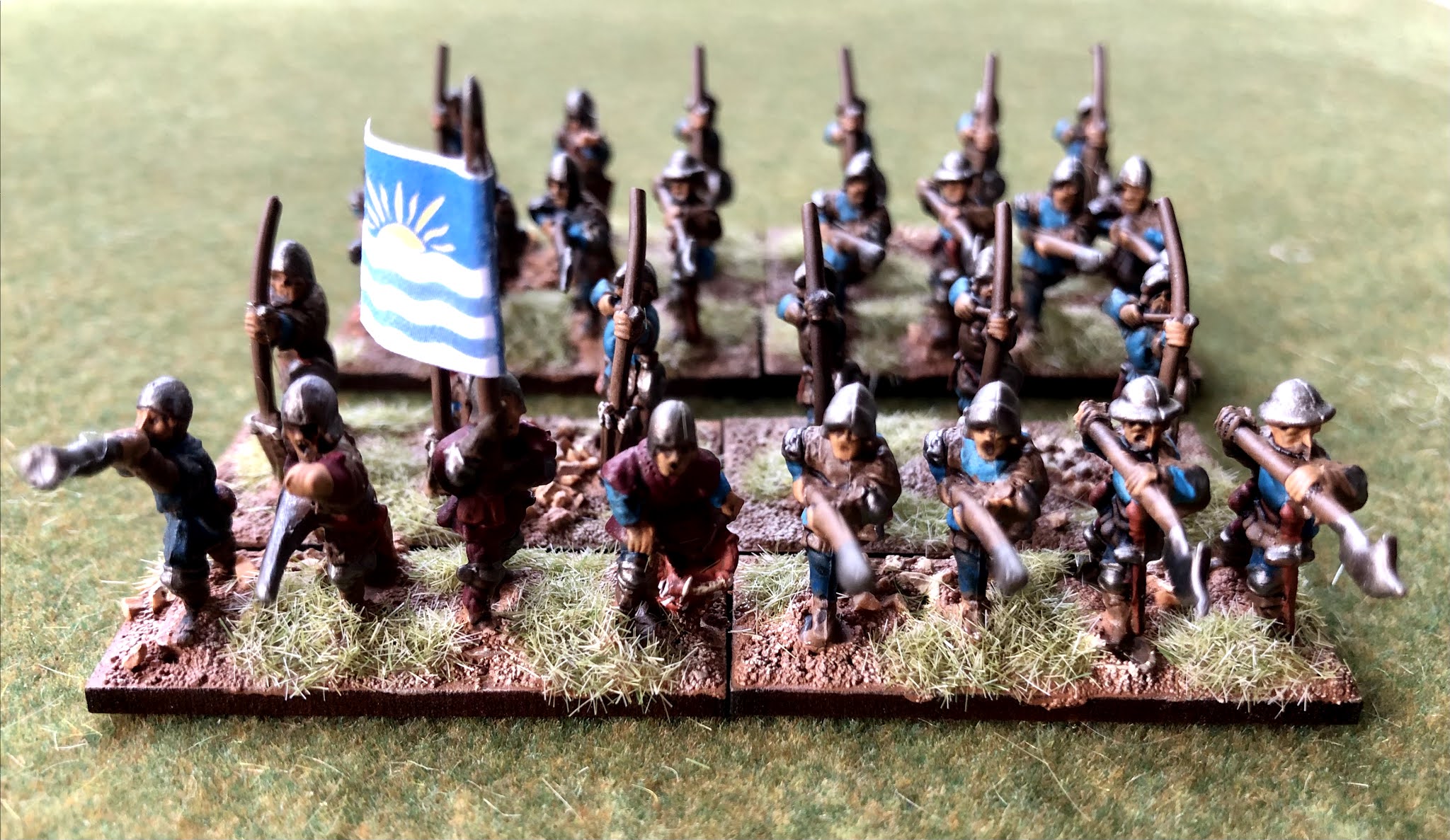
A small order to Peter Pig, and off we go. A typical retinue with Billmen and archers in equal numbers.

Then onto the tabletop for a game of To the Strongest! This highlighted that, in fact, I don't have enough figures. Another big downside of the pandemic is that you can't just paint one army and roll up to play a game at the club. Particularly for the Wars of the Roses when you need two similar armies for a game over Zoom. So, you may notice a few unlikely units being deployed to pad out the numbers in this game.


I know. There were no Teutonic Knights in the WofR.

So, back to the painting table. Another unusual feature of the Wars of the Roses is dismounted knights, including command elements. Peter Pig do some lovely character figures, including the knight holding a decapitated opponent. An illusion of Richard III's fate, but these wars were pretty savage compared with some of the preceding conflicts.


Then some dismounted knights and more archers. The knight supporting his wounded comrade is a nice touch.


I have another unit of billmen and archers to do, and that will do for now. There is a new version of L'Art de la Guerre coming out next month, so I should be able to field two armies for the playtest by then.


Sunday, 21 March 2021

The White Generals

 I picked up this book in a second-hand bookshop a couple of years ago, and for some reason, it never made it to the top of the pile. A mistake because this is an excellent study of the White movement in the Russian Civil War. I have the 1987 edition, but there appears to be a reprint available.

The first thing that strikes the reader of any aspect of Russian history is the country's sheer scale. The Imperial Russian Army, by the end of 1914, had mobilised 6,553,000 men. Even these numbers couldn't cover the entire front line, and in any case, there were only 650,000 rifles. The Russian soldier was brave but lethargic, and there was a shortage of trained NCOs. Despite the Tsar banning vodka at the start of the war, by 1916 drunkenness was as bad as ever. However, we should remember that the armies of the Allies were at breaking point in 1918, yet many Russian soldiers went on fighting until 1920.

This book looks at the different White armies and their commanders. The Whites' fundamental problem was the lack of a coherent command structure or even common grounds for fighting. There were Denikin and Wrangel in the South, the Ukrainians and cossacks fighting for independence, Admiral Kolchak and the Czechs (50,000 former PoWs) in Siberia, and the Finns in the North. 

The Allies intervened and provided supplies and equipment without any clear strategy. Churchill sat in London with a big map on the wall without any real grasp of the distances involved. He argued for assailing the Bolsheviks on as many fronts as possible, completely ignoring that the Red Army had interior lines of communications. Nowhere was Allied intervention more pointless than the troops sent to Murmansk. There was little support for intervention at home, and often second rate troops were sent to 'enjoy' the Russian winter.

This was a conflict very different from the trench warfare of the Western Front. Cavalry came back into its own with huge cavalry armies, supported by the armoured train. The limited railway system became the focus of advances and retreats. Tanks and aircraft made an impact, mostly supplied and manned by the British.

In the end, it was Trotsky who forged an effective fighting force that was able to push back the disorganised White armies. His HQ train was the stuff of legend, dashing around from front to front. The Netflix series on Trotsky may not have been good history, but the civil war scenes give you a flavour of this. In contrast, the command trains of at least some of the White generals resembled an upmarket brothel.

The Allies tired of the intervention's effort and cost, which cost the British alone some £24million. Nobody knows how many died, but 25 million is a credible estimate. Many Russians were displaced worldwide, and the conflict influenced Soviet foreign policy for years to come. 

I haven't got a specific Russian Civil war army, but I do have WW1 and Russo-Japanese War Russian figures. You could also use Germans, Austrian and even Japanese. They look a bit too smart and uniformed but will do. In 15mm, my rules of choice for this period are Bloody Big Battles. I dusted them down for a divisional level action. Peter Pig do a nice range if I was minded to expand......


Saturday, 20 March 2021

Greek War of Independence

 This coming week is the 200th anniversary of the start of the Greek War of Independence. The revolution was declared on 25 March 1821 by Metropolitan Germanos of Patras in the Peloponnese. While this date is questioned by some, it is clear that the revolution broke out in various places during the latter end of March 1821, and the 25th is celebrated today as a national holiday in Greece.

There are lots of books on the revolution, and there are bound to be more this year. I have several older studies, but my favourite one in print is David Brewer's 'The Flame of Freedom', although I see he has written another book on the subject since. He covers the background to the conflict and the war itself, which lasted until 1833 when French troops finally left. 

I have enjoyed the Hellenic Heritage Foundation's The Idea of Greece series of podcasts, which are a really good introduction to the subject. They are pleasantly balanced, which is not always the case on a subject prone to nationalist rhetoric.  I would also recommend the Facebook group, Wargaming the Greek War of Independence.

For the wargamer, Miniature Wargames did a two-part series in 1999, written by Spiros Koumoussis. It included some nice colour plates as well as a short history. Sadly, Spiros passed away at an early age. He also produced a range of figures for the war and a simple set of rules based on DBA.

My collection in 15mm largely comes from his range. They were based for the Principles of War rules. I have some of the excellent Steve Barber range in 28mm, although painted for the slightly earlier Serbian uprising. I would use Dan Mersey's Rebels and Patriots for the skirmish level actions, which were a feature of this conflict. There is a new range of 28mm figures from Old Man’s Creations, which look very nice. 

Ottomans and Egyptians are readily available from several ranges, and the irregulars can often be used for either side. Ottoman forces were busy putting down other revolts and facing up to the Russians during this period. Initially, they relied heavily on Albanian troops and later the Egyptians, who had a modern army. It is worth remembering that the Auspicious Incident happened in June 1826, which resulted in the death and disbanding of the Janissary corps. So no Jannisaries after that date, and not many beforehand. 

The Greeks had a history of seafaring in the Ottoman Empire, and the war at sea was an important feature of the war on the islands. It was the Great Power naval intervention at the Battle of Navarino that effectively secured the revolution for the Greeks. Black Seas works fine for these battles, and you can use your Napoleonic fleets. I have made a start on an Ottoman fleet.


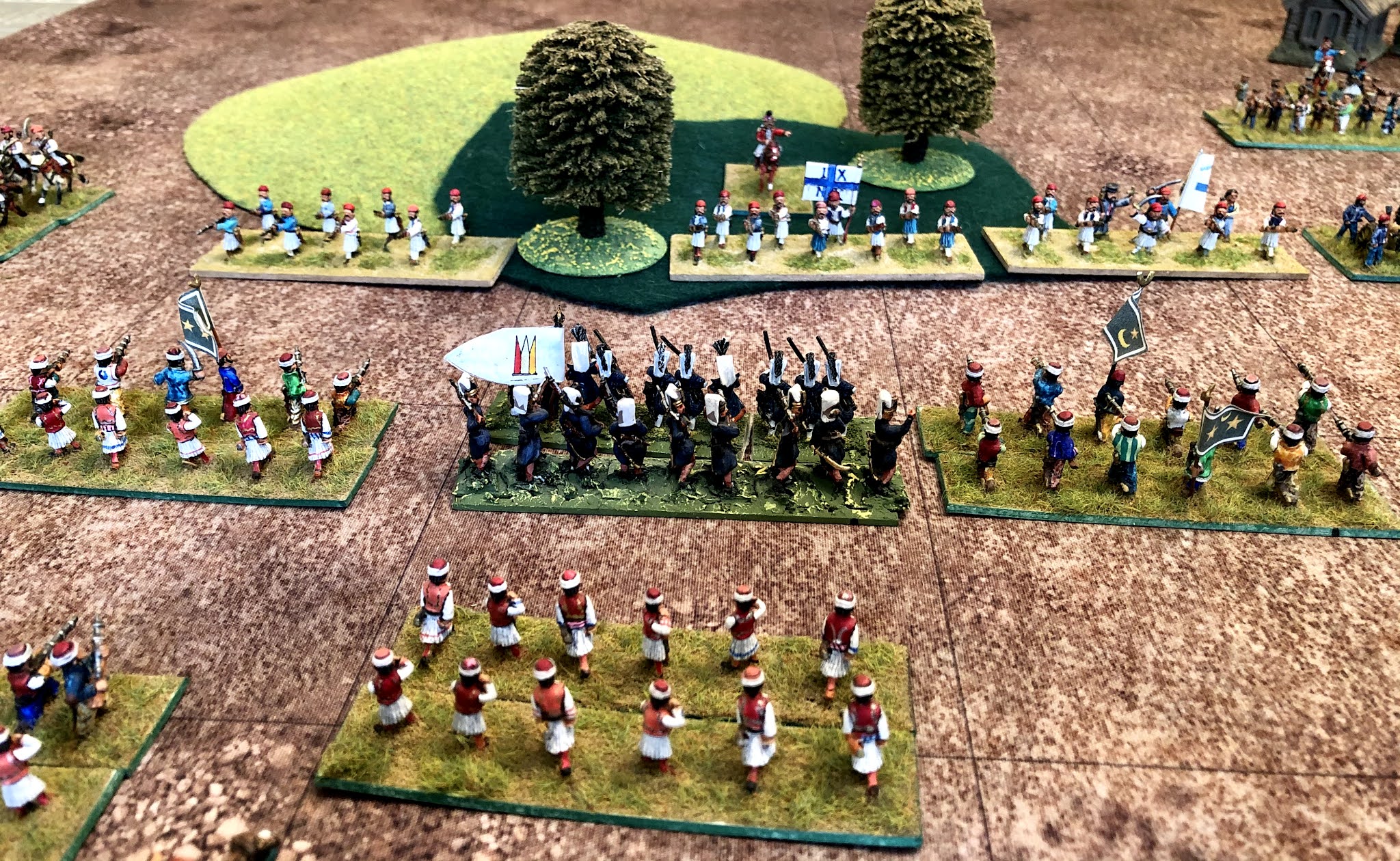
So, onto the tabletop, using Lasalle, my current favourite tactical rules for the Napoleonic period. This game was a steep learning curve in this ruleset. The army list is below and included two brigades on each side. The troop types are fairly similar as I rated the Greeks as similar to their Ottoman opponents who are listed in the army lists. The predominant militia types have the weak fire and rabble traits, bolstered by a few battalions of regulars.

Ottomans on the left. The Greek plan was to hold the Ottoman left by creating a firing line  on the edge of the woods, while pivoting the second brigade to crush the Ottoman right and roll up the line.


Ground level view from the Ottoman side

The Greeks got marginally the better of the firefight because of the cover, but the weak fire trait limited the fire effect

Lasalle combat rules can be brutal with the Greek cavalry on both wings destroying their opponents.

However, it works both ways. The Greek regulars are destroyed attacking the Egyptians on the hill. The Greek attack falters and another firefight ensues.


Another hard lesson. Don't let your militia get caught in the open by cavalry because rabble can't form square. Goodbye Albanians. Thankfully my reserve came good and with some artillery support shot the cavalry up, stopping them rolling up the left flank.


With combat halted, the battle developed into a firefight along the line, which the Greeks marginally got the better of. The Ottomans withdrew to fight another day. I haven't got these armies out for some time, and with many anniversaries of this war to come, it won't be the last time!


Saturday, 13 March 2021

Shake Loose the Border

 This is the third book in Bob Low's trilogy set in the Scottish borders in the 16th century. The 'Rough Wooing' conflict with England is coming to an end with Henry VIII's death, but that rarely stops conflict amongst the border reivers. 

Our hero, the wonderfully named Batty Coalhouse, accepts a commission to recover an old friend captured by English raiders. This should be a simple matter of paying the ransom. However, he has been sold on to a rogue warlord, Nebless Clem, on account of his nose being sliced off. Neb being old English for a nose or snout.

Batty is captured by Clem, who doesn't want to ransom his friend, and goes further by whipping Batty. Needless to say, this sparks a campaign of vengeance while capturing his friend from Clem's band. There are more than a few twists and turns, but I won't spoil the story.

As with the other two books in the trilogy, this story captures the feel of border warfare. Small bands of light cavalry skirmishing on both sides of the border. There are a few mercenaries still around from the English army that made extensive use of such units. In this book, they include a group of Albanian Stradioti. Not sure if such a unit made it to Scotland, but it gives me some further options for games.

Stradiots in 15mm and 28mm from my collection.


Sunday, 7 March 2021

The Wars of the Roses

 This book by Trevor Royle has been sitting on my to-read shelf for a few years. I have never really got into the Wars of the Roses since my very early teenage wargaming years playing a club campaign based on the board game Kingmaker. I was born in Lancashire, and my wife is from Yorkshire, so we have used the red rose - white rose theme over the years. However, the battles of the period itself always felt a bit of a slogging match.

The first thing to say about this book is that it's really a history of the 15th century. We reach the opening Battle of St Albans in Chapter 11, around halfway through the book. That's more than introductory context, although still interesting.

The wars were by no means continuous. Royle describes them as "little more than a series of violent outbursts which interrupted periods of uneasy peace."  The armies were not large and often quite professional. They were made up from the retinues of the nobility, supplemented by mercenaries. The mass of the peasantry was rarely called up to participate in the fighting, although they could face the sharp end of pillaging. The other interesting fact is that the Lancastrian cause was not focused on Lancashire any more than the Yorkists were based in Yorkshire. 

The Scots also got involved more often than I had appreciated. Taking advantage of the chaos to raid while supporting mostly the Lancastrian cause. They also maintained the Auld Alliance with France through most of the period.

This isn't a military history of the conflict, although the main battles are covered, and there is some discussion of the problems raising armies and maintaining them in the field. The focus is on politics, which are pretty complex at times. It's all very Game of Thrones with alliances shifting and some huge characters. Not just those who made it to the crown like Edward IV and Richard III, but also the players, including Warwick the Kingmaker. 

It all came to an end at the Battle of Bosworth in 1485 with the death of Richard III and Henry Tudor's accession to the throne. I have also been reading the new Osprey campaign series book on the battle by Christopher Gravett, which covers the military aspects of the wars much better. 


Here we get the commanders and their armies, together with their plans and the battle itself. As usual, there are some lovely colour plates and maps. I have visited the battlefield many years ago. Or, to be precise, what was thought to be the battlefield at the time. The latest archaeology puts the actual site a couple of miles away. Nonetheless, there is an excellent visitors centre.

Most of my medieval armies cover the earlier periods. I could probably field at least one army, but not both. So, I have decided to supplement the 15mm figures with some reinforcements from Peter Pig. They are true 15mm, so a little smaller than the oversize versions of recent years, but they look very nice.


Saturday, 6 March 2021

Victory at Sea - WW2 in the Eastern Mediterranean

 I am not a big player of naval wargames, although Warlord's Cruel Seas and Black Seas has got me interested. Having done land and air for my Turkish WW2 project, it was time to look at the naval aspects. David Hobb's new book on naval air warfare in the Mediterranean helped spark my interest.

The Turkish Navy suffered most of all from the financial restrictions placed on the new republic. A British naval attachĂ© reported in 1937 that: “Judged by the standards of modern navies, however small, the condition of the fleet is far from satisfactory”. He suggested that they had not been updated since the First World War (which wasn't quite correct) and “were defenceless against air attack”. The main naval base was GölcĂŒk in the Sea of Marmara.

The modest budget focused on the Dardanelles' defence, backed up by a mobile force led by the First World War battlecruiser Yavuz (ex Goeben) and four destroyers. The story of the Goeben escaping the British Fleet is well told by Dan Van der Vat in his book, 'The Ship that Changed the World’. His essential thesis is that by embroiling Turkey into World War 1, the war lasted for two years longer than it might otherwise have done. 

The fleet did have some modern destroyers and submarines built in Italy. This may appear surprising, but in 1928 there was a peace treaty with the Italians that included financial guarantees for ships built in Italian yards. Turkish officers were also trained in Italy during this period. There was a ten-year plan to modernise the navy, and ships were ordered from Britain and Germany, although not delivered because of the outbreak of war. The British did deliver two destroyers and ten MTBs during the war.

So, how to model and game this. Having enjoyed the simplicity of Warlord's recent naval games, my first stop was their new offering, Victory at Sea. The free set of basic rules in Wargames Illustrated looked very playable. However, I just don't like the ship models on their clunky resin bases. Turning to my rules shelf, I found a set of rules called Victory at Sea. It turns out these were the original rules by the same author, published in 2007 by Mongoose. They have been tweaked a bit for the Warlord offering but are essentially the same mechanisms. I assume Warlord bought the rights as it isn't on the Mongoose website any more.


Freed from the constraints of Warlord models, I decided to go for Navwar's 1/3000 ships. Old school ordering system, but they arrived quickly.

I did the Turkish fleet first with the Yavuz, two destroyers and two submarines. The Atilay class were German U-Boats.


 Then some Allies in the form of elements of the Royal Navy's Mediterranean fleet.


And finally, the enemy, the Italian fleet.


That will do for now. The original rules are in hardback, but the paper quality is poor, and the binding isn't likely to last long. There are also limited ship types, although it's not difficult to work them out using the trusty Ian Allan ships of WW2 series. So, I might play the new rules without the models and make my own cards.

The original rules played pretty well in a quick test game. Sadly, the Yavuz didn't last long. The Italian Littorio battleship's 15" guns ranged in pretty quickly, and it was crippled before even denting the Littorio. British cruisers sailed to the rescue, and with the help of much smoke, covered a retreat. I think we will need the Warspite or Illustrious to tackle the Littorio.

Littorio in the background, escorted by a Zara Class heavy cruiser and two destroyers

The Yavuz with two Kocatepe Class destroyers, ironically built in Italy.