Welcome to my blog!

News from a wargamer with a special interest in the military history of the Balkans. It mainly covers my current reading and wargaming projects. For more detail you can visit the web sites I edit - Balkan Military History and Glasgow & District Wargaming Society. Or follow me on Twitter @Balkan_Dave
or on Mastodon @balkandave@mastodon.scot, or Threads @davewatson1683

Saturday, 2 March 2013

Flodden 1513

This year is the 500th anniversary of the Battle of Flodden. It was fought in Northumberland on 9 September 1513 between a Scottish army led by King James IV and an English army led by the Earl of Surrey. It was the largest battle ever fought between the two kingdoms and resulted in a major defeat for the Scots and the death of King James.

The war began when Henry VIII invaded France in 1513. Scotland was allied to France and James agreed to a diversionary attack on England. He invaded with an army of 60,000 men supported by French arms including the first use of pikes by a Scots army. The Earl of Surrey mustered 26,000 troops from across northern England, as the best troops were in France.

By the time the Scots army reached the hill of Flodden Edge it had shrunk to around 35,000. This was a strong position with entrenched artillery so Surrey marched the English army to the north forcing James to move to Branxton Hill. After suffering casualties from English artillery fire James advanced his pike blocks off the hill to attack the English lines. After initial success on the left the main attack faltered under artillery and bow fire. The arrival of Stanley's force seals the victory. Some 10,000 Scots were casualties including the King. English losses were around 1500.
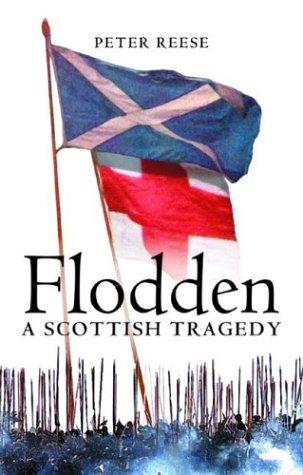
Cover of: Flodden by Peter Reese
My reason for reading up on the battle was our plan to include this in this year's GDWS display game programme. We like to do at least one anniversary battle. So I started with a good general history, Peter Reese, 'Flodden - A Scottish Tragedy' and then the Osprey Campaign 'Flodden 1513'. Having understood the battle, I then moved onto the armies. The Osprey MAA series does a book on both armies and I also have Ian Heath's excellent study 'Armies of the 16th Century'. There are some good online resurces as well including the Flodden Ecomuseum.

After this reading we decided that sadly Flodden was not a viable project. We had thought that our late medieval armies would form the backbone and it would only need a few add ons. However, the Scots army in particular is almost unique to this battle and, other than the highlanders, very few of our figures would do. The English were also much more renaissance looking than we expected. Painting large numbers of figures for a display game is of course nothing new for us. But this was on a pretty daunting scale, in only a few months, to produce armies that, for the Scot's at least, can only really be used for this one battle.

So, I enjoyed the research but it won't feature on the tabletop, at least not in 28mm. I do have the English in 15mm, so other non-display possibilities there.

Back to the drawing board and we settled on another anniversary battle, Muret 1213 for our next display game at Carronade. But that is another story....


Sunday, 24 February 2013

German reinforcements

After my last game in the Flames of War, Seelowe Nord campaign, it became obvious that the Germans would need some heavier firepower as they advanced into Yorkshire. The Matildas in particular are difficult to stop with German army's 'doorknocker'.

So this week I have painted up a platoon of Pkw38t and an 88mm flak, poised for the ground role. The Pkw38's are from Forged in Battle and the 88 is from Battlefront.


The Pkw 38 started as the Czechoslovak army LT vz.38 built by Skoda and was taken over by the Germans after the occupation. Around 1400 Pkw 38's were produced in 8 different variants with various modifications, improved armour protection and armed with Czech made 37mm Skoda A7 vz.38 guns, designated by the Germans as 37mm KwK 38(t) L/48 (L/47.8). They were used by the 6th, 7th and 8th Panzer Divisions during the invasion of France and by the 8th Panzer Division in the Balkans. So it is entirely likely they would have been present has Sealion gone ahead.

The chassis was used for the later Hetzer and Marder SPGs. The tank was also also exported to German allies including Romania (50), Slovakia (90), Bulgaria (10) and Hungary (102). As well as neutrals in South America and Sweden.

I didn't get a chance to deploy them at the club today. We played FoW but I was using an 8th Army rifle company in Sicily against a German panzer company. My anti-tank guns failed badly on the left flank leaving both objectives exposed. However, my opponent pushed his command tanks forward to plug a gap my infantry were creating in the centre and they were both destroyed. So Monty rolls on to Messina! Good game and I learnt a bit more about the rules. 


Sunday, 17 February 2013

Seelowe Nord scenario

Today I fought another stage in the Seelowe Nord campaign. For those not familiar with the concept, this is a 15mm Flames of War campaign based on Andy Johnson's book Seelowe Nord that postulates a German invasion of Britain via the Yorkshire coast.

Today's scenario had a regular British platoon holding a bridge over a large river. They were tasked with holding the bridge until an engineer unit came to blow it up. Of course the engineers never arrived. A German armoured car and a scout platoon arrives and decides on a quick assault. They lost one armoured car to an ATR shot, but otherwise forced the bridge sending the Brits packing. Just as well as a Fallschirmjager platoon landed on their side of the bridge ready to attack their flank.

The bridge taken, a tank platoon trundled over with a Gebirgsjager platoon in support. Together with the paras they assaulted the village held by a Home Guard unit and the retreating regulars. The Home Guard were bundled out of the village quickly and the regulars did only slightly better.

British reserves were slow to arrive but a tank platoon led by two Matilda's brought the German armour to a halt after knocking out the Stug and PkwIV. The light PkwII's dived for cover. With the German's holding the village the late arriving British infantry and artillery had little prospect of launching a successful attack, so they withdrew to the next position. Victory to the invaders.


The initial set up

Sdkfz 221's storm the bridge
 
Tank platoons and supports cross the river

Fallschirmjager force the village


Nomonhan 1939

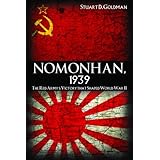
Keeping up the Far East World War Two theme my reading for this week has been Nomonhan 1939 by Stuart Goldman.

As obscure WW2 battles go this might take the biscuit, but it was actually very significant. Justifying, in my view, the book's sub-title The Red Army's Victory that Shaped World War II.

It took place on the border between Soviet controlled Mongolia and Japanese controlled Manchuria. This was an area of frequent border skirmishes between the two armies including large scale actions at the Amur River and Changkufeng. The primary cause of the clash was the very aggressive leadership of the Japanese Kwantung Army. Or more accurately middle ranking elements of the leadership. What was astonishing is the way they ignored, what would be in any other army a direct order from the General Staff in Tokoyo, to break off the action. To the extent that even after being pushed back they counter attacked again. This is put down to the spirit of gekokujo (the low overcomes the high) that pervaded the Japanese military, especially the Kwantung army. The concept was used as justification for junior and mid-level military officers engaging in principled disobedience if they were motivated by moral principles.
Product Details
The Nomonhan affair was based on a disputed border area. After what the Japanese regarded as an incursion by a small Mongolian force, the Kwantung army launched air attacks deep into Mongolia followed by a ground attack by a reinforced division that later expanded to become the 6th Army. The Soviets responded with what became the First Army Group commanded by none other than Zhukov. Soviet armour and artillery was vastly superior and despite fighting to almost the last man, the reinforced Japanese forces were destroyed. It was the worst Japanese defeat in modern times with some 23,000 casualties. The Soviets lost slightly more men at around 25,000.

The wider significance of the action was that Stalin felt able to focus on the West and the pact with Germany to divide Poland. It also meant he didn't have to fight a two front war unlike most other nations in WW2. Remember, it was Zukov's experienced Far Eastern army that saved Moscow and probably the Soviet Union from defeat in 1941/42. For the Japanese it encouraged a southern strategy that led to the Pacific conquests and war with the USA. Astonishingly, it was the same middle ranking officers that drove that failed strategy as well.

Overall this is an excellent study of an unusual and little covered conflict. Highly recommended.

Saturday, 9 February 2013

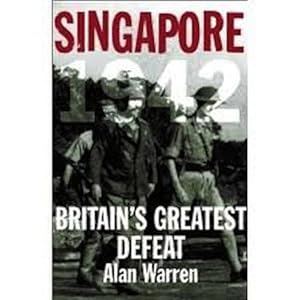
Singapore: Britain's greatest defeat


One of my projects for this year is the Far East in WW2, probably starting with the Malayan campaign that culminated in the fall of the Singapore 'fortress'. As always a new project starts with some background reading and so I dusted down Alan Warren's 'Singapore: Britain's Greatest Defeat' that has been in my reading pile for some time.

This is a very good narrative of the campaign starting with preparations for war and then every stage of the allied retreat down the Malayan peninsula to the last stand on Singapore Island. Very readable with reasonable maps and a good selection of photographs.

I suppose what shocked me the most was the absence of good military intelligence on the Japanese army. After all they had recently fought the Russians and the Chinese. In lectures troops were told that the Japanese were small, myopic and technically backward. An Australian battalion commander opined that his men deserved a better enemy and the British military attache in Tokyo complained that "our chaps place the Japs somewhere between the Italians and the Afghans".

At a strategic level, successive British governments failed to adequately prepare for a conflict in the Far East and there was little chance of rectifying the position after war broke out in Europe. There was no real fleet and air cover was minimal. There were arguably sufficient land forces, indeed the Japanese were outnumbered for most of the campaign. Rearguard operations were poorly handled with heavy losses in manpower and equipment caused by disorderly withdrawals.

General Percival gets much of the blame and he undoubtedly made many mistakes. He clearly should have replaced units in Malaya rather than letting them be degraded in continuous operations. British, Indian and Australian troops were in the main better equipped than the Japanese, particularly in terms of artillery and vehicles. They were also regulars, volunteers or reservists - not conscripts. They may not have had tanks, but they had enough anti-guns guns had they been used better. The speed of operations in Malaya was an obvious problem for senior commanders operating in a WW1 manner.

I haven't finally decided if I am going to do this campaign in 15mm for FoW or 28mm Bolt Action, or both. I am also attracted to the pre-war actions in China and against the Russians. More reading to follow.

Sunday, 27 January 2013

Capture Tito

Tried a miniature version of the raid on Drvar at the club today, using Bolt Action rules and 28mm figures.

The table below has Tito headquarters in a corner with Tito defended by his escort squad. In the village we have a couple of squads of partisans with two more arriving and over the river an assembling German force with tanks, armoured cars and two squads of infantry. Adding to the mix we have two squads of Fallschirmjager landing with a mortar and HQ unit. Highly compressed, but all the essential elements of the raid.

The Fallschirmjager started well driving the partisans from the graveyard. As veterans they are difficult to hit, especially with inexperienced partisan squads. However, numbers started to tell and firepower rained down on the graveyard as the attack ground to a halt. Aided it has to be said by some poor dice throwing by Iain. The relief force started to cross the river, but the infantry suffered casualties so there was insufficient force to capture the village, let alone move on to Tito's HQ.

The mechanisms worked well but the defences available to the partisans meant that the attackers needed a bigger force. Probably another couple of squads. None the less it has the making of a good display game on a larger scale with a bigger unit of Fallschirmjager. We are thinking of possibly two tables, one for Drvar and another for the relief force battle.


Wednesday, 23 January 2013

Crucible of Fate


This is latest book by Andy Johnson in his WW2 series.

I have given the first two books rave reviews, so I was looking forward to this read. I wasn't disappointed. I was surprised that he fast forwarded from 1940 to the Normandy landings as I expected the characters to turn up in Greece, the Western Desert or even Italy. However, there is no reason for not going back in time as he did with the second book.

The story is almost entirely based on the first day of the D-Day landings. The German defenders and in particular a unit of misfits who are tasked with holding a wooded hill, code named the Crucible. They may be less than fit, but they include several veterans of the Russian Front. The Brits are represented first by the Paras and then by one of the first infantry units ashore who eventually run up against the Crucible.

The writing style is very similar to the other books. Short chapters written in the first person of a character or characters in the different units. Very easy to put down and pick up again, although putting this book down is not easy.

If, like me, you are playing Bolt Action rules, this is the book to read. Most of the action is at platoon level so you get a real feel for the tactics. The use of cover, flanking moves and the importance of support weapons.

While reading this I have been taking a break from painting the 28mm figures by plugging a few gaps in my Flames of War 15mm armies. Some 20mm AA support for the Germans. Plus additional HMG's, ATRs, 2pdr ATG and mortars for the early war Brits. And another Matilda! The German AA are Battlefront and the Brits are Peter Pig. The Matilda is from the Skytrex range.


Sunday, 13 January 2013

Grande Armee

Played my first full game of Sam Mustapha's Napoleonic rules, Grande Armee today.

These are big battle rules with a unit on the table representing a brigade or similar of a few thousand troops. This means you can play the big multi-corps battles of the Napoleonic wars on a normal wargames table. Obviously at this scale there are lots of abstractions, but that also means the game flows quickly.

Weather effect is represented more than I am probably used you and the command elements are represented by command points and control distances. The combat mechanisms have separate skirmish and artillery phases, but all close combat, shooting and hand to hand, is brought together in one phase. There is a fair and helpful review here.

Our game was the Battle of Katzbach 1813. Blucher commanding Prussian and Russian forces against the French commanded by McDonald. In our game the main French effort was on their right. The Russians under Langeron fought and blocking action until they were supported by the Prussians under Yorke. An honourable draw that helped me get a better understanding of the rules.


This was one of several games played at the GDWS weekend of games. Once or twice a year we play big games over a whole weekend. A big AWI Black Powder game as well as Blenheim using Maurice rules. Plus command decision and of course the FoG competition. Photies on the GDWS website.


Sunday, 6 January 2013

Pike & Shotte

Played my first full game today with Pike & Shotte, the Black Powder derivative for the Renaissance period.. Tested them with Ottomans against Polish, mid 17th Century armies.

For those familiar with Back Powder the basic mechanisms are very similar. Unlike Hail Caesar that has far more changes. The same basic command system although initiative moves are limited to 6". Distances are generally shorter, I suspect reflecting experience with Black Powder (BP). We like many BP players use the two-thirds play sheet for BP. The key change is the hedgehog formation to reflect the close working of pike and shot units. If you get it right, pikes protect shot effectively against cavalry in particular. Dragoons are also factored in slightly differently to reflect their proper role as dismounted troops in this period. The special rules allow for all the classic renaissance tactics like caracole, gallopers and mercenary units.

More than half the book is taken up with army lists for all the main conflicts. Starting with the Italian Wars and finishing with the wars of the Sun King. A short historical overview followed by the main troop types and a few scenarios. There is a points system for those who feel the need. The options in the army lists are a bit limited. For example, no light infantry musket skirmishers for the Ottomans or foot Croats for the Imperialists, but these are easily added in. You are unlikely to need any supplements to play the period fully.

The game played well. The winged Hussars are very tough in these rules but not impossibly so. They rolled over the Sipahis of the Porte on one wing, but were pushed back on the other after the Balkan sharpshooters weakened them. The Janissaries and Polish foot blasted each other to a standstill and the skirmish cavalry did just that, skirmished inconclusively.

Lovely production values of course, masses of eye candy - worth the price for that alone. I have played the full set of these rules over the holiday period. While there are a few points I am not happy with, generally they all give a good game, with plenty of command uncertainty. I reckon they will be my staple rules for 28mm figures pre-20th Century.

Thursday, 3 January 2013

Terror in the Balkans

I have just finished reading Ben Shepherd's, Terror in the Balkans published by Harvard University Press.

This is a study of German armies and partisan warfare in Yugoslavia during WW2, with a focus on the early 1941-43 period. This is not a narrative history of the campaigns although there is a decent overview in the introduction. Instead the author looks at the main occupation divisions with a focus on the divisional and regimental commanders. He argues that many of these were actually Austrian and their actions were influenced by their experience on the Eastern Front during the Great War.
Terror in the Balkans: German Armies and Partisan Warfare
The occupation divisions were generally second line troops and poorly equipped for the terrain they had to fight in. The strategy was conditioned by the German abhorrence of irregular warfare to which was added Nazi ideology. Shepherd argues that the commanders experience and training made them more receptive to this strategy. It resulted in widespread terror with massive reprisal shootings, destruction of whole villages and in some cases deportation. The concept of winning hearts and minds featured only rarely and then only at higher echelons when they realised that the strategy was driving the population into the partisan camp. In particular little was done to address the actions of the Axis allies in the Croatian Ustasha.

This is a well written study taking a very different approach to the conflict in Yugoslavia and is essential reading for anyone wanting to understand the German approach to what was a major area of operations in WW2.

Tuesday, 1 January 2013

Happy New Year!

Seasons greetings to all. Wishing everyone a happy New Year and a good 2013.

So what are my plans for the coming year?

Projects at present include:
  • WW2 Yugoslavia in 28mm. Some more partisans and Italians for the 1941-43 period. I will also use the Italians as opponents for the Greeks. A few more of them to paint up as well.
  • Russo-Turkish War 1877 in 28mm. A few more infantry units for both sides.
  • Dacians in 28mm. Almost the last Balkan army I don't have. Probably a few more Trajanic Romans as well.
  • Britain 1940 in 15mm FoW. Still a few more units to finish this project off. Some British support weapons and engineers, plus some artillery and AA units for the Gebirgsjager.
  • VBCW in 28mm. Just a few character figures to finish the project off.
Overall, more a finishing off year rather than any new projects. But the year is still young and possibilities include:
  • Serbia 1876 in 28mm
  • Hungary 1848 in 15mm
  • Far East WW2 in 28mm, including the pre-war Chinese and Russian conflicts.
  • Medieval Scots.
I hope to do more gaming this year. In particular:
  • Black Powder along with Hail Caesar and Pike & Shotte.
  • Bolt Action for WW2 projects and VBCW (with chance cards).
  • Grande Armee. Dusting down my 15mm Napoleonics for what looks like an interesting game system.
  • I will persevere with Maurice despite my reservations about systems that are too card driven.
  • Flames of War. I think this is an elegant rules system.
For GDWS display games nothing is decided yet, but two outline plans. The first is the Battle of Glasgow Green, VBCW in 28mm. The second is WW2 Descent on Drvar in 28mm. Both using Bolt Action rules that I am very impressed with. We may also do Flodden given the centenary year.

I would like to get back to a bit more writing this year. Something that has dropped off in the last few years. My day job involves a lot of writing and I therefore find painting more of a relaxation.

Finally, my reading pile needs to be addressed although I have just spent my Xmas book tokens to add to it! As usual my reading can spark off new wargame projects. A longish list of historical fiction, some great stuff out there at present, as well as Balkan and other historical works.

Great plans as always. Probably far too much, but I will have fun trying!

Monday, 31 December 2012

Russo-Turkish War & Rasputin

Fought a small Russo-Turkish War 1877 skirmish yesterday. Three companies of Turkish Nizam with artillery and cavalry support against a similar Russian and Bulgarian Legion force.

I used Black Powder rules with infantry and cavalry in skirmish formation and it worked very well. I made the Russian and Bulgarians 'stubborn' but classified the Krenk rifle as a carbine to reflect the shorter range. The firefight was pretty inconclusive as both sides had light cover in the extensive woods. The Russians clinched the action with a successful charge on both flanks, but not without several rounds of hand to hand combat.

I got into this period in 28mm 'thanks' to a pal who bought me a few packs (in the tradition of the drug dealer!) of the excellent Outpost Miniatures at Claymore. The stand was behind our display game, so of course I couldn't resist a few more. I have a further pile of metal that needs some brushwork, as that equally evil Jeff at Outpost keeps adding to the range. Even asking me what new figures I would like! I think I foolishly mentioned 1876 Serbs would be useful, stop me please!

And Rasputin you ask? As he was born in 1869 he was barely a child in 1877. Well, we have a new cat and his name is Rasputin, or Razzy for short. He has taken a far too close an interest in wargaming. Wandering over the battlefield he managed to knock over several Turks, so at least he knew which side he was supposed to be on! Earlier in the week he got into the study and on top of my figure collections to tip over a box of, now lance less, German lancers. Where is the super glue.......


Saturday, 29 December 2012

Centenaries


As the New Year beckons I usually start with a look at forthcoming centenaries. Mainly as inspiration for display games in the coming year.

I suspect the 500th anniversary of the Battle of Flodden 1513 will be the big UK centenary and we have started to think about it. Many figures already in GDWS member's collections, but we are going to need more pike armed Scots. You could include the battles of Novara, Spurs and La Motta of the same year. 

The Thirteen's were not big in the Balkans with the obvious exception of the continuing Balkan Wars. The Fall of Jannina and then Edirne signalled the end of the First Balkan War. But then the Bulgarian's kicked it all off again in June 1913. Jannina is a city well worth visiting and it has the period Fort Bezane as well.
 
Less well known is the Battle of Camurlu, near Sofia, fought on 5 July 1413 Between Musa and Mehmet I to decide which son of Bayezid I would unite the Ottomans. Mehmet won with Byzantine support. An excuse to get out lots of Ottomans is one I am unlikely to miss during the year.

On a medieval theme Louis the Bavarian defeated his cousin Frederick I of Austria at the Battle of Gamelsdorf in 1313. Or a chance to use the Spaniards again because Simon de Montfort beat Pedro II of Aragon at the Battle at Muret in 1213.

The Napoleonic Wars continue to generate a range of options. Vittoria, Leipzig and the Pyrenees to name a few. The War of 1812 continued with several interesting actions although I prefer the South American Wars of Liberation. Bolivar's invasion of Venezuela and the Battle of Barbula on 30 September 1813.


Cheating slightly, the ACW has a number of 150th anniversaries including Chancellorsville, Chickamauga and of course the big one, Gettysburg.

That should be enough to keep anyone busy!

Friday, 28 December 2012

Knight's Move

The Knight's Move (Operation Rösselsprung) was a combined airborne and ground assault by the Germans on Tito’s headquarters at the Bosnian town of Drvar in May 1944. Operation Rösselsprung involved the 500th SS Parachute Battalion (Captain Rybka) making an air drop on the town while several ground force columns (XV Mountain Corps) converged on Drvar, supported by the Luftwaffe.

Faulty intelligence meant the paras attacked the town rather than the nearby cave that housed Tito's HQ. By the time they realised the error, partisan units arrived to make the attack a costly failure. Tito escaped before the ground troops could close the trap.

David Greentree has written a very good history of the operation for Osprey in its Raid series. As you would expect from Osprey, it includes many photies and several excellent colour maps.

Santa has been good in providing some 28mm metal Soviet and partisan types to supplement my VBCW workers who can make the shift to Yugoslavia quite easily. Iain from Flags of War is working on the Paras and I have some ground troops. Any ideas for Prinz Eugen fez wearing figures would be welcome. We are considering this as one of GDWS display games in 2013, so expect more on this theme.

I have also written a longer piece on the operation for the New Year, Balkan Military History update. My holiday reading is 'Terror in the Balkans' by Ben Sheperd, so I am likely to bore the pants off my loved ones on the subject as well!


Monday, 17 December 2012

Insurrection


This is the first of Robyn Young's take on the Robert the Bruce story.

She starts with the death of King Alexander and the Bruce's formative years. Then his time at the English court is played out in some detail before his return to Scotland. Firstly, supporting Edward and then his conversion to the Scots cause. This volume ends just after the disastrous battle of Falkirk and the falling out between Bruce and Comyn.
The narrative sticks fairly closely to what we know of the period, although this is limited. What does come over is the complexity of Robert the Bruce and his shifting allegiances. There is good historical note that explains the historical deviations.

I picked this up because I really enjoyed this author's  Brethren trilogy. This story is not quite so dramatic but it is well written and has everything you would expect in the best historical fiction. I will read on.

Sunday, 18 November 2012

More Bolt Action

We had another go at using the Bolt Action rules today for a Very British Civil War battle.

Just under 1000 points a side which gave us 5 infantry squads a side plus supporting tanks and armoured cars. Mostly woods in the centre of the table which meant lots of close combat. The rules regard an attack within 6" as a surprise attack and that means no defensive fire. Big advantage for the attackers as they go first. Close combat is very bloody with the losing side destroyed.

My copy of the first Bolt Action supplement, Armies of Germany, arrived this week. The army lists are laid out like the ones in the rules, but with more detail. Beautifully illustrated with Osprey colour plates and models. Just what I need for the Tito raid project we are planning for next year. More details will follow as the project takes shape.

I will leave you with a couple of photies of today's opponent the Solemn League and Covenant. This first is the League command unit and the second is the Boys Brigade squad. These are from Iain's collection with his own great flags at Flags of War.


Sunday, 11 November 2012

Targe

On Saturday we trekked up to the Kirriemuir Club show, Targe. One of the smaller Scottish shows, but usually well supported and well organised. Although as my alarm went off at 4:30am, my enthusiasm was somewhat dulled!

Our display game was Fort Ticonderoga 1777 - American War of Independence in 28mm using Black Powder rules. The actual battle was a rather tame affair with St Clair abandoning the fort when he realised the British had taken the high ground dominating the fort. So our ‘what if’ scenario assumes that St Clair was not aware of the full strength of the British forces and decided to take the initiative after his troops were forced off the outlying defences. So instead of abandoning the fort he counterattacks.

In this refight he did rather well. Knocked Fraser's Brigade off the hill and fought off the main British force. The game played well and looked good on the table. Most of the figures came from Andy McGeary's collection and very able paintbrush. The fort and redoubts were recycled from the ones I built for our game a few years ago on the Danube.

Lots of people came up for a chat about the game and the rules which is always one of the best aspects of putting a game on at a show. I also picked up a few useful items at the Bring and Buy, so a very worthwhile trip. Just need to catch up on some sleep!

Sunday, 28 October 2012

Roman Conquests: Macedonia and Greece

The Roman Conquests: Macedonia and Greece

My latest reading has been Philip Matyszak's, Roman Conquests: Macedonia and Greece.

The book starts with some very nice maps and a good overview of Greece in 221BC. We are then presented with the wider Mediterranean context including the Punic Wars and the wars of Alexander's successors.

The detailed narrative covers the three Macedonian wars and the internal conflicts within Greece. Or how Rome started to acquire its eventual empire in the eastern Med. The crucial battles of Cynoscephalae and Pydna include a discussion on why and how the Roman legion defeated the Macedonian phalanx.

This is a conflict I had limited knowledge of, other than the main battles. This book is an excellent introduction and very well written. Highly recommended.

Sunday, 21 October 2012

Clydeside reinforcements - T26

I returned to the Very British Civil War today at the club. This time using Bolt Action rules with 1000 points a side. My Clydesiders against Iain's League of St Andrews.

My Clydesiders received some fraternal reinforcements this week in the form of a T26 tank from the Soviet Union, with 'volunteer' tank specialists. It did very well in its first outing, knocking out an enemy tank and supporting the final push to victory over the bourgeois posties, Covenanters and others that make up the League.


Scotland is not of course the first time the T26 has been exported. It first arrived in Spain on 12 October 1936, when a force of 50 landed in Cartagena commanded by Brigadier Krivoshein. They were quickly in action in the defence of Madrid. The T26 was not a very robust design and most were out of action being repaired by December. After that they were husbanded for special operations, although infantry cooperation was abysmal throughout the Spanish Civil War.

Despite these difficulties the T26 was probably the best tank in the Spanish Civil War, at least until the BT5 arrived. The Nationalists captured so many that one was attached to each of their Pkw I units. The 45mm main gun outclassed anything the fascists could supply. Around 281 were supplied in total. The T26 remained in Spanish army service until the 1960's.

The model comes from the Empress Miniatures range. Painted a neutral green with dry brushing earth and a coat of Devlon Mud. While it is an excellent model, the parts are not a great fit and needed a lot of work to get them to fit, particularly the gun barrel. At £19 a go they could do better. Some instructions wouldn't go amiss either. I would have struggled without the excellent Osprey, Spanish Civil War Tanks.

Bolt Action rules worked well for the game. Although we will probably add some chance cards next time.


Sunday, 14 October 2012

The Balkan Wars - 100th Anniversary


A hundred years ago this month, the First Balkan War began. On Oct. 8, 1912, Montenegro declared war on the Ottoman Empire, and invaded Albania. Bulgaria, Greece and Serbia followed suit as part of the Balkan League. By March 1913, their campaigns had effectively pushed the weakened Ottomans out of the Balkans. However, by July 1913, Greece and Serbia would clash with Bulgaria in the Second Balkan War, a bitter month long struggle that saw more territory change hands and many more lose their lives.
In military terms these conflicts were a prelude to the far greater slaughter that was the First World War. Ariel bombardment, trench warfare and the machine gun all played a similar role as they would in the later conflict. The Balkan states were pawns in a much bigger game of great power rivalry. Serbian nationalism, backed by Russia, put the two ultimately at odds with Austria-Hungary, triggering World War I. However, “The Balkans were not the powder keg, as is so often believed: the metaphor is inaccurate,” writes Balkans historian Misha Glenny, in his book, The Balkans: Nationalism, War and the Great Powers, 1804-1999. “They were merely the powder trail that the great powers themselves had laid. The powder keg was Europe.”
The Balkan Wars 1912-1913: Prelude to the First World War (Warfare and History)
I have a number of resources relevant to this conflict on the Balkan Military History website. The armies in 15mm, a bibliography, a feature on the key early battle of Kumanovo and travel tips are spread across the travel section.

If you want to read more I would recommend Richard Hall’s, ‘The Balkan Wars 1912-13’ as a good overview. For the Ottoman army, Edward Erickson’s, ‘Defeat in Detail’ is excellent. For wargamers, Alexander Vachkov’s, ‘The Balkan War 1912-13’ is in an Osprey style format with good colour plates and plenty of photographs.

Finally, we should never forget that the Balkan Wars erased a generation of Serbs, Greeks, Montenegrins and especially Bulgarians, who suffered a 25% casualty rate. Not to mention an estimated 100,000 Turks.