Welcome to my blog!

News from a wargamer with a special interest in the military history of the Balkans. It mainly covers my current reading and wargaming projects. For more detail you can visit the web sites I edit - Balkan Military History and Glasgow & District Wargaming Society. Or follow me on Twitter @Balkan_Dave
or on Mastodon @balkandave@mastodon.scot, or Threads @davewatson1683

Saturday, 31 October 2020

The Mask of Dimitrios

This is a bit left-field for this blog as I don't normally read much in the way of crime novels. However, 'The Mask of Dimitrios' by Eric Ambler is set in the 1930's Balkans and gives some background atmosphere to the period. A point drawn out by Mark Mazower in his modern introduction.  It is also a very good story, well written, and was made into a film in 1944.

The story is built around a crime writer Charles Latimer who is shown a body, claimed to be Dimitrios, in an Istanbul mortuary by a Colonel Haki of the Turkish secret service. He decides to trace the story of Dimitrios, for interest and possibly as a story. 

His journey takes him across the Balkans and onto Switzerland and finally Paris. Dimitrios was involved in various criminal activities including a political assassination in Bulgaria and an attempted one in Turkey. He was a man of the times; born in Ottoman Salonika, present at the evacuation of Smyrna during the Greek-Turkish War, and then across Europe like so many displaced persons.

I won't spoil the story and certainly not the ending. It remains an entertaining guide to a difficult decade. 


Thursday, 29 October 2020

Hungarian Uprising 1848 - reinforcements

 Steve Barber Models have been expanding their range of 28mm figures for the 1848 Hungarian Uprising. I have been dabbling at skirmish level with this period, starting a few years ago, but the new figures inspired me to pad out some units and add a few as well.

In 1848, Hungary was part of the Hapsburg Empire but there were growing demands for greater autonomy or even independence. 1848 was the year of revolutions and this encouraged the Hungarian parliament on a course of separation while retaining the Hapsburg monarchy. The Austrian troops were engaged in putting down revolts elsewhere in the Empire and it was some months before Joseph Jellacic brought a largely Croat army to attack Hungary. Initially defeated by the Hungarian troops, the Austrian counter-attack eventually retook Hungarian territory and the uprising collapsed in June 1849.

The Hungarian army was a mixture of Hungarian regulars, the Honved (National Guard) and volunteer units. I would strongly recommend Ralph Weaver's book from Partizan Press if you are tempted. 

First off, a Hungarian army without hussars is absurd. The range now includes the Hunyadi Hussars. A bit of variety and some command models would have been nice, but I accept this is a niche interest.

Then some additions to the Honved units with mostly command elements and some character figures. I like the figure drinking, very revolutionary! The flags were printed off the Warflags site. The slogan is Liberty, Equality, Fraternity in Hungarian.


The some Grenadiers. There is a great reenactor group doing these in Hungary. Plus some Polish volunteers.


Finally a general.


My sympathies are with the revolutionaries, but the reactionary Austrians had to be padded out as well. Here we have from left to right - Jager, Grenadiers, Line and Grenzer. Making each unit up to twelve figures.


And that's it. Until the drug dealing, Barber models strike again!


Friday, 23 October 2020

Zulu Frontiersman

 'Zulu Frontiersman' is the edited memoirs of George Dennison who served in a variety of colonial units in South Africa at the end of the 19th century and after. It covers his experiences in all the major conflicts of the period including the Anglo-Zulu Wars and the Boer Wars.

While being born in the Cape Colony, he lived for most of this period in the Boer territories, the frontier states often in conflict with their African neighbours and Imperial expansion. He fought with the Boers in volunteer units and despite his Imperial sympathies respected them as friends and neighbours. As he put it; "Good folk, but the superstition of ignorance ruled them strongly". During these early conflicts, he got himself into some tight spots including being held for execution by the Swazis. Escaping captivity became something of a theme. Of some interest to me, he fought with a Captain Campbell who served with the Turkish army during the Shipka Pass battle in the Russo-Turkish War. Some soldiers of the period certainly got about!

During the Anglo-Zulu War 1879, he fought at the Battle of Hlobane, another of the badly mismanaged clashes of the war, as well as Kambula. His irregular horse regularly raided into Zulu territory. He remained sort of neutral in the subsequent First Boer War but was forced to move into the growing Kimberly diamond fields.

Then we have a gap in his narrative before the Second Boer War of 1899-1902. His original account of the war was published in 1904. He managed to get captured twice, got wounded and fought in many skirmishes. He also lost two sons. 

He finished the war commanding the Dennison Scouts during the guerilla phase in the Western Transvaal. He was highly critical of many British officers (but not the rank and file) who allowed leaders like De Wet to escape because of 'jealously and incapacity'.  While he opposed the British farm burning policies he was equally scathing about the Boer atrocities, including the shooting of native runners in cold blood; "The shedding of native blood is not counted as murder by many of them; on the contrary, they talk and laugh over the deed, describing the fear and agony of the poor sufferer with jeers and laughter."

The editors have generally done a good job in tidying up the narrative, although it is sometimes difficult to follow the broader context from his text. A bit more explanation might help the general reader at the start of each chapter. Nonetheless, this is a raw description of the wars fought on the frontier of South Africa during the period with plenty of material for the wargamer to use in small skirmishes using rules like 'The Men Who Would Be Kings.'

Zulus from my collection in 10mm

Boers again in 10mm


Sunday, 18 October 2020

War Lord

Any Bernard Cornwell book is a reason to cancel all engagements and just read it. However, the conclusion of The Last Kingdom series is a double cause for a weekend devoted to the story of Lord Uhtred of Bebbanburg, Northumbria and the making of England.

Our hero is feeling his age, as well he might after thirteen books in which he fought his way across the length and breadth of what today we call England. When this saga began, Alfred was barely holding onto to Wessex. As the story unfolds, the separate kingdoms of Mercia and East Anglia would be incorporated into England, leaving only Northumbria. Not to mention invading Vikings, Scots, Welsh and the Norsemen of the islands and Ireland. 

Despite various plots to remove Uhtred from his fortress at Bebbanburg, he remains semi-independent and loyal to Alfred's grandson, Aethelstan. Albeit disposing of some of his enemies in Aethelstan's court on the way. Bebbanburgh is an important border fortress, not only for Aethelstan but also for Constantine of Scotland.

This book concludes with the Battle of Brunanburh in AD 937. Arguably the most important, if little known, battle fought on English soil. Precisely which soil has been the subject of considerable debate over the years, although now largely accepted as in the Wirral thanks to recent archaeology.

On this battlefield, Aethelstan faced up to a coalition of enemies led by Anlaf Guthfrithson, King of Dyflin in Ireland and Constantine of Scotland. Their allies included Strathclyde, the Hebrides, Orkneys and local Norse from Northumbria, Cumbria and the Wirral. We don't know much about the battle other than, in the words of the Anglo-Saxon Chronicle, 'never was there such slaughter in our islands'

I won't spoil the detail of the plot but needless to say it is another page-turner from the master storyteller. I was watching his interview with Dan Snow on History Hit recently in which he indicated that his next book would be a return to Sharpe. Excellent news!


Vikings and Saxons from my 28mm armies.


Friday, 16 October 2020

Memoirs of a Stuka Pilot

Helmet Mahlke trained as a naval aviator expecting to serve on Germany's planned Zeppelin aircraft carrier. Instead, his unit was transferred to the Luftwaffe and he took part in most of the early war campaigns. He flew the iconic Stuka dive-bomber or properly, the Ju 87 Sturzkampfflugzeug.

The early war period was probably the heyday of the Stuka. Operating when the Luftwaffe had air superiority, and able to protect the Stuka from enemy fighters. The exception was the Battle of Britain when the Stuka units suffered significant losses. One fact I wasn't aware of was the Stuka's nickname, Iolanthe. Why is not made clear? Assuming that Luftwaffe pilots were not big Gilbert and Sullivan fans, perhaps it was the moth of the same name.

Mahlke didn't serve in the Polish campaign and first saw combat in the French campaign when his unit flew over sixty missions. These varied from interdicting supplies and reinforcements, to direct attacks on front line positions. Unlike Allied fighter-bombers later in the war, there was not always a forward air observer calling in Stukas, so they had pre-planned missions or attacked targets of opportunity.

The next stop was Sicily and North Africa, where the Stuka managed the conditions pretty well. It was particularly interesting to understand how ground operations were organised. As with the rest of the German armed forces, motor transport was scarce. So, his unit cannibalised British trucks in both France and North Africa. When moving airfields, the ground crew sometimes traveled in the Stuka, or in planned operations were moved in transport aircraft.

In many operations, the Stuka was most effective attacking ships, even when there was extensive flak. His unit sank plenty of transport ships during the siege of Tobruk. Pilots were surprised how much damage the Stuka could take. Also in North Africa, they worked with an Italian Stuka unit known as the Pichiatellis. They were rated highly by the German pilots along with Macchi fighters who provided close fighter cover in North Africa.

Finally, his unit was present at the invasion of the Soviet Union. Early targets included army headquarters and bridge approaches. He was shot down behind enemy lines three times but got back as the German advance caught up with him. However, in the last one, he was badly injured and after recovering spent the rest of the war in staff roles on the Eastern Front. He was also awarded the Knights Cross. His unit ended the war flying FW 190's in the ground attack role and surrendered to the British on an airfield not that far from the Keil base they started from. Mahlke died in 1998.

I am not a huge fan of air warfare histories, but this is interesting, perhaps because it involves ground attacks. Well worth a read.  


Wednesday, 14 October 2020

Operation Dragoon

 This book by Anthony Tucker-Jones covers the invasion of Southern France in 1944, originally called Operation Anvil until changed to Operation Dragoon when it was delayed, negating the anvil to Operation Overlord. This is a book of two halves. The strategic debate over the benefits of the operation and the campaign itself.


For me, the strategic debate is the most interesting part of this study. Churchill, the champion of the Meditteranean strategy was resolutely opposed to the campaign, supported by his generals. He viewed it as a diversion of resources from the Italian campaign, which he wanted to extend into the Balkans before the Soviets could get there. The Americans led by General Marshall were the strongest advocates, supported by De Gaulle who saw it as an opportunity to deploy the newly raised French divisions in the liberation of France.  Stalin was also supportive because it kept Allied forces out of the Adriatic and the Balkans.

Eisenhower, the classic coalition general, did his best to keep the peace, even though he knew he did not have the resources, particularly landing craft to mount Overlord and Dragoon at the same time. Many years later he was to concede that Churchill might have been right. He described the row with Churchill as "one of the longest sustained arguments that I had with Prime Minister Churchill throughout the period of the war." 

Not all the Americans were on board, including Eisenhower's Chief of Staff, Walter Bedell Smith. General Clarke recorded in his diary; "The Boche is defeated, disorganised and demoralised. Now is the time to exploit our success. Yet, in the middle of this success, I lose two corps headquarters and seven divisions. It just doesn't make sense."

In the end, Eisenhower said no to Churchill and the campaign was launched two months after Overlord. German troops had already been drawn north to Normandy leaving a very thin crust of largely second-rate divisions defending the coast. The campaign was an initial success with French and American forces capturing Toulon and Marseilles in just 14 days, well ahead of schedule. They took 100,000 prisoners at a cost of 13,000 Allied casualties. However, many units did escape into Germany and the French and American divisions had a grim slogging match to get through the Belfort gap into Germany. Axis units from France contributed to what the germans dubbed 'the miracle in the west', stabilising the front before the West-wall.  

The campaign did provide useful ports to supply Eisenhower's broad front strategy, but it did little to take the pressure off the Soviets. Overlord did that, and Operation Bagration was probably the most successful operation of the war.

The author concludes that Dragoon was an unwanted distraction and should have been cancelled or maintained as a threat. The logistic resources would have been better deployed in support of Overlord. It remains doubtful if it would have made any difference in Italy, where the Allies failed to breakthrough until the end of the war. A campaign through the Brenner Pass into Austria would have been very ambitious. Churchill remained of the view that a much bigger opportunity had been lost and the world became a much worse place for it.


Monday, 12 October 2020

Armies of the Italian-Turkish War

 This is the latest in the Osprey Men at Arms series by Gabriele Esposito covering the little known Italian-Turkish War 1911-12.


The Kingdom of Italy was fully unified in 1870 and so was late to the scramble for colonies. After failing to acquire Tunisia, Italy moved into the Horn of Africa. However, an attempt to expand into Ethiopia came a cropper at Adowa in March 1896, when the invasion force was destroyed with 11,000 casualties. With the British in Egypt and the French in Tunisia that only left Libya, which was the last remnant of the Ottoman Empire in North Africa.

The Italian expeditionary force consisted of a two division corps supported by strong naval forces. The Ottoman garrison was a weak division with understrength units. The Italian Navy was one of the most modern in the world and hugely outclassed the Ottoman Navy. This allowed the Italians to land on the coast in September 1911, largely uncontested, and occupy the capital Tripoli and key ports including Tobruk. 

The Ottomans withdrew from the coast and reorganised around nearby wells. To the surprise of the Italians, local forces rallied to the Ottomans, which enabled a number of counter-attacks most successfully at the Battle of Sciara Sciatt on 23 October 1911. This forced the Italians to reinforce the campaign with a further division and additional corps troops.

By spring 1912, having failed to achieve a decisive victory in Libya, the Italians used their naval strength to capture islands in the Aegean and the Dodecanese, although an attempt to force the Straits failed. This placed additional pressure on the Ottomans who were coming under pressure in the Balkans. The opening of the First Balkan War in October 1912, forced the Ottomans to sign the Treaty of Lausanne, which recognised the Italian occupation. The Italians were supposed to leave the Dodecanese but failed to do so, knowing that the Ottomans were too weak to eject them. 

A number of Ottoman officers continued to support local resistance in Libya along with the Senussi uprising, which wasn't suppressed until the 1930s. The cost of the war was ruinous to the Italian economy, putting the country's development back ten years. 

This book has all the key elements we have come to expect from the MAA series. A potted history of the war, full orbats, and a chapter on the organisation of both armies. There are period photographs and excellent colour plates by Giuseppe Rava. 

I am not aware of any specific figure ranges for this war. However, it wouldn't need a lot of conversion from Italian pith helmeted WW2 and Ottoman WW1 figures. For board gamers, Strategy and Tactics 325 will cover this war.


Sunday, 11 October 2020

Indo-Pakistani War of 1971

 My painting activity in the last fortnight has focused on upgrading my Indian and Pakistani forces for the 1971 conflict.

The 1971 war developed from attempts by East Pakistan to become independent. The liberation struggle to create the modern state of Bangladesh was supported by India, and Pakistan initiated a formal conflict with a pre-emptive airstrike on Indian airbases. This led to counter strikes and land operations in Bangladesh and the western border between the two countries. The superior Indian navy also led attacks on Pakistan ports including Karachi. Indian land forces quickly occupied Bangladesh following a three-column 'Blitzkrieg' assault on the capital Dacca. In the west, Pakistani incursions were beaten off and counter-attacks captured significant Pakistani territory. A ceasefire was agreed 13 days after the war broke out, with Pakistan humiliated, leaving India as the dominant power in the region.

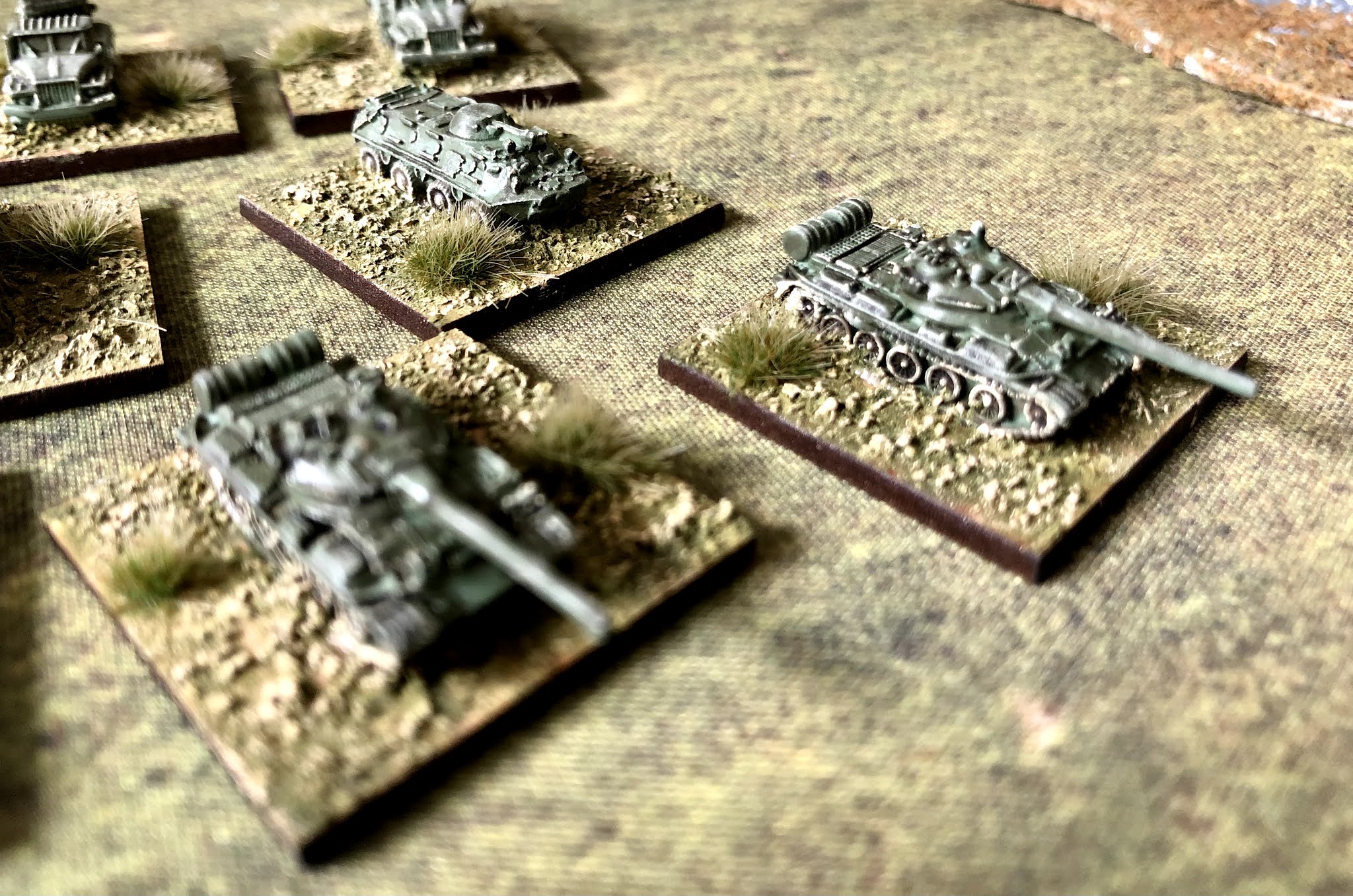
The Indian army in 1971 benefited from the introduction of Soviet equipment to at least partially replace their British AFVs. The MBTs included the T54/55 together with a range of APCs including the BTR60. They also acquired BM21 rocket launchers and 122mm howitzers. All these models are from the GHQ range.


The main addition to the Pakistan army was the Chinese T59 tank. More than 700 were delivered before war broke out. Again, these are GHQ models.


GHQ models are superb, but they generally come in packs of 5, which are fine for MBTs but too many for support weapons. I am a big fan of 3D printed models but I thought it might be too fiddly for this scale. These Sherman, M109, and M36 models for the Pakistan army come from the Butler's range are very nice models, and the waste material peeled off without any problems.


I also added heavy weapons to the infantry units with mortars and HMGs.

I had a quick skirmish before heading off on holiday this week. A big battle game using Corps Commander over Zoom is planned for the week I get back.


Wednesday, 7 October 2020

Building Anglo-Saxon England

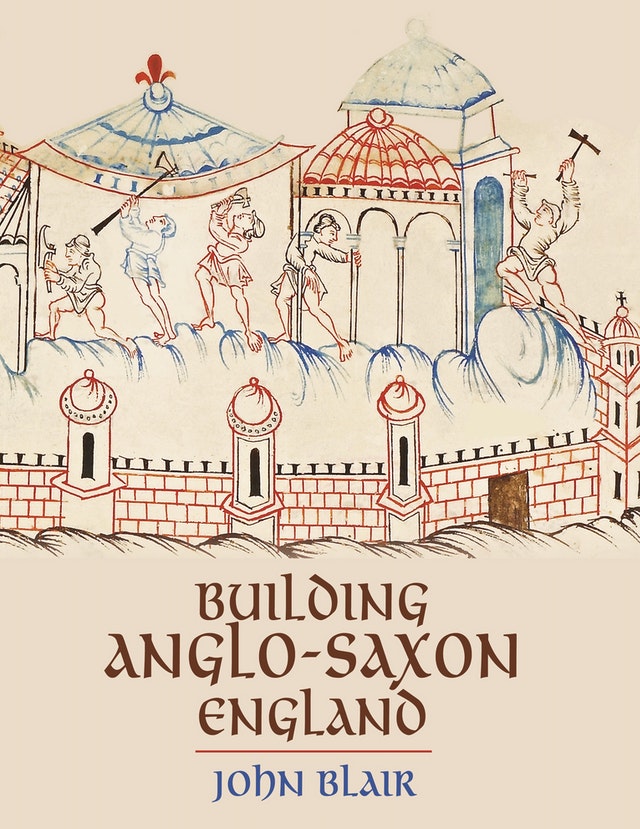
This is a weighty book by John Blair, which looks at the latest archaeological evidence on the built environment and the inhabitants of Anglo-Saxon England. I was given this beautiful book as a Christmas present last year, and until now have only dipped into it.

The author takes the reader on a journey through both time and place, identifying what we know about Angl-Saxon England and its influences. It is well illustrated throughout with extensive maps and reconstructions of the buildings. This is important because unlike their Roman predecessors and the following medieval era, the Saxons largely built with wood. In effect, they didn't build to last, unlike the many stone buildings we can view even today.

One of the main takeaways from this book for me was the role of Mercia. When we think of the Anglo-Saxons we immediately think of Alfred and Wessex. This is primarily because of the available written sources, which are few and far between for the Mercians. Their name means 'the frontier people' and the frontier in question was north-west from their heartland in what is now Staffordshire and Derbyshire towards the British and Welsh. The high point of this kingdom was probably during the rule of King Offa in the 8th century. Today better known for the fine walk along the route of Offa's Dyke, his defence against the Welsh. His successor Coenwulf developed this with his own earthwork; Wat's Dyke, which I confess I have never heard of before.

The author argues that Wessex copied many elements of Mercian building and culture. Not just with their own dykes, but also forts including the famous Burghs. Late 8th century Wessex was overshadowed and at times dominated by their northern cousins. Sadly, Mercia has no Anglo-Saxon Chronicle, no Burghal Hidage, no mint names and few charters, which leaves the archaeology described in this book. The archaeological evidence is also growing as the recent weapon finds in Berkshire show.

For the wargamer and military historian, the system of defensive Burghs is of most interest. While we have no written list of the Mercian ones, many can be identified by archaeology. Even the later Wessex ones were not a standardised fortification. Some developed into towns, but others remained simple forts, which reflected the local terrain. However, the technology for building them evolved in Mercia.

The lack of permanent Saxon buildings does not mean any lack of sophistication. The Anglo-Saxons had a complex form of government and coinage, which was influenced by Scandinavia and the Carolingians but was poised autonomously between them. In addition, regionality is important and we should not assume that the better known West Saxon systems applied uniformly across the rest of England.  In particular, we know much less about eastern England during this period. 

This is not a light read and probably more for reference than a straightforward read. However, it does challenge our popular conception of the period.

I have been expanding my late Saxon army this year with more to come.


Thursday, 1 October 2020

The Long Range Desert Group in the Aegean

The Long Range Desert Group (LRDG) are best known for trekking around the western desert in jeeps and trucks, guiding raiding parties and gathering intelligence. However, they fought in other settings, and this new book by Brendan O’Carroll (Published by Pen and Sword) covers operations in the Aegean, or more specifically during the Dodecanese Campaign in November 1943.


There have been many good books on this campaign, which has been fairly described as ‘Churchill’s folly’. Most focus on the main battles on the islands of Leros and Kos, where inadequate infantry forces were deployed without proper air or naval cover. As a consequence, they were quickly defeated by German counter-attacks. 

This book focuses on another aspect of the campaign. The role of small parties of LRDG soldiers who were landed on most of the islands to gather intelligence and later to support the fighting, or on at least one occasion, wrongly used as conventional infantry. Many of these highly trained and resourceful servicemen came from New Zealand. The author has painstakingly researched each of the actions from the war diaries, memoirs and later contributions to the journals of the LRDG Associations.

I first came across their story reading W.E Benyon-Tinker’s bookDust Upon the Sea’, which described the tough conditions they operated under. Being dropped on a small island with limited rations, operating for long periods without washing, led to a range of medical conditions. On the ground, the fighting was often at close quarters in which the lightly equipped LRDG fought at a disadvantage against German mortars, snipers and co-ordinated attacks from the air.

The author gives an overview of the other units fighting in this campaign and the Germans. The invasion forces were elite units like the Fallschirmjager, Brandenburgers and Gebirgsjager, all of whom respected the LRDG. They were quickly replaced by garrison troops who were typically older, poorly equipped units, often regarded as politically unreliable. In the air, aircraft like the Stuka were able to operate largely without challenge, bar the occasional sortie from P38 fighters based in Libya. Some of the Italians stood their ground when the Germans attacked, but many did not. In fairness, they had more to lose when captured as many, particularly the officers, were executed.

For my own research, it was interesting to note how often Turkish waters were used to shelter in and the assistance they received from the Turkish police. The modern resort of Bodrum was as familiar to Commonwealth troops in 1943 as it is to British tourists today.

The other key takeaway from this book was the support from the Greek islanders. They provided guides, food and did everything possible to help the Allied troops. All the more remarkable given the fatal consequences if they were caught.

There is an outstanding amount of detail in this book, perhaps on occasion too much for the general reader. However, it covers an often missed aspect of this campaign and pays due credit to some courageous and resourceful men.


The LRDG was not quite as well uniformed as these British Commandos of the period 


Monday, 28 September 2020

Afghans onto the tabletop

The latest pandemic measures in Scotland means face to face gaming in the house is on hold for the present, so it's back to Zoom. Just as I have finished the Afghans and was looking to get them on the tabletop. 10mm isn't the best scale for Zoom games, but we managed.

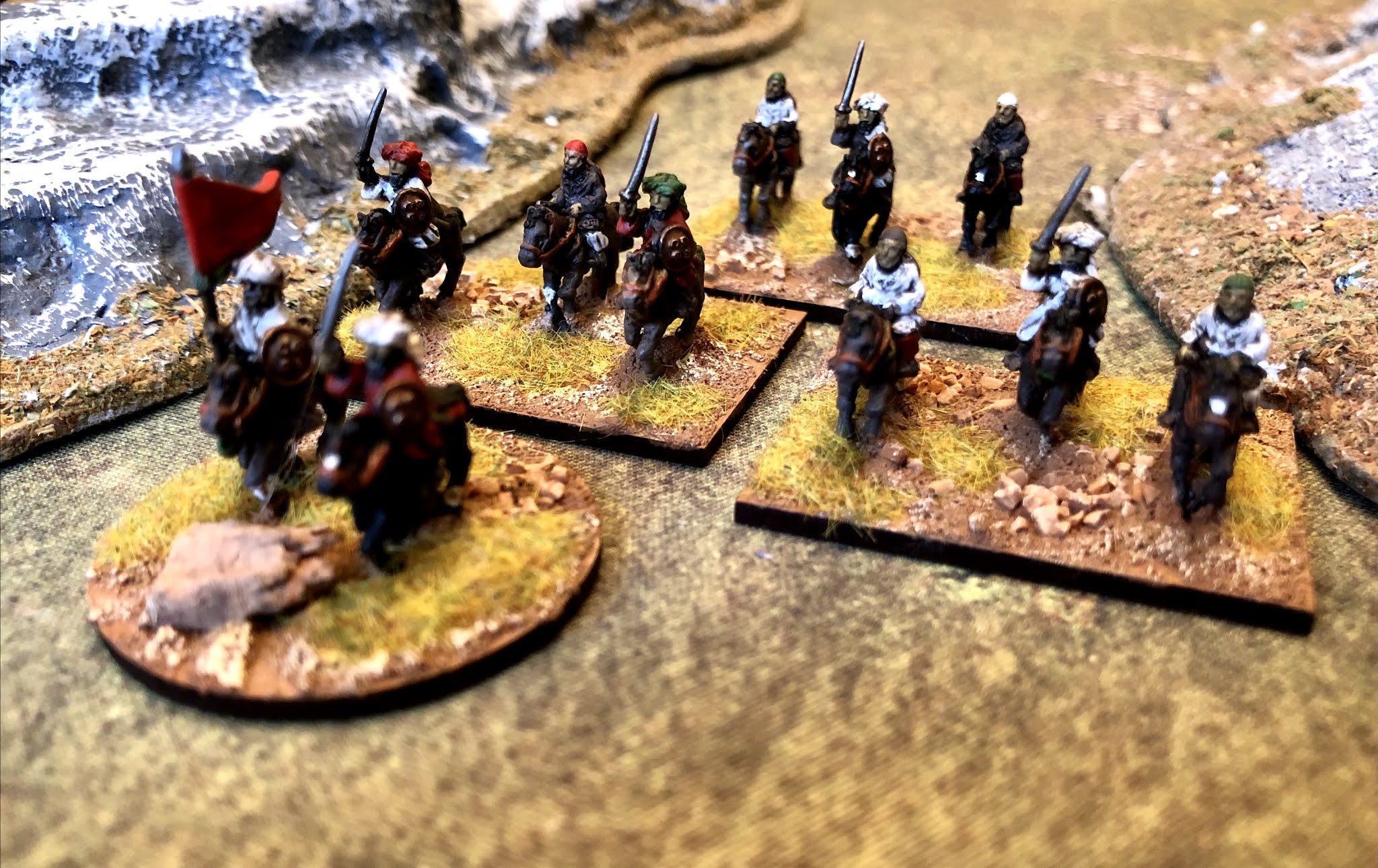
Last week's painting added cavalry, infantry and guns to the Afghan orbat. All the figures are from the Pendraken range. First, we have a tribal cavalry unit. On Saturday night I watched the film 12 Strong, which is about a US special forces unit attached to the Northern Alliance fighting the Taliban after 9/11. If you substituted an AK47 for the muskets, these figures wouldn't be out of place today.

Two field guns and two more rifle units complete the army, although I probably have enough figures left for another tribal infantry unit.


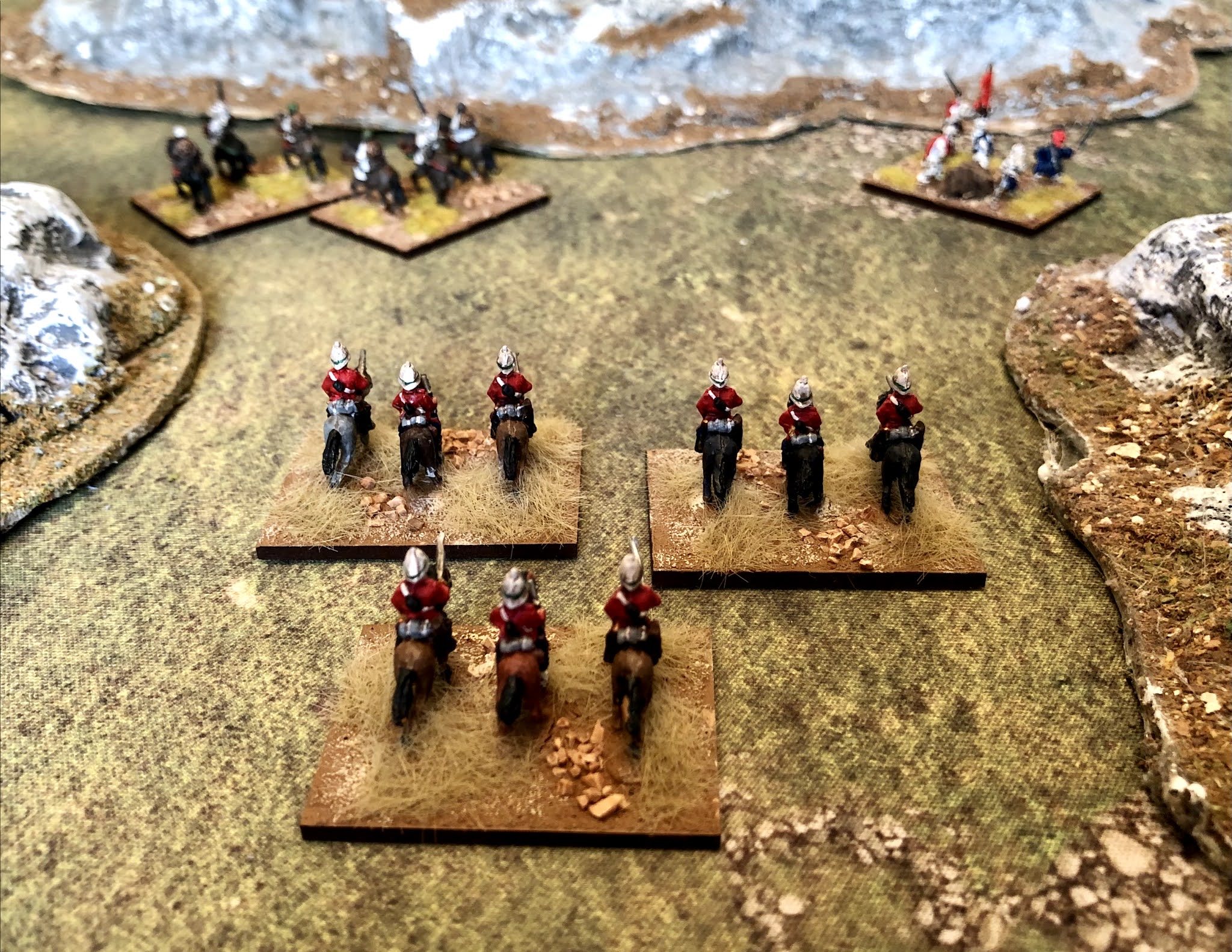
 For the game, we used The Men Who Would Be Kings rules with 33 points a side, somewhat larger than the standard game. I decided on a Second Afghan War scenario. The British have to break through the pass. 

Learning from their mistakes in the First Afghan War, the British aimed to capture the high ground before attacking the pass.


An Afghan counter-attack by infantry and then cavalry was easily beaten off by volley fire.


That allowed the British cavalry to complete the rout and capture the pass.


A fun, short game, just what a Dan Mersey set of rules is designed to deliver.


Saturday, 26 September 2020

God's Shadow: The Ottoman Sultan Who Shaped the Modern World

 This is Alan Mikhail's new book about Selim 1, sometimes known as Selim the Grim or Selim the Resolute, the Ottoman Sultan from 1512 to 1520. In western historiography, he tends to be eclipsed by his son, Suleyman the Magnificent. This is probably because his focus was the Middle East rather than Europe. However, he nearly tripled the size and population of the Ottoman Empire in his short rule, and so deserves greater attention.

Selim was a younger son of Bayezit II, which meant he was destined for a short life once his older brother took the throne. His father favoured his older brother but Selim from his base as governor of Trabzon revolted against his father and forced him from the throne, killing his other brothers. 

His experience in the east gave him a focus against the Persian Safavids and he led several successful campaigns against them, including the decisive Battle of Chaldiran. The Safavids had brought Shia Islam to Persia and Selim was a devout Sunni. He also persecuted Shias within the Empire. For Selim, the Venetians, Spanish and Genoese were secondary enemies, the paramount enemy was the heretic Safavids who offered an alternative vision of Muslim power.

Having defeated the Safavids he turned his attention to the waning Mameluk Empire. His victory at Marj Dabiq (near Aleppo) in August 1516 enabled the conquest of Syria and the Levant, including Jerusalem. The Battle of Raidanayya in January 1517 opened the way to Cairo and the conquest of Egypt down to the Indian Ocean. In Yemen, Selim’s army found coffee. Few people, at least in the West, quite appreciates that an Ottoman sultan made coffee the global phenomenon it is today.

This led to the further expansion of the Empire along the coast of North Africa supported by the Barbarossa brothers. This brought him into conflict with Spain and he died before attempting the invasion of Morocco and the Spanish enclaves on the coast. So, by this huge expansion of the Empire, it was Selim who created the imperial infrastructure that allowed Suleyman to become one of the most significant sultans in Ottoman history.

Mikhail also argues that Selim caused the Spaniards and English to look towards the Americas for colonial expansion. Columbus and John Smith both fought the Ottomans and many of the Conquistadores ended their careers fighting the Ottomans in North Africa. He even argues that had Selim lived, he would have challenged Spain in the Americas and the Portuguese in Africa. He makes a link between modern-day hostility towards Islam in the West to Selim's expansion in the 16th century.  

This is a great book on a lesser-known Sultan whose achievements were indeed enormous. I am less convinced about the 'shaped the modern world' argument, but I see the link. Well worth a read and when you drink your next cup of coffee, say thanks to Selim!

Support from the Janissaries was crucial to Selim gaining power.

   
Persian Safavid cavalry

Thursday, 24 September 2020

Agent Cicero - Hitler's most successful spy.

This is Mark Simmons’ take on the story of Agent Cicero, who was arguably Germany’s most successful spy in WW2. Cicero was the code name for an Albanian, Elyesa Bazna, who was the British Ambassador to Turkey, Sir Hughe Katchbull-Hugessen’s valet. I have read the memoirs of his German handler, Ludwig Moyzisch, which was largely confirmed by the German Ambassador Von Papen. However, this book takes a wider look including the now released US and British files.


Given that this was wartime and Turkey was a nest of spies, it seems quite astonishing that Basna was employed without any serious checks being made on his background. Helped by the fact he was a ‘walk-in’ spy motivated by money, rather than a trained spy. The Germans, at least in Berlin, thought he might be a British plant, but the quality of the documents he copied from the Ambassador’s box persuaded most that he was genuine. However, power struggles in the German hierarchy undermined the use of the material, and they drew the wrong conclusions or took no action.

The most important documents were the minutes of the big wartime conferences, including Moscow, Cairo, Tehran and Casablanca. It may also have helped with breaking some minor codes and certainly helped gain a better understanding of Turkey’s position on entering the war. In particular, it undermined deception operations that aimed to persuade the Germans that the allies might land in the Balkans. Even the planned date of Operation Overlord was disclosed through this route.

The Germans largely paid Basna in forged notes. These were printed by forgers based in a concentration camp (Operations Andrea and Bernhard), which were originally aimed at undermining economies but later were used for intelligence operations. There use resulted in two agents being captured in Egypt and a double agent was parachuted into England with notes that still had bands stamped ‘Reichsbank Berlin’ on them. These were elementary errors that add to the poor reputation of German intelligence in WW2.

There was an attempt to cover up the failure of security by claiming Basna was a double agent. This is clearly untrue and MI6 later admitted ‘the potential damage was enormous’.

The story of Cicero has been told by Basna himself in his 1961 memoirs as well as by the key players, Moyzisch and Von Papen. Given his dismal failure to follow basic security procedures, Sir Hughe understandably avoided mentioning it in his own memoirs or later! The excellent film Five Fingers, starring James Mason, is largely based on the Moyzisch account, and there are links to other works of fiction including From Russia With Love and the Guns of Navarone.

This book takes an objective look at the story using a range of sources. It also makes a very good read about what was Germany’s greatest intelligence success of the war.


Saturday, 19 September 2020

Afghans and the British army in India.

 I am a bit behind on the painting schedule having spent a very pleasant week away in the Lake District. However, the first Afghan tribesmen are now done. These are 10mm figures from Pendraken, which I will use against my Zulu and Boer War British for the 2nd and 3rd Afghan Wars. I will use The Men Who Would Be Kings rules.

First up a unit of tribesmen.


Then two units of irregular infantry. This is the first time I have used a white primer for a very long time. I found a very old tin of GW Skull White in the garage, which surprisingly worked the first time.


For reading inspiration, I picked Britain's Army in India by James Lawford off my to-read shelf. It has been gathering dust there for some time. 

It isn't directly relevant to the Afghan Wars because it covers the early British presence in India. From the early guard units in the East India Company warehouses, up to the Battle of Buxar in 1764. It is a detailed narrative history of the campaigns with quite a bit on how the Sepoy and European units were organised and deployed. As well as the varied Indian armies of the period. The Mughal Empire operated in name only during this period, and there is a bewildering array of Indian armies to choose from.

I have suitable figures for this period in 28mm as GDWS did several display games a few years back. The Indian armies are very colourful, although I recall some very late nights finishing them in time for the first show. Those were the days!


Wednesday, 16 September 2020

Soldier of the Queen

 This is the first in Max Hennessy's fictional series on the Goff family. It is set in the second half of the 19th century and the hero is Colby Goff, an officer in the 19th Lancers based in Yorkshire. Not a bad choice for a fictional regiment as the 19th Light Dragoons did convert into lancers in 1816, although they were disbanded in 1821, long before this book begins. 


So, where to start a book about British lancers? Balaclava 1854 of course, where the young Goff is with the Light Brigade in the Crimea. He of course survives, albeit wounded. A recovery back in the family home at Braxby (actual place by the way) in Yorkshire and some, well described, but routine regimental duties. 

Partly to avoid the marriage advances of a local girl, he is off to America as a correspondent with the Morning Post to follow the American Civil War. He starts on the Union side and then moves to the Confederate cavalry of Jeb Stuart. He gets a bit hands-on for a British officer, but it makes a better read!

Back home after another wound, he meets the up and coming General Garnet Wolseley who sends him to France to observe the Franco-Prussian War. He manages to get to both sides and ends up in the massive cavalry battle at Mars-la-Tour. Later he is in the Paris Commune. If this all sounds a little unlikely, it actually isn't. British, and other nations, officers in the late 19th century often swanned about Europe turning up in other people's wars. A number wrote books or at least articles on their adventures.

Back home he followed Wolseley to the Ashanti Uprising becoming one of his famous 'ring' of acolytes. I was hoping he might turn up in the Russo-Turkish War next. However, instead, he was off to South Africa to take on the Zulus. 

This is an entertaining romp around 19th century warfare. Not a bad nighttime read with just enough facts to make the fiction bearable. I can't say I will follow this series through but not a bad read.

I sold off my Crimean war figures some time ago. However, the Zulus are a project half completed after my visit to Zululand last year, and the lancers are done.


Thursday, 10 September 2020

Rebels on the Niagara

 This is a book by Lawrence Cline that I picked up on my visit to Canada last year. It covers the Fenian Brotherhood's invasion of Canada in 1866. There was a further effort in 1870, which together make up the last invasion of Canada.

The Fenian Brotherhood was a large membership organisation in the USA, largely made up of recent immigrants and those of Irish descent, committed to supporting Irish independence. After the American Civil War, a significant number of Irish Americans had gained military experience and the Brotherhood decided that this could be put to good use with an invasion of Canada to put pressure on the British Empire. At this time Canada had not become the confederation it is today, and the colonies were organised separately. 

The book explains the various debates that took place amongst the organisation, which resulted in splits and some disorganisation, as well as a shortage of funds to finance the invasion. Whilst they had significant political support in Congress and elsewhere, which chased the Irish vote, the US government was not supportive. Diplomatic relations, which had been strained during the Civil War, was fairly positive. 

Gathering weapons was not a huge problem in the USA given the gun ownership laws and culture. This didn't stop the US authorities from making some efforts to impound weapons. Both sides gathered intelligence, both in Canada and the USA. The Brotherhood was infiltrated by spies and even in the USA, it is difficult to hide gatherings and drilling of armed men. The actual movement of troops is even more difficult to hide, not that many of the participants made much effort when it came to security. Trains bound for the border were full of men drinking, singing Fenian fight songs, bragging and generally showing little concern for security.

The Fenian strategy was, to put it mildly, ambitious. They planned multiple incursions, an approach that well-trained armies of the period would have found challenging.  Communication problems were exacerbated by no access to the telegraph or railway systems. Little attention was paid to logistics, hoping to live off the land, which given the military experience of the commanders, seems very strange. It is important to emphasise that the plan was to seize and hold territory, not simply to raid.

The main attack was in the Niagara area and had some early success at the 'Battle' of Ridgeway when the Canadian militia launched a premature attack on the Fenian forces. Really just a skirmish with casualties on either side in single figures. However, as the colonial authorities got their act together, and the promised Fenian reinforcements failed to arrive, they decided to fall back on the disused Fort Erie. The remaining force was evacuated by ship, only to be captured and arrested by the US authorities. A further invasion was tried in 1870, this time in Quebec province. It was halted by a better prepared Canadian militia at Eccles Hill.  

While the invasion had a minimal impact on Irish independence, it was a factor in driving the confederation of Canada in 1867.

This is an interesting story but I think I can manage to avoid an outbreak of wargamers disease over this campaign. There is a board game from Last Legion if you are so minded.

A few pictures of Fort Erie as it is preserved today.


Monday, 7 September 2020

Fighting in Hell

 This is another book that has been sitting on my 'to read' shelf for some time. Edited by Peter Tsouras, he uses a number of studies written by former German generals for the US Army after WW2. The focus in this book is officers who had extensive experience of the eastern front. They are written by Germans and from a German point of view, translated but not interpreted by American personnel. They provide an interesting insight into combat on this front.


The main study is written by Erhard Rauss on Russian combat methods, followed by his views on the effect climate had on combat in European Russia. The other studies are on warfare in the far north and combat in forests and swamps.

One of the biggest surprises, to me at least, was how ill-prepared the German military was for fighting in the East. The General Staff had taken no interest in the history of wars in the north and east of Europe. I naively assumed their much-vaunted efficiency would have included the possibility that German troops might at some stage be required to fight in these regions. At the very least you would have thought some hurried work would have been commissioned in late 1940 when Hitler first indicated that he was considering such a move.

This is vital because, as General Rauss puts it, 'he who steps for the first time on Russian soil is immediately conscious of the new, the strange, the primitive. The German soldier who crossed into Russian territory felt that he entered a different world, where he was opposed not only by the forces of the enemy but also by the forces of nature."

Putting to one side the racial stereotypes that you might expect from a German officer of the period, these are fairly objective studies, albeit omitting the atrocities they also committed. All the Russian tactics are covered, supplemented by examples from actual operations. These include a number that I have never heard of, including the practice of setting large areas of forest on fire. One German brigade was nearly wiped out by a fire on the Luga River in 1941.

Like the editor, the description of the fighting in the snow reminded me of Laurence Oliver's haunting commentary in the World at War television series. I haven't read much about the war in the far north, the Continuation War, in Finland. Apparently no German tank or self-propelled gun ever saw service north of the Arctic Circle. The description of how the German troops adapted to the conditions is fascinating, as is the way the Russians had learned from their mistakes in the earlier war.

This is not your usual narrative military history book. The focus is on tactics and logistics, both on land and in the air. A rare insight into the mechanics of fighting in what really must have been hell for the soldiers on both sides.


Sunday, 6 September 2020

Libertad!

 Rob Anderson and Mark Fry have written this supplement ('Libertad' is 'freedom' in English) for the Blitzkrieg Commander rules covering the Spanish Civil War. You will need the core rules as well to use this supplement. It is available as a 35 page PDF download from Wargames Vault for $6.60.

There are a few rule amendments to reflect specific features of this conflict including fixed formations and improvised street barricades. They have simplified the bewildering array of armoured cars that were deployed by both sides into those with and without AT capability and the rest. There is also a rule for Molotov Cocktails.

Then we get five scenarios with some very nice maps drawn by Henry Hyde. These include some well known and lesser actions.

The meat of the supplement is the army lists, which include all the many factions that made up both the Nationalist (Rebels) and Republican (Government) armies. These include a brief description of the faction and then the Blitzkrieg Commander statistics. They also have a few special rules and equipment.

There are plenty of excellent books on this conflict to expand your reading. More recently these have included books that focus on the military history of the war. Charles Esdaile’s ‘The Spanish Civil War: A Military History’ is a recent contribution, and Alexander Clifford 'The People's Army in the Spanish Civil War', which focuses on the wider People's Army, not just the International Brigades. I have seen a positive review of a new book by Giles Tremlett 'The International Brigades' in the latest edition of the BBC History magazine. Their History extra podcasts also have the prolific SCW author Paul Preston being interviewed in their series 'Everything you wanted to know...."

I have 15mm and 28mm armies for the Spanish Civil War. The 15mm armies were initially based for a similar Flames of War supplement but work equally well for Blitzkrieg Commander. You can, of course, use Italian WW2 forces and tanks from early war German and Soviet forces. No Pasaran!