Welcome to my blog!

News from a wargamer with a special interest in the military history of the Balkans. It mainly covers my current reading and wargaming projects. For more detail you can visit the web sites I edit - Balkan Military History and Glasgow & District Wargaming Society. Or follow me on Twitter @Balkan_Dave
or on Mastodon @balkandave@mastodon.scot, or Threads @davewatson1683

Tuesday, 26 July 2022

StuG III Brigade 191

 This is the operational history of the German Army Brigade 191, known as the 'Buffalo Brigade', written by one of its members, Bruno Bork. The unit was equipped with the Sturmgeschutz III assault gun throughout WW2. 


The unit started as Abteilungen 191, formed of three batteries of six vehicles each and an extensive tail of support vehicles, something that wargamers tend to forget. They were part of the artillery and wore the field grey of that branch rather than the black uniforms of the panzers. Their role was generally to support infantry units with close-range firepower. It was equipped with the StuG III and the short-barrelled 75mm L/24. This was upgraded to the long-barrelled L/48 at the end of 1942, which enabled it to knock out Russian tanks.

My main interest in getting this book was because they first saw action in the Balkan campaign of 1941. The unit was based near the Romanian oilfields at Ploesti. In March, they crossed the Danube at Giurgiu into Bulgaria, travelling across the Balkan Mountains through the Shipka Pass and down to the Greek border. It was a strange route for an armoured unit, which put a lot of strain on the vehicles. It took 14 days to overhaul and repair them.

The unit's baptism of fire came in the attack on the Metaxas Line, supporting I/Inf.Regt 100. Despite some remarkable driving in the mountains, they suffered serious casualties and didn't break through the lines. However, once the Greeks surrendered, they advanced through Salonika and down to Thermopylae before being sent all the way back to Moravia to refit for the Russian campaign.

In the early stages of the Russian campaign, they fought over some topical places in Ukraine, including Kyiv. The speed of the advance meant they were attacked by Luftwaffe bombers, despite having swastika flags on the top of the vehicles. Apparently, the Luftwaffe thought this was a false flag operation. It is worth remembering that German ground-air coordination was not always as good as claimed as this wasn't the last time this happened. The appearance of T34 tanks came as a shock, as it took 18 AP rounds to knock them out. 

The Russian winter was the next shock, with a lack of winter clothing and adequate supplies. They supplemented these with captured Russian stocks, although one platoon ended up with super-diarrhoea when they translated 'Rata Aircraft Motor Oil' as 'finest salad oil'! The battalion was part of the thrust south into the Caucasus, and the descriptions of how they were used tactically are interesting. When working with the panzers, they were in reserve until the panzer spearhead came upon enemy resistance when they took cover while the StuG's took over. Needless to say, this wasn't popular, and they were pleased to get back to supporting the infantry.

Having reached the Caucasus, they had to retreat back via the fierce fighting in the Kuban Bridgehead and the Crimea. The unit was abandoned at Sevastopol, although many troops were evacuated. During the retreat, when they lost vehicles, crews were formed into ad-hoc infantry units. The unit was reformed and sent back to the Balkans, fighting in Romania, Yugoslavia and Hungary. The street fighting in Belgrade is another reminder of the importance of armour being supported by infantry. Finally, the unit ended up in Austria, where it surrendered to the Americans.

The author was a professional soldier before the war and served as an NCO before he was wounded. He ended the war as a Leutnant. While this isn't an entirely objective study, it's a bit vainglorious in parts, but it does give a detailed understanding of how assault guns were used in combat. It is also very readable, with more than 100 illustrations.
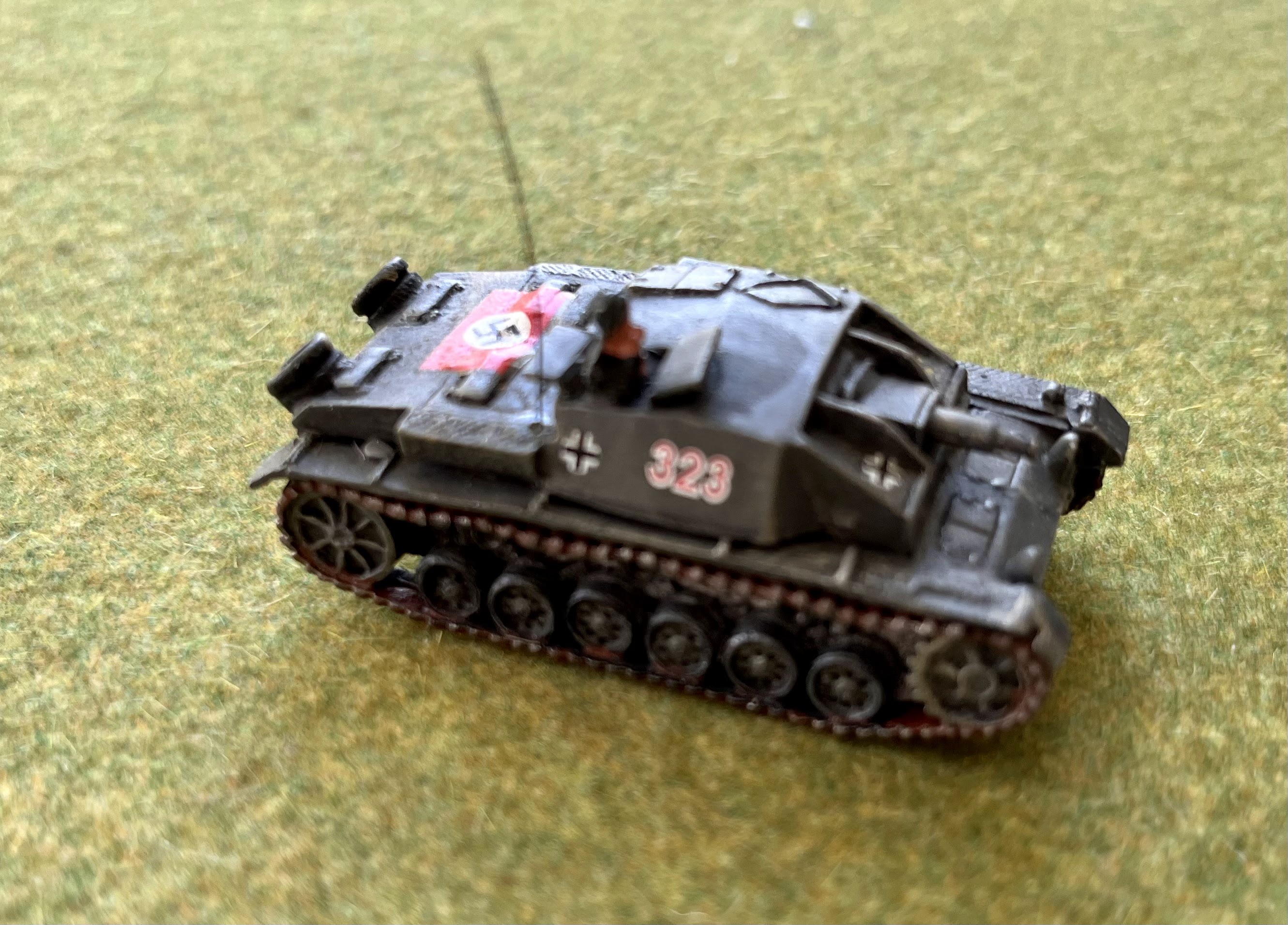
I was quite pleased with my 15mm StuG III and its flag until I read this book!


Thursday, 21 July 2022

Budapest: The Stalingrad of the Waffen-SS

This is Richard Landwehr's study of the siege of Budapest with a focus on what he calls 'the backbone of the defensive effort', IX SS Corps and the 'Florian Geyer' and 'Maria Theresia' cavalry divisions. There are more detailed and more objective studies of the siege. In particular, Battle for Budapest by Krisztian Ungvary, as well as a good Bolt Action supplement for wargames. I collected a Hungarian army based on the supplement.

I started to get suspicious when there was no introductory chapter on the divisions and how they got there. The soldiers are described as 'sharing one thing in common: an inner fortitude of inextinguishable dimensions'. No mention that the 'Florian Geyer' Division killed an estimated 3,000 Russians in a 'pacification' campaign, the great majority of whom were unarmed! 

While there is a decent collection of photographs and descriptions of the action, the narrative continued to emphasise that these SS troops were 'saving countless lives that otherwise would have been engulfed in the red tide.' 

At this stage, I thought I had better check out the publisher and the author. The publisher has had a mixed background, but the author is noted for his extreme admiration of the Waffen SS. As Wikipedia sums him up, 'Richard Landwehr is the author of numerous books about the Waffen-SS, its non-German volunteers, in particular, providing revisionist and apologetic accounts of these men and their battles. He has been producing the magazine Siegrunen on the same topic for over 30 years. Landwehr has written for the Journal for Historical Review (JHR), which is published by the Institute for Historical Review, an American Holocaust denial organization.'

So, one to avoid. 

Here are some 28mm Hungarian cavalry from the Great Escape Games range.

P.S. I see Helion has the edited Soviet General Staff study, The Budapest Operation, with 20% off.

Tuesday, 19 July 2022

HMS Amphion 1798

 This is Michael Feather's short study of the Royal Navy frigate HMS Amphion, which served during the Napoleonic wars. He has looked at the frigate's life from construction to decommissioning. My interest is that this was the ship William Hoste took into the Adriatic for his earlier voyages before he was given command of the larger frigate HMS Bacchante.


The author's interest was sparked when he passed the abandoned Betts yard at Mistley in Norfolk, where the 32-gun HMS Amphion was built between 1796-1798 at the cost of £13,958. One of five frigates constructed to the same design from English oak. She served for 22 years, which was quite long for a frigate. She was fitted out at the Chatham shipyard. Her guns were 26 18lbrs on the upper deck, 6 24lbr carronades on the quarter deck and fo'c'sle, and 6 6lbr long guns on the fo'c'sle deck and fo’c’sle (this gave a specification of 32 guns as the small 6lbrs were not counted).

William Hoste was a protege of Nelson's and was given command of Amphion on 13 October 1805 at the age of 24. He was on a mission to Algiers, so he missed Trafalgar. After some limited action with Sir Sydney Smith, he was sent on ‘the best cruise in his command’ to the Adriatic, joining the Unité in harassing enemy shipping and shore stations. In 1809, Hoste became the senior captain and, for a time, the only frigate captain in the Adriatic, which meant that he did not have to share so much of the prize money with others. A constant concern as he was financing his spendthrift father.

Hoste was commanding Amphion at the Battle of Lissa in 1811, the last major naval action of the war. The Amphion returned to England and lay shattered at Greenwich for a while, needing more than the typical hasty repairs. As a point of honour, she was repaired although she was already obsolete, not big enough. The Americans were causing havoc with their large, heavy frigates, and the French were building 44 gun frigates. Hoste returned to the Adriatic campaign in Bacchante. When Amphion was repaired, she performed anti-smuggling tours in home waters and a show the flag tour of South America before being sunk as a breakwater in 1820.

This is an interesting study using the original records in the archives. I know from my own experience that this is pretty challenging, not just because of the age of the documents but also trying to interpret the handwriting.

There are plenty of scenarios here for games of Black Seas. I am currently painting Russian ships, but the Royal Navy ships are ready to sail once again.


Saturday, 16 July 2022

The Devil's Pact

 I have read most of James Holland's history books, but his historical fiction has passed me by. However, I saw this book in his Jack Tanner series in my local library and decided to give it a go. 


Jack Tanner is an infantry officer in a fictional Yorkshire regiment. This is book 5, and he has reached the rank of Captain. The Tunisian campaign is ending, and he is seconded to the Americans as the allies prepare to invade Sicily. He takes part in an undercover operation to liaise with the Mafia, who have agreed to assist with the invasion in return for giving them a free run to return to their pre-fascist glory days. This is a historical fact, although the details have remained shrouded in secrecy. This is the devil's pact in the title.

On returning to the unit for the invasion, there is a new battalion commander. They have a past, and the new commander engages in various dirty deeds to get Tanner killed or injured. As if war isn't dangerous enough. I won't spoil the story, but our hero fights his way up the east coast of Sicily, around Mount Etna, with Monty's army. With a bit help from the Mafia, his American pals under Patton go the long way around.

The sales blurb calls this series 'A Sharpe for the Blitz years', which is a pretty good description of the style. Tanner has been promoted from the ranks and is despised by some of his seniors and supported by others. He has a positive relationship with his men and leads from the front. If you like Sharpe, you will enjoy this. I certainly did and will probably go back to the start. That appears to be the Norway campaign, a particular favourite of mine.

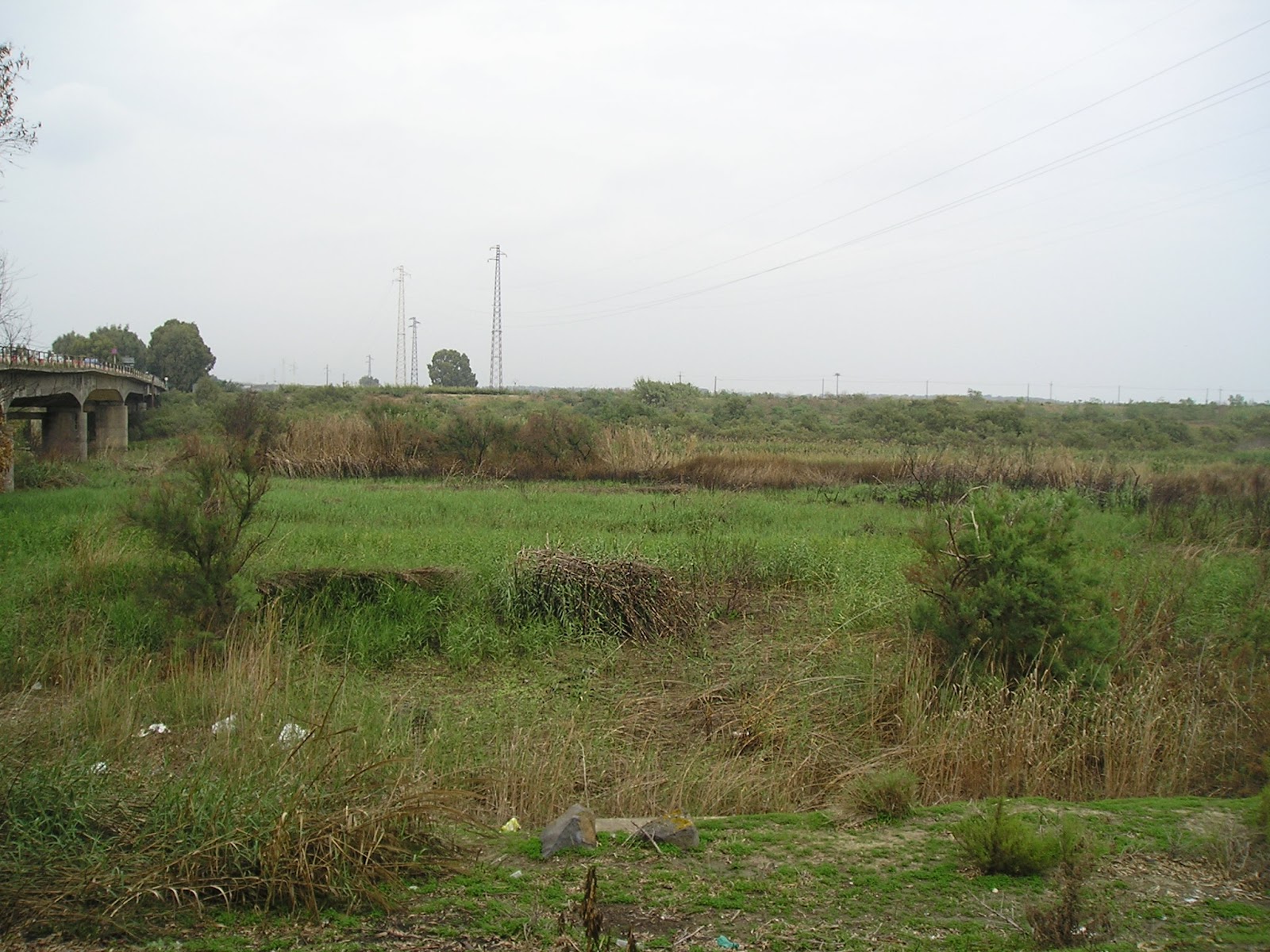
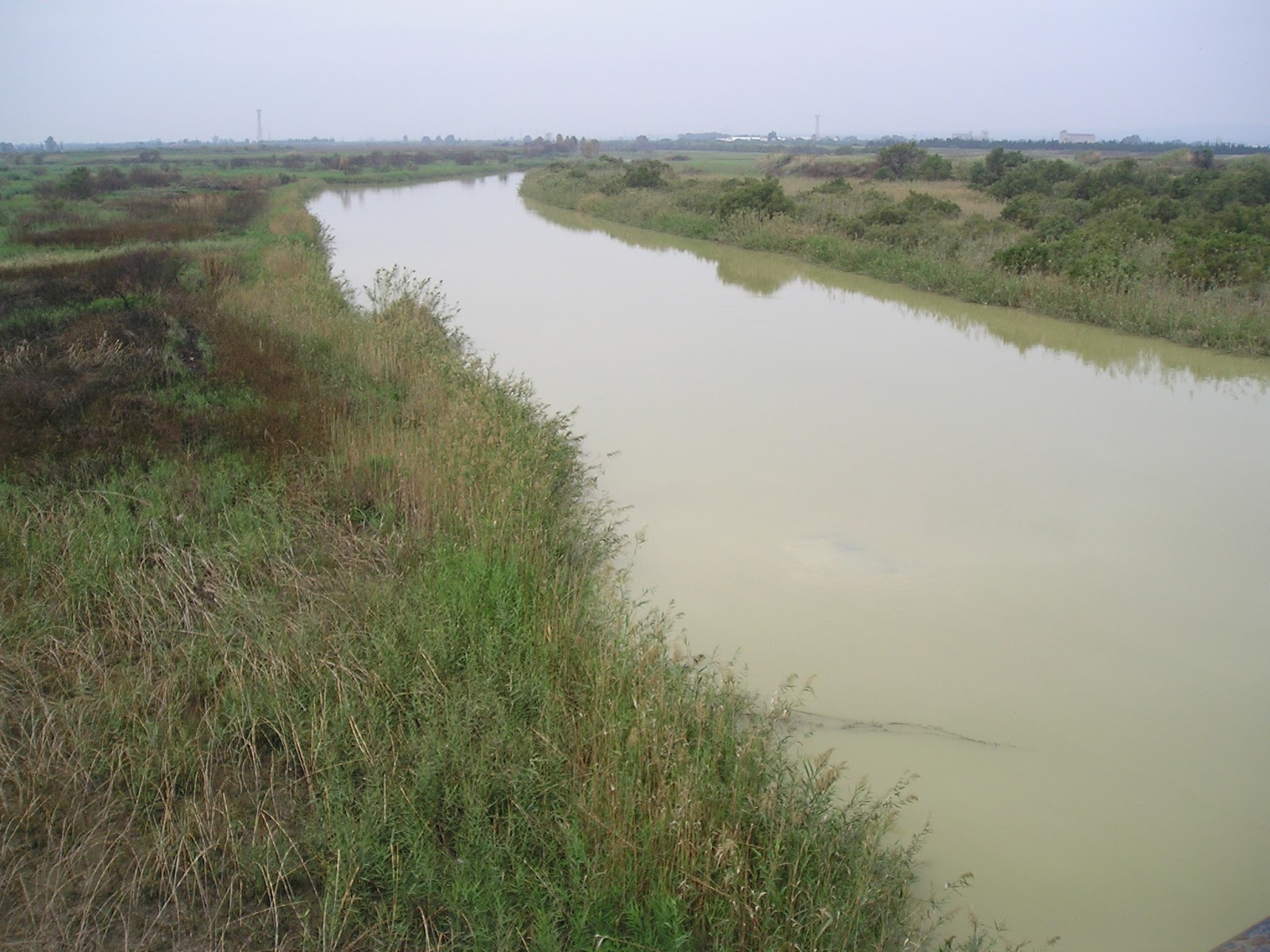
I have also visited the main battle sites on Sicily. One of the operations covered in this book was the airborne assault on Primosole Bridge across the Simeto River and the infantry relief operation. A smaller version of Operation Market Garden. I remember my wife looking bemused (not for the first time!) as I stopped the car on the rather grubby-looking river. The bridge in the pictures below is, of course, a modern one. Much to my wife's amusement, a group on the river bank turned out to be a Sandhurst field trip.


Thursday, 14 July 2022

The Ionian Islands

 I have been indulging in some background reading for my Adriatic project. The first book was Jim Potts' The Ionian Islands and Epirus. This is described as a cultural history, and while there is plenty of that, there is also plenty of general history to help me better understand the islands and their strategic position in the Napoleonic wars. I spent a week touring Epirus some years ago and visited the coastal ports traditionally linked to the islands, but I haven't been on the islands themselves.


The Venetians held onto most of the Ionian islands, and the mainland ports of Parga and Preveza, during the long Ottoman occupation of Greece. The French took Corfu and the other Ionian Islands in 1797 to be temporarily driven out in 1799, but they returned in 1807. The British then invaded the southern Ionian Islands (Zakynthos, Kefalonia, Ithaca and Kythira) in 1809 and held onto them until handing them over to Greece in 1864.

Napoleon wrote, "I think that henceforth the chief maxim of the French Republic should be never to give up Corfu, Zante, etc." He cited economic reasons but also highlighted the strategic value, "With Malta and Corfu we should soon be masters of the Mediterranean.... Corfu and Zante make us masters of the Adriatic, and these islands are of the greatest importance to us." He also saw the islands as an essential staging post to take advantage of any break-up of the Ottoman Empire.

British tourists came in large numbers to Corfu when it became a major tourist destination. And although it is probably not as popular these days, many thousands still descend on the islands. You can even still play cricket. British tourists have not always behaved, with the combination of sun and cheap booze being an early attraction. As the author points out, this is not new. Lt. Col. Napier, writing in 1825 about Kefalonia, blamed drunkenness as one of the main causes of disease and death amongst British soldiers, as well as exposure to the sun, bare-headed.

The Ottoman governor of Epirus, Ali Pasha, regularly features in the book. His is a fascinating story, rich with anecdotes to liven any tale. Quentin and Eugenia Russell are the latest to write a biography of the old rogue and very good it is. As the Reverend Hughes put it, "As long as he lives he will exert all his energies to gain a footing in the Ionian Islands, and upon his death-bed he will bequeath these sentiments to a successor." The islanders, particularly the Pargians, wisely did their best to keep him out. But, sadly, it was the British who sold them out in the end, and many ended up on Corfu. 

I was in the Scottish National Book Town of Wigton last week. It hasn't reached the levels of Hay on Wye, but it has a few very good second-hand book shops. I picked up two books related to my project. Celia Irving's The Adriatic Islands and Corfu is an old-style travelogue of the sort you don't see as often these days. When she wrote it in 1971, most readers would have bought it for the vicarious thrill, while today, they are all within reasonable travel range. While the travel details are pretty outdated, the history and anecdotes are still relevant. I have quite a few of these covering Balkan travels, and they are still worth a read.

The other book is Colonel Leake in the Mani, edited by Martin Jones. Leake was sent by William Pitt to survey the Peloponnese and northern Greece. He liaised with Ali Pasha and brought him artillery and other military stores. These included Congreave Rockets. I have yet to find a first-hand description of their use in action, but it must have been a sight to behold!

This is all interesting background reading that I suspect probably won't get many readers to dash out and buy them. However, if you are planning a holiday to any of the Ionian islands, then Jim Potts' book is worth a read on the plane and can be picked up cheaply on the Kindle.

Some of my Greeks of the period from the Old Man's Creations range.


Monday, 11 July 2022

Tanks at the Iron Curtain 1960-75

 This is a new look at NATO and Warsaw Pact tanks during the height of the Cold War, written by the premier tankie, Steven Zaloga. I started being a bit sceptical about this approach, as the tanks involved have been extensively covered in other Osprey Vanguard books. However, this book highlights the development of tanks during the period and how they compared, and I certainly learned something new from it.

At the start of the period, both sides were debating the future armament of their tanks. Should they be armed with anti-tank missiles, or should they attempt to outgun their opponents? For the Soviets, with the 100mm T55 as the standard MBT, the army wanted a bigger gun when they evaluated the new American M60. The Americans experimented with the missile option in the M60 and in their new light tank, the Sheridan. The Russians developed the Obiekt 150, which was championed by Khrushchev, who exclaimed, 'The tank has no future against this weapon!' In the end, both sides decided that the versatility of gun tanks was best, and ATGMs could be fired from lighter, faster and cheaper AFVs. Ammunition storage was another factor against the missile tank.

I was interested in the tank production data. The Soviets (excluding the Warsaw Pact) continued to produce the T55 long after the T62 was in full production and even after the T64 and T72. For example, in 1973, they still churned out 385 T55s as well as 1,620 T62s, 500 T64s and the first 30 T72s. Most exports came from the Warsaw Pact producers, so that is not the only explanation. 

In design terms, Soviet tanks were lighter but similarly armoured to NATO tanks, at the cost of ammunition storage. The cost was always a factor with all armies of the period. A T-62 tank took 5,855 man-hours to build, but the T-64 required 22,564 man-hours, four times as much. The price for a T-62 in 1973 was 62,000 rubles compared to 143,000 for the T-64A, more than double the price. The rationale for accepting the T-72 into production simultaneously with the T-64 (and the T55 and T62) was that it was less costly since it used less elaborate fire controls. As a result, it could serve as a wartime “mobilization tank” that could be quickly built in larger numbers. Also, it could be manufactured by the other Warsaw Pact countries.

On the NATO side, attempts to agree on a standard design failed for all the usual political and economic reasons. Hence the array of new tanks, including the Leopard, Chieftain, AMX30 as well as the M60 in many variants. The Leopard 1 became the standard NATO tank of its generation, with about half of total production going to eight other NATO armies. Exports also allowed the cost to be kept down, and in the British case, more Chieftains were exported than served in the UK armed forces. The M48 was also updated in several NATO armies. The British 105mm gun was used in several designs. During the Hungarian Revolt of 1956, insurgents in Budapest drove a captured Soviet T-54A tank to the British embassy, where it was inspected by the military attaché’s office. The thickness of the frontal armour proved very worrying and led to the development of the 105mm gun.

Thankfully, as the Cold War never got hot in Western Europe, it is difficult to evaluate the effectiveness of different designs. Lessons from outside Europe were limited. The Americans only needed the older M48s in Vietnam because there was no armoured opposition. Similarly, the Soviet invasion of Czechslovakia was unopposed by armour. The Indo-Pakistan Wars were fought with tanks that were mostly obsolete in western armies. And the Arab-Israeli conflict outcomes were determined by the superior training and tactics of the Israel Defense Forces (IDF) rather than technological issues. The missile threat was evaluated. However, the early studies exaggerated the effect of the Egyptian use of Soviet ATGMs. Of 7,000 missiles fired, about 250 tanks were damaged or destroyed. This suggested a success ratio of 1:28 or a 3.5 per cent probability of hit.

The book concludes with a technical analysis of the different elements of tank design, including firepower, fire control, armour, and mobility. This chapter concludes with an interesting classified Soviet comparative analysis. They rated most NATO tanks as better than the main Soviet designs, although the high rating of the T10 is a bit of a mystery.

As usual with this series, you get plenty and data, photos and some very nice colour plates. The tankies might want more, but for the wargamer, in particular, this is a useful addition to the bookshelves. 


Saturday, 9 July 2022

Dumfries Aviation Museum

 Dumfries Aviation Museum is located on the site of the former RAF Dumfries, on the outskirts of Dumfries. It's a small museum run by a dedicated team of volunteers. They have an eclectic collection of aircraft, most of which need some renovation, with displays about the airfield, airborne forces, engines and equipment. 

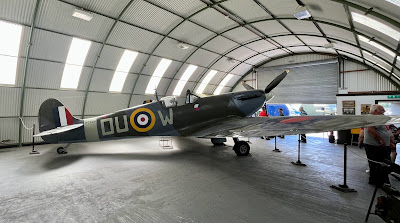
The star attraction is the Loch Doon Spitfire. This is a Mark II Spitfire that fought in the Battle of Britain. It was then sent to Scotland as a training aircraft for a Czech squadron, and it crashed in Loch Doon on a training flight. Volunteer divers found the aircraft, which had been restored at the museum.


 Outside they have an interesting collection of Cold War aircraft. Starting in the car park with the English Electric Lighting. Perhaps not the most elegant jet fighter, but I had the Airfix kit hanging from my bedroom ceiling as a kid.


Also in the RAF inventory is the Hawker Hunter.


A couple of USAF fighters, the Sabre and Super Sabre, one of my favourites.


A French Mystere.


And a Saab Draken, which is the second one I have seen this month after my trip to Sweden.

The Fleet Air Arm Gannet has to be one of the most appropriately named British aircraft.


And finally, a Westland Wessex, another favourite kit of mine.


Well worth a visit if you are in the area.

Wednesday, 6 July 2022

Wargaming Campaigns

 Henry Hyde's long-awaited tome on wargame campaigns has, at last, crashed through the letterbox. Well, actually, it was too big for the letterbox, and my wife suspected this was another addition to my lead pile! At 526 pages, you can see below, it dwarfs the classic (75 pages) 1973 'Setting up a Wargames Campaign' by Tony Bath. 


Henry has many virtues, but as listeners to his podcast will know, brevity is not one of them! And I even pay him through Patreon for the privilege. In fairness, much has changed in the hobby since 1973, and this tome covers far more than was even available to Tony in those early days of the hobby. Looking at my copy of Tony's book, I can see my pencil amendments to his costings, which reminded me of all those campaigns I organised using his book, with lovingly drawn maps on hex paper. Today, with tools like Inkarnate, we can have stunning fantasy maps at the click of a mouse. And it is developments like this that are reflected in this new book, hopefully encouraging a new generation, and some old grognards, to extend their tabletop battles to campaigns.

I did worry that this book might veer too far towards nostalgia. There is a fine chapter, 'Standing on the Shoulders of Giants', which had me reaching for my bookshelf. However, in the main, this is bang up to date with chapters on mapmaking and digital campaigns that drip with valuable ideas and resources. I use Inkarnate, but Worldographer looks good, and the Cartographers Guild website is a great resource. There are many good ideas about using spreadsheets and other technology to take a lot of the effort out of the paperwork that used to grind many of my early campaigns to a halt. I think I still have some of the many desk diaries I used to pick up cheaply at the end of every year. Henry is also supporting the book with online resources.

So what do you get for your money? After an introduction to campaigns, there is a chapter on generalship and strategy, followed by how to write your own campaign rules. Most chapters give you the theory, followed by practical examples and his suggested rules to get you started. The book is well illustrated throughout, not just with eye candy but with screen grabs and other practical pictures. Solo campaigns are not ignored, reflecting the impact of the pandemic on most of us. 

The following chapters get into the detail, covering issues like characterisation, roleplaying, weather, as well as campaigns at sea and in the air. The naval chapter will come in very handy for my Adriatic project. Most of us ignore weather in our games, which is surprising given how much we talk about it generally! Henry has created a deck of 52 cards to download that will go with his suggested rules. An excellent example of how this is much more than just a book.

I suspect most wargamers will use this book as a reference resource rather than reading it from cover to cover. Nonetheless, I loved this book, which I will keep within easy reach. It is a mixture of inspiration and technical manual, not an easy mix, but one Henry has done very well.


Monday, 4 July 2022

Fighting Napoleon - John Hildebrand of the 35th Foot

 This book covers the memoirs of Lieutenant John Hildebrand 35th Foot in the Mediterranean and Waterloo Campaigns, edited by Gareth Glover. The 1st Battalion of the 35th Foot was the main British regiment serving in the Adriatic during the Napoleonic Wars. John Hildebrand was present during most of the island and coastal hopping campaigns between 1811 and 1814. Glover has done an excellent job editing these memoirs, which were written sometime after the action. He corrects obvious errors and gives some important context.


He was born in Berwick-upon-Tweed, a long way from the regiment's recruitment area in Sussex. Although his father served in the Sussex Fencibles when based near Glasgow, which may explain some influence in his getting the Ensign position without purchase. The 35th Foot was often divided into detachments for individual actions, which meant that even junior officers had independent commands. Young army officers serving in the Adriatic, being granted more freedom and often working without close supervision, caught the same bug as the 'gung-ho' naval officers. The latter were always looking for an adventure, whether at sea or on land. 

The battalion first arrived in the Adriatic in September 1809 as part of General Oswald's expedition to capture the Ionian Islands from the French, together with foreign regiments including the Royal Corsican Rangers and the Greek Light Infantry. Hildebrand was with another force in Sicily. They captured Zante, Cephalonia and Santa Maura, and he joined the garrison on Zante in May 1811. He wasn't much impressed with the Greek Light Infantry, saying, "1st Battalion of the Greek Light Infantry Corps was raised, a fine-looking body of men but, as it turned out, utterly useless as soldiers and worse; so troublesome and unruly in discipline that, however hard the duties of the different garrisons of Zante, Santa Maura, Cephalonia, &c, no commanding officer could ever be persuaded to have that corps, if he could possibly avoid it."

He was part of a detachment that occupied Lissa (Vis) in May 1812. From there, under the command of Colonel Robertson, they attacked other French-held islands, including Lagosta (Lestovo) and Curzola (Korcula). Hildebrand was given command of the garrison at Lagosta, unusual for such a junior officer of the period. On his own initiative, he joined the siege of Ragusa (Dubrovnik) during 1813-14, being prosecuted by local irregular forces. The siege is covered in detail before the Austrians arrived and took the French surrender. He was given retrospective approval by Robertson, which was just as well given the sensitive politics of the siege.

He was offered a promotion in a new regiment being raised in Italy, but Napoleon's defeat in 1814 cut short that prospect, and he ended up back in the garrison at Corfu. The main enemy there appears to have been the fleas! He was sent home due to ill health but rejoined the regiment before Waterloo. The regiment was on the periphery of that battle.

Napoleonic memoirs can be a bit turgid and often full of detail the reader can do without. However, this is excellent, not least because of Glover's editing. An excellent primary source for my Adriatic project. The actions described are perfect for small battle rules like Sharp Practice or Rebels and Patriots.

I picked up this 1879 map of the Austrian Empire in a second-hand bookshop while on holiday in the Lake District. Very useful for these campaigns.


Thursday, 30 June 2022

The Debatable Land

 This book by Graham Robb is about a stretch of land on the England/Scotland border called the Debatable Land. For several centuries this desolate tract of land, of around 50 square miles, was treated as a sort of no man's land where by parliamentary decree, "all Englishmen and Scottishmen are and shall be free to rob, spoil, slay, murder and destroy, all such person and persons, their bodies, property, goods and livestock.... without any redress to be made for same."


Like most borderlands, during this period, the border between England and Scotland was a pretty violent place, subject to what was known as reiving, essentially cross-border raids. Flags of War have a Kickstarter that I have signed up for with rules and figures covering the Border Reivers. I have struggled with the main histories of the period, including Steel Bonnets, so I thought I would have another go with this book.

The author moved to the area, so this is a bit of a travelogue and a history. I did find the structure of the book a little hard going, but there are plenty of gems to make the journey worthwhile. For example, the word 'blackmail' comes from the protection money paid to a powerful neighbour who assumed the responsibility for getting back your stolen goods by organising a 'hot trod'. Also, 'bereaved' which initially simply meant robbed. The phrase 'debatable lands' comes from 'batable', which meant pasture lands used by both nations. It was not disputed but recognised as neutral by both governments. 

There were no permanent buildings or fortifications, but the border clans, most notably the Armstrongs and Grahams, had property on either side and frequently contested each other. These were no castles as such but tower houses called Pele Towers. There were few sieges, but the word 'scumfishing' meant surrounding the tower with damp straw and smoking the occupants out. Just outside the Debatable Land is Hermitage Castle, as stark and functional as a castle that I have ever visited. It was most famous when Mary Queen of Scots made a famous marathon journey there on horseback from Jedburgh to see the wounded Earl of Bothwell, only a few weeks after the birth of her son.

The first proper map was drawn by Henry Bullock, and it looks like the sort of fantasy map I might draw using Inkarnate. It was used to divide the land in 1552, marked by parallel ditches, which can be seen today. This marked the end of the independent territory, and each nation took responsibility for its own portion. It effectively ended with the joining of the crowns under King James VI (1st of England). He also decided to end lawlessness more generally within the borders. He hung many using what was known as 'Jeddart justice', the practice of having a trial after the execution! Some of the most troublesome clans found themselves shipped off to Ireland, including many Armstrongs and Grahams.

This isn't a history of the borders like Steel Bonnets, but you can pick up a feel of what it was like to live there during this period. Ideal for small skirmish games, although at times, up to a thousand horsemen would take part in raids. They were also a feature of the Scottish and English armies of the period. I am looking forward to getting the new figures on the table when the Kickstarter arrives.

I used some 28mm borderers in my Game of Thrones project as the TV series used similar costumes.


Sunday, 26 June 2022

Kashmir at the Crossroads

I needed a book for a couple of flights and a layover this week. I have been reading many military history books about the Pakistan-India conflicts, and the key theme is Kashmir. So, a deeper dive is required, and who better for an objective study (if anyone on the sub-continent can be!) than Sumantra Bose. I was drawn to this book after listening to a podcast interview of his Kashmir at the Crossroads a while back.

The Kashmir conflict is the most stubborn territorial dispute between India and Pakistan since partition. The territory has been divided into a larger and much more populous part under Indian authority and a smaller part in Pakistan. The dividing line was known as the Ceasefire Line (CFL) from 1949 until 1972 and relabelled as the Line of Control (LoC) by an intergovernmental agreement in July 1972. The Kashmir conflict has been the bane of the subcontinent and the cause of at least three wars between the two countries and many smaller-scale conflicts. Since 1990, at least 60,000 people have been killed in civil unrest.

Sadly, the root cause of the conflict was created by the British decision at partition to allow the princely states to decide which country they went into. Kashmir had a Hindu ruler but a Muslim majority population. There was supposed to be a plebiscite under UN supervision, but that never happened despite Indian commitments. This is why the region remains a contested zone.

In this context, the wars and insurgencies that followed all seem pretty obvious. However, there are nuances that I hadn't appreciated. For most of this period, most of the Muslim population did not support joining Pakistan. Their favoured option was an independent state or at least significant autonomy. It is doubtful how practical the first option was, even though it was a theoretical option at partition. The Indian Government deposed the region's premier in 1953 when he pressed for maximum autonomy, and it's been downhill ever since. Rigged elections and government-appointed stooges removed any local accountability, and insurgency has been the consequence. As Jaya Prakash Narayan, a prominent Indian opposition leader put it: ‘We profess democracy, but rule by force in Kashmir. We profess secularism, but let Hindu nationalism stampede us into establishing it by repression. Kashmir has distorted India’s image in the world as nothing else has done. The problem exists not because Pakistan wants to grab Kashmir, but because there is deep and widespread discontent among the people.’

The current situation has brought China into the equation. China has two border disputes with India. The Aksai Chin/Ladakh area bordering western Tibet in the western Himalayas, and the North-East Frontier Agency or NEFA region in the eastern Himalayas. The irony of China supporting dispossesed Muslims when they persecute the Uighurs, should not be lost on anyone. Pakistan’s leaders, civilian and military, have long referred to China as Pakistan’s ‘all-weather friend’.

In 2019, legislation promoted by the nationalist BJP government opted for an ultra-centralist approach by revoking the status of the region as a constituent state of the Indian Union and dismembered it into two ‘union territories’. The hammer-and-axe offensive unleashed on 5 August 2019 took repression to a surreal level and turned the Kashmir Valley, in particular, into a real-life approximation of George Orwell’s Nineteen Eighty-Four. It was somewhat akin to what Serbia’s Milosevic regime did in 1989 by unilaterally revoking Kosovo’s autonomy. That didn't end well and the current repression has been a disaster for the people of the region and risks a three-way conflict in the future.

This book is a detailed narrative of the conflict in Kashmir at its various stages. The internal politics are complicated, but the wider implications are serious. There is a significant amount of repetition, and referencing back, which is useful if you dip into the book, but irritating for a straight read. Otherwise, it provides all you need to know. I should emphasise this is a political history, the military aspects are better covered in the Helion Asia@War series. Kashmir is a grim lesson in the ruinous potential of nationalism, or in this case nationalisms competing for supremacy.

Some of my 1/285th forces for the conflict.

Friday, 24 June 2022

Russian Fleet in the Mediterranean 1797-1810

 I have been looking at a little-covered episode in the Napoleonic Wars, the presence of a significant Russian fleet in the Mediterranean, specifically the Adriatic. I have been helped by two books, one old and one new on the subject. 

I picked up a pristine copy of Norman Saul's 1970 book 'Russia and the Mediterranean 1797-1807'. This covers the early period when the fleet was commanded by Vice-Admiral Ushakov. It included six ships of the line, seven frigates and three brigs. The focus of Russian attention was the Ionian Islands, headquartered in the great fortress at Corfu. This book is a concise description of the campaigns against the French in the context of the major conflicts in central Europe and Italy. The Russians had major challenges, not least when relations with the Ottomans were poor, as they often were. During these periods, the Straits would be closed, and the Russians either relied on allies or had to move ships and supplies all the way from St Petersburg.

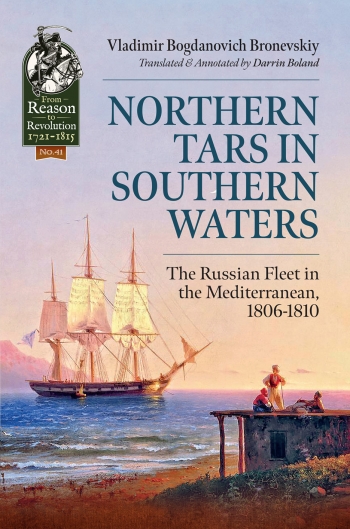
The second book was written by a Russian naval officer, Vladimir Bogdanovich Bronevskiy, who mainly served on the Frigate Venus as part of Vice-Admiral Senyavin's fleet during the period 1806-1810. Darrin Boland has done an excellent job translating and lightly editing his memoirs in 'Northern Tars in Southern Waters', published by Helion.


Naval warfare in the Adriatic mainly was a small ship war, and the Russians had frigates like the Venus that engaged French supply convoys and intercepted neutrals. In May 1806, The French General Molitor was travelling from Venice to Trieste when his merchant ship was intercepted. He managed to persuade the Russian captain that he was an Austrian merchant. The fact that he carried papers to support this claim indicates that this was not a one-off precaution. Russian commanders, like their Royal Navy counterparts, had to use their own initiative being weeks away from command centres in St Petersburg.

The Russians had far more ships of the line in the Adriatic than other navies, and these were mainly used to support operations on land. Typically the fleet would attack a French garrison and knock out the defender's artillery before Russian and Montenegrin troops would land and capture the island. The Montenegrins and the Bokez (citizens of the Bay of Cattaro) were sympathetic to Russia and provided excellent, if ill disciplined, light infantry. The only significant fleet action was against the Ottomans at the Battle of Athos.

The Russian fleet was generally very effective, but as was often the case events elsewhere intervened. The Treaty of Tilsit resulted in Russia abandoning much of its Adriatic possessions. Tilsit meant Senyavin was stranded in the Mediterranean without a base. He couldn’t go back through the Straits so he sent the troops home via Trieste and Austria, scuttled or sold some ships, and sailed the rest back towards the Baltic. He was blockaded by the British in Lisbon, and only two ships made it home in 1813. A sorry end for one of Russia’s finest fleets that had operated successfully in the Adriatic. 

For the wargamer, the Adriatic offers plenty of opportunities for naval and land operations at a manageable scale. Right on time, Warlord have brought out a supplement for their Black Seas naval rules, Hold Fast. They include chapters on the Russian and Ottoman navies, as well as most of the other minor naval powers. There are lots of new scenarios for smaller games, including the use of galleys and xebecs in the Meditteranean.

This looks excellent and I hope to try a few games this weekend. I have some Russian ships on the painting bench to do battle with my Ottomans and French.

Xebecs from the Hagen range.

Ottoman ship of the line at the Istanbul Naval Museum


Ottoman galleys


Wednesday, 22 June 2022

Flygvapenmuseum - Swedish Air Force Museum


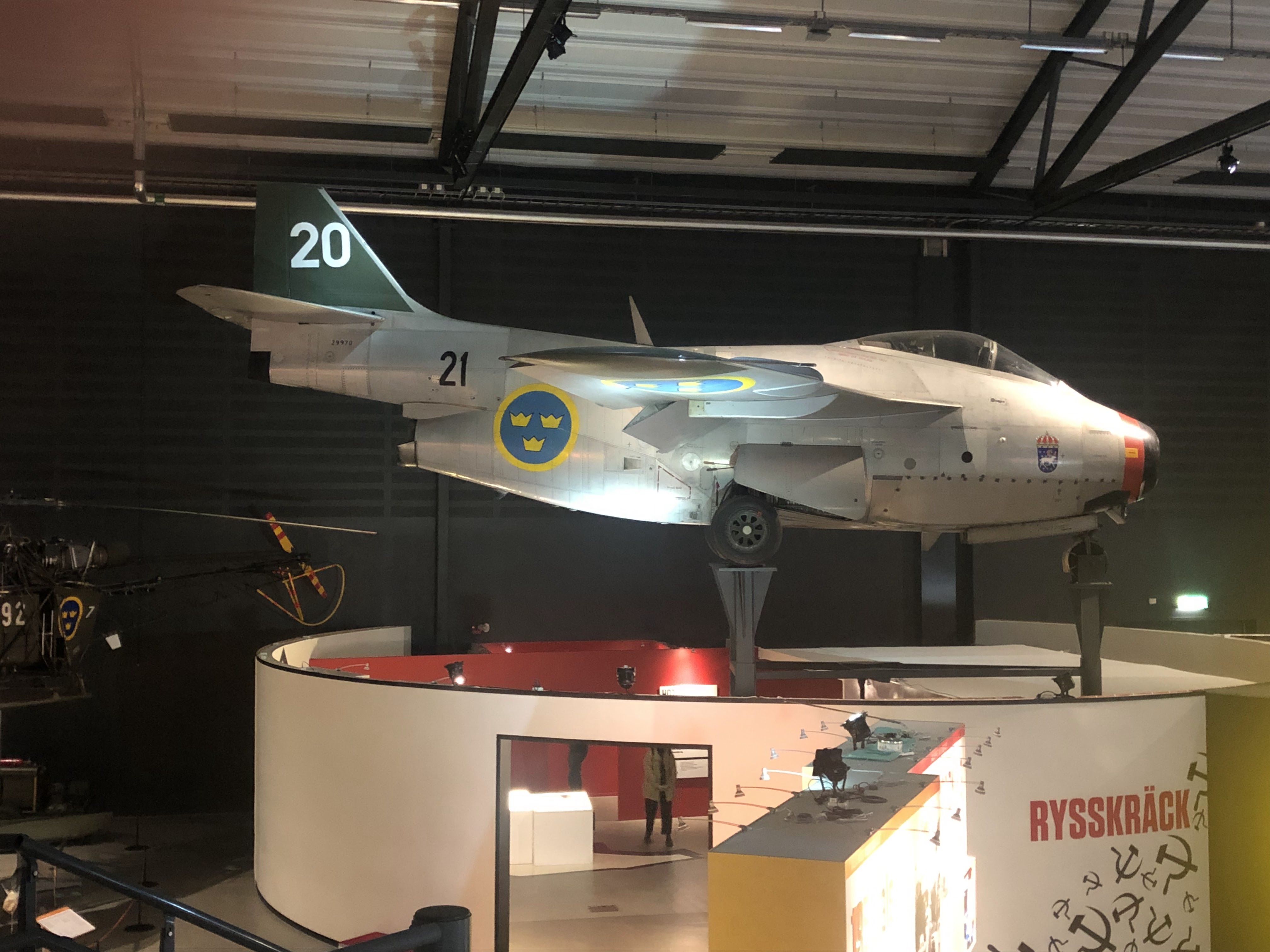
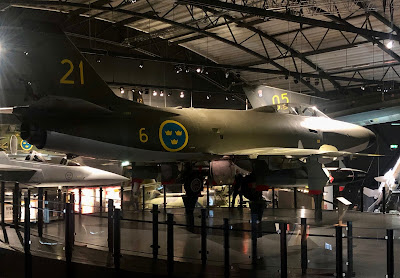
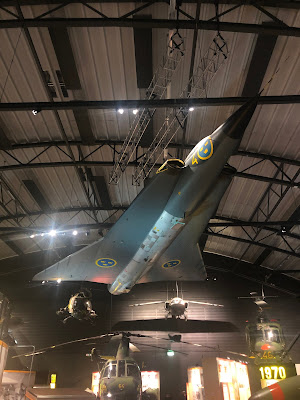
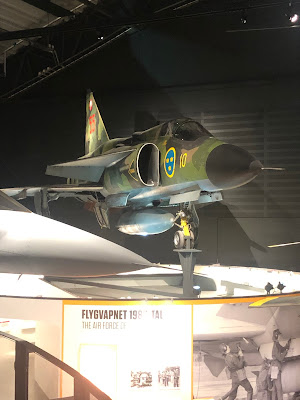
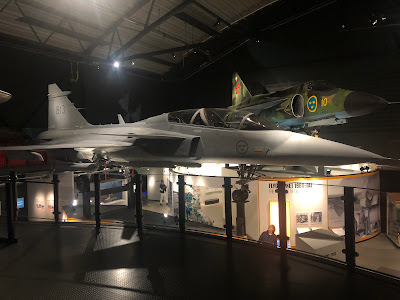
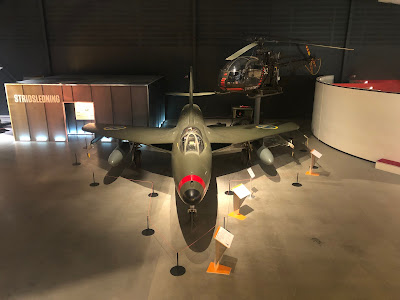
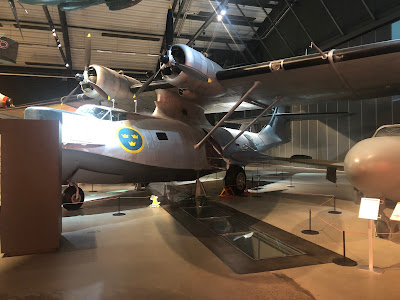
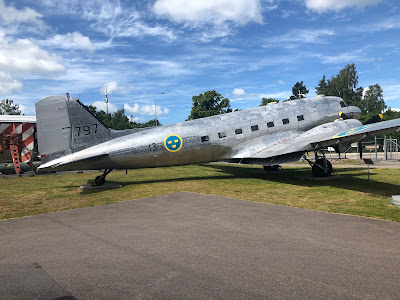
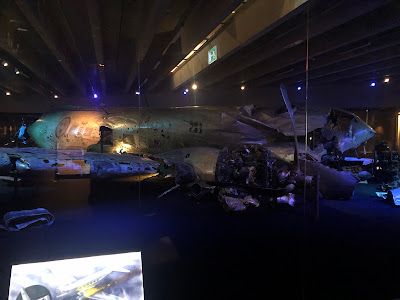
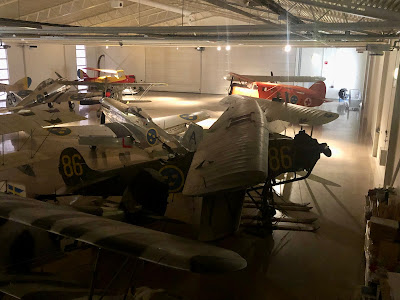
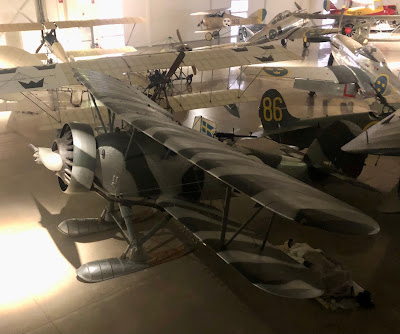
The second major museum trip on my visit to Sweden this week was to Flygvapenmuseum, the Swedish Air Force Museum near Linkoping, over two hours drive from Stockholm. The city is home to a Saab plant, and the museum is next to a major air base. Sadly, half the museum, WW2 and earlier, was closed for a refurbishment, but it was still worth the effort. Apologies for the darkness of the pictures. After watching many Swedish crime dramas, I am convinced that there is a national lightbulb shortage in the country!

Sweden has a significant aircraft industry; while it has imported planes, the main post-war designs are designed and built in Sweden. The second jet, introduced in 1951, was the Saab 29, named the Tunnan (Barrel), for obvious reasons. Not the most stylish aircraft to grace the skies.

Next was the Saab 32 Lansen, which came in fighter, attack and recon versions.


Then a personal favourite, the Saab 35 Draken, because I had a kit of this hanging from my bedroom ceiling as a kid. Although I thought it meant dragon, it means kite, emphasising the double delta wing.


Another unusual design was the Saab 37 Viggen. 


And finally, right up to date is the Saab 39 Gripen.


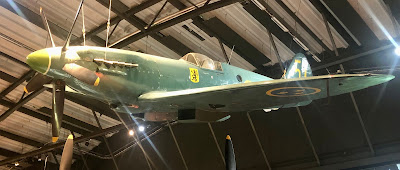
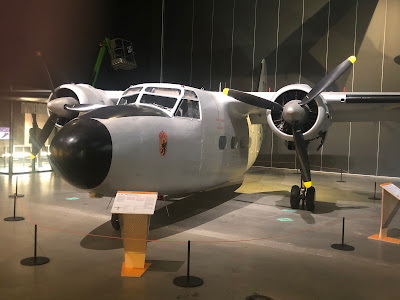
The Swedish Air Force also used aircraft from the UK and elsewhere. 

Hawker Hunter

Spitfire PR

Pembroke C1

Catalina

Douglas DC3

One of their Douglas DC3 aircraft was shot down by a Soviet MiG-15 in 1952 while on reconnaissance. The basement display has the remains of the plane lifted from the seabed and the whole story. Yes, it's even darker down there!


They have a Mig-15 on display in the main hall.


The earlier display hall is being refurbished, but you can see part of the hall from the activity area.


If you have children with you, this is a great museum for them. Lots of interactive stuff, flight simulators etc. I couldn't get on! Excellent museum, well worth the effort to get there.

Sunday, 19 June 2022

Arsenalen - Swedish Tank Museum

I am in Sweden for a few days on a work trip, so I flew in early for the weekend. I did all the Stockholm museums on my last visit just before the pandemic hit. So, this time I thought I would see a bit of rural Sweden. Two words sum up the countryside here - trees and water. There are a couple of museums that I wanted to see, and the first is the Swedish Tank Museum. It is near a pretty town called Strangnas, about an hour's drive from Stockholm. If you have a car, visit Mariefred at the same time, which is stunning, including a fine castle and a preserved railway.


I was chatting to the curator, who told me they have around 400 AFVs in the collection, with about 100 on display at any one time. They have plenty of German, British, US and Soviet AFVs, but I'll focus on the rarely seen Swedish ones.

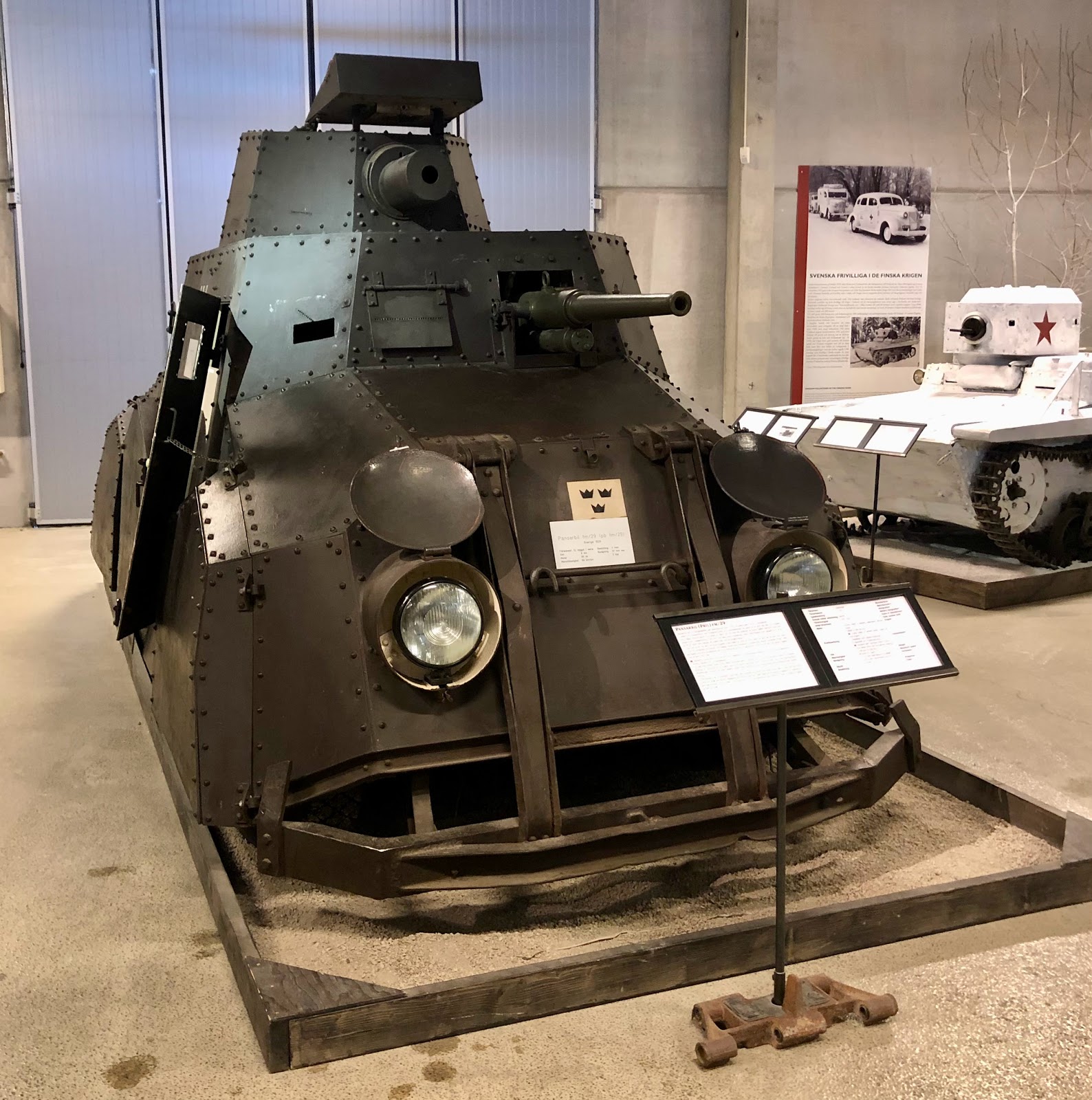
This is a Pannsarbil FM/29 armoured car, built-in 1932 for the cavalry regiment. It had a driver at both ends for a quick getaway. Not a success as it was too large and expensive.


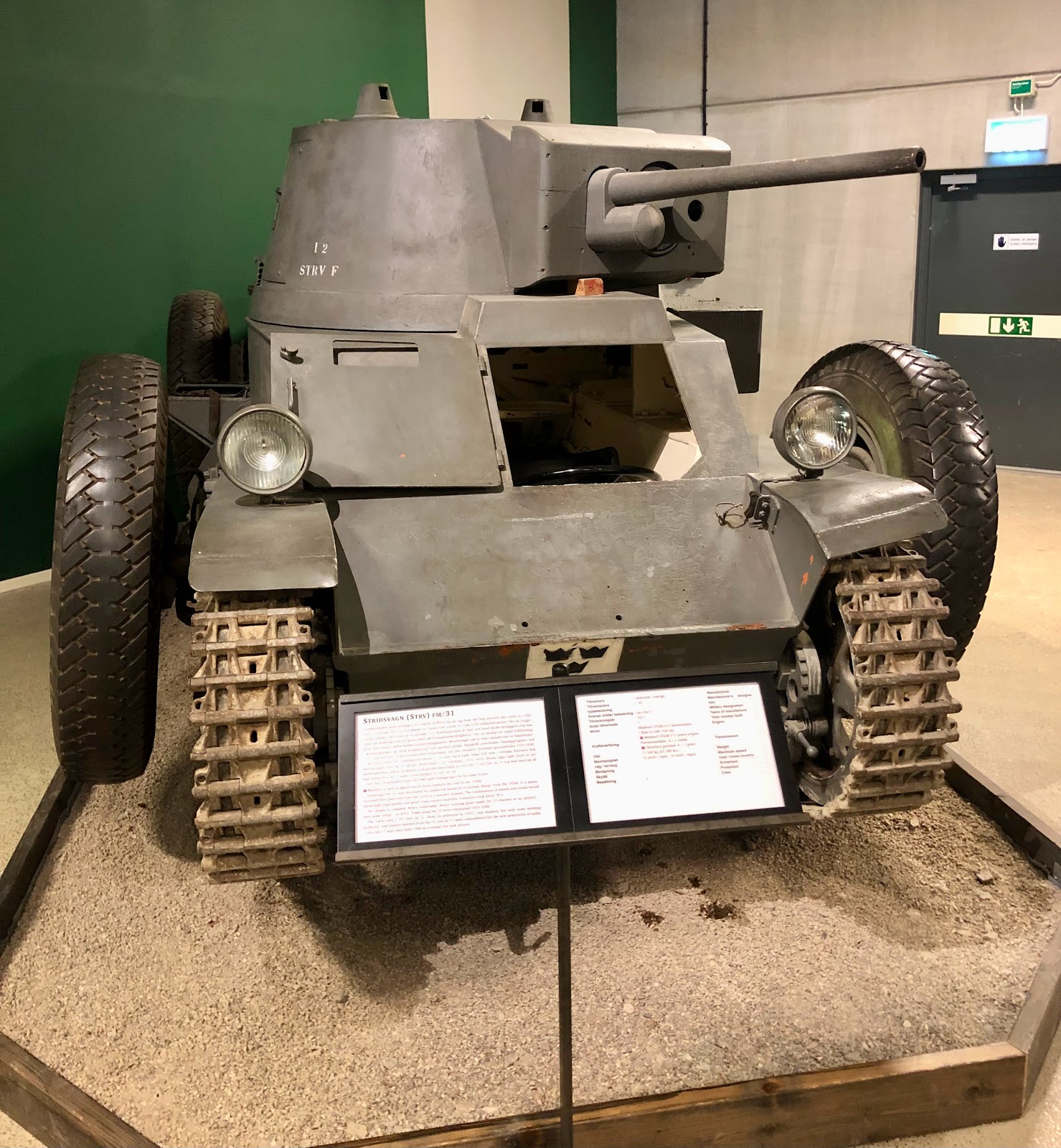
This is the Striv FM/31. It had road wheels and tracks, the idea being to save the tracks. However, a better track design meant it never got past the prototype.


Next is the Striv M/37, a Swedish-built version of the Czechoslovak ÄŒKD AH-IV tankette.


The Pansarbil M/31 armoured car was a 4x4 vehicle mainly used for training during WW2.


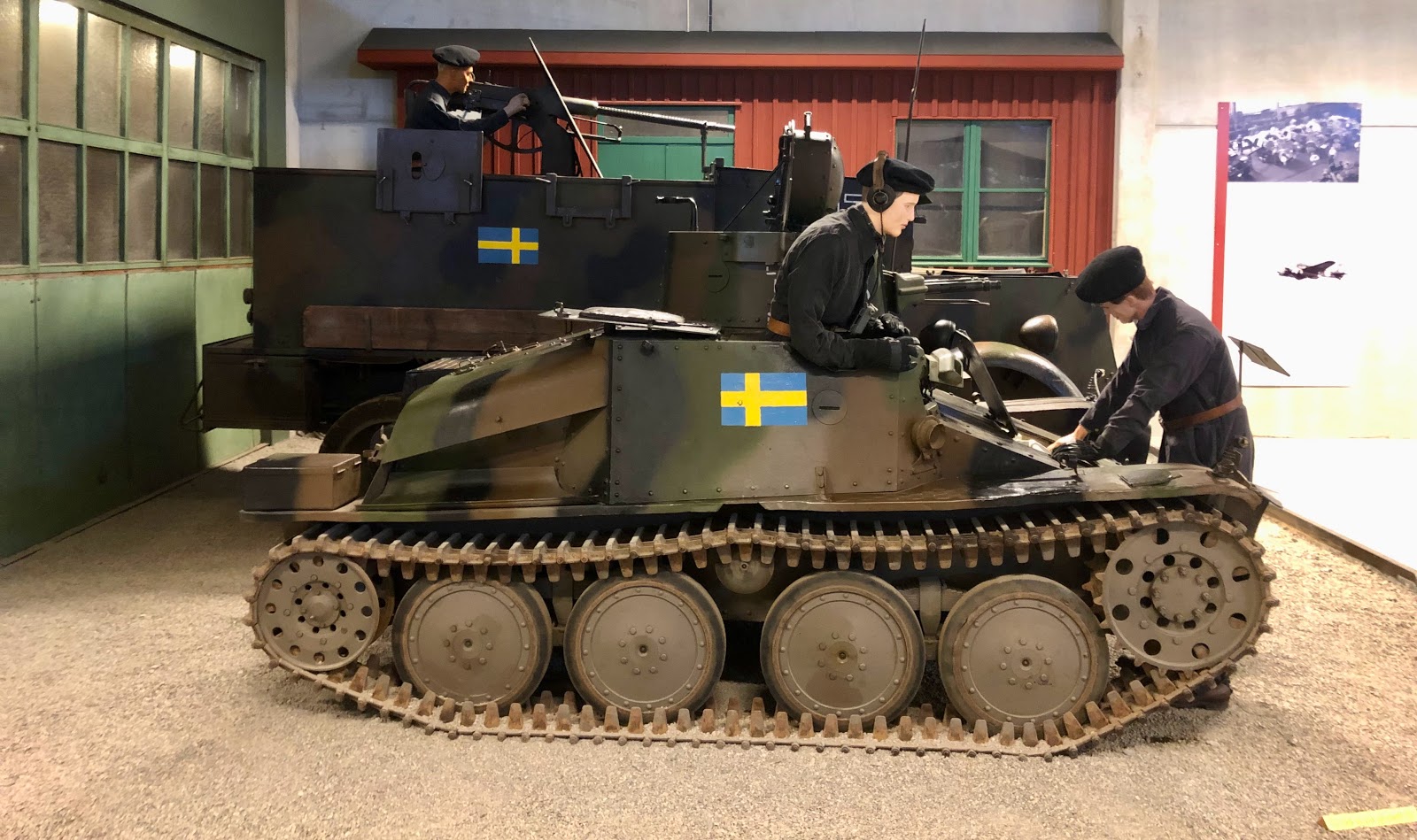
The Striv M/38 light tank. 216 vehicles of different variants were produced from 1939 through 1944. The vehicle remained in the service of the Swedish army until the 1960s.


The Striv M/42 was a medium tank with a 75mm gun introduced in 1943, although already out of date by wartime standards.


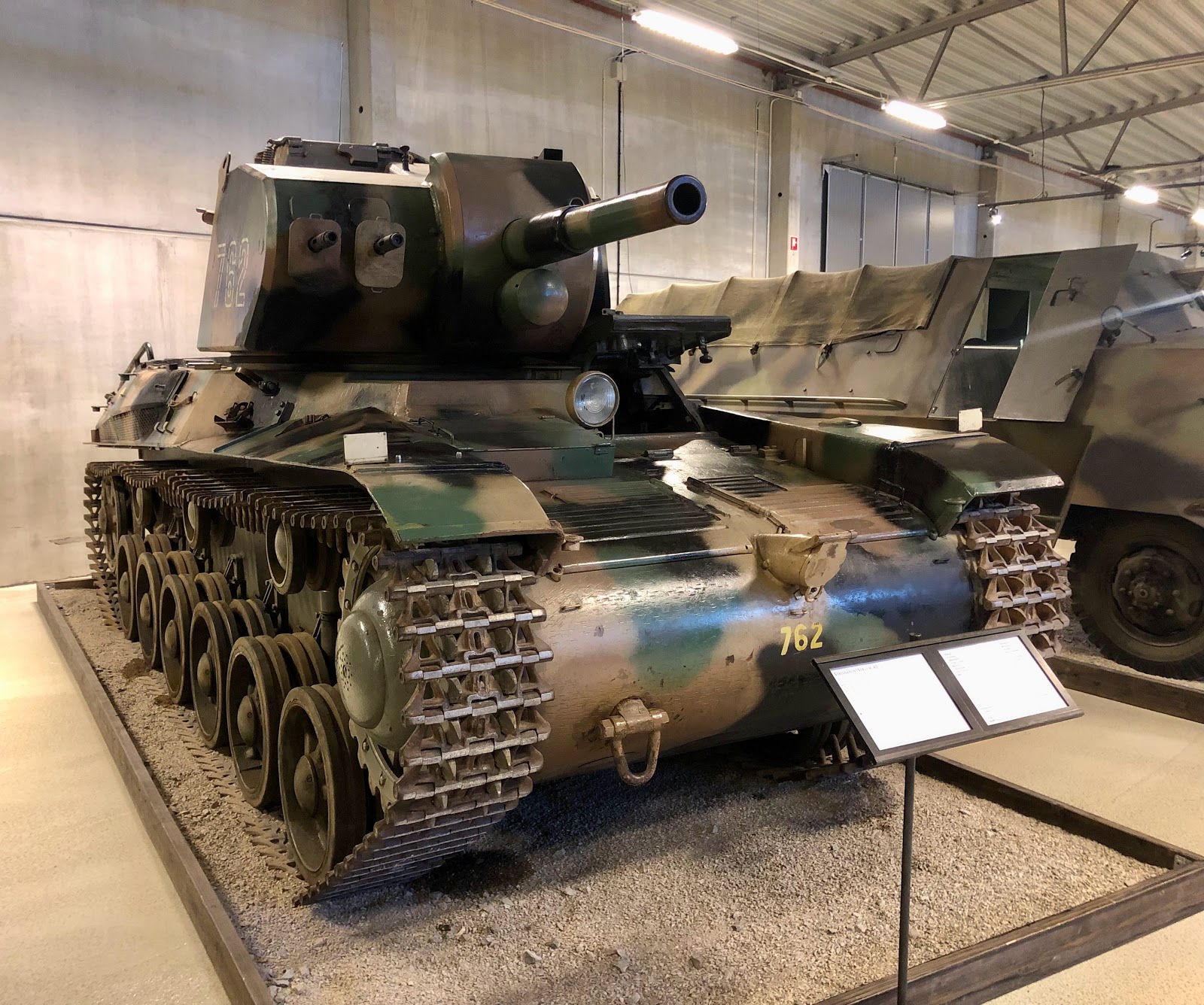
The Pvkv M/43 was a tank destroyer version of the M/42 with a larger calibre 75mm gun. It remained in service until 1970.


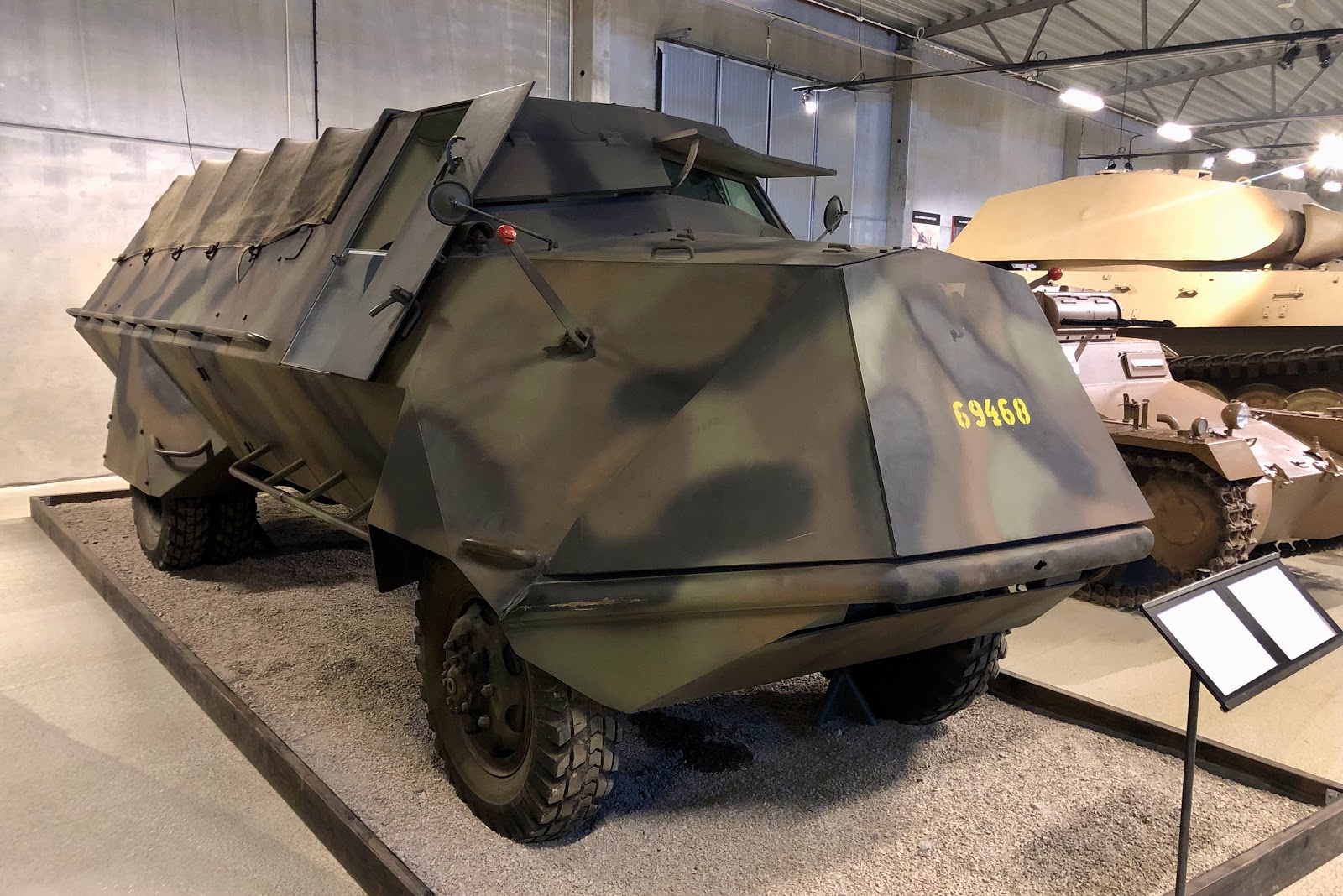
The M/42 SKP 'KP-bil' was an armoured truck developed as an APC in 1942. It was called the coffin because of its shape but remained in service until 2004. They saw service with the Swedish element of the UN forces in Cyprus.


The Lvkv FM/43 was an armoured, tracked AA vehicle for use with armoured brigades. It had twin 40mm guns.


The SAV m/43 was a 105mm SPG. Came into service in 1943 and remained until 1973.


The IKV 91 was the replacement tank destroyer for infantry brigades in the 1960s, and it typically carried an infantry section on the rear.


The Pbv 301 was a 1960s APC with a 20mm auto-cannon.


The Strv 74 was a light tank that served from the 1960s until 1984.


The Pbv 302 is an APC. Developed after the Swedish army rejected the M113.


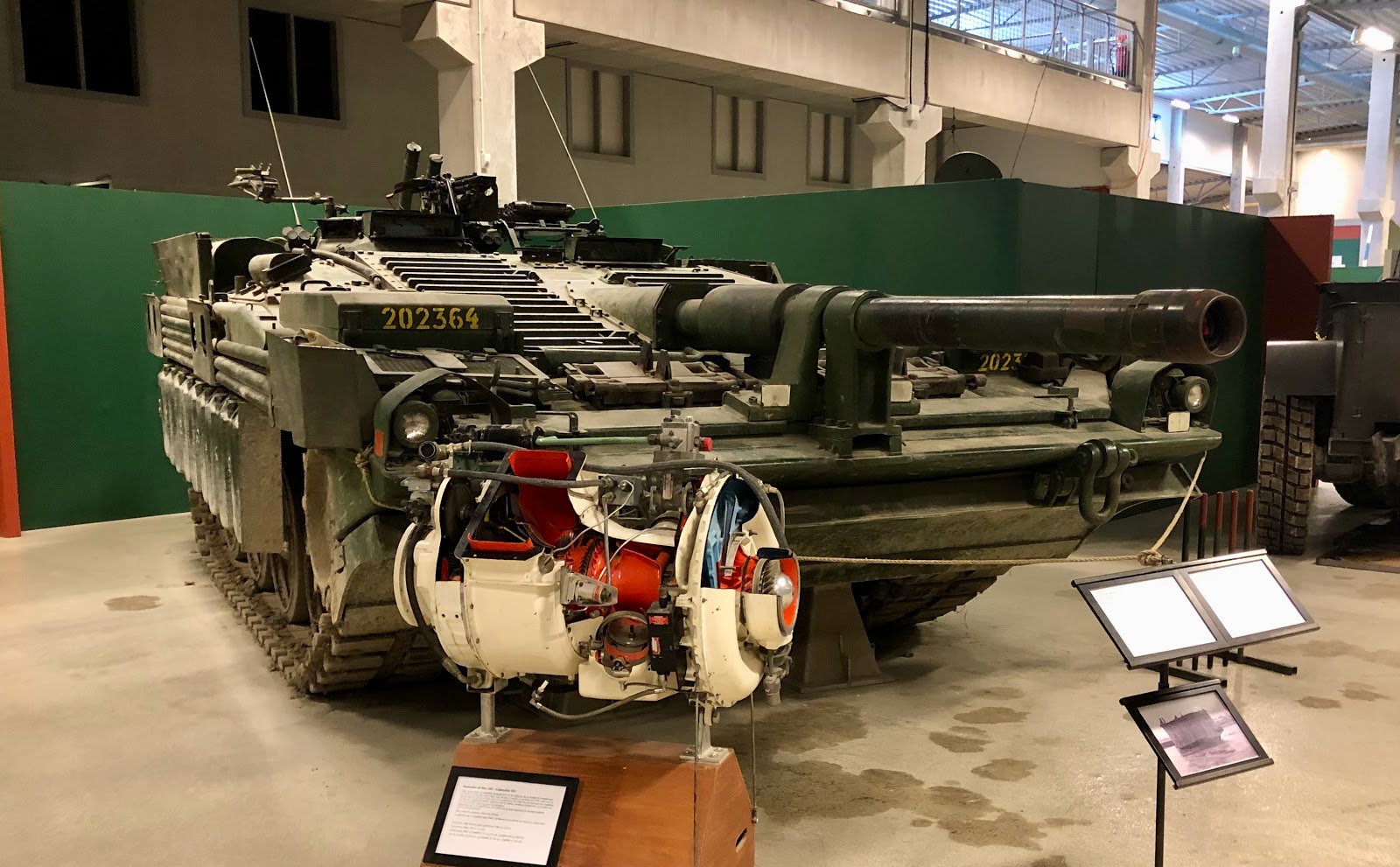
 And finally, the iconic and unique S-tank. 


Upstairs there is also a small regimental museum for the Sodermanlands Regiment. Guns, uniforms, a full-size wargame unit and some very nice flats of a battle against the Russians at Stäket on 13 August 1719.


Overall, an excellent museum, with accommodating and engaging staff. Well worth the effort getting there.