Welcome to my blog!

News from a wargamer with a special interest in the military history of the Balkans. It mainly covers my current reading and wargaming projects. For more detail you can visit the web sites I edit - Balkan Military History and Glasgow & District Wargaming Society. Or follow me on Twitter @Balkan_Dave
or on Mastodon @balkandave@mastodon.scot, or Threads @davewatson1683

Saturday, 28 November 2020

The Normans in Italy 1016-1194

This is a new Osprey publication in their Men-at-Arms series by Raffaele D'Amato. It covers the Normans who left Normandy to make their fortune in Italy and beyond. These were typically the younger sons who would not inherit lands at home - have horse and armour, will travel.


I was first introduced to the story of these knights in the works of that brilliant storyteller John Julius Norwich, who sadly passed away a couple of years ago. He wrote Normans in the South and followed it up with The Normans in Sicily. For many years I used a Siculo-Norman army in WAB competitions with some success. 

This book gives a brief history of the Normans in Italy, from their arrival as mercenaries and bandits to Papal recognition after the Battle of Civitate in 1053. They fought the Lombard and Byzantine rulers but also assimilated the peoples of the region. The author makes the point that there were never huge numbers of Normans, although their ferocious charge was often the decisive tactic.

There are chapters on the organisation of the Normans and their armour and weapons. They were organised into small tactical units known as conrois, typically 20-30 men. They organised the land they acquired into the feudal system, welcoming other north European troops and enfiefing locals. The Kingdom of Sicily included Muslim units and incorporated local leaders. This provided light skirmishing cavalry and fine archers, which gives this army balance. 

As usual with this series, the book is profusely illustrated with photographs and colour plates. A very useful introduction to the period.

On the subject of Normans, the latest edition of Hobilar, the journal of the Lance and Longbow Society, is a special on the Normans. There are articles on the Normans in Wales, Sicily and on crusade. It includes my own article, The Normans in the Balkans. There are also reviews of a number of recent publications on the Normans. 


My 28mm army has figures from a number of ranges. The wargamer is not short of options when it comes to these warriors.


Friday, 27 November 2020

Salvation and Catastrophe: The Greek-Turkish War, 1919-1922

The Greek-Turkish War of 1919-22 is often forgotten amongst the great conflicts of the period including the Balkan Wars and the First World War. However, it was a large-scale conflict with massive consequences for millions of ordinary people, which continue to reverberate to the present day. 


This major new book, edited by Konstantinos Travlos, brings together a range of academics to consider different aspects of the conflict. The book is divided into three parts, broadly covering the causes of the war, its conduct and the aftermath. This is not a purely military history of the conflict. All wars have their political and economic context, which are important in understanding the military conduct. The Greek-Turkish War was as Travlos says in his introduction, “a political war par-excellence”.


The first section covers the political causes of the war, and the leaders, Eleftherios Venizelos and Mustafa Kemal (later known as Ataturk). For Venizelos the war aims were ostensibly to achieve the Megali Idea (Great Idea), a Greek state that would include the large Greek populations within the Ottoman Empire. Although one author argues that this was a tool rather than a goal, he was driven by the need to protect the physical and economic security of Greek populations under foreign rule. Kemal’s political goals were also nationalist, rebuilding a Turkish state for Turks out of the remnants of the multinational Ottoman Empire after the First World War.


The trigger for the war was the decision to send a Greek army to Asia Minor in 1919. This book isn’t a narrative history of the war, so if you are not familiar with the conduct of the war, it is worth reading a potted history first. What you do get is an examination of the causes of Greece’s defeat, a war which was almost entirely financed by France, Britain and the USA. I certainly had realised by just how much and the loss of this international support after Venizelos lost the 1920 elections and the restoration of King Constantine, damaged the Greek effort along with national division. 


Militarily, the war started well for the Greeks when they landed in Smyrna and secured the Greek population areas. However, as Kemal reorganised the Turkish armies, the Greeks needed to destroy them to conclude the war. This meant an advance towards Ankara that resulted in extended supply lines and large areas to garrison. By September 1921, they were on the defensive which eventually collapsed under the Turkish counter-attack. This was not helped by political culling after the Greek elections on a scale that would have embarrassed Stalin! Unsurprisingly, replacing battle-hardened officers with inexperienced political placeholders didn’t do much for the effectiveness of the Greek army. This added to exhaustion, lack of supplies and high casualties eroded the morale of the conscripts.


These factors were exploited by the Turks, notably by the development of a strong cavalry arm, making a comeback in this conflict after WW1. They were able to wreak havoc on the Greek supply lines, while the infantry dug in and bled the Greek infantry attacks dry in front of their fortifications. When it came to the Great Offensive, the Turks were able to achieve local superiority concentrating 70% of their available strength against about 56% for the Greeks. This led to a monumental battle of encirclement and annihilation on par with the German victory at Tannenberg in 1914. At the tactical level, the chapter on the Turkish use of German assault troop doctrines (Stormtroop tactics), is particularly interesting. Ottoman troops had been trained by the Germans, and this was developed by Kemal and his commanders, although they lacked the same levels of equipment, organisation and education of NCOs.  


Even if you know little about this war, you have probably heard about its aftermath, the massive population exchanges. This was not unique to this conflict and had happened as a consequence of the earlier wars, albeit not on this scale. Around 360,000 Muslims of Greece went to Turkey, and 1.2 million Greek Orthodox went in the other direction. Chapters in this book explain the complexity of the issue. For example, the Turkish speaking Orthodox Karamanlis were expelled to a country they had no affiliation with and didn’t speak the language. The test, unusually for a secular nation building project was effectively religion, not language.


The Greek-Turkish War was one of the major aftershocks of WW1 and led to the establishment of the modern Republic of Turkey, whose leaders until the 1950s commanded armies in the war. This is a substantial tome, which takes a detailed inter-disciplinary approach to the subject. It is clearly aimed at an academic audience, and the general reader may find some the theoretical analysis a little hard going. It is also outwith the price range of most readers who may want to persuade their library to get a copy. If they do, they won’t be disappointed.  This is, without doubt, the book to read on the conflict.


For the wargamer, I would start with the Osprey on the war. Then move onto this book, which adds much to our understanding of the conduct of the war. There are several unusual units, but I use my Greek and Turkish armies of WW1 and some from the Balkan Wars. 15mm for rules like Bloody Big Battles, and 28mm for Bolt Action. While there was trench warfare, it also has more open battles as well as raids and small unit actions.   


Greek infantry in 28mm

 
Turkish infantry in 28mm

Saturday, 21 November 2020

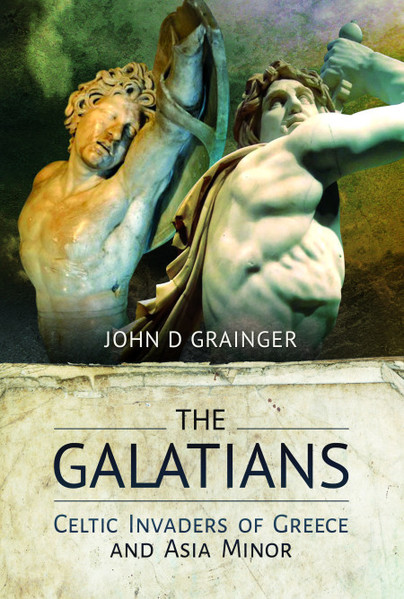
The Galatians

The Galatians are one of the lesser-known peoples of the Balkans in the ancient period. This may be because they had no written history of their own when the focus was on the Greek and then Roman impact on the region. John Grainger has written a very readable new history of the Galatians which pulls together what is known about these fierce warriors.


The Gauls expanded from their homeland north of the Alps into northern Italy and then westwards to France and Spain, and eastwards into the northern Balkans by the fourth century BC where the Greeks called them Galatians. They appeared as a piecemeal migration involving all or part of several tribes, subjugating and assimilating the inhabitants of a wide area around modern Belgrade (Celtic Singidunum). They became known as the Scordisci, although this was still a loose grouping of tribes with no permanent central authority. The Galatians didn’t do kingship, relying on temporary leadership for their further expansion towards Greece, Thrace and later into Asia Minor.


They bumped into Alexander the Great during his Balkan campaigns around 335BC when an agreement was reached on spheres of interest. With the Romans pressing the Gauls in Italy and the Dacians resisting their expansion to the north, they began to expand south-eastwards towards Thrace. Alexander’s death and the subsequent wars of succession created an opportunity, which the growing Galatian population exploited. 


The Galatian method of warfare was the equivalent of the Scottish clans ‘Highland charge’. Very effective in open ground, but could be blocked in mountainous terrain and by cities, as they had little siege warfare experience. Later they developed a strong cavalry arm, which was probably constituted from the tribal elites while the foot increasingly came from subjugated peoples. 


They invaded Macedon and Greece on several occasions, and while the Greek sources called these raids, it is likely that they were also looking for new lands rather than simple plundering. After being repulsed, they establish two loose states around the Scordisci and a new state in Thrace called Tylis. The latter lasted only sixty years or so while the Scordisci were an important Balkan power for three centuries.


One of the surviving groups from the wars against Macedon moved into Thrace and then across into Asia Minor, which was itself divided in a period of endemic warfare. The Galatians were initially used as mercenaries, going on to establish three separate tribal groupings in central Anatolia called the Tolistobogii, Tektosages and Trokmoi. While the Greeks called them barbarians, it seems clear that they abided by the diplomatic and treaty conventions of the period. Antiochos halted their further expansion at a battle known as the Elephant victory (269 or 268BC), which the Galatians had not met before. Despite this defeat, the Galatians were still a force to be reckoned with, raiding neighbours they didn’t have treaties, still primarily for settlement purposes and being used as mercenaries. Galatian cavalry was particularly sought after.


By the 2nd century, they were being squeezed between the Romans and Pontus in Asia and Roman expansion in the Balkans. This weakened their control of subjugated tribes, and both states went into decline, eventually becoming Roman provinces.


This is an excellent narrative history of the Galatians, perfect for the general reader who wants to know more about these extraordinary warriors who were also better organised and more effective diplomats than the ‘barbarian’ tag might imply.


For wargamers, it is another tabletop use for those Gallic warbands supported by more cavalry. However, I wonder based on the evidence in this book, if the army lists full of impetuous heavy swordsmen is correct for the later period.


28mm Gauls from my collection


Thursday, 19 November 2020

Blucher and the War of 1812

 This week's Zoom game stuck with the War of 1812, but with a different set of rules. Sam Mustafa's Blucher is not the obvious choice as it was designed for the really big Napoleonic battles. However, there is an option to scale it down using battalions as the base unit rather than regiments or brigades. 

The set up was inspired by one of the larger battles of the war, The Battle of Lundy Lane. Even this was a pretty modest affair with two or three brigades a side. The British on the right are defending the position and are preparing to be attacked.


  The American plan was to pin the British right flank with the largely militia brigade, while the brigade of regulars supported by light dragoons and artillery turn the British left flank.

The American artillery weakened the flank and the subsequent firefight routed a British line battalion. However, British light dragoons not only plugged the gap but went on to push back the US line regiment trying to turn the flank. The Canadian militia survived both a firefight with the US rifles and a charge from the US light dragoons.

Somewhat unexpectedly, it was the American militia brigade that managed to turn the British flank, pushing back one unit, but again it was the Canadian militia that held firm. 


By this stage, the Americans had run out of attacking options with five units fatigued. Score draw to the British, but it was a damn close-run thing, as the Duke of Wellington might have said.

I haven't played Blucher for a while, and I had forgotten what an elegant game system it is. The movement trays were made for me by Warbases. 

Finally, a few pictures of the Lundy's Lane battlefield today. Sadly, it is largely built over in a busy commercial area, but the battlefield is marked in several places.


Wednesday, 18 November 2020

Fortress of Fury

This is the latest (No.7) in Matthew Harffy's Bernicia Chronicles series set in 7th century Britain. This is a good setting for historical fiction as our written sources of the period are limited. It truly is the Dark Ages, even if historians these days don't like the label.


The action takes place in the year 647, mostly in Northumbria, which at the time was split between Bernicia, north of Hadrians Wall and Deira to the south. These were Saxon kingdoms, although as always they would have incorporated earlier populations. Mostly Christian, although the church was not as yet fully established. The power to the south of the Humber was Mercia, which was a pagan kingdom dominating central England.

Our hero is Beobrand, a thegn and modest landowner in Bernicia, sworn to King Oswiu, and a famed warrior with his personal band of warriors called the Blackshields. Most of this story focuses on the invasion of Bernicia by the Mercian King Penda and his Gwynedd (Welsh) allies. The Mercians besiege the fortress of Bebbenburg (on the site of Bamburgh Castle today), yes, the same one as Bernard Cornwell's Last Kingdom series, although that is set in a later period.

I won't ruin the story, but the Mercians try a variety of ways to get into the fortress. After the siege, King Oswiu returns (he was away dallying with a mistress) and events move south to Deira.

This book has all the elements fans of Bernard Cornwell will expect to see in historical fiction. Plenty of action, interesting characters, treachery, and a bit of love interest. As with the other books in the series, it is well written and an excellent light read.

The time spent on my recent War of 1812 project has somewhat dulled my painting mojo, but I have a few Saxons left to paint, which have at least got past the priming stage. Here are some of my Saxon Fyrd efforts as inspiration for the small battles of the period, which are very playable on the wargames table.


Thursday, 12 November 2020

Zooming the War of 1812

 We are back to Zoom games due to the pandemic restrictions in Scotland. While this isn't as good as the real thing it does have the advantage of engaging with friends from overseas. As my current project is the War of 1812, a game with an American seemed very appropriate.

First up I needed to finish the outstanding units. These are the US line infantry from the Old Glory range. I really should do standard units first, but like most wargamers, I am drawn to the most interesting units.

I have plenty of British figures but the Canadian militia had distinctive headgear, so a pack of them will make my British army a lot more authentic.

Games over Zoom have to be kept very simple so we went for 'Rebels and Patriots' with a standard 24 point force for each side.

This was a straight-forward lineup and the Americans advanced first with the centre pushing ahead. The US artillery struck first blood, being well positioned on the hill and quickly disordered one of the British line units.


The US rifle unit with its expensive 'good shots' upgrade planned a sneaky move through the woods to flank the Canadian militia or shoot up the light dragoons. However, disaster struck with them failing their activation roll four times! I have now learned a few new American expletives from my opponent!


This left the centre cruelly exposed to British volley fire, and after a few rounds, it was game over. The rifles eventually arriving when it was all done and dusted.


A comprehensive victory for the Brits and Canada is saved for the Empire. Technically Canada didn't exist but you get the drift. Rebels and Patriots work well for this conflict but I have a fancy to try a scaled-down game of Blucher with these figures next.

A reenactor at Fort Niagara on my visit to the battlefields in 2018 


Tuesday, 10 November 2020

Hitler's New Disorder - WW2 in Yugoslavia

 This is a new paperback edition of Stevan Pavlowitch's book on The Second World War in Yugoslavia. The events before and particularly after the Axis invasion are, to put it mildly, complex. They have also been the subject of historical revisionism, particularly since the death of Tito, which makes the author's objective analysis very welcome.

The book is structured as a broad narrative history of the events, starting with the end of the Kingdom of Yugoslavia and the new structure imposed by the Axis powers. This involved the dismemberment of Yugoslavia with a German-controlled residual Serbia, a puppet state of Croatia and a range of annexations of territory around the fringe.

The insurgency started almost immediately with Mihailovic's Serbian nationalist Ravna Gora Movement making early progress while Tito's communist-led partisan movement struggled to survive under Axis pressure. The fascist Croatian puppet state did its best to make it difficult for their Axis allies through the terror inflicted by the Ustase. Successive German commanders sought to replace the Ustase, recognising the problems they caused for the occupation, but Hitler rejected every request. Although it should be stressed that the Wehrmacht also committed atrocities in Yugoslavia, particularly units led by former Habsburg officers.  

Muslims in Bosnia came under pressure from all sides and even sent a plea to the Turkish National Assembly to support massive migration. They settled for a mix of self-defence groups and even joined a Muslim SS Division in order to get weapons and protect their villages. As the war progressed more joined the partisans.

The fall of Italy in 1943 mostly benefited the partisans in terms of equipment and they used that to engage in more effective resistance to the occupation. Mihailovic never had quite the same degree of control of the varied groups of chetniks, many of which tacitly, and in some cases openly, collaborated with the Germans. The Allies shifted their support to Tito when it was obvious from German intercepts that the partisans were the only real resistance. Accepting that the first priority of both factions was to destroy the other and place themselves in a position to control the post-war state. Mihailovic even admitted to his British liaison officer that he would attack the Germans only when he had dealt with the "partisans, ustashas, Muslims and Croats". That didn't leave much of the population to build a movement around!

The western Allies engaged in extensive deception operations that threatened to invade the Balkans. These were believed by most of the internal players and Hitler, even if the German army was sceptical. In the end, it was the Soviets who arrived in the Balkans, and with their support, Tito was able to secure his position as the future government. We should not forget that Yugoslavia suffered greater human and material loss than in any other European country, except Poland and the Soviet Union.

The narrative of this conflict is complex and nuanced. I have read many histories of the period and this book is one of the best explanations I have read. 

28mm partisans from my collection


Saturday, 7 November 2020

The War of 1812

As many of us have been glued to our TV screens this week as the US elections play out, it seemed an appropriate time to put in some work on my long outstanding War of 1812 project. This originated in a classic case of wargamers disease after I visited the battlefields around the Niagara River a couple of years ago, and more recently finished the excellent historical fiction series on the war written by A.J Mackenzie. 

The War of 1812, also called The American War 1812-14, started when the USA declared war against Britain and invaded the colonies in what is now Canada. The ostensible cause was the Royal Navy's impressment of American seamen, although imperialist American politicians also regarded Canada as unfinished business from the revolution. Thomas Jefferson thought the war would be quickly over given the small British garrison, "a mere matter of marching". It didn't quite turn out that way. The invasions of Canada were repulsed and the war ground to a halt with a peace treaty in 1814. The border has remained ever since.

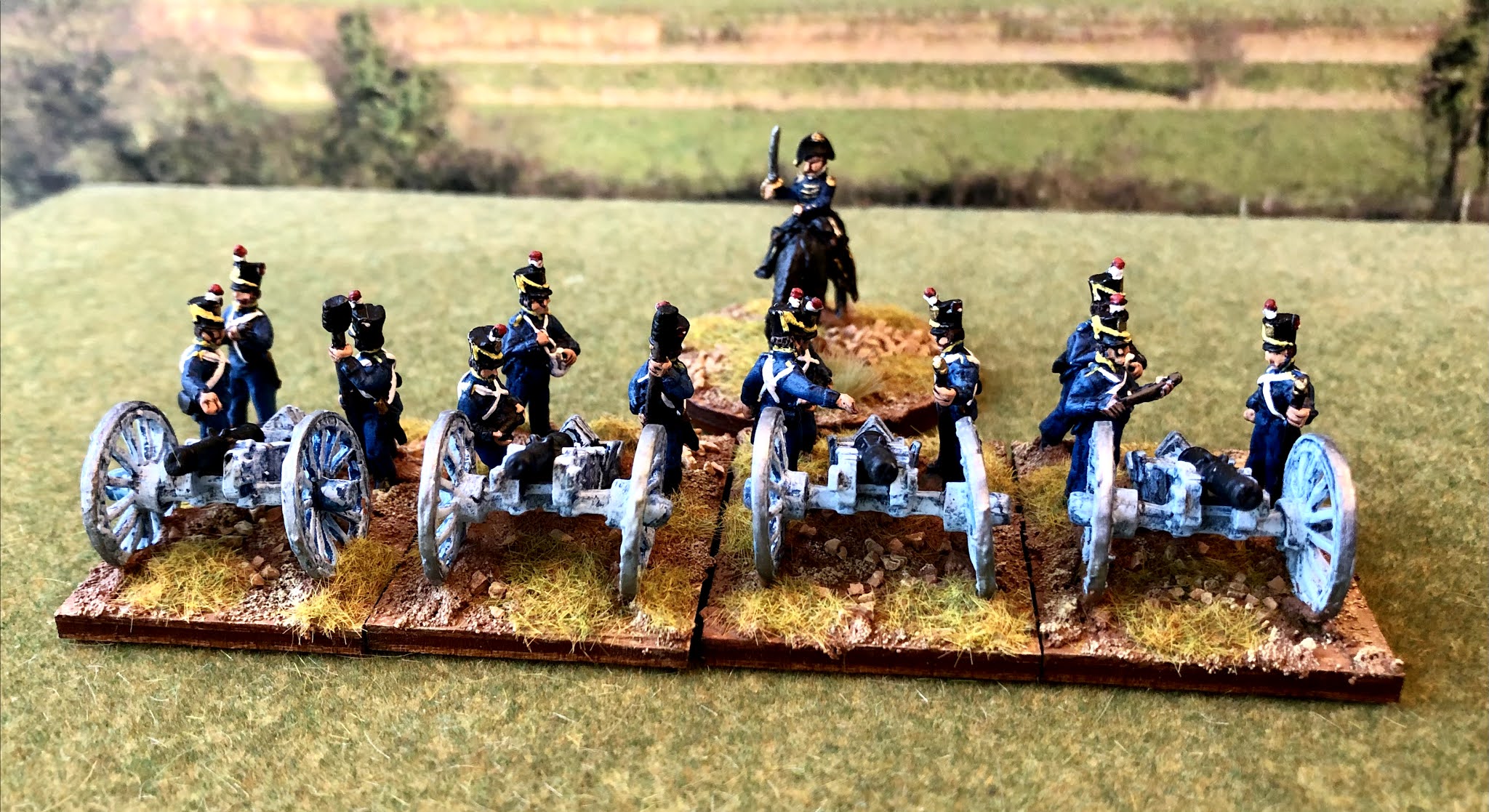
I decided to do this project in 15mm, primarily for speed and cost reasons, and I have plenty of British troops of the period. Looking at the figure options I decided on Old Glory figures, even if the packs are a little on the large size. I plan to mainly use the 'Rebels and Patriots' rules, which suit the many small scale engagements that were a feature of the war. 

First up is the US Rifle regiment, one of the better quality units and I like the uniform.


Then the militia who made up the bulk of the US army of the period. The quality of these troops varied considerably and were not always uniformed. Hunting shirts were popular, particularly in the summer.


Next the artillery - more than I really need but a consequence of the pack sizes.


There is a similar issue with the cavalry. I really only need one unit but have enough for three. Still, they will work if I do a game using the Black Powder rules. These are the rather splendid US Light Dragoons.


Finally, some Major-Generals.


That's enough to get a balanced force on the table. I have a Zoom game planned with an American friend who will be pleased with the election outcome. I have promised not to burn the White House down this time!

I have US line infantry and some Canadian militia still to finish and that is the project done. At least until the next outbreak of wargamers disease!

Friday, 6 November 2020

Partisan

 This is the first of series of historical novels by Christopher Nicole based in Yugoslavia during the German invasion in 1941. Needless to say, I am an obvious customer for WW2 fiction in the Balkans, although I haven't come across this fairly prolific author before.


Our hero is a British army captain serving in the British embassy in Belgrade after being wounded in France. He has a Croatian girlfriend whose best friend is a French journalist working for a news agency. The book starts with the March 1941 coup, which deposed the Regent (Prince Paul) and replaced him with the young King Peter. Hitler ordered an immediate invasion, which started with a terror bombing of Belgrade. 

The three friends leave Belgrade and head for the hills. Even allowing for the scope of historical fiction they manage to meet the main three Yugoslav players of the period in their travels. I can live with that because it does allow the author to explore the internal conflicts that wracked Yugoslavia before and during the war.

I don't want to be over picky, but the author's research could have been a bit more thorough. For example, accession to the Tripartite Pact in Yugoslavia's case did not require the passage of German troops. In fact, Hitler's negotiating aims were simply to neutralise Yugoslavia while he dealt with Greece and secure vital raw materials. Also, King Alexander was not assassinated by a Croat. He was shot by a Bulgarian member of IMRO, who was trained by the Croatian fascist Ustase in Italy. 

Meeting Draza Mihailovic just after they escaped the bombing of Belgrade (6 April) was some achievement as historically he didn't return to Serbia until 29 April. I can live with that fiction but to describe him as the 'Chief of the Yugoslav General Staff' is just factually incorrect. Mihailovic was an assistant to the Chief of Staff of the 2nd Army in Northern Bosnia at the time of the invasion. Very much out of favour, not least because he attended an event at the British embassy - so at least that bit is right.

Our unlikely threesome next bump into Ante Pavelic, the Croatian leader of the Ustase. In this book, he was driving around Serbia massacring communists with a company of men. This is very silly as he was a little busy at the time establishing the puppet Croatian state (NDH). 

By now you will have guessed that the third key figure our group meets is Tito. The attack on Uzice used in the book actually happened many months later. Tito was in Belgrade during the period covered by the book, so this is less of a stretch. The meeting with Mihailovic did take place, albeit not at this time. This is one of the better chapters so I can live with this stretching of the facts.

I have to say that even within the bounds of historical fiction these errors did irritate. Some of the language also annoyed me, like the description of sub-machine guns as 'Tommy guns'; not a likely small arm in Serbia at this time! Which is a shame because the book is an enjoyable romp. So much so that I have downloaded the next in the series. 

So, enjoy the story, even if we could wish the author had made a bit more effort with his research.

A Yugoslav command element of the period from my 28mm collection


Saturday, 31 October 2020

The Mask of Dimitrios

This is a bit left-field for this blog as I don't normally read much in the way of crime novels. However, 'The Mask of Dimitrios' by Eric Ambler is set in the 1930's Balkans and gives some background atmosphere to the period. A point drawn out by Mark Mazower in his modern introduction.  It is also a very good story, well written, and was made into a film in 1944.

The story is built around a crime writer Charles Latimer who is shown a body, claimed to be Dimitrios, in an Istanbul mortuary by a Colonel Haki of the Turkish secret service. He decides to trace the story of Dimitrios, for interest and possibly as a story. 

His journey takes him across the Balkans and onto Switzerland and finally Paris. Dimitrios was involved in various criminal activities including a political assassination in Bulgaria and an attempted one in Turkey. He was a man of the times; born in Ottoman Salonika, present at the evacuation of Smyrna during the Greek-Turkish War, and then across Europe like so many displaced persons.

I won't spoil the story and certainly not the ending. It remains an entertaining guide to a difficult decade. 


Thursday, 29 October 2020

Hungarian Uprising 1848 - reinforcements

 Steve Barber Models have been expanding their range of 28mm figures for the 1848 Hungarian Uprising. I have been dabbling at skirmish level with this period, starting a few years ago, but the new figures inspired me to pad out some units and add a few as well.

In 1848, Hungary was part of the Hapsburg Empire but there were growing demands for greater autonomy or even independence. 1848 was the year of revolutions and this encouraged the Hungarian parliament on a course of separation while retaining the Hapsburg monarchy. The Austrian troops were engaged in putting down revolts elsewhere in the Empire and it was some months before Joseph Jellacic brought a largely Croat army to attack Hungary. Initially defeated by the Hungarian troops, the Austrian counter-attack eventually retook Hungarian territory and the uprising collapsed in June 1849.

The Hungarian army was a mixture of Hungarian regulars, the Honved (National Guard) and volunteer units. I would strongly recommend Ralph Weaver's book from Partizan Press if you are tempted. 

First off, a Hungarian army without hussars is absurd. The range now includes the Hunyadi Hussars. A bit of variety and some command models would have been nice, but I accept this is a niche interest.

Then some additions to the Honved units with mostly command elements and some character figures. I like the figure drinking, very revolutionary! The flags were printed off the Warflags site. The slogan is Liberty, Equality, Fraternity in Hungarian.


The some Grenadiers. There is a great reenactor group doing these in Hungary. Plus some Polish volunteers.


Finally a general.


My sympathies are with the revolutionaries, but the reactionary Austrians had to be padded out as well. Here we have from left to right - Jager, Grenadiers, Line and Grenzer. Making each unit up to twelve figures.


And that's it. Until the drug dealing, Barber models strike again!


Friday, 23 October 2020

Zulu Frontiersman

 'Zulu Frontiersman' is the edited memoirs of George Dennison who served in a variety of colonial units in South Africa at the end of the 19th century and after. It covers his experiences in all the major conflicts of the period including the Anglo-Zulu Wars and the Boer Wars.

While being born in the Cape Colony, he lived for most of this period in the Boer territories, the frontier states often in conflict with their African neighbours and Imperial expansion. He fought with the Boers in volunteer units and despite his Imperial sympathies respected them as friends and neighbours. As he put it; "Good folk, but the superstition of ignorance ruled them strongly". During these early conflicts, he got himself into some tight spots including being held for execution by the Swazis. Escaping captivity became something of a theme. Of some interest to me, he fought with a Captain Campbell who served with the Turkish army during the Shipka Pass battle in the Russo-Turkish War. Some soldiers of the period certainly got about!

During the Anglo-Zulu War 1879, he fought at the Battle of Hlobane, another of the badly mismanaged clashes of the war, as well as Kambula. His irregular horse regularly raided into Zulu territory. He remained sort of neutral in the subsequent First Boer War but was forced to move into the growing Kimberly diamond fields.

Then we have a gap in his narrative before the Second Boer War of 1899-1902. His original account of the war was published in 1904. He managed to get captured twice, got wounded and fought in many skirmishes. He also lost two sons. 

He finished the war commanding the Dennison Scouts during the guerilla phase in the Western Transvaal. He was highly critical of many British officers (but not the rank and file) who allowed leaders like De Wet to escape because of 'jealously and incapacity'.  While he opposed the British farm burning policies he was equally scathing about the Boer atrocities, including the shooting of native runners in cold blood; "The shedding of native blood is not counted as murder by many of them; on the contrary, they talk and laugh over the deed, describing the fear and agony of the poor sufferer with jeers and laughter."

The editors have generally done a good job in tidying up the narrative, although it is sometimes difficult to follow the broader context from his text. A bit more explanation might help the general reader at the start of each chapter. Nonetheless, this is a raw description of the wars fought on the frontier of South Africa during the period with plenty of material for the wargamer to use in small skirmishes using rules like 'The Men Who Would Be Kings.'

Zulus from my collection in 10mm

Boers again in 10mm


Sunday, 18 October 2020

War Lord

Any Bernard Cornwell book is a reason to cancel all engagements and just read it. However, the conclusion of The Last Kingdom series is a double cause for a weekend devoted to the story of Lord Uhtred of Bebbanburg, Northumbria and the making of England.

Our hero is feeling his age, as well he might after thirteen books in which he fought his way across the length and breadth of what today we call England. When this saga began, Alfred was barely holding onto to Wessex. As the story unfolds, the separate kingdoms of Mercia and East Anglia would be incorporated into England, leaving only Northumbria. Not to mention invading Vikings, Scots, Welsh and the Norsemen of the islands and Ireland. 

Despite various plots to remove Uhtred from his fortress at Bebbanburg, he remains semi-independent and loyal to Alfred's grandson, Aethelstan. Albeit disposing of some of his enemies in Aethelstan's court on the way. Bebbanburgh is an important border fortress, not only for Aethelstan but also for Constantine of Scotland.

This book concludes with the Battle of Brunanburh in AD 937. Arguably the most important, if little known, battle fought on English soil. Precisely which soil has been the subject of considerable debate over the years, although now largely accepted as in the Wirral thanks to recent archaeology.

On this battlefield, Aethelstan faced up to a coalition of enemies led by Anlaf Guthfrithson, King of Dyflin in Ireland and Constantine of Scotland. Their allies included Strathclyde, the Hebrides, Orkneys and local Norse from Northumbria, Cumbria and the Wirral. We don't know much about the battle other than, in the words of the Anglo-Saxon Chronicle, 'never was there such slaughter in our islands'. 

I won't spoil the detail of the plot but needless to say it is another page-turner from the master storyteller. I was watching his interview with Dan Snow on History Hit recently in which he indicated that his next book would be a return to Sharpe. Excellent news!


Vikings and Saxons from my 28mm armies.


Friday, 16 October 2020

Memoirs of a Stuka Pilot

Helmet Mahlke trained as a naval aviator expecting to serve on Germany's planned Zeppelin aircraft carrier. Instead, his unit was transferred to the Luftwaffe and he took part in most of the early war campaigns. He flew the iconic Stuka dive-bomber or properly, the Ju 87 Sturzkampfflugzeug.

The early war period was probably the heyday of the Stuka. Operating when the Luftwaffe had air superiority, and able to protect the Stuka from enemy fighters. The exception was the Battle of Britain when the Stuka units suffered significant losses. One fact I wasn't aware of was the Stuka's nickname, Iolanthe. Why is not made clear? Assuming that Luftwaffe pilots were not big Gilbert and Sullivan fans, perhaps it was the moth of the same name.

Mahlke didn't serve in the Polish campaign and first saw combat in the French campaign when his unit flew over sixty missions. These varied from interdicting supplies and reinforcements, to direct attacks on front line positions. Unlike Allied fighter-bombers later in the war, there was not always a forward air observer calling in Stukas, so they had pre-planned missions or attacked targets of opportunity.

The next stop was Sicily and North Africa, where the Stuka managed the conditions pretty well. It was particularly interesting to understand how ground operations were organised. As with the rest of the German armed forces, motor transport was scarce. So, his unit cannibalised British trucks in both France and North Africa. When moving airfields, the ground crew sometimes traveled in the Stuka, or in planned operations were moved in transport aircraft.

In many operations, the Stuka was most effective attacking ships, even when there was extensive flak. His unit sank plenty of transport ships during the siege of Tobruk. Pilots were surprised how much damage the Stuka could take. Also in North Africa, they worked with an Italian Stuka unit known as the Pichiatellis. They were rated highly by the German pilots along with Macchi fighters who provided close fighter cover in North Africa.

Finally, his unit was present at the invasion of the Soviet Union. Early targets included army headquarters and bridge approaches. He was shot down behind enemy lines three times but got back as the German advance caught up with him. However, in the last one, he was badly injured and after recovering spent the rest of the war in staff roles on the Eastern Front. He was also awarded the Knights Cross. His unit ended the war flying FW 190's in the ground attack role and surrendered to the British on an airfield not that far from the Keil base they started from. Mahlke died in 1998.

I am not a huge fan of air warfare histories, but this is interesting, perhaps because it involves ground attacks. Well worth a read.  


Wednesday, 14 October 2020

Operation Dragoon

 This book by Anthony Tucker-Jones covers the invasion of Southern France in 1944, originally called Operation Anvil until changed to Operation Dragoon when it was delayed, negating the anvil to Operation Overlord. This is a book of two halves. The strategic debate over the benefits of the operation and the campaign itself.


For me, the strategic debate is the most interesting part of this study. Churchill, the champion of the Meditteranean strategy was resolutely opposed to the campaign, supported by his generals. He viewed it as a diversion of resources from the Italian campaign, which he wanted to extend into the Balkans before the Soviets could get there. The Americans led by General Marshall were the strongest advocates, supported by De Gaulle who saw it as an opportunity to deploy the newly raised French divisions in the liberation of France.  Stalin was also supportive because it kept Allied forces out of the Adriatic and the Balkans.

Eisenhower, the classic coalition general, did his best to keep the peace, even though he knew he did not have the resources, particularly landing craft to mount Overlord and Dragoon at the same time. Many years later he was to concede that Churchill might have been right. He described the row with Churchill as "one of the longest sustained arguments that I had with Prime Minister Churchill throughout the period of the war." 

Not all the Americans were on board, including Eisenhower's Chief of Staff, Walter Bedell Smith. General Clarke recorded in his diary; "The Boche is defeated, disorganised and demoralised. Now is the time to exploit our success. Yet, in the middle of this success, I lose two corps headquarters and seven divisions. It just doesn't make sense."

In the end, Eisenhower said no to Churchill and the campaign was launched two months after Overlord. German troops had already been drawn north to Normandy leaving a very thin crust of largely second-rate divisions defending the coast. The campaign was an initial success with French and American forces capturing Toulon and Marseilles in just 14 days, well ahead of schedule. They took 100,000 prisoners at a cost of 13,000 Allied casualties. However, many units did escape into Germany and the French and American divisions had a grim slogging match to get through the Belfort gap into Germany. Axis units from France contributed to what the germans dubbed 'the miracle in the west', stabilising the front before the West-wall.  

The campaign did provide useful ports to supply Eisenhower's broad front strategy, but it did little to take the pressure off the Soviets. Overlord did that, and Operation Bagration was probably the most successful operation of the war.

The author concludes that Dragoon was an unwanted distraction and should have been cancelled or maintained as a threat. The logistic resources would have been better deployed in support of Overlord. It remains doubtful if it would have made any difference in Italy, where the Allies failed to breakthrough until the end of the war. A campaign through the Brenner Pass into Austria would have been very ambitious. Churchill remained of the view that a much bigger opportunity had been lost and the world became a much worse place for it.