Welcome to my blog!

News from a wargamer with a special interest in the military history of the Balkans. It mainly covers my current reading and wargaming projects. For more detail you can visit the web sites I edit - Balkan Military History and Glasgow & District Wargaming Society. Or follow me on Twitter @Balkan_Dave
or on Mastodon @balkandave@mastodon.scot, or Threads @davewatson1683

Tuesday, 28 October 2014

Dystopian Wars - Ottoman Empire

Dystopian Wars is popular at my club, GDWS, and having played my first game the other week, I can see why. The Victorian science fiction genre is attractive, as are the very fine models and a decent rule set.
So, what fleet should I go for. In the absence of an obvious Balkan state, no models for the Greeks yet, it of course has to be the Ottomans. The decision was made when I saw a nicely painted starter fleet on EBay, so I wasn't just going to add them to the metal pile!
This is 750pts under the rules and gives me a nicely balanced force that I can add to later.

The Commodore will reside on this Sadrazam Class battleship.

Supported by a squadron of these Fettah Class cruisers.

And some frigates from the Mizrak Class.

I will probably add to the force with some non-skimming ships. Then consider an opponent. The Greeks are the obvious choice if the models appear, but otherwise it will have to be the Russians.

Tuesday, 21 October 2014

Game of Thrones - House Stark

My painting schedule has drifted off in the last month. Busy at work and I have spent my spare evenings rebuilding the Glasgow and District Wargaming Society website. I am very pleased with the result. Please give it a visit and if you do Facebook and Twitter give us a follow there as well. I have used Weebly for this site and I am very impressed with the software.

What painting I have done is to complete my Saga Game of Thrones army for House Stark.

Ed Stark commands this force, with a figure from the Dark Sword range. A bit big for 28mm, but you can get away with this for a command figure.

The Stark and Lannister armies got their first run out on Sunday at the club. The Starks won and so Ed still has his head!


Sunday, 19 October 2014

The Long Turkish War

Soldiers and Weapons is a new series to me, published by TheSoldier Shop in Italian and English, splitting each page in half. The format is similar to Osprey, with plenty of illustrations and quality colour plates. I got my copy from Caliver Books.

No.24 is on the Long Turkish War 1593-1606. After a short introduction there are chapters on the Ottoman and Transylvanian armies as well as good description of the Austro-Hungarian forces on the military border. Military operations are in the final chapter covering the main actions and the small war that continued either side of formal operations.


The colour plates are excellent and cover all the main troop types. They include a plate of a Scottish infantryman belonging to a company based in Transylvania in 1596. This is a Balkan-Scottish link I was unaware of. It seems Stefan Bathory in Poland originally hired them. They served at the siege of Temesvar and then the garrisoned the Prince of Transylvania’s residence at Gyulafehervar. The uniform was similar to Scottish troops of the period.

Warlord Games have just released some Croat cavalry for the Thirty Years War, which would be fine for this period as well.

Somewhat tangentially, I dragged my beloved on Friday night to see the film ‘Dracula Untold’.  I had some modest hopes for this film as it at least appeared to be set in the correct historical context. The introduction was pretty accurate, describing the early years of Vlad Tepes. Sadly, as far as history goes that was it. The story disintegrated into a horror movie plot with Vlad doing a deal with a Vampire in return for superhuman powers to fight off the Ottomans, single-handed!


The portrayal of Wallachian/Transylvanian troops wasn’t too bad, but the Ottomans were too uniformed and disciplined. None the less it wasn’t a bad film and Luke Evans looked the part as Vlad. His interview at least shows that he understood the historical context and that the real Vlad is to this day regarded as a national hero in Rumania. Worth a look for entertainment value, even if not for the history.

Friday, 10 October 2014

Hannibal: Clouds of War

This is the third in Ben Kane's Hannibal trilogy and is another gripping read.

It follows two unlikely friends, one a Roman and the other a Carthaginian, as they fight in the Second Punic War. The last book ended in the Battle of Cannae and the surviving legions are dispatched to Sicily. Inevitably our Carthaginian hero is also dispatched there by Hannibal to support their ally Syracuse. The book ends with Roman siege and of course the main characters meet up, albeit briefly.

I thought I knew quite a bit about the Punic wars, the Carthaginians were my first wargames army. I also associate the Sicily theatre more with the First Punic War. So I found the historical context interesting.

As with Ben Kane's other books, there is a close attention to historical detail without it slowing up the pace of book. It has all the elements you look for in the best historical fiction. The history, action, treachery and the personal interaction. Recommended.

Saturday, 4 October 2014

Somerled and the Battle of Renfrew

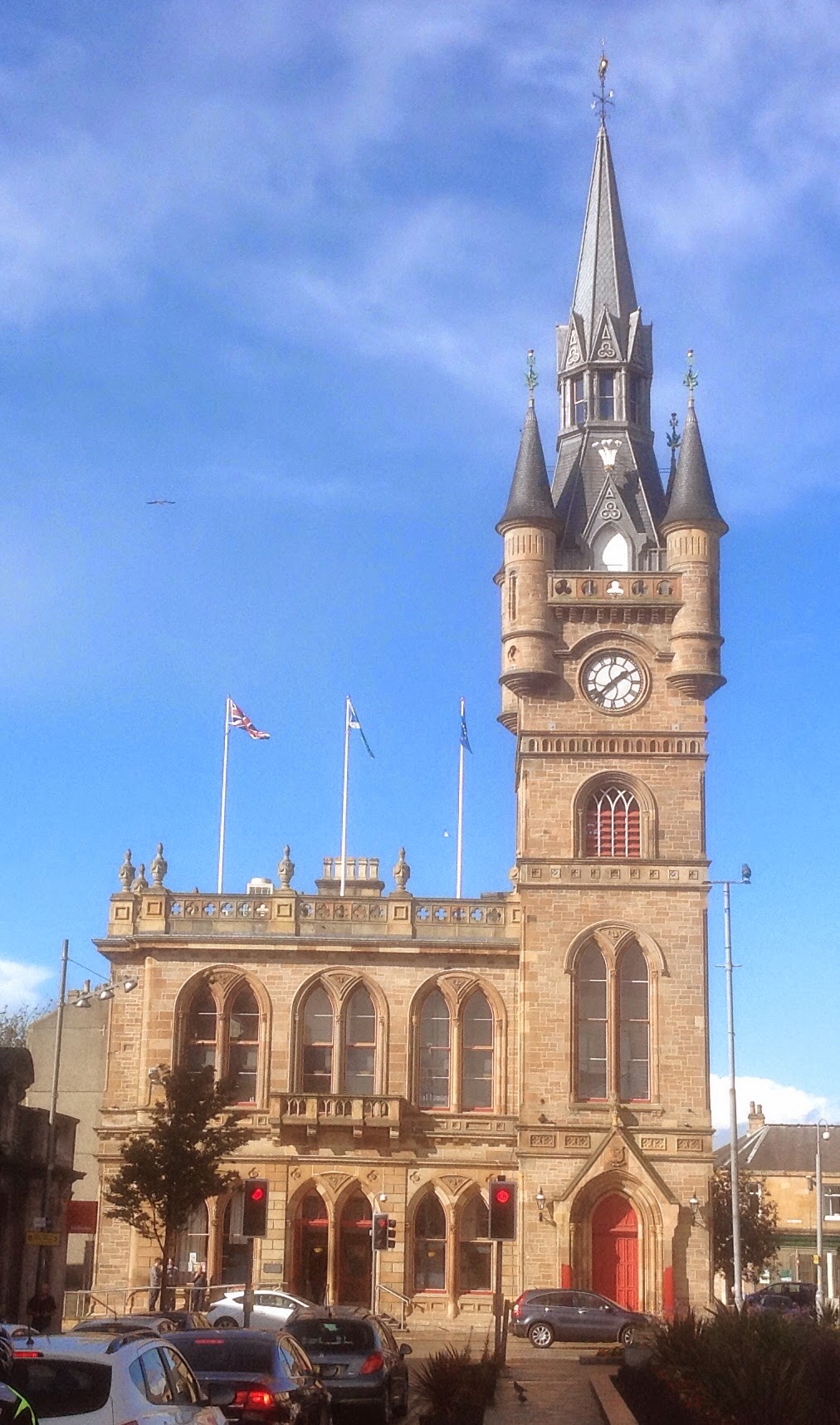
I attended the Somerled and the Battle of Renfrew conference today, held in the fine setting of Renfrew Town Hall. For those not familiar with Scottish town halls, many were built in the baronial style, and Renfrew is a particularly fine example.

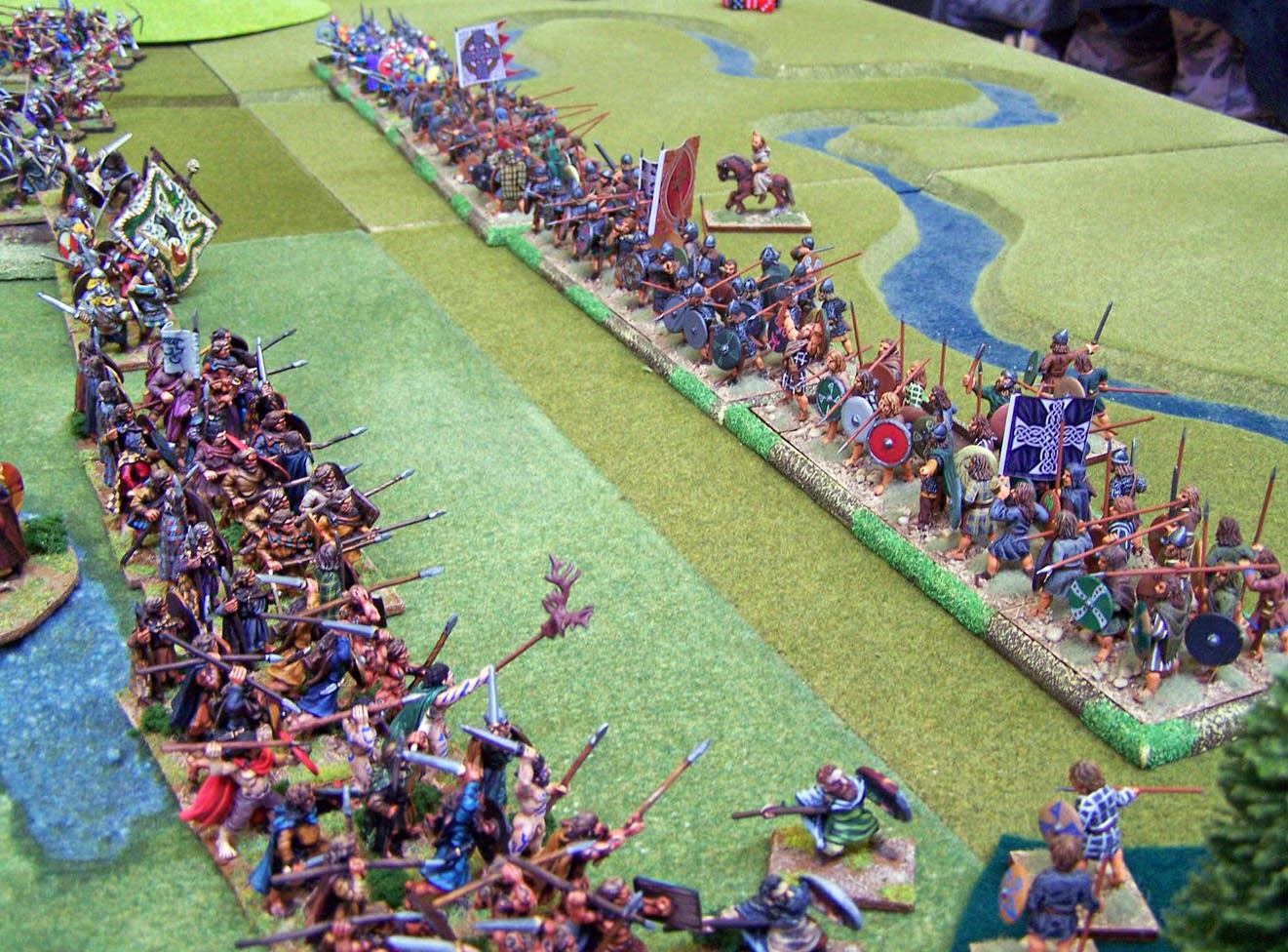
My particular interest in this local battle goes back to a GDWS display game in 2011, Somerled's Last Stand.

Somerled, King of Argyll and Lord of the Isles died at the Battle of Renfrew otherwise called, Bargarran, Knock or Inchinnan in 1164. His Islesmen, Manx and Irish allies were defeated by a Norman/Scots army led by the High Steward, Walter Fitz-Alan. We actually know very little about the battle or the forces involved, so the game was somewhat conjectural.

The first session by Ted Cowan gave us some background to the period and, for me at least, confirmation that we have very few sources. Then Denis Rixson reviewed the evidence of the West Highland galleys that were an essential element of the armed forces of the isles. Birlinns were smaller versions of the classic Viking longship, more suited to the economy and warfare of the isles. He has a new book out on the subject.

The main primary source for the battle is a later poem, 'The Song of the Death of Somerled and the Sacking of Glasgow'. Dr Alex Woolf has a paper analysing the poem and what little it tells us about the battle.

In the lunch break we had an excellent original musical interlude from the Renfrewshire Youth Music Initiative. A haunting tune that beautifully captures the battle.

In the afternoon David Caldwell talked about Somerled and the Lordship of the Isles. Again, we have limited sources. It is likely that he came from Ireland in about 1130 to lead a brilliant campaign to recapture Argyll from the Norse and eventually became King of Argyll. David outlined the likely strongpoints and administrative structures.

Derek Alexander gave us an archeologists perspective with a description of what the area looked like in the 12C and an overview of the key players. The favourite site is on the Knock, Kemp Howe in Moor Park housing estate, but no real hard evidence. What we do know is that the victory enabled the Steward's to expand across the west of Scotland.

Really interesting day, pulling together what little we know about a little known battle that had important consequences for the development of Scotland.


Saturday, 20 September 2014

Game of Thrones - House Stark

Back to the Saga, Game of Thrones project this week.

I decided to use GW Lord of the Rings figures again, this time Riders of Rohan seemed the closest fit for House Stark. I know some war gamers regard GW as the evil empire, and it has to be said their figures don't come cheap. However, they are well sculpted and unlike a lot of historical plastics they fit together well with properly designed lugs etc.

I decided to go with the grunge look for the Stark's as in the TV series. The Direwolf shield transfers are again from Vini Vidi Vici. I have some banners from Flags of War, which i'll use with the command figures that are the next paint job

These are the hearthguard.


and these are a unit of mounted warriors.


I am thinking of starting a new blog on the perils of wargamers with cats. I left these outside while I got my iPad for the photos and came back to find the cat on top of them. Much glue required for repairs. More Grrrr from me rather than Meow!

Saturday, 13 September 2014

Dividing the Spoils of Alexander's empire

I have had a Seleucid army for many years and I notice it is pretty popular amongst tournament FoG players. I can see why with its balance of quality cavalry and infantry together with exotic units such as elephants and chariots. However, my (and I suspect most players) understanding of the period was a bit sketchy.

Step up Robin Waterfield, author of 'Dividing the Spoils - The War for Alexander the Great's Empire'. It probably should have been called 'wars' for the empire, because there were at least four main wars and plenty of conflict in between. The period 323-281BC were filled, not just with conflict, but intrigue, diplomacy and treachery. Game of Thrones has nothing on this period!

Waterfield has narrated these conflicts well, almost in the style of a historical novel. It's one of those books you can pick up and read in short bursts, thanks to subchapter headings, without losing the flow of the story. Recommended.

A couple of units from my 28mm armies of the period


Tuesday, 2 September 2014

Aussies in the Far East

Some reinforcements for the Empire forces in Malaya 1942, in the form of Aussies.

These are Warlord Chindits painted up as Australian infantry. The reluctant mule is a nice touch as are the native scouts.


I picked up some more Japanese off EBay, so that's just about the project finished. Of course there is always a 'but' there. A Lanchester armoured car would be nice and ......

Sunday, 31 August 2014

More on Vis during World War Two

I have just finished the September update of Balkan Military History.

The feature article is a more detailed account of how the allies used the island of Vis during WW2 as a base to attack German garrisons in the Adriatic. There are many small scale actions that are ideal for wargaming with Bolt Action. I have tried a couple out on the tabletop. This one involves a joint attack on a fortified position on the island of Solta by partisans and commandos. It's one of the earlier raids before the Germans really dug in.

This is the German position.


Here you can see the Commandos starting their attack. Still needs a figure for Colonel 'Mad Jack' Churchill, with his Claymore!


and then the Partisans launch a flank attack.


The allies had a 1,000 point force, the Germans 600 points. It was still a difficult job to break in and thats without mines and barbed wire. One German defence position had more than 30,000 mines!

If you want to get a real feel for what it was like on the island, Bill Strutton's 'Island of Terrible Friends' is a great read. The medical facilities can only be described as basic, even worse for the partisans.


Wednesday, 20 August 2014

Commandos on Vis

Back to the Second World War and my recent trip to the Adriatic island of Vis.

Following the Italian capitulation on 8 September 1943, the Germans poured troops into the Balkans, with the 114th Jager Division supressing the Italian divisions. The partisans were not equipped to fight set piece battles so they harassed the Germans and then withdrew to the hills. The islands created a different problem for the Germans, who had limited naval assets in the region, to capture and then to hold them. None the less they eventually captured the islands closest to the coast.

While this was going on the allies, having landed in Southern Italy, were looking for an advanced base with a defensible harbour. This would be a base for RN Coastal Forces (MTB and MGBs) to raid the coast and as a base for the island partisans. A landing strip to enable close support for the partisan operations was also planned. The obvious place for this base was Vis, the furthest out of the islands, closest to Italy and with two natural harbours. The island was not new to the British, who had used it as a naval base in the Napoleonic wars.

The allied liaison officer with the partisans, Fitzroy Maclean, persuaded Churchill and Tito of the merits of his plan and got the Commandos of No.2 Special Service Brigade assigned as a garrison for the island with a remit to raid from it. This included Churchill’s son, Major Randolph Churchill.

So, having collected partisans and Germans in 28mm, I need some Commandos. Well, need is perhaps a little strong! Fortunately, Warlord do a very nice box of them, reasonably priced in plastic. Usual fiddly assembly, but they do at least provide a wide range of positions, appropriate for Commandos.


I’ll be developing some scenarios, based on actual raids, for Bolt Action. But if you want to read more, I recommend Michael McConville ‘A Small War in the Balkans’; Bill Strutton ‘Island of Terrible Friends’ and of course Fitzroy Maclean ‘Eastern Approaches’. For the naval war there is ‘Secret Flotillas Vol2’ by Brooks Richards.


There aren't a lot of WW2 sites on the island, but this is what’s left of the airstrip. It's just about the only flat bit of land on the whole island!


Saturday, 16 August 2014

Bolt Action - Serbian Army of WW1

A century ago, to this day, Austro-Hungarian troops reached the foothills of Mount Cer in western Serbia. In a four day battle they were heavily defeated and retreated back over the border into Bosnia. There is some video footage and a photo of the battlefield memorial here.

The Serbian Army of the early war period was the battle hardened force that had been victorious in the Balkan wars only two years earlier. However, there had been only limited requipment and they were heavily outnumbered. I have prepared a basic army list for Bolt Action rules.

The 28mm figures below are mostly from the Tiger Miniatures with some from the Old Glory range and represent the First Ban divisions that had the best equipment. Other troops had outdated rifles and few even had the full uniform. Yes they did favour a moustache!


Sunday, 10 August 2014

Bolt Action - Austro-Hungarian Army of WW1

Some reinforcements for the WW1 Austro-Hungarian army, in time to take the tabletop for the centenary of their offensive into Serbia in 1914.

28mm figures for the early period are a bit of challenge since Renegade has gone into hibernation. So these are Old Glory. Nice figures, but much smaller than the chunky Renegade figures. This still leaves me short of artillery, even if Hapsburg doctrine didn't bother with such niceties as preliminary bombardment.

First the infantry.


Then the machine guns.


I am using Bolt Action rules for 28mm WW1. So here is a basic Austro-Hungarian army list I have pulled together.


Monday, 4 August 2014

SAGA - The Crescent and The Cross

I played my first game of the new SAGA rules, 'The Crescent and the Cross' yesterday, after picking them up at Claymore.

I say new rules because this isn't a supplement - it's a stand alone package. The rules haven't changed much from the original, more a case of clarifications, largely to address daft games playing from the rules lawyers.

So what do you get for your £30? What can only be described as a beautiful hardback rulebook, printed on glossy paper that should stand up to a bit of rough handling. A bit of crusading background and then straight into the rules. Plenty of explanation and worked examples, not to mention the obligatory eye candy.

There are some new weapons to reflect the later period, and a new unit type, priests. They have a range of special rules and can substitute for a warlord. Then there are the army lists for Crusaders, Saracens, Religious orders and their opposite number the Mutatawwja, Spanish, Moors and mercenary Dogs of war. These have their own battle boards with their own special abilities. Finally some scenarios and a QRS.

My test game was Spanish against Moors. Just 4 points a side. The Spanish with two hearthguard knights, warrior Jinetes and some foot. The Moors also had two hearthguard nobles, warrior foot and levy archers. The game played well, and mounted javelins are an interesting unit. As always with SAGA it takes a while to understand how best to use the special abilities, but first impressions are very positive.


Sunday, 3 August 2014

Game of Thrones - Lannister Army

In between my other holiday painting, rain keeping me off the golf course, I have completed my first Game of Thrones army for SAGA.

This is the Lannister army, led by the arch villain Tywin Lannister, one of my favourite characters in the TV series, played brilliantly by Charles Dance. The bold Tywin is a Dark Sword model, beautifully sculpted, although not in a traditional wargame figure way, that provided me with some painting challenges that I am not sure I have overcome.

The three warrior and one hearthguard units (in SAGA speak) are warriors of Minas Tirith from GW Lord of the Rings range. The only conversion being the filing down of the embossed shields and replacing with Veni Vidi Vici transfers. The flags are from the new Flags of War range.


I bought some Perry mercenary foot figures at Claymore yesterday, for another faction. However, my next effort will be the Stark's as I have a Eddard Stark Dark Sword model. My medieval Scots will supply most of the feudal levy for this faction.

I also picked up the very long awaited Crescent and the Cross SAGA book yesterday. Given that I bought the dice at Salute! Settling down to read this after lunch and then perhaps a short game.....

Saturday, 2 August 2014

Claymore 2014

Off to Edinburgh today for Claymore 2014. I particularly enjoyed this year's show because I attended as a punter, rather than havng to organise the GDWS display game. Thanks to George and David who did an excellent Wild West participation game that had plenty of takers.


The event was well supported, no doubt helped by the wet weather! There seemed to be more traders and plenty of business. My prime purchase was SAGA Crescent and Cross from Gripping Beast, given I purchased the dice back at Salute! Some Perry plastics for another GoT faction and lots of bits and pieces from a variety of suppliers.

Not a lot of new games, with clubs repeating their Carronade offerings, but these are the ones that caught my eye.

Claymore Castings adapted SAGA for a Highland v Lowland medieval clash.
 
 
Tidy ACW battle in 15mm

 
Interesting way of doing the opening battles of WW1 in France on a strategic level.

 
And another 15mm ACW - Baton Rouge from memory

 
Forcing the Dardanelles - or probably not!

 
Very good Indian Mutiny game showcasing the excellent Mutineer Miniatures figures

 
Durham boys brought their 54mm Napoleonics up - always impressive.


Kirriemuir's Thracian game - well worth a repeat.


As always, thanks to the South East Scotland club for the massive effort involved.

Thursday, 31 July 2014

Battle of Harlaw 1411

More holiday reading, this time John Sadler’s ‘Clan Donald’s Greatest Defeat: The Battle of Harlaw 1411’.

The battle, sometimes called 'Red' Harlaw due to the casualties, took place on 24 July 1411 north of Inverurie in Aberdeenshire. It was fought between Donald, Lord of the Isles with a force of some 10,000 islesmen and highlanders, against Alexander, Earl of Mar with a Lowland force several thousand strong. 

Donald was enforcing his claim to the Earldom of Ross and was threatening Aberdeen when Mar assembled a force to oppose him. It is likely that the arrival of the Lowland army surprised Donald camped near Harlaw. Mar’s advanced guard consisted of the men of Angus and they were attacked by the Islesmen, being pushed back until Mar arrived with the main battle to support them. The main action was a battle of attrition with the islesmen and highlanders charging the spear armed lowland schiltrons. The rearguard, led by Forbes, joined the battle on the right wing and helped to push back the last assaults by Donald’s army. By nightfall, the Lowland army had lost around 600 men and the islesmen over 900. Mar held the field and Donald withdrew overnight. Probably a score draw to to Mar, but importantly, Aberdeen was saved. 
Sadler gives an extensive background to the conflict and the armies involved. As with most battles of this period, sources are scarce and the battle is described in a single chapter. The book is really a history of Scotland’s relationship with the Lordship of the Isles, rather than simply the battle itself.

Having read the book, it was time to refight the battle using Hail Caesar rules and 28mm figures.

The battle starts with the Lowland Angus vanguard being attacked by the Macintoshes. The left wing is routed and the right forced back.

Mar arrives with the main battle to form a new line as the main force of Islesmen advance.


The highland charge routs the remaining men of Angus and the right wing of Mar's force, but Mar himself fights off the Islesmen.


Finally Forbes arrives with the Lowland rearguard, but so do the Macleans and the whole line is engaged. So far pretty much as we believe the actual battle went.


However, history is now overturned, with Forbes being routed and the isolated Mar pushed back as the Lowland army breaks.


The gates of Aberdeen beckon for the highland host! 

Hail Caesar worked really well for this battle. The command system provided the staggered arrivals and there were credible lulls in the fighting while commanders rallied their men for the next stage.

Tuesday, 29 July 2014

The Ottoman Cycle - 2 & 3

Holiday travel enabled me to read the next two books in S.J.A.Turney’s, Ottoman Cycle.

The first was the ‘Priest’s Tale’, where our ‘hero’ Skioros leaves Crete (Candia) on his journey of revenge against the Sultan’s brother Cem, who is an exile in the Vatican. He blames him for the death of his brother. His ship is captured by Ottoman pirates and he and his comrades are taken to Tunis to be sold as slaves. They escape and make the long land journey with Tuareg traders across North Africa and then across the straits to Spain. The story ends with him being separated from his companions by accident and ends up with Columbus sailing for the New World.

In the second book, ‘The Assassin’s Tale’, he has returned from the Americas and rejoins his companions who agree to help him in his quest. They join a Condottieri lance commanded by one of their group and fight their way across Italy, before being engaged by Cesare Borgia in the Vatican. This gives them access to Cem, albeit with the complication that the French King has his own plans for him.


It’s difficult to badge this series as its not a conventional swashbuckling historical fiction in the Cornwell mode. The characters are very well developed and the historical research is evident. The second book brilliantly covers the complex machinations of 15th Century Italian politics. Perhaps more importantly, its a great read with lots of twists in the tale and certainly no shortage of action. I particularly like the way the main character develops across the three books. Recommended.


Monday, 28 July 2014

Opening of the First World War

Today is the 100th anniversary of the opening declaration of what would become the First World War.

Matthew Seligmann explains the process from regional squabble to World War in his article in today's 'The Conversation'; "With the exquisite turn of phrase for which she was so highly regarded, Barbara Tuchman once likened the Austro-Hungarian declaration of war against Serbia of 28 July 1914 to an example of “the bellicose frivolity of senile empires”."

The early battles of the war have not received much attention in the English language with the focus on the western front and the great battles in France. The centenary publications have at least begun to change that and I have outlined the early actions and a reading list in a recent feature article in Balkan Military History.

My post on return from holiday, includes a free Flames of War supplement for WW1 in this month’s Wargames Illustrated. It looks good and I might give it a go later this week.
Here are my 28mm early war Austrian Hussars as a taster.

And some Serbian infantry in 15mm