Welcome to my blog!

News from a wargamer with a special interest in the military history of the Balkans. It mainly covers my current reading and wargaming projects. For more detail you can visit the web sites I edit - Balkan Military History and Glasgow & District Wargaming Society. Or follow me on Twitter @Balkan_Dave
or on Mastodon @balkandave@mastodon.scot, or Threads @davewatson1683

Saturday, 30 January 2021

Murder's Art

 This is the second in Christopher Nicole's historical fiction Partisan series set in Yugoslavia during WW2.  Despite the first in the series, Partisan, being riddled with historical inaccuracies, I decided to persevere. I'm afraid that was a mistake.

Sadly, few of the unnecessary errors in the first book are corrected. Draza Mihailovic is still described as the former 'Chief of the Yugoslav General Staff', which he wasn't. Ante Pavelic, the Croatian leader of the Ustase, turns up again liaising with Mihailovic. Croatian nationalist meets Serb nationalist is not a marriage made in heaven!

Our hero, the left behind British military attache, and his new girlfriend Sandrine are now with Tito's partisans in Uzice. It was attacked by both the Chetniks and Germans, so the basis for the story is fine. However, the author has linked the massacre at Kragujevac, which did happen, with the attack on Uzice. In his retelling, the German left pincer moved through the town where they were attacked by our hero and his all-female regiment (women were generally incorporated into units) before they skipped back to Uzice. That is a distance of over 100km in rough terrain! Even by the remarkable partisan standards, 50km a day was the limit, and 30km was the norm. 

The murders are attributed to the SS when the Wehrmacht was just as capable of committing atrocities, particularly former Austro-Hungarian commanders in Serbia.

I have no problem with sexing up historical fiction. However, the Nazi S&M in this book is possibly a bit much for many readers. Then we have female partisans engaging in sexual activity with our hero as their commanding officer. It may have been an unwritten rule, but amorous relationships were strictly forbidden. So at the very least, they would need to be discreet.

I'm afraid these points and others got the better of me. It may be historical fiction, but some basic research would have corrected many of these errors and still provided a good story. I won't be moving on to the next in the series.

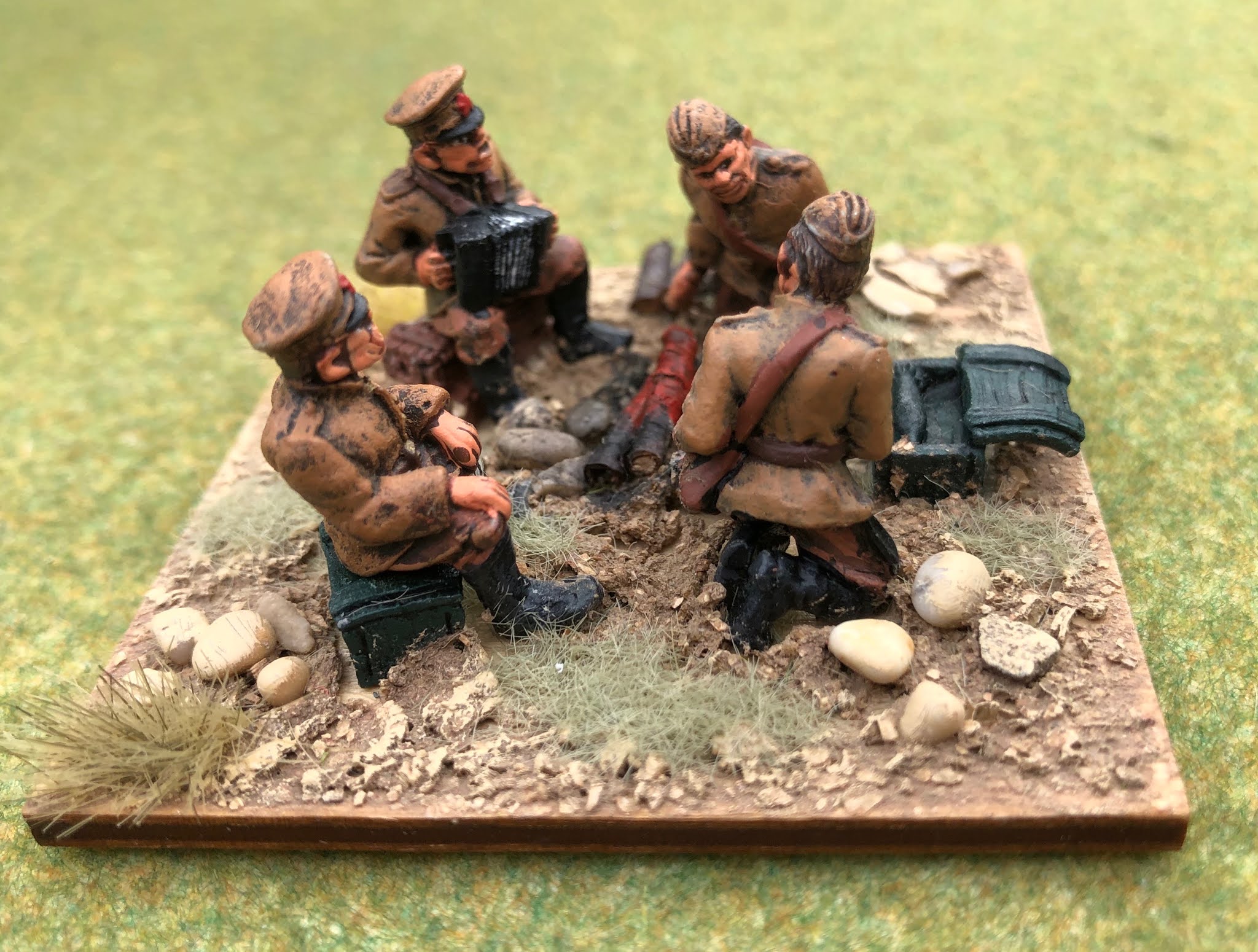
Partisans around the campfire in 28mm.


Thursday, 28 January 2021

Russo-Turkish War 1768-1774

 This is Brian Davies' study of Catherine the Great's war against the Ottoman Empire. Yes, there are a lot of Russo-Turkish Wars, and it can get confusing. My interest in this particular conflict was sparked by the Netflix Russian language series on Catherine. Season 3 of Ekaterina has the Russo-Turkish War as a backdrop, which ended in 1774 with Russian gains in the Treaty of Kuchuk-Kainarji.

The Russian tsars had gradually expanded their southern borders at the Ottomans' expense for over a hundred years before this conflict. They had established military colonies on the border along with support from the Cossack hosts. The Tatars in the Crimea were a major irritant, as they raided Russia mostly for slaves. However, the Russo-Turkish war of 1736-39 had demonstrated that militarily they could be beaten when a Russian army successfully invaded the Crimea and burned the Khan's palace. 

Catherine had recently seized power in Moscow in a palace coup and saw the war as an opportunity to cement her position. The Russian government was centralising power while the Ottomans were decentralising. Ottoman armies had changed little in a hundred years or more. They were huge, with a core of janissaries, and sipahis, supplemented by locally raised infantry and large numbers of Tatars.

Davies explains the context and describes the Russian army of the period, including the many reforms since the days of Peter the Great and the more recent Seven Years War. Jager regiments were added to the infantry arm, eventually growing to 40 battalions. Cavalry was becoming heavier, converting dragoons into Carabiniers and tactically relying more on shock. Tactics in the south relied on large infantry squares, which abandoned the swine feathers as a defence against cavalry favouring more flexible and manoeuvrable formations. Cavalry and jagers deployed in reserve and in-between the squares. Artillery had become lighter and included innovative designs. 

The war started with the Khotin campaign of 1769, in modern-day Ukraine with a fine fortress still standing today. The Russian First Army was supposed to have 80,000 troops, which required a staggering 5186 supply wagons. By the time they reached Khotin the army was 45,000 strong facing a garrison of 20,000, although the Ottoman field army was mobilising and up to 80,000 Tatars were in the region. An attempt to storm Khotin failed, but the siege was eventually successful, and the Russians moved into Wallachia capturing Bucharest. 

The Russians consolidated their success in 1770 with a major victory at Kagul in August forcing the Ottomans to flee back across the Danube. The Russians also sent a fleet into the Mediterranean from the Baltic, which stirred up revolts in Greece and Dalmatia. The Ottoman navy was more effective on the Danube, making it difficult for the Russians to cross the river until they developed their own flotilla. 

The war ground on into a war of outposts, putting a strain on both sides and their finances. A peace treaty was signed in 1774 which created an independent Crimea, moved the border further south into Moldavia, and the Russians gained key Black Sea forts. The Russians used these to build a Black Sea navy and quickly incorporated the Crimea into Russia. Davies concludes that the war resulted in one of the most dramatic shifts in the power balance in the 18th century. It also laid the foundations for the later Greek and Serbian revolts. The once independent cossack hosts were incorporated into the Russian state and the Crimean threat, centuries-old, was ended. Catherine herself consolidated her position by managing the Russian war effort more effectively than her predecessors while balancing the competing political factions. 

This is a well-written study of the war using mostly Russian language sources. There are far fewer Ottoman sources for all the period's conflicts, but the author has not ignored them. 

I have a Russian army of the Seven Years War in 6mm, although Adler figures are nearer 8mm. I used Angus Konstam's two-volume Osprey for uniforms. This book doesn't offer the sort of detail wargamers need on uniforms. According to Knotel, Catherine introduced new clothing regulations in 1763, including a lighter green coat for the infantry and a slightly different grenadier cap. However, at 8mm, I can live with these details. The Ottomans from the earlier and later periods all work fine, although I will need to expand from Irregular or Baccus, which I suspect are a bit smaller.

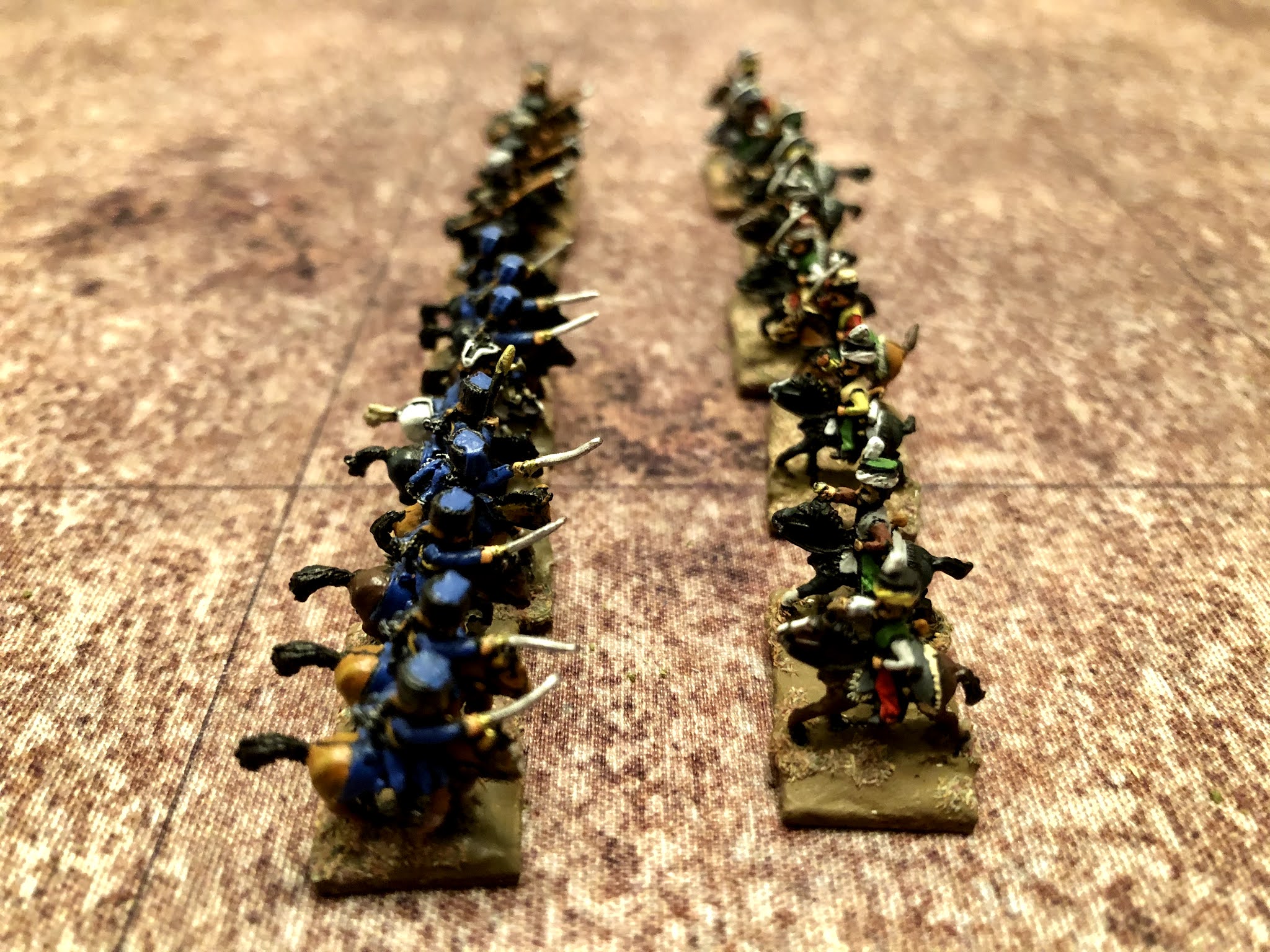
And onto the tabletop to demonstrate the Russian tactical system.


Saturday, 23 January 2021

Riders of Fury

 This is the fourth in the Arrows of Albion historical fiction series by Jonathan Lunn. It is set in the War of the Breton Succession (1341-56), which was one of many conflicts bound together in the Hundred Years War.


Our hero is Martin Kemp, an English longbowman commanding a unit known as a Twenty, which is fighting for the English backed cause. He falls out with his current employer and joins another band of near brigands. He helps them to capture a castle and make a claim on a larger landholding. After falling out with this band, he joins the Anglo-Breton army just as the book reaches its conclusion at the Battle of Mauron 1352. There are the usual sub-plots and characters, but I won't spoil the story.

The Hundred Years War is best known for its big pitched battles like Crecy, Poitiers and Agincourt. However, it was mostly a small war of skirmishes and sieges, making for a good story and ideal for the tabletop. It also had some great characters and a few of these sneak into this story, including Rob Knollys and John Hawkwood. Both rose from humble origins to command significant forces, which was pretty rare in any country of the period.

And for those who argue warfare was a bit samey with French knights shot to pieces by the Longbow, this was not always the case. Longbowmen needed the protection of men at arms, especially when they had insufficient numbers as was probably the case at Mauron. The French were also learning from their early mistakes and used dismounted knights and the terrain to minimise the longbow's effectiveness. The Longbow was also most effective as a mass firing weapon, which is less of a superweapon in skirmishes.

This is a good read with all the essential elements of historical fiction. I thought I had read others in the series, but I can't see them in my collection. So, I will take another look at the earlier books in the series.

Longbow unit in 28mm from my collection.


Thursday, 21 January 2021

The Mongols and Ertugrul

 I blame the Netflix series Ertugrul! If you are not familiar with this mega, and I mean mega, Turkish historical drama, it follows the life of Osman's father the founding dynasty of the Ottomans. It has over 450 episodes over five seasons, so it takes some stamina. And there is a sequel!

I am currently in season two, in which Ertugrul's Kayi tribe has migrated to Erzurum in Eastern Anatolia. His Turkish tribe is part of the Seljuk Empire, which is threatened by the Mongols. The Mongol advanced guard is led by Baycu Noyan, and they are the featured conflict of this season. Noyan is your archetypical baddie, played brilliantly. The production values are pretty good, even if the history is all bit speculative. While the actors have learned to ride pretty well, there is a lot of fighting on foot. Horse archery is a very skilled business!

Anyway, I looked at my collection of 28mm Mongols, which is sadly lacking. I have a more substantial 15mm army, but this is the small battle territory, best played with Saga or Lion Rampant rules. In particular, I was short of heavy cavalry, so an order goes off to Gripping Beast. Three packs give you nine figures, enough for two hearthguards and a command figure for Saga, and with my existing figures enough for two units for Lion Rampant.  


On to the tabletop with Saga, which is enjoying something of a renaissance in my gaming, for a battle with the Seljuks, including a unit led by Ertugrul.


 Sadly, I couldn't repeat the heroic, if somewhat implausible, combat feats of Ertugrul and his Alps. The Mongols went first and hurtled across the table, routing my archer levies and disturbing the Sultans tea. There was a bit of a rally as the Seljuk heavies counter-attacked. However, when Noyan killed the Seljuk commander, it was curtains for the Turkish cause. 

A sword might have been better than a Hawk in single combat!

Even on a hill, bow armed levies will get trampled over.

So you have a captive, well done, but you are disturbing my tea.

The Damascus Steel special ability worked well for the Seljuks here.

I am not having much luck fighting with Turkish armies in any period at present! A good quick game though and while not the easiest to play over Zoom, works so long as your opponent has a copy of the battle board. 

Saturday, 16 January 2021

Strategic Deception

 I have been reading Volume 5 of the late Sir Michael Howard's history of British Intelligence in the Second World War. This volume focuses on strategic deception operations launched by the British and later with their allies. Most of us will be familiar with the deception operation aimed at persuading Hitler that the D-Day landings would be at the Pas de Calais rather than Normandy (Operation Fortitude). However, that very successful operation was based on many others that the British had become skilled at delivering and made no small contribution to the outcome of WW2. 


Deception aims to conceal a commander's true intentions to lead his adversary to act in such a way as to make his own task easier. It is not enough to persuade the enemy to think something; it is necessary to persuade him to do something. All battlefield commanders attempt to do this, but this book is about strategic deception. The British achieved so much in this regard because they had the advantages of excellent intelligence, particularly signals using Ultra, and the UK's high level of security. Later in the war, allied air superiority meant the Germans couldn't see what was actually happening. So poor was photo-reconnaissance that even deception ops were not spotted.

I have spent quite a lot of time reading the National Archives files on the operations launched in my main area of interest, the Eastern Mediterranean. They make fascinating reading, and the scope and detail of the plans are quite remarkable. One of the main achievements was to make the Germans believe that the Allied order of battle was larger than it actually was. For example, in 1942, the deception unit 'A' Force based in Cairo created one bogus armoured division and seven bogus infantry divisions. In 1943 they added eight more infantry divisions and several HQ units. We know from signals intelligence that the Germans bought much of this, to the extent that they overestimated British forces by 40-45%.

This was achieved by a mix of actual and dummy troops, including realistic signals traffic and dummy equipment. Double agents and other offensive intelligence also contributed. 

One of the most important deception operations in the Mediterranean was Operation Barclay in 1943. This operation aimed to divert Axis units from Sicily by threatening targets in the Eastern Mediterranean, including Crete and the Peloponnese, as well as bringing Turkey into the war. This included the famously successful Operation Mincemeat, which planted a courier's body carrying dummy plans for an invasion of Greece.

While it was impossible to hide Operation Overlord given the array of troops assembling in England, a deception Operation Zepplin was mounted to maintain credible threats in the Eastern Mediterranean to stop the Germans from shifting units to France. While it would be impossible to hide the experienced divisions coming home, three more bogus divisions were invented to replace them. This meant a quarter of the notional Allied strength of 70 divisions in the Mediterranean were actually bogus. 

There were deception operations in the Far East thanks to Wavell creating a similar unit to the one he had established when commanding in the Middle East. In my view, Wavell is one of the underrated British commanders of the war. Churchill may not have liked him, but he was more innovative than others. His Far East deception unit was commanded by the author Peter Fleming. 

This is a fascinating book, written well by one of Britain's greatest historians. It is quite difficult to get hold of at a reasonable price, but it is well worth a read when libraries reopen.


Thursday, 14 January 2021

Fistful of Lead - The Cheti

 A friend wanted to play A Fistful of Lead in this week's Zoom game. If you have read my review of these rules, they make for a good quick skirmish game, which works well over Zoom.

My choice of forces was inspired by a recent episode in the excellent Bulgarian History Podcast - Time of the Cheti. The Cheti were small bands of Bulgarian irregulars who infiltrated into Bulgaria to foment revolution and attack Ottoman garrisons. They were mostly based in Romania and Serbia and aimed to establish armed camps in the Balkan Mountains, where the terrain suited guerilla warfare. This modern picture I took from the Shipka Pass monument gives a pretty good impression of this.


Bulgaria during this period was part of the Ottoman Empire. They introduced some limited reforms and economic development, partly to address the rising nationalism that had led to Serbia, Romania and Greece largely breaking away. However, political change was fiercely suppressed, which led to increasing revolutionary activity, although it was very much an urban, educated movement that hadn't really reached the peasantry in a largely rural, agrarian economy. 

The podcast focuses on 1867, but bands of Cheta were being infiltrated since at least the 1860s and would continue until the Russo-Turkish War of 1877. Revolutionary leaders like Vasil Levski, Panayot Hitov and Filip Tityu are national heroes today. Still, in practice, they achieved very little at the time other than raising awareness of the Bulgarian cause. Most of the Cheta were small compared to the Ottoman garrisons who included regular and irregular troops, including the notorious Bashi Bazouks. Most Cheta were quickly identified and destroyed. My favourite leader is Panayot Hitov, who has a spectacular moustache!


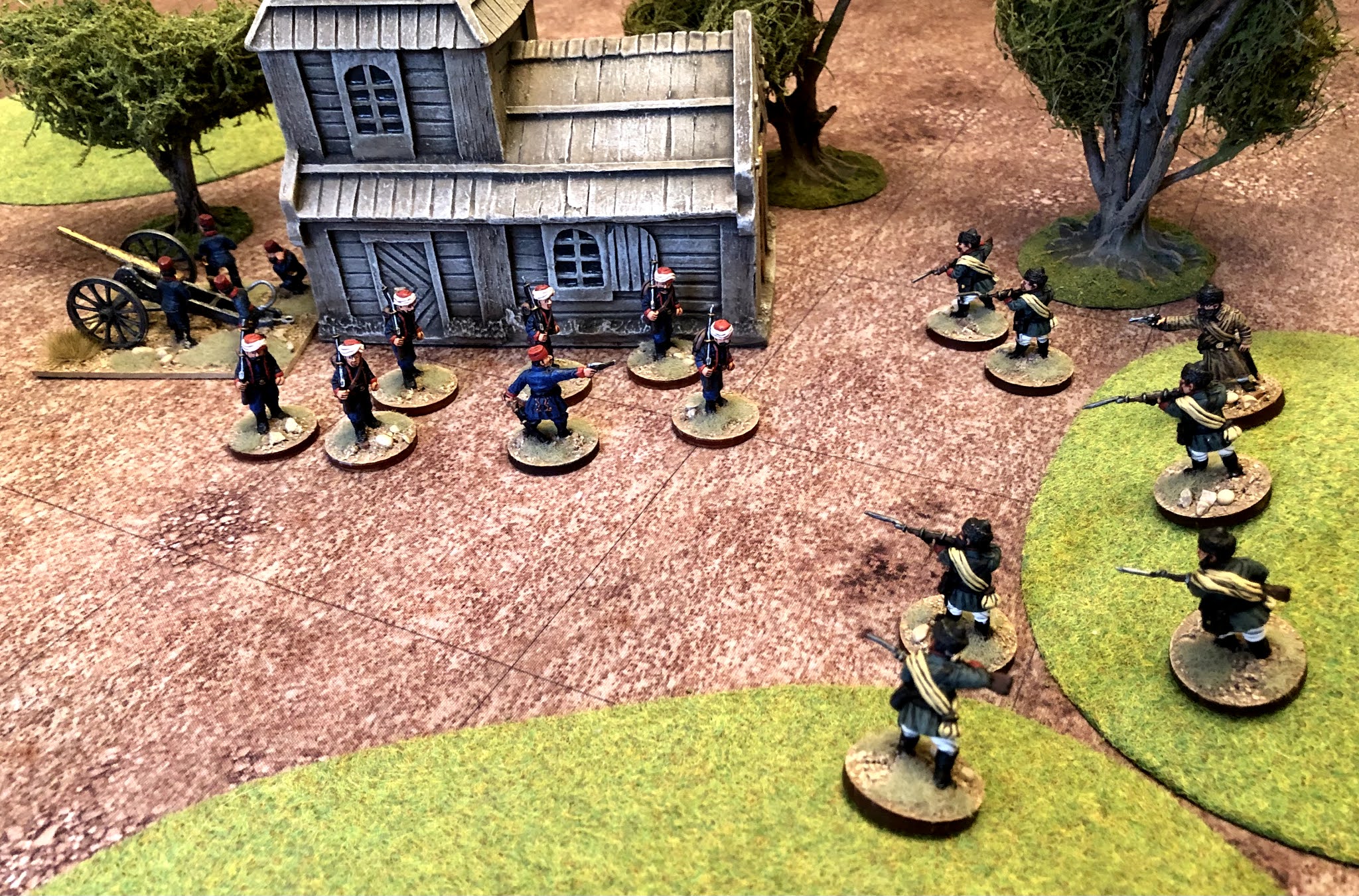
 For the game, I used an Ottoman gun position that the Cheta is going to try and capture. I used second-line Ottoman troops from my 28mm 1877 collection. The Bulgarians are Bulgarian Legion figures from 1877. Except for the pistol-wielding leader (only a modest moustache), I suspect these are somewhat better equipped than the Cheti of this earlier period. Although the Cheti bands were incorporated into Bulgarian Legions. 


  Sadly, playing the Bulgarians, I achieved as little as my historical counterparts. I would now be languishing in an Ottoman dungeon, or worse! 


Sunday, 10 January 2021

A Dish of Spurs - The Border Reivers

 This is the first of a trilogy of historical fiction books by Bob Low, based on the Scottish Borders. After his series on the Vikings and the Wars of Independence, not to mention the Romans, he has clearly got the bug for the Borders. The final book in the trilogy is already coming out this month. Bob is also a re-enactor and wargamer who used to play at my wargames club (GDWS) before he moved away. 


We are talking about the area on either side of the border between Scotland and England for those not familiar with the Scottish Borders. It was a region of mixed allegiances, where clans (Grayne is the Borders word) switched national sides depending largely on their family interests. It is described as a lawless land where violence and raiding were common, although both countries established a wardens system to regulate disputes. This book is set in the Debatable Land in 1542, a strip of land around Canonbie which both countries claimed until the border was settled in 1552.  It was dominated by one family, the Armstrongs.

Our hero in this book, although the hero might be pushing it, is the wonderfully named Batty Coalhouse. He is a one-armed mercenary who fought in the Italian Wars and gets involved in a local feud when commissioned to bring the murderer of the father of the book's heroine, Mintie Henderson to justice. This brings the family into conflict with the powerful Armstrong clan based at Hollows Tower. I won't spoil the story, but there are several sub-plots, including the kidnapping of Mary Queen of Scots, a baby at the time. This was a conflict with Henry VIII, known as 'The Rough Wooing' because Henry wanted Mary to marry his son Edward and so link the crowns. The author tends to drift off at a tangent on occasions when you just want the narrative to flow. However, other than that minor criticism this is another great read, and I have already downloaded the next in the series. 

I should caution that this is not a story for the squeamish. If it ever gets to the screen, it will be 18 rated for violence alone! The Borders was not a wealthy area, so large castles were rare. Instead, the Lairds had tower houses, many of which can still be visited today. Even families of modest means would fortify their houses with thick walls and two stories, known as Bastel Houses. This is Smailholm, a good example of a Tower House.


Despite staying not far from the Borders, it's not a period I have tackled seriously on the wargames table. The classic history is George MacDonald Fraser's The Steel Bonnets, which I found very hard going. Not what I expected from the author of the Flashman series. There are some excellent 28mm figures, and I used these below for the Tully horse in my Game of Thrones army, as they match the TV series's depiction very well. David Weinczok makes a good case for the Borders being the historical basis for the Riverlands in GoT. 


I have an English army of the period in 15mm, which includes border horse. So, onto the tabletop for a small game of Pikeman's Lament. The troop types in these rules don't really work well for this earlier period, but it provided a fun short game. 'Fat Henry', as he is called in this book, was sent packing!


Friday, 8 January 2021

Atatürk: The Rebirth of a Nation

 On a visit before Christmas, my daughter took a rare interest in my bookshelves (she is a microbiologist). The question followed, 'do you have any books on Turkey?', with my response 'is the Pope a Catholic!' and a brief (well not too brief) tour of how my several thousand books are organised. The mystery was resolved on Christmas Day when one of my presents was Lord Kinross's classic biography of Kemal Atatürk. I had actually read it in the library many years ago but never owned a copy.

The founder of The Republic of Turkey was born in Greece, albeit Salonika when it was part of the Ottoman Empire. It was middle class upbringing, which despite some opposition from his mother, led to a military education and career. After service in the Middle East and the against Italy in Libya, he arrived back in Europe too late to fight in the First Balkan War, which saw the loss of his Macedonian home. This was a loss he felt deeply with his mother and sister having to flee the family home, "how could you surrender that beautiful Salonika to the enemy", he said to brother officers. 

Mustafa Kemal, as he was known in the days before Turks adopted surnames, made his name in the Gallipoli campaign of WW1. As the British official historian puts it, "Seldom in history, can the exertions of a single divisional commander have exercised, on three separate occasions, so profound an influence not only on the course of a battle but, perhaps, on the fate of a campaign and even the destiny of a nation". As a modern visitor to the battlefield I could see the importance of the positions he held and also his gracious commentary.

He went on to command on the eastern fronts where his eventual successor as President, Ismet (later Inönü) was his chief of staff. Military comrades from this time would form an important group in supporting him later. He ended the war in Syria and also visited Germany, where he met Hindenburg and Ludendorff. 

He actually sounded out the British for a role during the occupation of Constantinople. Then broke with the rump Ottoman government by going to Ankara with others to form the Grand National Assembly and after a short civil war, the resistance to the division of Anatolia by the wartime Allies. His command during the Greek-Turkish War of 1919-23 is given a relatively short treatment in this book, although the outline of the extended Greek advance and Turkish counterattack is explained. If you want more on this, there is a very recent book worth reading.     

The end of the Sultanate and the creation of the Republic of Turkey is explained in detail. The way the British sneaked the last Sultan out of Istanbul is an entertaining story that I hadn't recalled. The eunuchs came before the wives in the evacuation priorities, achieved in the back of an ambulance! Kemal was elected the first President of the Republic, which was based in Ankara rather than Istanbul. The rest of the book deals primarily with his internal reforms and the treaties that secured the boundaries of the new state.  Military matters are not entirely absent, as there were a number of revolts, primarily in the Kurdish areas. 

Ataturk (Father of the Nation) as he became known in 1935, showed extraordinary insight into world affairs in the 1930s. Despite significant pro-German sympathies amongst the Turkish leadership, he described Hitler as a 'tin-peddler' and expressed his horror at his language and thoughts. He promoted counterweights to Italian and German imperialism through the creation of the Balkan Pact in 1934. This was followed by the Saadabad Pact with the countries on the eastern border. In discussion with General Douglas MacArthur, he predicted the outbreak of war between 1940-45, the German advances and defeat once the USA entered the war. But the real victors he predicted would be the Soviet Union. I had read this before but didn't know he also compared the Maginot Line to a tomb that anyone could go around the edge of it.

I enjoyed this traditional biography and learned some new details about his life and times. My one criticism would be the way the author ascribes almost mystical characteristics to Ataturk, the 'extra dimension' as he puts it. There is no doubt that Ataturk was a remarkable leader, certainly in military terms if perhaps less so politically. But his character and physical bearing is possibly given too much weight, and modern readers might find this approach a bit grating at times. 

That said, it's well worth a read, and thanks to my daughter for the addition to my library. Her mother was less impressed by her adding to it! 

It also inspired me to get on with some related painting in the form of another squad of 28mm WW2 Turkish infantry. These are converted from the Crusader Miniatures French Dragon Portes. Better equipped Turkish regiments had French style helmets and a similar tunic. These are sans the greatcoat that so many French wargame figures have, so work well for my purpose. They are also very nice models, which I have painted in the winter uniform, unlike my 15mm armies in the summer kit. More to come from this range.


Tuesday, 5 January 2021

Poland against Sweden 1626-29

 I have been reading Michael Paradowski's new book, Despite Destruction, Misery and Privations: The Polish Army in Prussia During the War against Sweden 1626-1629, in the excellent Helion Century of the Soldier series. Bizarrely, this was the conflict that got me interested in the Renaissance period when I was given Michael Roberts two-volume, Gustavus Adolphus: A History of Sweden 1611-1632. George Gush's groundbreaking book and rules followed quickly on.

When Gustavus Adolphus is mentioned, we immediately think of the Thirty Years War. However, his earlier conflict with Poland was where he refined the tactics and organisation that was to have such a major impact on the titanic struggle that was the Thirty Years War. Peter Wilson's book is the recent one to read for that. Sweden during this period included modern-day Finland and much of the Baltic States. After the decisive victory at Walmozja in 1626, Gustavus landed an army in Prussia, starting a war that lasted for three years before Imperial intervention delivered a truce, still largely to Sweden's advantage. It was a conflict involving modest armies with many small scale actions rather than big set-piece battles. This makes it very gameable on the tabletop.

The focus of this book is on the Polish army of the period. This was my first Renaissance army, although it has long gone. I now have the armies in 28mm and 15mm. Of course, the main attraction is the Winged Hussars, and a print of them stares down at me from my study wall. 


However, there are many other interesting units, including cossacks, pancerni and the haiduk infantry with axe and musket. You can also pad out the army with mercenary western units including pike and shot, reiters etc. In fact, this was the period when the Poles turned to mercenary foot in increasing numbers, but they don't look as good on the tabletop and are less fun to paint!

The author explains in considerable detail how the army was recruited, commanded and organised. Then takes us through the different unit types. As with other books in the series, it is profusely illustrated, including colour plates by Sergey Shamenkov.

If you want more on the Swedish army of the period the series has a volume on them, The Lion from the North. The title references the Thirty Years War but starts in 1618. I was lucky enough to visit the Stockholm Army Museum and Royal Armoury just before lockdown last year, which is the museum for this subject. 

Unsurprisingly, this reading led to this week's Zoom game. We played a typical small skirmish using Pikeman's Lament rules in 15mm.


It was a big win for the Poles on this occasion. Done and dusted in an hour and a bit. 


Friday, 1 January 2021

Here's to a better 2021!

 Happy New Year! Well, 2020 was certainly different. Precious little face to face gaming and no shows for me after York in February. We adapted with games over Zoom and other online offerings, but it hasn't been the same. The only plus side is that more figures got painted, books got read and the hobby seems in decent shape with folk rediscovering gaming in all its formats. Zoom games also allowed me to play with people on different continents, which was enjoyable.

On the painting front, I almost got to the bottom of the lead/plastic mountain, had I not got drawn into new projects, of which there have been many! I have largely finished the Turkish Army of WW2 in 15mm and made a start on the 28mm version. The big 15mm project was the War of 1812, albeit a couple of years after visiting the battlefields. In the smaller scales, I finished the India-Pakistan wars in 1/285th scale using GHQ models. I dabbled with fantasy, inspired by Oathmark and built a decent sized dwarf army, which can be used against my many Dark Ages armies under these rules. It also got me painting more figures from the Conan game, including the barbarians.

Earlier in the year, I finished off several projects including the 28mm Soviets (with some Romanians) and the Hungarians for Bolt Action Fortress Budapest. Another project stimulated by an overseas trip was the Zulu and Boer wars, this time in 10mm, to which I have added Afghans as additional opponents. I also managed some smaller 28mm projects with more Saxons, including Alfred and AethelflaedViking shield maidens, Venetians for the Cretan War, Russ Druzhina and infantry, and 1848 Hungarians. I also added to the 20mm moderns with eastern European militias and Brits. I am a rubbish sailor, but that hasn't stopped me adding Ottoman ships to my Black Seas fleets.

For the new year, I am adding more Mongols to field at least a Saga force. My Netflix viewing includes the epic Ertugrul series, so that needs to get onto the tabletop. These are some heavy cavalry I finished basing this morning. The models are from Gripping Beast.

Next up will be 28mm Turkish WW2 infantry and support weapons for Bolt Action. I am converting these from Crusader Miniatures, French Dragon Portes. Other than bits and pieces that's it from the lead mountain, but new rules, books and hopefully travel (remember that!) will no doubt stimulate new projects.

On rules, playing over Zoom has meant keeping it simple. I have rediscovered Saga through the Age of Hannibal supplement, and for bigger games To the Strongest! remains my main ruleset. I got around to writing the Medieval Balkan army lists this year, which are now published in a nice looking booklet. Lion Rampant works very well over Zoom, and the new book on the Crusades may tempt me into new territory. Rebels and Patriots, also from Dan Mersey, has been a regular favourite, for 1848 and American wars. Sam Mustafa's games are always innovative, and I have played Rommel and Blucher a bit this year. I could well be tempted by the new edition of Lasalle. 

For WW2 at the smaller scales, Blitzkrieg Commander is my go-to set, and I must dust down my Spanish Civil War armies to play the Libertad supplement. Cold War Commander is also due a new edition this year, which is just as well as my copy is past its best. In 28mm it remains Bolt Action, although I haven't played as many games this year as the number of units painted might justify. I have recently returned to Bloody Big Battles for the Greek-Turkish War and aim to play more games with this elegant rule set this year. Some wargame pals have got me interested in a Fistful of Lead, which is handy, along with Open Combat, for a quick game.

On the writing front, I have managed a record number of blog posts (134) this year, aiming at two a week. However, I only managed a couple of journal articles, and my book project could have moved a lot faster. I have just past 50,000 words, and I am filling in with research notes, thankfully done before lockdown. My semi-retirement has not freed up as much time as I had hoped for hobby writing. When I spend a day writing policy papers, painting and gaming is a more attractive evening activity. 

Travel, or the lack of it, was the biggest downside of the year. I was fortunate to get to Sweden just before lockdown on a work trip, which may generate a project or two. I am giving some thought to trips in the early summer and beyond, and they almost always generate new projects. 

Lockdown certainly increased my reading, and my to-read shelf is almost bare. I am currently working my way through a biography of Ataturk, and then it will be The Russo-Turkish War of 1768. At the same time, I have several WW2 tomes to work through as research for my own book. 

So, that's it for 2020 and my plans for 2021. The biggest step forward would be getting back to the wargame clubs I play at, and other face to face gaming, not to mention shows. Our hobby is all said and done a sociable pastime, best enjoyed in good company. 

Tuesday, 29 December 2020

Bloody Big Battles - 1st Inonu

 I took a day off writing this week to play a game of Bloody Big Battles. An elegant ruleset that I should play more often allows battles to be fought on a grand tactical scale with 15mm figures. Having recently read Salvation and Catastrophe, a detailed study of the Greek-Turkish War 1919-23, I was keen to try that conflict on the tabletop. I was moved to action when the author of the Bloody Big Balkan Battles supplement for these rules (Konstantinos Travlos) kindly sent me a draft of a scenario he and his collaborator, Onur Buyuran, have written for the early stages of Battle of 1st Inonu.

The Greek-Turkish War 1919-23 attempted to expand the Greek state to include Greek populations in Anatolia, taking advantage of the Ottoman defeat in WW1. An army landed in the predominately Greek city of Smyrna (modern Izmir) and advanced towards the newly formed Turkish Grand National Assembly forces, led by Mustafa Kemal (later known as Ataturk). The Turks withdrew, causing the Greeks to extend and protect their lines of communication. 

The scenario for this game deals with a reconnaissance in force by the Greeks to test the Turkish defences along the approaches from Bursa/Prusa towards Eski-Shehir on 28 December 1920 to 10 January 1921. I do like a centenary! The Greek force consisted of elements of two divisions, which were not ordered to occupy Eski-Shehir itself, instead the town of Inonu was the operational objective. The Turkish forces were commanded by Ismet Pasha (later to become the Turkish President and take this battle as his surname). The Turks had similar numbers of men but fewer machine guns and artillery.

This is the tabletop at the start of the game with the Turks entrenched on the east of the stream and the Greeks forming up in the west. The larger building on the nearest edge represents the Greek objective, the town of Inonu.


The Greeks were organised into two regimental sized battlegroups, which aimed to break through the gaps on either side of the high ground. The initial Turkish defence fire was dire, while the Greek artillery immediately caused heavy casualties and disrupted the Turkish units. This set the tone for Turkish dice rolling throughout the game!

This offensive fire allowed the Greeks to capture the villages of Kovalka in the south and Bozoyuk in the north without even having to mount an assault.


The Turks improvised a second line of defence in the north and dug in around the town of Inonu. The heavily outnumbered scratch force in the north held on for a couple of moves, but Inonu's defenders quickly collapsed. 


Objective secured for the Greeks by move 6 of 8. The scenario provides the chance that Turkish reinforcements could arrive in move 7 or 8. Needless to say, the dice said No!


 Complete victory for the Greeks by the end of move 8, who will be celebrating with the captured raki stores in Inonu tonight. 


I hope Konstantinos and Onur are working on the Battle of 2nd Inonu. The President is not likely to want to adopt this battle as his surname without a chance for a comeback!

While it was a walkover for the Greeks, the scenario is actually pretty balanced. With a bit more luck, the Turks could have held their initial positions long enough to allow the Turkish reinforcements to arrive. The authors have made a few tweaks to the rules for this conflict, largely to take account of the terrain, artillery deployment, and the use of machine guns. These look about right to me and it was an enjoyable game.

Saturday, 26 December 2020

To the Strongest! El Cid

 With my daughter glued to her Nintendo Switch and my wife tackling a Chrismas jigsaw, I had control of the remote on Xmas Day. So, it was MacArthur, The Longest Day and finally El Cid. In my pre-multi channel TV childhood, this great film had a guaranteed slot on the holiday schedules. I even owned a VHS copy of it at one point.

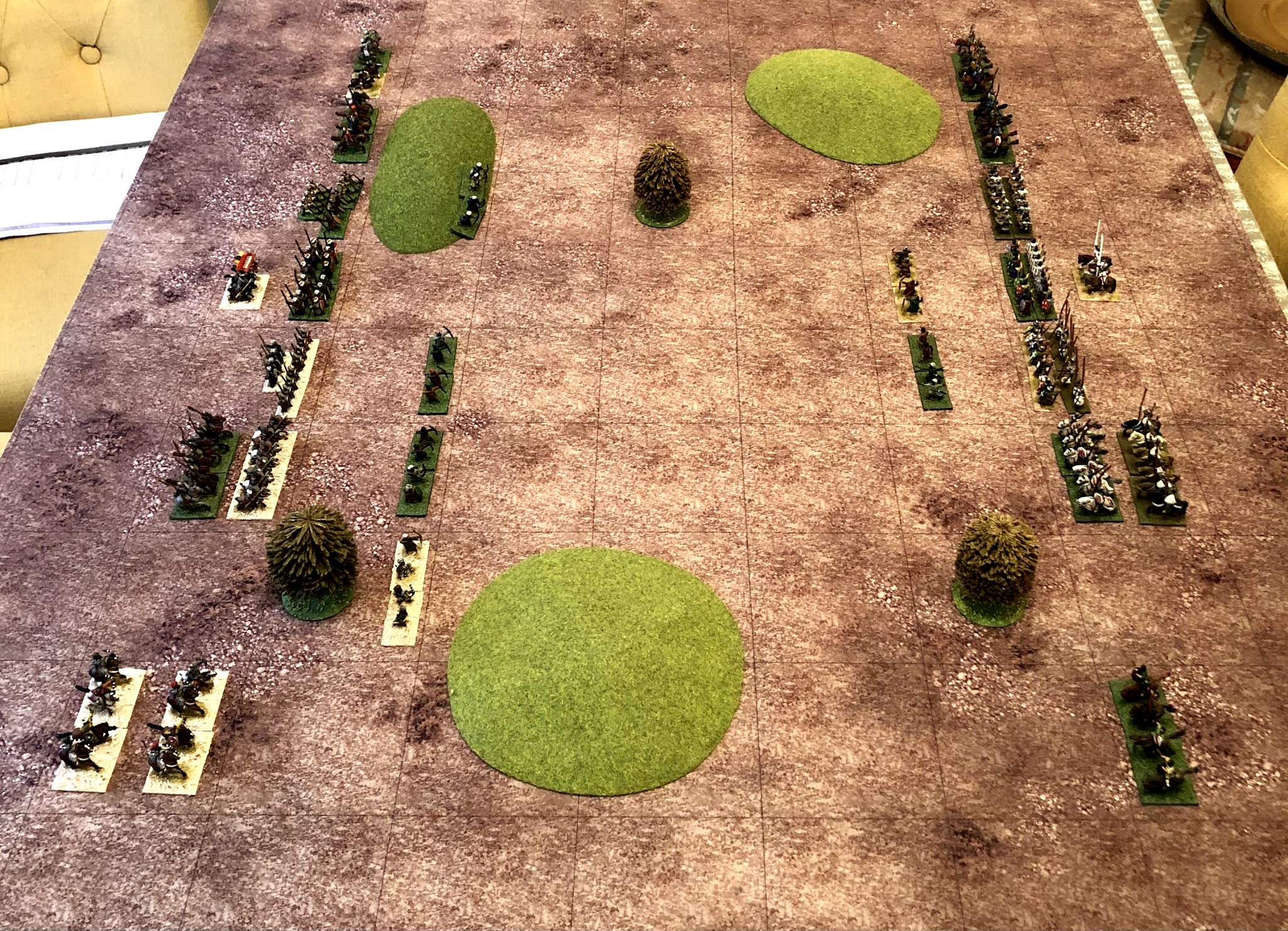
It guided another decision, which armies to field for a promised Boxing Day game of To the Strongest! with a friend who was stuck at home alone because of the pandemic measures. We decided on a small 80 point game, which works well over Zoom, not least because the cards are very visual and the squares avoid measuring. It also allowed me to go through the newly produced army lists. Simon has brought the large collection of army lists for these rules into two booklets, making it a lot easier to find what you want.

El Cid meant moving away from the lists I wrote in the Medieval Balkans section, to Feudal Spanish and Al Andalus.


The Moorish light infantry damaged the Spanish, but as ever it was the Spanish heavy cavalry that decided the day. Smashing through their lighter opponents, even when I managed to position them on a hill. Charlton will be returning to the arms of Sophia on this occasion!


Thursday, 24 December 2020

Syria: A Recent History

 The war in Syria may have been largely missing from our TV screens, but the conflict's misery is very real for Syrians. In this book, John McHugo looks at Syria's history with a focus from the 20th century to the present-day conflict.

Shaam (or Greater Syria, as it used to be called) is divided between modern-day Syria, Lebanon, Israel, Palestine and Jordan, and includes part of southern Turkey. It literally means 'the land to the left' and points out that modern borders are artificial constructs drawn largely on a map in the 20th century. 

After the Ottomans were defeated in 1918, the main colonial interest came from France who sought to spread their values through its self-appointed mission civilisatrice or 'civilising mission'. They engaged in the typical divide and rule policies of the colonial powers, promoting the varied ethnic and religious groups. Syria has a particularly diverse makeup. In 1914, 20% of the population was Christian, although they fought amongst themselves as much as their neighbours of the Muslim or Jewish faith. Similarly, the Muslim peoples were divided into the great schism between the Shias and Sunnis and the Alawis, Druze and the Kurds. 

The French struggled to find the resources to police Syria and frequently resorted to repression when quashing revolts. The Maydan revolt in 1926 involved what may well have been the most intensive and systematic aerial bombardments against a civilian population that had taken place up to that time anywhere in the world, as their planes returned to bomb villages daily. Large numbers of colonial troops were often brought in from Algeria, Senegal and Madagascar and a significant role was also played by badly disciplined militias.

After WW2, the newly independent state of Syria and its offshoot in Lebanon got drawn into the Cold War. Syria and the West had different views of what constituted a threat to security. For America and Britain, security in the Middle East involved keeping the area free of Communism and Soviet influence. For Arabs, it was primarily about liberating themselves from foreign domination, defending themselves against Israel and restoring the Palestinians' rights.

In time the Ba’thist party elite took the place of the notables and, later still, neglected the poor who had now become dependent on them. They also found themselves forced to rely on quasi-tribal solidarity. That was the story of the Assads and the Alawi community. For most of this period, Syria was ruled by Hafez al-Assad. While the regime was corrupt and repressive, it also modernised Syria with education, piped water and reduced infant mortality. 

He was followed by his son, Bashar al-Assad, who initially appeared to support democratic reforms but quickly resorted to his father's repressive ways. This led to the current civil war, in which Syria is once again the plaything of foreign interests (see Tom Cooper's book on the Russian military role). Regional actors have lined up behind sectarian ideologies, caring little for the suffering on the ground. Solutions often resort to the old Western disease of drawing pretty lines on maps and then expecting Greater Syria's peoples to step neatly into the zones marked with the particular colour chosen for them. Things do not work like that in practice. It was ultimately only possible to establish a predominantly Jewish state in Palestine by widespread population displacement, and the same would be required in Syria.

This book is a good overview of the recent history of Syria and the surrounding region. It isn't a cheerful read, but it helps us understand the context of the current conflict.

It also inspired me to dust down my Arab-Israeli armies in 10mm. Using Cold War Commander for a 1973 scenario. The Syrian army in 1973 performed better than expected, certainly much improved on its dismal 1967 showing. However, in this game, the two Israeli battlegroups managed to blast through the flanks and capture the objective with few casualties.


Tuesday, 22 December 2020

Fistful of Lead

 My wargaming pals at the club have played a lot of the skirmish game, Fistful of Lead, during the various stages of lockdown that have halted our face to face gaming. So, I thought I would give it a go. 

These are genuine skirmish games, typically played with six to eight models on each side. The core ruleset was developed from the Old West gunfight game, which is still available. The core set covers all periods, but there are supplements for a couple of periods, and there are Horse & Musket and Sci-Fi versions. 

The basic mechanism is a card activated system using playing cards to determine which figure goes first. You can then take two actions, e.g. movement, shooting etc. Shooting and combat use a D10 with a few modifiers, and the outcome can cause shaken or wounded/down markers on the target, or sometimes an outright kill. Shaken and down markers can be recovered as an action. You can increase complexity by adding traits, which can add specialist skills or positive and negative traits.

The rules make no pretence at being a simulation. Instead, they provide a fast and fun game. They can be downloaded as PDF's rather than the cost and tribulations of getting the printed books from the USA.

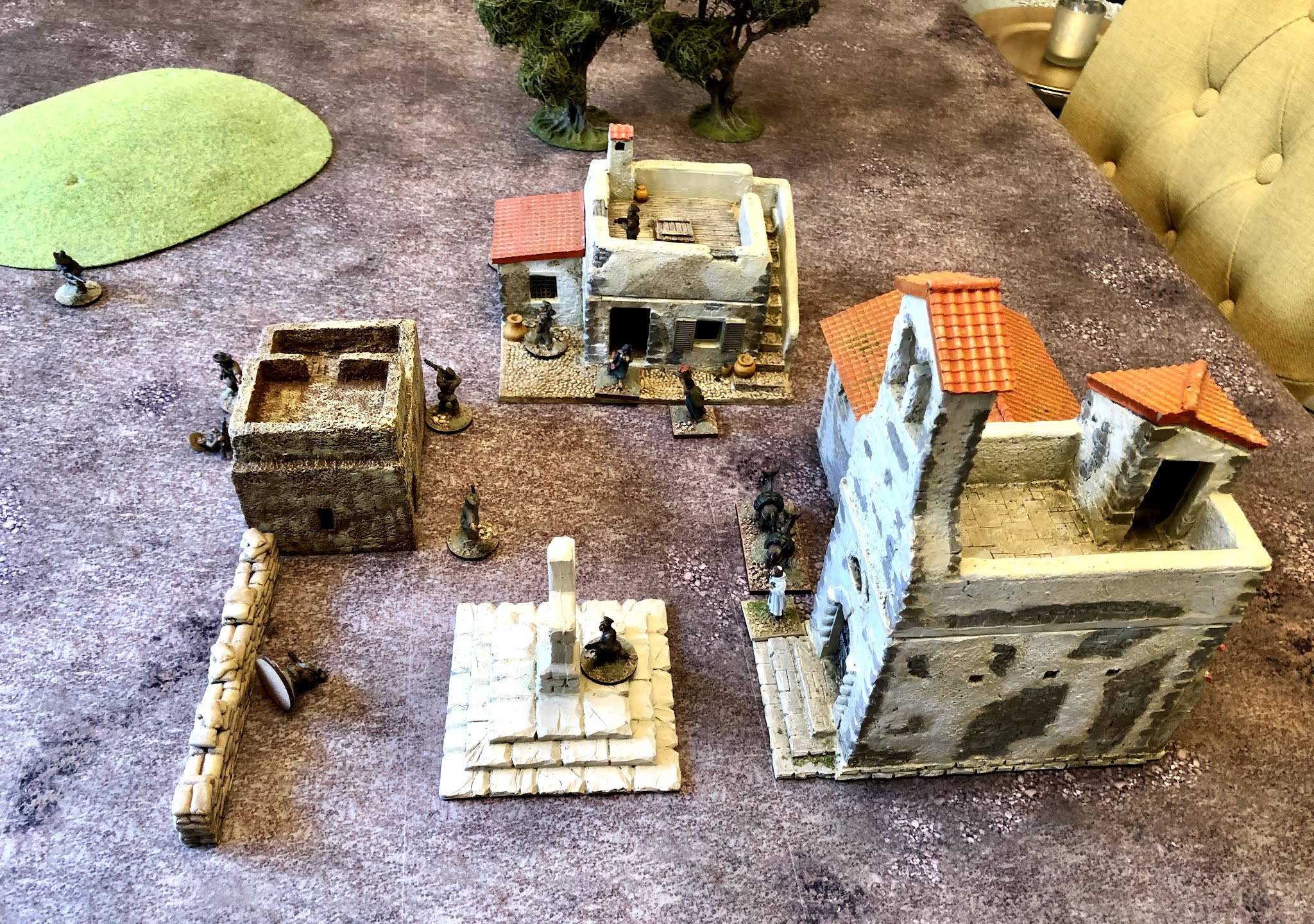
I also bought the Mexican Revolution supplement, which was an opportunity to dust down my 28mm figures for the period. The first game involved Pancho Villa attacking a village held by the Federales.


In the second game, the Federales had created a gun position outside a church (is nothing sacred!). The Villaistas tried to pin them down before a characteristic mad cavalry charge. One round from the gun, and admittedly some impressive dice rolling and that came to nought.


For the final game, I shifted the period to the Greek-Turkish War of 1919-22. The Greeks held a bridge which had to be taken by the Turks.


I also bought the Horse & Musket set of the rules and will give that a go over the holidays.

My first impression is very favourable. There are plenty of times when I fancy a quick game, particularly using figures that don't get a regular outing. I will probably stick with Open Combat for the pre-gunpowder period, but these work well for the later periods.