This is the first of a trilogy of historical fiction books by Bob Low, based on the Scottish Borders. After his series on the Vikings and the Wars of Independence, not to mention the Romans, he has clearly got the bug for the Borders. The final book in the trilogy is already coming out this month. Bob is also a re-enactor and wargamer who used to play at my wargames club (GDWS) before he moved away.
Welcome to my blog!
or on Mastodon @balkandave@mastodon.scot, or Threads @davewatson1683
Sunday, 10 January 2021
A Dish of Spurs - The Border Reivers
Friday, 8 January 2021
Atatürk: The Rebirth of a Nation
On a visit before Christmas, my daughter took a rare interest in my bookshelves (she is a microbiologist). The question followed, 'do you have any books on Turkey?', with my response 'is the Pope a Catholic!' and a brief (well not too brief) tour of how my several thousand books are organised. The mystery was resolved on Christmas Day when one of my presents was Lord Kinross's classic biography of Kemal Atatürk. I had actually read it in the library many years ago but never owned a copy.
The founder of The Republic of Turkey was born in Greece, albeit Salonika when it was part of the Ottoman Empire. It was middle class upbringing, which despite some opposition from his mother, led to a military education and career. After service in the Middle East and the against Italy in Libya, he arrived back in Europe too late to fight in the First Balkan War, which saw the loss of his Macedonian home. This was a loss he felt deeply with his mother and sister having to flee the family home, "how could you surrender that beautiful Salonika to the enemy", he said to brother officers.
Mustafa Kemal, as he was known in the days before Turks adopted surnames, made his name in the Gallipoli campaign of WW1. As the British official historian puts it, "Seldom in history, can the exertions of a single divisional commander have exercised, on three separate occasions, so profound an influence not only on the course of a battle but, perhaps, on the fate of a campaign and even the destiny of a nation". As a modern visitor to the battlefield I could see the importance of the positions he held and also his gracious commentary.
He went on to command on the eastern fronts where his eventual successor as President, Ismet (later Inönü) was his chief of staff. Military comrades from this time would form an important group in supporting him later. He ended the war in Syria and also visited Germany, where he met Hindenburg and Ludendorff.
He actually sounded out the British for a role during the occupation of Constantinople. Then broke with the rump Ottoman government by going to Ankara with others to form the Grand National Assembly and after a short civil war, the resistance to the division of Anatolia by the wartime Allies. His command during the Greek-Turkish War of 1919-23 is given a relatively short treatment in this book, although the outline of the extended Greek advance and Turkish counterattack is explained. If you want more on this, there is a very recent book worth reading.
The end of the Sultanate and the creation of the Republic of Turkey is explained in detail. The way the British sneaked the last Sultan out of Istanbul is an entertaining story that I hadn't recalled. The eunuchs came before the wives in the evacuation priorities, achieved in the back of an ambulance! Kemal was elected the first President of the Republic, which was based in Ankara rather than Istanbul. The rest of the book deals primarily with his internal reforms and the treaties that secured the boundaries of the new state. Military matters are not entirely absent, as there were a number of revolts, primarily in the Kurdish areas.
Ataturk (Father of the Nation) as he became known in 1935, showed extraordinary insight into world affairs in the 1930s. Despite significant pro-German sympathies amongst the Turkish leadership, he described Hitler as a 'tin-peddler' and expressed his horror at his language and thoughts. He promoted counterweights to Italian and German imperialism through the creation of the Balkan Pact in 1934. This was followed by the Saadabad Pact with the countries on the eastern border. In discussion with General Douglas MacArthur, he predicted the outbreak of war between 1940-45, the German advances and defeat once the USA entered the war. But the real victors he predicted would be the Soviet Union. I had read this before but didn't know he also compared the Maginot Line to a tomb that anyone could go around the edge of it.
I enjoyed this traditional biography and learned some new details about his life and times. My one criticism would be the way the author ascribes almost mystical characteristics to Ataturk, the 'extra dimension' as he puts it. There is no doubt that Ataturk was a remarkable leader, certainly in military terms if perhaps less so politically. But his character and physical bearing is possibly given too much weight, and modern readers might find this approach a bit grating at times.
That said, it's well worth a read, and thanks to my daughter for the addition to my library. Her mother was less impressed by her adding to it!
It also inspired me to get on with some related painting in the form of another squad of 28mm WW2 Turkish infantry. These are converted from the Crusader Miniatures French Dragon Portes. Better equipped Turkish regiments had French style helmets and a similar tunic. These are sans the greatcoat that so many French wargame figures have, so work well for my purpose. They are also very nice models, which I have painted in the winter uniform, unlike my 15mm armies in the summer kit. More to come from this range.
Tuesday, 5 January 2021
Poland against Sweden 1626-29
I have been reading Michael Paradowski's new book, Despite Destruction, Misery and Privations: The Polish Army in Prussia During the War against Sweden 1626-1629, in the excellent Helion Century of the Soldier series. Bizarrely, this was the conflict that got me interested in the Renaissance period when I was given Michael Roberts two-volume, Gustavus Adolphus: A History of Sweden 1611-1632. George Gush's groundbreaking book and rules followed quickly on.
When Gustavus Adolphus is mentioned, we immediately think of the Thirty Years War. However, his earlier conflict with Poland was where he refined the tactics and organisation that was to have such a major impact on the titanic struggle that was the Thirty Years War. Peter Wilson's book is the recent one to read for that. Sweden during this period included modern-day Finland and much of the Baltic States. After the decisive victory at Walmozja in 1626, Gustavus landed an army in Prussia, starting a war that lasted for three years before Imperial intervention delivered a truce, still largely to Sweden's advantage. It was a conflict involving modest armies with many small scale actions rather than big set-piece battles. This makes it very gameable on the tabletop.
The focus of this book is on the Polish army of the period. This was my first Renaissance army, although it has long gone. I now have the armies in 28mm and 15mm. Of course, the main attraction is the Winged Hussars, and a print of them stares down at me from my study wall.
However, there are many other interesting units, including cossacks, pancerni and the haiduk infantry with axe and musket. You can also pad out the army with mercenary western units including pike and shot, reiters etc. In fact, this was the period when the Poles turned to mercenary foot in increasing numbers, but they don't look as good on the tabletop and are less fun to paint!
The author explains in considerable detail how the army was recruited, commanded and organised. Then takes us through the different unit types. As with other books in the series, it is profusely illustrated, including colour plates by Sergey Shamenkov.
If you want more on the Swedish army of the period the series has a volume on them, The Lion from the North. The title references the Thirty Years War but starts in 1618. I was lucky enough to visit the Stockholm Army Museum and Royal Armoury just before lockdown last year, which is the museum for this subject.
Unsurprisingly, this reading led to this week's Zoom game. We played a typical small skirmish using Pikeman's Lament rules in 15mm.
It was a big win for the Poles on this occasion. Done and dusted in an hour and a bit.
Friday, 1 January 2021
Here's to a better 2021!
Happy New Year! Well, 2020 was certainly different. Precious little face to face gaming and no shows for me after York in February. We adapted with games over Zoom and other online offerings, but it hasn't been the same. The only plus side is that more figures got painted, books got read and the hobby seems in decent shape with folk rediscovering gaming in all its formats. Zoom games also allowed me to play with people on different continents, which was enjoyable.
On the painting front, I almost got to the bottom of the lead/plastic mountain, had I not got drawn into new projects, of which there have been many! I have largely finished the Turkish Army of WW2 in 15mm and made a start on the 28mm version. The big 15mm project was the War of 1812, albeit a couple of years after visiting the battlefields. In the smaller scales, I finished the India-Pakistan wars in 1/285th scale using GHQ models. I dabbled with fantasy, inspired by Oathmark and built a decent sized dwarf army, which can be used against my many Dark Ages armies under these rules. It also got me painting more figures from the Conan game, including the barbarians.
Earlier in the year, I finished off several projects including the 28mm Soviets (with some Romanians) and the Hungarians for Bolt Action Fortress Budapest. Another project stimulated by an overseas trip was the Zulu and Boer wars, this time in 10mm, to which I have added Afghans as additional opponents. I also managed some smaller 28mm projects with more Saxons, including Alfred and Aethelflaed, Viking shield maidens, Venetians for the Cretan War, Russ Druzhina and infantry, and 1848 Hungarians. I also added to the 20mm moderns with eastern European militias and Brits. I am a rubbish sailor, but that hasn't stopped me adding Ottoman ships to my Black Seas fleets.
For the new year, I am adding more Mongols to field at least a Saga force. My Netflix viewing includes the epic Ertugrul series, so that needs to get onto the tabletop. These are some heavy cavalry I finished basing this morning. The models are from Gripping Beast.
Next up will be 28mm Turkish WW2 infantry and support weapons for Bolt Action. I am converting these from Crusader Miniatures, French Dragon Portes. Other than bits and pieces that's it from the lead mountain, but new rules, books and hopefully travel (remember that!) will no doubt stimulate new projects.
On rules, playing over Zoom has meant keeping it simple. I have rediscovered Saga through the Age of Hannibal supplement, and for bigger games To the Strongest! remains my main ruleset. I got around to writing the Medieval Balkan army lists this year, which are now published in a nice looking booklet. Lion Rampant works very well over Zoom, and the new book on the Crusades may tempt me into new territory. Rebels and Patriots, also from Dan Mersey, has been a regular favourite, for 1848 and American wars. Sam Mustafa's games are always innovative, and I have played Rommel and Blucher a bit this year. I could well be tempted by the new edition of Lasalle.
For WW2 at the smaller scales, Blitzkrieg Commander is my go-to set, and I must dust down my Spanish Civil War armies to play the Libertad supplement. Cold War Commander is also due a new edition this year, which is just as well as my copy is past its best. In 28mm it remains Bolt Action, although I haven't played as many games this year as the number of units painted might justify. I have recently returned to Bloody Big Battles for the Greek-Turkish War and aim to play more games with this elegant rule set this year. Some wargame pals have got me interested in a Fistful of Lead, which is handy, along with Open Combat, for a quick game.
On the writing front, I have managed a record number of blog posts (134) this year, aiming at two a week. However, I only managed a couple of journal articles, and my book project could have moved a lot faster. I have just past 50,000 words, and I am filling in with research notes, thankfully done before lockdown. My semi-retirement has not freed up as much time as I had hoped for hobby writing. When I spend a day writing policy papers, painting and gaming is a more attractive evening activity.
Travel, or the lack of it, was the biggest downside of the year. I was fortunate to get to Sweden just before lockdown on a work trip, which may generate a project or two. I am giving some thought to trips in the early summer and beyond, and they almost always generate new projects.
Lockdown certainly increased my reading, and my to-read shelf is almost bare. I am currently working my way through a biography of Ataturk, and then it will be The Russo-Turkish War of 1768. At the same time, I have several WW2 tomes to work through as research for my own book.
So, that's it for 2020 and my plans for 2021. The biggest step forward would be getting back to the wargame clubs I play at, and other face to face gaming, not to mention shows. Our hobby is all said and done a sociable pastime, best enjoyed in good company.
Tuesday, 29 December 2020
Bloody Big Battles - 1st Inonu
I took a day off writing this week to play a game of Bloody Big Battles. An elegant ruleset that I should play more often allows battles to be fought on a grand tactical scale with 15mm figures. Having recently read Salvation and Catastrophe, a detailed study of the Greek-Turkish War 1919-23, I was keen to try that conflict on the tabletop. I was moved to action when the author of the Bloody Big Balkan Battles supplement for these rules (Konstantinos Travlos) kindly sent me a draft of a scenario he and his collaborator, Onur Buyuran, have written for the early stages of Battle of 1st Inonu.
The Greek-Turkish War 1919-23 attempted to expand the Greek state to include Greek populations in Anatolia, taking advantage of the Ottoman defeat in WW1. An army landed in the predominately Greek city of Smyrna (modern Izmir) and advanced towards the newly formed Turkish Grand National Assembly forces, led by Mustafa Kemal (later known as Ataturk). The Turks withdrew, causing the Greeks to extend and protect their lines of communication.
The scenario for this game deals with a reconnaissance in force by the Greeks to test the Turkish defences along the approaches from Bursa/Prusa towards Eski-Shehir on 28 December 1920 to 10 January 1921. I do like a centenary! The Greek force consisted of elements of two divisions, which were not ordered to occupy Eski-Shehir itself, instead the town of Inonu was the operational objective. The Turkish forces were commanded by Ismet Pasha (later to become the Turkish President and take this battle as his surname). The Turks had similar numbers of men but fewer machine guns and artillery.Complete victory for the Greeks by the end of move 8, who will be celebrating with the captured raki stores in Inonu tonight.
Saturday, 26 December 2020
To the Strongest! El Cid
With my daughter glued to her Nintendo Switch and my wife tackling a Chrismas jigsaw, I had control of the remote on Xmas Day. So, it was MacArthur, The Longest Day and finally El Cid. In my pre-multi channel TV childhood, this great film had a guaranteed slot on the holiday schedules. I even owned a VHS copy of it at one point.
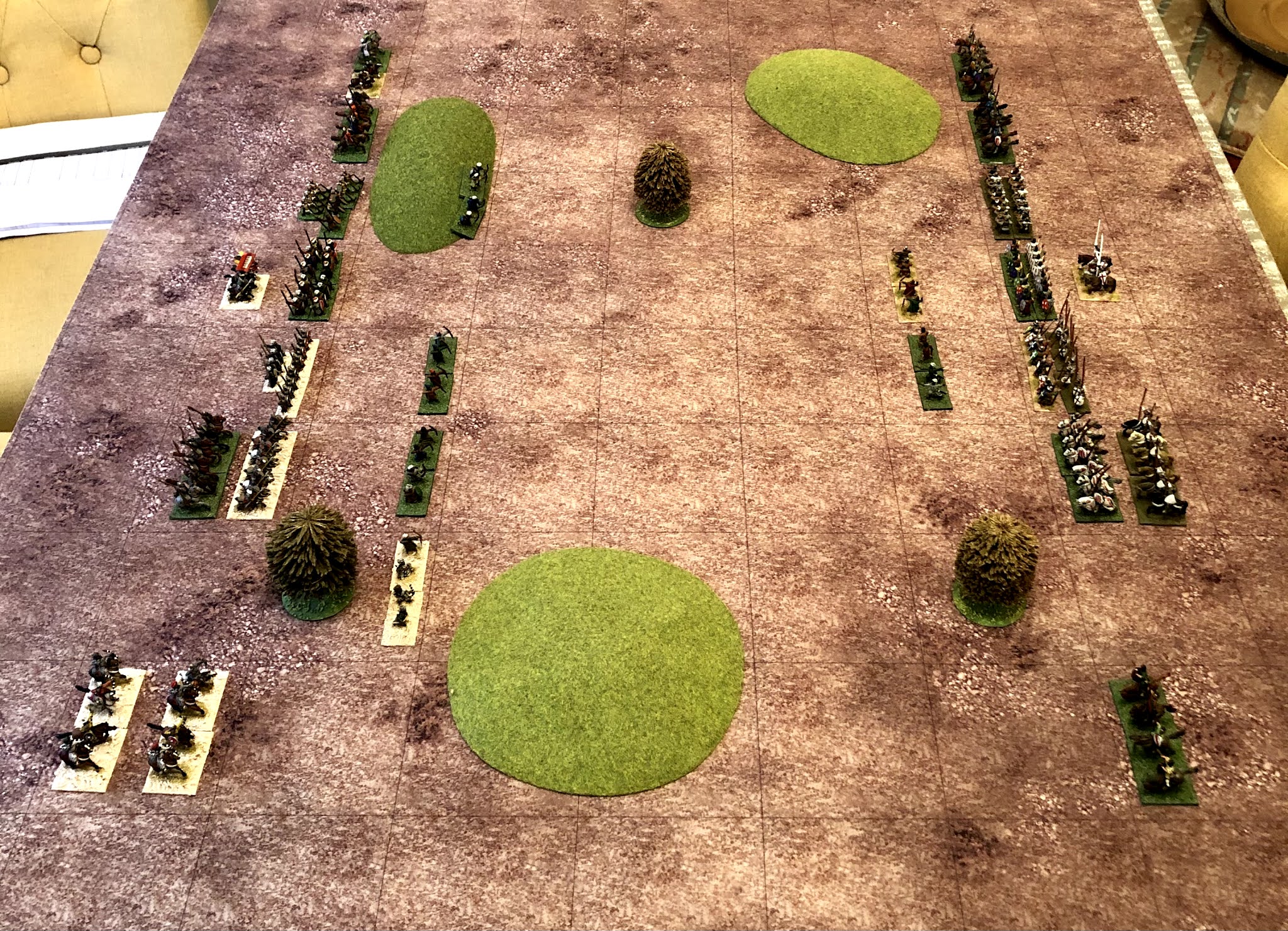
It guided another decision, which armies to field for a promised Boxing Day game of To the Strongest! with a friend who was stuck at home alone because of the pandemic measures. We decided on a small 80 point game, which works well over Zoom, not least because the cards are very visual and the squares avoid measuring. It also allowed me to go through the newly produced army lists. Simon has brought the large collection of army lists for these rules into two booklets, making it a lot easier to find what you want.
El Cid meant moving away from the lists I wrote in the Medieval Balkans section, to Feudal Spanish and Al Andalus.
The Moorish light infantry damaged the Spanish, but as ever it was the Spanish heavy cavalry that decided the day. Smashing through their lighter opponents, even when I managed to position them on a hill. Charlton will be returning to the arms of Sophia on this occasion!
Thursday, 24 December 2020
Syria: A Recent History
The war in Syria may have been largely missing from our TV screens, but the conflict's misery is very real for Syrians. In this book, John McHugo looks at Syria's history with a focus from the 20th century to the present-day conflict.
Shaam (or Greater Syria, as it used to be called) is divided between modern-day Syria, Lebanon, Israel, Palestine and Jordan, and includes part of southern Turkey. It literally means 'the land to the left' and points out that modern borders are artificial constructs drawn largely on a map in the 20th century.
After the Ottomans were defeated in 1918, the main colonial interest came from France who sought to spread their values through its self-appointed mission civilisatrice or 'civilising mission'. They engaged in the typical divide and rule policies of the colonial powers, promoting the varied ethnic and religious groups. Syria has a particularly diverse makeup. In 1914, 20% of the population was Christian, although they fought amongst themselves as much as their neighbours of the Muslim or Jewish faith. Similarly, the Muslim peoples were divided into the great schism between the Shias and Sunnis and the Alawis, Druze and the Kurds.
The French struggled to find the resources to police Syria and frequently resorted to repression when quashing revolts. The Maydan revolt in 1926 involved what may well have been the most intensive and systematic aerial bombardments against a civilian population that had taken place up to that time anywhere in the world, as their planes returned to bomb villages daily. Large numbers of colonial troops were often brought in from Algeria, Senegal and Madagascar and a significant role was also played by badly disciplined militias.
After WW2, the newly independent state of Syria and its offshoot in Lebanon got drawn into the Cold War. Syria and the West had different views of what constituted a threat to security. For America and Britain, security in the Middle East involved keeping the area free of Communism and Soviet influence. For Arabs, it was primarily about liberating themselves from foreign domination, defending themselves against Israel and restoring the Palestinians' rights.
In time the Ba’thist party elite took the place of the notables and, later still, neglected the poor who had now become dependent on them. They also found themselves forced to rely on quasi-tribal solidarity. That was the story of the Assads and the Alawi community. For most of this period, Syria was ruled by Hafez al-Assad. While the regime was corrupt and repressive, it also modernised Syria with education, piped water and reduced infant mortality.
He was followed by his son, Bashar al-Assad, who initially appeared to support democratic reforms but quickly resorted to his father's repressive ways. This led to the current civil war, in which Syria is once again the plaything of foreign interests (see Tom Cooper's book on the Russian military role). Regional actors have lined up behind sectarian ideologies, caring little for the suffering on the ground. Solutions often resort to the old Western disease of drawing pretty lines on maps and then expecting Greater Syria's peoples to step neatly into the zones marked with the particular colour chosen for them. Things do not work like that in practice. It was ultimately only possible to establish a predominantly Jewish state in Palestine by widespread population displacement, and the same would be required in Syria.
This book is a good overview of the recent history of Syria and the surrounding region. It isn't a cheerful read, but it helps us understand the context of the current conflict.
It also inspired me to dust down my Arab-Israeli armies in 10mm. Using Cold War Commander for a 1973 scenario. The Syrian army in 1973 performed better than expected, certainly much improved on its dismal 1967 showing. However, in this game, the two Israeli battlegroups managed to blast through the flanks and capture the objective with few casualties.
Tuesday, 22 December 2020
Fistful of Lead
My wargaming pals at the club have played a lot of the skirmish game, Fistful of Lead, during the various stages of lockdown that have halted our face to face gaming. So, I thought I would give it a go.
These are genuine skirmish games, typically played with six to eight models on each side. The core ruleset was developed from the Old West gunfight game, which is still available. The core set covers all periods, but there are supplements for a couple of periods, and there are Horse & Musket and Sci-Fi versions.
The basic mechanism is a card activated system using playing cards to determine which figure goes first. You can then take two actions, e.g. movement, shooting etc. Shooting and combat use a D10 with a few modifiers, and the outcome can cause shaken or wounded/down markers on the target, or sometimes an outright kill. Shaken and down markers can be recovered as an action. You can increase complexity by adding traits, which can add specialist skills or positive and negative traits.
The rules make no pretence at being a simulation. Instead, they provide a fast and fun game. They can be downloaded as PDF's rather than the cost and tribulations of getting the printed books from the USA.
I also bought the Mexican Revolution supplement, which was an opportunity to dust down my 28mm figures for the period. The first game involved Pancho Villa attacking a village held by the Federales.
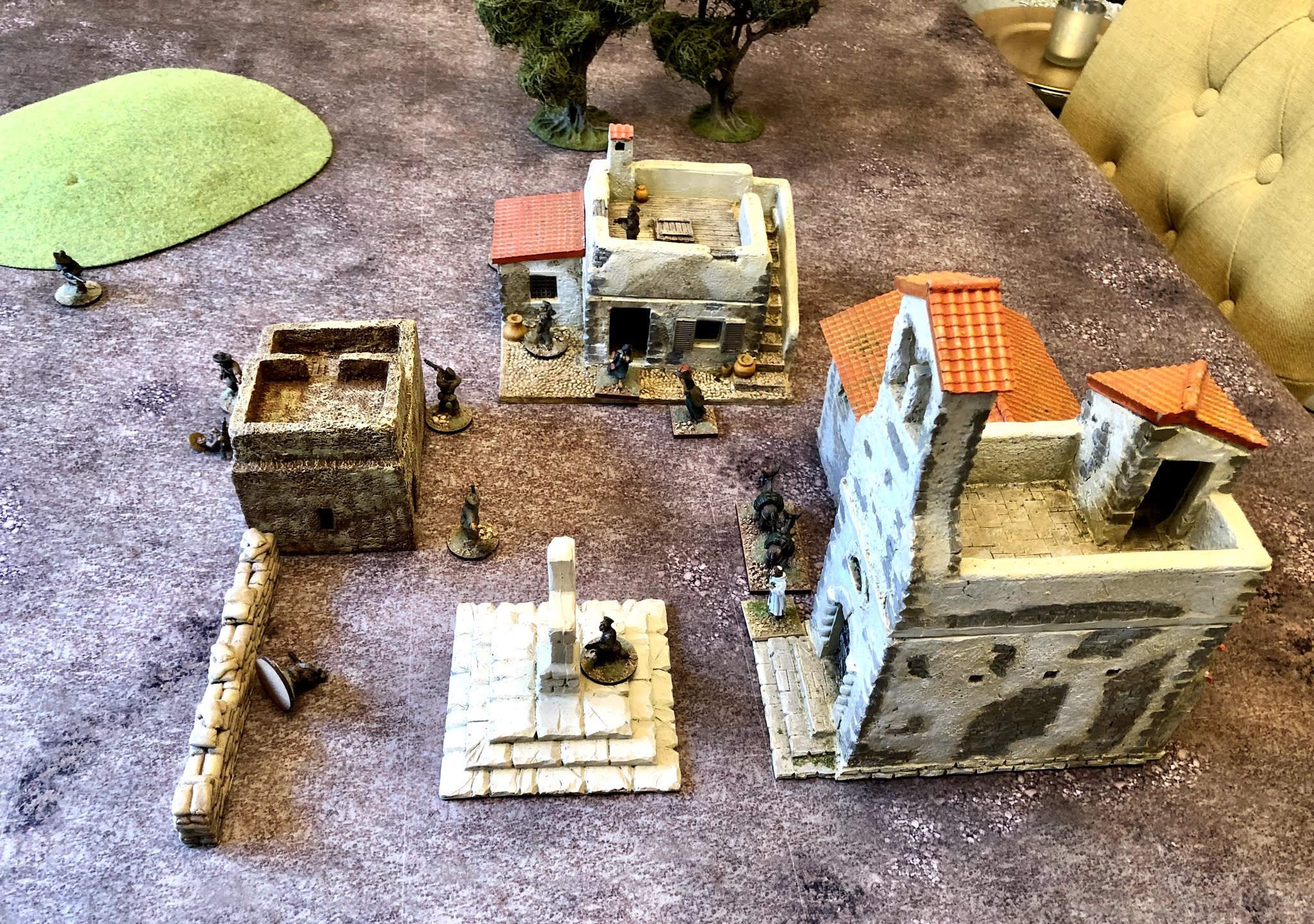
In the second game, the Federales had created a gun position outside a church (is nothing sacred!). The Villaistas tried to pin them down before a characteristic mad cavalry charge. One round from the gun, and admittedly some impressive dice rolling and that came to nought.
For the final game, I shifted the period to the Greek-Turkish War of 1919-22. The Greeks held a bridge which had to be taken by the Turks.
I also bought the Horse & Musket set of the rules and will give that a go over the holidays.
My first impression is very favourable. There are plenty of times when I fancy a quick game, particularly using figures that don't get a regular outing. I will probably stick with Open Combat for the pre-gunpowder period, but these work well for the later periods.
Saturday, 19 December 2020
Hereward - The Immortals
This is the latest in James Wilde's historical fiction series based on Hereward the Wake. We don't have good primary sources on Hereward's life, but he was part of the resistance to William the Conquerer's occupation of England after 1066. He was based in the fenland of the east of England around Ely.
After monks betrayed a route into Ely to the Normans, the revolt was defeated. It is not clear what happened to Hereward. He may have continued the guerilla struggle or made his peace with William. The alternative as proposed in this book is that he left England, like so many Anglo-Saxon lords, and found his way to Constantinople.
| Hereward and his merry band stand firm against the Normans |
Thursday, 17 December 2020
Zooming with Rommel in Thrace
This week's Zoom game used Sam Mustafa's Rommel to play an Operation Gertrud scenario. With German panzer divisions storming into Thrace, the Turkish army sends it armoured brigades forward while strengthening the Catalca lines, the last line of defence before Istanbul. At the bottom of the table, Gebirgsjager push through the hills while Turkish infantry fight a delaying action.
Sunday, 13 December 2020
Donovan's Devils
This is Albert Lulushi's history of OSS raids behind enemy lines in WW2 with a focus on the operational Groups Command in the Meditteranean theatre of operations.
The Office of Strategic Services was established before the USA entered WW2. Not without difficulty given the strength of the isolationist lobby. It was the brainchild of William Donovan, its founder and director and was the precursor of the modern-day CIA. Its job was not just to collect intelligence, it also organised operational groups (OGs), which operated behind enemy lines, typically with resistance groups. The British equivalent was SOE.
In the Mediterranean theatre, the focus was on Italy. Aided by the many Italian speaking Americans that OSS recruited. The book describes a wide range of operations in support of the Italian campaign. After the Italian armistice, they worked with the resistance groups operating behind the German lines.
My main interest was in the chapters covering operations in the Balkans. While this was primarily a British franchise, OSS again recruited many US immigrants from the region. Company C was created in fall 1943 with OGs destined for the Balkans, and the first for Yugoslavia arrived in October 1943. The island of Vis, off the Dalmatian coast, became their main base of operations. This was a major supply base for the Yugoslav partisans, and over two hundred Yugoslavian OGs became part of the Allied garrison on the island.
Later Yugoslavian operations included rescuing US airmen who bailed out after raids on Romania. Most of these landed in partisan areas and were quickly moved to the Adriatic coast and back to Italy. Operation Halyard rescued over 500 airmen from Chetnik controlled areas, particularly tricky as the Allies had switched support from them to the partisans. Another high profile mission rescued American nurses from Albania.
A Greek OG unit was formed in the summer of 1943, after an OSS recruiting team visited Camp Carson, Colorado, seeking personnel who spoke Greek. So many of the 122nd Infantry Battalion volunteered for duty that its commanding officer offered the entire battalion. A total of 18 officers and 172 enlisted men went through the OG training curriculum, and the first group of twenty-three landed by boat on the western coast of Greece on April 23, 1944. By the time the Greek OGs withdrew in November 1944, their accomplishments had included fourteen trains ambushed, fifteen bridges blown, sixty-one trucks destroyed, six miles of railroad lines blown, 349 confirmed enemy killed, and almost 1,800 estimated killed or wounded.
OSS recruited some interesting operatives. For example, the mission of convincing the Italian garrison in Sardinia to lay down their arms was entrusted to Lieutenant Colonel Serge Obolensky who was a former Russian prince and Czarist officer. The OSS also played an important role in bringing war criminals to justice after the war.
Some of the actual operations described in this book would not be out of place in historical fiction. They are told clearly using official record and other resources. Well worth a read.
| The WW2 landing strip on Vis is still visible today. |
| The runway apron is now used as a cricket pitch, and I even got a bowl! |
![]() |
| Partisan command stand in 28mm. |
Friday, 11 December 2020
Spies of the Balkans
Spy fiction is not my usual genre, but needless to say the title pulled me in. The setting is Salonika at the outbreak of WW2, always an interesting city, and like Istanbul was something of a nest of spies during this period.
Our hero is Costa Zannis, a senior police detective, although his unit operates a bit like Special Branch in the UK. In essence, he deals with politically sensitive crimes and keeps a watch on espionage. Greece in 1940 was regularly visited by very fit young Germans, who had an extraordinary photographic interest in infrastructure and military facilities!
This was the period of the Metaxas dictatorship, so freedom of speech is very limited, although that falls to another agency. His personal life can be a bit complex and exotic. Not all the spies are German. His lover is a British spy and others operate in the city.
He is also an army reservist and spends a bit of time in a communications role after the Italian invasion.
He gets involved in an escape line for Jews from Germany. Salonika had a significant Jewish community in Ottoman times, welcomed there after they were expelled from Spain. He uses his contacts in Hungary, Yugoslavia and Bulgaria to facilitate the escape line. The British prevail on him to use it to get a British airman (who has knowledge of radar) from Paris to Salonika.
I won't spoil the finale, but it involves some new love interest as the panzers roll south.
This is a really good read and an interesting setting. Sadly, his other books don't appear to follow the story on. Modern day Thessalonika is well worth a visit, not least for its military museum.
![]() |
| My loved ones posing in front of the White Tower on the modern day Thessalonika seafront. |
![]() |
| Outside the military museum. |
![]() |
| And why not some 1940 Greek infantry in 28mm. |