Welcome to my blog!

News from a wargamer with a special interest in the military history of the Balkans. It mainly covers my current reading and wargaming projects. For more detail you can visit the web sites I edit - Balkan Military History and Glasgow & District Wargaming Society. Or follow me on Twitter @Balkan_Dave
or on Mastodon @balkandave@mastodon.scot, or Threads @davewatson1683

Wednesday, 17 February 2016

Blitzkrieg Commander

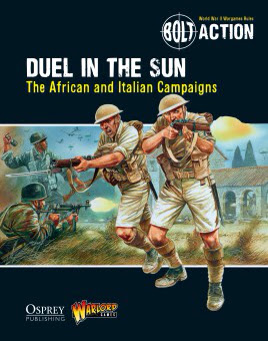
My blog on Warlord's 'Duel in the Sun', reminded me that I haven't dusted down my 10mm Western Desert armies for some while. I usually use Spearhead, but I have played a couple of games of 'Blitzkrieg Commander' in recent years. I had downloaded the very reasonably priced PDF set, but haven't really done much with them.

Blitzkrieg Commander can be played at different figure ratios, but a typical 2000 point army would give you a couple of tank units with infantry and artillery support. I used early war Italian and British battlegroups.

The focus is on the command mechanism, which is similar to Black Powder in that you have to roll below the command value to take an action, which can be movement or shooting. The difference is that you move or shoot once and then roll again at a minus one for eac successful action. You keep taking actions until you fail. At short range there is an initiative phase which allows you to take an action without a command role. It means that if you are lucky, you can take several actions a bound. However, just like Black Powder, you are just as likely to grind to a halt, just when you least want to.

The firing and close assault mechanisms are very straightforward with few modifiers. You very quickly remember these and even the QRF becomes redundant.

It does make for an interesting and entertaining game. A lot more random than Spearhead. There are no movement limitations, a mechanism I never really liked in Spearhead. I understood the reasoning for the rigidity of Spearhead's turn and move, but it never felt right.

On balance, while Blitzkrieg Commander is perhaps too random, the mechanisms provide for an entertaining game where you focus on the tactics, not the rules. The book includes all the army lists you are likely to need, another big plus. I suspect this will become my default set for 10mm tank battles.


Saturday, 13 February 2016

Agents of Empire

There has been a dearth of book reviews from me recently, largely because I have been working my way through Noel Malcolm’s latest work, ‘Agents of Empire’. Malcolm also wrote short histories of Bosnia and Kosovo, although the latter is controversial in pro-Serbian quarters.


This is a big book in every sense of the word. It covers mostly the Adriatic during the second half of the sixteenth century, although the actors play important roles in the wider Christian and Ottoman worlds of the period. Instead of a straightforward narrative, the author tells the story of two Venetian-Albanian families, the Brunis and the Brutis, who held such diverse roles as an archbishop, galley captain, advisor to the Voivod of Moldavia and a dragoman in Istanbul. They were often the go-betweens for the empires as traders, slavers, diplomats and spies. This gives a complex, yet fascinating insight into the period and the Balkans in particular.

The research has to have been monumental, drawing on archives from across the region in at least ten languages. Yet despite the detail and the length, it is still a very readable book. The author’s stint as a journalist shows through.

The big events of the period, such as the Battle of Lepanto and The Long War between the Habsburgs and Ottomans, are not ignored. Not least because the families played important roles. However, my own favourite were the chapters on Moldavia, the shifting power struggles and impact of raiding in this borderland. Tartars and Cossacks as well as the Polish and Ottoman states.


This book will take over your reading life for a period, but it’s worth the investment.


Sunday, 7 February 2016

Duel in the Sun

Duel in the Sun is the latest supplement for Warlord's popular WW1 platoon level game, Bolt Action. It covers the war in the Meditereanean from the Italian invasion of Greece to the allied assault on Italy.


The main section of the book covers the Western Desert campaign, one of my favourites, but not in 28mm. For me the desert war is about tanks, and they are best gamed in smaller scales - 1/200 being my personal preference. I bought this supplement primarily for the Greek campaigns, even though the army lists are in other supplements.

There is a decent scenario for the Battle of Tempe Gorge, an Anzac delaying action against the German 12th Army's juggernaut invasion of Greece. Also a scenario for Maleme Airfield on Crete during Operation Marita. There are some new unit descriptors, including the Maori battalion, with special rules as formidable warriors.

I doubt if I will be tempted into the desert in 28mm, although those LRDG vehicles look very nice and raiding warfare is very doable in 28mm. My Vis based Adriatic commando unit should work in Italy and some of the later scenarios look interesting.

As a break from my main Napoleonic project, I have painted a Warlord German 105mm howitzer. I haven't had much luck with the off table artillery in Bolt Action. I am more like to stonk my own troops rather than the enemy. So I decided to bring the big guns into the table.

One assembled this is a nice model, but not for the first time, I find the absence of instructions hugely irritating. The excuse that 'we are only a small firm', simply doesn't wash. If you charge £18 for a modest model like this, the least you can expect is a simple diagram. Pictures of the finished model on the website is of little use when they don't show the internal set up. Warlord really can and should do better than this. Rant over - for now!


Monday, 25 January 2016

Pancho Villa and the Mexican Revolution

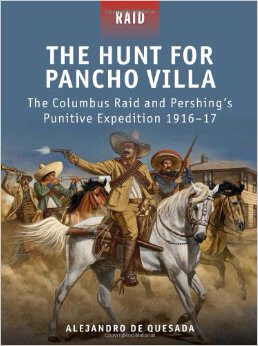
This year is the centenary of Pancho Villa's raid on Columbus, New Mexico, the last invasion of the USA by foreign troops. It sparked a punitive expedition by US troops led by General Pershing, with actions at Parral and a larger battle at Carrizal on June 21 1916. The American forces failed to capture Villa, but they did keep him out of trouble and gained some useful, if not exactly comparable, combat experience before they shipped out to Europe.
Osprey do the attack on Columbus and the consequences in their Raid series.
This title gives you a brief background to the raid, the action itself and the details of Pershing's expedition. Villa was a hero and military genius to some and a common criminal to others. The author's view is that he was somewhere between the two.
This action led me on to a more detailed look at the Mexican Revolution. Again Osprey provides the basics with their Elite series ' The Mexican Revolution 1910-20'.
The Mexican Revolution began as a movement of middle-class protest against the long-standing dictatorship of Porfirio Diaz (1876-1911). The first uprising was led by Francisco Madero who was elected President in October 1911. After that there is a complex series of rebellions and coups. There is a good summary by Alan Knoght at History Today.
Villa became a serious player in the conflict because his Division of the North was an effective military unit, at times closer to an army than a division. In 1914, allied with another faction, the Zapatista, he captured Mexico City. However, in the end the Constitutionalists, led by Alvaro Obregon, triumphed using modern tactics and equipment. Villa insisted on frontal cavalry charges against entrenched opposition, who by 1915 had learned the lessons of the Western Front. The raid on the USA was something of an afterthought, probably aimed at securing weapons and supplies. Villa accepted an honourable retirement in 1920, but was assassinated on Obregon's orders in July 1923.
The attractions of the period are colourful characters like Villa and Zapata and exotic troop types. Think westerns with machine guns, artillery, a few armoured vehicles and aircraft. My favourite is the tactic of loading a train with dynamite and percussion caps and sending it unmanned in a town to cause chaos before the attack. Railroads were absolutely key to the conflict.
For the US forces, Osprey also do 'The US Army 1890-1920' in the MAA series.
This does appeal to me - just a decision as to scale. Bolt Action in 28mm was my first thought, but perhaps a few more figures in 15mm.
Must finish those Napoleonics first though. Inspired by a very good weekend of gaming at our club's Open Day. We refought the Battle of Fuentes de Onoro in 28mm using Black Powder. Another option for the Mexican Revolution - Viva Villa!

Saturday, 16 January 2016

Viking Storm

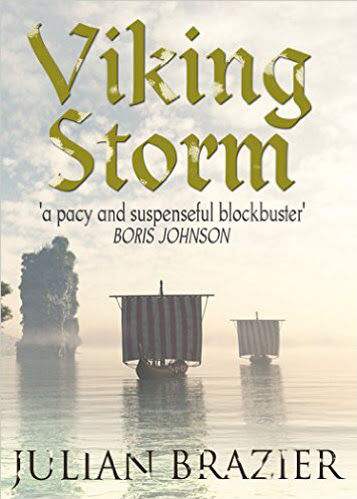
A new author for me is Julian Brazier who has written a new take on the Alfred the Great story in his novel Viking Storm.The story broadly follows the historical record, such that it is, with Viking armies conquering Northumbria, Mercia and East Anglia. Next is Wessex and the young king Alfred is betrayed by his own nobles then driven to the remote marshes in Somerset to regroup. He organises a comeback rallying the Fyrd and defeating the Vikings led by Guthrum. The cakes get burnt and all the usual elements are touched on.


The twist in this version is that Alfred finds unlikely allies in Constantinos, a Byzantine soldier and diplomat and his bodyguards who all find their own reasons to fight. These are professional cavalry in a war fought mostly by foot militia and they add a new dimension to the Saxon forces.


It's not easy to find a new take on such a well known story and the author does it well. The story rattles on at a good pace, with plenty of action and several sub plots. A good read.

Sunday, 10 January 2016

GoT - Lannister Pikemen

I have started to use my Game of Thrones armies for Lion Rampant as well as SAGA. This requires some additional troops for the standard 24pt army.

A box of Perry Miniatures, European Infantry 1450-1500 provides some 40 figures in a huge variety of combinations at outstanding value for money. The big downside of this variety is assembly, but Perry's are not bad and it didn't take that long.

The first unit up assembled and painted is a unit of pikemen. I settled for a simple one stage painting followed by army painter dip. This is quick and easy and produces a decent result.

You can pad out a Game of Thrones army with almost any medieval figure, either as feudal troops or sell swords. I did that at the club today. Tywin Lannister and his unit of knights performed miserably in both games, but the new pikemen held their own. Some crossbowmen next I think.


Saturday, 9 January 2016

Battle of Bataan 1942

One of those ‘on this day’ tweets reminded me that the siege of Bataan started at this time in World War Two. Over the holidays I had been sorting out some old pre-digital photo albums, including my trip to the Far-East in 1993.

The Battle of Bataan was fought between 7 January and 9 April 1942, after the Japanese invaded Luzon along with several islands in the Philippines. General Douglas MacArthur, consolidated all of his Luzon-based units on the Bataan Peninsula after the original beachhead defensive plan failed. By this time, the Japanese controlled nearly all of Southeast Asia and the Bataan peninsula and the island of Corregidor were the only remaining Allied strongholds in the region. Filipino and American forces engaged in a fighting retreat southward that ended on the fortress island of Corregidor on 9 April. The delay cost the Japanese valuable time and prohibited immediate victory across the Pacific.


While I was in the Far-East I visited the Philippines and the island of Corregidor, which has a museum and well preserved fortifications.


The top picture is Corregidor and the bottom the Bataan peninsular


War memorials


The Malinta Tunnel that goes under the rock at Corregidor and housed the army HQ, hospital and other services


Battery Way


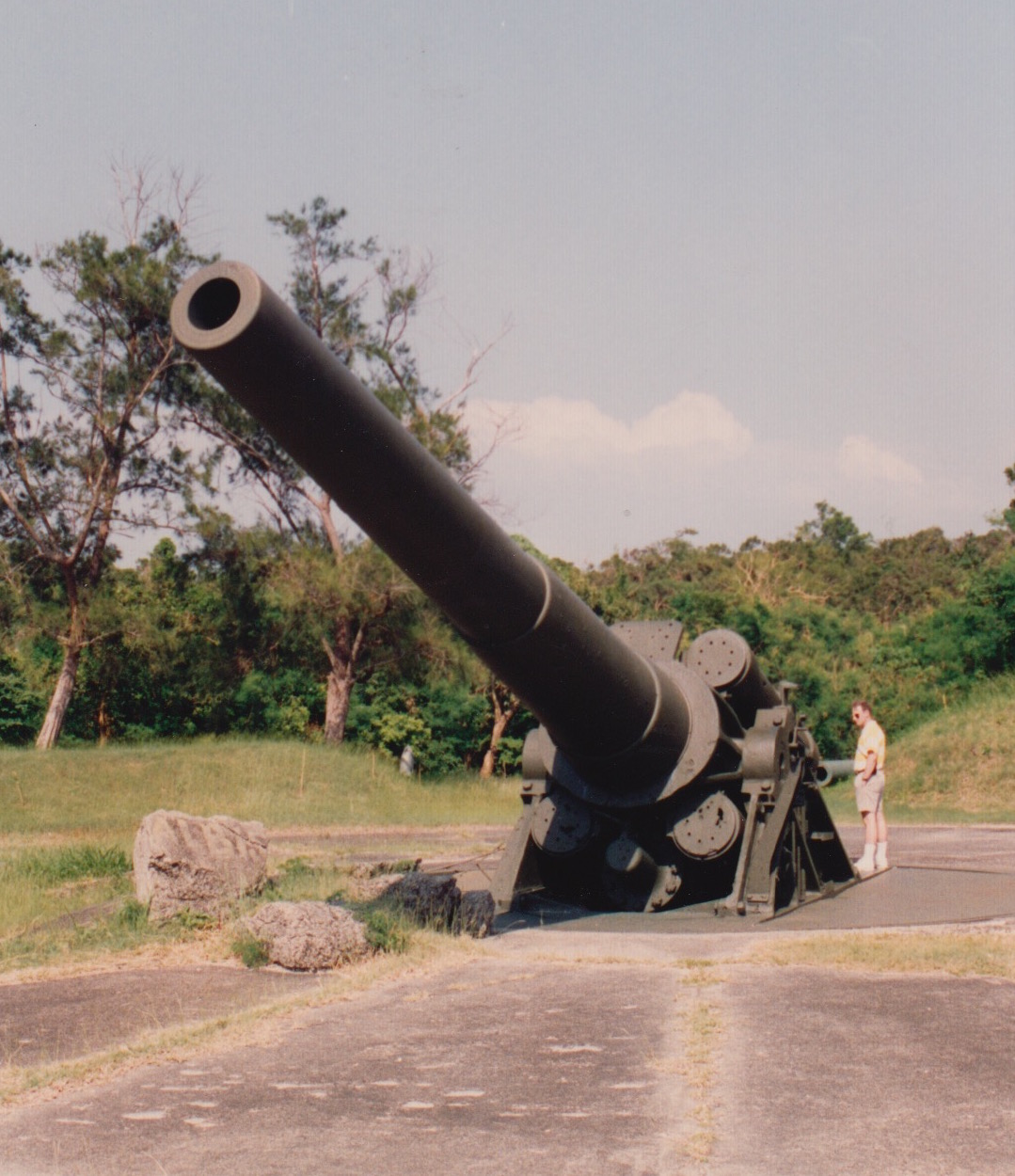
Battery Hearn. Its 12" WW1 era gun had the longest range  and engaged in counter battery fire right up the peninsular


Battery Crockett had two positions equipped with 12" cannon

No US or Filipino figures my collection, but I do have these 28mm Japanese.


Monday, 4 January 2016

One ridge, two bridges

Another fill in job completed on the early war Germans in 15mm with some more rifle teams. I was thinking about a Seelowe Nord scenario, when it occurred to me that my Nomonham 1939 Russians would also work for a Barbarossa scenario.

This month's Miniature Wargames offered a suitable scenario, based on an 1809 battle. The essence of the scenario is a ridge at one end of the table as an objective. However, half way across the table is a river with two crossing points. So the Russians have to decide how much of their force to commit at the river crossings and the Germans where to direct the Schwerpunkt. The game was played in 15mm using Flames of War rules.

The Russians decided on a forward Defence with an armoured reserve behind the wood and artillery on the ridge. The Germans dummied to the left crossing but put in the main effort on the right.

The Germans force their way across the river but lost a lot of armour. Must remember how light early war German tanks are!

Would never have got there without priority air support from the Stukas.

This is a good scenario for a range of periods. The Miniature Wargames article includes ancient, horse and musket as well as WW2. A good end to my holiday gaming - back to work tomorrow!


Friday, 1 January 2016

Looking forward (and back) in 2016

Happy New Year! The New Year is a time to look back, and more importantly, to look forward.

My blogging slipped a bit last year, but I still managed a post per week on average. Looking back on some of the rule sets I tested, not all have met the test of time, despite my original enthusiasm. However, I did complete my new projects for the year, covering Sheriffmuir 1715 and the Second Serbian uprising 1815.

I have also just completed the first stage of the rebuilding of the Balkan Military History website. After 18 years it needed a clear out and a new platform. It has a new home at www.balkanhistory.org and the old site will be an archive while I slowly work through the massive amount of content accumulated over the years. The new platform is much easier to update, so expect more news updates than the old monthly cycle.

My projects for this year are in the main some filling in. Expanding my Game of Thrones armies for Lion Rampant or Saga, in anticipation of the new TV series in April. More Bolt Action troops for Yugoslavia and some WW2 15mm fillers. The big job is French Allies in 28mm for the Peninsular War – Poles, Italians and Wild Geese. 

As usual I will take a look at centenaries for project inspiration. This year’s Balkan centenaries are interesting, but fortunately I have most of the armies already.

The last British troops evacuated Gallipoli on 9 January 1916. After the Brusilov offensive in June, Romania declared war against the Central Powers. Not a great success this one and I don’t know any figure manufacturer who does WW1 Romanians, so that may deter me. 

Mainstream WW1 interest will no doubt focus on the Somme (July) and Verdun (Feb) centenaries. It is also the 100th anniversary of the Mexican Revolution. Pancho Villa v Pershing could provide some interesting skirmish games. On a skirmish note, the Easter Rising could provide a challenge for the model-building specialists and I expect to see the Dublin Post Office on the show circuit this year.

Nothing much happened in 1816 as the world recovered from the Napoleonic Wars - although the Bombardment of Algiers, marked the beginning of the end for the Barbary pirates.

1716 brings a special Balkan centenary, with the 300th anniversary of the Battle of Petrovaradin on 5 August. I have done Prince Eugene’s famous victory on the Danube before and this will be an opportunity to dust down the armies and the fortress I built.


On 10 January 1616, Sir Thomas Roe presented credentials to the Mughal Emperor Jahangir - opening the door to the British presence in India. I feel an opportunity to dust down my Mughal armies here. 1616 was also when Cardinal Richelieu was appointed, turning France into a centralised state – although for wargamers an excuse for some Three Musketeer games!


The Ottomans and Persians were still at war in 1616 and there was a little known victory for the Safavids at Lake Gokce in Armenia. Not even sure of the date, but I have these armies in 28mm. The Uskok War 1615-18 was also continuing between Venice and the Habsburgs. After my summer visit to Senj, I must use this as an excuse to get my Uskoks onto the table.


A century earlier the Ottoman’s did somewhat better. In July 1515, Sultan Selim invaded Mameluk Syria and defeated them at the Battle of Yaunis Khan in October.

Medieval centenaries include the 5 July 1316 Battle of Manolada in the Peloponnese. This was an Angevin win for Louis of Burgundy over Ferdinand and the dreaded Catalan Company. Back in England a century earlier, the First Barons War was being waged. This included the little known French occupation of London and half of England by Louis VIII. King John’s death in November 1216 allowed William Marshall to recover the royal cause on behalf of Prince Henry. Richard Brooks, ‘The Knight Who Saved England’ is a good read on this conflict.

In July 1116, the Doge of Venice defeated Stephen II of Hungary who attempted to relieve Zadar and other towns in Dalmatia - bringing the Adriatic coast of modern Croatia under Venetian control for 700 years. This might inspire me to take a closer look at early Venetian armies.

In 1016 some of my favourite historical characters, the Norman mercenaries in Southern Italy made their appearance. They were hired by Melus of Bari to attack Byzantine-held Southern Italy. The books of John Julius Norwich are just brilliant on this subject.

Going right back into ancient times we have the Battle of Mardia in December 316AD. Constantine I defeated his rival Licinius and Valerius Valens near the town of Harmanli in modern day Bulgaria. 

However, the big anniversary for ancient gamers must be the Battle of Cannae. On August 2 216BC, Hannibal’s 40,000+ Carthaginian army defeats a Roman force of 70,000 led by consuls Paullus and Varro. This was the classic double envelopment, and in my view, the finest victory by the greatest general of all time.


So, plenty to pick from in 2016 centenaries. Not too much painting required for me – although Pancho Villa is very tempting and I have already ordered the Osprey’s!


P.S. On a positive note my football team, Fulham, has a new manager from the Balkans. By some coincidence Slavisa Jokanovic was born in Novi Sad, which is the city next to Petrovaradin. I hope that is a good omen for what's left of the season!

Wednesday, 30 December 2015

Brothers' Fury - Giles Kristian

My holiday fiction reading has been the second volume in Giles Kristian’s 'Bleeding Land' trilogy, Brothers’ Fury - set in the English Civil War.


The main characters come from the Rivers family. One brother, Mun, fights for the King and the other, Tom, for Parliament - mainly due to a feud with another local family. They also have a sister Bess who tries to find her brother and bring him back to the family.

The book mostly focuses on the small war, so typical of this conflict. Small units interdicting supplies, attacking columns of reinforcements and supporting or relieving sieges. In addition, we have subterfuge and plenty of internal feuds. The stories come together at different times as their respective units of horse almost clash. In Cornwellian style the book ends at at a major battle - in this case the first Battle of Newbury in 1643.


As other reviewers have said, this is on the grimmer, gorier, grittier side of historical fiction. The characters are certainly gritty, not really likeable, and certainly not in the heroic school of historical fiction. However, none of that makes this book any the less readable.

Many of the actions would make good skirmish wargames using rules like Donnybrook. I might dust down my ECW figures for a game before the holiday is over.


Monday, 28 December 2015

Somua S-35 in German service

Given the growing pile of metal (and plastic) on my painting table, my Christmas list was very restrained this year. However, one addition was some 28mm armoured support for my German WW2 units serving in the Balkans.

I thought I would start with a PKW III, however, the Warlord model is part of their link up with the kit maker Italeri. If you are a model kit builder this is fine, but they are not good wargame models. They are too fiddly and time consuming to build, and more importantly, simply not robust enough for the wargames table. The tracks in particular are not nearly strong enough, even if you manage to construct them.

My pre-Christmas trip down to my Mum's included a stop over in what is probably my idea of heaven - the book town of Hay on Wye. A castle, good pubs, and over 20 second hand bookshops. One of my many purchases was a MMP publication on the 'Prinz Eugen' Division. This superbly put together publication has masses of photographs of the division in action in the Balkans. What caught my eye was the extensive use of captured French armour. I was aware of the H38 and R35 being used, but not the much heavier Char B1. 17 of these heavy tanks went to the Balkans.

However, I settled on the Somua S-35, not least because the Warlord model is one of their much more robust resin models. Just a few parts that go together quickly, even the gun barrel has a half decent lug, one of my pet hates with poor tank model design.

German forces in the Balkans had 43 tanks of this type used by Panzer Battalion 202 and 212 as well as Special Purpose Armoured Company 12. They were known as Panzerkampfwagen Somua 35S(f) 739 in German service.

The S-35 was built between 1936 and 1940 for the French Cavalry Divisions. For its time it was a well designed tank, better than most of its opponents. The problem was a complex and expensive production methodology and poor strategic and tactical deployment. Around 440 were built. It had a 47mm main gun and MG, with a petrol engine that managed 25mph on roads and around 20mph cross country. I have seen originals at Saumur, Bovington and in the USA. A few in Bulgarian service survived in post-war police roles.

I painted this model Panzer Grey, added some German markings and dirtied it up with plenty of Balkan mud. A very decent model that does the job well.


Friday, 25 December 2015

Dragon Rampant

Having played Lion Rampant I decided to give the recently published fantasy version a go. Also an opportunity to dust down my box of fantasy figures.

The essence of the rules are the same, so I won't repeat my explantation of the game mechanics. The rules use the same basic unit structure and game mechanisms for movement, shooting and combat. Retinues become warbands.

In this version you get some additional units, including two sizes of war beasts for those big models. The big addition is a section called fantastical rules. Here you can add hate, terror etc and of course magic. You can pay for different types of spellcasters who can use a range of spells, the more powerful of which require higher dice throws to activate.

As with Lion Rampant, you get a number of scenarios and sample army lists. Although again you are encouraged to make up your own.

So, onto the tabletop. We have an Orc Warband with a Big Boss, an Orc Shaman with a few limited spells, and several units of warriors classed as Bellicose Foot. They all have Wild Charge, so that's what they do once in attack range.

Their opponents are Goblins led by a Daemon Prince, with a Shaman, wolf riders, archers and several units of spear armed warriors.

The Orcs rather predictably stormed across the table, scattering the Goblins whose shooting abilities caused some damage.

The Daemon Prince was left a bit isolated, but difficult to kill. The solution was to use a spell from the Orc Shaman that leaves units 'battered', fighting at reduced strength, and then attack with another unit. With the death of their leader that was game over for the Goblins.

As with Lion Rampant, the rules provide for a quick and enjoyable game. Unlike some fantasy rules the magic element isn't dominant, it provides a bit of longer range artillery and other benefits. You can use any figures in these rules you want and Warbands are limited only by your imagination.

I enjoyed these rules and will certainly use them again.


Tuesday, 22 December 2015

Lion Rampant

The holiday break is an opportunity to catch up on some outstanding projects, one of which is trying out the Lion Rampant rules. These are pretty popular at my club, even eclipsing SAGA at present.

Lion Rampant is published by Osprey and written by Daniel Mersey. They are a simple set of rules for the medieval period based around a retinue of typically around 50 models in six or so units of 6 or 12 figures, although you can do smaller and bigger actions. It's not quite skirmish, but it is part of trend towards smaller games that don't require a year's painting before you get a game on the table. A 6' by 4' table is standard.

Each retinue has a leader, who is important, but not a super hero. Try not to get him killed though, as the courage tests can be painful. The activation sequence starts with Leaders issuing challenges, rallying battered units and testing for wild charges by your Knights. However, the key is ordered activations that require different dice throws to move, shoot or attack. This is very clever as it reflects a units willingness do undertake different actions. For example, knights are difficult to get moving but easy to charge. If you fail an activation, your turn ends, a bit like Black Powder. This means you need to decide which activations are most important to your battle plan and have lower dice requirements, so the risk of failing is lower.

The shooting and combat mechanisms are very straightforward, based on the ability of the unit and the armour class to survive hits. You remove models and that weakens the unit's impact once you reach half strength. Losing figures is even more important in the courage (morale) tests that you have to take after losing casualties, because they get deducted from the dice roll.

The game is usually played to a number of scenarios, but you can make your own up. These are typically small action scenarios around raiding, convoys and collecting taxes.

There are a few sample army lists, but you are encouraged to write your own, with some limitations to stop super army design. There are eleven troop types, all typical Western European medieval types, but you can rename them for other parts of the world. These are adequate, but might need a bit of tweaking for units like Janissaries, who don't fit well.

So, onto the tabletop. My retinues, you will be surprised, are from the Balkans! Bosnians and Ottomans for this play test. The Ottomans are the attackers and made it across the table quickly (horses move 10/12" and foot 6/8"), while the Bosnians kept failing activations and largely hugged the baseline.

This helped the Ottomans who are strong in shooters and they peppered the Bosnians causing courage tests and consequential retreats.

The Bosnian Knights eventually got a wild charge in but were clevely lured onto rough ground that made them less effective. When they routed it was game over and mass conversions followed!

These are definitely my type of rules. Simple, easy to remember game mechanics, yet plenty of subtle game play. Recommended.


Tuesday, 15 December 2015

Strathclyde and the Anglo-Saxons in the Viking Age

Precious little wargaming or related reading recently, as work has taken over all waking hours. Roll on Xmas!

One book I have finished is Tim Clarkson's 'Strathclyde and the Anglo-Saxons in the Viking Age'. This has been on the reading shelf for some time and I picked it up knowing very little of the kingdom that that covered the area where I live today. I suspect my solitary knowledge was the partial chapter in the WAB Age of Arthur book and the stones at Govan Old Parish Church in Glasgow.


Strathclyde is the modern name for Strat Clud, indicating a kingdom based on the strath or lower valley of the River Clyde. They were also known as Cumbrians and their kingdom stretched from Glasgow down the Solway Firth and then on into modern day Cumbria.They were ethnically Britons or North Welsh, but as becomes clear in the book, we know very little about them. The limited sources almost all come from mentions in the annals of other nations.

The book covers the period from the middle of the 8th Century to the beginning of the 12th. From the capture of their original capital on Dumbarton Rock by the Vikings, until they were overrun by the Scots and the Scottish parts of Strathclyde became part of Scotland.

It covers conflicts with the Vikings, the Anglo Saxons and less frequently the Kingdom of Alba. They were probably present at the great battle of Brunanburgh in 937 when the Saxons defeated the Norse and their Scots and Strathclyde allies - even if no one is quite sure where the battle site is.

The other great battle was Carham in 1016 or 1018, between the English and the Scots. The English or more properly the Northumbrians, were probably commanded by Earl Uhtred of Bamburgh. Yes, that's Bebbenberg. For those watching 'The Last Kingdom' or reading the Bernard Cornwell books, a Uhtred did actually exist. He was obviously a renowned warrior and leader, but perhaps not quite as well travelled as Cornwell's character!

This book fills a gap in our understanding of a Kingdom that was an important part of Dark Ages Britain. I will look that bit more carefully at the stones on my next visit to Govan.

Monday, 23 November 2015

Warriors of the Storm

Yes, it's that time - a new Bernard Cornwell book. You just have to forget about doing anything else. Just put the kettle on, cup of tea, a comfy chair and read it from cover to cover.

This is the latest in the renamed 'The Last Kingdom' series to match the title of the new TV series. Our hero Uthred tackles a norse Jarl Ragnall Ivarson who attempts to conquer parts of England. Driven out of his previous territory in Ireland, this Jarl sails into the Mersey, which is held by Uhtred, and links up with Viking Northumbria. After beating off Ragnall, we have a diversion to Ireland where he rescues his Daughter, married to Ragnall's estranged brother Sigtryggr, and together their joint army lands in Cumbria. From there they capture York and make Sigtryggr King of Northumbria. The book ends as usual with a climatic battle at which Ragnall meets a well deserved end.

This book has just about everything. A solid plot, very loosely based on what little we know of the actual history, great characters, humour and of course action. Cornwall does battle scenes like no other author.

Nothing more to be said. Just read it!


Tuesday, 17 November 2015

Greece 1940-41

'The Defence and Fall of Greece 1940-41' by John Carr, primarily covers the Italian invasion of Greece that started in October 1940.

It plugs an important gap, in the English language at least, in the history of the Balkans in World War 2. Mario Cervi's excellent 'Hollow Legions' looks at the campaign from the Italian side, albeit critically. I used his work, together with the memoirs of British participants, in my own article on the campaign after I visited some of the battlefields and the museum at Kalpaki. This really is one battlefield you need to visit to understand what happened.

Mussolini's bungled campaign was far from the quick campaign he planned. Badly led Italian divisions ground to a halt against determined Greek resistance, in terrain that levelled the technical inferiority of the Greek forces. A Greek counterattack forced the Italians back into the Albanian mountains and a winter campaign that took a terrible toll on both armies. By the Spring, Hitler was forced to bale out his allies with a blitzkrieg in the Balkans that rolled up the exhausted Greek armed forces and their recently arrived British and Commonwealth allies.

The author has drawn heavily on Greek sources for this book, both from the diaries of front line soldiers as well as the war diaries of Prince Peter, who served on the General Staff and as liaison with the British. It covers the war on the ground as well as in the air and at sea. It is very well written, a real page turner. It could have done with more maps and illustrations, but that is a small criticism for what is an excellent history.

Reading the book inspired me to dust down my 15mm Flames of War armies for the campaign. On this occasion the Italians broke through.

Here is the battlefield with the Italians storming across a stream from the left.

Finally a link to my 25mm figures for the campaign. You can tell I'm really into this period!