Welcome to my blog!

News from a wargamer with a special interest in the military history of the Balkans. It mainly covers my current reading and wargaming projects. For more detail you can visit the web sites I edit - Balkan Military History and Glasgow & District Wargaming Society. Or follow me on Twitter @Balkan_Dave
or on Mastodon @balkandave@mastodon.scot, or Threads @davewatson1683

Thursday, 30 January 2025

Swiss Army of WW2.

 Last September, I reviewed Jim Ring's book, Hitler's War in the Alps, which started me down the rabbit hole of Switzerland and WW2. I have previous on this sort of wargaming distraction, not to mention a book on another neutral, Turkey.

The Swiss published a German invasion plan in 1933, but more needed to be done to modernise the Swiss Army and their defence plan. In 1938, in the aftermath of Anchluss, the Swiss declared that it was 'Switzerland's secular mission in Europe to guard the passage of the Alps in the interests of all.' 

General Guisan reorganised their defences and, in May 1940, mobilised 700,000 men, almost one in five of the Swiss population. He controversially decided to screen the border and fall back to the Alpine Redoubt. This meant abandoning the major cities, but the idea was more of a deterrence as the Axis would be blocked from the main communication routes like the Simplon Tunnel. The army was equipped to fight WW1, although the terrain and the size of the military would have made it a challenging prospect for the invaders.

On 12 August 1940, Captain von Menges revised his plan and submitted it to Halder. He allocated 11 divisions (150,000 men) for the attack, adjusting the Axis of the attack following a reconnaissance along the border. Operation Sea Lion and Operation Barbarossa put the plan on the back burner.

So, a modest wargaming 15mm project was born. The first challenge was figures, as the Swiss army wore a distinctive helmet. No manufacturer did it, although a scalpel to the Dutch helmet might work. Then I came across these 3D prints by Eskice Miniatures.  Postage from France was prohibitive, but I found a UK supplier, although his illness meant the delivery was delayed a long time. It's not a massive problem, as I am not short of projects! The prints are well-sculpted and relatively clean. They don't come with the bases in the sales picture, so use a strong super glue. We will see how robust they are after handling on the wargame table.

I went for the early war grey uniform and black helmet, as that was the period most likely for invasion. This Swiss militaria site was helpful, and a museum in Switzerland has a range of uniform types.


Equipment was less of a problem as the Swiss didn't have a massive armaments industry and bought it overseas. I found some support weapons in my spares box and got the German 20mm AA and a mountain howitzer from Butlers. The main light tank was the Panzer 39, manufactured in Czechoslovakia. It was similar to the Pkw 38t, close enough in 15mm. The air force had bought modern fighters, including the Me 109 and the MS 450.


That gives me eight infantry bases, with an HMG and mortar as support weapons, AA, light artillery, and a tank. That should be plenty for defending part of the Alps against German mountain troops using Blitzkrieg Commander rules. We will see!

Tuesday, 28 January 2025

Lord and Master - Master of Gray Trilogy

 The latest in my Nigel Tranter re-reading project is set during James VI's reign, although we have now moved into his adult reign. The story is told through the life of Patrick, Master of Gray, and this is the first of a trilogy. He obviously intrigued Tranter.

The book is narrated by Patrick's half-brother, David, who is portrayed as a very different character. I am unsure if Tranter made him up, as I can't find a reference to him, but he may have been missed as an illegitimate offspring. 

Patrick, Master of Gray (1559–1612), was a Scottish nobleman and politician who played a notable, though often controversial, role during the reign of James VI of Scotland. Known for his political cunning and shifting allegiances, Gray was deeply involved in the intrigues and power struggles that defined late 16th-century Scotland. He was born into the influential Gray family and became Master of Gray, a title that referred to the heir to the chief of the Gray family. 

Gray emerged after Mary’s forced abdication and subsequent imprisonment by Queen Elizabeth. Initially a supporter of Mary, his loyalties shifted as he sought to secure his position and favour with her son, James VI. He became an important courtier and diplomat during James VI's reign. 

Tranter adapts the history somewhat (this is fiction). For example, he went to Glasgow, not St Andrews University, which is important in later volumes. He was entrusted with missions abroad, including to England, and Tranter captures his duplicity well. His trips to France are interesting, as this is the French War of Religion period. Most infamously, he is believed to have betrayed Mary, Queen of Scots, during her imprisonment in England, which Tranter takes as fact. Gray, ostensibly sent to plead for Mary’s life in 1586, reportedly advised Elizabeth I to execute her, aligning his interests with those of James VI and Elizabeth. According to Tranter, this was his undoing when Patrick was declared a traitor and sentenced to death, only to be rescued by his half-brother's intervention. He was undoubtedly jailed and later banished from Scotland, but the Tranter version is a better read. Some of the Master of Gray's papers were published in 1835 and can be read here, but they are not easy to read.

Patrick was a politician and not a soldier, so this is not an action read. However, he offered to join Philip Sidney at Vlissingen (Flushing) in April 1586, fighting against the Spanish with 2,000 or more Scottish recruits. Something Tranter chooses to ignore. He does get into a few fights, although how anyone fought in that Tudor dress is beyond me! 

This volume ends with his banishment, but he will return.

Saturday, 25 January 2025

The Athenian Army 507-322 BC

 There have been many general studies of the armies of this period, but now the Athenian Army has a stand-alone Osprey by Nick Sekunda. Fortunately, there are surviving texts about ancient Athens and lots of archaeological evidence. However, as the author highlights, that doesn't mean there are no differences in interpretation.


The book starts with Cleisthenes's reforms in 507 and a new 'democratic' system of government. However, it was a limited form of democracy as Athenian society was a slave-owning society and economy. Consequently, its citizens could be released to perform military service without the economy collapsing. This was tested early on by the Persian Wars, including the battles of Marathon and Platea. 

This book's strength is in the army itself. It starts with the practically universal liability for military service, with registration from 17 and the oath-taking. Service was limited to the boundaries of Attica until age 20, an obligation that remained until age 50, then only within the borders again until 60. The citizen of sufficient wealth would serve as a hoplite, providing their own equipment accompanied by a psilos, which usually meant an attendant (often a slave) rather than a lightly armed combatant. 

The evidence for Athenian cavalry is limited, but they appeared to be recruited from the wealthier citizens. They originally numbered no more than 300, although this was expanded to 1,000 during Pericles's reforms. They provided their own horses and equipment but were paid a fodder allowance and a grant to replace horses lost on campaigns. There was also a 200-strong unit of horse archers.

At the start of the Peloponnesian War, the Athenian army's strength was 13,000 citizen hoplites of military age with 16,000 ephēboi (old and young), limited to home service. There were 1,200 cavalry, including the 200 horse-archers and 1,600 foot-archers. The Athenian fleet was one of its strongest assets, with 300 seaworthy triremes. The triremes would have required over 50,000 oarsmen if fully manned, which meant the Athenians depended on foreigners to crew their navy. The fighting troops on board included hoplites, archers and peltasts.

The organisation and equipment did not change hugely during this period. However, the author shows how it evolved in response to losses, economic pressures and the different campaigns. For example, at the end of this period, wealthier citizens would donate equipment to allow poorer citizens to fight. The hoplite shield was particularly expensive. 

As you would expect in an Osprey, there are excellent colour plates and other illustrations for all the troop types. These are situated close to the relevant text in the Elite series, which I prefer, although it takes a bit of getting used to. 

Some of my 28mm Athenian hoplites.


Wednesday, 15 January 2025

Fighters over the Aegean

 The Dodecanese campaign has been the subject of many books, but they tend to focus on the land and naval aspects. The air war is often brushed over with the comment that attempting to hold islands without adequate cover was folly. It was, but that doesn't mean there wasn't an air warfare component. Brian Cull examines the air war across the Aegean in the second half of the war.

The region saw intense aerial engagements between the Allies and Axis forces. These operations were characterised by bombing raids, naval support missions, reconnaissance, and dogfights over islands, the sea, and mainland targets. 

After the failure of the Dodecanese campaign, The RAF and USAAF conducted bombing raids targeting German airfields, supply depots, and shipping lanes to weaken the Axis hold in the region. Long-range aircraft, such as B-24 Liberators and B-25 Mitchells, operated from air bases in Egypt, Cyprus, and later southern Italy. Fighter cover, including Spitfires, Beaufighters, and Hurricanes, was crucial in protecting bombers and supporting ground troops during operations. 

German air superiority during the early part of the campaign was mainly due to the proximity of their airbases and the rapid response of their forces. They utilised a variety of aircraft, including Messerschmitt Bf 109s, and the Stuka still had a role to play in this theatre. The Arado seaplane is another aircraft that came into its own here, and the Ju-52 transport workhorse of the Luftwaffe was crucial in supplying the islands. The Allies eventually achieved air and naval superiority in the Aegean, but the campaign demonstrated the challenges of coordinating joint operations in a geographically complex area.

The author works his way through the various phases, starting with Churchill's obsession, or as Brooke put it, 'He has worked himself into a frenzy of excitement about the Greek islands. He refuses to listen to any arguments or to see the dangers. The whole thing is sheer madness.' The Beaufighter doesn't get many plaudits, but in this region, its range and versatility made it a useful aircraft. They devastated German naval supply craft, forcing the Luftwaffe to fly in Ju-52s at night. Quite a few interned in Turkey, who kept the planes and returned the crews. Several squadrons were based in Cyprus, another WW2 base rarely mentioned, and more were in the Libyan airfields.

252 Squadron Beaufighter (Martin Čížek)

Once Operation Dragoon had finished, seven small carriers were redeployed to the Aegean, unleashing Seafires, Hellcats, and Wildcats on targets in the islands and mainland Greece. The author also outlines Luftwaffe operations, and there is an interesting chapter on the challenges they faced in reconnaissance operations. Radar coverage and RAF night fighters were crucial in protecting the various deception operations prepared across the Middle East.

I am not a huge fan of air warfare books from a readability perspective. Planes take off, shoot down the enemy, and return, which can be tedious. However, the author breaks up this narrative with lots of first-hand accounts. The rarely covered aircraft types are a big plus as well. This book is currently on special offer at the Naval and Military Press. For £3.99, you can't go far wrong.

I definitely need some Beaufighters and Arados for my Blood Red Skies games.


Wednesday, 8 January 2025

Cypria: A Journey into the Heart of the Mediterranean

 Books on Cyprus written by Greek or Turkish Cypriots are rarely objective. I have a collection of them, often including pages of text in capitals where the author literally shouts at the reader. Frequently illustrated with pictures of atrocities - only those committed by the other side, of course. Alex Christofi, while a Greek Cypriot, has written something close to an objective history of Cyprus. While it is a personal journey of discovery, it's not just a travelogue.


He starts in modern Nicosia (Lefkosia/Lefkoşa), crossing the border at Ledra Street. There is an illustrative story of what will come when he visits the old caravanserai on the Turkish side. This is where Greek and Turkish Cypriots have met every Saturday since the crossing opened almost 20 years ago to enjoy each other’s company. When a new UN special representative was appointed in 2022, he came to the Büyük Han Coffee Club to say hi, and the group gave him a toy donkey to remind him that in Cyprus, what you need most is patience.


Most books on Cyprus's history rush quickly to the 19th century. However, Christofi lingers in the earlier periods. The island was not only strategically important even then, but it was also an innovator, the first to learn the secret of smelting iron. Alexander carried a Cypriot sword into battle. The island had Indigenous peoples, Greek, and Phonecian colonists. The Jewish Revolt against the Romans was fought in Cyprus in the Kitos War between 115 and 117 CE. Cyprus was an important centre of early Christianity and a base for Islam when the island was conquered in 649. For three centuries, they shared power with the Byzantines and divided taxes. This is all the more remarkable as they were at war for most of this period.

For those into culinary matters, I hadn't realised Cyprus's role in bringing cauliflower, sugar and halloumi (hellim) cheese to our tables. The sugar-plantation complex was first conceived in Cyprus, making it the main sugar producer for Europe for two centuries.

The strength of this book is its exploration of the pre-modern history of the island. I covered Richard the Lionheart in a recent post and the Venetian and Ottoman periods. As an example of objective history, the author dismisses Spyridakis' assertion that ‘under the Turkish domination no important cultural achievements were made’, saying 'that is not only untrue but it fails to appreciate the unique blend of cultures that I find is most special about Cyprus.' The story of the US and British robbery of historical artefacts from the island makes Lord Elgin look positively progressive! 100 museums worldwide harbour Cypriot antiquities.

Objectivity becomes more challenging in the modern period. For someone of his heritage, I think the author steers a reasonable course through this. For example, he doesn't avoid the genocidal statements made by Makarios, acted upon by Grivas and Sampson. One detail he gets wrong is that "Turkey’s military codename for the invasion, Operation Attila, makes it hard to avoid the implication of invading and sacking Greek villages." It is a common mistake, but Attila is the name the Turkish armed forces gave to the eventual demarcation line; the operation was called 'Victory' or 'The Peace Operation'.

This is an entertaining and well-researched history of the island. Illustrated by good stories from his own family and others. 

Richard the Lionheart v Isaac Komnenos. Unmistakably a game of To the Strongest!

Sunday, 5 January 2025

The Empress and the English Doctor

 My library pick last month was Lucy Ward's book, The Empress and the English Doctor. While not my usual military history fare, Catherine is a key player in my current writing project.


Thomas Dimsdale was a physician from Hertfordshire, England, known for his expertise in smallpox inoculation. He had published a book, The Present Method of Inoculating for Smallpox (1767), which attracted Catherine's attention. She invited him to Russia to perform the procedure.

Dimsdale arrived in St. Petersburg in 1768 and faced significant challenges. Inoculating a monarch and the heir to the throne was a high-stakes endeavour. Failure could result in political or personal ruin or worse, and the consequences for Russia could have been incalculable. Catherine put her Royal Yacht on standby to whisk Dimsdale and his son away if it went wrong.

To ensure success, Catherine underwent a preparatory regimen to optimise her health. The inoculation was conducted in secrecy to avoid public panic or political fallout. It was successful, and Catherine recovered without complications. She even ordered her court to follow suit, popularising the practice among the Russian nobility. She went on to institute other much-needed medical reforms.

While British kings had inoculated their children, Catherine was the only reigning monarch to undergo the procedure - an act of courage that has since been all but forgotten. The methodology was not the refined modern vaccination but simply inserted a small amount of infected matter into pierced skin. This conveyed a mild case of the illness and a lifetime immunity. The idea made its way into Europe from Turkey, where elderly women delivered the jab with a blunt needle. 

This is topical, given the anti-vaxers in our own age, and was even more controversial in the 18th century. Reading this book, my admiration for Catherine went up a notch. It took some nerve to do this, given the religious and political views of the period. Even in Britain, where the beneficial results were clear, churchmen claimed it interfered with the divine plan, "God sent the disease either for the trial of our faith or for the punishment of our sins." Other objections were as remarkably ill-informed as the conspiracy theorists of the 21st century.

A fascinating story, well-researched and told.

Cartoon showing Edward Jenner, Thomas Dimsdale and George Rose seeing off opponents of vaccination.


Wednesday, 1 January 2025

Richard the Lionheart and Cyprus

 My current bedtime reading is Cypria, a history of Cyprus by Alex Christofi. It reminded me of a little-known excursion Richard the Lionheart made to Cyprus on his way to Acre and the Third Crusade. 

The Third Crusade (1189–1192) was launched to recapture Jerusalem, which had fallen to Saladin in 1187. Richard I and Philip II of France journeyed to the Holy Land by sea. Richard had already stopped off in Sicily and dabbled in the local politics there before sailing for Acre with a fleet of 150 ships and 53 galleys. 

In April 1191, Richard’s fleet encountered a storm near Cyprus. Several ships, including one carrying his fiancée, Berengaria of Navarre, and his sister, Joan of England, were blown off course and landed on the island. Cyprus was controlled by Isaac Komnenos, a Byzantine nobleman who had declared himself Emperor of the island. Isaac seized the opportunity to capture some shipwrecked Crusaders and their supplies. Richard unsurprisingly decided to intervene and landed at Limassol on May 6, 1191. He viewed the island as a helpful resource and a strategic base for the Crusade. The English chronicler Benedict of Peterborough says, "Then in great wrath, he sent messengers to the Emperor of Cyprus, once, twice, and yet a third time, making his request with mild entreaty, that his fellow pilgrims, whom the Emperor was keeping in durance, should be restored to him together with their belongings. To whom the Emperor made answer with proud words, refusing to surrender either the prisoners or their belongings, and saying that he had no fear of the king of England or of his threats." 

Limassol Castle today

The concept of Richard making a 'mild entreaty' is unlikely! Richard's forces quickly overwhelmed the defenders at Limassol in a contested amphibious landing. Many of the local nobility and merchants, dissatisfied with Isaac's oppressive rule, submitted to Richard, bolstering his position. Isaac initially conceded defeat and even promised to join the Crusade. However, he then retreated into the interior, hoping to rally resistance. Richard sailed around to the north of the island, leaving Guy of Lusignan in command of the army to pursue Issac. It is unclear how many actions were fought, but the evidence points to at least one significant battle, and Richard did capture the main castles. This included St Hilarion Castle, which was no mean feat. Just climbing to the top was enough for me.


Isaac eventually surrendered after being promised lenient treatment. Richard honoured his word but added a twist: Isaac was imprisoned in silver chains, as he had requested not to be shackled in iron. Richard sold the island to the Knights Templar later in 1191, who then resold it to Guy of Lusignan, the deposed King of Jerusalem, establishing the Kingdom of Cyprus. A vital stronghold for Christian powers in the Eastern Mediterranean for centuries.

This story formed the basis for our midweek game of To the Strongest in 15mm. The Crusader army lists work fine for Richard's forces. We used the later Byzantine Komenean list for Issac. The chroniclers mention men at arms and Turcoples, but there must have been local spearmen.


The battle initially went well for Richard, who seized the high ground in the centre and made good progress on the left wing.


However, the Byzantines rallied and, with some impressive shooting on the right, managed to win the game with one victory point left.


A good, close game and an interesting bit of history.


Happy New Year!

A Happy New Year to everyone! The weather has somewhat curtailed Hogmanay celebrations in Scotland, but a dram or two were still raised. My wife is suffering from the lurgy, and while I have largely recovered, my left ear is still blocked, making hearing challenging. Not always a bad thing 😉.

2024 was productive on the writing front. Two books were published, and two were written and are with the publisher, making six since I semi-retired. 


I have a couple of books planned for writing this year, with one just underway. This is irritating the cat, who has to manoeuvre his way past a large pile that constitutes the first research scan from my bookshelves. 


I also averaged two blog posts a week and kept the website updated. I wrote a few articles for journals and was very chuffed to receive the prize for the best overall article in Slingshot for my piece on the Young Alexander. I reviewed 60 books last year. My reading pile is relatively modest, although that is unlikely to last, with book tokens burning a hole in my wallet.

Some of my planned wargame projects, including Ruritania and the Indo-Pakistan War, never made it to the painting bench, and I still have the Starfighter kit from last Xmas to build. However, I finished the Montrose and Covenanters project in 15mm and made an excursion into Ireland. I finished more ships for the Black Seas, Falklands and WW1, and just the sails to finish some reinforcements for the Russian fleet. More Cyprus infantry and armour were completed in time for participation games at the Carronade and Targe shows. Strength and Honour bases were painted for the Young Alexander project, jet aircraft for Blood Red Skies, Border Wars, sci-fi, and some cowboys/girls. A book on the Caucasus started a project on the Persian army of the Napoleonic Wars in 15mm, which is now finished. Finally, in 28mm, I painted a Russian force for the late 18thC Russo-Ottoman Wars, although as my daughter bought me more figures for Xmas, that project has a way to run.


For the coming year, I have a pile of 6mm Ottomans for the 18thC wars, a modest force of WW2 Swiss (yes, another book impulse), and more 28mm Napoleonic Ottomans and Greeks. The Strength and Honour supplement has sparked a project on the Punic Wars, a return to my first wargame army. There are other bits and pieces to reinforce other projects, including my current Cold War dabble. I was remarkably disciplined about not being sidetracked with lots of new rules in 2024, but this is unlikely to be repeated! I have actually returned to some old favourites this year, including DBA. The Nigel Tranter re-reading project is getting perilously close to the Jacobite rebellions, but thankfully, I already have the figures.

Last year, my overseas trips took me to Vienna and Türkiye. Nothing has been finalised yet for 2025, but I haven’t been to Romania for a long time. I got to a few shows in England and many museums linked to the shows or following the mighty whites (Fulham FC), who are having a better-than-expected season. I will certainly be at the York show, conveniently after the Newcastle game; Hammerhead and Salute are pencilled in.

I hope everyone had a good holiday season, and I wish you all a happy and productive 2025.


Sunday, 29 December 2024

The Honved War

 This new book by Nigel Smith covers the armies of the Hungarian War of Independence 1848-49. I was pulled into this conflict through Steve Barber's range of 28mm figures and Ralf Weaver's book on the Hungarian armies. This book is a little more detailed and covers the Austrians and Russians as well.


For those unfamiliar with this obscure war, The Hungarian War of Independence of 1848–1849 aimed to achieve Hungarian autonomy within the Habsburg Monarchy. Inspired by the broader European Revolutions of 1848, the movement sought constitutional reform, civil liberties, and national independence. It started on 15 March 1848 with an uprising in Budapest, which led to the formation of a Hungarian government under Lajos Kossuth and the acceptance of the "April Laws" by Emperor Ferdinand I, granting Hungary limited self-rule. When Austria attempted to revoke Hungarian autonomy, war broke out in September 1848. Hungary initially succeeded under leaders like Artúr Görgei but faced setbacks when Austria allied with Russia, whose intervention in 1849 turned the tide. The combined Austrian-Russian forces overwhelmed the Hungarian army. The revolution ended in August 1849 with the surrender at Világos.

The author gives the historical background, although other books in this Helion series go into detail. The focus here is on the organisation of the three main armies, their commanders and uniforms. There are detailed orbats, plenty of illustrations and some fine colour plates. The Hungarian Army has a range of volunteer units, which add a bit more colour to what is already a colourful array. The commanders included an Englishman, Richard Debaufre Guyon, born in Bath in 1803. He joined the Habsburg army, fought for the Hungarians and ended up as a Pasha in the Ottoman army during the Crimean War. 

The Hungarians started the war short of modern firearms, in a period when the percussion musket became the standard, with some regiments armed with pikes and farm implements. However, realistically, the effective range of a musket was still around 100 yards. The Austrians had moved to column attacks with the bayonet when the terrain was suitable. Jagers did skirmish, but they were also used as storm troops. The Hungarians had plenty of Hussar regiments for screening, etc. However, the Austrians had the heavy battlefield cavalry.

This is a very useful addition to the library on this conflict. It also inspires me to get my armies back on the tabletop.


Saturday, 28 December 2024

Ground Forces in the Korean War (1)

 This is a new Osprey MAA on the North Korean and Chinese ground forces in the Korean War by Benjamin Lai and Zhao Guoxing. There is an old 1980s Osprey on this conflict, but the subject deserves a more up-to-date and detailed series. I got drawn into this as a project when researching the Turkish troops for my book on the Cyprus crisis of 1963. I restricted myself to 10mm, and the air war, as lovely as the Warlord figures are, it was just too much repetitive painting in 28mm.


The authors start with some helpful historical background, reminding us that the Chinese have always seen Korea as the back door to China, which MacArthur might have recognised if he had read more history. Chinese intervention was not simply ideological. The origins of the North Korean Army (KPA) predated WW2 and included service in Chinese and Soviet forces. Kim Il-sung learned his trade in these conflicts, and the Soviets brought him back when they arrived in Korea in 1945 after the Japanese collapse.

We then get chapters on the KPA structure and doctrine. Initially equipped with captured Japanese weapons, they received modern Soviet weapons before manufacturing their own versions. Equipment included 150 T34/85 tanks and 32 SPGs. Organisation was on the Soviet model, although they were short of radios. A brief chapter on the Korean War actions focuses on how the KPA was forced to reorganise after being pushed back from South Korea. For more on this, there is a good Osprey essential histories study of the war.

This approach is replicated for the Chinese People's Volunteer Army (PVA). Mao and Stalin did not want to get involved in the war, viewing it as a Korean squabble. Kim did not share his invasion plans and thought he could win without Chinese or Russian help. However, when US forces moved to the border, the age-old fear of invasion kicked in, and troops were diverted to shore up the North Korean position. It was a rushed job with summer uniforms and a mixture of weapons. The classic padded uniform came later. PVA tactics were based on the infiltration system they had learned during their civil war, and UN troops often described being surrounded. Effective use of terrain and camouflage was a key element. Again, the shortage of radios meant relying on horns and whistles, a practical measure not designed to intimidate. They were also short of support weapons, including machine guns and mortars.

As you would expect from this series, there are plenty of photographs and excellent colour plates—everything the wargamer needs. I use Blitzkrieg Commander rules for the Korean War, which is just an extension of WW2. There is an excellent supplement which I highly recommend.


Friday, 27 December 2024

Shadows of the Slain

 This is the tenth book in Matthew Harffy's Bernicia Chronicles, which follows our hero Beobrand and his warband around 7th-century Britain and then Europe. Whilst fiction, it uses the limited sources we have on the period as the basis for a plot.


In the last book, our hero was escorting a group of priests, including the actual Wilfred (later St Wilfred), on a pilgrimage to Rome when they got involved in Frankish politics. In this book, they arrive in Rome, not without a few adventures en route. In the 7th century, Rome was not the imperial capital it once was, as the once great buildings fell into ruin, and local warlords fought for power. Multiple sacks and sieges, floods, earthquakes and plagues had seen an incredible decline in the city’s population. Rome went from over a million inhabitants in AD 300 to fewer than 50,000 in the seventh century. The Pope attempted to run the church during this period, but this pre-dated the Vatican and the temporal power the church gained in medieval Italy.

In the author's retelling, St Wilfred turns out to be less than saintly, a point backed up by our sources. The religious conflicts of the period were as confusing as Italian politics, but Beobrand fought through it all with his customary vigour. 

Ten books about Northumbria during this period might have been a push. So, this European excursion has been an excellent storyline. The Franks and the Lombards make an interesting backdrop to the journey. Our hero is now returning to Northumbria for the next book. I am looking forward to that.

There are no big battles in this book, but plenty of skirmish action. This made an ideal quick post-dinner game on Christmas Day. The priests were tasked with bringing relics back to England, which formed the basis for a skirmish with local warbands. Open Combat is a nice, simple system players can pick up quickly.


Saturday, 21 December 2024

A Rage of Regents

 The latest in my Nigel Tranter project covers the period after the Battle of Langside in 1568 when Mary Queen of Scots fled to England, and Scotland was ruled by regents for the young James the Sixth.

In classic Tranter fashion, the story is told through the eyes of a Lanarkshire laird's son, John Carmichael. On the wrong side at the Battle of Langside, his father decides to marry him off to the sister of the Earl of Morton, one of the regency council led by Mary's half-brother, the Earl of Moray.

He gets dragged into various special missions for Morton and develops a close relationship with the young Earl of Angus, head of the Red Douglases. When Moray is assassinated, Morton eventually grabs the regency, and John ends up on further missions, including a trip to Queen Elizabeth's court in London. He was also appointed Warden of the Middle March, as most of the hereditary holders of those positions fled the country after Langside. 

Morton was arguably the most effective of James's regents, but he made enemies. He fell from favour when Frenchman Esmé Stewart, first cousin of James's father Lord Darnley, arrived in Scotland and quickly became a favourite of James.  James I was proclaimed an adult ruler in a ceremony of Entry to Edinburgh on 19 October 1579. Morton was executed on 2 June 1581, belatedly charged with complicity in Darnley's murder.

In military terms, this was a relatively quiet period. There was some skirmishing over the border but no major battles. There were a few revolts, but they never amounted to much in terms of battles.

This is Border Wars territory for wargamers, with plenty of potential scenarios for small-scale clashes, for which the rules work so well. There are even models for the Queen's emissaries that fit in well with the missions John was sent on.


Wednesday, 18 December 2024

Bulgaria and Turkey in the Cold War

 A new and an older book has scratched an itch for a side project on a what-if clash between Bulgaria and Turkey during the early Cold War period.

The new book is Hot Skies of the Cold War by Alexander Mladenov and Evgeni Andonov, published by Helion.
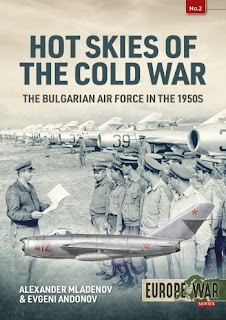

The Bulgarian Air Force was Sovietised after WW2 and started to receive the latest Soviet aircraft, including the early jet fighters the Yak-23 and Mig-15. The first 23 Mig-15s arrived in 1951, boxed in crates. More arrived each year after that, totalling more than 100, plus trainers. While there were no open hostilities, the CIA organised incursion flights from Greece. Bulgarian air defences were limited, but Mig-15s made 130 launches in 1954 alone. These incursions had tragic consequences when two Mig-15 pilots shot down an Israeli airliner (Flight LY402) on 27 July 1955, which had strayed into Bulgarian air space. 58 passengers and crew died. This incident takes up most of the book, which, while tragic, is a bit too much. The Mig-17 was a significant improvement because of its all-weather capability. These started arriving in 1955, totalling around 74 by the decade's end. Later versions had radar. The Mig-19 was the first supersonic fighter, ideal for air defence. 84 of these arrived between 1957 and 1959. The book has lots of photos and some excellent colour plates.

The second book, Turkey Between East and West, edited by Vojtech Mastny and Craig Nation, looks at the other side of the hill. It is a series of essays examining different aspects of Turkey's development during this period and later. The book was written in 1996, so the forward-looking chapters are interesting for what they got right and wrong!


Stalin’s attempt to acquire the Straits after WW2 framed Turkey’s relations with the Soviet Union in the 1950s. It brought them firmly into the US sphere of influence through the Truman Doctrine, which brought the US Sixth Fleet to Turkish ports and a steady equipment flow when Turkey joined NATO. This relationship cooled with the Cuban missile crisis and the loss of Jupiter missiles on Turkish soil, followed by the Cyprus crisis of 1963-64. 

I also dusted down a few more books on this subject from my shelves for this project. Unlike other Warsaw Pact nations, the Soviets didn't station troops on Bulgarian soil. They relied on advisors, trainers and the KGB, which, coupled with historical links, made Bulgaria a reliable ally. Bulgaria sent advisors and equipment to communist regimes across the world, although they did not participate in combat operations like the Cubans in Angola. There is some evidence that Bulgaria supplied weapons to Kurdish separatists, which is always a sensitive issue in Turkey.

The Bulgarian People’s Army (Bulgarska Narodna Armiya – BNA) consisted of Ground Forces, Air Force, Navy and Border Troops. It is estimated that Bulgaria had 180,000 regular troops in 1951. At its peak in 1955, it had 12 rifle and two tank divisions, falling to six rifle and two tank divisions by the start of the 1960s. The structure was similar to the Soviet organisation, just on a smaller scale. The country was divided into three military districts (Sofia, Plovdiv and Sliven). Conscripts served two years from age 19 (three in the Navy) and then went into the reserve. While part of the Warsaw Pact, the BNA played a limited role, reflecting the lower strategic position and the armed forces' limited combat value. It received older equipment than other Warsaw Pact nations, and most rifle divisions were still foot infantry. The T34 tank was still the primary MBT when other Warsaw Pact armies received or made the T54/55. The 1936 uniform and helmet was still in service until the 1970s. In a conflict between NATO and the Warsaw Pact, the Bulgarians could expect support from Romania and the Soviet Odesa and Kyiv Military Districts.

Turkey had to face the Soviet Union directly on its northern border, a frontier some 620km long. Facing Bulgaria in Thrace was the Turkish 1st Army. A 15-20km deep border zone with Turkey along the 279km long border made intelligence estimates difficult to verify. However, there are obvious invasion routes across the border, and amphibious units were based at Ahtopol, close to the border, which could launch attacks on the Straits. There were extensive fortifications on both sides of the border zone, but once breached, the terrain in Turkish Thrace is primarily open plains. However, access was more manageable from the Greek side over the Evros River, which made it difficult to separate Greece from any conflict. The Turkish Corps based at Corlu would have faced the brunt of any attack from Bulgaria. While there are some defensive positions around Edirne and the wooded Yildiz Daglari, the Turkish strategy would likely follow the historical plan of a fighting withdrawal to the 20km wide Catalea position in front of Istanbul. Additional fortifications were defending the Thracian beaches near the Straits from amphibious assault.

The Turkish armed forces gained some warfighting experience in Korea and joined NATO in 1952. US military equipment arrived in modest numbers, including the M47 MBT. The armed forces implemented some reforms, slimming down the largely infantry army and the number of officers. However, progress was slow, with centralised training only introduced in 1954, and literacy was well below NATO standards. The Navy received US and British WW2-era destroyers and submarines in the 1950s. This was adequate when facing the small Bulgarian Navy, but would be reliant on assistance from the US Sixth Fleet in a conflict with the Soviet Union. Air bases were quickly upgraded after 1952 with modern early warning systems and communications. The Air Force received modern jet fighters, including the F84 Thunderjet in 1953/54, and refurbished Canadair Sabres in 1954/56. The first supersonic F-100 Super Sabres started to arrive in 1958. The first female fighter jet pilot to operate under a NATO flag was Leman Bozkurt Altınçekiç, from the Turkish Air Force, in the early 1950s.

The military had a special position in Turkish society and regularly intervened in politics, including a military coup in 1960. The NATO archives include a period film on Turkey and NATO, which shows Turkish soldiers in their WW2-style British battledress. The helmet was still used as late as the Cyprus intervention in 1974.

https://youtu.be/QyeLGnaaMpg

Even before the Cyprus conflict, Greece and Turkey were unstable allies, and Bulgarian planning would have taken this into account. Ethnic Turkish groups in Bulgaria (11-15% of the Bulgarian population) were regarded as suspect, although full-scale assimilation campaigns didn't begin until the 1970s and 1980s. In the 1980s, friction between Turkey and Bulgaria over this issue brought both countries close to war, although the US and Soviets would have intervened to stop it.

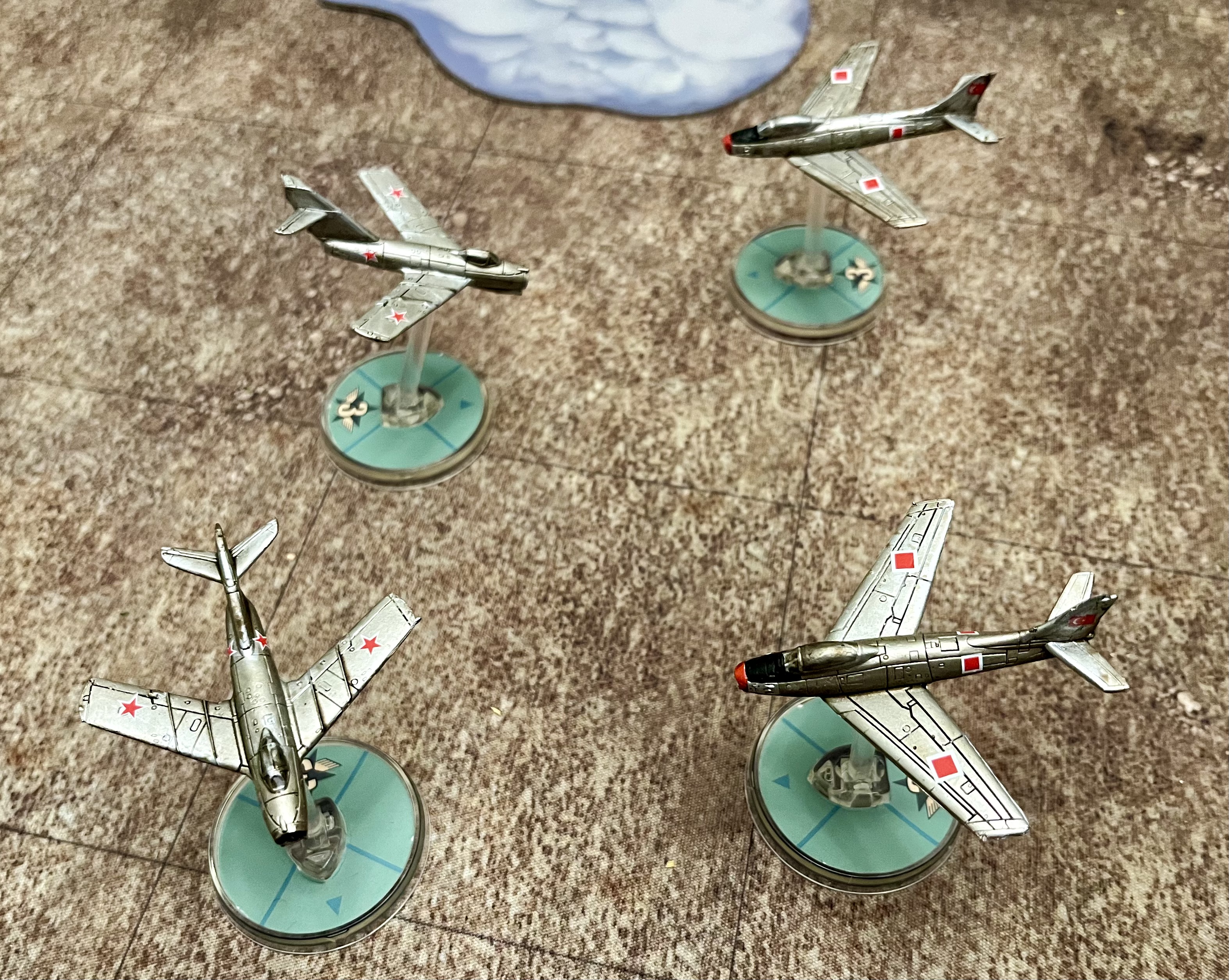
My first tabletop dabble was a game of Blood Red Skies, with Sabres and Mig-15s dogfighting over Thrace. I haven't found any Bulgarian decals in 1/200th yet, so I had to settle for Soviet ones. Turkish ones are available from Pendraken.


The midweek game this evening will be an armoured clash with a Turkish armoured brigade fighting a rear-guard action on the Thracian plains. This will be in 6mm using Cold War Commander rules.


Tuesday, 17 December 2024

The Campaign in Gallipoli

 As if I need more books on Gallipoli, this was my thought when faced with more at the Gallipoli Association's stall at the Battleground show. However, I relented for this memoir written by a German officer, Hans Kannengiesser. He was among the German advisors to the Ottoman Empire when the First World War broke out. Not simply as a liaison officer with the Ottoman Army, he commanded Ottoman troops in the field, including the Ottoman 9th Division.

This book gives readers a different perspective on the Gallipoli campaign fought between April 1915 and January 1916. Allied forces, primarily from Britain, Australia, New Zealand, and France, attempted to secure the Gallipoli Peninsula in modern-day Turkey. The goal was to open up a sea route to Russia via the Dardanelles Strait and weaken the Ottoman Empire, a Central Powers ally. The campaign could have been better planned and executed, facing fierce Ottoman resistance and challenging terrain. It resulted in heavy casualties on both sides, over 250,000 for the Allies, and ultimately ended in a costly and humiliating Allied withdrawal.

The author was working with the Ottoman Army when war broke out, and he describes early efforts to strengthen defences on the Gallipoli Peninsula. If you are unfamiliar with the campaign, he covers all the salient points. However, the strength of this memoir is his observations on the Ottoman forces he not only advised but also led.

I have toured this battlefield, hiring a car in Istanbul, so I hadn't appreciated how poor the lines of communication were. He describes the best route as being by sea, although even warships were attacked and sunk by British submarines. The language barrier was challenging, and he often relied on inadequate translators. Not unlike much later NATO officers, it didn't occur to him to at least learn some Turkish! I'm feeling righteous, having just finished a 100-day streak on Duolingo 😁.

I hadn't appreciated how limited ammunition was, which would have reduced Allied casualties given the modest area they occupied. He also tackled the communication and coordination of Ottoman batteries. Relations with Ottoman commanders were mixed. Some ignored him when in an advisory role, but there were fewer difficulties when he directly commanded Ottoman formations. Heat and disease were constant challenges, not just for the German troops. Scurvy broke out in three battalions he commanded due to the unchanging rations and the lack of vitamins. 

The Ottomans also had a prodigious bureaucracy. Regiments and divisions had to render strength reports every 14 days, which contained 458 columns to be filled in. He complained that methods of correspondence 'were most ceremonious'. 

His personal description of the battle was interrupted when he was wounded by a machine gun bullet to the chest by the New Zealanders. On 7 September, he had recovered enough to return to the front. This is a classic 'The Other Side of the Hill' study, which has been helpfully edited by John Wilson into a very readable study.

Some of my 28mm Ottoman and British WW1 troops.


Thursday, 12 December 2024

Conquest: Alexander and Hannibal

 Strength and Honour (S&H) is my favourite ruleset for big battles in the ancient world. One of my wargaming pals finds this ironic as he reminds me of the grief we gave him over a France 1940 game he organised in 3mm. In my defence, we spent most of the afternoon trying to identify the type of tank firing! Whereas the 2mm figures for S&H are mounted on large bases and labelled.

 The main rules mainly cover the Imperial Roman world. Mark has written a new supplement covering earlier conflicts, including Alexander, the Successors, and the Punic Wars. I dabbled at this with my Young Alexander in the Balkans campaign (published in Slingshot), but this allows me to extend the campaign to the Persians. I have always fancied a Persian army, and in 2mm, it is quickly completed. I also have a soft spot for the Carthaginians because they were my first wargame army, in 25mm using Warrior Miniatures. I will need some 2mm Romans in manipular legion formation, so another order is off to Martin at Warbases.


The supplement provides some new rules for the period extension and some tweaks based on feedback. There are 12 new army lists covering this earlier period and 20 scenarios. It all comes as a PDF download, which makes sense. I prefer a hard copy for rules, but a PDF is easy to use and a significant cost-saving, particularly for colour printing. I did the same with my new Cyprus 1974 guide for wargamers. I have printed off the new rules I will likely use, which are just a few pages.


Onto the tabletop for the midweek game last night. Alexander has crossed the Hellespont and faces a Royal Persian Army.


It went badly for the Persians from the outset, with both flanks driven in.


The centre held up better, with the mercenary hoplites doing a good job for the Persians. However, Homunculus Est! was called successfully with only a handful of setback cards in the Macedonian pile. I was a bit short of cavalry for this game, which may have helped the Persians, and some more archer units might have slowed up the Macedonian phalanx. We will have another go after Christmas.


When a giant cat arrived on the battlefield, Alexander was pleased to see it was a Moggie, not a Persian 😅.