Welcome to my blog!

News from a wargamer with a special interest in the military history of the Balkans. It mainly covers my current reading and wargaming projects. For more detail you can visit the web sites I edit - Balkan Military History and Glasgow & District Wargaming Society. Or follow me on Twitter @Balkan_Dave
or on Mastodon @balkandave@mastodon.scot, or Threads @davewatson1683

Sunday, 11 January 2015

The Last Crusaders

My latest reading is the ‘The Last Crusaders’ by Barnaby Rogerson. It tells the story of 15th and 16th Century conflicts between the Christian states of Europe, mostly led by the Habsburg’s, and the Ottoman Empire and fellow Islamic states in North Africa.


While the Ottoman invasions of the Balkans have been well covered, this book also covers the crusades of Portugal and Spain in North Africa. Both countries had a foothold on the coast and fought a series of wars against the local rulers and later against the corsairs. These are wars I was much less familiar with.

His choice of final conflict is the Battle of the Three Kings1578.  The young King Sebastian of Portugal invaded Morocco. Facing him was the dying Sultan Abdul Malik who had to be strapped into his saddle his horsemen attacked the Christian square. In a renaissance version of Custer’s Last Stand, the flower of Portugal’s nobility was wiped out with 26,000 men dead or captured.


The author writes a narrative history of the period in the best tradition of the historical storyteller. A very good read.

Sunday, 4 January 2015

Dacia: The Roman Wars

This is one of those books that you say ‘wow’ on opening, before you even read a chapter.

‘Dacia - The Roman Wars’ by Radu Oltean is truly a superb piece of work. The author sets out the latest archeological evidence in a straightforward way for the general reader, offering alternative scenarios when the evidence is contestable. However, what gives this book the ‘wow’ factor is the illustrations. They come in several forms. Photographs of the sites today; exhibits from museums; clear colour maps; and best of all, colour plates that reconstruct the forts and battles of the campaign.


For those not familiar with historical Dacia, it covered much of modern day Romania, but was centred on Transylvania. The key fortresses that the Romans wanted to capture were in the Carpathian Mountain chain and the rugged terrain and valleys that make up that region.

My Dacian army and their Roman counterparts are covered here.


Highly recommended.

Saturday, 3 January 2015

Open Combat and skirmish games

I find myself playing many more skirmish games than I used to. With work and other commitments eating into my limited time - shorter games and less painting is a big plus. Certainly compared to the big projects I have done in recent years.

Bolt Action isn't really a skirmish game, but it only needs 30 or so figures compared with 100 plus for Hail Caesar or Black Powder. However, Saga has been the real driver, again with less than 30 figures.

The current supplements only cover the Dark Ages and the Crusades, but there are a growing number of unofficial battle boards. I have recently played with Romans and Gauls, thanks to battle boards developed by Doug Colbeck, available through the Saga forum that is a great resource. They play really well and with a tweak or two, I plan using them for my Dacians.

Listening to the Meeples and Miniatures podcast drew my attention to a new set of skirmish rules called Open Combat from Second Thunder Games. These are real skirmish level games, arguably pretty close to role playing, with the introductory 150pt games involving six or eight figures a side.

The beauty of these rules is that they work for any army in a pre-gunpowder setting, including fantasy. You can produce your own warband list using the simple point system. Each ability level; speed, attack, defence etc and special rules all cost a point each. So you can create different ability levels within the same warband.

I used the Romans and Gauls again to test the rules. My Roman band had Macro and Cato from the Simon Scarrow novels with higher attack, defence and fortitude levels than the rest of the legionaries in the warband. The Gauls were of course led by a super stat Asterix. Sadly, his stats didn't save him from Cato's pilum, even after our cat had made one of his increasingly regular interventions on the wargames table. Razzy has a high 12 attack factor!

The rules themselves play very well and games can be finished in a hour or so. I quickly switched to the QRF with only occasional references back to the full rule set on my iPad. They are available as a PDF download for only £10 and the production quality is excellent.

I can see some great possibilities for this system, with super heroes battling their way through hordes of low quality troops, using the flexibility that you just don't get with other systems. It also means that you can get troops onto the table quickly. Good for the early stages of bigger projects as well as some niche games using figures that don't have a bespoke rules system.

Highly recommended and at £10 you really can't go wrong.


Tuesday, 30 December 2014

To the Strongest

'To the Strongest' is a new set of wargame rules for the ancient and medieval periods by Simon Miller.

I was attracted to them following a couple of reviews including the latest edition of Wargames, Soldiers and Strategy. The mechanisms are very different from anything I have played before, offering up the prospect of a quick game.

So what's different?

Firstly, there is no time wasted on measurements because it uses a grid. You don't need ugly squares on your tabletop, I just put felt pen black dots on the reverse side of my normal cloth. Units generally move one square for foot, two for mounted. Diagonal and sideways moves are possible, but require higher activation card scores. This really does speed up play and obviates the need for any debate over movement distances, match ups etc that can get in the way of a game like FoG. You can use different size squares depending on the scale of figures you want to use.

Secondly, there are no dice. Instead you use two packs of playing cards. You separate the court cards out to be used for strategems. The number cards are used for everything else. Activation requires anything other an Ace to start with and you can keep going so long as you draw a higher card. If you fail that ends the turn for that command. Activation can be used to move, shoot or charge into melee. Again the cards are used with a minimum score to hit, plus or minus a few modifiers. Then the defender saves and then hits back. There are different hit scores and saves for units in the generic or specific army lists.

I have only played one game, but it works very well. I used 100 Years War French and English and it resulted in a quick game that looked and felt right for the period. Melees did drag on a little longer than I would have expected, but they may just have been the luck of the cards.


The rules come as a very reasonably priced (£9.99) PDF download and are nicely laid out with hyperlinks between the relevant sections. The QRF could have done with a few more of the basics, but once you have played a few times, I suspect the numbers will be remembered easily enough. There are a few army lists available as a free download and the generic points system is easily adaptable for others.

Playing cards are perhaps not visually great, but you can substitute poker chips or something else. The MDF markers are ammo chips. Each shooting unit has a limited number at the start of the game, another rarely used mechanism in ancient wargaming.

These rules are a bit different and well worth look at this price.


Saturday, 27 December 2014

Some wargaming inspiration - 2015 anniversaries

As we approach the New Year, I will do my usual look forward to military anniversaries. 2015 will see some pretty significant commemorations that I suspect we will see represented on wargame tables across the globe.

There are a few in the Balkans.

The Gallipoli campaign started in April 2015 and in May Italy joined the war on the side of the Entente. In October, Bulgaria joined the Central Powers and invaded Serbia, which together with the renewed German/Austrian offensive, spelt the end for Serbian resistance and led to the long and terrible retreat over the Albanian mountains.


Talking of Albania, they will undoubtedly celebrate the birth of Norman Wisdom, a somewhat bizarre cultural icon on Albania. His films were one of the few western productions allowed in that country during the Hoxha regime.

In April 1815, the Second Serbian uprising against the Ottomans started and this led to the recognition of Serbia as a semi-independent state. The Ottomans had more success a hundred years earlier in July 1715 when the fall of Nauplion in the Peloponnese, effectively ends Venetian resistance to Ottomans in the Morea.

Five hundred years ago, 615 is the date usually ascribed to the Slav invasion of the Balkans that led to the modern day Serbian and Croat states. Actually, the Slavs slipped into the Balkans gradually over many years, but 615 saw significant events such as the siege of Thessalonica.

Interesting though these anniversaries are to me, I suspect one or two others might get more prominence. The 200th anniversary of Waterloo is of course the big one, alongside the 600th anniversary of the Battle of Agincourt 1415. I see the Perry’s are ahead of the game with their new plastics for the period.

In Scotland, we have the 1715 Jacobite Rebellion and the Battle of Sheriffmuir. While in England the 1215 signing of Magna Carta will no doubt be remembered, with probably less attention given to the subsequent First Barons War.

The Swiss will want to make a noise about the November 1315 Battle of Morgarten, when they defeated Leopold’s Austrians and went on to found the Swiss Confederation. For gamers of a certain age, the William Tell TVseries will be a reminder of the period. Even if it was filmed in Snowdonia.

And finally, not to miss out our American cousins who may wish to mark the 50th anniversary of the introduction of the first combat troops (US Marines) in Vietnam 1965. More significantly, it is also the 150th anniversary of the end of the American Civil War.


More than a few events here to keep us busy painting and gaming in 2015.

Wednesday, 24 December 2014

Dystopian Wars - Russian Coalition

The battle flotilla of the Russian Coalition joins my Dystopian Wars collection. That's a Dreadnought, 3 gunships, 4 destroyers and 2 submarines.

They got their first outing today, doing battle with the Ottomans. Only my second game and the rule book can be a bit irritating as you have to keep flitting back and forward. Not to mention remembering all the special rules. However, it plays fairly well and once I get used to the characteristics of each ship, I'm sure it will get quicker.


Sunday, 7 December 2014

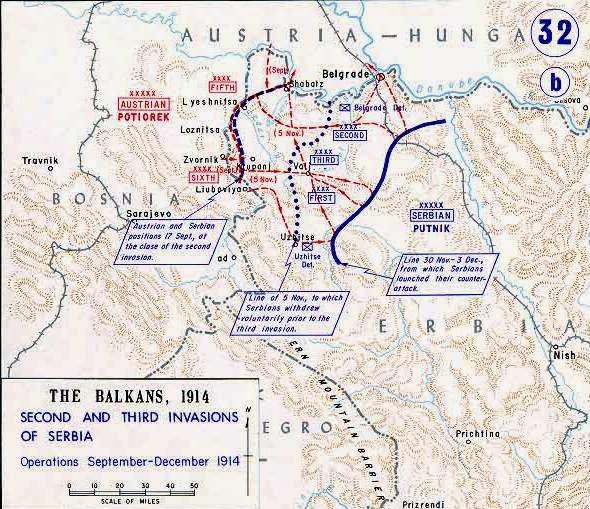
Battle of Kolubara - December 1914

One hundred years ago, in December 1914, Serbian troops counterattacked at the Battle of Kolubara and drove the Austro-Hungarian army from Serbian territory.

Apart from the anniversary, my attention was drawn to the battle when I acquired a copy of the novel ‘A Time of Death’ by Dobrica Cosic. Not easy to get hold of and my copy came from a US bookseller – it once graced the shelves of Anaheim Public Library in California.


The novel catches the confused and desperate nature of the fighting in the mountains of north-western Serbia. It follows the story of the 1st Army commander Zivojin Misic and a group of students who are called up to bolster the ranks of the retreating Serbian army.

The battle started on 16 November, when the Austro-Hungarians, commanded by Oskar Potiorek, reached the Kolubara River. They had captured the strategic town of Valjevo and forced the Serbian Army to retreat. The Serbs abandoned Belgrade on 30 November.

The book focuses on the surprise Serbian counterattack on 2 December. The Austro-Hungarian forces were extended with weak supply lines which meant they were unable to take full advantage of their superiority in artillery. The Serbian retreat had allowed a brief rest for the hard-pressed troops and supplies of artillery shells and other equipment had arrived.

The Serbs retook Valjevo on 8 December and the Austro-Hungarians retreated to Belgrade, which had to be abandoned on 15 December. Both armies suffered heavy casualties, with more than 20,000 dead on each side. However, the defeat humiliated Austria-Hungary and Potiorek was relieved of his command.


‘A Time of Death’ has been criticised as a nationalist polemic, largely I suspect due to the author’s later political career. He was the first President of the rump Yugoslavia (Serbia and Montenegro) in 1992, riding a wave of Serbian nationalism and was a supporter of the Bosnian Serb Army during the Bosnian War. Although he later fell out with Milosevic.

In fairness, while the book entirely focuses on the Serbian forces, it doesn’t spare the command deficiencies of the Serbian high command. By modern standards of historical fiction this book can be tough going and could have been more concise. However, it does give a gritty portrayal of winter warfare in the mountains. It was certainly grim and you can only admire the endurance of the men involved.


Early war Serbian troops in 28mm from my collection

Tuesday, 25 November 2014

19th Century skirmish wargames

I have been looking for a set of rules to play skirmish games of up to around 50 figures a side. This is primarily for the Russo Turkish War of 1877.

I have now tested two options, Bolt Action and Terrible Swift Sword.

Bolt Action may seem a bit out of the time line, but I have played WW1 games very successfully with these rules. The basic mechanisms are very elegant and has the advantage that I and other gaming partners can pick them up and play quickly. In the trial game I made a few changes, such as shortening the rifle range, but it certainly played very well. If I go with this, I will need to think up some national characteristics and tweak the weapons to reflect important differences between the Russian and Turkish armies.

Terrible Swift Sword is a Sharpe Practice variant for the Amercian Civil War. I'm not a huge fan of card driven games, but the fun narrative behind Sharpe Practice won me over and we have had some really good games. The trial game didn't really work as it is too period specific. Russians and Turks don't really fit the U.S. cards that are the key to the game.

On balance I think I will go with Bolt Action, but not ruling out doing some cards for TSW and giving it another go when I have more time.

Here are a few pictures of the game. Three ten man infantry squads a side, together with a cavalry troop and light artillery.


And finally, when the Turks looked as if they might have the upper hand, our cat Rasputin intervened. At least he recognised which side he was supposed be on, positioning himself in the Russian lines. However, you might note a bit of 'blue on blue' - c'est la guerre!


Sunday, 23 November 2014

Chaldiran 1514

This year is the 500th anniversary of the Battle of Chaldiran that took place on 23 August 1514. The Ottomans led by Selim 1st decisively defeated the Persian Safavids led by Shah Ismail.

Selim came to the Ottoman throne by overthrowing his father Bayezid II and winning the subsequent civil war against his brothers. The Persian Safavids were Shia Muslims and encouraged a revolt in Ottoman Anatolia. Selim put down the rebellion with great force and advanced on Persia. The Safavids were also being invaded by the Uzbeks in the east, so they retreated in the face of the Ottoman army. The Ottomans caught them at Chaldiran in modern day northwestern Iran.


The Ottomans deployed their heavy artillery and Janissaries behind a barrier of carts. The Safavids attacked the Ottoman wings with their cavalry in an unsuccessful effort to avoid the Ottoman firepower. The Safavid army was primarily armed with traditional weapons and suffered heavy casualties as a consequence.

After their victory the Ottomans captured the Safavid capital Tabriz, which they pillaged and then abandoned, but secured permanent control over the far eastern part of Anatolia and also over northern Iraq. Shah Ismail did not take part in any further military engagements for the rest of his reign, delegating the fighting to his generals.


The Safavids learned from this battle and adopted firepower infantry and artillery in addition to their traditional horse archers, many of whom were actually Turkish tribes.

Here are some Safavids from my collection.


Foot archers


Camel gunners


Cavalry


Musketeers (reforms after Chaldiran)


Qizilbashes (Elite cavalry)


The figures are mostly from the Essex range.

Sunday, 16 November 2014

The Empty Throne

The latest Bernard Cornwell book will always be high on my reading list and 'The Empty Throne' did not disappoint.

This is Book 8 in the Warrior Chronicles set in Anglo Saxon England, featuring our hero Uhtred of Bebbanburg.


The historical context is the death of the Mercian ruler, with no legitimate heir. His wife is the obvious choice, but women rulers were rare, to put it mildly. Uhtred is wounded and a sub plot is his journey to recover the sword that wounded him. While the 'English' are divided the Vikings step up their raids on the west coast from Ireland. As usual the book ends with a grand battle, this time on the walls of Chester.

I am frankly running out of superlatives to describe Bernard Cornwell's writing. It is simply a book that you can't put down - the very best in historical fiction.

Sunday, 9 November 2014

WW1 Serbian Boys

I am always interested in military history links between Scotland and the Balkans, so this story in today’s Scotsman newspaper caught my eye.
To mark the 100th anniversary of the outbreak of the First World War, George Heriot’s school in Edinburgh has posted on its website the first instalment of what will be a four-year project designed to chart the stories of 27 Serbian boys, aged 12 to 17, who were taken in by the educational establishment in 1916.
These boys had experienced the harrowing ‘retreat’ over the Albanian mountains to the coast and then on to Corfu.
The sporting interest comes from the boys playing rugby, creating a Serbian team. They are credited with bringing the game to Serbia after the war.
The last surviving ‘boy’ was Dimitrije Dulkanovic who explained when interviewed in his eighties: “The prime of our lives were spent here in this beautiful country with your grandfathers and grandmothers. At that war time we were homeless and parentless so our gratitude to Scotland and the Scottish people will last till the end of our lives.”

Good story and well done to the school for recording it.