Welcome to my blog!

News from a wargamer with a special interest in the military history of the Balkans. It mainly covers my current reading and wargaming projects. For more detail you can visit the web sites I edit - Balkan Military History and Glasgow & District Wargaming Society. Or follow me on Twitter @Balkan_Dave
or on Mastodon @balkandave@mastodon.scot, or Threads @davewatson1683

Tuesday, 15 August 2023

Ottoman Armies 1820-1914

 This is the latest in the Osprey Men-at-Arms series by Gabriele Esposito. It fills a gap in the Osprey coverage of Ottoman armies, although specific conflicts in this time frame have been covered before. In particular, Ian Drury's 1994, The Russo-Turkish War 1877, inspired me to build a 15mm army for the conflict and later an essential reference for a 28mm force.


The author takes a chronological approach to the period, which was one of considerable change. The period starts at the end of the Napoleonic Wars, which I covered in my new book, The Frontier Sea. Many attempts had been made to reform the Ottoman military, and this was finally achieved in the 1820s with the disbandment of the Janissaries (The Auspicious Incident) and, later, the semi-feudal cavalry, the Sipahis. By the end of the decade, the Ottoman state had the core of an army organised on modern lines. However, it was only a core, insufficient for a wartime army, and irregulars remained an essential element of the military during wartime.

This was demonstrated during the Tanzimat period 1840-53, particularly when challenged by Egypt in the war of 1839-41. So, in 1843 the army was expanded considerably, including conscription (1848) and the creation of a reserve (Redif). Regular light infantry and cavalry units were also introduced. 

The Ottoman armies that fought in the Crimean War have not always been given the credit they deserve, with most accounts ignoring the fighting in Moldavia and in the Caucasus. Even less well known are the irregular units officered by British and French officers, and the line regiments bolstered with British cadres. There were also Polish volunteer units.

This painting is of Tunisian troops sent to Balkans in 1877, in the Tunisian Military Museum.

The Russo-Turkish war of 1877, has been the subject of detailed work since Ian Drury's 1994 Osprey. Most notably, Quintin Barry's War in the East, and a special favourite of mine Frank Jastrzembski's, Valentine Baker's heroic stand at Tashkessen 1877. The Ottoman forces had to be reformed again after this war, which addressed the manpower shortages, but not the quality. There were some minor reforms in 1890s, with irregular units (Hamidye) still required in border regions.

Finally, we have the Young Turks period, with further reforms that took the army through the Balkan Wars and the First World War, which ended the Ottoman Empire. There are also descriptions of the vassal states, including Egypt, Tunisia, Serbia, Montenegro, Moldavia and Wallachia. These also provide some of the most colourful and original colour plates in the book. Moldavian lancers look terrific, as do Egyptian cuiraissiers. 

If you have any interest in the Ottomans, this is a must read. 

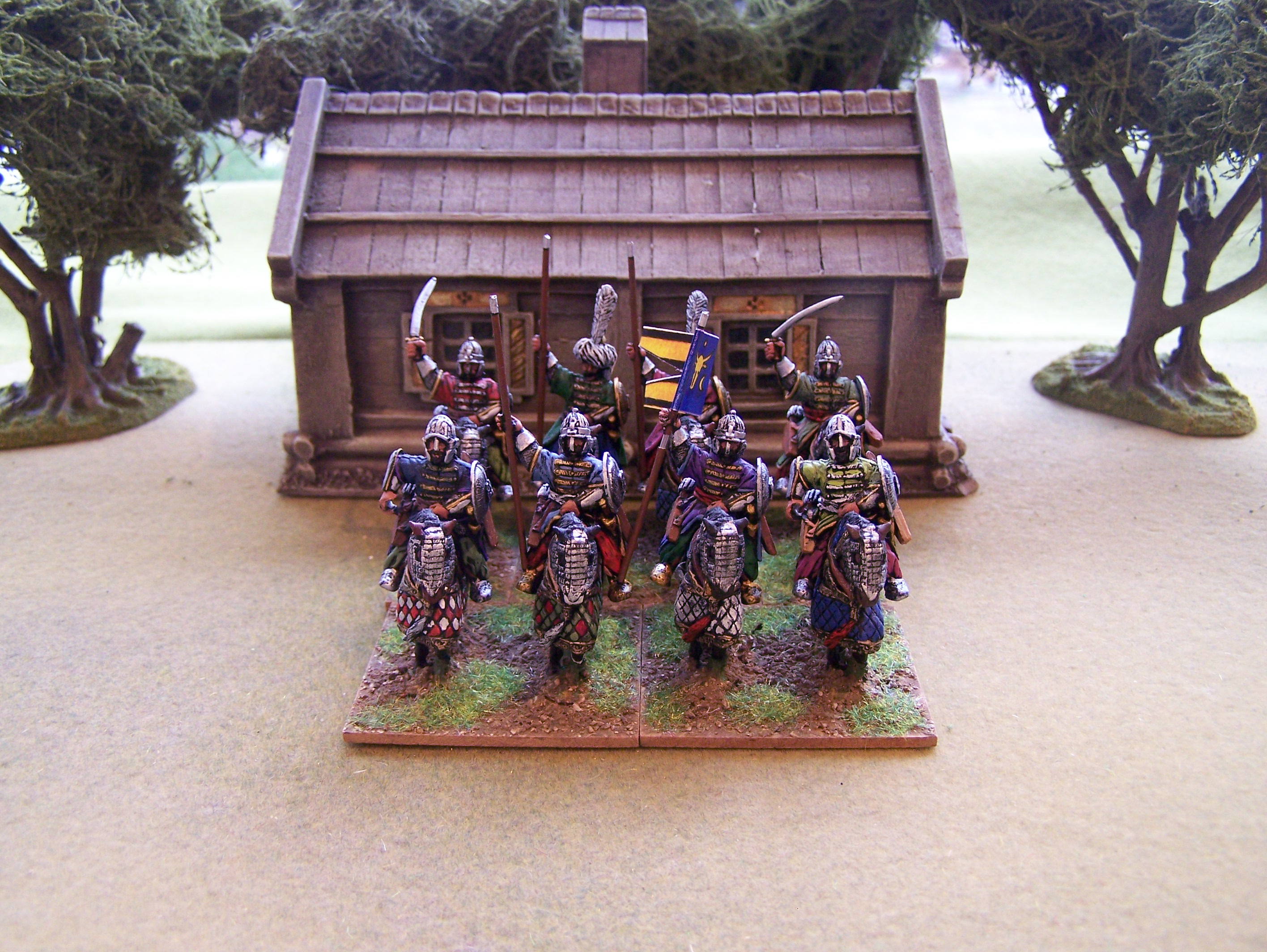
My 28mm Turkish cavalry and artillery for 1877


Sunday, 13 August 2023

Empire First

 It has been said the world is divided into those who venerate Churchill and those who hate him. If you are in the first category, this book will not be good for your blood pressure. Empire First is Graeme Bowman's study of Churchill's opposition to Operation Overlord, the invasion of France in WW2.


The author's thesis is that Churchill prioritised British oil and empire interests in the Mediterranean over efforts to liberate Europe from fascism. Churchill's prosecution of a Mediterranean strategy is not in dispute. It has been examined by eminent historians like Sir Michael Howard in his classic 1968 study. And more modestly, in my own book, Chasing the Soft Underbelly. Howard was kinder to Churchill, arguing that he was the catalyst for a much broader view amongst the military establishment whose memories of the killing fields of WW1 and lack of resources drew them away from the direct route into Hitler's Germany. In fairness, Bowman also highlights these factors and adds Churchill's low opinion of British military capability. A view reinforced by the capitulation of Singapore in particular. Brooke shared this view, arguing that the cream of manhood had been lost in WW1. Consequently, they believed the Overlord was beyond the Army's capacity. 

Memories of Churchill's interwar calls for rearmament tend to gloss over his spell in the Treasury in the 1920s when he fully supported the government's economic austerity policies, which included massive defence cuts. Bowman also points to Churchill's less-than-outright opposition to negotiations with Hitler in 1940 while accepting a Fabian strategy may have been involved. After rallying the country in 1940, he is not the first historian to point to Churchill's failures, including Norway, Greece, the Dodecanese and the Far East. 

On the Mediterranean strategy, there is nothing new in his analysis of the events of 1942-3. The conferences, reports and debates between the British and Americans are dissected in detail. Churchill's pursuit of his Balkan strategy right into 1944 is probably less well known. Bowman rightly highlights the weaknesses of this strategy, with little attention paid to the defensive advantages well-equipped German troops had in Italy rather than the plains of Northern Europe. The Balkans lie 1200 miles from the Rhur in mountainous terrain, a point well illustrated by the topographical maps in the book.

 Churchill's optimism over Turkey's entry into the war is also covered, and I largely agree with Bowman on this. I am less convinced by his arguments over Izmir and the Dodecanese campaign. Still, in general, Churchill ignored the advice he was given on Turkey, including his access to Turkish diplomatic cyphers.

The American analysis that British designs in the Mediterranean were designed to protect the empire and British post-war interests certainly had merits. Churchill and Brooke were reluctant participants in Overlord, dragged into it by the Americans and the Russians. It was also about checking Soviet advances in the Balkans, and Bowman offers a fascinating alternative history on this point. He argues that if Churchill got his way, Allied troops would be fighting slowly through the Balkans while the Soviets swept across the North German plain, ending the war at the Channel. A post-war Europe divided North/South rather than East/West.

It is hard to disagree with the thrust of Bowman's thesis, which is well-researched and argued. He possibly goes a little far occasionally and doesn't include other interpretations that reflect Churchill's often contradictory positions. Churchill was, at heart, a 19th-century imperialist, and it would, therefore, be surprising if he didn't put the Empire first. I take a more balanced view of Churchill overall, but having studied the same sources, he was wrong about the Mediterranean strategy, whatever his underlying motives. 

US Rangers storm the harbour at Durres, one of Churchill's 'soft underbelly' schemes.


Wednesday, 9 August 2023

War around Ragusa (Dubrovnik) in 1806

 In my new book, The Frontier Sea, I cover Russian attempts to capture Ragusa (Dubrovnik) in 1806. This includes the Battle of Bergatto Heights, which is also a wargame scenario in the appendix to the book. 


My primary source for this little-known campaign was the memoirs of V. Bronevskiy, a Russian naval officer (Northern Tars in Southern Waters, Helion, 2019), who served with the Russian fleet in the Adriatic. While he covers the Battle of Bergatto Heights in some detail, he quickly skims over the earlier actions around Old Ragusa (Cavtat), where the Russians landed and the subsequent siege of Ragusa. I am therefore grateful to the Croatian archaeologist Nikola Cesarik for pointing me to an article published in the Croatian journal Kolo, War around Dubrovnik in 1806. This article covers the diary of an Italian observer of the events of 1806, Francesco Maria Appendini. It is confusing in places (he couldn’t have been at every action), but it adds to our understanding of the campaign. Old Ragusa (Cavtat) is 20km south of Ragusa (Dubrovnik), a modern tourist spot near the airport.

The first clash was south-east of Old Ragusa on 30 May, where 300 French troops clashed with a similar number of Montenegrins around Tarcikovac. It appears to have been a running skirmish lasting around five hours, with limited casualties, other than an unfortunate French sergeant whose severed head was subsequently recovered and sent to Ragusa by locals for the reward.

On 3 June, the Russians landed around 150 troops from a frigate, successfully attacking French batteries near Ragusa. They were supported by gunfire from the frigate, naval gunfire being a key element of Russian strength in this campaign. However, this does not appear to have been a significant landing attempt, as the action then shifted back to Old Ragusa, presumably because the Russians needed a harbour.

There appears to have been some further fighting south of Old Ragusa, which also involved Ottoman troops (the border was close to the coast here), barring the passage of Montenegrin and Russian troops. However, the French decided that Old Ragusa could not be defended and built several batteries along the coast to delay the Russian and Montenegrin advance towards the Bagratto Heights. The diary doesn’t say which Russian units were involved, but based on Bronevskiy, it was probably detachments from the Vitebsk Musketeers and 13th Jager Regiment, commanded by Major Zvyagin.

Appendini doesn’t have much to say specifically about the Battle of Bagratto Heights and merges it with several clashes inland involving the Montenegrins and on the coast where Russian naval firepower was critical again. His main narrative moves to the siege of the city, where the Russian batteries were established on the heights above the city. Anyone who has visited the city can only wonder at the effort involved by Russian sailors to get heavy naval guns up to those heights. A feat repeated by British sailors in 1814. The Montenegrins focused on plundering the surrounding area, and there were several sallies by French and Ragusan troops to dislodge Montenegrin sharpshooters. 

The walls of Ragusa

The main Russian effort was to capture the island of San Marco, which dominates the approaches to Ragusa harbour. 600 Russian naval infantry and a company of Jagers landed on the island supported by gunboats. However, the French fort on the island was too strong, and the Russians withdrew, with 13 killed and 57 wounded. 

The diary describes the deprivations of the citizens starving and short of water in the city. This was relieved when Molitor’s French column arrived. The Russians began a withdrawal to Old Ragusa, where they embarked while the Montenegrins headed home with their plunder. Appendini was understandably not a fan of the Montenegrins, who he says, ‘The passion for stealing runs in their blood.’ 

As military history goes, the diary is a difficult and confusing read. However, it adds much more detail than we have from other sources and is certainly more objective than Bronevskiy. I will certainly be taking it with me on my next visit. For the wargamer, the many skirmishes he describes are ideal for small actions using rules like Sharp Practice or Rebels and Patriots.


Sunday, 6 August 2023

Claymore 2023

 It was the Claymore show in Edinburgh yesterday, one of two big shows in Scotland each year. It is held in the Edinburgh College, Granton campus, which offers two large halls and some side rooms. Good access with plenty of car parking and OK public transport links.

I was running a participation game for Glasgow and District Wargaming Society, so I only had time for a quick scout around the show and traders. I picked up some scenic items for Strength and Honour, but Warbases didn't bring their Antonine Miniatures range, so my credit card was saved for a few days at least. The other items on my shopping list were unavailable at different stalls, so my spending was minimal.

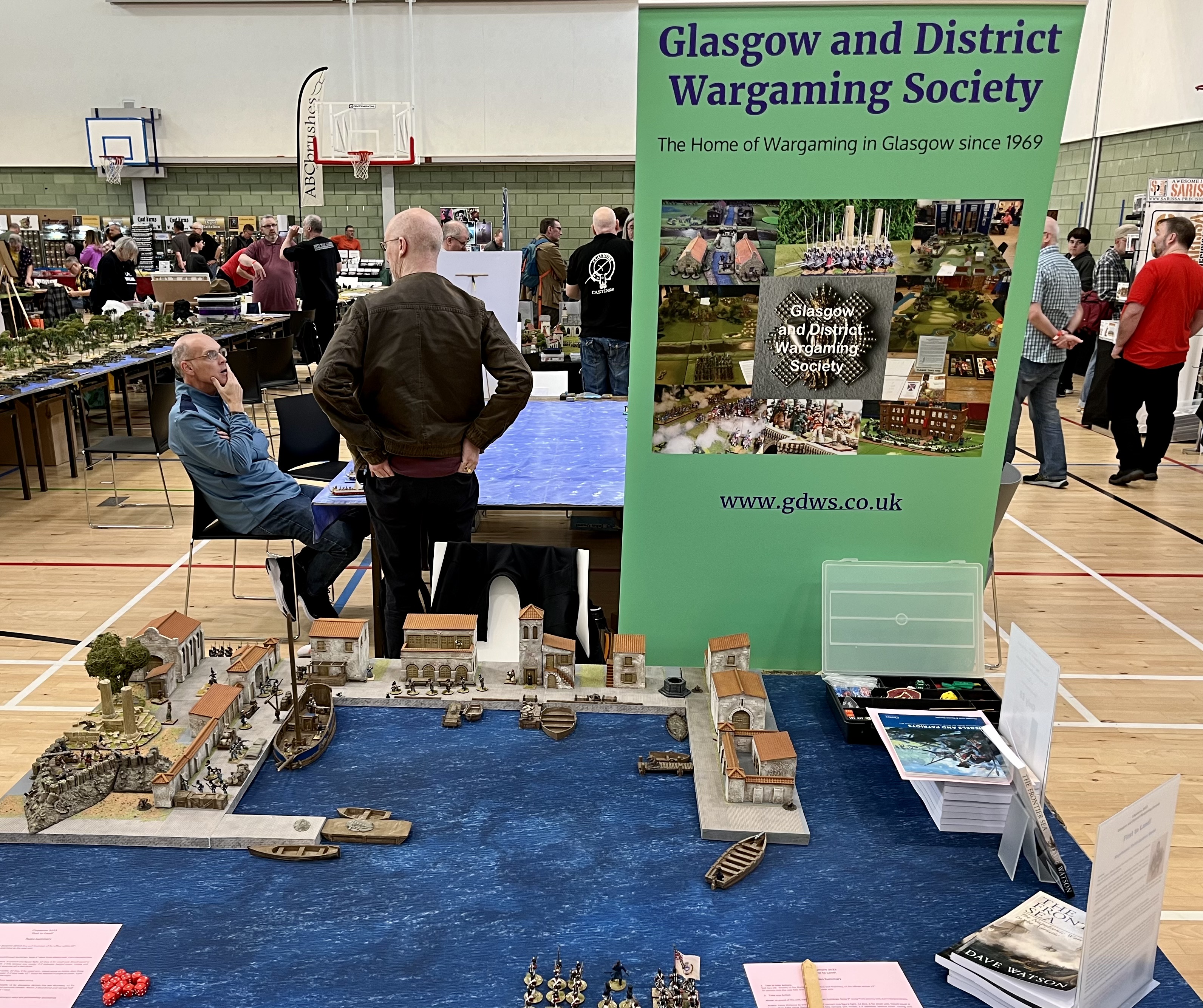
The participation game was, First to Land!, a Napoleonic harbour game loosely based on the Grado scenario in my, The Frontier Sea book. The book sold well on the day, which was great.

There was a significant increase in participation games at this year's show, which the organisers hope might be a trend. We have shifted to participation games in recent years with mixed success. Yesterday it worked well, with five games being played. It was a quick game, typically played in 30-40 minutes. We used Rebels and Patriots rules, which are quick to pick up even if you haven't played them before. There is only a little time to play games at a one-day show, and they tend to become a trade show. However, there were more folk hanging around till the afternoon, despite the start of the football season! So, hopefully, that was a consequence of more participation games. We were certainly playing until closing time.

For the record, the British won three games, the French two. 


I only looked at the other games quickly, which is a shame because there were some good-looking, original tables. Here are a few that caught my eye.

Ancient galleys on the Nile.

A big Pacific War game - Ngesbus.

Loved this Game of Thrones castle. I must finish my Lannisters.

A big naval game, the details of which I still need to remember. But looks good.

Battle of Falkirk using the acrylic stands. 

Barry Hilton's Dutch attack on the Medway game was beautifully modelled.

As usual, a big thanks to the Edinburgh club for organising the event. 

Wednesday, 2 August 2023

Peerless among Princes: The Life and Times of Sultan Süleyman

 This is Kaya Sahin's study of Sultan Süleyman, commonly described as The Magnificent in the West, or The Lawgiver in Türkiye. I have several biographies of arguably the best known Ottoman Sultan, but there is certainly room for a modern, scholarly and balanced look at Süleyman. Particularly for those of us reeling from the Turkish TV series, The Magnificent Century!


I found the chapters on his early life interesting. Fratricide may have given the Ottoman dynasty an  advantage in the fragmented political world of Anatolia and the Balkans, enabling its territories to be passed undivided from one generation to the other. However, it was a ruthless existence if you were a prince. While Süleyman reached the throne without having to compete with brothers, his father's route was bloody in the extreme, which must have impacted him. If he had failed, there would have been no Süleyman the Magnificent. Süleyman is the Turkicized Arabic form of Solomon, a point highlighted by him in his poetry.

He inherited his father Selim's considerable conquests, particularly in the Middle East. This is ably covered in Alan Mikhail's book on Selim. The Empire covered 2.5 million square miles and had 20 million subjects. Military conquest was an essential requirement for any Ottoman Sultan. His 1526 campaign and the Battle of Mohacs set the tone for his reign. 

Relationships with the other major powers are not ignored. It wasn't a period of continuous warfare; diplomacy was also important. The Ottomans understood the power structures in Western Europe and their main opponent to the east, Safavid Persia. Their enmity towards the Safavids was in some ways stronger than the European Christians. The Ottomans viewed them as heretics and believed that Safavid propaganda was behind the Anatolian rebellions.

It is difficult to fully understand the importance of personal relationships from historical sources. However, it seems clear that the relationship with his Grand Vizier Ibrahim was crucial to their vision for the Empire as well as his wife, Hürrem. Ibrahim's execution meant losing his closest associate. For the rest of his life, he refrained from making other close friends, becoming increasingly lonely at the top of the state. The death of his sons Bayezid and Mustafa and their families, while not unusual in late reign Ottoman power struggles, cannot have been easy.

Süleyman did his best to ensure that his legacy would be viewed as he wished, through his own history, the Sulaymannama and his charitable works. This partly explains why he is probably the best-known Sultan, along with his longevity on the throne for 46 years. He also lived at a time when there was an explosion in record-keeping, the expansion of the printing press in Europe, and a burgeoning manuscript culture in Ottoman territories. This positive image is propagated even today through the education system and the present government's promotion of Süleyman’s central role in Ottoman history.

Süleymaniye Mosque in Istanbul, built by Mimar Sinan, Suleiman's chief architect.

The author concludes, 'This is where we now find Süleyman, after centuries of mythmaking and scholarship. He lives on under various garbs, offering shelter with his buildings, keeping academics busy, boring school children, and enticing readers and viewers to dream through him of a world filled with sound and fury.'

There is nothing boring about this book, despite its length. It covers the highs and lows of his reign in a balanced way, setting him in the broader context of the period. Well worth a read.

28mm Sipahi of the Porte


Tuesday, 1 August 2023

The Men of Warre

 This is Jenn Scott's study of the clothes, weapons and accoutrements of the Scots at war between 1460 and 1600. This was period of battles against England at Pinkie and Flodden, as well as civil wars and clan warfare.


After an introduction to the period, the largest chapter is devoted to the weapons of war in the period. This was a period of transition, with gunpowder weapons becoming established. The earliest gun casting in Scotland was in 1470, although bombards and expertise were imported. The most famous is Mons Meg, given to James II as a wedding present. The traditional Scottish spear was still important, although getting longer than in medieval times. A law was passed forbidding the sale of spears shorter than 5.5 metres, which is a pike to most of us. This rather destroys the myth that the failure at Flodden was due to unfamiliarity with the pike.

The naval chapter reminds us of the importance of shipping routes in the period and the retention of Birlinns (small Viking-style galleys) on the West Highland coast. They were not much use as fighting ships by this period but were excellent for raiding. I imagined that Birlinns were quite cheap, but the total cost of just one ship cost around one-third of the annual income of one Campbell laird from his estate. The Earl of Argyle could move 3,000 men in his fleet, and the last uprising to restore the Lordship of the isles involved 180 galleys and 4,100 men. The King had large ships that could fight at sea, supplemented by armed merchant ships. These did not come cheap. The Michael (250ft long) took five years to build and cost 30,000 pounds, an amount equal to the Kings annual income. 

This was also the period of the border reivers. This chapter will be of particular interest to those of us playing Border Wars (from Flags of War). Scottish mounted troops were recruited from the Borders and sought after by the French as well. Border reivers used firearms but retained light crossbows, which were more reliable than pistols.  


The chapter on Highland warfare tackles some more myths. We tend to paint up our Highland units ready for a mass charge. However, Scott points to the bows carried by these troops as providing the greatest clue to their battlefield tactics. Sadly, it also appears that bagpipes only appeared on the battlefield in the 16th century. And the earliest mention of tartan is in 1532; whatever Mel Gibson thought!

This is a thoroughly well-researched book on a subject that needed a detailed look to address the many myths. And some lovely colour plates.

Lets have some 28mm Lord of the Isles troops anyway!


Saturday, 29 July 2023

The Young Alexander

This book is Alex Rowson's examination of the early life of Alexander the Great, from his birth to the invasion of the Persian Empire. Most studies of Alexander focus on the great events in the East, so it was interesting to read about his formative years.


Alexander was born around 20 July 356 BC in Pella, which became the new centre of Macedon towards the end of the fifth century BC. I have visited the excavated site, which is a fair way from the coast, so it's hard to imagine the waterfront city it once was. The mosaics are impressive though.

The book is a narrative history, although the author discusses the sources and the archaeology as he goes. I thought this might irritate me, but it doesn't. He goes off on a few other tangents, but again they all add to the story. There is a lot about Macedonian religious rites as they applied to Alexander, remembering that infant mortality was shockingly high by modern standards.

It is impossible to understand Alexander's early years without discussing his father, Phillip. I have always thought he didn't get enough credit for creating the Macedonian army that he used to dominate Greece and much of the Balkans. Alexander reminds me of Napoleon, who didn't create the French military system, but he did develop and use it brilliantly. This book is, in some ways, a history of Phillip as much as Alexander, and none the worse for that. However, Nicholas Hammond's, Phillip of Macedon, is my go-to study of Phillip. Alexander was also tutored by Aristotle, so his intellectual development was not ignored.

There are a few fascinating stories about the relationship between father and son. How Alexander tamed his famous horse, Boukephalas is particularly good. He noticed what others had missed. The horse was spooked by his shadow, so he turned the horse to face the sun. After dismounting to the cheers of the court, Phillip said, 'My boy, you must find a kingdom which is your equal. Macedonia is too small for you.' They later fell out before Phillip's death, forcing Alexander and his mother into self-imposed exile. She was another important influence on him, and fascinating character in her own right. However, they were later reconciled before Phillip's assassination.

Alexander's early campaigns are interesting, particularly those in the Balkans. This was where he honed his military skills under the guidance of his father and other experienced generals. The Thracians were a particularly tough opponent and became an important part of his later armies.

He was at some of the later battles that cemented Macedonian control of Greece, commanding the cavalry wing at Chaironeia. He also had to deal with a rebellion when he took the throne, led by Thebes with Athenian encouragement. He also had to return to the Balkans before he was ready to cross the Hellespont for the campaign against Persia.

While this is not a quick read, it is well-written. It covers the latest archaeology and discusses conflicting sources without a heavy academic style. Well worth a read.

Got to have a picture of the Macedonian phalanx


Sunday, 23 July 2023

The Frontier Sea

 I am delighted that my new book, The Frontier Sea: The Napoleonic Wars in the Adriatic, is now on sale. It can be ordered through your local bookshop, Amazon in paperback or Kindle editions, or the Balkan Military History website. There are links to these on the website, along with extracts from the book. 


I have presented the book on the BMH YouTube channel, which explains what the book covers and picks out some of the personalities that add colour to the story.

The book examines the campaigns, armies, navies and personalities that fought in the region between 1797 and 1815. Campaigns rarely mentioned in the history of the period. Austrian, French, Russian, British, and their foreign regiments fought up and down the coast. Sometimes with or against local leaders like Peter I of Montenegro and Ali Pasha of Ioannina. Many commanders were far from home, with orders taking weeks to reach them. This meant even junior officers could take military and diplomatic decisions usually reserved for more senior officers. 

Most of the great powers contested the lands around the Adriatic Sea during the Napoleonic wars. While never a major theatre of operations, it was part of the overall strategy of most of the combatants. It had an essential role in the conflict, influencing alliances and diverting troops and ships, which all contributed to the defeat of Napoleon. It was also a period of significant change, with the French and British intervening in a region that had long been a battleground reserved for the Austrian, Russian and Ottoman empires.

For wargamers, the book has a chapter on the armies and navies that fought in the Adriatic and a wargaming appendix. There are a couple of outline scenarios in the book to get you started, and there is more material on the dedicated page on this blog. 

Locally raised French troops facing Ali Pasha


Several folks have commented on what appears to be my prolific output, with two books in almost as many months. This is deceptive as it has more to do with publishing time and schedules. I wrote the first draft of Chasing the Soft Underbelly in 2021 and this book in 2022. This year's output should be published later this year. No AI is involved!

I still have more painting to finish all the armies. The last army is the Austrians, which are a bit of a nuisance as they changed their uniforms over the period more than most. However, I have made a start this week with the first batch of Jagers off the painting bench. They are from the Perry range.


Wednesday, 19 July 2023

Hellfire

 Hellfire is the latest in my bedtime reading of James Holland's Jack Tanner series. After Crete, Jack ends up Cairo, and the Yorks Rangers find themselves withdrawing to the El Alamein position. They are then sent back to the Pyramids to retrain as a motorised battalion with significant anti-tank elements.


Jack is wounded and takes up with a military nurse. At the same time, he bumps into Major Vaughan, one of the Crete story characters working for SIME, MI5's unit in the Middle East. Jack gets temporarily seconded to them in the hunt for a German spy ring linked to Egyptian Nationalists. This builds on the story told in Ken Follett's, The Key to Rebecca, and Samuel Marquis's, Lions of the Desert, which I reviewed last year. I won't spoil the plot, but this also extends to a couple of SBS-style raids behind enemy lines. Our Jack is a busy boy!

The story ends at the battle of El Alamein when the newly commissioned Jack Tanner is involved in holding back Rommel's counterattack. As usual, the battle scenes are brilliantly described. You can taste the sand, smoke and confusion.

One of the interesting intelligence stories picked up in the story is the shooting down by the Luftwaffe of the newly appointed 8th Army commander General Gott. Was it just a coincidence, or was the interception based on intelligence. The pilot flying the Bombay transport aircraft subsequently met one of the German pilots Herr Claude, who told him that when they touched down again a short while later, they were met by a senior officer who said, ‘Congratulations. You have just killed the new commander of the British Eighth Army.’ There are some possible explanations, but my money is on intelligence. It is an intriguing 'what-if' of history if Gott had survived and led the 8th Army instead of Montgomery.

This is the sort of historical fiction I enjoy the most. It sticks closely to historical facts, includes several sub-plots, and plenty of action. It also has some interesting social commentary on the British officer class. Attitudes that had primarily stayed the same since Sharpe's time. Overall highly recommended.

Some of my 10mm British for the Western Desert campaigns.


Tuesday, 18 July 2023

North Korean's onto the tabletop

 The second part of my Korean War project has made progress with the painting of my North Korean and Chinese forces. Or at least enough to get some tabletop action. I was drawn into this project after researching the Turkish Brigade, and I wasn't looking forward to painting large numbers of similar figures. However, in 10mm, it wasn't too bad.

The North Korean armed forces had a fair amount of combat experience before the Korean War. Korean communists, including their leader, Kim Il-Sung, fought against the Japanese invasion of China in 1932. He returned with the Soviets in 1945 and took power backed by his 150,000-strong People's Militia. North Korean troops also assisted the Chinese communists in their struggle with the Nationalists. By 1950, the Korean People's Army was 223,000 strong organised into ten infantry divisions. They also had an armoured brigade equipped with T34/85 tanks.  

The figures are from the Pendraken range. As with the Turks, I struggled a bit with the uniform shade. It apparently developed a yellowish hue with wear and tear. I started with a desert yellow primer for depth and a light wash mix of pale sand and yellow. There aren't too many details to pick out, thank goodness, in 10mm! The exception is the distinct shoulder boards that retained their original olive green colour. I finished with a brown wash that sinks well into the fantastic detail that Pendraken achieves with these diminutive warriors.

The Chinese had a slightly different uniform shade. For these, I primed with a light sand rattle can I picked up at an art shop. Then painted the details and gave them a brown wash. I finished these in a few hours, although they needed the hairdryer treatment to dry the bases for Sunday's game. 

Armour and artillery came from my WW2 Soviets, a big time saver.

For the first tabletop outing at the club, I adapted Scenario 3 from the Blitzkrieg Commander, Korean War supplement. The Battle of Wawon, 27-29th November 1950. This was fought over very hilly terrain, so I dusted down my old Spearhead hills that define height well without the bases sliding down the hills.

The Turkish Brigade is on the right, hastily dug in around the village of Wawon, which covered a vital road junction. The North Korean and Chinese forces had to capture the village. They sent their tank regiment down the centre, pushing infantry attacks on both flanks. The historical battle didn't include armour, but I gave the Turks a supporting US tank company to balance the game. 

The special rules in the supplement make North Korean infantry pretty devastating if they get into hand-to-hand combat. They bounce back if knocked out rather than being destroyed. A bit like fighting zombies! Balanced in this scenario by the Turks getting the 'tough' rule. Correctly in my view, given their historical performance. However, on the left, the North Koreans were destroyed by gunfire. They did better on the right, only stopped by the Turkish reserve, plugging the gap. Always keep a reserve!

By this stage, both forces had lost half their points, and although the North Korean armour had reached the village, they needed infantry to take the handful of Turkish units left inside. Technically a Turkish victory, but I conceded it was probably a draw.

An excellent game, which has whetted my appetite for more Korean War action. My WW2 British can go straight onto the table. I'll just need to paint up some more Chinese.

Thursday, 13 July 2023

Dracula's Wars

 This is James Waterson's take on Vlad the Impaler and the wars in the Balkans during and after his lifetime. I must have missed this when it was published in 2016 and only noticed it when he was one of the experts in the recent Netflix series. 


The author gives us a broad history of the period, with Vlad popping into the story regularly. I'm unsure if that is deliberate or just because he thought the sources are a bit thin for an entire book. He starts with a lengthy overview of the period dominated by Ottoman expansion into the Balkans. Vlad's father, Vlad II Dracul, who ruled between 1408 and 1418, starts the story properly, and that is on page 78. Hunyadi was the primary opponent of the Ottomans during this period, and his wars are also covered.

Vlad spent his early years as a hostage in the Ottoman court and was released on his father's death. Alliances during this period were flexible and local lords focused on protecting their own interests. As Waterson puts it, 'Higher politics and ideologies were largely forgotten'. Vlad's first reign maintained good relations with the Ottomans, who had lent him an army. The second battle of Kosovo strengthened Ottoman rule, but Hunyadi still had the resources to support Vladislav II's power grab when Vlad refused to meet him. 

It was back to Edirne for Vlad, but he quickly found his way back to the region via Moldavia. The death of Hunyadi and his son Matthias coming to the Hungarian throne gave Vlad another opportunity. However, he didn't always pick the winning side in internal strife. Even family ties were not sacrosanct, with Vlad fighting against his half-brother, the wonderfully named Vlad the Monk.

His second reign came in 1456 with Hungarian backing. He violently put down Saxon revolts in Transylvania and then fought his most famous war against the Ottomans. Afterwards, the Boyars abandoned him, and the Hungarians betrayed him despite taking papal cash for the war. This allowed his brother Radu to grab the throne. The 15th-century Balkans was a rollercoaster ride! He was back with another army but probably died in a skirmish in 1477.

Waterson is not a big fan of Vlad's. He doesn't buy the nationalist revisionism, which was popular in the 19th century and even under communism. He favourably quotes the poet Ion Bogdan's view that 'he was a man with a diseased mind who killed and tortured for sadistic pleasure.' Even the softer defence that he was a man of his time is dismissed. The book ends with the usual look at how he is remembered, Bram Stoker and all.

Given that ruling anywhere in the 15th-century Balkans was a tough gig, I have always taken a somewhat more sympathetic view. However, you have to accept that even by the standards of the period, Vlad was more ruthless than most. It is a great period for wargamers, and there was an excellent WAB supplement on these wars written by John Bianchi in 2006. I helped a bit with this, and we provided some figures for the eye candy. The 2004 GDWS display game The Real Dracula was based on Vlad's most famous battle, the Night Attack.


This probably won't be my go-to book on Vlad the Impaler. There are more focused studies. However, it is a decent overview of the Balkans in the 15th century.


Every Vlad army has to have a camp impalement! 15mm from Essex, if I remember correctly.


Saturday, 8 July 2023

War in Ukraine 2

This is the second volume in Helion's study of the war in Ukraine. It is challenging to write about an ongoing conflict, not least because of the amount of disinformation. However, this volume covers the first two weeks of the Russian invasion of Ukraine in 2022, for which the narrative is clearer, although details remain obscure. This is also a vitally important conflict for so many reasons. If you want a taster, you can watch an interesting online book launch here in which the authors described the writing challenges and sources. 


The first chapter covers the weakness of the Ukrainian armed forces during the Crimean debacle of 2014 and the Donbas fighting. Then how they rebuilt into the effective armed forces we see in action today. This included refurbishing their Soviet-era weapons systems and then incorporating NATO equipment. This was initially primarily defensive, but as the conflict developed, more lethal weapons have been delivered, including cluster bombs this week. Just as important has been the reorganisation of the army, away from the ragtag collection of volunteer units to an integrated all-arms structure capable of mounting offensive operations, as well as home defence.


Technology has been a feature of the conflict, along with establishing an integrated air defence system capable of protecting cities against Russian missiles and drones. The Ukrainian Air Force gets less media attention but still plays an important role.


The second chapter looks at the development of Russian forces, covering some of the ground addressed in more detail in Mark Galeotti's excellent Putin's Wars. The graphics and orbats of the Battalion Tactical Groups (BTGs) are particularly good. The use of private armies is not ignored, even if this was before the recent events. While the numbers looked impressive, the analysis in this chapter highlights the poor state of much Russian equipment and training. There is also a short chapter on Russian efforts to reorganise the Donbas People’s Militia. This involved pulling the numerous ‘battalions’ into a formalised structure under a unified chain of command and ‘removing’, by any means necessary, several violent and unruly commanders.


The chapters on the 'Special Military Operation' looks at Putin's planning and motivation for the invasion, how it was prepared under cover of the Zapad military exercise and his personal involvement in the operational aspects of the invasion. Documents show that it was intended to start on 20 February and end on 6 March. Putin was micromanaging the entire campaign in Ukraine by bypassing the established chain of command and issuing orders directly to commanders of BTGs, sometimes even below that level.


While strategic strikes took place using missiles and cyber to attack air bases and the strategic communications systems, the attack on Kyiv became the best-known part of the invasion. The Battle of Hostomel Airport was facilitated by a Ukrainian traitor who enabled the Russians to take down the air defences. As the Russian attack on Kyiv stalled, Putin pushed more units towards the city. This meant advancing through built-up areas, ideal for Ukrainian ambushes. We saw Russian armour moving through these areas unsupported by infantry. With even armchair wargamers worldwide screaming at their TVs, don't do that!


The final chapters are devoted to the assaults outside Kyiv, some advanced with little resistance, but others ground to a halt, particularly in the cities. In addition, the poorly maintained Russian vehicles started to break down, causing traffic jams that were easily ambushed. The war in the Donetsk and Luhansk so-called republics was reignited with the support of regular Russian forces. However, conscripts from these regions were thrown into battle against some of the best Ukrainian units, with predictable consequences. 


The most successful Russian advance was in the south, helped by the sparsely populated terrain and the failure to fortify the border with Crimea. Southern Ukraine is a vast and flat plateau, with large distances but no major obstacles between the urban centres except for the rivers Dnipro and Buh in its west. The Ukrainian armed forces rushed to the region, and after fierce fighting at Voznesensk, the advance on Odesa was halted.


As the authors conclude, 'Contrary to all expectations, a combination of massive resistance by the population, the stubbornness of the government in Kyiv, and much more effective operations of the ZSU in the north, north-east, and east than ever expected, effected a quick collapse of what can be described as ‘Putin’s Plan A’: a coup in Kyiv and a quick conquest of about half of Ukraine.' 


There has been a lot written about this conflict already. Personally, I have been impressed by The Economist's coverage. This volume should appeal to wargamers and modellers in particular, given the superb colour plates, orbats and the detailed descriptions of the critical actions.


A photo of some of my 20mm Russian troops advancing in a 2021 wargame that turned out to be a little too close to reality.


Thursday, 6 July 2023

Eight Years Overseas 1939-1947

 I was in the Lake District two weeks ago on our annual family holiday there. There is little historical interest, but I visit a few second-hand bookshops. I was delighted to find a copy of Jumbo Wilson's WW2 memoirs in one at a reasonable price. I had only dipped into this in the British Library for my book, Chasing the Soft Underbelly, because Wilson was a key figure in British aid to Turkey during WW2.


Henry Maitland (Jumbo) Wilson started WW2 as General Officer Commanding-in-Chief British Troops in Egypt, launching Operation Compass in December 1940, which destroyed the Italian army. He had less success with the ill-fated expeditionary force to Greece in April 1941 and returned to be General Officer Commanding British Forces in Palestine and Trans-Jordan in May 1941, which included the Iraq and Syria operations. He became GOC Persia and Iraq Command in August 1942 when it looked like the Germans would break through the Caucasus. After that threat went away he became GOC Middle East Command in February 1943 and then Supreme Allied Commander in the Mediterranean from January 1944. He ended the war as Chief of the British Joint Staff Mission in Washington D. C. from January 1945 until 1947.

It is obvious from the above that Wilson was a central player in the Middle East and Mediterranean campaigns of WW2. However, he is a far less familiar public figure than say Montgomery or Alexander. This is probably because he was primarily the organiser of victory, ensuring that troops and equipment were there for the fighting armies. In this regard, he had to have the political skills a coalition commander needs, so it is no surprise that Eisenhower wrote the forward to this book, paying fulsome tribute to his wartime comrade.

This book is primarily a narrative history of his wartime service. It was written in 1948, arguably too soon for a more candid memoir. For example, there are few revelations of the sort we read in Alan Brooke's diaries. Wilson remained a careful political operator even in his memoirs. I was particularly disappointed that he offered no new insights into relations with Turkey in WW2, although there is a lovely story about British and German missions being housed in the same Ankara hotel. I suspect because he wrote this book when Turkey was being considered for membership of NATO, a sensitive negotiation that the British supported, so candid references to the challenges in equipping the Turkish armed forces would have been unhelpful.

Churchill did not make Wilson's job easy during WW2. The apparent tensions are the Greek campaign, support for Turkey, Syria, Iraq, and the Dodecanese campaign. However, Wilson is again diplomatic about his disagreements with Churchill, who in fairness rarely criticised Wilson when things went wrong, and obviously rated him highly. The only time they fell out seriously was when Churchill felt Wilson wasn't supporting his position over Operation Anvil. Wilson explains that his credibility as a coalition commander would have been destroyed if he took Churchill's line.

There are several interesting what-if campaigns arising from Wilson's comments in the book. He describes the possibility that the Turks might have given in to German pressure during the Syrian campaign and allowed the passage of German troops along the railroad that was in fact built by the Germans before WW1. He explains that he would have had to withdraw from northern Syria to the mountains of Lebanon if that happened. 

Another is the Iran (the British still called it Persia, wrongly) campaign. I hadn't appreciated how seriously the Allies took the risk of the Germans coming at Iran, with its crucial oil, through the Caucasus. Wilson commanded two whole army corps and prepared detailed defence plans to defend the country. This would also have resulted in Soviet troops fighting alongside the British and Commonwealth divisions. I am itching to do this on the tabletop!

Wilson was also closely involved in establishing the Allied base on Vis as a base for raiding the Adriatic coast. He kept it under his responsibility, establishing a command at Bari, as Alexander was too busy with the Italian campaign. He confirms the intelligence assessments of Mihajlovic's inactivity, hence the shift in support to Tito.

This book probably won't be on many folk's reading lists as copies are not cheap. But if you can get one in the library, it is worth a read and has some wartime photos I had yet to see.

Some WW2 Australians in 28mm. Wilson speaks highly of them.


Saturday, 1 July 2023

What a Cowboy!

 I gave in to these rules at Salute, even though I am not a big fan of Westerns, but I only got around to playing them today. I admire the Lardies work, even if I sometimes think they overdo the friction element.


The complete bundle is usually £51 (although currently on sale at £48.60), and you get the softback rulebook, the cards and tokens. A cheaper option is the PDF version, although you still need the cards, if not the tokens, at £29 in total.

The rulebook is high-quality full colour, which looks robust because you will be doing a lot of flicking through it. There isn't a QRF, which initially irritated me, but it probably wouldn't have helped much after playing a game. I will probably create one for some of the most frequently used tables. The rules are set out logically. You need to make record sheets for each character and populate them with buckets of action dice (D6). I copied these from the book, but I see Warbases is doing an MDF version.

The cards include the game deck, which decides the order of activation and Desperado cards for random extra abilities. The Bonanza tokens allow interruptions and some rerolling of action dice. There is a chapter on creating your gang, with a points system and random traits, all adding colour to the period. There are also townsfolk who marginally interact with the game.

The key mechanism is the six action dice allocated to each character, or groups called henchmen. You roll and use the outcome to move, spot, aim or shoot. A six (Aces High) can be turned into any dice number you need. You can lose dice as the game goes on to shock and wounds. Some can be recovered, but others can be lost permanently. If you run out of action dice your character flees. This happened more often than getting killed in our games. There are rules for mounted figures, hand-to-hand fighting (brawling), buildings, and obstacles. These are all straightforward, and once you have played a few turns, quick. As usual with Lardies rules, many detailed rules are spread around the rulebook. Easy to forget, which I am not a fan of. A flow chart is one way of dealing with this, and I hope someone does one.

There are several scenarios to get you started for a one-off game and a complete campaign system. This allows your characters to develop as they progress through the campaign scenarios. This looks comprehensive and a lot of fun.

For the playtest, we started with three characters per side. One gunslinger and two shootists. These are the middle two levels. I bought some cowboys at Partisan, but they have yet to get past the priming stage. Playmobil was an option (-:), but instead, I dusted down my Mexican revolution figures.

You need a bit of terrain for an interesting game, primarily for obstacles and cover. Getting high is an advantage, so buildings with different levels work well. I used a three-foot square table, but they recommend a four-foot square for larger games than this. Pistols are effective under 12", and rifles typically double that.

Pancho and his gang had a bad habit (pun intended) of using the priest and the cross for cover, which should keep them busy in confession. 

However, in the end, Lt. Diego was a bit too rash and got gunned down. You need to think carefully about finding cover to reload, as it can take some time. Also, to recover action dice.

Razzy arrived a little too late to help them!

Unsurprisingly, my mind switched to other uses for the rules. So, we switched to the Russo-Turkish War of 1877 for the second game. Lt. Mustafa and his men were protecting a camel train when they were attacked by the Bulgarian Legion. 

This looked like a swift game when Lt. Mustafa was martyred in the third move. However, the Ottomans rallied and drove the Bulgarians off.

Overall, despite a few niggles, this is a fun set of rules, which give a good flavour of the period. It is an investment if you are not into the Wild West, but you don't need many figures for a decent game.