Welcome to my blog!

News from a wargamer with a special interest in the military history of the Balkans. It mainly covers my current reading and wargaming projects. For more detail you can visit the web sites I edit - Balkan Military History and Glasgow & District Wargaming Society. Or follow me on Twitter @Balkan_Dave
or on Mastodon @balkandave@mastodon.scot, or Threads @davewatson1683

Tuesday, 25 November 2014

19th Century skirmish wargames

I have been looking for a set of rules to play skirmish games of up to around 50 figures a side. This is primarily for the Russo Turkish War of 1877.

I have now tested two options, Bolt Action and Terrible Swift Sword.

Bolt Action may seem a bit out of the time line, but I have played WW1 games very successfully with these rules. The basic mechanisms are very elegant and has the advantage that I and other gaming partners can pick them up and play quickly. In the trial game I made a few changes, such as shortening the rifle range, but it certainly played very well. If I go with this, I will need to think up some national characteristics and tweak the weapons to reflect important differences between the Russian and Turkish armies.

Terrible Swift Sword is a Sharpe Practice variant for the Amercian Civil War. I'm not a huge fan of card driven games, but the fun narrative behind Sharpe Practice won me over and we have had some really good games. The trial game didn't really work as it is too period specific. Russians and Turks don't really fit the U.S. cards that are the key to the game.

On balance I think I will go with Bolt Action, but not ruling out doing some cards for TSW and giving it another go when I have more time.

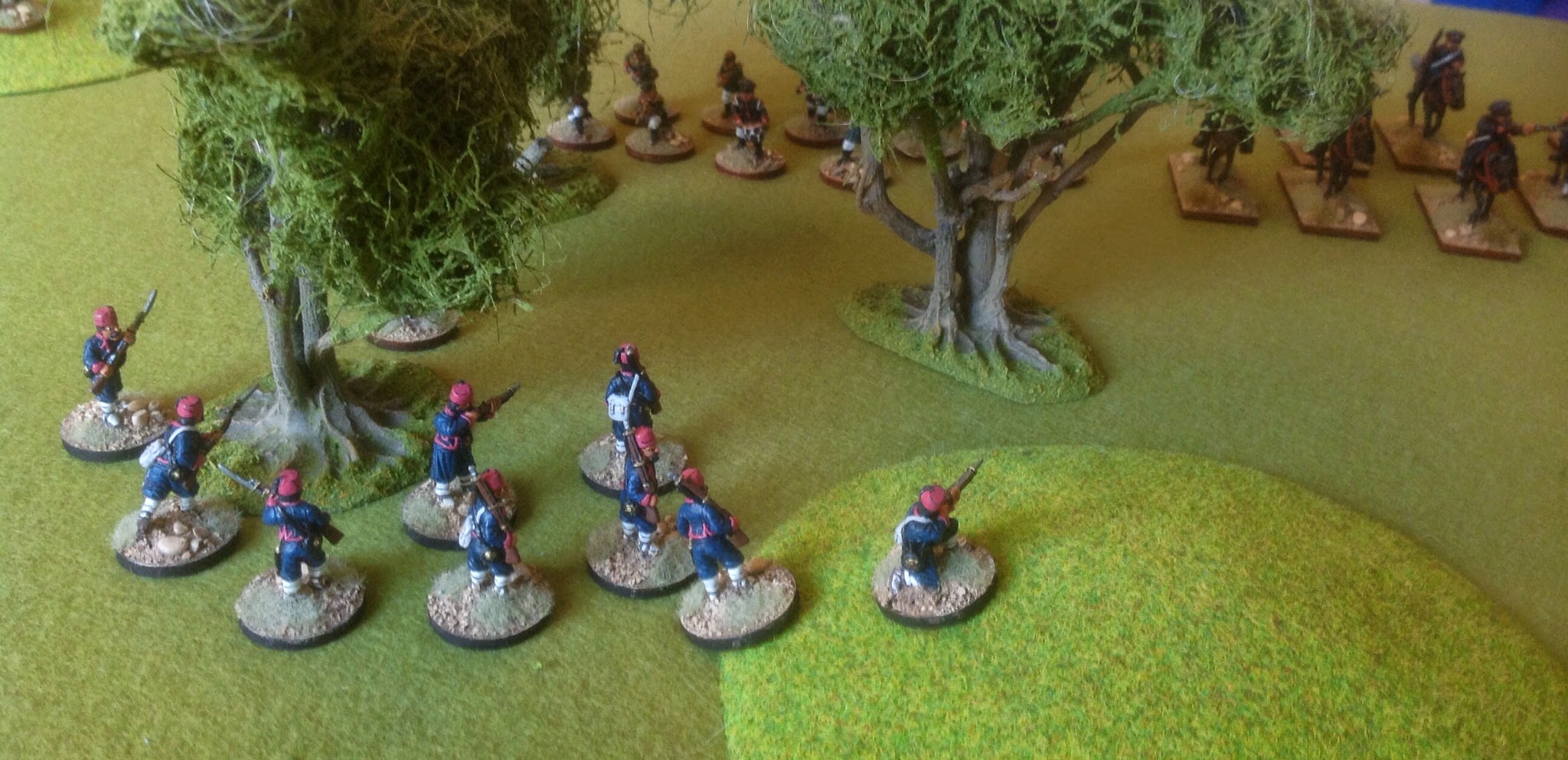
Here are a few pictures of the game. Three ten man infantry squads a side, together with a cavalry troop and light artillery.


And finally, when the Turks looked as if they might have the upper hand, our cat Rasputin intervened. At least he recognised which side he was supposed be on, positioning himself in the Russian lines. However, you might note a bit of 'blue on blue' - c'est la guerre!


Sunday, 23 November 2014

Chaldiran 1514

This year is the 500th anniversary of the Battle of Chaldiran that took place on 23 August 1514. The Ottomans led by Selim 1st decisively defeated the Persian Safavids led by Shah Ismail.

Selim came to the Ottoman throne by overthrowing his father Bayezid II and winning the subsequent civil war against his brothers. The Persian Safavids were Shia Muslims and encouraged a revolt in Ottoman Anatolia. Selim put down the rebellion with great force and advanced on Persia. The Safavids were also being invaded by the Uzbeks in the east, so they retreated in the face of the Ottoman army. The Ottomans caught them at Chaldiran in modern day northwestern Iran.


The Ottomans deployed their heavy artillery and Janissaries behind a barrier of carts. The Safavids attacked the Ottoman wings with their cavalry in an unsuccessful effort to avoid the Ottoman firepower. The Safavid army was primarily armed with traditional weapons and suffered heavy casualties as a consequence.

After their victory the Ottomans captured the Safavid capital Tabriz, which they pillaged and then abandoned, but secured permanent control over the far eastern part of Anatolia and also over northern Iraq. Shah Ismail did not take part in any further military engagements for the rest of his reign, delegating the fighting to his generals.


The Safavids learned from this battle and adopted firepower infantry and artillery in addition to their traditional horse archers, many of whom were actually Turkish tribes.

Here are some Safavids from my collection.


Foot archers


Camel gunners


Cavalry


Musketeers (reforms after Chaldiran)


Qizilbashes (Elite cavalry)


The figures are mostly from the Essex range.

Sunday, 16 November 2014

The Empty Throne

The latest Bernard Cornwell book will always be high on my reading list and 'The Empty Throne' did not disappoint.

This is Book 8 in the Warrior Chronicles set in Anglo Saxon England, featuring our hero Uhtred of Bebbanburg.


The historical context is the death of the Mercian ruler, with no legitimate heir. His wife is the obvious choice, but women rulers were rare, to put it mildly. Uhtred is wounded and a sub plot is his journey to recover the sword that wounded him. While the 'English' are divided the Vikings step up their raids on the west coast from Ireland. As usual the book ends with a grand battle, this time on the walls of Chester.

I am frankly running out of superlatives to describe Bernard Cornwell's writing. It is simply a book that you can't put down - the very best in historical fiction.

Sunday, 9 November 2014

WW1 Serbian Boys

I am always interested in military history links between Scotland and the Balkans, so this story in today’s Scotsman newspaper caught my eye.
To mark the 100th anniversary of the outbreak of the First World War, George Heriot’s school in Edinburgh has posted on its website the first instalment of what will be a four-year project designed to chart the stories of 27 Serbian boys, aged 12 to 17, who were taken in by the educational establishment in 1916.
These boys had experienced the harrowing ‘retreat’ over the Albanian mountains to the coast and then on to Corfu.
The sporting interest comes from the boys playing rugby, creating a Serbian team. They are credited with bringing the game to Serbia after the war.
The last surviving ‘boy’ was Dimitrije Dulkanovic who explained when interviewed in his eighties: “The prime of our lives were spent here in this beautiful country with your grandfathers and grandmothers. At that war time we were homeless and parentless so our gratitude to Scotland and the Scottish people will last till the end of our lives.”

Good story and well done to the school for recording it.

Tuesday, 28 October 2014

Dystopian Wars - Ottoman Empire

Dystopian Wars is popular at my club, GDWS, and having played my first game the other week, I can see why. The Victorian science fiction genre is attractive, as are the very fine models and a decent rule set.
So, what fleet should I go for. In the absence of an obvious Balkan state, no models for the Greeks yet, it of course has to be the Ottomans. The decision was made when I saw a nicely painted starter fleet on EBay, so I wasn't just going to add them to the metal pile!
This is 750pts under the rules and gives me a nicely balanced force that I can add to later.

The Commodore will reside on this Sadrazam Class battleship.

Supported by a squadron of these Fettah Class cruisers.

And some frigates from the Mizrak Class.

I will probably add to the force with some non-skimming ships. Then consider an opponent. The Greeks are the obvious choice if the models appear, but otherwise it will have to be the Russians.

Tuesday, 21 October 2014

Game of Thrones - House Stark

My painting schedule has drifted off in the last month. Busy at work and I have spent my spare evenings rebuilding the Glasgow and District Wargaming Society website. I am very pleased with the result. Please give it a visit and if you do Facebook and Twitter give us a follow there as well. I have used Weebly for this site and I am very impressed with the software.

What painting I have done is to complete my Saga Game of Thrones army for House Stark.

Ed Stark commands this force, with a figure from the Dark Sword range. A bit big for 28mm, but you can get away with this for a command figure.

The Stark and Lannister armies got their first run out on Sunday at the club. The Starks won and so Ed still has his head!


Sunday, 19 October 2014

The Long Turkish War

Soldiers and Weapons is a new series to me, published by TheSoldier Shop in Italian and English, splitting each page in half. The format is similar to Osprey, with plenty of illustrations and quality colour plates. I got my copy from Caliver Books.

No.24 is on the Long Turkish War 1593-1606. After a short introduction there are chapters on the Ottoman and Transylvanian armies as well as good description of the Austro-Hungarian forces on the military border. Military operations are in the final chapter covering the main actions and the small war that continued either side of formal operations.


The colour plates are excellent and cover all the main troop types. They include a plate of a Scottish infantryman belonging to a company based in Transylvania in 1596. This is a Balkan-Scottish link I was unaware of. It seems Stefan Bathory in Poland originally hired them. They served at the siege of Temesvar and then the garrisoned the Prince of Transylvania’s residence at Gyulafehervar. The uniform was similar to Scottish troops of the period.

Warlord Games have just released some Croat cavalry for the Thirty Years War, which would be fine for this period as well.

Somewhat tangentially, I dragged my beloved on Friday night to see the film ‘Dracula Untold’.  I had some modest hopes for this film as it at least appeared to be set in the correct historical context. The introduction was pretty accurate, describing the early years of Vlad Tepes. Sadly, as far as history goes that was it. The story disintegrated into a horror movie plot with Vlad doing a deal with a Vampire in return for superhuman powers to fight off the Ottomans, single-handed!


The portrayal of Wallachian/Transylvanian troops wasn’t too bad, but the Ottomans were too uniformed and disciplined. None the less it wasn’t a bad film and Luke Evans looked the part as Vlad. His interview at least shows that he understood the historical context and that the real Vlad is to this day regarded as a national hero in Rumania. Worth a look for entertainment value, even if not for the history.

Friday, 10 October 2014

Hannibal: Clouds of War

This is the third in Ben Kane's Hannibal trilogy and is another gripping read.

It follows two unlikely friends, one a Roman and the other a Carthaginian, as they fight in the Second Punic War. The last book ended in the Battle of Cannae and the surviving legions are dispatched to Sicily. Inevitably our Carthaginian hero is also dispatched there by Hannibal to support their ally Syracuse. The book ends with Roman siege and of course the main characters meet up, albeit briefly.

I thought I knew quite a bit about the Punic wars, the Carthaginians were my first wargames army. I also associate the Sicily theatre more with the First Punic War. So I found the historical context interesting.

As with Ben Kane's other books, there is a close attention to historical detail without it slowing up the pace of book. It has all the elements you look for in the best historical fiction. The history, action, treachery and the personal interaction. Recommended.

Saturday, 4 October 2014

Somerled and the Battle of Renfrew

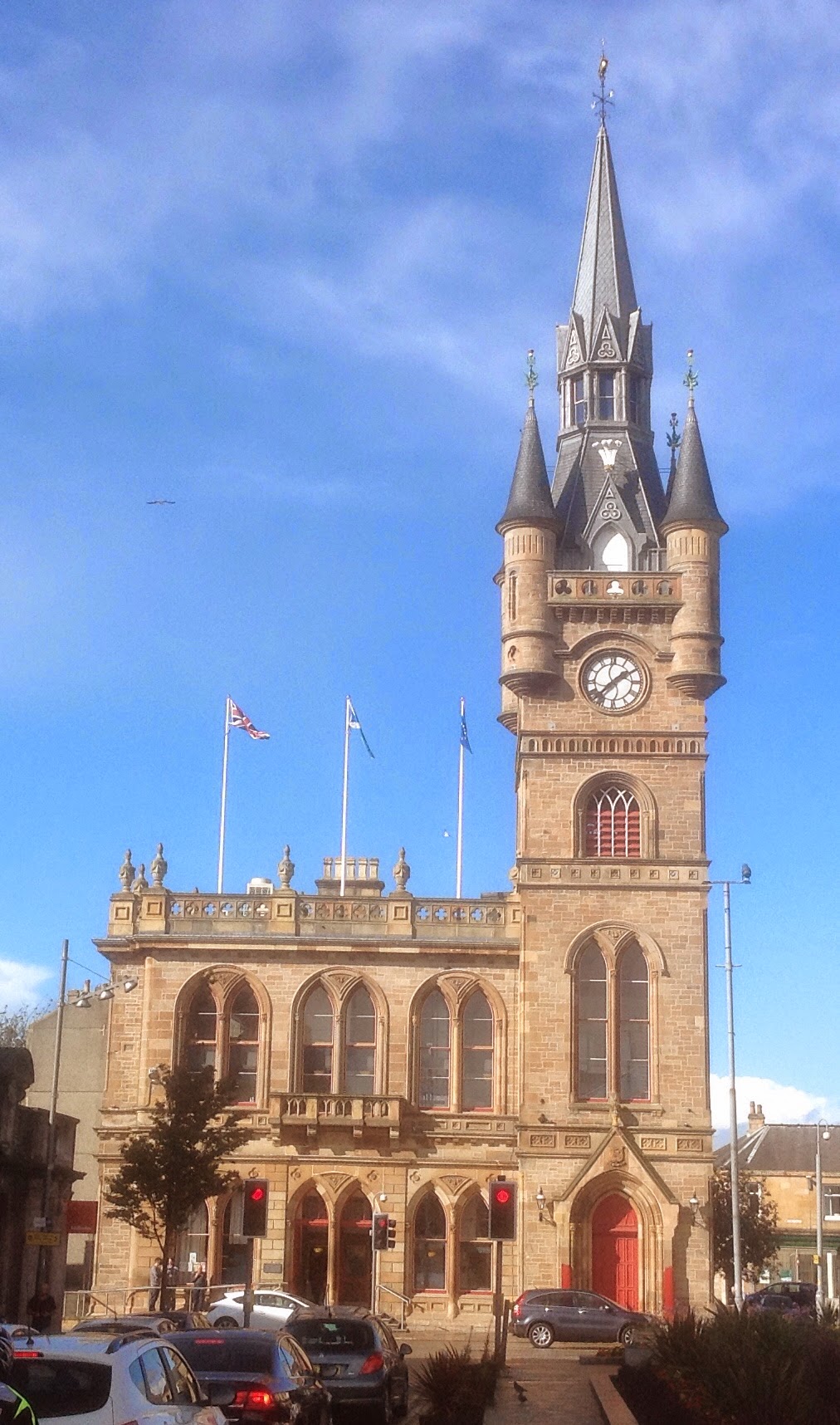
I attended the Somerled and the Battle of Renfrew conference today, held in the fine setting of Renfrew Town Hall. For those not familiar with Scottish town halls, many were built in the baronial style, and Renfrew is a particularly fine example.

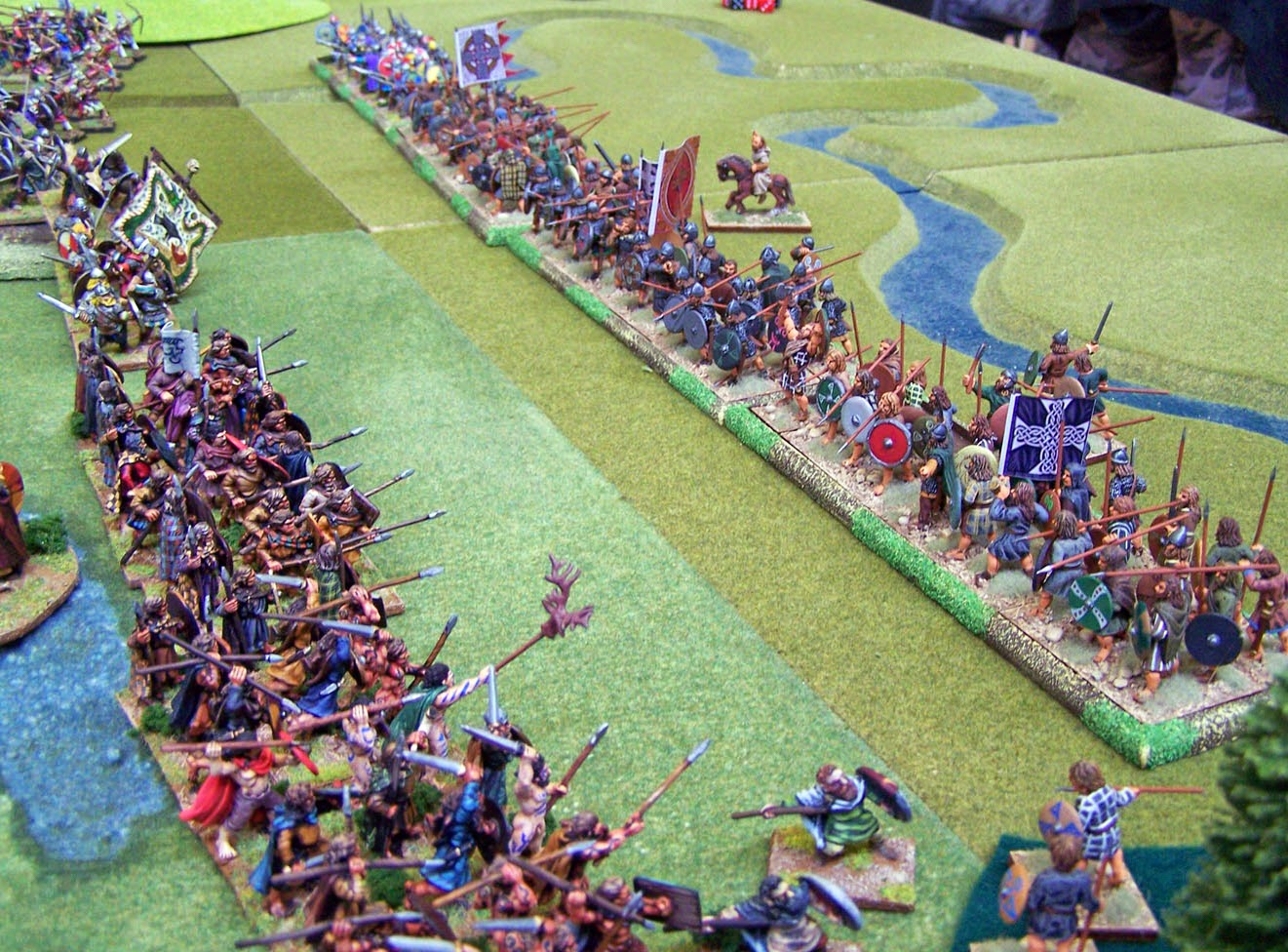
My particular interest in this local battle goes back to a GDWS display game in 2011, Somerled's Last Stand.

Somerled, King of Argyll and Lord of the Isles died at the Battle of Renfrew otherwise called, Bargarran, Knock or Inchinnan in 1164. His Islesmen, Manx and Irish allies were defeated by a Norman/Scots army led by the High Steward, Walter Fitz-Alan. We actually know very little about the battle or the forces involved, so the game was somewhat conjectural.

The first session by Ted Cowan gave us some background to the period and, for me at least, confirmation that we have very few sources. Then Denis Rixson reviewed the evidence of the West Highland galleys that were an essential element of the armed forces of the isles. Birlinns were smaller versions of the classic Viking longship, more suited to the economy and warfare of the isles. He has a new book out on the subject.

The main primary source for the battle is a later poem, 'The Song of the Death of Somerled and the Sacking of Glasgow'. Dr Alex Woolf has a paper analysing the poem and what little it tells us about the battle.

In the lunch break we had an excellent original musical interlude from the Renfrewshire Youth Music Initiative. A haunting tune that beautifully captures the battle.

In the afternoon David Caldwell talked about Somerled and the Lordship of the Isles. Again, we have limited sources. It is likely that he came from Ireland in about 1130 to lead a brilliant campaign to recapture Argyll from the Norse and eventually became King of Argyll. David outlined the likely strongpoints and administrative structures.

Derek Alexander gave us an archeologists perspective with a description of what the area looked like in the 12C and an overview of the key players. The favourite site is on the Knock, Kemp Howe in Moor Park housing estate, but no real hard evidence. What we do know is that the victory enabled the Steward's to expand across the west of Scotland.

Really interesting day, pulling together what little we know about a little known battle that had important consequences for the development of Scotland.


Saturday, 20 September 2014

Game of Thrones - House Stark

Back to the Saga, Game of Thrones project this week.

I decided to use GW Lord of the Rings figures again, this time Riders of Rohan seemed the closest fit for House Stark. I know some war gamers regard GW as the evil empire, and it has to be said their figures don't come cheap. However, they are well sculpted and unlike a lot of historical plastics they fit together well with properly designed lugs etc.

I decided to go with the grunge look for the Stark's as in the TV series. The Direwolf shield transfers are again from Vini Vidi Vici. I have some banners from Flags of War, which i'll use with the command figures that are the next paint job

These are the hearthguard.


and these are a unit of mounted warriors.


I am thinking of starting a new blog on the perils of wargamers with cats. I left these outside while I got my iPad for the photos and came back to find the cat on top of them. Much glue required for repairs. More Grrrr from me rather than Meow!

Saturday, 13 September 2014

Dividing the Spoils of Alexander's empire

I have had a Seleucid army for many years and I notice it is pretty popular amongst tournament FoG players. I can see why with its balance of quality cavalry and infantry together with exotic units such as elephants and chariots. However, my (and I suspect most players) understanding of the period was a bit sketchy.

Step up Robin Waterfield, author of 'Dividing the Spoils - The War for Alexander the Great's Empire'. It probably should have been called 'wars' for the empire, because there were at least four main wars and plenty of conflict in between. The period 323-281BC were filled, not just with conflict, but intrigue, diplomacy and treachery. Game of Thrones has nothing on this period!

Waterfield has narrated these conflicts well, almost in the style of a historical novel. It's one of those books you can pick up and read in short bursts, thanks to subchapter headings, without losing the flow of the story. Recommended.

A couple of units from my 28mm armies of the period


Tuesday, 2 September 2014

Aussies in the Far East

Some reinforcements for the Empire forces in Malaya 1942, in the form of Aussies.

These are Warlord Chindits painted up as Australian infantry. The reluctant mule is a nice touch as are the native scouts.


I picked up some more Japanese off EBay, so that's just about the project finished. Of course there is always a 'but' there. A Lanchester armoured car would be nice and ......

Sunday, 31 August 2014

More on Vis during World War Two

I have just finished the September update of Balkan Military History.

The feature article is a more detailed account of how the allies used the island of Vis during WW2 as a base to attack German garrisons in the Adriatic. There are many small scale actions that are ideal for wargaming with Bolt Action. I have tried a couple out on the tabletop. This one involves a joint attack on a fortified position on the island of Solta by partisans and commandos. It's one of the earlier raids before the Germans really dug in.

This is the German position.


Here you can see the Commandos starting their attack. Still needs a figure for Colonel 'Mad Jack' Churchill, with his Claymore!


and then the Partisans launch a flank attack.


The allies had a 1,000 point force, the Germans 600 points. It was still a difficult job to break in and thats without mines and barbed wire. One German defence position had more than 30,000 mines!

If you want to get a real feel for what it was like on the island, Bill Strutton's 'Island of Terrible Friends' is a great read. The medical facilities can only be described as basic, even worse for the partisans.


Wednesday, 20 August 2014

Commandos on Vis

Back to the Second World War and my recent trip to the Adriatic island of Vis.

Following the Italian capitulation on 8 September 1943, the Germans poured troops into the Balkans, with the 114th Jager Division supressing the Italian divisions. The partisans were not equipped to fight set piece battles so they harassed the Germans and then withdrew to the hills. The islands created a different problem for the Germans, who had limited naval assets in the region, to capture and then to hold them. None the less they eventually captured the islands closest to the coast.

While this was going on the allies, having landed in Southern Italy, were looking for an advanced base with a defensible harbour. This would be a base for RN Coastal Forces (MTB and MGBs) to raid the coast and as a base for the island partisans. A landing strip to enable close support for the partisan operations was also planned. The obvious place for this base was Vis, the furthest out of the islands, closest to Italy and with two natural harbours. The island was not new to the British, who had used it as a naval base in the Napoleonic wars.

The allied liaison officer with the partisans, Fitzroy Maclean, persuaded Churchill and Tito of the merits of his plan and got the Commandos of No.2 Special Service Brigade assigned as a garrison for the island with a remit to raid from it. This included Churchill’s son, Major Randolph Churchill.

So, having collected partisans and Germans in 28mm, I need some Commandos. Well, need is perhaps a little strong! Fortunately, Warlord do a very nice box of them, reasonably priced in plastic. Usual fiddly assembly, but they do at least provide a wide range of positions, appropriate for Commandos.


I’ll be developing some scenarios, based on actual raids, for Bolt Action. But if you want to read more, I recommend Michael McConville ‘A Small War in the Balkans’; Bill Strutton ‘Island of Terrible Friends’ and of course Fitzroy Maclean ‘Eastern Approaches’. For the naval war there is ‘Secret Flotillas Vol2’ by Brooks Richards.


There aren't a lot of WW2 sites on the island, but this is what’s left of the airstrip. It's just about the only flat bit of land on the whole island!