Welcome to my blog!

News from a wargamer with a special interest in the military history of the Balkans. It mainly covers my current reading and wargaming projects. For more detail you can visit the web sites I edit - Balkan Military History and Glasgow & District Wargaming Society. Or follow me on Twitter @Balkan_Dave
or on Mastodon @balkandave@mastodon.scot, or Threads @davewatson1683

Sunday, 12 January 2020

King in Waiting

This is the second in the prolific historical fiction author Griff Hosker's Lord Edward's Archer series. I thoroughly enjoyed the first in this series and the latest book does not disappoint.


The setting is the second half of the 13th century during the Second Barons War. Our hero, Gerald War Bow, is commanding a small company of archers in the pay of Prince Edward, son of King Henry III and the future Edward I.

Gerald is present at the Battle of Lewes (May 1264), when Simon de Montfort and the rebel lords defeated Henry and captured him and Edward. Gerald escapes the battle and takes employment in Yorkshire guarding a merchant and his convoys.

He keeps in touch with the loyal barons and takes part in the rescue of Edward from captivity. Edward gathers his forces and this culminates in the Battle of Evesham (August 1265), where Simon de Montfort is killed.

The story keeps pretty close to history, other of course than our hero's involvement. As with the first book, this stretches credulity somewhat, but this is fiction. And very well written fiction it is.

The battlefield at Evesham is well worth a visit. It is well preserved with excellent information boards and a walking trail from the town.


The hill Simon de Monfort's knights had to charge up - to their doom!

This book and the Barons War generally is an excellent source of wargaming scenarios for small battle rules like Lion Rampant. These are some of my 28mm figures.


Monday, 6 January 2020

Frontline Ukraine

Any mention of Ukraine at present inevitably focuses on President Trump's impeachment for withholding military aid until Ukraine's President Zelenskiy announced an investigation into the former US vice-president Joe Biden, and his son, Hunter. However, this masks the ongoing crisis in Ukraine and the separatist conflict in the east of the country. 

While the recent prisoner exchange may point to some progress in resolving the conflict, I was interested to understand it in greater detail. Richard Sakwa's book 'Frontline Ukraine' has been sitting on my to-read shelf for some time. The reviews indicated that this was a balanced view of the conflict, all be it challenging some of the assumptions we might make based on western media presentations.


Ukraine as a nation-state is a fairly new creation, but the author gives a brief overview of what he fairly describes as borderlands. Winston Churchill once said that the Balkans produces more history than it can absorb, and the author argues the same is true of Ukraine. If you want a proper history then I would recommend 'Ukraine- The Gates of Europe' by Serhii Plokhy. 

This title introduces one of the author's key themes - that Ukraine reflects two Europes. A struggle between Russia in the east and a wider Europe to the west. The West focuses on what it sees as Russian aggression, without recognising that EU enlargement, linked to NATO expansion, has aggravated the conditions that provoked the conflict. The basis for this conflict is the asymmetric Cold War settlement, which has consolidated the EU Wider Europe policy. This would not have been a problem until the EU allowed enlargement to be a harbinger of NATO enlargement, with understandable security concerns for Russia.

There are two primary divisions of approach within Ukraine. The Monists who support a single view of Ukraine with a distinctive history and culture, and the Pluralists who argue that post-Communist Ukraine is home to many disparate peoples. This division has played out in democratic elections and less democratic revolutions. Attempts to find federalist solutions, as other countries have done, foundered on this division.

The borders of Ukraine have changed considerably over the years. The Crimea with its Russian speaking majority was only added in 1954 because of water links. It includes the main base of the Russian Black Sea fleet at Sevastopol, a crucial security concern for Russia, who could not afford to allow NATO into its backyard. There is some polling evidence that people in the Crimea would have supported a federal approach to remaining within Ukraine, retaining the Russian base lease, but a Monist Ukraine egged on by the USA, blocked that option. 

There is no doubt that Putin annexed Crimea using Russian troops (Little Green Men) rather than the fictional internal revolt. The subsequent referendum clearly did not meet international standards, although there is unlikely to be a majority in favour of returning to Ukraine in the current circumstances. David Owen has suggested a sensible compromise of international status for the Crimea, a long lease for the base (Like Guantanamo in Cuba), followed by a referendum under international supervision after five years.

The subsequent conflict in the Donbas region is often seen as the next stage of Russian expansionism. However, this is a more complex dispute that has grassroots in the region. There has been Russian support, but Putin does not exercise the same degree of local control over the protest and subsequent militarisation. The inability to understand that this was a genuine revolt against a specific form of government has undermined subsequent efforts to resolve the conflict.  

Sakwa's main argument is that the crisis in Ukraine is a manifestation of the failure to establish an adequate structure of international politics since the end of the Cold War, coupled with the failure to address the domestic contradictions in Ukraine that have deep historical foundations. 

As with any book on current affairs, events have moved on since this book was published. However, sadly, the underlying problems have not been addressed, although there are some more recent signs that progress might be possible.

For the wargamer, this book is not a military history, it is a political and diplomatic study. For that, I would recommend Mark Galeotti's 'Armies of Russia's War in Ukraine'. This book is a useful companion and provides a well written and balanced view of the conflict that could have global implications for us all.

There are plenty of figure ranges for this conflict. These are my 20mm generic east European irregulars.

Saturday, 4 January 2020

Boer War - onto the tabletop

I have managed a fair amount of painting over the holidays, although I have been a bit of butterfly, hopping between projects. One project I have finished, or at least got to a playable stage, is the Boer War.

The final Boer units are completed with three more mounted infantry units, a town Boer infantry unit, a couple of guns, command figures and an oxen cart.


The models are all from the Pendraken range and very nice they are. The artillery is very fiddly at this scale and could do with better lugs for the wheels, but otherwise good.

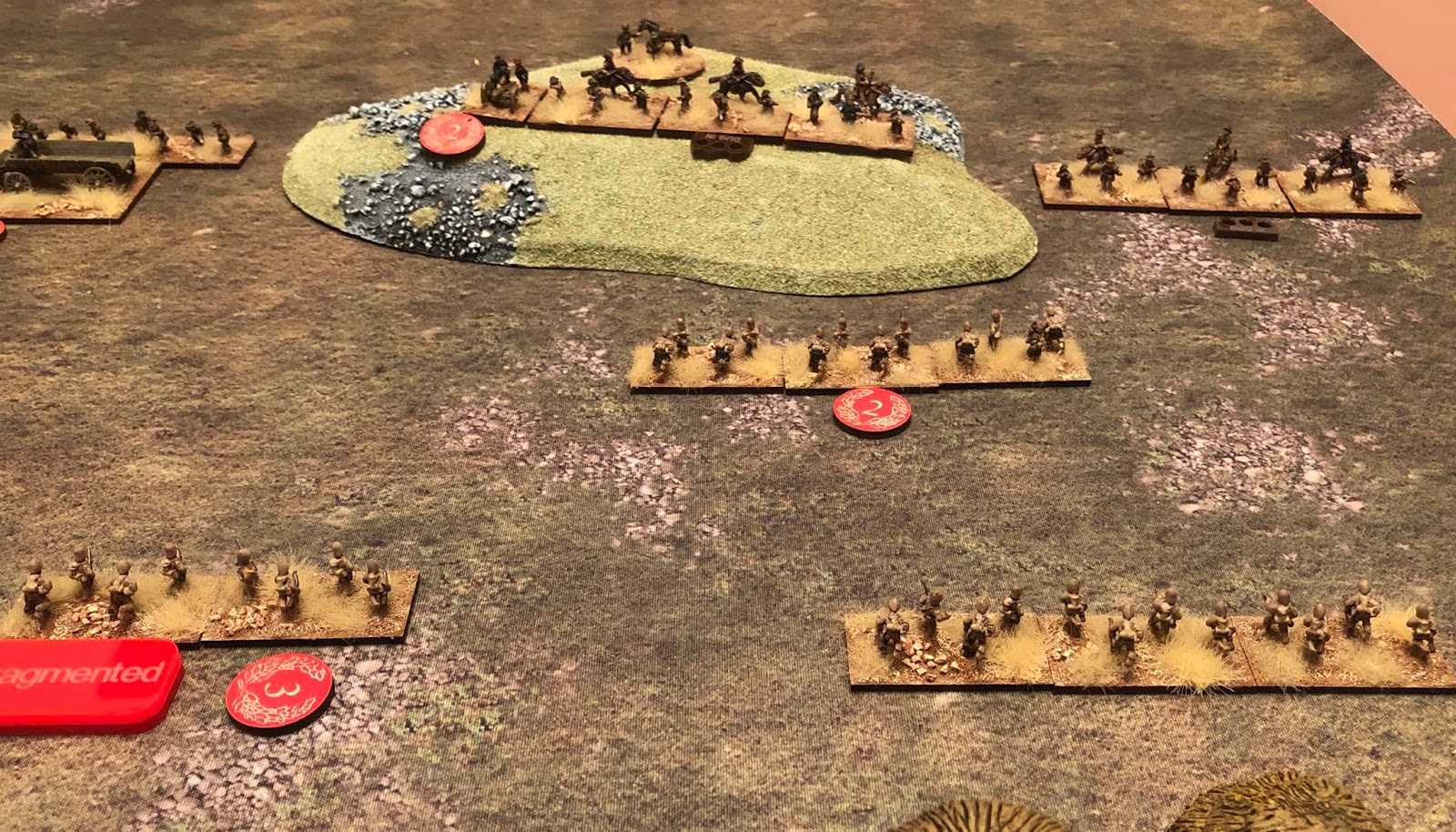
Time for a tabletop test. I have enough painted figures for more than 60pts a side in my favoured 'Men Who Would Be Kings' ruleset. That is twice the normal army size for these rules. I gave the Boers their usual high ground defensive position and so took away a couple of units.


The rules delivered a historical result, with the Brits attempting a diversionary attack on the left with Imperial mounted infantry supported by lancers, while the main infantry attack went in on the right. The Boer sharpshooters were deadly, even at long range, and the attack quickly ground to a halt.

Imperial horse skirmish with Boers on the left.

The Lancers charge, and well, they are no more!

That's as near as the British got on the right. 

Lesson learned, even a 2-1 attack ratio on the right wasn't nearly enough. Now, where is that flank?

I still have plenty of figures to paint. The ambition is to get enough units for a Black Powder game. But for now, other projects beckon.

Thursday, 2 January 2020

Birthright

My Christmas fiction reading has been ‘Birthright’ by Ethan Jones. 


The setting is late 11th century Ireland and North Wales. Our hero is Gruffudd the exiled heir to the throne of Gwynedd, one of several Welsh kingdoms fighting each other and the advance of the Normans.

The story starts in Ireland where Gruffudd is fighting for his foster father who is part of the King of Munster’s army besieging Viking Dublin. His success brings him lands and an army to cross the Irish Sea to take back his birthright.

I won’t spoil the story, but suffice to say, all does not go according to plan. There are battles, romance and betrayal, all told at a fast pace. The battle scenes are particularly well described, with little detail spared for the squeamish!

If you enjoyed K.M.Ashman’s ‘Blood of Kings’ series, this covers a similar period, if a little earlier and in South Wales. The battles are not massive and offer plenty of scenarios for the wargamer. SAGA and Lion Rampant are ideal rules for this period. Gruffudd’s army is particularly interesting, with the mix of Viking, Irish and Welsh troops.

I thoroughly enjoyed this book and look forward to the rest of the series - historical fiction at its best.


Wednesday, 1 January 2020

Happy New Year!

Happy New Year to everyone. This is where I look back on the previous year and plan projects for the new year.

My lead pile hasn't diminished much, although they are mostly newer additions. I did finish the Yugoslavian WW2 project last year and even did the Hungarians, inspired by the Fortress Budapest supplement for Bolt Action. I have made a start on the Soviets, and Santa brought me the remaining infantry units.


The 15mm Assyrians got done, and they have even been on the tabletop a few times. This project reminds me not to go to British Museum exhibitions! I also painted quite a lot of Cruel Seas boats, and the first Black Seas sailing ships are done and made it to the tabletop.

The 20mm moderns have progressed with more Russians, and I have made a start on more eastern European insurgent types. The Game of Thrones project is completed, not for the first time thanks to the discipline of show deadline.

Travel has also inspired new projects that I need to complete this year. My holiday to Crete in May resulted in various figures for the 17thC Cretan War, and they should be ready for the tabletop soon. An extended work trip to South Africa in September resulted in hordes of Zulu War and Boer War figures in 10mm. The British and Boers are nearly done, but a large pack of Pendraken Zulus haven’t even been opened yet.

I am off to Sweden in a couple of weeks for a work conference, so who knows what that will inspire!

I also have a few niche projects to finish, including a shield maiden Warband, led by Lagertha. I must stop watching the new Vikings season! Not least because it reminds me that I have always wanted to build a Rus army. I am on my third Catherine the Great Russian TV series at present, so there are bound to be consequences! This might get serious if a possible trip to St Petersburg comes off.

We had some great new wargame rules last year. It’s interesting to look back on my reviews to see which ones I am still playing! Rebels and Patriots is now my standard horse and musket rules, except for the occasional big battle using Black Powder. I have played a few games using the Bloody Big Balkan Battles supplement, but I hope to find the time for more.

I played a lot more Cruel Seas than I expected, not least because of my regular opponent at Prestwick Wargames enthusiasm for naval games, despite my remarkable dice throws. Black Seas is likely to feature similarly in the coming year. Blitzkrieg Commander is a new edition of an old favourite, which is now my go-to set of WW2 rules for 15mm and smaller - although Rommel is also good for the massive battles. 


To the Strongest! will continue to be my main ancients and medieval rules. We had a good event at GDWS last year, which is followed up by a club competition. I have also promised Simon some Balkan army lists.

Bolt Action remains my 28mm rules of choice for the 20thC and the modern adaptation. I also play a bit of ADLG, and I will undoubtedly give their new Napoleonic version a go.

I haven't done as much historical writing as I had hoped in my semi-retirement. Several weighty work papers somewhat dented my enthusiasm and time for the book project, but I did spend a couple of weeks in the National Archives doing the research. I have managed a record 100 blog posts this year and a couple of journal articles.

Anniversaries are always a hobby inspiration for me. However, it looks like the historical '20s were particularly peaceful, unusually so in the Balkans. The Illyrians were winding up the Romans in 220BC, and the Goths invaded the Balkans in 220AD. In 620 the Slavs besieged Salonika unsuccessfully but did control the countryside across much of the Balkans. In 1320 the Byzantines were reconquering parts of Greece, and in 1420 Michael I of Wallachia was defeated and killed by his cousin Dan II with Ottoman support.

In 1770 the Russo-Turkish War was still ranging and this year is the 250th anniversary of the Battle of Kagul. Into the 20thC we have the Treaty of Rapallo in 1920, which temporarily settled the borders of the what would become Yugoslavia, and the Treaty of Sevres, which partitioned the Ottoman Empire.

The respective 80th and 75th WW2 anniversaries are likely to feature strongly this year. The Italian invasion of Greece is an interesting campaign, as is the Norway campaign. The fall of France and Operation Sealion will be popular, and will be the GDWS display game this year – Captain Mannering as well!


1945 signals the end of WW2 and a public holiday will be moved to recognise VE Day in the UK. We shouldn’t forget the Pacific War and the often forgotten Soviet-Japanese War. In the Balkans, we had the siege of Budapest and the race for Trieste. Not to mention the founding of my adopted Balkan football team, Red Star Belgrade!

Outwith the Balkans, modern wargamers might be attracted to the conflicts in Lebanon and Jordan 50 years ago as well as the latter stages of the Vietnam War. The Polish-Soviet war in 1920 is pretty epic. The Mexican Revolution comes to a sort of end with Pancho Villa surrendering and the Irish War of Independence ends with the partition of Ireland in the same year. 

Earlier, the Thirty Years War was grinding on in 1620 with the Battle of White Mountain. In the medieval period we have the Hussite Wars in 1420, the Livonian Crusade and Mongol invasions of 1320, and crusader campaigns in Spain and the Levant in 1120. For those reading Bernard Cornwell’s current series, Uhtred and his brother Ealdred submitted to the overlordship of the Saxon King Edward in 920 – surely not!

So, that’s it for the coming year. Here’s wishing everyone an enjoyable year ahead and say hello on-line or at the shows. Make sure you make time for the hobby in your busy lives – it's an important element of good mental health, and it's fun!

Friday, 27 December 2019

Review of 2019 Books

2019 was another fruitful year for books, and I am pleased to see that sales of the printed word have increased this year. In particular, I want to thank the specialist military history press, Pen and Sword, Helion and Osprey, for their prolific output. Here is my pick of the year.

The Cretan War 1645-1671, isn't a conflict that many will recognise, but at the time it dominated the eastern Mediterranean. The focus was the siege of Candia (modern Heraklion) and drew in volunteers and mercenaries from across Europe. Bruno Mugnai provides not just a narrative history of the conflict, but also a detailed description of the armies backed up with colour plates. I visited Crete earlier this year, and this book was the essential companion, although the wargame figures are still awaiting a paintbrush.


Carole Divall’s biography of Sir Ralph Abercromby brought a less well-known commander of the French Revolutionary Wars into focus. The book is really a study of British involvement in this conflict, which is often overlooked by the larger scale Napoleonic wars that followed.

In The Great Illyrian War, Jason Abdale introduces the Illyrians and their conflict with Rome to the general reader. I had a few criticisms of the book's style, but it opens up a little-explored period of Balkan history. 

Arras Counter Attack by Tim Saunders is the sort of detailed operational history, which is very difficult to write understandably. The Matilda tank is probably my favourite AFV of WW2 and next year's 80th anniversary of this battle will be an excuse to pick out another scenario from this book.

2019 was the last in the Game of Thrones TV series, which I thoroughly enjoyed and regularly wargame. David Weinczok has made a possibly too higher claim for Scotland being the context in his The History Behind Game of Thrones, but it's fantasy, so why not! 


I often find aviation history hard to read, but Alexander Mladenov and pals have done a good job with their The Bulgarian Air Force in the Second World War. A bit obscure for most, perhaps, but I enjoyed it. 

I had never even heard of the Trieste Crisis 1953 before picking up Bojan Dimitrijevic’s book. This is hardcore military history with comprehensive ORBATs and equipment schedules, as well as being profusely illustrated. This is a conflict I must try and get onto the tabletop.  

Julie Peakman’s Hitler’s Island War, tells the story of the Leros campaign in WW2, mainly through the extensive use of letters, diaries and interviews, which make a very readable account of this botched British invasion. 


Alexander Watson’s The Fortress is not a cheery read. He tells the story of the siege of Przemysl in 1914 where obsolete defences and elderly reservists held back the Russian steamroller on the eastern front, for a while at least. Pretty harrowing stuff, but well worth a read. 

I haven't added significant numbers of Osprey books to my already vast collection this year. Mark Galeotti’s writings on modern warfare are always worth a read, and his Armies of Russia's War in Ukraine is particularly useful. I also enjoyed Kos and Leros 1943 by Anthony Rogers and Nicholas Sekunda’s The Army of Pyrrhus

I should touch on the historical fiction I have enjoyed this year. A special mention goes to Matthew Harffy’s, Bernicia Chronicles, and I also enjoyed Griff Hosker’s Lord Edward’s Archer. Of course, no review of the year would be complete without the latest Bernard Cornwell book, Sword of Kings – magnificent as always.


Roll on 2020!

Tuesday, 24 December 2019

Neville Chamberlain's Legacy

To most of us, Neville Chamberlain was a posh Tory Prime Minister who thought he could secure peace through appeasement with Hitler. Well, he was all of those things, but as ever the story is a bit more nuanced.

In a new biography, Nicholas Milton gives us a more rounded picture of Chamberlain. His private letters to family and friends provide an insight into his thinking and reveal much about him as a politician.


Chamberlain entered politics late, particularly given his famous political family. He worked in the family business before getting drawn into local government in the family's Birmingham base. In many ways, he was the archetypal hunting, shooting, fishing toff, although he gained a reputation championing public housing as well as widow's pensions and the first midwifery service.

His love of nature, particularly bird watching, is probably the most striking if a bit repetitive, feature of this book. At all the key historical moments, he was exchanging letters with fellow enthusiasts and wandering through St James Park with his civil servants. This love of nature had institutional consequences through the establishment of The Wildlife Trusts and his support for the Campaign for the Preservation of Rural England - although his participation in driven grouse shooting seems a bit bizarre today!  

Foreign affairs dominated his period as Prime Minister. He was determined to secure peace, scarred as many of his generation were after the horrors of the First World War. His cousin Norman was killed in 1917.

He was convinced that Musso, as he called Mussolini, could be detached from Hitler, despite the advice of the Foreign Office and plenty of evidence to the contrary. A policy he pursued even after the outbreak of war. In April 1940 he wrote to his sister saying that “Musso will go as far as he dares to help Hitler without actually getting himself involved in the war.”

It is often forgotten today, but the Munich Agreement was popular at the time. The author dedicates a chapter of the book listing the astonishing array of gifts and other acknowledgements from a grateful world. Sponsoring hospital beds in his name was particularly popular and some 40,000 letters and gifts flooded into Downing Street.

He was eulogised by the right-wing press, including the Daily Mail, whose owner Lord Rothermere was an admirer of Hitler. In the early 1930s, Rothermere was so close to Oswald Mosley’s British Union of Fascists that Daily Mail staff began to mimic their dress – wearing black shirts to work.

Even after Hitler broke the agreement and occupied the rest of Czechoslovakia, Chamberlain persisted with appeasement. Although he did start to rearm, mainly the RAF, after years of cuts. Even after war broke out following the invasion of Poland, he didn't believe Hitler would attack in the west. Chamberlain thought Hitler would seek to wear down the British through 'boredom'.

Once this delusion ended, he remained in the war cabinet after resigning as PM in favour of Churchill. I didn't know he was the creator of the Special Operations Executive (SOE), which made an important contribution to victory.

Chamberlain died on 9 November 1940 of cancer. He reflected “I regret nothing that I have done and I can see nothing undone that I ought to have done". History has not agreed with this assessment, understandably so.

I had expected a more sympathetic biography, but the author doesn't spare us Chamberlain's many faults. Instead, he gives us a more rounded picture of the man and the politician in the context of the period.

Next year is the 80th anniversary of the 1940 campaigns that ended Chamberlain's premiership. He could have used our cat to keep the peace!

Saturday, 21 December 2019

Soviet Armour - SU-100

The next stage in my Soviet Bolt Action force, to take on the late-war Hungarians, was a choice of AFV. I was tempted to repaint a spare Sherman, as the Soviet Southern Front armies had a lot of Lend-Lease kit. However, the model I picked up appears to be a little on the large size. The ubiquitous T34 was an obvious choice, but I fancied something different and decided on the SU-100.

The SU-100 was the next stage in the development of Soviet tank destroyers after the SU-85 was struggling to match the latest German designs, particularly the Panther. The 100mm D-10S gun could penetrate even the front armour of the Panther at a range of 1500m. It also had thicker armour and a better commander workspace. 

Mass production began in September 1944 and it was used in large numbers in Hungary, another good reason for my choice of AFV. Over 2300 were built by the end of the war and it continued in service for many years in both Soviet and other armies around the world. Most recently one was spotted in the Yemen conflict.

On to the model. I have decided that 3D printing is the way forward for guns and vehicles. This model is from Butlers Printed Models. It comes in one piece, no messing about and hardly any flash. This photo is straight out of the box.


Like most Soviet AFVs, this isn't a complex paint job. A primer spray and some dry brushing produces a decent outcome. I have looked a lot of pictures and some SU-100's have no markings, others just a number and others a red star. I had a spare red star in the transfer box, so that's it. Just a matt varnish spray and it is ready for the tabletop.


I'm assured Santa is bringing the infantry for Xmas!

Thursday, 19 December 2019

True Soldier Gentlemen

Since the end of Bernard Cornwell's Sharpe books, I have missed a good series of Napoleonic historical fiction.

It is now 13 years since the last in the series, and although Bernard is still churning out great books, it doesn't look as if Richard Sharpe is going to make a comeback. I still have a vain hope that he might turn up, as many of his riflemen comrades did, with Bolivar in the South American Wars of Liberation.

It is a tough act to follow, but I had missed Adrian Goldsworthy's series, which starts with 'True Soldier Gentlemen'. I associate this author with the Roman army and have several of his non-fiction books on that subject. He has published six in what he said was a planned 12 books, culminating in Waterloo. The first six came out at a very steady pace, but there hasn't been one since 2015.


Unlike the Sharpe books, which are focused on one character, this series has a range of characters serving in the fictional 106th Regiment of Foot. The author explains that he has largely mirrored the actions of the 29th. We also get a bit of context with occasional diversions into the activities of Wellesley and his French opponents.

The story starts in 1808 as the regiment prepares for service abroad. The focus is on a group of junior officers in the regiment and one gentleman volunteer. The first half of the book introduces the reader to regimental life in Britain and the struggles of the typical officers, who were not wealthy enough to purchase a commission. While I accept the necessity to establish the characters and the storyline, this did drag on a bit.

The regiment is included in the expedition to Portugal and the second half of the book covers the battles of Rolica and Vimeiro, which established Wellesley as a commander in the European theatre of operations. The military establishment at the time didn't really count his victories in India.

There are a couple of side stories, which have Sharpe like features to them. However, otherwise, this is the story of a conventional line regiment. And none the worse for that.

Despite the slow start, I enjoyed this book and will read more.

I might even dust down my Peninsular War armies for some tabletop action.


Sunday, 15 December 2019

Soviet Artillery

I was in urgent need of some distraction this weekend. For those reading this from outside the UK, the country has justed voted for a buffoon as Prime Minister. It is at times like this that the hobby brings some much-needed therapy.

So, I looked at the lead mountain and Soviet artillery seemed somehow appropriate. With some of Henry Hyde's excellent Patreon podcasts as background, paint was applied.

When we think of Soviet armies in WW2, we tend to focus on T34 tanks and serried rows of infantry. However, it was artillery that the Soviet commanders called 'The God of War'. Unlike other armies, the Soviets used their artillery more in the direct fire mode. Not least because lower educational standards made it difficult to recruit forward observers. For the Bolt Action tabletop game, bigger guns are also not really appropriate. Not that it stops some gamers deploying Nebelwerfers!

I started with the ubiquitous 76mm ZIS-3 Field Gun, the mainstay of divisional artillery in WW2. A staggering 103,000 of these guns were produced. This is a Butlers 3D printed model. I have decided that 3D printing is the way to go for guns and tanks in 28mm. I am fed up with poorly designed kits, inadequate instructions and superglued fingers. These models may lack a bit of detail, but they are robust, and most importantly, come in one piece. There is a bit of flash, but this is just pulled off with plyers. I couldn't find anyone who sold stand-alone gun crew, so I had to adapt some mortar crew.


Then I needed an ATG. These are later war Soviets that will take on my Hungarians, but I wanted a manageable piece for the tabletop. I, therefore, went for the 57mm M1943 ZiS-2. Some 10,000 of these effective ATGs were produced, which could penetrate the armour of late German tanks, including the Panther and Tiger. They were still being used in Africa in the 1990s.


Therapy over for now, but still plenty more Soviets to paint!


Sunday, 8 December 2019

Carthage’s Other Wars

Outwith the Balkans, I am always drawn to a new book about Carthage. It was my very first wargame army, although, like most wargamers, it was a Second Punic War army led by Hannibal.

Books on Carthaginian campaigns outside the Punic Wars are rare. So, this new book, Carthage’s Other Wars, by Dexter Hoyos (Pen and Sword), is very welcome.


The author starts with the city and state, in the context of the Mediterranean during the ancient period. Carthage was at its core a trading state, and this was reflected in the army and fleets, which relied heavily on mercenaries.

We then get a narrative of the numerous wars Carthage engaged in from the 5th century BC. These campaigns mostly involved Sicily where Carthage established a territory in the west of the island called the epikrateia. This brought Carthage into conflict with the Greek city-states in the east, primarily Syracuse. These campaigns occasionally threatened Carthage itself, although only once did a Greek army set foot in the African homeland. 

By the summer of 264, Carthage and Syracuse became formal allies in the face of the growing power of Rome. Once invited to intervene in Sicily, the Romans never left, ending the Greek wars and opening the first chapter of the Punic Wars. 

The campaigns in Africa and Spain are briefing covered. Carthage expanded into Libya and established new colonies. This brought them into conflict with the native Libyan peoples and the Numidians, although the latter were often allies. The stress of the First Punic War led to the Truceless War in Libya, which involved atrocities that were horrific even by the standards of the period.

After losing Sardinia and most of Sicily, Carthage invaded Spain in 237. They quickly developed a significant empire, which brought in substantial revenues and revitalised the state. It was here that the nine-year-old Hannibal learnt the art of war from his father, Hamilcar.

The challenge in writing a book on these wars is the scarcity of sources. I would have loved to find out more about the early Carthaginian expeditions, which went as far as the west coast of Africa. However, the longest surviving Carthaginian text is just three pages long. Modern archaeological work has uncovered some parts of the early city, despite the destruction and subsequent rebuilding by the Romans. I had the pleasure of visiting the site a few years ago.  

The harbour area today

Mostly later Roman ruins
This means we rely on mostly non-Punic sources, including Greek and Latin records. Even these, like Diodorus of Sicily, were written around the time of Julius Caesar. Self-evidently they are not telling the story from a Carthaginian viewpoint. Some were more objective, including Aristotle who put the Carthaginian system on a par with those of many Greek states.

The other challenge is names. Individual Carthaginian names repeatedly occur over the centuries. Hanno, Hamilcar, Hasdrubal and Mago pop up frequently. The author does his best to make sense of the story, but it does make the narrative a bit difficult to follow.

Allowing for the historical challenges, Dexter Hoyos does his best with the limited and often contradictory sources. The narrative of the wars in Sicily can get a bit tedious after a couple of chapters, and I enjoyed the early and later chapters covering the other campaigns the most. This book opens up a period that deserves closer attention and for that alone is worth a read.     

Libyan spearmen from my current 28mm Carthaginian army
  

Saturday, 7 December 2019

Eastern odyssey of the Anglo-Saxons

In this month's BBC History Magazine, Caitlin Green tells an interesting story of a journey made by post-Norman Conquest Anglo-Saxon exiles.

For Anglo-Saxon nobles, after the conquest, there were two options. Make peace with the Normans or go into exile. The story of how the exiles sailed to Constantinople and became part of the Varangian Guard is fairly well known. They set sail for the Mediterranean raiding and looting, with modern Ceuta, Majorca and Minorca amongst the targets. They arrived in Constantinople around 1075 when the Emperor took them into his personal bodyguard. One of the exiles, Hardigt, is credited with becoming commander of the imperial fleet.

So far so good, but Caitlin Green says that they then asked the Emperor for lands of their own. He offered them former Byzantine territories in the Crimea if they could conquer them. The Jatvaroar Saga says that a force led by Earl Siward did just that and called it England, with the main towns called London and York.

Many historians have dismissed this story as fanciful, but there is evidence that the Byzantines did regain control of the region around 1100. Place names in 14th-16th-century coastal charts refer to a 'Varangolimen' in the Crimea, as well as 'Londina' and 'Susaco'. Franciscan friars who passed through the region in 1246-47 say that Christian 'Saxi' defended themselves against the Tartars.

The Varangian Guard continued until at least 1204, and it has been suggested that these Crimean settlements, 'Nova Anglia', provided replacements. They weren't the only source of manpower as the guard recruited fairly widely after the initial Viking recruits.

There is no firm evidence as to how long the colony survived. However, there are references in the official records as late as the mid-14th century. The De Officiis record states that they wished the Emperor good health at Christmas, in English. That would be 300 years after their ancestors left England.

Possibly not a large enough colony to justify an army list under big battle rules, but a skirmish or two using Lion Rampant might be justified. We have little idea of how they developed over 300 years, but they would have been aware of military developments and probably allied with local tribes. The Greeks had colonies in this area in ancient times, so the concept is not that outrageous. Either way, it's a good story!

Varangian Guardsmen from my collection.


Tuesday, 3 December 2019

Soviet riflewomen

My work is taking every waking hour of my life at present, and a few of the sleeping ones as well. So, I decided I needed a day’s break from the computer screen to do some painting.

Looking for a quick option from the lead mountain, I choose some Soviet riflewomen that I picked up from Bad Squiddo Games. Having finished the Hungarians, I needed some Soviet opponents and I wanted some different units to break up the monotony of the standard rifle squads.

Some 800,000 women served in the Soviet armed forces during the Second World War. Like most of the combatant nations, this was mostly in medical and auxiliary units. However, the Soviets did allow a significant number of women to join combat units. 

The snipers are probably the best known, with 2,484 serving, of whom about 500 survived. Lyudmila Pavilchenko was the subject of the 2015 film Battle for Sevastopol. Nicknamed Lady Death, she was credited with 309 confirmed kills. Bad Squiddo do a very nice female sniper team, which I will paint when I have a bit more time to do them justice.

There were also three all women air regiments, one fighter and two bombers. Women also constituted significant numbers to the partisan units. Nearly 200,000 women were decorated and 89 received the highest award, the Hero of the Soviet Union.

This is my first batch off the painting table. The figures are nicely sculpted by Alan Marsh and come in a blister pack of six. Virtually flash free as well.


Tuesday, 26 November 2019

The Fortress - The Great Siege of Przemyśl

The Fortress by Alexander Watson is the story of the fortified city of Przemyśl in the First World War. Today, it lies in the south-eastern corner of Poland, on the modern border with Ukraine. At the start of the twentieth century, it belonged to the Habsburg Empire and was the main garrison defending the province of Galicia.


In September 1914, the Russian army routed the Austro-Hungarian field army in Galicia and the fortress at PrzemyÅ›l was all that stopped the Russian advance deep into the Habsburg domains. The 130,000 man garrison was a ragtag collection of reservists from across the empire. 

They were, in the main, the oldest age group, between 37 and 42 years old, commanded by academics, businessmen and middling state officials with reserve commissions; or, as one bluntly described his comrades, ‘well-past-their-prime fatties’. Typically, the officers commanded troops of a different nationality and did not speak the language of their men.

The fortifications were also pretty old and some cases obsolete. The outer defences covered some 48km with 17 main and 18 subsidiary forts. They were latterly joined up with trenches, some hastily built. When war broke out the fortress was unprepared and antiquated. Fortunately for the Habsburg troops, the Russians had no siege artillery, although their experienced artillery still put down accurate bombardments. 

The fortress commander was Hermann Kusmanek, left stranded in a fortress 70km from the field army. The Russian commander Brusilov was initially told just to screen the fortress, but he believed he could storm the fortress, thereby releasing some 90,000 troops for the next stage of the offensive. However, the assault failed and the siege had to be abandoned as the Habsburg field army mounted a counter-attack that relieved the fortress. The ‘fatties’ had held on!

Within a month the field army had again been defeated and the Russians were back. This time there would be no relief as Habsburg armies tried to break out through the Carpathian Mountains in winter. The Russians simply blockaded the fortress and starved the garrison into surrender. 9 Habsburg generals, 2,500 officers and 117,000 other ranks fell into Russian hands. One in five died in captivity.

The author tells the story of the men and the civilians who endured the siege. It is a harrowing tale of atrocities, corruption and deprivation. Particularly for the rank and file troops and the civilians left behind. Well research and written, it tells a story of a key turning point for the Austro-Hungarian Empire in WW1 that most will never have heard of.

Austrian infantry - no 'fatties' here!

Tuesday, 12 November 2019

Attack at Dawn - Narvik WW2

I have always been interested in the Norwegian campaign of May 1940, and I suspect it will attract new interest as the 80th-anniversary approaches next year. I have visited some of the battlefields and the fine museum in Oslo. It would also make a great, if challenging, demonstration wargame for a show.

I, therefore, picked up a copy of Ron Cope's book, 'Attack at Dawn: Reliving the First Battle of Narvik in World War Two', with some interest as I know very little about the naval aspects of the campaign. My recent games of Cruel Seas has sparked a bit more interest as well.


This is a very personal book, inspired by the author's father who served as a Torpedoman on the destroyer HMS Hardy. He was the first to fire a salvo of torpedos in Narvik harbour. He has done a huge amount of research, assisted by his own naval service, including interviews with other sailors serving on the ship.

HMS Hardy was commanded by Captain Warburton-Lee, who was also the flotilla commander of five destroyers who attacked German shipping in Narvik during April 1940. Their repeated attacks on the harbour were very successful, sinking German destroyers and merchant ships. However, on the way out of the Fjord after the attack they ran into a much stronger German fleet including cruisers. Hardy was heavily damaged and the decision was made to beach the ship. Many of the crew made it to shore and were picked up during later attacks.

This is a micro-history of the battle, with the narrative painstakingly developed. In wargames, we abtract such a lot that it comes as a bit of a shock when you read the detail of how a destroyer operated in battle.

The detail means this is not an easy read and I did struggle on occasions.  I understand the temptation to include all your research in a publication, but this book would have benefitted from a bit more editing.  It is quite difficult to follow the bigger picture of the battle.  

None the less, if you want to understand how WW2 ships were fought, in pretty difficult circumstances, this is a good book. For a general understanding of the campaign, there are better options, including Maurice Harvey's 'Scandinavian Misadventure'.

Below are a couple of life-sized dioramas from the military museum in Oslo.


Saturday, 9 November 2019

Sword of Kings

Sword of Kings is the latest in Bernard Cornwell's Last Kingdom series. This follows the fictional story of Uhtred of Bebbenburg and his early 10th-century engagements around England. This is the twelfth in the series if you don't count the TV series, so our hero is beginning to feel his age.


Bernard Cornwell is, without doubt, the greatest living author of historical fiction and he doesn't let us down with this latest offering. Uhtred is bound by his oath to Aethelstan to support him as King Edward lies dying in 924AD. He sails south from Northumbria to rescue Edward's Queen and children. Aethelstan and Aelfweard will ignore Edward's wish to split the Kingdom between Wessex and Mercia and will fight it out.

Most of the action takes place in London, a key strategic point between Wessex and Mercia, not least for its wealth. I won't spoil the story, but it has all the elements you would expect. Black humour, some new female interest for Uthred, and of course brilliant action. As usual, impossible to put down.

Northumbria remains apart from the new English state. So, there will be another book. Can't wait!

Too busy at present for much gaming, but this book is great inspiration for a bit of Dark Ages wargaming.


Tuesday, 5 November 2019

Black Seas

For a confirmed landlubber, I do seem to be playing a lot of naval games recently. Cruel Seas started the trend and now a shiny new box has arrived from Warlord Games - Black Seas.

One of my reasons for not playing naval games has been the complexity of the rules. Cruel Seas is a very straightforward system and Black Seas, while a bit more complex, follows that lead.


I bought the starter set, Master and Commander, which gives you all you need to get started. The rule book, dice, markers and measuring aids. There is a paper playing surface, but I use a nice mousemat version from Deep Cut.

You also get three frigates and six brigs. I have been critical about Warlord models. Their plastic AFVs are far too complex and delicate for wargamers, and the better resin models rarely have proper instructions or lugs for assembly. Gun barrels are a particular irritation. However, like the Cruel Seas models, these go together very well and the all-important mast sections went in with a reassuring click. If you want to add extra detail, it gets a lot more fiddly. The sails are not bad with a press-out card that can be bent around a pen and glued on. The acetate ratlines need cutting out and are very fiddly to glue in place on the smallest ships. As for the cotton rigging, one look at the book convinced me that this was not for my large fingers! None the less even without these additions, the 1/700th models look fine.


The rules use similar mechanisms to Cruel Seas. The wake markers and the ship cards will be familiar, although irritatingly they are a different size so don't really fit into my custom MDF holders, which I use as a replacement for the pretty poor paper clips in the game.  Obviously, the main difference is the importance of wind and the mechanisms are a lot more straightforward than other games I have played. This won't stop me crashing into my own ships!


Shooting is also similar with a base hit, a few modifiers and accumulated damage points. As with all rule sets in a series, the author has taken on board feedback from Cruel Seas with some of the mechanisms, including a Break Value. Advanced rules add extra options like ammo types, fire ships and the weather.

There are plenty of scenarios, although I doubt many players will reach Trafalgar! I certainly will have glued all my fingers together by then. There are fleet lists and background info on some nations as well as a helpful section on terminology. Nothing for the Ottomans or the Russians, but I'll take that as a challenge. Finally, there is a chapter on campaigns.

Like Cruel seas, my scenarios of choice will be in the Adriatic, where British and French frigates fought it out. I'll be re-reading Malcolm Scott Hardy's book, 'The British and Vis - War in the Adriatic 1805-15. 

I doubt I will be building fleets (2 frigates and 2 brigs so far), but my initial impressions are positive. This looks like another fun game.

Early tabletop action!