Welcome to my blog!

News from a wargamer with a special interest in the military history of the Balkans. It mainly covers my current reading and wargaming projects. For more detail you can visit the web sites I edit - Balkan Military History and Glasgow & District Wargaming Society. Or follow me on Twitter @Balkan_Dave
or on Mastodon @balkandave@mastodon.scot, or Threads @davewatson1683

Monday, 29 June 2020

Russ Druzhina

I have long had a fancy to collect a Russ army, but never quite got around to it. Then along came the Russian 2018 TV series, The Golden Horde. It is showing with sub-titles on Amazon Video.


This is based in the Thirteenth Century when the Russ states were paying tribute to the Mongol offshoot, the Golden Horde. There are sixteen episodes, so settle down for a long journey. I am a big fan of Russian historical TV. The history may be a touch speculative, but the setting, costumes etc are brilliant.

As wargamers disease had struck, it occurred to me that I could use Russ figures for Lion Rampant or SAGA and as one of the eastern states in my Oathmark campaign. Hence the imaginatively named city of Gorod!

In 28mm, the Russ means Gripping Beast. The first unit off the painting bench is some Druzhina cavalry. These were the household troops of the Russ princes, although they could reach substantial numbers. Alexander Nevsky had 3000 troops in his Druzhina.

The figures needed a bit of a cleanup, and have an irritating level of assembly required for metal figures. The lances I accept, but not scabbards, bows and quivers. Needless to say to shields have poor connections to the arms.

You get a random range of shield types, which is particularly irritating when ordering shield transfers. I have generally had a positive experience with LBM transfers, but these were very difficult to peel off the plastic cover. I just about got six usable ones from a sheet of twelve.

Anyway, here they are. Some infantry next.


Sunday, 28 June 2020

Porphyry and Ash

My latest bedtime fiction reading has been Peter Sandham's 'Porphyry and Ash', which is based around the siege of Constantinople in 1453.


The author keeps fairly close to the history of siege, even taking actual historical characters and developing them. His main character is a Scot, John Grant, who arrives in the city as a mercenary, seeking repentance for a shady past. While Scots have a habit of turning up any war, I didn't know of this one. 

The other is Anna Notaras, daughter of the Byzantine Megas Doux, Loukas Notaras. She gets involved in a significant number of sub-plots, which take the reader into the history and factions of the last Roman occupants of the city.

The story of the siege is told from the inside. The Ottomans are largely kept 'over the wall' until of course the Janissaries finally breach them. The tensions between the Genoese and Venetian communities as well as the religious divide are all teased out.

The life of the city has been thoroughly researched. This shows in the detailed descriptions of everyday life - the food and drink, the streets, occupations and business. You can smell the city in the words.

This isn't a Bernard Cornwell style historical fiction. The battle scenes are excellent, but you get a slow build-up with many sub-plots to consider. As others have commented, this is historical storytelling at its best.

I really enjoyed this story and I have already downloaded the next in the series.

28mm Janissaries of the period


Saturday, 27 June 2020

War in the Aegean

There have been many books written about the war in the Aegean, including some recent ones like Julie Peakman’s ‘Hitler’s Island War’, which focuses on the stories of those who lived and fought on the island of Leros. I have recently returned to an older book (2008) by Peter Smith and Edwin Walker on the subject.


 In this book, the authors give the reader a decent narrative of the campaign, but also a careful analysis. The appendices alone are very instructive. 

The key strategic arguments, for and against the campaign, are well-argued. At the highest strategic level, it was another example of Churchill’s ‘soft underbelly’ as against the direct approach favoured by the USA. This campaign also had more grand tactical implications. Hitler was always going to want to defend the islands for fear of allied bombing on his crucial Romanian oil supplies. An economic aspect of Hitler’s strategy that is often understated.

The author’s sum up the USA position well:

“The United States never had the slightest interest in either the Balkans or the Aegean area, and it saw any attempts by Britain to take the war into this area as mere stalling for time from an ally that was reluctant to face the cost in the final reckoning, which it knew must be decided in Europe. “On to Berlin” was the only strategy the Americans were interested in. They were not interested in the Dodecanese, except for a strong inclination to try to keep Britain out.”

The authors don’t hide their own view:

“In examining the final assessments of the value of the Aegean Sea area to the future prosecution of the war, one is struck by the clarity and similarity of foresight expressed by both Churchill for Britain and Hitler for Germany, as well as the almost naive truculence of the American Chiefs of Staff and the shortsightedness of their policy.”

In the context of 1942-3, I think Churchill had a point. However, in the longer term, as Michael Howard and others have pointed out, the ‘soft-underbelly’ isn’t quite so soft when you get nearer to Germany.

When it comes to the Aegean, I’m afraid the description of the Kos and Leros campaigns as ‘Churchill’s folly’ seems pretty accurate. The key was Rhodes, and it wouldn’t have taken huge resources to capture it. General Wilson reckoned it was doable with the 10th Indian Division and an armoured brigade. What was lacking was naval and air support. However, to plough on without it was outright folly.

There is an interesting sub-plot, touched on in this book, that Churchill believed that Turkey would agree to air cover from Turkish bases. We now understand that this was unlikely. In any case, expecting a handful of troops to hold isolated islands without being certain of air support, remains a folly.

As a wargamer, I have played a number of tactical games based on these campaigns. However, I remembered that I had a board game, ‘War in the Aegean’ (Against the Odds 2005) which represents the grand tactical level campaign.


 When you play this game, it becomes immediately apparent how important Rhodes was. Admittedly, in my case not helped when Tilney’s task force was sunk by Stukas before it even got to Leros!

I usually find board games overly complex, but this game gives a very different perspective of the campaign and is well worth the effort. 

Monday, 22 June 2020

Kargil War 1999

This new book by Sanjay Badri-Maharaj covers one of the more obscure and frankly pointless conflicts of the modern era. The Kargil War between India and Pakistan was fought between 3 May and 26 July 1999 in Kashmir. The fighting took place on mountain tops, typically 5,000 metres high.


Skirmishing along the contested Line of Control (LOC) in Kashmir is commonplace. However, this was no skirmish. The Pakistan Army inserted a brigade-size group of their Northern Light Infantry and Mujahideen combatants across the LOC in Operation Badr. To eject them, the Indian Army deployed two infantry divisions (52 battalions) and 19 artillery regiments, plus air support.

Indian soldiers had to climb 16,000ft with packs weighing up to 25kgs in temperatures between -5 and -11C. At places, the attack was more akin to mountain climbing with ropes. The defenders were entrenched in sub-groups of 30-40 men and even rolled stones down on the attackers.

The initial assaults were rushed, not least because the infiltration was almost entirely missed by Indian intelligence, and senior commanders on the ground did not appreciate the scale of the incursion. This leads to heavy casualties before proper air and artillery support was organised.  By the end of the conflict, the Indian artillery fired some 250,000 shells, around 5,000 per day.

The book gives an outline of the conflict in Kashmir and the broader wars between India and Pakistan. Then a breakdown of the two armies in 1999, including detailed ORBATs and equipment. As usual in this excellent Helion Books series, it is profusely illustrated including colour plates. The rival air forces are also covered, although only a few Indian Air Force squadrons were deployed in this particular conflict. Both nations have nuclear weapons, and both sides prepared these for deployment and possible use.

The overall war plans of both countries are set out, before looking at the ORBATs for both sides in the Kargil area. This book is largely written from the Indian perspective, so Pakistan force deployments are speculative. The final chapters cover the battles for the mountain tops, again from an Indian perspective. They involved astonishing feats of endurance and bravery.

That bravery came at a cost. The Indian forces lost 1,714 killed, wounded and missing, plus two aircraft and a helicopter. Pakistan's losses have never been declared. The Pakistan Army named 453 soldiers killed in the sector during 1999, but that does not include the Mujahidin. As a former Pakistan Chief of the General Staff put it; "It had no purpose, no planning and nobody knows even today how many soldiers lost their lives". Even today, civilians on both sides remain displaced.

Given the entrenched views of both sides over Kasmir, the documentaries lack objectivity. However, they are worth a look on YouTube just to see the terrain.

It is likely that this won't be the last conflict on the 'top of the world'. Only a few days ago 20 Indian troops died in a clash with Chinese troops in the region. The wider conflicts are covered well, this time from the other side of the line, by Eric Margolis in his book 'War at the Top of the World'.

Add caption


Sunday, 21 June 2020

More Oathmark lockdown painting

This week's lockdown painting was in two parts.

Firstly my Dwarf army was in need of some punch. Looking at the options I settled for some heavy-duty guys from the Mantic range. Not sure about the flat heads on the command figures, but otherwise one part castings, with no bits to glue on - or fall off!


I also added the general figure from this range. I'm not expecting much strategic leadership from this guy - looks pretty hands-on with that axe!


The Eastmark realm (sort of Norman) borders onto Malumter, the orc and goblin kingdom. So border raiding is common. This fortified house is just the job. It won't stop a full-blown siege, but it should hold off raiders. The building comes from the Noch range, which comes primed and is made from a hard foam material, so very light. Thanks to Mrs W for the birthday present.


Thursday, 18 June 2020

The Armies of the Ottoman Empire 1645-1718

I read a lot of books, particularly anything related to the Balkans. However, every so often a really 'wow' book arrives. This study of the Ottoman Empire at war, by Bruno Mugnai, is just such a tome.


The timescale is 1645 to 1718. A period that starts with the long, but successful conflict with Venice that culminated with the capture of Crete in 1669. In the Balkans, the Ottomans campaigned in Transylvania, were held in Austria at Szentgotthard, defeated the Poles, and finally halted at the siege of Vienna in 1683.  After that, the Ottomans were on the defensive, with the Holy League pressing into the Balkans, retaking Hungary and Belgrade. The Venetians captured much of the Peloponnese and the disaster at Zenta resulted in the Treaty of Carlowitz in 1699.

The Russians opened a new front in 1711, which demonstrated the Ottomans could kick back, surrounding Peter the Great at the Pruth. They also recaptured the Peloponnese. The period ends with Prince Eugene's victory at Peterwardein and the Peace of Passarowitz in 1718.

This is the Ottoman army some way from its peak, but still able to deliver decisive results on the battlefield. The author takes the reader through the complex structures that held the Empire and its wider 'Commonwealth' together.

The meat of the book is a long chapter on the Ottoman armies covering all the various units, from the well-known Janissaries to the more obscure militias and specialist troops. The Ottoman allies, like the Tartars, are also covered.

Then another long chapter on the Ottoman art of war, which examines the strategy and tactics used during this period. The coverage of logistics is particularly good, given the challenges of getting huge numbers of troops to the battlefields on the edges of the Empire. Finally, a chapter on dress and equipment.

The whole book is profusely illustrated and there are colour plates in Mugnai's crisp style.

When I started to collect Ottoman armies we had a few stapled booklets for reference. Now we have beautiful books like this, which benefit from new research using western and Ottoman sources. If my collections were not so large, I would be seriously tempted to start all over again!

This book is just excellent. Highly recommended.

One of the many types of Serhaddkulu units.


Sunday, 14 June 2020

Hungary 1848 Reinforcements


Given the events worldwide over recent weeks, I decided my lockdown painting would take a revolutionary direction with some reinforcements for the 1848 Hungarian revolution.

First up some Hungarian Honved riflemen. These are Steve Barber Models.


Neither side has any artillery, so these Hungarians are again from the Steve Barber range. A really solid looking cannon and crew.


Finally, some artillery for the Austrians. These are from the North Star range. There was a lot of irritating flash, which was also difficult to spot. The knife had to come out several times when painting. Also, the cannon had no sockets for the wheels. I wonder just how long they will survive on the tabletop. In summary, not very impressed.


Friday, 12 June 2020

Freyberg: Churchill's Salamander


This is a study of key actions in the WW2 experience of Lieutenant-General Bernard Freyberg, who commanded the New Zealand Expeditionary Corps in the Mediterranean theatre.

Freyberg's legacy is mixed, with his performance, particularly as a Corps commander, being criticised by his own subordinates as well as senior commanders like Auchinleck and Mark Clark. However, Churchill, Montgomery and Wavell, were all fulsome in their admiration. This is a sympathetic study, although based on a detailed analysis of his decisions during these campaigns.


This book focuses on the Crete and then the Tunisian and Italian campaigns. Freyberg's substantive command was the 2nd New Zealand Division but he was often commanding ad-hoc corps in Crete, Tunisia and Italy.

My main interest is in the Crete campaign. I have read most of the main books on this campaign and have walked the battlefields. Freyberg was the commanding officer on Crete, which was defended by most of his New Zealand Division, plus British and Greek battalions. Many of these were survivors of the retreat from Greece and had to defend the island with limited supplies and crucially, limited air cover.

Freyberg benefited from excellent intelligence, courtesy of ULTRA, although he was constrained in its use to avoid the Germans guessing their codes had been compromised. He, therefore, knew that the Germans would target the airfields and deployed his troops accordingly. As he knew the RAF would be unable to provide sufficient air cover from these airfields, so, I think the criticism that he failed to disable them is fair.

However, after that, his deployments envisaged a fixed defence supported by prompt counterattacks. These did not happen as envisaged and the Germans were allowed to consolidate near Maleme, then capture the airfield and bring in mountain infantry formations. Once they had an airfield, the battle was all but over.

The book looks in some detail at this crucial part of the battle. It is clear that the defending 22nd Battalion commander sought support from the battalion that was supposed to counterattack and from the Brigadier. These decisions were rightly delegated to that level and Freyberg cannot be responsible for their failure to implement the Brigade plan for the defence of the airfield. That responsibility mainly fell on Brigadier Hargest.

Maleme Airfield today

Hargest's classification as unfit for active service had been overridden by the intervention of the New Zealand Prime Minister. He was a politician, who used those skills to pass the buck onto Freyberg.

Freyberg went on to create an innovative formation that specialised in infantry/armour combinations. They were used effectively in left hooks around Axis positions at El Agheila in Libya and the Tebaga Gap in Tunisia. The Italian campaign became a meat grinder unsuited to his unit's strengths, but he was not the only commander to struggle at Cassino. He ended the war with an impressive drive all the way to Trieste.

As the authors concede, Freyberg was no Napoleon or Lee. However, he was a brilliant divisional commander and a competent corps commander. A decent man who deserved better from his critics.


Wednesday, 10 June 2020

Oathmark Dwarves

One of my favourite fantasy races is the dwarves - probably a Hobbit thing as at 6'-2" tall there is no obvious affinity!

However, this isn't reflected in my modest collection of fantasy figures, which rest on some very Oldhammer Bugman's dwarves from the old Citadel range. This means my Oathmark dwarf kingdom is looking decidedly underpopulated.

Looking at the various ranges on offer, I plumped for the 'Dark Age' dwarf spearmen from Conquerer models, as they looked suitably rank and file and in keeping with the Oathmark setting. They aren't quite as barrel-chested as most fantasy dwarves, but the sculpts are nice. The one major irritation is the shields. They have a lug in the shield, but no corresponding piece on the arms. With little contact, superglue struggled and I reverted to epoxy resin. We will see how they survive with play.


Next, they need a home. My wife bought me a very nice model for my birthday made by the German firm Noch. This is a hard foam model, so very light and comes primed. This means just a bit of dry brushing is required. Very pleased with this and who needs socks anyway in lockdown!


So, let battle commence. The latest action from the Oathmark lands involves a punitive raid by Eastmark (Normans) and Holdfast (Dwarf) alliance on the Orcs and Goblins of Malumter. A 1500pt Oathmark game.


Bugman's dwarves, despite their age, did well against two units on the right flank.


The left flank didn't do so well and the alliance General was surrounded and killed. Time to beat a hasty retreat home.


It was a close-fought game, as you can see from the depleted bases, and the rules work well. I haven't tried the advanced rules yet, or magic. That is for another day.

Tuesday, 9 June 2020

Fields of Glory

My latest bedtime fiction reading has been Michael Jecks' 'Field of Glory'. This is his take on the Crecy campaign of 1346.


As with most historical fiction, the story is told through some minor players in the English (and Welsh) army of Edward III. These include Sir John Sully, who apparently died aged 106 or 107. Astonishing today, never mind the 14th century, not to mention that he fought in almost every major battle of the period. In the Crecy campaign, he was in his sixties.

The other characters come from a vintaine (unit of up to 20 men) of archers led by a professional soldier called Berenger. Their backstories are examined as they cross the channel and march across Nothern France.

Most of the book is taken up with the actions of a classic chevauchee. Essentially the pillaging of the enemy's territory, for its own sake or probably, in this case, to bring the French King to battle. While the author describes the actions of this warfare well, it is a bit tedious at times. While our heroes are given special tasks, it somehow lacks the variety of sub-plots you would get in a Bernard Cornwell book. The characters are gritty, but perhaps not that interesting.

The final chapters are devoted to the Battle of Crecy. The numbers and formations in this battle are disputed, but the author goes with the plausible view that Edward planned to bring the French to battle in terrain that favoured the vastly outnumbered English. We then had hordes of French knights charging up the slope to the English line while being cut down by longbowmen and some early battlefield artillery. Most sources agree that there was still a fierce hand to hand combat, but the longbow had sufficiently weakened the French to deliver victory.

I did struggle at times with this book. It is true that the lives of all soldiers are full of fear, boredom, misery and sudden horror. I just think historical fiction needs a bit more than that.

28mm Longbowmen of the period from my collection


Saturday, 6 June 2020

Milovan Djilas - Wartime

This is the classic account of partisan warfare in Yugoslavia during WW2. It has been sitting on my 'to read' shelf for a number of years, occasionally dipped into but never properly read.


Milovan Djilas was a senior member of the Central Committee of the Communist Party throughout the war and became the Vice-President of Yugoslavia until his expulsion in 1954. This book covers his wartime activities starting in July 1941, when the decision was taken to start the armed struggle.

Djilas was sent to his native Montenegro to organise the resistance there. The uprising liberated large parts of that country, but the Axis response weakened his position and he was ordered out. He became the editor of the Party newspaper Borba.

In March 1942, he was back in Montenegro where a civil war had broken out with the Chetniks. He describes the establishment of the partisan army and the various attempts to destroy it by Axis and collaborationist forces. The breakout from the German encirclement attempts in the fourth and fifth offensives is described in detail. This included difficult decisions over Italian prisoners and leaving partisan wounded behind.

The Italian surrender provided the partisans with military equipment and they gradually built support amongst the population as the only resistance actively fighting the occupation forces. This also led to recognition by the Allies and further military support.

The arrival of Soviet armies gave the partisans a new role in cutting off the German retreat and the eventual liberation of Belgrade.

The best parts of this book are the descriptions of his extensive movements around Yugoslavia during the war. Illustrated in this map.


The fighting against Axis troops, the Ustashi and Chetniks, in very challenging terrain, is described in vivid terms. The descriptions of the ideological debates within the Party is less engaging and I found myself skipping pages. This isn't a military history of the campaigns, but it is an on-the-spot account of a senior player in the conflict. Just don't expect an easy read!

Some of my 28mm partisans. We really can't do justice to the terrain these battles were fought over on the tabletop.


Sunday, 31 May 2020

Churchill and the Politics of War 1940-41

This book by Sheila Lawlor looks at the political decisions taken by Churchill and the War Cabinet in the early period of the war when Britain was largely fighting alone. It shows that Churchill was not quite the bombastic gambler as sometimes portrayed. In fact, at times he was cautious when others were perhaps hasty in their desire to act.


The first part of the book looks at how Churchill came to power after his 'wilderness years'. In his own history of the war, he views himself as the man of destiny when in reality he played a shrewd political game, balancing his criticism of Chamberlain with avoiding the accusation of disloyalty. His restraint in not deploying scarce resources to France was a consistent feature of his later strategy.

One snippet from the book I hadn't seen before was the analysis by Sir John Dill (CIGS), in July 1940, that he believed Hitler would try the indirect approach, invading Britain via Ireland or Scotland, possibly the Orkneys and Shetland. That is an interesting 'What-if' for wargamers!

The second part of the book moves to the Middle East and the defence of Egypt. The author looks in detail at the difficult decisions that had to be taken in terms of allocating resources there at a time when the invasion of Britain was still a possibility. Eden and Wavell were focused on the desert war, and they were concerned over Churchill's rhetoric towards supporting the Greeks following the Italian invasion. In fact, Churchill was more cautious than his rhetoric appears, a  stance that was not obvious to close colleagues on the ground.

The third part, and the most interesting from my point of view, is Britain's approach to the Balkans from January 1941, and the decision to intervene in Greece. The author has drawn upon official minutes and private papers to show the views of the main players, including the military and political leadership. Churchill alternated between reluctance to intervene in Greece and confidence, partly based on optimistic military appreciations on the ground. Interestingly, almost all the key players favoured giving Turkey priority in terms of troops and equipment. Turkey was regarded as the key to the Middle East, something with the benefit of hindsight we have perhaps forgotten.

This book shows that the decisions were more complex than the broad sweep of the historiography of the period might show. The records show that Churchill was often hesitant in the face of conflicting advice, which is understandable given the scarcity of resources and the consequences of getting it wrong. But it varies from the confident narrative in his own post-war account.

This is perhaps a bit too detailed for the general reader and at times can be a little repetitive. However, by taking the reader through the views of each of the key players, you get a clearer view of the factors that made up these very difficult decisions.

As you can see from my tabs - this is a source I will return to!


Saturday, 30 May 2020

Oathmark barbarians

As I start to develop my Oathmark nations, I remembered that I have some unpainted fantasy figures in the Conan game box that I backed on Kickstarter. I had painted some character figures for a participation game at Carronade in 2017, but the bulk of the figures remain untouched.

The barbarian types are pretty good sculpts, if lacking in variety. I added a character figure as a Shaman to lead them.


I have made a start on my Oathmark nations. Years ago I used to use a programme called 'Campaign Cartographer' for this sort of thing. Looking at the examples published on the Oathmark Facebook page, I plumped for Inkarnate, an on-line tool, which does the same thing, only much better.

It really is a very flexible map making system, and reasonably priced as well. I could have used Photoshop, like Henry Hyde, who has published some helpful tutorials, but this platform takes a lot of the hard work away. It's also a lot of fun.

Anyway, here is my first go. A lot more detail to be added, but it is a start.


Oathmark is more a Dark Ages setting than the traditional High Medieval fantasy settings. So I am going to have Normans and Saxons in the middle, Scots to the north, Vikings to the west, Nomadic tribes in the east, with Byzantine, Spain and the Seljuks in the south.

This has also been an excuse to tidy up my eclectic collection of fantasy figures. Some rebasing and improving my painting from many years ago.


Wednesday, 27 May 2020

British Genius for Deception 1914-45

The full title of this book by Nicholas Rankin is, 'Churchill's Wizards: The British Genius for Deception 1914 - 1945'. While Churchill was undoubtedly a supporter and protagonist for deception operations, he was not quite the guiding light throughout both world wars.


As the scope of this book indicates, British deception operations were developed during WW1 and then expanded and refined in WW2. The first half of the book covers early camouflage efforts, often aided by artists. In fact, the British learnt much from early French efforts, which were on a much larger scale. In addition to camouflage, there were steel trees as a base for snipers and extensive propaganda efforts aimed at enemy civilians and neutral countries, as well as opinion at home.

It was in WW1 that the British adopted the lessons learned in the Boer War, most notably in the Middle East with T.E. Lawrence. Lessons that are still used today. The 2006 US Army field manual on counter-insurgency extensively cites T.E Lawrence's 'Evolution of a Revolt and 'Arab Bulletin'.

Churchill had seen how the Spanish had been outfoxed in Cuba in 1895 and later famously in the Boer War. The creation of the SOE owed much to Lawrence and the Arab Revolt.

Churchill also took a direct interest in camouflage. At the outbreak of WW2, he was at Scapa Flow as First Sea Lord when he was told dummy ships had fooled aerial spotters. He said they needed spectacles because there were no gulls around them, "Feed the gulls and fool the Germans!"

The book covers the WW2 developments in camouflage and propaganda as well as commando raids. Often the very same people picked up where they left off in WW1. Britain's spy networks were effective in WW2, to the extent that the Germans never successfully operated agents in the UK. The work of GARBO, Juan Pujol Garcia, was a very special example.

WW2 also saw the development of large scale deception operations. The best known is Operation Fortitude, which aimed to persuade Hitler that the real D-Day landings would be in the Pas de Calais.  Montgomery credited these deception measures as playing 'a vital part in our success in Normandy'. Whole fictitious armies were created for the purpose. There were similar operations in the Meditteranean and to a lesser extent in the Pacific.

A deception plan persuaded the Germans that Auchinleck was not ready to launch his Crusader offensive because three divisions had to be diverted to the Caucasus to help the Russians. That was one of many devised by Colonel Dudley-Clarke. A better-known plan was Operation Mincemeat, which persuaded the Germans to divert troops to the Balkans before the invasion of Sicily.

This book is an excellent and comprehensive study of deception in wartime. It undoubtedly played an important part in winning both world wars, even if some of the lessons have been misunderstood in more recent years.

Sunday, 24 May 2020

Castilian Knight

When I was a young lad, before videos and Netflix (yes I am getting on a bit!), the Christmas holidays meant classic films on the TV. There was one film you could guarantee would be on - El Cid, starring Charlton Heston and Sofia Loren.


Castilian Knight, is the first of Griff Hosker's series on the story. This book covers the early years of the life of El Cid, El Campeador, Rodrigo Diaz de Vivar.


There are different approaches to historical fiction. This book uses a third-person narrator, in this case, William Redbeard. He is the adopted son of El Cid's father's Armiger or champion. He is tasked with training Prince Sancho's young nobles to be knights. They take part in campaigns against Moor Taifas - as Islamic Spain had been divided up into these petty kingdoms at the end of the 11th century.

Christian Spain was also divided and the book ends with the siege of Graus and battle between Castile and Aragon. El Cid has become the Prince Sancho's Armiger and defeats the Aragonese champion in individual combat.

There are few better stories to tell than El Cid and this book makes a decent go at it.

Time to dust down the armies for the tabletop. 28mm ADLG in the reduced 100 point format. Feudal Spanish v Andalusian.


Playing the Spanish I was manoeuvring my elite knights for a crushing blow on the lighter Andalusian horse when to my surprise they charged me! The melee went, on and on, until eventually weight prevailed and they were routed.


Matters went somewhat better on the left and I managed to flank the Moorish infantry.


 Game over and another triumph for El Cid! Hopefully, I will get my reward in the arms of Sofia Loren. Now I am writing the fantasy version!


Tuesday, 19 May 2020

More Saxons

My latest lockdown painting has been to expand my late Saxon forces. I have a reasonable collection of armoured types, but it was time to assemble the Fyrd.

These are from the Footsore range. They don't come with spears, I had some, but I do find this irritating. If you are selling Saxon spearmen, you should provide the spear. The hands are solid enough to drill through. This is a bit of a faff but has the advantage that they are unlikely to fall off given rough tabletop handling. The shields are separate but come with a small lug. I used LBM shield transfers, which fit well and are easy to use.


The Fyrd does, of course, require a leader. And they don't come bigger than Alfred the Great. Another Footsore model with his standard-bearer.


Finally, Alfred's daughter, Aethelflaed. This time the dismounted version. 


For some background reading, I picked up Osprey's Viking Warrior v Anglo-Saxon Warrior. They were very generously giving these away as ebooks at the start of lockdown.


You get a concise overview of how these warriors were recruited, trained and equipped with a couple of very nice colour plates. This is followed by a focus on three major battles during the period - Ashdown, Maldon and Stamford Bridge. As a Fulham fan, the mere mention of that name is shocking!

There is a useful analysis section at the end which concludes that they fought in a similar way, with similar weapons, using similar tactics. I have played a few games with both sides recently and they do tend to be slugfests. Tactical nuance is limited.

However, it is a great period, brought to life by Bernard Cornwell and the Last Kingdom series.

Sunday, 17 May 2020

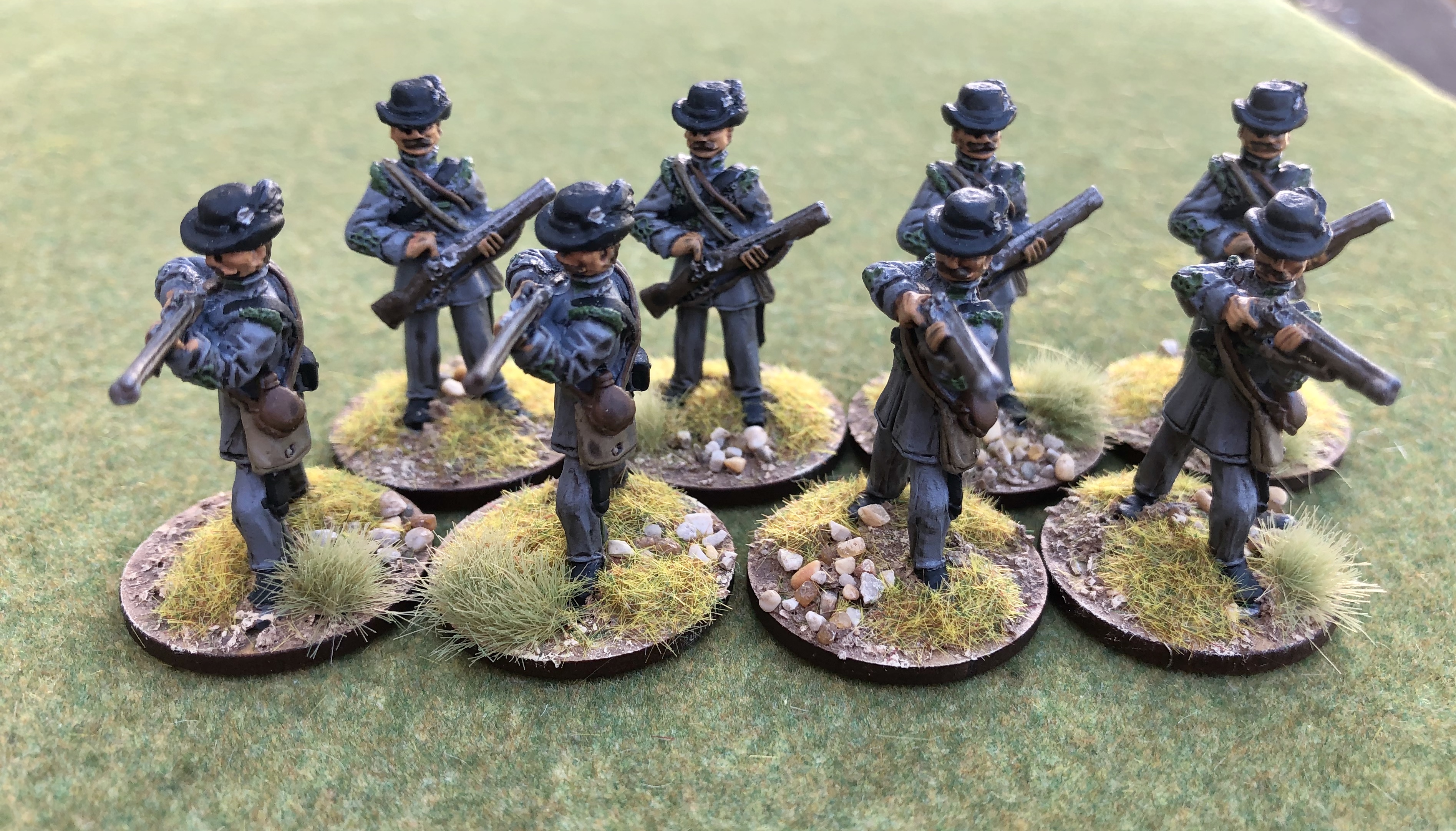
Zooming with Mercians and Vikings

This week's lockdown Zoom game pitched two fearsome women against each other. Largertha and her Viking Warband against Aethelflaed and the Mercians. We decided to use L'Art de la Guerre in the reduced 100 point format. Not only easier to manage over the cameras, but shieldwall battles can be a bit of a dice slog and extra units don't add much.

The Mercians took the initiative and advanced quickly across the table. Or as quickly as heavy spearmen can!

After a bit of skirmishing on the flanks, the shieldwalls clashed.


The Vikings generally got the better of the first round, with their impetuous bonus. The Mercians were looking a bit shaky in the next turn and on the third turn, the Mercian right flank collapsed.


The Mercian Great Fyrd in reserve was moved up to plug the gap. They don't look keen - impetuous v mediocre!


But before they could respond the Mercian left flank collapsed and it was game over. Where is Uhtred when you need him!


 The Vikings celebrated in the traditional manner!