Welcome to my blog!
or on Mastodon @balkandave@mastodon.scot, or Threads @davewatson1683
Monday, 6 April 2015
Danubia
This is more about the Habsburg lands rather than the Habsburg's themselves, although they make up an important part of the story. It's a sort of mix between a narrative history and a travelogue. He takes the reader chronilogically from their medieval base up to the dissolution of the empire in 1918. But he does so illustrating the history with descriptions of the towns and cities he has visited. It's entertaining because there are eccentric characters and interesting stories.
It's also a tragic story. Obviously for the last Habsburg's, but more so for the populations who have been displaced, many times. This is reflected in the different names of the towns in the region as the state boundaries were moved around with associated ethnic cleansing.
By no means a conventional history, or a military history. However, a more than useful insight into the Habsburg's who played an important role in the Balkans for more than four centuries.
Friday, 3 April 2015
More testing of Blucher
Got my new bases for Blucher on the Wargames table at last. 1809 Austrian against French. Austrian's won, which makes a change. I am convinced that most Napoleonic rules have a built in bias in favour of the French!
I used the download from Sam's site for the Austrian cards, but in future I think I will just use the roster sheets. Easier to refer to once the figures are on the table.
Here a few photies.
Wednesday, 25 March 2015
Lanchester 6x4 Armoured Car
Another fill in project to work down my pile of lead has been the 15mm QRF version of the Lanchester armoured car. These served in Malaya in 1942 and will give some much needed firepower for my Brits who had no tanks. Some bright spark in the War Office thought Malaya was unsuitable for tanks - shame no one told the Japanese!
The Lanchester had a six-by-four chassis and was similar in shape to the Rolls-Royce Armoured Car. The unusual rear part of the vehicle was used for the storage of equipment. Above the fighting compartment a two-man turret was mounted, with .5 inch (12.7 mm) and .303 inch (7.7 mm) Vickers machine guns in a dual mount. An additional .303 Vickers was located in front of the fighting compartment.
I usually dread this type of model as they are rarely designed well. However, on this model there is at least a decent lug to support the wheels that otherwise would a be a big problem for a wargame model. The cupola is a poor fit, a fair bit of flash, a couple of missing parts in one pack, but otherwise this is a decent model.
Saturday, 21 March 2015
Basing for Blucher
I have been impressed with my first few games of Blucher and I think it will be my rule set of choice for grand tactical games with 15mm figures. I'll stick with Black Powder for 28mm tactical games.
Learning the game with the cards is OK, but I am a figure gamer, so that can only be a stopgap. Now, as the rule book shows, you can just use your current basing. However, the angles and centre point on the card is useful as is the strip at the back to record casualties. My 15mm collection is based for PoW and so most infantry are on 30mm x 15mm, double depth for cavalry and 40mm depth for guns.
The solution is to turn to possibly my favourite wargame company, Warbases. I drew a design for a sabot base that combines the card and allows my figures to be inserted. In no time at all, at a reasonable cost, Martin delivers a very impressive result. There are two sizes, one for infantry and cavalry and other for guns. I allowed a few extra mm for oversized base width, probably should have done same for depth.
First some Ottomans. These regulars are fine, but I may have to hack about with the irregulars who are on much wider PoW bases.
No such problem for the British, including the deeper artillery bases.
And finally some Russian infantry and Austrian Uhlans.
Very pleased with these. Now to find time for some games!
Sunday, 15 March 2015
More Open Combat
I have played a few more games with the innovative skirmish rules 'Open Combat', published by Second Thunder Games.
These rules work for any army in a pre-gunpowder setting, including fantasy. You can produce your own warband list using the simple point system. Each ability level; speed, attack, defence etc and special rules all cost a point each. So you can create different ability levels within the same warband. The combat mechanisms are very straightforward and a game can be done and dusted in an hour.
In my trial game I created a Roman command using the characters from Simon Scarrow's novels, fighting Gauls. This time, just to test how open the system is, I dusted down my fantasy figures. So Macro and Cato were tasked with investigating a ruined temple and came up against an Orc warband led by the two handed sword wielding Carguk.
No problem at all for our heroes. Dispatched Carguk and his not so merry men without too much trouble. So, step up a bigger challenge. Carguk returns with his pal Shuzug, a minator lookalike, can't even remember where I picked this model up from.
The plan was to pick off the orcs and isolate the monster. Sadly, not even our heroes were up for this challenge. Shuzug despatched Macro with his two-handed axe, one hand for him, and the Roman's decided he could keep the temple!
The rules stood up to the test. So much so that I have signed up for the Kickstarter hard copy of the rules. It's already subscribed, so I am obviously not alone in enjoying this system.
Wednesday, 11 March 2015
Orkney Islands
I was up in the Orkney Islands this week, I haven't been up for a few years. One of my favourite Scottish island groups with a rich history. Picts then Vikings, Orkney was part of Norway until 1468 when it was effectively ceded to Scotland as part of Queen Margaret's dowry.
This is unsurprisingly a maritime story that includes the naval base of Scapa Flow, home to the fleet in both world wars. I picked up James Miller's book while up there, an an excellent and well illustrated read on the bumpy flight back.
A famous WW2 incident was the sinking of the battleship Royal Oak by U47 commanded by Gunther Prien. The loss of life is commemorated in the cathedral.
There is a small museum in Kirkwall with a few military items of interest. A new museum focusing on Scapa Flow will open soon at Lyness. Stromness also has a fine maritime museum.
And finally the Bishops and Earls palace.
Well worth a visit.
Monday, 9 March 2015
More filling in projects
Not much time for painting at present, but I have managed a couple of filling in projects.
I picked up this Empress Spanish Civil War command group at York. They will be replacement standard bearers for some of my VBCW figures who will be transported to Spain for our demo game at Carronade in May. No Pasaran!
My Bolt Action Germans are mostly Early to Mid War and are a bit under gunned against late war opponents. There must be more paras and fallschirmjagers on the tabletop than there ever where in one to one scale!
I picked up this '28mm' die cast model on eBay and have given it a new paint job. This is the first time I have used the Plastic Soldier dirty brown weathering spray I also picked up at York. Not sure about this, I think I prefer the control a paint brush gives me, but it will do for now.
Sunday, 1 March 2015
DBA revisited
I am sucker for a new rule set. My bookshelves creak with rules that at best I have read and played only once or twice. One reason why I think PDF versions are a very good idea!
I played the original version of DBA when it first came out and enjoyed it. Moved on to DBM, which I played for several years before getting fed up with many aspects of the mechanisms. Played a couple of games of DBMM, but largely the same faults as DBM, although I accept they do give a decent 'feel' for an ancients battle.
I blame the Historical Wargames podcast for my purchase of the latest version of DBA. They did a very good interview with an enthusiastic group of USA gamers who helped develop this edition. It's written in the same basic style as the original, although Phil Barker's writing style has been improved by some external input. No eye candy here, just the rules and all the army lists you will ever need.
My first game today reminded me what a good short game this is. Just 12 elements a side, quick set up and easy to remember factors. I played two games, Han Chinese v Later Greek Hoplites and it ended one each. I doubt if I will be a regular player, but when I fancy a quick evening game, I can see me returning to this set of rules again.
In many ways it feels more like a game of chess, which leads me to mention a very nice gift I was given on a trip to the Western Isles this week. A replica of the famous Isle of Harris chess set. The originals were carved from Walrus ivory and whale teeth. Looks great in my study and I will enjoy the odd game of chess with them.
Saturday, 21 February 2015
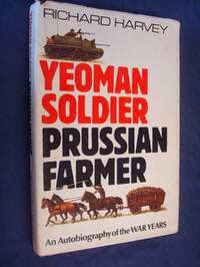
Yeoman Soldier, Prussian Farmer
Something a bit different in terms of World War Two memoirs.
Richard Harvey served in the 1st East Riding Yeomandry, a Yorkshire regiment based in Hull. The regiment was part of the British Expeditionary Force that went to France in 1940. They were equipped with Vickers Mark VI light tanks and armoured scout carriers. Harvey was a Bren gunner and wireless operator in the troop commander's carrier.
His unit was part of the fighting withdrawal to Dunkirk, but he was wounded and captured. He ended up in Prussia near the old Teutonic Knights castle at Marienburg.
They were billeted in a farm workers bothy and worked on a German farm. Getting out of the Bothy wasn't that difficult and they did it many times, but without an escape committee they had no access to the necessary paperwork and other resources needed to escape across Germany. He spent three years at the farm and was then sent to Stalag XXB, before ending up in a sugar factory. As the Russian's advanced they were evacuated with the civilians and nearly got killed by allied ground attack aircraft. Eventually they were liberated by the advancing American units, and sent back to Hull.
A short, but interesting read that inspired me to finish another short paint job. This time a couple of German 105mm howitzers for my early war German FoW army.
Monday, 16 February 2015
Blucher
Be warned, Sam Mustafa's new Napoleonic game 'Blucher' is very good and difficult to resist.
I was itching to get 'Blucher' on the tabletop once the package arrived in the post. The rule book is beautifully produced and seems very robust with the all important quality stiching. There is very little gratuitous eye candy, the graphics are there to explain the mechanisms. There are helpful summaries and examples of play in every section. The Hundred Days cards, an optional extra, are also very nice.
As recommended, I played the first game with cards rather than miniatures. Nine units a side, with the British defending the classic ridge and the French attacking. You start with the cards face down.
There is scope for strategic movement, called reserve moves, but otherwise you activate Corps, individual units or finally the CinC activation. Each activation costs Momentum Dice which unusually are rolled by your opponent and kept secret from you until they run out. The incentive is to do the essentials first.
Movement is by base widths, so the rules will work with any consistent basing, and are reduced to two speeds simple and difficult. A simple move is a pivot and then straight ahead, reminded me a bit of Spearhead. Difficult can be due to terrain or a pivot at the end of a move. The size of the cards and the engagement restrictions make it difficult to do any fancy manoeuvring when close to the enemy.
Fire and combat phases use a simple mechanism. It depends on the strength of the unit and a few bonuses and special rules. This is very much a game of attrition and reserves are important. Here you can see the French advancing and first cavalry clash on the British right. I used casualty markers rather than mark the cards.
Units retreat a couple of base widths if they lose a combat, but can come back if you want. You don't get long melees over several turns.
Anyway, the French pinned the British right with skirmishing and put their main effort on the left. The game ended with the French making a breakthrough.
There are most of the army lists you will need in the book, together with a campaign system and advanced rules. There are also some useful additional resources on the web site, including blank cards.
It's important to emphasise that this is a grand tactical level game. Small unit tactics are abstracted out. So it's not a replacement for say Black Powder. This is a big battle set of rules. Each card or base of miniatures represents 4 to 6 battalions or 2 to 4 batteries.
My initial reaction is very favourable. I play a lot of different games, so I favour simple mechanisms that allow you to focus on the game rather than the fine points of the rules. I anticipate dusting down my 15mm armies that haven't seen much action since I regularly played Principles of War.
Vorwarts!
Thursday, 12 February 2015
Sheriffmuir 1715
It's not a glorious story, more a grand muddle. The rising was poorly organised and coordinated without the necessary troops and equipment from France. In fact without even King James to lead it. He turned up with only two men after the battle.
Reid also documents the simultanous English uprising, with Scottish support, that ended in the Battle of Preston. This was an even more chaotic affair.
This is a proper military history with a detailed discussion of the troops on both sides. Hard evidence is limited, but he has pieced together what is known about each regiment that fought in the campaign. The loyalists were a mix of regular and militia troops, while the Jacobites had lowland troops and highlanders. The battle included a good example of the feared highland charge.
This is a good book for wargamers with most of what you need to game the campaign. I am pulling together a smallish skirmish force in 28mm for either side using the Donnybrook rules. Figures so far come from Reiver Castings, League of Augsburg and Front Rank.
Sunday, 1 February 2015
Vapartnak - York Wargames Show
I made the long trip to York today for the first big wargames show of the year. And it was well worth the effort.
The show is held at the York racecourse - indoors of course in the main stand. Sounds a strange venue, but it works well with stands on four levels. I am old enough to remember when the show was held in a medieval hall in the town centre, my head bumping off the beams! The only downside of the new venue is parking in muddy fields, bring your wellies!
Most of the usual traders were there and a few I hadn't seen before. A few figure manufacturers were missing that I could have done with, but I picked up a few packs to pad out my projects for the year. Then spray paints, including the elusive Testors varnish, and some rather nice casualty markers for Hail Caesar and Bolt Action.
The standard of display game was very high indeed, definitely the high point. Here are a few that caught my eye.
Pick of the bunch was this John Paul Jones raid on Leith (the port for Edinburgh). Apparently this was planned, but called off due to the weather. Had he arrived the locals would probably have greeted him with 'you'll have had your tea then'!
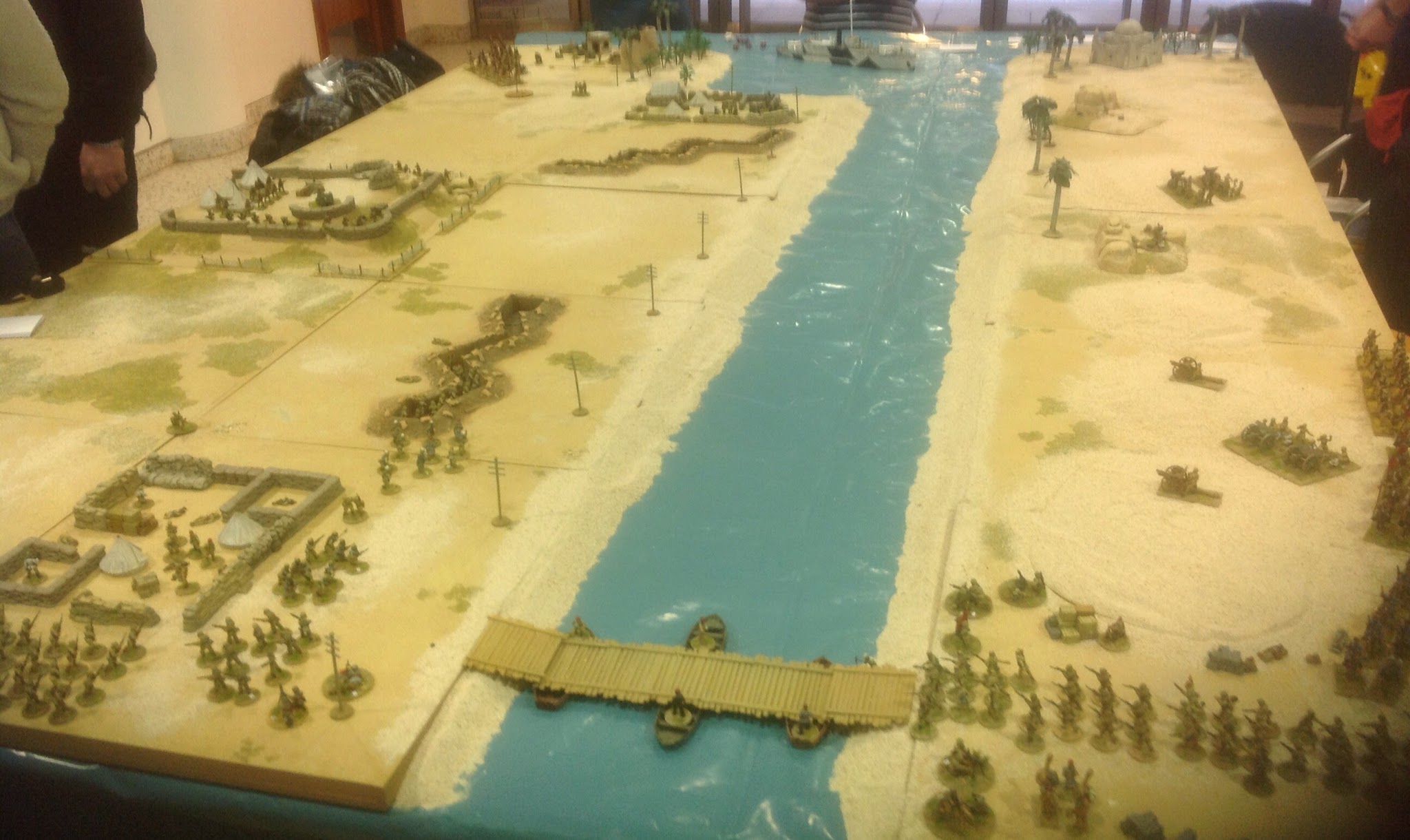
Then this assault across the Suez Canal in WW1
This participation game based on the 3rd Aghan War, captured the terrain well.
Zulu! Rorkes Drift in 28mm.
Zombies. Not my thing but it looked good.
And finally, this very good Age of Arthur game.
Tuesday, 27 January 2015
More WW2 Japanese
My painting schedule has dropped off to almost next to nothing. Work mostly, but the truth is I need to be the mood and I haven't been.
So I thought I would try some bite size filler projects, using the pile of lead awaiting the paint brush.
I have just completed the first of these, some reinforcements for my 15mm WW2 Japanese. This is a rifle squad with an attached light mortar and a couple of trucks. All from the FoW range. I particularly like their trucks, no assembly required!
I have also struggled through some related reading. 'Bloody Shambles' by Christopher Shores, tells the story of the Allied air campaign across Singapore, Malaya, Burma, Ceylon and the Philippines during World War II. It documents the Allied underestimation of Japanese ability, which led to the destruction of 50% of the British bomber force in two days.K
I say I struggled, more accurately I dipped in and out. I find air warfare books hard going at the best of times and this is no exception. The format is a diary of the campaigns and while I appreciate the detailed research, I'm afraid it is very easy to put down between chapters.
I have been gaming though, with a great GDWS double header and Open Day last weekend. I played in the big Bolt Action game, roughly 4,000pts a side with seven players.
This weekend I am off to York for the Vapartnak wargames show on Sunday. Looking forward to it and the Blackburn v Fulham game on the Saturday. Although a bit more trepidation about the latter!
Sunday, 11 January 2015
The Last Crusaders
Sunday, 4 January 2015
Dacia: The Roman Wars
Saturday, 3 January 2015
Open Combat and skirmish games
I find myself playing many more skirmish games than I used to. With work and other commitments eating into my limited time - shorter games and less painting is a big plus. Certainly compared to the big projects I have done in recent years.
Bolt Action isn't really a skirmish game, but it only needs 30 or so figures compared with 100 plus for Hail Caesar or Black Powder. However, Saga has been the real driver, again with less than 30 figures.
The current supplements only cover the Dark Ages and the Crusades, but there are a growing number of unofficial battle boards. I have recently played with Romans and Gauls, thanks to battle boards developed by Doug Colbeck, available through the Saga forum that is a great resource. They play really well and with a tweak or two, I plan using them for my Dacians.
Listening to the Meeples and Miniatures podcast drew my attention to a new set of skirmish rules called Open Combat from Second Thunder Games. These are real skirmish level games, arguably pretty close to role playing, with the introductory 150pt games involving six or eight figures a side.
The beauty of these rules is that they work for any army in a pre-gunpowder setting, including fantasy. You can produce your own warband list using the simple point system. Each ability level; speed, attack, defence etc and special rules all cost a point each. So you can create different ability levels within the same warband.
I used the Romans and Gauls again to test the rules. My Roman band had Macro and Cato from the Simon Scarrow novels with higher attack, defence and fortitude levels than the rest of the legionaries in the warband. The Gauls were of course led by a super stat Asterix. Sadly, his stats didn't save him from Cato's pilum, even after our cat had made one of his increasingly regular interventions on the wargames table. Razzy has a high 12 attack factor!
The rules themselves play very well and games can be finished in a hour or so. I quickly switched to the QRF with only occasional references back to the full rule set on my iPad. They are available as a PDF download for only £10 and the production quality is excellent.
I can see some great possibilities for this system, with super heroes battling their way through hordes of low quality troops, using the flexibility that you just don't get with other systems. It also means that you can get troops onto the table quickly. Good for the early stages of bigger projects as well as some niche games using figures that don't have a bespoke rules system.
Highly recommended and at £10 you really can't go wrong.