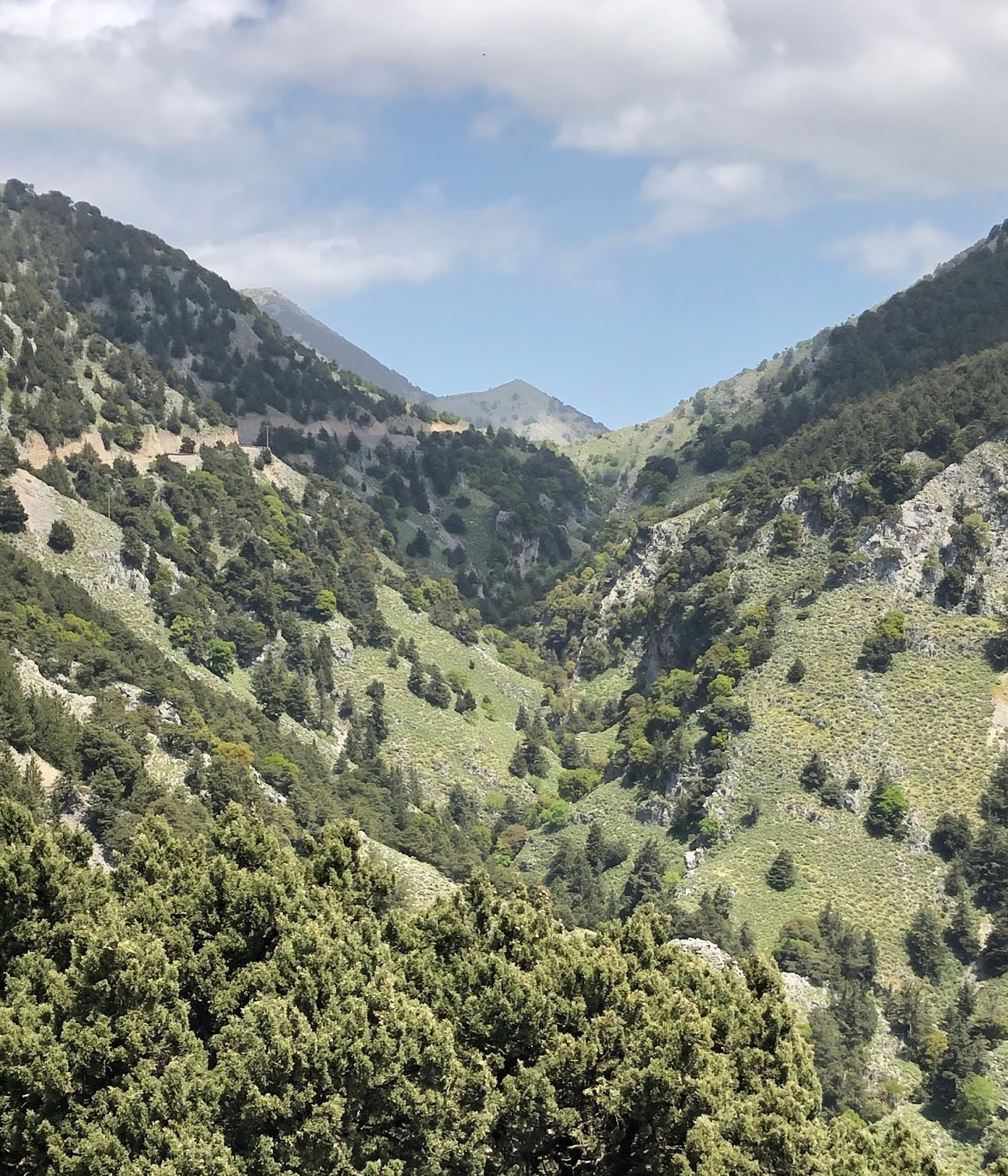
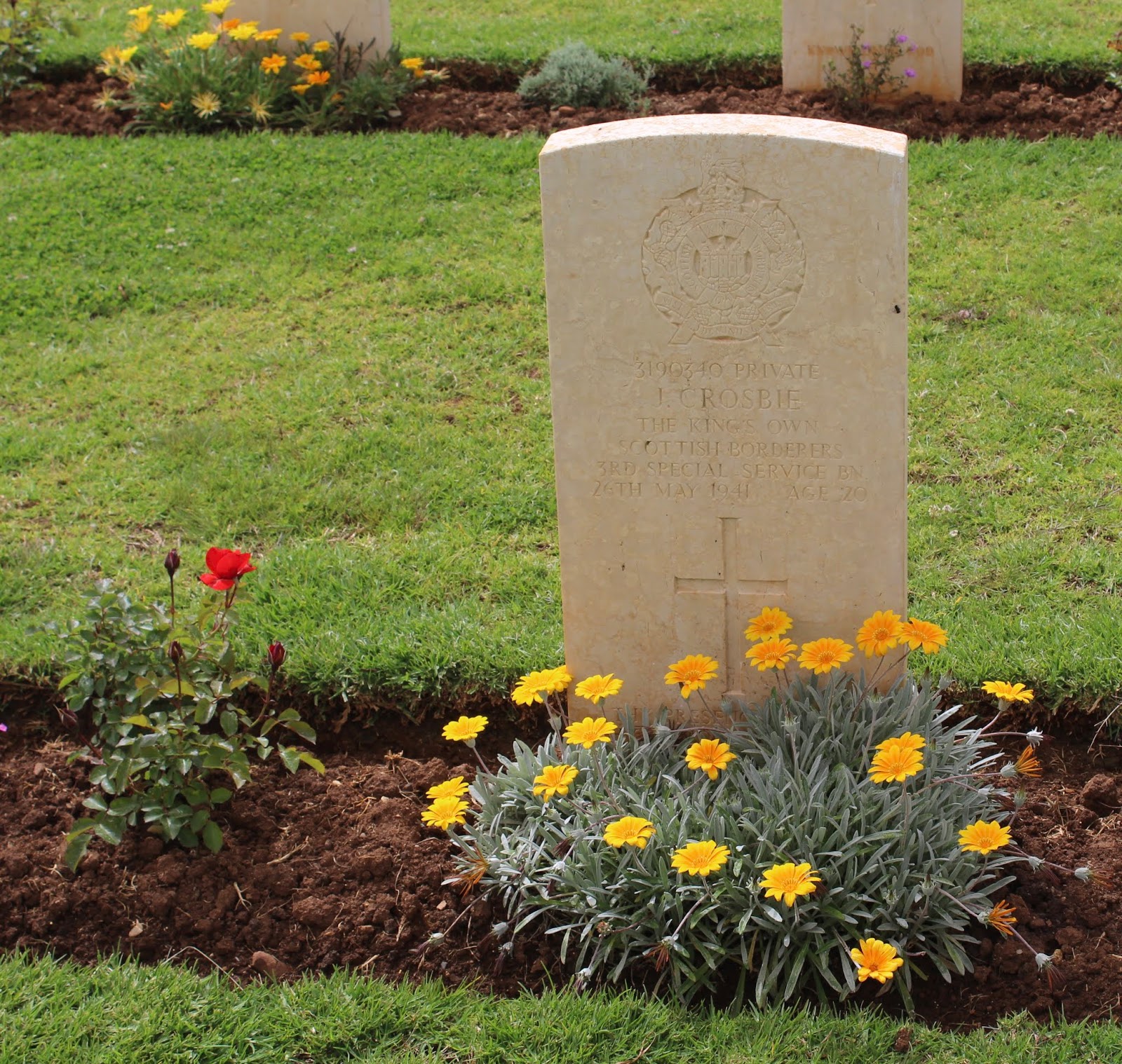
Sfakia is the most remote and mountainous region of Crete. Until recent times there was no proper road into the region, which allowed the locals to effectively resist all occupiers of the island - Venetians, Ottomans and even the Germans.
Today, you can drive across the White Mountains on a very good mountain road as we did today, armed with George Dalidakis's excellent book on the region's history. In fact, it is a very good history of Crete overall, with a focus on Sfakia.
First stop was the village of Askifou, situated on a plateau in the White Mountains. A must see is the small war museum run by George Hatzidakis. He has collected the most remarkable array of weapons and memorabilia found in the local area. Ranging from the 19th century to WW2. The British and Commonwealth units poured through the village on their way to the evacuation point, so there are rifles, Bren guns, helmets, medical kits and even a Norton motor cycle. He has every type of German and Italian small arms, the propeller from a Stuka and even a German X-ray machine.
And the village has a Turkish castle for good measure.
Next stop is the Imbros Gorge where the road ended in 1941 and British and Commonwealth troops had to hike it down to the sea. Modern day hikers use the same path, with modern kit and a taxi to drive you back to the top!
The evacuation point in 1941 was Sfakion, then little more than a beach. Today it is is a very pretty little port. The events of 1941 are remembered with this memorial.
A drive along the coast brings you to the castle of Frangokastello. Built by the Venetians in 1371-4 to subdue the locals, it was later improved by the Ottomans. It features in two of the very many revolts against Ottoman rule in 1770 and 1828.
The Sfakians were in almost continuous revolt and very often provided leadership for the rest of Crete. They were only defeated when the Turks managed to get overwhelming numbers of troops into the region. Even then the peace only lasted a short period as they fled to the mountains. Even today, the road signs are full of bullet holes!
Welcome to my blog!
News from a wargamer with a special interest in the military history of the Balkans. It mainly covers my current reading and wargaming projects. For more detail you can visit the web sites I edit - Balkan Military History and Glasgow & District Wargaming Society. Or follow me on Twitter @Balkan_Dave
or on Mastodon @balkandave@mastodon.scot, or Threads @davewatson1683
Monday, 6 May 2019
Sunday, 5 May 2019
Crete 1941
Today I retraced the key actions of the Battle for Crete in 1941, from Maleme Airfield to Souda Bay.
I started at the Tavronitis River which runs just at the end of the Maleme Airfield. This is where the battle began at 08:00hrs on 20 May when parachute and glider landings by the Luftlande Sturmregiment began. This bridge runs parallel to the modern bridge so may be the one seized by the Germans. The river bed provided a good base for the Germans to consolidate their positions.
This is the taxiway that runs parallel to the river. This is when a counterattack should have been organised.
This is the main runway. The Greeks are very fussy about photos near defence establishments, even when the aircraft are obsolete shells. So apologies for the long lens taken from Hill 107.
Next stop was the German Cemetery on what was Hill 107. On the morning of 21 May two German companies found the hill abandoned and they consolidated on this crucial position. The cemetery was inaugurated in 1974 and contains the graves of 4,465 soldiers. There is also a small display about the battle. The saddest and most unavoidable fact when you walk about is the age of the dead. Very few are over 23.
The RAF has a memorial near the river. Ground crew were left behind when the aircraft were relocated and they made up part of the airfield defences.
As the Commonwealth troops abandoned Maleme, the Germans started to land significant reinforcements from the 5th Gebirgs Division. The new Commonwealth line was hinged on the village of Galatos. There is a small memorial/museum in the village square with items of equipment from the battle. A very helpful cafe owner retrieved the key for me.
I spent an hour or so looking around the Venetian port of Chania (Hania) with its impressive walls. Brigadier Weston's HQ during the battle. Although it surrendered to the Turks in 54 days in 1645.
There is a Maritime Museum, although it was closed. After all, who would want to visit a museum on a Sunday!
Finally, across to Souda Bay and the British Cemetery. All maintained to the usual high standards of the CWGC.
I started at the Tavronitis River which runs just at the end of the Maleme Airfield. This is where the battle began at 08:00hrs on 20 May when parachute and glider landings by the Luftlande Sturmregiment began. This bridge runs parallel to the modern bridge so may be the one seized by the Germans. The river bed provided a good base for the Germans to consolidate their positions.
This is the taxiway that runs parallel to the river. This is when a counterattack should have been organised.
This is the main runway. The Greeks are very fussy about photos near defence establishments, even when the aircraft are obsolete shells. So apologies for the long lens taken from Hill 107.
Next stop was the German Cemetery on what was Hill 107. On the morning of 21 May two German companies found the hill abandoned and they consolidated on this crucial position. The cemetery was inaugurated in 1974 and contains the graves of 4,465 soldiers. There is also a small display about the battle. The saddest and most unavoidable fact when you walk about is the age of the dead. Very few are over 23.
The RAF has a memorial near the river. Ground crew were left behind when the aircraft were relocated and they made up part of the airfield defences.
As the Commonwealth troops abandoned Maleme, the Germans started to land significant reinforcements from the 5th Gebirgs Division. The new Commonwealth line was hinged on the village of Galatos. There is a small memorial/museum in the village square with items of equipment from the battle. A very helpful cafe owner retrieved the key for me.
I spent an hour or so looking around the Venetian port of Chania (Hania) with its impressive walls. Brigadier Weston's HQ during the battle. Although it surrendered to the Turks in 54 days in 1645.
There is a Maritime Museum, although it was closed. After all, who would want to visit a museum on a Sunday!
Finally, across to Souda Bay and the British Cemetery. All maintained to the usual high standards of the CWGC.
Friday, 3 May 2019
Rethymno
I am holidaying in Crete for a week, based in the attractive port of Rethymno on the north coast of the Greek island. Probably as far south as you can stretch the Balkans!
The port is dominated by a magnificent Venetian fortress. After the Ottoman pirate Ulic Ali burned the town in 1571, it was decided to build a fort. It was started in 1573 and completed in the 1580’s. The style is similar to the many Venetian coastal forts around the Balkans with its five star bastions and other gun positions.
Prior to the Cretan War in 1645, the fortress had a regular Venetian garrison of 500 men – Italians, French, Dutch and Corsican infantry. This could be supplemented by militia. The fort fell to the Ottomans in 1646 after a siege of only 24 days. They strengthened the defences, particularly around the gate area. They also added a mosque, which unusually remains today.
It was also used by the Germans in WW2 as their garrison for the area. In 1941, there was a small airfield to the east of Rethymno, and two battalions of the 2ndFallschirmjager were tasked with capturing the airfield and the town. The area was defended by 19thAustralian Infantry Brigade (plus two Greek regiments) who responded quicker than elsewhere and the Germans were pushed back to the olive oil factory at Stavromenos. Events elsewhere meant the town and airfield had to be abandoned and the retreat to the southern coast started. Gebirgsjager relived the paras and captured the town.
The fortress is well worth a visit, not least for the great views.
Wednesday, 1 May 2019
Wild Europe
Wild Europe by Bozidar Jezernik is a study of the Balkans in the gaze of western travellers from the fifteenth to the early twentieth centuries.
To the modern reader, the views of many of these travellers appear bizarre. They mostly cover the period when the Balkans were occupied by the Ottomans. In the early period travellers reflected the power of the Ottoman Empire, but that soon changed to less admiration as the empire declined.
In some cases there was outright racism, in others, it reflected a disdain for Islam. More often just shock at a different way of life that to western eyes of the period appeared backward. This results in an inability to credit the Ottomans for anything positive. This is well illustrated by the Mostar Bridge in Bosnia. Western 'experts' claimed it was a Roman construction despite the clearest evidence that it was built by the Ottomans. One author even corrected his wife's notes to this effect.
Most of these western observers also failed to recognise their own hypocrisy. They were shocked at the taking of heads in battle, but not the mass slaughter in trenches, the lynching of black men in the USA et al. Not to mention the similarity between the Ottoman divide and rule policy with similar approaches in the British empire.
One chapter describes the 'evidence' collected by several writers that Albanian men had tails. A clear example of how groups perceive others, sometimes for political reasons. Illustrated by the views of the Serbian Prime Minister, Vladan Dordevic (1897-1900) who was also a distinguished author and academic. He described Albanians as 'bloodthirsty, stunted, animal-like individuals, so invincibly ignorant that they could not tell sugar from snow'. Conveniently this meant they could not possibly rule themselves!
The original passages are interesting in themselves, but the author goes further in analysing how these western observers constructed their images of the Balkans. A really interesting book that has been extensively researched with many period illustrations.
To the modern reader, the views of many of these travellers appear bizarre. They mostly cover the period when the Balkans were occupied by the Ottomans. In the early period travellers reflected the power of the Ottoman Empire, but that soon changed to less admiration as the empire declined.
In some cases there was outright racism, in others, it reflected a disdain for Islam. More often just shock at a different way of life that to western eyes of the period appeared backward. This results in an inability to credit the Ottomans for anything positive. This is well illustrated by the Mostar Bridge in Bosnia. Western 'experts' claimed it was a Roman construction despite the clearest evidence that it was built by the Ottomans. One author even corrected his wife's notes to this effect.
Most of these western observers also failed to recognise their own hypocrisy. They were shocked at the taking of heads in battle, but not the mass slaughter in trenches, the lynching of black men in the USA et al. Not to mention the similarity between the Ottoman divide and rule policy with similar approaches in the British empire.
One chapter describes the 'evidence' collected by several writers that Albanian men had tails. A clear example of how groups perceive others, sometimes for political reasons. Illustrated by the views of the Serbian Prime Minister, Vladan Dordevic (1897-1900) who was also a distinguished author and academic. He described Albanians as 'bloodthirsty, stunted, animal-like individuals, so invincibly ignorant that they could not tell sugar from snow'. Conveniently this meant they could not possibly rule themselves!
The original passages are interesting in themselves, but the author goes further in analysing how these western observers constructed their images of the Balkans. A really interesting book that has been extensively researched with many period illustrations.
Saturday, 27 April 2019
Italians completed
The Italians for my Yugoslavia invasion project are now completed. Most unlike me, two weeks before the Carronade show - no hair dryer required!
First up, some seriously heavy artillery. This is the Ansaldo 149/40 from Heer46 Models with Perry's crew. I appreciate that it's a bit OTT for Bolt Action, but I couldn't resist. Some 590 were ordered, but only 51 were in service by the outbreak of war. It was a good design and the Germans took over production after the Armistice in 1943.
Like most wargamers, I usually paint the elite troops first, so I surprise myself with the late appearance of the Bersaglieri. Traditional light infantry units, by WW2 they were mostly attached to armoured, cavalry or motorised divisions. There was a battalion in Zara, which justifies their inclusion in this force. The models are from the Warlord range. The farmhouse buildings in the background are from the Tablescape range. A new firm to me, these are very light models and very nice indeed.
Lastly, we have the Blackshirts, or MVSN to give them their proper acronym. Originally they were Mussolini's street thugs and grew to 340,000 combat troops. A battalion was attached to most divisions and there was one in the Zara garrison. They were equipped like normal infantry units with the exception of black shirts and different insignia. These are standard Warlord Italian infantry models.
It's always nice to finish a project. If you come to the Carronade show on 11 May in Falkirk, you can command these units against the Royal Yugoslav Army in the GDWS 'Breakout from Zara' participation game.
First up, some seriously heavy artillery. This is the Ansaldo 149/40 from Heer46 Models with Perry's crew. I appreciate that it's a bit OTT for Bolt Action, but I couldn't resist. Some 590 were ordered, but only 51 were in service by the outbreak of war. It was a good design and the Germans took over production after the Armistice in 1943.
Lastly, we have the Blackshirts, or MVSN to give them their proper acronym. Originally they were Mussolini's street thugs and grew to 340,000 combat troops. A battalion was attached to most divisions and there was one in the Zara garrison. They were equipped like normal infantry units with the exception of black shirts and different insignia. These are standard Warlord Italian infantry models.
It's always nice to finish a project. If you come to the Carronade show on 11 May in Falkirk, you can command these units against the Royal Yugoslav Army in the GDWS 'Breakout from Zara' participation game.
Tuesday, 23 April 2019
The Traitors
Don't panic, I haven't become a social media troll! This is the title of a book by Josh Ireland who looks at four British traitors in World War Two.
The most infamous is William Joyce, Lord Haw-Haw. I didn't know that he was born in the USA before his family moved back to Ireland. He was a leading member of Moseley's BUF before falling out with them and starting his own fascist party. He headed for Germany just before war broke out and joined Goebbels propaganda ministry making his broadcasts.
John Amery was another British fascist, the son of Tory Cabinet Minister, Leo Amery. This made him a very useful propaganda asset, although he was a weak radio performer. He spent the war giving speeches and continuing his playboy lifestyle, this time financed by the Nazis.
Unlike the first two traitors, Harold Cole was from a working-class background. He was a small-time criminal who was left behind in France during the 1940 campaign, after stealing from the sergeant's mess. He escaped from his PoW camp and helped the resistance until they caught him embezzling funds. He fled to the Nazis and worked for them for the rest of the war, betraying many resistance networks.
Eric Pleasants joined the merchant marine on the outbreak of war and was captured in the Channel Islands. Bored with internment, he joined the Waffen SS, British Free Corps. After abandoning that unit he was placed in an SS punishment camp and ended up giving exhibition boxing bouts in the German officer mess. After escaping he was captured by the Russians in 1945 and spent seven years in a savage Arctic gulag.
All these traitors got their comeuppance. Joyce and Amery were hanged in Britain and Cole was shot trying to escape the French police. Pleasants was repatriated in 1952 and the authorities decided he had been punished enough in the gulag.
The author threads the stories together into a very readable book. The motivations of each traitor are different, but they all come across as inadequate and chaotic individuals. If there is a common thread, it is booze! You won't find much original research here and the subject has been extensively covered before. However, it has a modern style which will introduce the story to a new audience.
The most infamous is William Joyce, Lord Haw-Haw. I didn't know that he was born in the USA before his family moved back to Ireland. He was a leading member of Moseley's BUF before falling out with them and starting his own fascist party. He headed for Germany just before war broke out and joined Goebbels propaganda ministry making his broadcasts.
John Amery was another British fascist, the son of Tory Cabinet Minister, Leo Amery. This made him a very useful propaganda asset, although he was a weak radio performer. He spent the war giving speeches and continuing his playboy lifestyle, this time financed by the Nazis.
Unlike the first two traitors, Harold Cole was from a working-class background. He was a small-time criminal who was left behind in France during the 1940 campaign, after stealing from the sergeant's mess. He escaped from his PoW camp and helped the resistance until they caught him embezzling funds. He fled to the Nazis and worked for them for the rest of the war, betraying many resistance networks.
Eric Pleasants joined the merchant marine on the outbreak of war and was captured in the Channel Islands. Bored with internment, he joined the Waffen SS, British Free Corps. After abandoning that unit he was placed in an SS punishment camp and ended up giving exhibition boxing bouts in the German officer mess. After escaping he was captured by the Russians in 1945 and spent seven years in a savage Arctic gulag.
All these traitors got their comeuppance. Joyce and Amery were hanged in Britain and Cole was shot trying to escape the French police. Pleasants was repatriated in 1952 and the authorities decided he had been punished enough in the gulag.
The author threads the stories together into a very readable book. The motivations of each traitor are different, but they all come across as inadequate and chaotic individuals. If there is a common thread, it is booze! You won't find much original research here and the subject has been extensively covered before. However, it has a modern style which will introduce the story to a new audience.
![]() |
| Some Very British Civil War, BUF 28mm figures are probably the nearest I can get to some wargame interest! |
Sunday, 21 April 2019
1177 BC - The Ancient Dark Ages
The Late Bronze Age in the Eastern Mediterranean was full of thriving civilisations (Egyptians, Hittites, Canaanites, Cypriots, Minoans, Mycenaeans, Assyrians and Babylonians), which were interconnected through trade and culture. After around 1200 BC, they started to collapse. In this book, Eric Kline examines the evidence on how and why this happened.
The conventional view is that the collapse was caused by invasions of warriors known as the Sea Peoples. We know very little about the Sea Peoples, other than an Egyptian narrative, it is even unclear where they came from.
Kline argues that the collapse was likely caused by a range of factors, of which the Sea Peoples were only one. The records are understandably limited and the archaeological evidence is inconclusive. For example, while we know that many cities were destroyed, it is unclear if this was caused by natural events, invasion or even internal rebellion. Possible causes include:
The problem with these events is that they have all happened throughout history, without causing the collapse of so many civilisations. Countries dust themselves down and rebuild. This leads to the view that all of these events resulted in system collapse or a domino effect when one part of the system failing leads to failures elsewhere. As Kline puts it; 'a perfect storm of calamities'.
A very interesting book that describes the civilisations of the period and their destruction. I visited sites like Mycenae and Tiryns last year and I plan to visit the Minoan sites next month. For the wargamer, Osprey MAA109 provides a broad overview of the armies and the period.
The conventional view is that the collapse was caused by invasions of warriors known as the Sea Peoples. We know very little about the Sea Peoples, other than an Egyptian narrative, it is even unclear where they came from.
Kline argues that the collapse was likely caused by a range of factors, of which the Sea Peoples were only one. The records are understandably limited and the archaeological evidence is inconclusive. For example, while we know that many cities were destroyed, it is unclear if this was caused by natural events, invasion or even internal rebellion. Possible causes include:
- Earthquakes certainly struck many times during this period and crush injuries have been identified in excavations.
- Climate change, drought and famine, could have caused the movement of peoples and there is some evidence from Egyptian records of famine. Climate scientists agree that there was warming and drought during this period.
- Internal rebellions may be a more credible explanation for some destruction, but it is difficult to separate these from other forms of destruction.
- Sea Peoples or other migratory invasions remain a strong candidate. Particularly if this caused the collapse of international trade. The breakdown of trade could lead to decentralisation and the rise of private merchants rather than the state.
The problem with these events is that they have all happened throughout history, without causing the collapse of so many civilisations. Countries dust themselves down and rebuild. This leads to the view that all of these events resulted in system collapse or a domino effect when one part of the system failing leads to failures elsewhere. As Kline puts it; 'a perfect storm of calamities'.
A very interesting book that describes the civilisations of the period and their destruction. I visited sites like Mycenae and Tiryns last year and I plan to visit the Minoan sites next month. For the wargamer, Osprey MAA109 provides a broad overview of the armies and the period.
![]() |
| The Lion Gate at Mycenae |
Saturday, 13 April 2019
The Great Illyrian Revolt
A year before three Roman legions were famously destroyed in the Teutoburg Forest, a three-year rebellion in the Balkans came to an end. The Great Illyrian Revolt took 15 Roman legions more than three years to conclude, at a considerable cost in men and resources. This book by Jason Abdale is the first to cover this forgotten conflict.
The author starts with a detailed discussion about the Illyrians. While many modern Albanians claim they are descended from them, they were, in fact, a large group of around sixty tribes living in the countries that made up the former Yugoslavia, as well as Albania. The Greeks and Romans would have described them as barbarians, but that only meant they were foreigners or outsiders. They lived in towns and cities, traded across the Mediterranean, had a thriving culture, and their armies were well organised with modern warships that dominated the Dalmatian coast.
Their weakness, like most of Rome’s opponents, was that they never united as a nation. The individual tribes were culturally distinct, and their practices reflected the geography of the region. Those closest to Greece had become largely Hellenised, while the rest broadly split between the Dalmatians in the mountains of modern-day Bosnia, Croatia and Montenegro – and the Pannonians who lived in the more open plains of northern Serbia and eastern Croatia, including parts of modern Hungary.
The little we know about the Illyrians was written by outsiders and is undoubtedly biased. This is supplemented by archaeology, but the story of the Great Revolt is based mainly on Roman sources. The author makes several suggestions and suppositions, which may, or may not, be justified.
The Romans first came into contact with the Illyrians early in their expansion across Italy. However, they took a serious interest because of the actions of Illyrian pirates as the Romans moved into Greece. The Republic fought several wars against Illyrian tribes before creating the Province of Illyricum in 59BC. This controlled much of the coast and some of the internal trade routes. Mineral deposits, including gold and silver, were an important resource that the Romans wanted to secure.
![]() |
| Illyrian towns were usually built on hilltops like Shkodra in Albania. This is my photo from the later castle. |
The Roman civil wars were fought over part of these territories, and Caesar Augustus extended Roman control into Pannonia after a tough campaign that ended in 9BC. The so-called ‘Pax Romana' followed, and while there was plenty of conflict across the empire, Illyricum was relatively peaceful.
This changed in 6AD when Augustus recruited Illyrian troops for a planned campaign in Germany, led by Tiberius. This also denuded the province of regular soldiers. Burdensome Roman rule had increased dissatisfaction, and when it became apparent that they outnumbered the Romans, rebellion broke out. It was led by Bato of the Daesidate tribe. We know little about him, but he succeeded in uniting many of the tribes and defeating local Roman units.
There followed three years of warfare in which the Illyrians defeated the Romans several times. The conflict sucked in ever larger numbers of Roman troops and their allies, including the Thracians. However, as ever, Roman persistence and numbers triumphed. The fifteen legions deployed is about 75,000 men, plus auxiliaries, allies and support units. Fortunately for the Romans, Arminius’s revolt in Germany started just after Bato had surrendered. The Empire would have struggled to contain two rebellions of this size.
The author does his best with limited sources. His educated guesses of names and places are explained so the reader can make up their own minds. He has an informal writing style, which may irritate some readers, but it doesn't detract from the book's readability. My only criticism would be the use of modern and historical analogies, which are sometimes tenuous, overlong, and add little to our understanding of the period.
Overall, this is a very welcome book, which opens up an interesting and little explored period of Balkan history.
I have a small DBA Illyrian army in 15mm, which is looking a bit dated. Warlord and Relic Miniatures do some light infantry types, which fought with Alexander the Great. These look fine for the Hellenised southern tribes, but the further north you go, Celtic influences would be more apparent. This is reflected in the Magister Militum range in 15mm. A bit of mix and match with some conversions looks like the only realistic approach.
Romans are not a problem. Either from the Republic for the earlier wars or the Imperial Romans for the Great Revolt. This was a period when the equipment of the legionarius was evolving, but probably not as far as the Lorica Segmentata as depicted on the book cover. The dished oval shield would also be more common than the squared edged version, which only started to be adopted in the early 1st Century.
Reading the book inspired me to paint the 28mm Roman tent I purchased at the Varpartnak show from Magister Militum. A lovely model that paints up well.
Wednesday, 10 April 2019
Battle of Glenshiel 1719
This year is the 300th anniversary of a lesser known Jacobite uprising, which ended at the Battle of Glenshiel on 10 June 1719.
After the failed 1715 rebellion, the government attempted reconciliation by pardoning many of those involved through the Indemnity Act. However, some were excluded, most notably Rob Roy and the MacGregors. Britain and Spain had settled their differences at the Treaty of Utrecht in 1713, but war broke out again in 1718 when the Spanish occupied Sicily.
As a way of distracting the British, the Spanish planned to support a Jacobite rebellion with landings in England and Scotland. 300 Spanish troops landed on the west coast of the Highlands and occupied Eilean Donan Castle. They were joined by the MacGregors and a few other clans, although most clans opted out when the Spanish fleet with 5,000 troops was wrecked in a storm. No one could claim the Jacobites were lucky!
The Jacobite commander, William Murray, Earl of Tullibardine, left a small garrison at the castle and moved to the narrow pass at Glenshiel, which was easier to defend against the advancing government troops. The Royal Navy moved up the west coast in support and captured the castle with the Jacobite supplies.
Murray had around 1000 men, mostly from Clans Cameron, MacGregor, MacKenzie, MacKinnon and Murray. Plus 200 Spanish troops, the rest were left to garrison the castle. General Wightman, commanding the government forces, had 850 infantry, 120 dragoons and mortar teams.
Wightman used his dragoons to screen the set up of his mortars. They bombarded the Jacobite right followed by an infantry attack, which dislodged the Jacobites and exposed the centre. This led to a general attack on the Jacobite left which collapsed. The clans fled to avoid capture, while the Spanish executed a fighting retreat.
Peace with Spain ended any prospect of continuing the rebellion. In the aftermath, General Wade built his military roads and forts in Inverness, Fort Augustus and Fort William.
I built up small wargame armies of the period for the 1715 anniversary and most of these will work for the 1719 rebellion - I'll pass on the Spanish. The armies are small and suit small battle rules like Rebels and Patriots. I did succumb to the Flags of War Kickstarter for troops of the '45. Kidding myself on that while these are a little late for the period, you can never have enough Highlanders. Either way, they are very nice figures!
P.S. Helion Books has published a book on the battle by Jonathan Worton. I haven't read it, but there is a very positive review in the latest edition of the journal 'Arquebusier'.
After the failed 1715 rebellion, the government attempted reconciliation by pardoning many of those involved through the Indemnity Act. However, some were excluded, most notably Rob Roy and the MacGregors. Britain and Spain had settled their differences at the Treaty of Utrecht in 1713, but war broke out again in 1718 when the Spanish occupied Sicily.
As a way of distracting the British, the Spanish planned to support a Jacobite rebellion with landings in England and Scotland. 300 Spanish troops landed on the west coast of the Highlands and occupied Eilean Donan Castle. They were joined by the MacGregors and a few other clans, although most clans opted out when the Spanish fleet with 5,000 troops was wrecked in a storm. No one could claim the Jacobites were lucky!
The Jacobite commander, William Murray, Earl of Tullibardine, left a small garrison at the castle and moved to the narrow pass at Glenshiel, which was easier to defend against the advancing government troops. The Royal Navy moved up the west coast in support and captured the castle with the Jacobite supplies.
Murray had around 1000 men, mostly from Clans Cameron, MacGregor, MacKenzie, MacKinnon and Murray. Plus 200 Spanish troops, the rest were left to garrison the castle. General Wightman, commanding the government forces, had 850 infantry, 120 dragoons and mortar teams.
Wightman used his dragoons to screen the set up of his mortars. They bombarded the Jacobite right followed by an infantry attack, which dislodged the Jacobites and exposed the centre. This led to a general attack on the Jacobite left which collapsed. The clans fled to avoid capture, while the Spanish executed a fighting retreat.
Peace with Spain ended any prospect of continuing the rebellion. In the aftermath, General Wade built his military roads and forts in Inverness, Fort Augustus and Fort William.
I built up small wargame armies of the period for the 1715 anniversary and most of these will work for the 1719 rebellion - I'll pass on the Spanish. The armies are small and suit small battle rules like Rebels and Patriots. I did succumb to the Flags of War Kickstarter for troops of the '45. Kidding myself on that while these are a little late for the period, you can never have enough Highlanders. Either way, they are very nice figures!
P.S. Helion Books has published a book on the battle by Jonathan Worton. I haven't read it, but there is a very positive review in the latest edition of the journal 'Arquebusier'.
Sunday, 7 April 2019
The Habsburgs' Wings 1914
This book is the story of the early years of the Austro-Hungarian air force by the Polish historian Andrej Olejko.
The Balkans delivered another first in 1911 when aeroplanes were first used in combat operations during the Italian-Turkish War. A year later air power, albeit very primitive, grabbed the attention of the world's military through its use in the First Balkan War. By 1914, most nations had some form of air force, usually under the control of their army or navy.
Not everyone agreed with this new-fangled way of waging war. The British General William Nicholson said: "Aviation is a useless and costly peculiarity, practiced by several individualists, whose views do not deserve attention."
The author charts the birth of the Austro-Hungarian air force, which also struggled to get the attention and resources from a conservative military establishment. Although the Chief of Staff, Conrad von Hotzendorf in 1910 stated that planes were the future of reconnaissance. By the following year, the army had purchased its first aircraft and began the systematic training of pilots.
Balloon units were attached to the major border fortresses in Galicia, Hungary and Montenegro. Planes were assigned to all of the field armies by 1913, although in small numbers. This was hampered by a small and diverse aircraft industry, so the army also bought planes from their German allies. These included the very elegant Taube reconnaissance aircraft, pictured on the cover.
The navy also developed its own aviation wing including Lohner seaplanes. Like most of the world's navies, they quickly identified the benefits. Naval bases near Pula and Kotor were quickly established. The modern airport at Tivat had a flying boat wharf nearby.
Ground troops were not used to seeing aircraft and there were a number of early friendly fire incidents. This led to an early form of camouflage and national identification stripes.
At the outbreak of war, there were only 39 of the planned 90 planes available. Mostly of the Lohner and Aviatik types. The author lists all the pilots and the Fliegerkompanien, together with their bases and equipment.
The allies and enemies are also described in some detail. The Russian air force was not large in 1914 and had similar problems in deploying the planned numbers of aircraft to the field armies facing the Habsburgs in Galicia. They had around 162 combat aircraft, but these included the fronts facing the Germans. The Serbians had a few aircraft in the Balkan Wars, as well as balloon detachments. By 1914 they had an air squadron of seven French aircraft.
This is Volume 1, so I assume the author is planning to tell the story of air operations in the next volume. It is, without a doubt, an impressive piece of research. Added to which the book is extensively illustrated with period photographs. Including many from one of my favourite places in the Balkans, the Bay of Kotor, which has extensive remains of the Habsburg forts that defended the naval base.
Admittedly, this is probably not a book for the general reader, but it is likely to be the definitive work on the subject and I enjoyed it.
The Balkans delivered another first in 1911 when aeroplanes were first used in combat operations during the Italian-Turkish War. A year later air power, albeit very primitive, grabbed the attention of the world's military through its use in the First Balkan War. By 1914, most nations had some form of air force, usually under the control of their army or navy.
Not everyone agreed with this new-fangled way of waging war. The British General William Nicholson said: "Aviation is a useless and costly peculiarity, practiced by several individualists, whose views do not deserve attention."
The author charts the birth of the Austro-Hungarian air force, which also struggled to get the attention and resources from a conservative military establishment. Although the Chief of Staff, Conrad von Hotzendorf in 1910 stated that planes were the future of reconnaissance. By the following year, the army had purchased its first aircraft and began the systematic training of pilots.
Balloon units were attached to the major border fortresses in Galicia, Hungary and Montenegro. Planes were assigned to all of the field armies by 1913, although in small numbers. This was hampered by a small and diverse aircraft industry, so the army also bought planes from their German allies. These included the very elegant Taube reconnaissance aircraft, pictured on the cover.
The navy also developed its own aviation wing including Lohner seaplanes. Like most of the world's navies, they quickly identified the benefits. Naval bases near Pula and Kotor were quickly established. The modern airport at Tivat had a flying boat wharf nearby.
Ground troops were not used to seeing aircraft and there were a number of early friendly fire incidents. This led to an early form of camouflage and national identification stripes.
At the outbreak of war, there were only 39 of the planned 90 planes available. Mostly of the Lohner and Aviatik types. The author lists all the pilots and the Fliegerkompanien, together with their bases and equipment.
The allies and enemies are also described in some detail. The Russian air force was not large in 1914 and had similar problems in deploying the planned numbers of aircraft to the field armies facing the Habsburgs in Galicia. They had around 162 combat aircraft, but these included the fronts facing the Germans. The Serbians had a few aircraft in the Balkan Wars, as well as balloon detachments. By 1914 they had an air squadron of seven French aircraft.
This is Volume 1, so I assume the author is planning to tell the story of air operations in the next volume. It is, without a doubt, an impressive piece of research. Added to which the book is extensively illustrated with period photographs. Including many from one of my favourite places in the Balkans, the Bay of Kotor, which has extensive remains of the Habsburg forts that defended the naval base.
Admittedly, this is probably not a book for the general reader, but it is likely to be the definitive work on the subject and I enjoyed it.
Friday, 5 April 2019
Italian reinforcements
In the GDWS participation game for Carronade, 'Breakout from Zara', the Italians are inevitably the attackers. Having finished the Royal Yugoslav Army, I decided that the Italians need a bit more punch. Also, most of my Italian armour was painted for the Greece campaign and wasn't around in 1939.
First off a light tank, the M11/39. In 1939 it would be regarded as a breakthrough tank, although it was quickly superceded by the M13/40, so only 96 were built. It has a hull mounted 37mm light ATG because it wouldn't fit in the small turret, which instead has useful twin MMGs. The model is 3D printed from the Butlers Printed Models range. There is quite a lot of flash, but it peels off easily and in only two parts, it is a joy to assemble. I have painted all these models in the standard Italian dark green/grey colour for vehicles, plus some weathering.
No Italian army of the period would be complete without the L3/33 Tankette. You might think these were next to useless, but they can be quite effective with twin MGs in this early war period. This is another model from Butler's range.
Next up, something a bit different. The Fiat 3000 or L5/21 was the Italian produced version of the Renault FT-17 tank. Obsolete by the outbreak of WW2, 152 of them saw service. This one has a 37mm ATG. This is a resin model produced by Anyscale Models. A nice clean model that just needed a quick wash and a simple two-part assembly. They even insert the gun barrel, my frequent gripe with other firms.
Finally, Butler's do a 20mm Breda AA gun mounted on a Fiat truck. I added a Perry's driver. Virtually no flash at all on this model.
First off a light tank, the M11/39. In 1939 it would be regarded as a breakthrough tank, although it was quickly superceded by the M13/40, so only 96 were built. It has a hull mounted 37mm light ATG because it wouldn't fit in the small turret, which instead has useful twin MMGs. The model is 3D printed from the Butlers Printed Models range. There is quite a lot of flash, but it peels off easily and in only two parts, it is a joy to assemble. I have painted all these models in the standard Italian dark green/grey colour for vehicles, plus some weathering.
No Italian army of the period would be complete without the L3/33 Tankette. You might think these were next to useless, but they can be quite effective with twin MGs in this early war period. This is another model from Butler's range.
Next up, something a bit different. The Fiat 3000 or L5/21 was the Italian produced version of the Renault FT-17 tank. Obsolete by the outbreak of WW2, 152 of them saw service. This one has a 37mm ATG. This is a resin model produced by Anyscale Models. A nice clean model that just needed a quick wash and a simple two-part assembly. They even insert the gun barrel, my frequent gripe with other firms.
Finally, Butler's do a 20mm Breda AA gun mounted on a Fiat truck. I added a Perry's driver. Virtually no flash at all on this model.
That should keep the Yugoslavs occupied. All that is left is some artillery, Bersaglieri and Blackshirts. Avanti!
Wednesday, 3 April 2019
Crete - The Battle and the Resistance
My pre-holiday reading has been Antony Beevor's book on Crete. I am off to the island in a month's time and although I have read several books on this fascinating battle, this earlier book had passed me by.
Beevor rightly starts with the fall of Greece and Hitler's reluctance to authorise the attack on Crete. He references Martin Van Creveld's view (see my recent review) that Operation Marita had nothing to do with the delay in launching Operation Barbarossa. However, he makes the interesting additional point that the invasion of Crete may have given Stalin the impression that Hitler was aiming for the Suez Canal, not Russia.
The core of the book is the battle itself, starting with the German plan and Freyberg's defence. The German's had total air superiority, but limited naval resources. This meant they had to capture one or more of the three airfields quickly, so the second wave mountain division could be flown in to reinforce the Fallschirmjager.
Freyberg claimed he could not concentrate on the airfield defences for fear of giving away the Ultra intelligence. This seems a weak argument and he appears to have been fixated by an improbable threat of a seaborne landing. Either way, his failure to the launch immediate counter-attacks at Maleme was fatal to the defence. Once the Germans had established themselves, the battle was effectively lost. When he finally ordered an attack, he used only two battalions rather than the whole of the New Zealand Division.
The final part of the book covers the resistance to Axis occupation. The eastern end of the island was administered by the Italians, with the rest by the Germans. The Cretan resistance, supported by SOE operatives and supplies was particularly effective on Crete. The best known of these operatives was Patrick Leigh Fermor. Axis troops only really controlled the coast, with occasional sweeps through the mountain areas. The most famous event was the capture of General Kreipe, immortalised in the film 'Ill Met by Moonlight' starring Dirk Bogarde.
This is probably the best written history of the campaign I have read, from an author who has done much to popularise military history. His judgements are well argued and more balanced than say Alan Clark's book.
I am looking forward to my trip, and thankfully I have most of the figures needed to refight the battle in 15mm and 28mm.
Beevor rightly starts with the fall of Greece and Hitler's reluctance to authorise the attack on Crete. He references Martin Van Creveld's view (see my recent review) that Operation Marita had nothing to do with the delay in launching Operation Barbarossa. However, he makes the interesting additional point that the invasion of Crete may have given Stalin the impression that Hitler was aiming for the Suez Canal, not Russia.
The core of the book is the battle itself, starting with the German plan and Freyberg's defence. The German's had total air superiority, but limited naval resources. This meant they had to capture one or more of the three airfields quickly, so the second wave mountain division could be flown in to reinforce the Fallschirmjager.
Freyberg claimed he could not concentrate on the airfield defences for fear of giving away the Ultra intelligence. This seems a weak argument and he appears to have been fixated by an improbable threat of a seaborne landing. Either way, his failure to the launch immediate counter-attacks at Maleme was fatal to the defence. Once the Germans had established themselves, the battle was effectively lost. When he finally ordered an attack, he used only two battalions rather than the whole of the New Zealand Division.
The final part of the book covers the resistance to Axis occupation. The eastern end of the island was administered by the Italians, with the rest by the Germans. The Cretan resistance, supported by SOE operatives and supplies was particularly effective on Crete. The best known of these operatives was Patrick Leigh Fermor. Axis troops only really controlled the coast, with occasional sweeps through the mountain areas. The most famous event was the capture of General Kreipe, immortalised in the film 'Ill Met by Moonlight' starring Dirk Bogarde.
This is probably the best written history of the campaign I have read, from an author who has done much to popularise military history. His judgements are well argued and more balanced than say Alan Clark's book.
I am looking forward to my trip, and thankfully I have most of the figures needed to refight the battle in 15mm and 28mm.
![]() |
| One of my favourite British tanks of WW2 - The Matilda. A handful of these were on Crete. |
| And some Australian infantry. |
Subscribe to:
Posts (Atom)