Welcome to my blog!

News from a wargamer with a special interest in the military history of the Balkans. It mainly covers my current reading and wargaming projects. For more detail you can visit the web sites I edit - Balkan Military History and Glasgow & District Wargaming Society. Or follow me on Twitter @Balkan_Dave
or on Mastodon @balkandave@mastodon.scot, or Threads @davewatson1683

Saturday, 13 November 2021

Salute 2021

 I was at the UK's largest wargame show, Salute, in London today. I don't think I have been since 2015, which is while even allowing for the pandemic. It's usually in April, but the Warlords wisely decided to hold it later this year.

The queuing that used to be a feature of Salute has gone, with an efficient advanced ticketing system and access organisation. Much needed as typically 10,000 or so gamers turn up to the Excel centre. We passed the Star Trek convention on the way to our hall - I was disappointed not to see any Klingons!

The strength of Salute is that you get to see traders that don't make it to Scottish shows and others that you rarely see anywhere. There was a lot to see, and I had hardly got around half the show by lunchtime. With a 3:30pm train home, I had to get a move on. I used to tie a trip to Salute with a Fulham home game, but this is the international break, so I had a little more time than usual. My goodie bag has the evidence, along with the battered credit card.

My haul included more shades of olive green paint than you would have thought existed in the elusive search for the Turkish Army 1974 shade. I now have at least 5 new bottles to try, along with a similar number of spray cans. An airbrush would be cheaper! Plus brushes and sundry other bits and pieces of terrain. Not a lot of figures, although I gave in to some lovely Northumbrian Tin Soldier figures, including their new range of fighting cats. Our cat Razzy better look out! Plus a few late-war American vehicles that will work for my Turks.


Salute is not a great showcase for games, and that was certainly the case this year. In fact, there were a lot of empty tables, some with club names on them, which implies a no show. The best was probably the Stalingrad game.


Per's Poltava in 6mm was visually effective in showing the great Russian victory, even if I find 6mm hard work.


After those two, the rest were modest. Pirates were a strong theme for the participation games.


I liked this old school wars in India game and a tribute to Stuart Asquith.


This WW2 Battle of Britain game was simple, but looked fun to play.


Good to see folk are still playing A Very British Civil War. I must dust down my figures.


And Trump Apocolypse was inevitable sooner or later!


The Mexican revolution is always popular, and this was at a bigger scale.


Retreat to the Dnieper August 1943


The painting competitions were light on entires, but I thought this German 222 was good.


And finally, we had a Hurricane and a Spitfire. I do like Hurricane.


I am glad I made the effort. Fitted in some research in the British Library the previous day as well. Thanks to the Warlords for organising.


Tuesday, 9 November 2021

The Last Muslim Conquest

 This is Gábor Ágoston’s new book on the Ottoman Empire and its wars in Europe. This is a narrative history of the Ottomans from their emergence to what he calls the wars of exhaustion against the Venetians and Habsburgs in the 18th century. While the subject matter is not new, he draws on the latest research, destroying a few long-standing myths in the process.

The first of those myths is that the Ottomans were simply holy warriors or Ghazis, forcing the boundaries of Islam. A theory promulgated by the Austrian Ottomanist Paul Wittek in the 1930s. While religion was an important driver, the Ottomans were pragmatic as they incorporated the polyglot and multiethnic societies on their borders and their administrative systems. Byzantine aristocratic families—the Komnenoi, Tornikoi, Gabrades, and Mavrozomai, became members of the Seljuk nobility. Greeks worked in the Seljuk administration, while the Byzantine emperors hired Turkish troops. The emperors also launched joint military campaigns with the Seljuks against other rivals. There were also many aspects of a shared culture and language.

Three of the four most famous Ottoman marcher lord dynasties—the Evrenosoğulları, Mihaloğulları, and Malkoçoğulları (the Sons of Evrenos, Mihal, and Malkoç/the Serbian Malković family), were of Christian origin. However, a conquest that did not start as a ghaza became one over time. Such an approach is a reminder that an emphasis on Ottoman pragmatism, flexibility, inclusiveness, and political shrewdness should not overshadow the importance of religious fervour in the early Ottoman society. 

The Ottomans became a naval power more quickly than many realised. They turned Gallipoli into a maritime base and a naval arsenal, building on the existing Byzantine dockyards. Their use of Gallipoli as a springboard for raids in Europe demonstrated a significant difference between the Ottomans and the other Turkish emirs in Asia Minor. Ágoston spends some time explaining the Ottoman administrative structures and finances, which was an essential part of their success, and how they reined in the marcher lords. Their marriage strategy reminds us that the Ottoman conquest was not just about military force. 

While the Ottomans usually eliminated the royal dynasties and aristocracies of the conquered lands after a victory, they tried to win over the lesser nobility by granting them military prebends (timars). Christian timariot sipahis, voynuks, and martoloses significantly augmented the Ottomans’ military strength and provided essential manpower in southeastern Europe while contributing tactical diversity and geographical knowledge of enemy lands. Even by 1520, Christians constituted 82% of the Balkan households. 

It has been argued that the Ottomans failed to adopt new military technologies. However, from the 1420s onwards, they were on par with western Europe. This included the use of light cannons and firearms. By the second half of the fifteenth century, the combined use of field artillery, arquebus infantry, and the tabur had become a decisive factor in Ottoman battlefield victories.

By the 16th century, the strains on the Empire were beginning to show. More salaried troops took over from the timar system, while the Janissaries fighting potential was diluted. Whereas the salaried troops constituted only about 20–25% of Süleyman’s armies, their share rose to 40–50% by 1697–98. Conversely, while in the early 16th century, the timariot provincial cavalry accounted for 60–75% of the Ottoman combat forces, their proportion had dropped to 10–15% by the late 1690s.

There are many more insights like this as the story unfolds. While this is primarily about the wars in Europe, the campaigns in the East are not ignored. Particularly in the context of examining overall Ottoman strategy. This is an important book on the Ottomans, drawing on archival research with plenty of data and maps to back up his arguments. While at 688 pages, this is not a short read; it is accessible in style and price to the general reader. If you want to hear more, the author gives an interesting interview on the New Books Network.


An excellent excuse to dig out some Ottoman v Habsburg wargame figures as well.


Thursday, 4 November 2021

Cyprus 1974 remembered

 On 20 July 1974, the Turkish armed forces landed at Pentemilli (Five Mile Beach) near the village of Karanoglanoglu, as it is called today, after the colonel of the 50 Infantry Regiment who died there. The beachhead was secured, and the Turkish forces just about held off counterattacks from the Greek National Guard before being reinforced. 

This is landing beach today. The first thing that strikes the visitor is how small it is.

Inland, Turkish militia held the strategic Kyrenia Pass and territory towards Nicosia known as the Turkish Triangle. They were reinforced by Turkish airborne forces brought in by parachutes and helicopters. Lacking heavy weapons, they also struggled against Greek counterattacks until they were reinforced by armour coming off the beachhead. Both incursions relied heavily on Turkish air superiority. After a short truce broke down, the second phase of the operation resulted in Turkish forces reaching their objectives along the line that divides the island to this day. 

The best book on the operation is by Ed Erickson and Mesut Uyar, Phase Line Attila. For an excellent analysis of the amphibious operation, I recommend Güvenç, S & Uyar, M, On Contested Shores: Chapter 17: Against All Odds: Turkish Amphibious Operation in Cyprus, 20-23 July 1974 (Marine Corps University Press, 2020). Both are available as free downloads.  

The Turkish Republic of Northern Cyprus (TRNC) remembers 1974 in a series of memorials and museums. I visited a number of them during my trip to Cyprus. The starting point should be the Peace and Liberty Museum at Karanoglanoglu. The usual Cyprus health warning, do not expect objectivity in Turkish or Greek museums on this subject!

The small indoor museum was closed, but there is an outdoor section with an excellent collection of Greek National Guard armour, captured or knocked out during the fighting.

The T34/85 was the main tank deployed by the Greek National Guard.

3 Ton Gaz-63 trucks. Some carried the 106mm RCL.

British 25pdr field gun

Not quite sure what this is, but I suspect it is a TS APC used by the Assault Company of 21 EAN.  They were initially bought to transport the SA-2 SAM. Otherwise, it is an improvised AFV.

These are labelled as Dingos. But I think they are Marmon Herrington Mk IVF armoured cars.

BTR-152VI APC. The primary National Guard carrier.

Above the beach, there is a Turkish Navy landing craft. I assume it has been renumbered for the memorial.


The Karaoglanoglu Martyrs Memorial includes the monumental tombs of 8 officers, 5 sergeants and 58 soldiers who died here in 1974. The column behind symbolises the Turkish and Turkish Cypriot soldiers, with the gap in between symbolising a window to the Fatherland (Turkey).


In the mountains above the coast near St Hilarion Castle, there is a monument to Turkish and Cypriot soldiers who died fighting near there.


The Kyrenia Pass today is a modern dual carriageway, but in 1974 it was a narrow road. The battle for the pass is symbolised by this memorial.


The 287 Turkish and 26 TMT troops who died in battles in the Turkish Triangle north of Nicosia are commemorated in a huge memorial at Bogaz Sehitligi.


In Lefkosa (North Nicosia), there is the Turkish National Struggle Museum (Milli Mucadele Muzesi). This reflects the intercommunal violence before 1974 with a predictable focus on Greek atrocities. There are graphic photographs, artwork, newspaper reports, and a collection of weapons.


Outside the museum, there is a collection of TMT improvised AFVs and heavy weapons.


The Greek National Struggle Museum in Lefkosia (South Nicosia) has very little about 1974. Instead, it focuses on the resistance to British rule that led to independence in 1960. Predictably, this has a very different take on the island's history. This information board summarises their case.


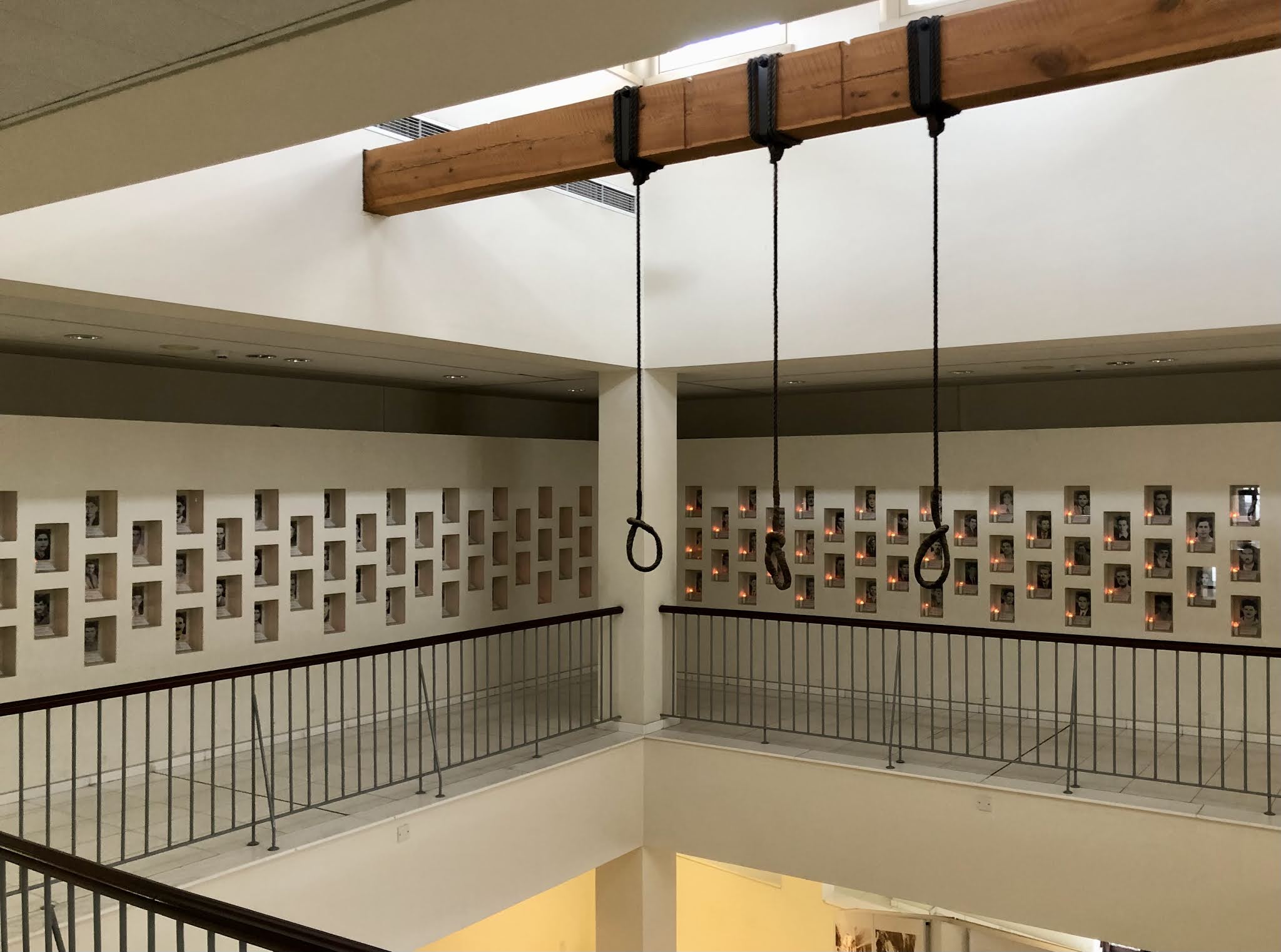
Perhaps the most effective visual in the museum is on the top floor. I assume the photos are of those sentenced to hang by the British, although most were commuted and nine were hanged between May 1956 and March 1957. Their graves are inside the central prison, known as the imprisoned graves.


The city maps do refer to the National Guard Commando Museum, but that is now a shop. I understand that there are plans to open a new National Guard Museum, and the exhibits are in store. This means that the remembrance of 1974 is more than a little one-sided, but they do say that history is written by the winners.

If you are in any doubt that you have entered a different country when crossing the border, this TRNC flag on the mountains is the size of six football pitches!


Wednesday, 3 November 2021

In Turkish Waters

 My holiday bedtime fiction reading has been 'In Turkish Waters' by Charles Whiting. This is one of a series featuring Common Smith VC and his Motor Torpedo Boat, HMS Swordfish. I have read a couple of his non-fiction books, and the subject title appealed.

The setting is 1922, at the height of the Greco-Turkish War. Smith is given a clandestine mission to sink two ex-British and French battleships being repaired in Istanbul. The 'wicked' Ataturk plans to use them to sink Greek ships carrying refugees fleeing Smyrna. This is to avoid the international opprobrium of massacring them on land, although why it would be any more acceptable to kill them at sea is not made clear.

The Swordfish, suitably civilianised, makes its way from the Humber through French canals, then to Greece and Alexandria. Before sneaking past the Dardanelles forts to attack the ships in the harbour. En-route they are attacked by Germans, Bolsheviks, Turks, and anyone else, it seems.

I regret to say few works of fiction have irritated me more than this book. Not only is the historical premise absurd, but even for historical fiction, the action scenes are ridiculous. Then there is the characterisation. The British are cartoon characters, two public school officer types, a rugged hard-drinking Scot and various working-class stereotypes. Their opponents are equally cartoonish, including the Bolshevik agents. 

But the most egregious characterisation is of the Turks and Kemal Ataturk in particular. The description of him is an offensive, racist stereotype, and every Turkish soldier is a sadist. It is implied that he was gay, which is unlikely given what we know of his personal and public life despite some Greek propaganda. He could be ruthless, but the language attributed to him is equally absurd. Then there is the failure to do any basic research. The most obvious is that his name wasn't Ataturk in 1922. He hadn't 'banished religion'. He hadn't even abolished the caliphate then or instituted his modernisation reforms. There is barely a page without similar inaccuracies. 

In summary, this book is not just awful; it's offensive nonsense. Its only redeeming feature is that it is short. So don't waste your money.


Tuesday, 2 November 2021

Cyprus castle tour

 I have been in Cyprus this week. Some autumn sun and research for a future book. However, there were a few obligatory castle visits, much to my wife's delight!

The very best castle in Cyprus, by some distance, is St Hilarion. Perched on a mountain peak 720 metres up, it dominates the coastal plain around the city of Girne (Kyrenia). Originally a monastery, the Byzantines spotted the strategic potential and converted it in the 8th century. The Luisignans, during the Crusader period, strengthened it around 1228. However, it fell into disrepair under Venetian rule and saw action in the 1974 conflict when it was held by the Turkish militia (TMT). 

It's a fair old drive up a military road as the area is still part of a Turkish army camp. When you get to the entrance, be warned there are 450 steps to the very top. Although there is plenty to see at the different levels and to take a well-deserved breather. 


The above is Prince John's Tower, close to the top. He chucked several of his Bulgarian mercenaries out from it when Queen Eleanor convinced him they were planning to revolt. Part of a devious plan of her's to get revenge for his role in her husband's murder. Once brought closer to her, she had him stabbed to death.

The views are impressive.


This is a long-range photo of the beach the Turkish forces landed on in 1974. Which emphasises the castle's strategic importance today.

Reinforced by this photo of the castle from the coast.


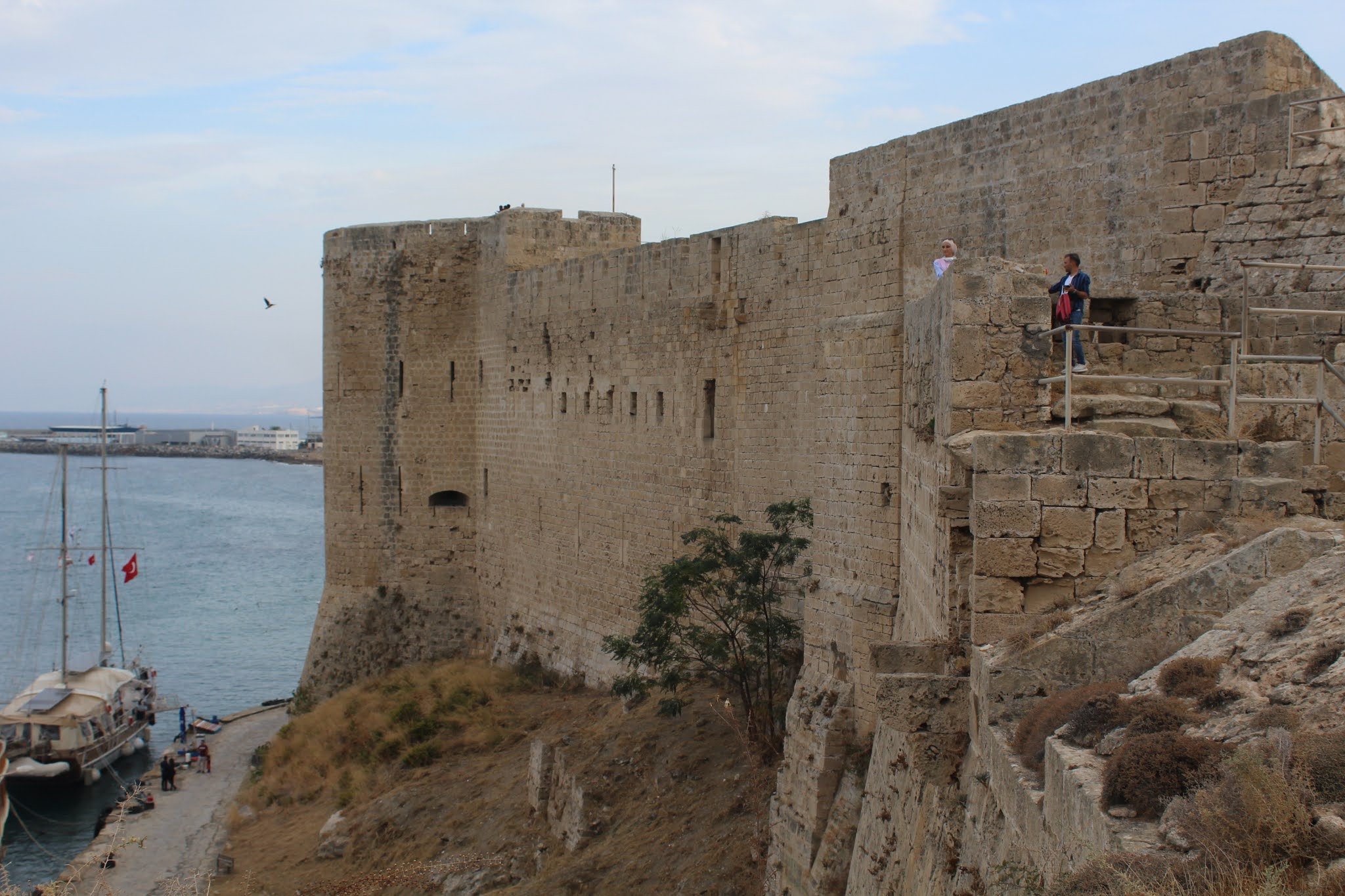
There are two other big castles in the Kyrenia Mountains, Buffavento and Kantara, which I didn't have time to visit. However, I did get down to Girne Castle, another Byzantine castle extended by the Luisignans. The Venetian commander surrendered it to the Ottomans in 1570 when they presented the head of his Nicosian counterpart!


Travelling south, the Venetian walls of Nicosia are worth a look, although the views are limited by developments on and around them.

Then across the border into southern Cyprus. The castles here are modest in comparison.

Lemesos Castle was built by the Luisignans after Richard the Lionheart sold Cyprus to them, and he got married here. The Venetians rebuilt it after an earthquake and then destroyed it. It was then rebuilt again by the Ottomans. There is an interesting medieval museum inside.


Just west of Lemesos is Kolossi Castle, built by the Hospitallers as their HQ on the island. This is probably the best castle in the south, but it is essentially a big square tower.


Nearby is Ancient Kourion. Not a castle but well worth a visit.

And finally, Paphos Castle. This was another Lusignan castle destroyed by the Venetians and rebuilt by the Ottomans. It guards the picturesque harbour.


 You will have gathered from this tour that North Cyprus is the best place for castles. It is challenging to fly from the UK and a logistical challenge to travel from the south. But well worth the effort.