Welcome to my blog!

News from a wargamer with a special interest in the military history of the Balkans. It mainly covers my current reading and wargaming projects. For more detail you can visit the web sites I edit - Balkan Military History and Glasgow & District Wargaming Society. Or follow me on Twitter @Balkan_Dave
or on Mastodon @balkandave@mastodon.scot, or Threads @davewatson1683

Monday, 6 December 2021

The Teutonic Knights


I was considering what medieval army to take to the club on Sunday for a game of To the Strongest! Then, I remembered that I had recently scanned my pre-digital photos of a tour of the Teutonic Knights castles in the Baltic States in 1994. 

I went in the summer, which unusually wasn't the campaign season for the Teutonic Knights. Iced over rivers and lakes made the winter a better option. This picture of the Sigulda region gives a good impression of the terrain.


 And the local castle.


There weren't many tourist signs back in 1994, so finding castles was a bit of a challenge. You usually just look up, but many Teutonic Knight castles were on river edges. Turaida is an exception to this rule, but again the terrain won't have changed much.


This is Bauska castle in modern-day Latvia. It was built by the Livonian branch of the Teutonic Order. Unfortunately, it was blown up by the Russians during the Great Northern War.


 This is Cesis Castle in Latvia, one of the better-preserved castles. This one was blown up by the defenders being besieged by Ivan the Terrible. Well, you might consider this as the lesser of two evils!


Koknese Castle is a good example of a riverside castle. I remember driving into many a Soviet housing scheme trying to find this one. Much to the bemusement of the locals!
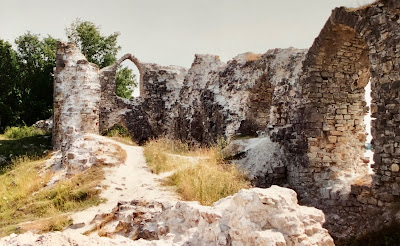

This is the Bishops Castle, which was also blown up by the retreating Russians in the GNW. They must have used a lot of powder doing this.


I finished the tour in the Estonian capital Tallinn, which has magnificent city walls. This tower is called Pik Hermann.


This one is called Neitstorn.


As for the tabletop battle, my mother warned me against playing card games, and she was right. One unit of knights bounced out of a flank attack, another failed three rallies on the trot and my Livonian horse archers, far from galloping around the flanks of the more static HYW French, dawdled without firing a shot. There was more, but you get the drift.

A nice open flank for the Ritterbruder

My brother knights are Hinchcliffe models, still very serviceable 40+ years on.

The crossbowmen didn't hit much all day. Under the old WAB army lists, you had the option of a unit of longbowmen to reflect the crusading tourists from England. I could have used them against the Grimaldi Genoese below.


Saturday, 4 December 2021

Western Desert Model Show

 It seemed slightly incongruous to go to the Western Desert Recce Group's model show on an industrial estate in Blantyre on this dreich Scottish Saturday. It's not my hobby, but I have never visited this group's base and starved of shows for the past couple of years; I will grasp at any straw!

The group are reenactors who specialise in the vehicles of the Middle East campaigns in both world wars.

They have a small collection of vehicles, some of which I have seen at events around Scotland.


Several local model clubs turned up to display their work, and very impressive it was too. Here are just a few that caught my eye.


Several local model shops also had stalls. Unfortunately, I am pretty useless when it comes to assembling kits, but I couldn't resist this Croatian Me 109 that will, sometime, be strafing my partisans. 


I also picked up a book full of colour plates of modern Turkish and Arab AFVs. Just the job.


Overall, it was a friendly wee show and well worth the effort.

Thursday, 2 December 2021

Opening the Black Box - Inside the Turkish Military

 Those of us interested in military history, particularly wargamers, tend to focus on the equipment, organisation, and tactics of the armies we study. We rarely dig deeper to consider the organisational culture that drives those armies. For modern militaries, this isn't always easy, as, in all countries, there is a reluctance to open the door. For my Cyprus project, I thought I would see if I could take a closer look at the Turkish Army.

I anticipated that this might be a challenge, particularly in the English language. However, Mehmet Ali Birand's 1986 study, Shirts of Steel, was translated into a 1991 book. This is difficult to get hold of today except at ridiculous prices, but I did get a chance to read it in the British Library. The introduction outlines the scale of the Turkish armed forces of the period (800,000 troops, including 35,000 officers) and the critical role it plays in society (25% of the national budget). 

Part one deals with the recruitment and training of officers. While vetting is part of all militaries, political vetting in the Turkish military is particularly stringent. Birand quotes one officer cadet who was dismissed because a cousin he had never met was jailed for inciting strikes. Ideology is an integral part of the training focusing on Ataturk's principles, particularly identifying separatist and extremist movements. Secularism is also important through the separation of religion and the state. Isolating the Army from politics is another principle, although that has not stopped the Turkish military from intervening when they believe Ataturk's principles are undermined. They are taught that their role is to protect the Republic from external and internal threats.

The experience of young officers once they join a unit is pretty demanding. Typically serving for ten years in the field before promotion to captain. While the pay was comparable with civil servants, there were fringe benefits, including housing, health care, shops, holidays and social clubs. The cream of officers enter the staff academies and become staff officers. It was less intensive than other NATO armies (one year instead of two) and more directive and theoretical. A unique feature is that all three services train on the same campus. The book outlines the structures of the General Staff in some detail and how it is supposed to work. A significant difference at this time was the minimal involvement of the civilian ministries in determining national military strategies. 

To bring the story up to date, I have also read Metin Gurcan's, Opening the Black Box: The Turkish Military Before and After July 2016. This is readily available and published by Helion. July 16 was the date of the failed military coup instigated by military officers but not by the High Command. This book is heavy going in places, but the author worked inside the military and was able to undertake qualitative and quantitive studies. As it was written after the coup, there is a focus on civil and military relations. After a theoretical discussion of military culture, he shows how the Turkish military was beginning to change well before the coup. Just analysing press release shows how the views of five Chief of Staff between 2002 and 2014 had softened their approach to politicians and the media. From 'active hostility' in 2002-6 under Hilmi Ozkok to 'delicate harmony' in 2011-14 under Necdet Ozel. 

Modernisation is illustrated by practical measures, including recruiting female officers who had reached 3.3% of the total with a target of 5%. These included 96 colonels who typically worked in staff posts and 360 majors in unit commands. There were a staggeringly high number of colonels in the Turkish military, more than 6,000 or 15% of all officers. That is five times the ratio in the US military. The book also highlights other changes, often forced by bottom-up processes. These include improving the rights and status of NCOs, violations of soldiers rights and ending the headscarf ban for relatives on military sites.

The quantitative analysis includes a detailed survey of those serving in the Turkish military, which shows opinions that have moved some way from the descriptions outlined in Shirts of Steel. For example, junior officers thought the military's primary task was to protect against external threats, whereas senior officers thought it was still external and internal. This generational split is reflected in other responses. For example, even after the election of Erdogan's government, half of the officers did not think secularism was under threat. However, very few officers trusted the parliament, reinforcing the long-standing distrust of politicians. There are similar attitudes towards the media and the police. 

The last chapter covers the July 2016 coup. The more egalitarian views of younger officers clearly provided a braking mechanism that stopped the limited uprising from turning into a full-fledged insurgency. But, by any standards, it was an extraordinarily poorly organised coup. There has been a large scale purging of officers (20,000 so far), particularly senior ranks, since 2016, which is still ongoing. Only this week, StateWatch, a UK-based international rights organisation monitoring the state and civil liberties in Europe, says an algorithm used to detect alleged government opponents in the Turkish Armed Forces, TSK, has been used to persecute thousands of people.

While the post-coup changes have already brought the Turkish military under greater civilian control, it remains to be seen how far the organisational changes will go and how they will impact operational effectiveness. In addition, the Turkish military is engaged in Syria and internal security actions against Kurdish groups. 

Neither of these books is likely to attract the general reader, but they remind us that we sometimes have to dig a bit deeper to understand military history. 


Monday, 29 November 2021

David The Prince

 This is the latest in my chronological re-read of Nigel Tranter's novels covering the history of Scotland.  This book is about David I, who ruled from 1124 to 1153. David is not as well remembered as some of the later medieval monarchs, perhaps because he doesn't fit into the modern nationalist view of history. Nevertheless, Tranter was clearly a fan, as this is a very sympathetic history of him.

David was born in 1084, probably the eighth son of King Malcolm III and the sixth and youngest borne by Malcolm's second wife, the blessed Margaret. As such, he had no expectations of becoming King and spent much of his youth in the English court of Henry I, who married his sister Matilda. As a brother in law to the King, David prospered and was granted the Earldom of Huntingdon after he married another Matilda, the former Earl's widow. Matilda appears to have been a popular name choice, as there are confusingly many of them in this story!

He was also appointed Prince of the Cumbrians, probably after Henry pressured his brother, the Scots King Alexander. This has little to do with the modern region of NW England, although it certainly included Carlisle.  It covered most of southern Scotland, and David used the revenues from Huntingdon to build abbeys and castles in the Norman style.

When Alexander died without an heir in 1124, David was the last surviving brother. Life could be very short in medieval Scotland! However, the Scots had no tradition of primogeniture, so his election was far from certain. Tranter portrays his accession as reasonably smooth, but historians of the period point to considerable opposition, particularly in the North. The backing from Henry and the threat of an English army was the decisive factor. In practice, David only ruled in the south for the early years until a revolt by the northern earls was defeated at Stracathro in 1130. Then, with the help of the Norman knights he had brought to Scotland and military aid from Henry, he pacified the rest of Scotland. The Normans who came to Scotland included families who would later make their mark on Scottish history, including Bruce, Balliol and Stewart, anglicised from their French names.

David is best known as an administrative reformer, introducing the parish system that partially survives to this day, burghs and the feudal system. It is this following of English practice, imposed with Anglo-Norman cash and swords, which makes David problematic for nationalist history.

After Henry's death, relations with England reverted to more normal hostility. David had backed Henry's daughter, another Matilda, for the throne. However, Stephen had usurped the throne, and civil war in England allowed David to assert Scottish rule over Northumbria. Despite losing the Battle of the Standard, he still managed to reach an agreement on holding these lands in the name of his son. He died in 1153 with the borders of Scotland at their largest, although they didn't survive long after his death.

For further reading, I would recommend the very readable Richard Oram's David: The King Who Made Scotland. My copy is the 2008 edition, but I notice there is a 2020 edition.

On to the tabletop for a game of To the Strongest! The armies of the period are interesting, with the Scots having a couple of units of Norman knights alongside the usual massed ranks of spearmen. The Anglo-Norman army is quite different from the typical feudal English armies. The Normans kept the Saxon fyrd, so you get shieldwall Saxons alongside Norman spearmen. The bows and crossbows are light units, so they don't dominate. In the Battle of the Standard, the Normans dismounted to fight, which was a rare experience.


The Anglo-Norman left-wing quickly defeated their opposite number and started to roll up the Scots right.


The Scots left got the better of their fight but not in time to save the centre. This was some melee, but it broke the Scots army. So Northumbria was won for the Anglo-Normans in this refight.


Saturday, 27 November 2021

Greek-Turkish Relations Since 1955

 This book by Tozun Bahcheli is some background reading for my Cyprus 1974 project. After a brief background chapter, the focus is on Cyprus and the diplomatic efforts to address it. Military operations are only briefly touched on.

Despite the book's title, the author challenges the view that the Cypriot communities were observers in the dispute between the two countries. He argues that the Cypriot communities often took the initiative, and their role in determining the course of events has been underestimated. The Greek and Turkish governments often reacted to events rather than initiating them.

The first chapter sets the scene for the post-1955 conflict by outlining the island's history and the limited integration between the communities. This goes back to the Ottoman millet system, reinforced by separate education systems and, of course, religion. For UK readers, the pattern of segregation looks dismally familiar to Northern Ireland. However, despite these differences, there was no history of communal violence for over 400 years until the mid-1950s. 

The Greek-Cypriot campaign for Enosis (union with Greece) in the early 1950s changed everything. In the early years, this campaign was aimed at Britain as the colonial power with the armed insurgency, led by EOKA, starting in 1955. While Greek governments and domestic public opinion supported Enosis, they were initially reluctant to support the armed struggle, as Britain was an ally. However, Makarios used public opinion and the non-aligned movement through the UN to promote the Greek Cypriot case, gradually winning over the Greek government. 

The Turkish government was initially relaxed, hoping that the campaign would fizzle out, although their strategic concerns over Greece gaining control of Cyprus remained. However, public opinion in Turkey also played its part in forcing the Turkish government to take a stronger line in protecting the Turkish community. After inter-communal violence increased in 1958 with more than 120 people killed, Ankara provided more aid to the Turkish defence organisation, the TMT.

The independence settlement in 1960, guaranteed by Greece, Turkey and Britain, initially calmed tensions. However, when Makarios abrogated the agreement and prepared the Akritas Plan to knock out the Turkish communities, the scale of fighting dramatically increased. The threat of Turkish military intervention put something of a brake on the Greek Cypriot offensives. Still, by 1964 the Turkish minority had largely been forced into enclaves for their own security. Only US intervention stopped Turkey from intervening in 1964 and again in 1967, although their capacity to put boots on the ground was limited. The book covers the various peace plans and other initiatives before the Greek military coup of 1974, which led to the Turkish peace operation/invasion. 

I took from this book that several of these initiatives came closer to an agreement than I had thought. It is tempting to view the Cyprus issue as impossible to resolve, but this history shows that the diplomats were not entirely wasting their time and effort.  Many Greek Cypriot politicians believed the Turkish enclaves could be whittled away through economic blockades rather than military action. It is a matter of opinion how much of the blame for 1974 can be placed conveniently on the junta rather than Makarios. 

The many post-1974 peace efforts have failed to find a resolution. These also have to be seen in the context of growing tensions between Greece and Turkey over issues other than Cyprus. These include the continental shelf, territorial waters and airspace issues in the Aegean. There are also disputes over the treatment of minorities in Istanbul and Western Thrace, which were exempt from the population exchanges in the 1920s.

While this book was published over 30 years ago, little has changed in the region. Cyprus remains a highly militarized island, and relations between Greece and Turkey have not improved. In fact, it could be argued that they have deteriorated to the extent that they came close to armed conflict this year. Overall, this is an interesting and very readable history, if not an uplifting read!

Just one of the many Turkish memorials to 1974.

A Turkish painting of 1964 Kokkina enclave defence


Saturday, 20 November 2021

Modern Turkish Armed Forces

Our daughter returned home for most of the last week, which meant I was outvoted with the TV remote. The good news is that it forced me back to the painting table and caught up with History Hit shows and podcasts. 

After I finished the Venetian galleons, it was back to the Cyprus 1974 project in 20mm. Having painted some armour, it was time to tackle the infantry. I now have two squads and a spotter team. The figures are from the Elhiem range, which look pretty tall for 20mm but are nice figures with only a little flash in the usual places. There are some compromises as obviously, no one does specific models for the Turks, so they are a mix of US army/marines and Vietnam figures. 

One of the advantages of doing a modern army is the availability of colour photos. I trekked around Salute in search of the closest spray paint I could find and settled on a new firm to me, TTC, which have an impressive range of colours. Perhaps a little too dark, but there was a range of shades from the photos even before they hit the dusty ground. First, a primer followed by some block painting, including a darker shade of green for the webbing and the distinctive helmet covers. Then a brown ink wash, finishing with dry-brushing dark sand. 


One of the reasons I use 20mm for moderns is the availability of ready built and painted models. These are from the Easy Model range. The downside is that they usually have the wrong decals for my obscure armies. That was the case with these M113s and the Huey. The plus side of having our daughter at home is that she has acetone nail varnish remover. This is terrific stuff that, with a bit of careful application with cotton buds, brings the decals off, although it stinks! The M113s needed a bit of conversion work to change them from the US version, but the overall effect is fine after some dry-brushing. Twenty M113s landed with the first wave of the amphibious assault on 20 July 1974, and many more in the second wave.


A key element of the Turkish plan was to use airborne troops to hold what was known as The Triangle. This was an area of Turkish villages north of Nicosia held by the local Turkish Cypriot militia (TMT). They parachuted in an Airborne Brigade and used helicopters to bring in three commando battalions and a battalion of infantry that was hurriedly trained in the role. To achieve this, just about every available helicopter in the Turkish Army and Air Force was brought together for the task. I helpfully had some roundels and transfers leftover from my WW2 project, after a liberal application of acetone. Thanks, daughter!


There aren't many books on the Turkish military in English at least, although I am collecting everything available. However, there are quite a few academic papers, which are very helpful. I have just finished reading a Masters thesis by Connor Murphy, 'Modernisation of the Turkish Navy' (2020). The focus is post-1974, but it shows how the Turkish Navy has shifted its strategy and procurement policies since the Cyprus operation and the subsequent arms embargo. 

The traditional strategy of coastal defence is shifting towards what is called a 'Blue Homeland' policy. This envisages the navy operating across the Mediterranean, including Cyprus and Libya. Ships have also taken part in anti-piracy operations off the coast of Somalia and visited ports across the world. The navy now has a base in Qatar. Instead of relying on European and US shipbuilders, they now have the capacity to build corvettes, frigates and even destroyers. I can see a new naval project coming, although sourcing these ships is likely to be challenging! 


Friday, 19 November 2021

A Viking in the Sun

 This is the second Lion Rampant supplement written in collaboration with the University of Edinburgh. It loosely follows the journeys of Harald Hardrada (more properly Harald Sigurdsson) and his fighting journey from Norway to the Byzantine Empire. Harald is better known in the UK for his failed attempt to take the English throne in 1066, but he had a much more exciting story before that.

This is the late Viking period; Harald was even a Christian! He was born sometime around 1015. Harold was forced into exile after his brother was killed at the Battle of Stiklestad 1030 and the throne seized by Cnut the Great. He took the route favoured by many Vikings before him, into Kievan Rus and then onto Constantinople. He joined the Varangian Guard around 1034.

Harald brought around 500 men with him from Rus and spent ten years fighting for the Byzantines all around the Mediterranean. These campaigns are covered in the army lists for Lion Rampant in this supplement. It also brings some optional rules that better reflect the troop types in this earlier period. I am looking forward to trying a few of these, particularly feigned retreats. Not entirely convinced by the medieval hand grenades, but I'll give them a go.

The new factions include the Varangians, Byzantines, Southern Italian Principalities, Normans and Muslim powers. These will be useful for extending Lion Rampant into other periods, as many already do. But I am sure there will be more supplements. Each faction has some special rules and limitations. 

Harald fought in Sicily and Italy as well as the Balkans, so he would have bumped into the Normans as allies and enemies. This is another of my favourite historical stories, beautifully told by John Julius Norwich. The second half of the book covers campaigns, allowing the player to link games together. Lion rampant can be played in an hour or two, so this works very well. There are three campaigns based around his fighting in the Holy Land, Sicily and Italy. There are special rules and scenarios for each campaign.

This is an excellent supplement for a set of rules I have let lapse recently. They are handy when you want a quick game, as it requires very few figures and a quick set-up. Highly recommended.

My 28mm Varangians, just the job for Harald and his lads.

And some Byzantine cavalry to cover his flanks.

The Normans popped up everywhere. Have horse and lance, will travel.

And not forgetting the Muslim armies.

I was listening to the History Hack podcast on my morning walk today. They have an entertaining interview with Georgios Theotokis about his new book on Bohemond of Taranto. Very to the point here.

Wednesday, 17 November 2021

Scottish National Gallery

 I had to meet a client in the Scottish National Gallery yesterday. I hadn't visited for several years and had forgotten that there are several items of historical interest. The National Gallery houses what I would call 'proper' art'. If you want modernist spray painting and the like, there is the gallery of Modern Art.

As you enter the gallery, the largest, visually stunning painting is of King Alexander III being rescued from the fury of the stag. Alexander III ruled from 1249 to 1286, so I am not entirely sure the dress is correct. However, that isn't the point, as this was a PR effort by Clan Mackenzie after their role in the failed 1715 Jacobite uprising.

Then we have Sir John Sinclair of Ulbster, one of many paintings by the prolific Scottish painter Sir Henry Raeburn. He finished more than 1,000 paintings. Sir John is described as an 'agricultural improver'. What that really means is that he cleared people off his land and replaced them with sheep. A dark period of Scottish history is known as the clearances. He is pictured in a uniform of his own design as colonel of the Rothesay and Caithness Fencibles. Ironically a regiment that required men, not sheep!


This portrait by van Dyck is of the Lomellini family around 1625. Giacomo was the Doge of Genoa, but they had a rule against portraits to prevent personal propaganda. What would they have made of social media!


A bit of Balkan related interest with two pictures of Venice by Canaletto. Probably the most iconic images of the renaissance city.


We have to include a Scottish castle. This is Dunnottar castle near Stonehaven as it looked in 1867.


I wouldn't put the National Gallery on the list of military sites to visit in Edinburgh. But if you have the time, it is worth a look. Free admission as well.


Monday, 15 November 2021

Suez Crisis 1956

 I watched the BBC drama series 'The Hour', which is set in a newsroom covering the Suez Crisis in 1956. My wife started to bombard me with questions about the events of that year, and I realised that my knowledge of the detail was limited. So, I have been reading David Charlwood's 'Suez Crisis 1965: End of Empire and the Reshaping of the Middle East', published by Pen and Sword.


This is a concise overview of the crisis with an emphasis on political and diplomatic events. It isn't a detailed military history, although that would, in any case, be a reasonably short book. British and French troops had barely landed before a ceasefire was agreed, although the Israeli Sinai campaign took a little longer.

The story that most people will know is that Egyptian President Nasser nationalised the Suez Canal. The British and French took exception, even though the treaty end was not that far off. They made some diplomatic efforts to resolve the issue before colluding with Israel to invade. The US and the Soviet Union made different threats to force a withdrawal, and the British PM Anthony Eden had to give in. He resigned soon after. Ironically, allowing Macmillan to become PM, one of the initial hawks in the Cabinet.

The book flagged up some details I didn't know.

Nasser claimed that 120,000 Egyptians died building the canal, a figure that the author doesn't challenge. It is widely quoted (including the Building Safety Journal), but others are sceptical. It totals seven deaths a day, which doesn't sound that unlikely by the shocking standards of the mid-nineteenth century but is much higher than the company medical officer's record. Of course, he isn't an objective source, but the truth is probably somewhere in-between.

I understood the US opposition, but perhaps not just how furious Eisenhower was. He was facing an election, but he was also concerned not to be drawn into what he regarded as French and British imperialist policies. It was the US refusal to cover the loss of oil supplies and dollar reserves once the canal was blocked that forced the British to give in. The Russians were obviously interested in developing their Middle East influence, even if the moral high ground is somewhat challenging when you are invading Hungary simultaneously!

I hadn't appreciated the French linkage to the conflict in Algeria. They were convinced that Nasser was helping arm the liberation movement. It was the French who initiated the secret deal with the Israelis (Sevres Protocol), creating the casus belli for the intervention. Israel saw it as an opportunity to damage the growing Egyptian threat. Many thought the Israeli mobilisation targeted Jordan, which created an interesting problem for the British, who had a treaty obligation to support Jordan.

The political fallout between the western allies didn't end at Suez. When Harold Wilson refused to support the US over Vietnam, officials reminded the US of their response to Suez. It remains the greatest rift in the 'special relationship'. 

Militarily, the campaign is not without interest. It was one of very few seriously contested amphibious landings since WW2. The Turkish intervention in Cyprus in 1974 is arguably the only other one. I have gamed the Sinai campaign in 10mm, but it was something of a walkover. 

Overall, this is an excellent overview of the crisis, well written with plenty of illustrations.