Welcome to my blog!

News from a wargamer with a special interest in the military history of the Balkans. It mainly covers my current reading and wargaming projects. For more detail you can visit the web sites I edit - Balkan Military History and Glasgow & District Wargaming Society. Or follow me on Twitter @Balkan_Dave
or on Mastodon @balkandave@mastodon.scot, or Threads @davewatson1683

Sunday, 2 June 2013

Wappinshaw 13

Yesterday was the Wappinshaw show in Glasgow's Kelvin Hall. A new venue for this show and not likely to be repeated as the halls are being refurbished for the Commonwealth Games.

It is a large hall with plenty of room for the games and traders. Mostly local or smaller traders as Partizan is the next day and attracts the bigger names in the hobby from England. I had got most of my purchases at Triples, but still managed to pick up some unusual kits and collected some Black Powder bases that Martin at Warbases had made up for me. The organisation was first rate and there appeared to be a decent attendance.

Our display game was Glasgow Green 1938. We thought this was appropriate for the Glasgow show. The focus being a big 28mm model of the Peoples Palace. Courtesy of Iain from Flags of War.


Four of us played the game and all agreed it was the most enjoyable game we had played at a show. Still plenty of time to chat to an appreciative audience. The Red Clydesiders just held on but it was very close.


There were some other fine games, my quick collection of photies.

 
Big Napoleonic game from Phoenix

 
Very nice figures in this fantasy game

 
ACW

 
And another VBCW.
 
 
All credit to the organisers for a good local show.


Monday, 27 May 2013

Tito

These figures are for our Claymore demo, Raid on Tito. They will be Tito and his bodyguard. However, they will make an appearance at Wappinshaw this weekend as Soviet advisors to the Red Clydesiders in our Battle of Glasgow Green VBCW game. Wappinshaw is at a new venue, the Kelvin Hall in Glasgow. It's a good size venue and should be a good show. Hope to see you there.


Tuesday, 21 May 2013

Triples 2013

We made the journey down to Sheffield over the weekend for two days at the Triples show. My first time at the new venue. Plenty of space in a nice light sports hall. We stayed at the Garrison Hotel that is converted from the old barracks. Highly recommended.

Not having to work a display game meant I had time to really go around the stalls and view the display games. There was a good balance of both. Picked up a number of books for current projects and a few others beside. Then lots of bits and pieces - paint, glues and several cans of Testors Dullcote. The only surprise when I got home was very few figures. Probably best given the current lead pile!

These are the games that caught my eye.


My favourite was this renaissance game with an amazing Landsknect pike block

The scenery was well done in this FoW game

Napoleonic I think

Unusual Maori wars game

Gunboats on the Nile

Sunday, 12 May 2013

Carronade 13

It was the Falkirk  Carronade show yesterday. Fine venue for a big show feel. What I really like is the large amount of games being played. Plenty of trade, but it feels more like a wargames show than a trade fair that some other shows have become. It looked busy as well.

My purchases were fairly modest. Some Perry Desert Rats that I will use for my Malaya project. Plus some Warlord Japanese guns for the same project. The latest Black Powder supplement 'Albion Triumphant' and the Soviet Bolt Action supplement. Plus a very nice King John, in case I get around to doing the forgotten invasion. Plus bases and some more foam inserts, oh and the complusory visit to Last Valley of course. Club outing to Triples next weekend so much more time to peruse the stalls.

Our own game was Muret 1213, that came together very well after some last minute revisions on the Friday night. The refight went as per the historical battle. Even King Peter nearly got killed, or would have, had I thrown 10+ rather than a 9.


More Muret 1213 photies at the GDWS web site.

Running a display game means time is limited for looking at the rest of the show, but here's a selection of what caught my eye.

 
Durham's big 54mm Maurice game.

 
Eyecatching, but can't remember what it is!


Charge of the Light Brigade participation game

 
Simon and the Dumfries club with VBCW

 
Nachod 1866. Very nice scenery and even though the 10mm figures look a bit lost, you get a real feel for the battle.


Very nice WW1 skirmish

 
Chalons, big battlefield, lots of figures as you expect from Phoenix


On the Antonine Wall. Mostly Prince August molds that took me back!


Thursday, 9 May 2013

Glasgow Green dry run

We did a cut down version of our Wappinshaw display game, Glasgow Green 1938, at the club on Sunday. Waves of Government forces attacking the frame of what is shaping up to be a very good model of The People's Palace.

The Communist units holding the sandbag emplacements were wiped out, but the workers militia in the building just about hung on. A few tweaks to the Bolt Action rules plus some new event cards, and we should have a very good game.


Monday, 6 May 2013

Blood Cries Afar


My background reading for our display game at Carronade next week took me to Sean McGlynn's book, 'Blood Cries Afar'. This covers the French invasion of England in 1216.

Now, other than a few raids and aborted efforts, I had no idea that there was such a French invasion in 1216, or that it very nearly succeeded. I suspect I am not alone, hence the sub-title 'The Forgotten Invasion of England 1216'.


Blood Cries Afar: The Forgotten Invasion of England 1216
King John was on the throne and after losing Normandy and other French territory, the Angevin Empire was very much on the defensive. Capetian France ruled by Philip Augustus was on a roll, particularly after the Battle of Bouvines in 2014. The English barons were yet again in revolt against John, despite Magna Carta in 2015. They controlled London and invited Philip's son Louis, who had a tenuous claim to the crown, over as King. They controlled London, so facilitating  the invasion.

John pursued a battle avoiding strategy holding key royal castles, but was gradually being forced out of southern England, with the exception of the key castle at Dover, that held out. Then John dies of an illness and bizarrely that was the turnaround for the Angevin fortunes. His son Henry was only a child, but the Regent rallied and took advantage of splits between the rebel barons and the French. The royalists won the Battle of Lincoln in 1217 and a naval battle off Sandwich that dispersed a relief fleet. Louis sued for peace and left for France.

The book is a good narrative history of the campaigns that led up to the invasion and the campaigns in England. The military strategy of the period is also covered in depth. Well worth a read and a campaign I will certainly return to.

It also helped my understanding of the context for our display game, Muret 1213. The production line of knights continues. Not as many as I had hoped to do, work keeps getting in the way, but probably enough after a few late nights this week. These are the latest additions.


Saturday, 27 April 2013

Knights and more knights

When we started the Muret 1213 project there was a naive assumption that we had most of the figures required. Of course when we came to look at army lists we realised how many knights would be required. After further research it also became apparent that most of club members collections were later Hundred Year's War knights with all too much plate armour for Muret.

So, not for the first time we are in mad painting mode. Carronade is only two weeks away and I have been away on business for a week.

Thankfully Andy McGeary's  skilled brushwork has helped with this unit of Templars. They are Old Glory figures.


This is my more modest contribution from the Gripping Beast range. A particular irritation was the prelate. In a rush I gave him a sword, but it didn't look right, even for a medieval bishop. My nighttime reading is on the period when the author reminded me that fighting prelates used maces so they didn't spill blood. Apparently bashing your enemies head in with a mace was fine!


More on the painting baton. Some late nights ahead!

Monday, 8 April 2013

Grande Armee - Talavera

Got a game of Grande Armee in over Easter. We refought Talavera, very doable in this scale as are all the big battles of the Naploeonic wars.

I took the British and Spanish. The French came at my British left flank and ignored the Spanish. I extended my flank to meet them, but had strong units on the ridge. This is a battlefield I have visited so I could picture the terrain. My recollection was that it was much more rugged than the scenario, but we got to the same point of decision as in the actual battle.

Somewhat disconcertingly my veteran British line collapsed and I was struggling to plug the gaps with cavalry while they rallied. In fairness to the scenario my dice throwing was abysmal. None the less I think it is important that the effectiveness of British volleys is reflected better in the strength points in the scenario. There are few variable factors in the rules to keep it simple, so the British advantage needs to be reflected in strength points.

This picture shows the point of near disaster.


The rally rules are a particular feature of Grande Armee and certainly saved my bacon. The cavalry held up the French and my line brigades rallied and held the line.

Despite some faults with the scenario, I think the rules are still good for big battles in 15mm.
 

Muret 1213 Update


We tested a cut down version of the scenario for our Carronade display game, Muret 1213, at the club on Sunday 8 April. The basic idea worked fine using Hail Caesar rules. Unlike Black Powder there are no rallying rules in Hail Caesar so we will have to introduce them for this battle, otherwise the French Crusaders will be too weak by the time they get around to the Toulouse forces.

As usual there will be some last minute painting. We have plenty of foot figures but not enough feudal knights. Masses of Hundred Years War figures but they have too much plate armour. Fortunately, the Spanish and Southern French hadn't moved on so much, so our Normans and El Cid figures can be deployed there.


Crusaders crash into the Spanish forces


The besieging forces


Two fingers from the Castle of Muret!

Sources in English for this battle are limited. Oman's classic Art of War in the Middle Ages covers it. Happily there is a Spanish Osprey look alike on the battle and campaigns. In Spanish but the pictures and battle plan are excellent.

la batalla de muret 1213 (guerreros y batallas, 80)-ruben saez abad-9788492714414

Thursday, 4 April 2013

Panzerschlacht - Hungarian Plains 1944

My Easter reading has been Perry Moore's book 'Panzerschlacht: Armoured operations on the Hungarian Plains, September- November 1944.'

The text covers, in some detail, the battles on the Hungarian Plain in the autumn of 1944. In particular the battles at Torda and Debrecen. I have driven around this area and can confirm that this is prime tank country, broken only by the many rivers that became a feature of the defensive positions.

Front CoverHungary became a battlefield in late 1944, when the Romanian border was breached by the Russians and the Romanians switched sides. Heavily outnumbered Hungarian and German units fought a series of strategically defensive operations, with some local counter attacks. They often held up large Russian and Romanian units, but in the end numbers prevailed.

This is a big book physically, almost coffee table size. The level of detail is a remarkable testimony to the research that must have gone into this book. Ideal for wargamers, as it describes German battle groups down to the numbers of men and tanks for a huge number of actions. It is not so strong on the Russian and Romanian units.

The level of detail makes the narrative hard going in places, but it's supported by good maps and plenty of them. Again, something you don't often get with this type of publication. Helion's high standards show throughout this book. However, the book is worth the price for the photographs alone. Hundreds of them that make full use of the books size. Plus orbats and some nice colour plates of the main AFV's.

If you are planning on gaming this section of the Eastern Front - this is a must have book.

Sunday, 31 March 2013

Dacians

One of the very few Balkan conflicts I haven't done before is Trajan's invasion of Dacia.

I have been collecting Roman units for the past six months or so. Not quite a full Hail Caesar army yet but getting close. I have a reasonable collection of generic Celtic infantry that will muster at the least the back ranks of the Dacian foot units. There were several Celtic tribes in the area so they can also be fielded in their own right.

To supplement this I have used the Warlord Dacian plastics. Tremendous animation in these figures, probably too much to fit together well, but these will provide the front rank for my units. Not really enough falxmen so I will need to supplement these with metals.


Some command stands of course. Although with Hail Caesar rules you can't rely on your units to take any notice of them!


What I really like about the Dacians is the balance the Sarmatians give the army. Shock cavalry and horse archers. These Warlord metals are very nice indeed. My horse archer collection will probably suffice, but can I resist a unit of female warriors? Probably not.


If these fine figures are not enough for the project, Warlord have produced a supplement, 'Rome's Dacian Wars', written by Craig Woodfield. This is very good. Plenty of eye candy to go with the potted history, scenarios and army lists. In addition some rule additions including sieges and a skirmish game. I am also painting up some Foundry casualty figues for those very nice Warbase casualty counters.

Hail Caesar - Rome's Dacian Wars

Monday, 25 March 2013

Constantine the Great


A short interregnum in my reading around my key projects has been Elizabeth James book, 'Constantine the Great - Warlord of Rome'.

Constantine is of course best known as the Roman emperor who converted to Christianity and effectively led the Empire very quickly in the same direction. However, as the title implies, the author seeks to remind us that this was only possible because he was also an outstanding general.

James sets out the organisation and equipment of the Roman army in the 4th Century and how it sought to defend the extensive borders of the Empire. Constantine was in Britain when his troops declared him Emperor and there is a statue of him in York. She then takes us through the campaigns of the ensuing civil war including the 'vision' at Milvian Bridge that led to his conversion. Then the later campaigns in the Balkans that led to the capture of Byzantium. This was converted into the new capital that bore his name, Constantinople.

This is a good narrative history and while the religious impact is explained, this book focuses on his military campaigns and the armies he led.

Sunday, 24 March 2013

Russo-Turkish War 1877

Some reinforcements for my Russo-Turkish War 1877 project in 28mm. These are from the seriously good Outpost Miniatures range. I have returned to this project largely due to being inspired by Quinton Barry's excellent book 'War in the East'. It includes some of my photies taken at Shipka Pass, a very well preserved battlefield.

First up a unit of Redif infantry. These are reservists that had been called up when war broke out with Serbia the previous year. These are modelled with the turban wrapped around the Fez. This distinguishes them from the regular line infantry although they didn't all do this. The main difference was the rifle. Reservists were mostly armed with the older Snider rifles, inferior to the Berdan issued to regulars, but still as good as the Russian Krnk.


Then a Turkish Pasha to command the army together with some officers and line infantry reinforcements for existing units. He has been modelled in what I assume is closer to full dress uniform. Most of the photos show a slightly plainer uniform but we do like our generals to stand out.


Next up a unit of Russian guardsman. The main difference with the line is the Furashka cap instead of the kepi.


And finally, no Russian army would be complete without General Mikhail Skoboleff. He is surrounded by some line infantry reinforcements. I would welcome any suggestions for a suitable flag.


I am of course kidding myself that is is still a skirmish project! Hence the individual bases. But Warbases helpfully provide slot bases for units in regular formation for a full Black Powder game.

Saturday, 16 March 2013

Albigensian Crusade


I am getting into the research for our first display game of season at Carronade in May, the Battle of Muret 1213.

I usually start with a general history and this is Jonathan Sumption's 'The Albigensian Crusade'. To most people 'crusade' means the Holy Land or perhaps Spain, or if like me your interest is in the Balkans, then perhaps Nicopolis 1396. You probably wont think about Southern France and the Languedoc in particular. However, in the early 13th Century there were several fully authorised crusades aimed at extinguishing the Cathar church.

Front CoverThe beliefs of the Cathar church are not at all clear because the Catholic church destroyed their writings, but they appear to have been similar to the Bogomils in the Balkans. They were certainly a protest against what they perceived to be the moral, spiritual and political corruption of the Catholic church. They opposed war and capital punishment, marriage vows, sexual intercourse even to the extent of not eating the product of any intercourse. Instead of priests they had Perfects who administered  the Consolamentum, involving a brief spiritual ceremony to remove all sin from the credente, or believer.

While this was a grass roots movement, it had widespread support amongst the nobility, including at least tacit support from the area's main ruler, Count Raymond VI of Toulouse. Militarily this meant the crusade pitted the knights of Northern France against those from the South. The widespread northern enthusiasm for the Crusade was less to do with religious fervour than the papal decree permitting the confiscation of lands owned by Cathars and their supporters.

The crusade was led by Simon de Montfort, no not the Barons War one, but his father. The war fell into a routine of summer gains, mostly through siege warfare, when Simon was supported by large numbers of crusaders. Then some falling off during the winter when he had to hold off the locals with a small number of knights. The decisive battle was Muret in 1213, a victory against Raymond of Toulouse and his allies, including Peter of Aragon who died in the action. In the longer term it had greater significance to the royal house of France than to Simon de Montfort, as it was a big step in the creation of the unified French kingdom we know today.

Sumption's book explains the dualist tradition of the Cathar Church and then the main campaigns that didn't conclude until the French King Louis VIII led a crusade in 1224 - 29. The Cathar church gradually died away after that. The last major military stand was at the Cathar fortress of Montsegur in 1244.


While Sumption describes the campaigns he doesn't say much about the armies. For that I turned to Osprey MAA 231 'French Medieval Armies' that has a rather good colour plate of Simon de Montfort on the cover. Ian Heath, 'Armies of Feudal Europe' is always a good source. Oman covers the battle itself in Volume One of his 'Art of War in the Middle Ages'.

So, history understood, the next stage is the armies. I have started to collect flags from a variety of suppliers and a few figures including the Mirleton version of de Montfort. Then we will need an audit of figures in the collection of GDWS members to identify the gaps for the painting table.

Sunday, 10 March 2013

Albanich 2013

My first wargame show of the season was yesterday's Dumfries show, Albanich. I was working in the morning so I only had time for a brief visit in the afternoon. This is a small show, but apparently a good turnout and there was a strong showing by traders. They certainly did well out of my short visit, including books, paint and more than a few figures from the Warlord stand.

I resisted adding to my ancients, but it was difficult when you see the quality of these Aventine figures.


There were only a few games but they were all very good.


Being Dumfries a VBCW game is mandatory.


French Indian wars


Bolt Action
 
 
An unusual Russo Japanese skirmish


And finally the Battle for Madrid (SCW)

Saturday, 2 March 2013

Flodden 1513

This year is the 500th anniversary of the Battle of Flodden. It was fought in Northumberland on 9 September 1513 between a Scottish army led by King James IV and an English army led by the Earl of Surrey. It was the largest battle ever fought between the two kingdoms and resulted in a major defeat for the Scots and the death of King James.

The war began when Henry VIII invaded France in 1513. Scotland was allied to France and James agreed to a diversionary attack on England. He invaded with an army of 60,000 men supported by French arms including the first use of pikes by a Scots army. The Earl of Surrey mustered 26,000 troops from across northern England, as the best troops were in France.

By the time the Scots army reached the hill of Flodden Edge it had shrunk to around 35,000. This was a strong position with entrenched artillery so Surrey marched the English army to the north forcing James to move to Branxton Hill. After suffering casualties from English artillery fire James advanced his pike blocks off the hill to attack the English lines. After initial success on the left the main attack faltered under artillery and bow fire. The arrival of Stanley's force seals the victory. Some 10,000 Scots were casualties including the King. English losses were around 1500.

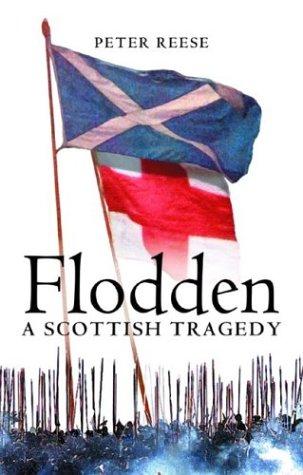
Cover of: Flodden by Peter Reese
My reason for reading up on the battle was our plan to include this in this year's GDWS display game programme. We like to do at least one anniversary battle. So I started with a good general history, Peter Reese, 'Flodden - A Scottish Tragedy' and then the Osprey Campaign 'Flodden 1513'. Having understood the battle, I then moved onto the armies. The Osprey MAA series does a book on both armies and I also have Ian Heath's excellent study 'Armies of the 16th Century'. There are some good online resurces as well including the Flodden Ecomuseum.

After this reading we decided that sadly Flodden was not a viable project. We had thought that our late medieval armies would form the backbone and it would only need a few add ons. However, the Scots army in particular is almost unique to this battle and, other than the highlanders, very few of our figures would do. The English were also much more renaissance looking than we expected. Painting large numbers of figures for a display game is of course nothing new for us. But this was on a pretty daunting scale, in only a few months, to produce armies that, for the Scot's at least, can only really be used for this one battle.

So, I enjoyed the research but it won't feature on the tabletop, at least not in 28mm. I do have the English in 15mm, so other non-display possibilities there.

Back to the drawing board and we settled on another anniversary battle, Muret 1213 for our next display game at Carronade. But that is another story....