Welcome to my blog!

News from a wargamer with a special interest in the military history of the Balkans. It mainly covers my current reading and wargaming projects. For more detail you can visit the web sites I edit - Balkan Military History and Glasgow & District Wargaming Society. Or follow me on Twitter @Balkan_Dave
or on Mastodon @balkandave@mastodon.scot, or Threads @davewatson1683

Wednesday, 1 May 2019

Wild Europe

Wild Europe by Bozidar Jezernik is a study of the Balkans in the gaze of western travellers from the fifteenth to the early twentieth centuries.


To the modern reader, the views of many of these travellers appear bizarre. They mostly cover the period when the Balkans were occupied by the Ottomans. In the early period travellers reflected the power of the Ottoman Empire, but that soon changed to less admiration as the empire declined.

In some cases there was outright racism, in others, it reflected a disdain for Islam. More often just shock at a different way of life that to western eyes of the period appeared backward. This results in an inability to credit the Ottomans for anything positive. This is well illustrated by the Mostar Bridge in Bosnia. Western 'experts' claimed it was a Roman construction despite the clearest evidence that it was built by the Ottomans. One author even corrected his wife's notes to this effect.

Most of these western observers also failed to recognise their own hypocrisy. They were shocked at the taking of heads in battle, but not the mass slaughter in trenches, the lynching of black men in the USA et al. Not to mention the similarity between the Ottoman divide and rule policy with similar approaches in the British empire.

One chapter describes the 'evidence' collected by several writers that Albanian men had tails. A clear example of how groups perceive others, sometimes for political reasons. Illustrated by the views of the Serbian Prime Minister, Vladan Dordevic (1897-1900) who was also a distinguished author and academic. He described Albanians as 'bloodthirsty, stunted, animal-like individuals, so invincibly ignorant that they could not tell sugar from snow'. Conveniently this meant they could not possibly rule themselves!

The original passages are interesting in themselves, but the author goes further in analysing how these western observers constructed their images of the Balkans. A really interesting book that has been extensively researched with many period illustrations.

Saturday, 27 April 2019

Italians completed

The Italians for my Yugoslavia invasion project are now completed. Most unlike me, two weeks before the Carronade show - no hair dryer required!

First up, some seriously heavy artillery. This is the Ansaldo 149/40 from Heer46 Models with Perry's crew. I appreciate that it's a bit OTT for Bolt Action, but I couldn't resist. Some 590 were ordered, but only 51 were in service by the outbreak of war. It was a good design and the Germans took over production after the Armistice in 1943.


Like most wargamers, I usually paint the elite troops first, so I surprise myself with the late appearance of the Bersaglieri. Traditional light infantry units, by WW2 they were mostly attached to armoured, cavalry or motorised divisions. There was a battalion in Zara, which justifies their inclusion in this force. The models are from the Warlord range. The farmhouse buildings in the background are from the Tablescape range. A new firm to me, these are very light models and very nice indeed.


Lastly, we have the Blackshirts, or MVSN to give them their proper acronym. Originally they were Mussolini's street thugs and grew to 340,000 combat troops. A battalion was attached to most divisions and there was one in the Zara garrison. They were equipped like normal infantry units with the exception of black shirts and different insignia. These are standard Warlord Italian infantry models.


It's always nice to finish a project. If you come to the Carronade show on 11 May in Falkirk, you can command these units against the Royal Yugoslav Army in the GDWS 'Breakout from Zara' participation game.

Tuesday, 23 April 2019

The Traitors

Don't panic, I haven't become a social media troll! This is the title of a book by Josh Ireland who looks at four British traitors in World War Two.


The most infamous is William Joyce, Lord Haw-Haw. I didn't know that he was born in the USA before his family moved back to Ireland. He was a leading member of Moseley's BUF before falling out with them and starting his own fascist party. He headed for Germany just before war broke out and joined Goebbels propaganda ministry making his broadcasts.

John Amery was another British fascist, the son of Tory Cabinet Minister, Leo Amery. This made him a very useful propaganda asset, although he was a weak radio performer. He spent the war giving speeches and continuing his playboy lifestyle, this time financed by the Nazis.

Unlike the first two traitors, Harold Cole was from a working-class background. He was a small-time criminal who was left behind in France during the 1940 campaign, after stealing from the sergeant's mess. He escaped from his PoW camp and helped the resistance until they caught him embezzling funds. He fled to the Nazis and worked for them for the rest of the war, betraying many resistance networks.

Eric Pleasants joined the merchant marine on the outbreak of war and was captured in the Channel Islands. Bored with internment, he joined the Waffen SS, British Free Corps. After abandoning that unit he was placed in an SS punishment camp and ended up giving exhibition boxing bouts in the German officer mess. After escaping he was captured by the Russians in 1945 and spent seven years in a savage Arctic gulag.

All these traitors got their comeuppance. Joyce and Amery were hanged in Britain and Cole was shot trying to escape the French police. Pleasants was repatriated in 1952 and the authorities decided he had been punished enough in the gulag.

The author threads the stories together into a very readable book. The motivations of each traitor are different, but they all come across as inadequate and chaotic individuals. If there is a common thread, it is booze! You won't find much original research here and the subject has been extensively covered before. However, it has a modern style which will introduce the story to a new audience.

Some Very British Civil War, BUF 28mm figures are probably the nearest I can get to some wargame interest!


Sunday, 21 April 2019

1177 BC - The Ancient Dark Ages

The Late Bronze Age in the Eastern Mediterranean was full of thriving civilisations (Egyptians, Hittites, Canaanites, Cypriots, Minoans, Mycenaeans, Assyrians and Babylonians), which were interconnected through trade and culture. After around 1200 BC, they started to collapse. In this book, Eric Kline examines the evidence on how and why this happened.


The conventional view is that the collapse was caused by invasions of warriors known as the Sea Peoples. We know very little about the Sea Peoples, other than an Egyptian narrative, it is even unclear where they came from.

Kline argues that the collapse was likely caused by a range of factors, of which the Sea Peoples were only one. The records are understandably limited and the archaeological evidence is inconclusive. For example, while we know that many cities were destroyed, it is unclear if this was caused by natural events, invasion or even internal rebellion. Possible causes include:

  • Earthquakes certainly struck many times during this period and crush injuries have been identified in excavations.
  • Climate change, drought and famine, could have caused the movement of peoples and there is some evidence from Egyptian records of famine. Climate scientists agree that there was warming and drought during this period.
  • Internal rebellions may be a more credible explanation for some destruction, but it is difficult to separate these from other forms of destruction.
  • Sea Peoples or other migratory invasions remain a strong candidate. Particularly if this caused the collapse of international trade. The breakdown of trade could lead to decentralisation and the rise of private merchants rather than the state.   

The problem with these events is that they have all happened throughout history, without causing the collapse of so many civilisations. Countries dust themselves down and rebuild. This leads to the view that all of these events resulted in system collapse or a domino effect when one part of the system failing leads to failures elsewhere. As Kline puts it; 'a perfect storm of calamities'. 

A very interesting book that describes the civilisations of the period and their destruction. I visited sites like Mycenae and Tiryns last year and I plan to visit the Minoan sites next month. For the wargamer, Osprey MAA109 provides a broad overview of the armies and the period.

The Lion Gate at Mycenae


Saturday, 13 April 2019

The Great Illyrian Revolt

A year before three Roman legions were famously destroyed in the Teutoburg Forest, a three-year rebellion in the Balkans came to an end. The Great Illyrian Revolt took 15 Roman legions more than three years to conclude, at a considerable cost in men and resources. This book by Jason Abdale is the first to cover this forgotten conflict.


The author starts with a detailed discussion about the Illyrians. While many modern Albanians claim they are descended from them, they were, in fact, a large group of around sixty tribes living in the countries that made up the former Yugoslavia, as well as Albania. The Greeks and Romans would have described them as barbarians, but that only meant they were foreigners or outsiders. They lived in towns and cities, traded across the Mediterranean, had a thriving culture, and their armies were well organised with modern warships that dominated the Dalmatian coast.

Their weakness, like most of Rome’s opponents, was that they never united as a nation. The individual tribes were culturally distinct, and their practices reflected the geography of the region. Those closest to Greece had become largely Hellenised, while the rest broadly split between the Dalmatians in the mountains of modern-day Bosnia, Croatia and Montenegro – and the Pannonians who lived in the more open plains of northern Serbia and eastern Croatia, including parts of modern Hungary.

The little we know about the Illyrians was written by outsiders and is undoubtedly biased. This is supplemented by archaeology, but the story of the Great Revolt is based mainly on Roman sources. The author makes several suggestions and suppositions, which may, or may not, be justified.

The Romans first came into contact with the Illyrians early in their expansion across Italy. However, they took a serious interest because of the actions of Illyrian pirates as the Romans moved into Greece. The Republic fought several wars against Illyrian tribes before creating the Province of Illyricum in 59BC. This controlled much of the coast and some of the internal trade routes. Mineral deposits, including gold and silver, were an important resource that the Romans wanted to secure. 

Illyrian towns were usually built on hilltops like Shkodra in Albania. This is my photo from the later castle. 
The Roman civil wars were fought over part of these territories, and Caesar Augustus extended Roman control into Pannonia after a tough campaign that ended in 9BC. The so-called ‘Pax Romana' followed, and while there was plenty of conflict across the empire, Illyricum was relatively peaceful. 

This changed in 6AD when Augustus recruited Illyrian troops for a planned campaign in Germany, led by Tiberius. This also denuded the province of regular soldiers. Burdensome Roman rule had increased dissatisfaction, and when it became apparent that they outnumbered the Romans, rebellion broke out. It was led by Bato of the Daesidate tribe. We know little about him, but he succeeded in uniting many of the tribes and defeating local Roman units.

There followed three years of warfare in which the Illyrians defeated the Romans several times. The conflict sucked in ever larger numbers of Roman troops and their allies, including the Thracians. However, as ever, Roman persistence and numbers triumphed. The fifteen legions deployed is about 75,000 men, plus auxiliaries, allies and support units. Fortunately for the Romans, Arminius’s revolt in Germany started just after Bato had surrendered. The Empire would have struggled to contain two rebellions of this size. 

The author does his best with limited sources. His educated guesses of names and places are explained so the reader can make up their own minds. He has an informal writing style, which may irritate some readers, but it doesn't detract from the book's readability. My only criticism would be the use of modern and historical analogies, which are sometimes tenuous, overlong, and add little to our understanding of the period. 

Overall, this is a very welcome book, which opens up an interesting and little explored period of Balkan history.  

I have a small DBA Illyrian army in 15mm, which is looking a bit dated. Warlord and Relic Miniatures do some light infantry types, which fought with Alexander the Great. These look fine for the Hellenised southern tribes, but the further north you go, Celtic influences would be more apparent. This is reflected in the Magister Militum range in 15mm. A bit of mix and match with some conversions looks like the only realistic approach.

Romans are not a problem. Either from the Republic for the earlier wars or the Imperial Romans for the Great Revolt. This was a period when the equipment of the legionarius was evolving, but probably not as far as the Lorica Segmentata as depicted on the book cover. The dished oval shield would also be more common than the squared edged version, which only started to be adopted in the early 1st Century.


Reading the book inspired me to paint the 28mm Roman tent I purchased at the Varpartnak show from Magister Militum. A lovely model that paints up well.


Wednesday, 10 April 2019

Battle of Glenshiel 1719

This year is the 300th anniversary of a lesser known Jacobite uprising, which ended at the Battle of Glenshiel on 10 June 1719.

After the failed 1715 rebellion, the government attempted reconciliation by pardoning many of those involved through the Indemnity Act. However, some were excluded, most notably Rob Roy and the MacGregors. Britain and Spain had settled their differences at the Treaty of Utrecht in 1713, but war broke out again in 1718 when the Spanish occupied Sicily.

As a way of distracting the British, the Spanish planned to support a Jacobite rebellion with landings in England and Scotland. 300 Spanish troops landed on the west coast of the Highlands and occupied Eilean Donan Castle. They were joined by the MacGregors and a few other clans, although most clans opted out when the Spanish fleet with 5,000 troops was wrecked in a storm. No one could claim the Jacobites were lucky!

The Jacobite commander, William Murray, Earl of Tullibardine, left a small garrison at the castle and moved to the narrow pass at Glenshiel, which was easier to defend against the advancing government troops. The Royal Navy moved up the west coast in support and captured the castle with the Jacobite supplies.

Murray had around 1000 men, mostly from Clans Cameron, MacGregor, MacKenzie, MacKinnon and Murray. Plus 200 Spanish troops, the rest were left to garrison the castle. General Wightman, commanding the government forces, had 850 infantry, 120 dragoons and mortar teams.

Wightman used his dragoons to screen the set up of his mortars. They bombarded the Jacobite right followed by an infantry attack, which dislodged the Jacobites and exposed the centre. This led to a general attack on the Jacobite left which collapsed. The clans fled to avoid capture, while the Spanish executed a fighting retreat.  

Peace with Spain ended any prospect of continuing the rebellion. In the aftermath, General Wade built his military roads and forts in Inverness, Fort Augustus and Fort William.

I built up small wargame armies of the period for the 1715 anniversary and most of these will work for the 1719 rebellion - I'll pass on the Spanish. The armies are small and suit small battle rules like Rebels and Patriots. I did succumb to the Flags of War Kickstarter for troops of the '45. Kidding myself on that while these are a little late for the period, you can never have enough Highlanders. Either way, they are very nice figures!


P.S. Helion Books has published a book on the battle by Jonathan Worton. I haven't read it, but there is a very positive review in the latest edition of the journal 'Arquebusier'.


Sunday, 7 April 2019

The Habsburgs' Wings 1914

This book is the story of the early years of the Austro-Hungarian air force by the Polish historian Andrej Olejko.


The Balkans delivered another first in 1911 when aeroplanes were first used in combat operations during the Italian-Turkish War. A year later air power, albeit very primitive, grabbed the attention of the world's military through its use in the First Balkan War. By 1914, most nations had some form of air force, usually under the control of their army or navy.

Not everyone agreed with this new-fangled way of waging war. The British General William Nicholson said: "Aviation is a useless and costly peculiarity, practiced by several individualists, whose views do not deserve attention."

The author charts the birth of the Austro-Hungarian air force, which also struggled to get the attention and resources from a conservative military establishment. Although the Chief of Staff, Conrad von Hotzendorf in 1910 stated that planes were the future of reconnaissance. By the following year, the army had purchased its first aircraft and began the systematic training of pilots.

Balloon units were attached to the major border fortresses in Galicia, Hungary and Montenegro. Planes were assigned to all of the field armies by 1913, although in small numbers. This was hampered by a small and diverse aircraft industry, so the army also bought planes from their German allies. These included the very elegant Taube reconnaissance aircraft, pictured on the cover.

The navy also developed its own aviation wing including Lohner seaplanes. Like most of the world's navies, they quickly identified the benefits. Naval bases near Pula and Kotor were quickly established. The modern airport at Tivat had a flying boat wharf nearby.  

Ground troops were not used to seeing aircraft and there were a number of early friendly fire incidents. This led to an early form of camouflage and national identification stripes.

At the outbreak of war, there were only 39 of the planned 90 planes available. Mostly of the Lohner and Aviatik types. The author lists all the pilots and the Fliegerkompanien, together with their bases and equipment.

The allies and enemies are also described in some detail. The Russian air force was not large in 1914 and had similar problems in deploying the planned numbers of aircraft to the field armies facing the Habsburgs in Galicia. They had around 162 combat aircraft, but these included the fronts facing the Germans. The Serbians had a few aircraft in the Balkan Wars, as well as balloon detachments. By 1914 they had an air squadron of seven French aircraft.

This is Volume 1, so I assume the author is planning to tell the story of air operations in the next volume. It is, without a doubt, an impressive piece of research. Added to which the book is extensively illustrated with period photographs. Including many from one of my favourite places in the Balkans, the Bay of Kotor, which has extensive remains of the Habsburg forts that defended the naval base.


Admittedly, this is probably not a book for the general reader, but it is likely to be the definitive work on the subject and I enjoyed it.

Friday, 5 April 2019

Italian reinforcements

In the GDWS participation game for Carronade, 'Breakout from Zara', the Italians are inevitably the attackers. Having finished the Royal Yugoslav Army, I decided that the Italians need a bit more punch. Also, most of my Italian armour was painted for the Greece campaign and wasn't around in 1939.

First off a light tank, the M11/39. In 1939 it would be regarded as a breakthrough tank, although it was quickly superceded by the M13/40, so only 96 were built. It has a hull mounted 37mm light ATG because it wouldn't fit in the small turret, which instead has useful twin MMGs. The model is 3D printed from the Butlers Printed Models range. There is quite a lot of flash, but it peels off easily and in only two parts, it is a joy to assemble. I have painted all these models in the standard Italian dark green/grey colour for vehicles, plus some weathering.


No Italian army of the period would be complete without the L3/33 Tankette. You might think these were next to useless, but they can be quite effective with twin MGs in this early war period. This is another model from Butler's range.


Next up, something a bit different. The Fiat 3000 or L5/21 was the Italian produced version of the Renault FT-17 tank. Obsolete by the outbreak of WW2, 152 of them saw service. This one has a 37mm ATG. This is a resin model produced by Anyscale Models. A nice clean model that just needed a quick wash and a simple two-part assembly. They even insert the gun barrel, my frequent gripe with other firms.


Finally, Butler's do a 20mm Breda AA gun mounted on a Fiat truck. I added a Perry's driver. Virtually no flash at all on this model.


That should keep the Yugoslavs occupied. All that is left is some artillery, Bersaglieri and Blackshirts. Avanti!

Wednesday, 3 April 2019

Crete - The Battle and the Resistance

My pre-holiday reading has been Antony Beevor's book on Crete. I am off to the island in a month's time and although I have read several books on this fascinating battle, this earlier book had passed me by.


Beevor rightly starts with the fall of Greece and Hitler's reluctance to authorise the attack on Crete. He references Martin Van Creveld's view (see my recent review) that Operation Marita had nothing to do with the delay in launching Operation Barbarossa. However, he makes the interesting additional point that the invasion of Crete may have given Stalin the impression that Hitler was aiming for the Suez Canal, not Russia.

The core of the book is the battle itself, starting with the German plan and Freyberg's defence. The German's had total air superiority, but limited naval resources. This meant they had to capture one or more of the three airfields quickly, so the second wave mountain division could be flown in to reinforce the Fallschirmjager.

Freyberg claimed he could not concentrate on the airfield defences for fear of giving away the Ultra intelligence. This seems a weak argument and he appears to have been fixated by an improbable threat of a seaborne landing. Either way, his failure to the launch immediate counter-attacks at Maleme was fatal to the defence. Once the Germans had established themselves, the battle was effectively lost. When he finally ordered an attack, he used only two battalions rather than the whole of the New Zealand Division.

The final part of the book covers the resistance to Axis occupation. The eastern end of the island was administered by the Italians, with the rest by the Germans. The Cretan resistance, supported by SOE operatives and supplies was particularly effective on Crete. The best known of these operatives was Patrick Leigh Fermor. Axis troops only really controlled the coast, with occasional sweeps through the mountain areas. The most famous event was the capture of General Kreipe, immortalised in the film 'Ill Met by Moonlight' starring Dirk Bogarde.

This is probably the best written history of the campaign I have read, from an author who has done much to popularise military history. His judgements are well argued and more balanced than say Alan Clark's book.

I am looking forward to my trip, and thankfully I have most of the figures needed to refight the battle in 15mm and 28mm.

One of my favourite British tanks of WW2 - The Matilda. A handful of these were on Crete.

And some Australian infantry.


Saturday, 30 March 2019

Royal Yugoslav Army completed!

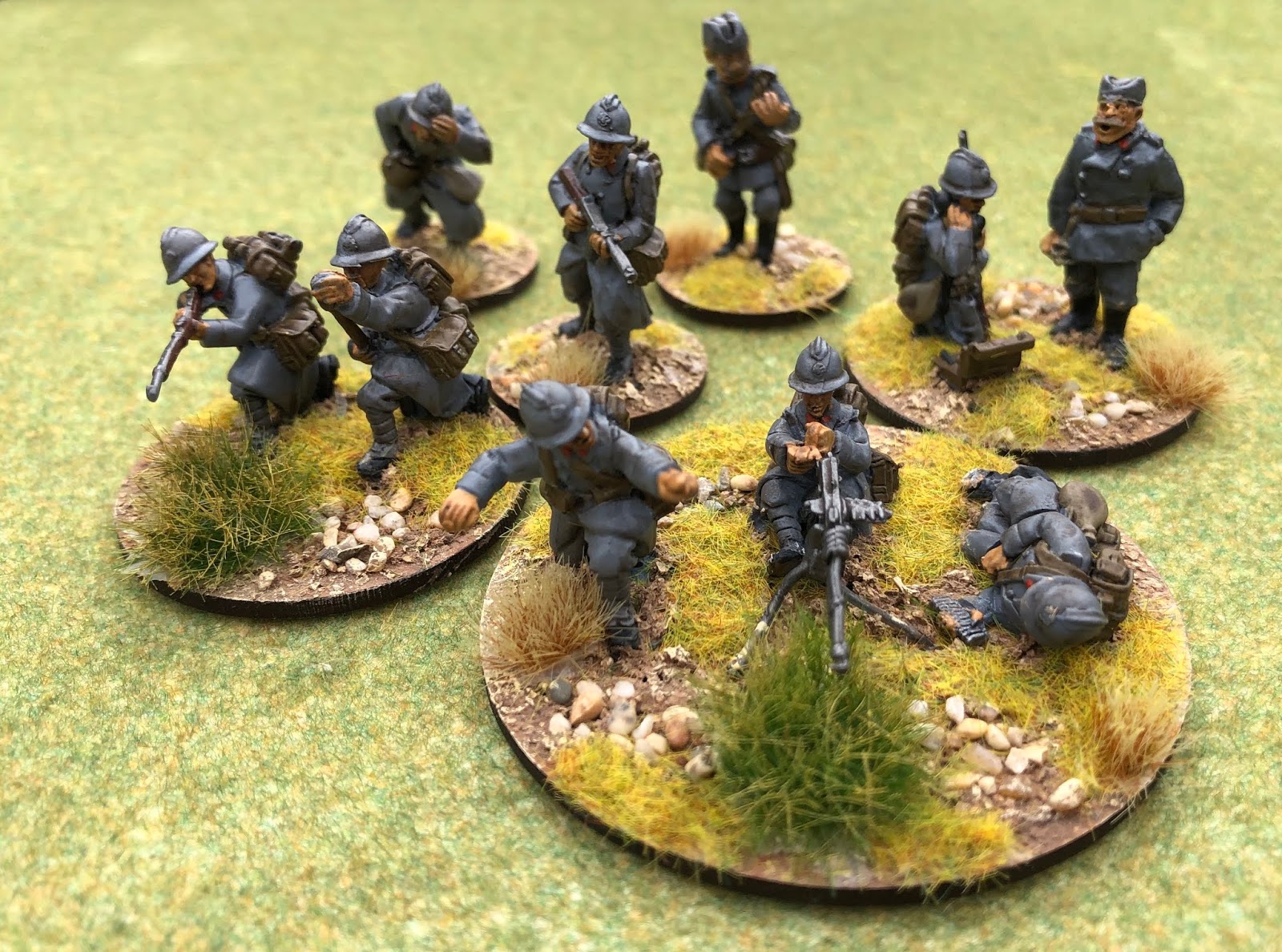
Well as far as any project is ever completed! I now have almost 1000 points for Bolt Action and enough for the participation game at Carronade on 11 May.

Below we have three rifle squads with close support from an MMG, medium mortar and a sniper team. A medium field gun, ATG and an R35 light tank provide the heavy stuff.


Here is a close up of the Schnieder 105mm gun. The model comes from Mad Bob Miniatures and the crew are warlord and Tiger Miniatures.


Painting rifle squads were getting a bit tedious but livened up with the odd grizzled officer.


The last stage of painting was the odds and sods, including an MMG and sniper team.


Not forgetting Sir!


I am on a bit of a roll painting wise, with several projects. But I must return to the Italians and finish them off before Carronade.

Sunday, 24 March 2019

Mithridates the Great

I was looking for a break from my WW2 research and painting when I picked up a copy of Philip Matyszak's book on the Pontic King, Mithridates the Great.


His army is one of those interesting ancient army lists I have come across in various rules over the years. Like Successor armies, it has a bit of everything. Sarmatian heavy cavalry supported by Skythian horse, scythed chariots, Thracian and Galatian foot with either a pike phalanx or imitation legionaries. All that is missing is a few flaming pigs!

Sarmatian horse 

However, I suspect like many ancient wargamers, I had only a vague idea of where Pontus was, or much about its most famous ruler.

Pontus was on the Black Sea coast in what is northern Turkey today. Although it stretched along the coast into the Caucasus and into southern Russia. Mithridates expanded the kingdom to the Bosporan Kingdom, based on the Crimea and the Kerch peninsula. He was closely allied with Armenia and at its height, the Kingdom extended into most of modern-day Turkey and Greece.

This expansion brought him into the Roman sphere of influence, although he hoped they were otherwise occupied with internal wars in Italy and revolts in Spain. His early success was halted when he came up against two of Rome's finest generals of the period, Sulla and Lucullus. Even a young Julius Ceasar makes a brief appearance in the story.

He fought two wars and lost them both through a combination of poor strategy and tactics and the sheer perseverance of the Romans. Nonetheless, his resistance to Roman expansion lasted longer than most and justifies the subtitle of this book, 'Rome's indomitable enemy'.

His longevity was down to geography and the wealth that his kingdom provided in order to finance large numbers of mercenary troops. He also had a large fleet, which restrained the largely landlubber Romans. He wasn't a great battlefield general, but he did have inspired commanders and quality troops.

Philip Matyszak writes a very good narrative history of the campaigns in this book. There are good campaign maps and battlefield diagrams, something that is often missing in books covering this period. This book is for the general reader and he tells a great story.

I have never fielded this army on the wargames table, but I probably have most of the main elements in 28mm.

Phalanx

Thracian foot


Tuesday, 19 March 2019

Salonika 1940 - an alternative early war campaign

No, it's not a typo. I do mean 1940, not 1916. In 1940, before the invasion of France, the Allies were looking for a way of attacking German interests, without turning the Western Front into another WW1 horror. The Balkans were essential to Germany as a source of raw materials, particularly oil and chrome.

The Allies also wanted to support their allies in the region including Yugoslavia and Greece, by forming them into an effective Balkan Entente, which could resist Germany and possibly Italy - although the British hoped to keep Italy neutral. The problem with this plan was the enmity between many Balkan states, notably Bulgaria and Turkey. They all had revisionist claims to each other's territory.

The French were the primary driver of this policy. At the Supreme War Council, the French premier Daladier stressed 'the importance of maintaining an Eastern Front' and said that some tangible evidence of Allied intention to help the Balkans, 'such as the despatch of a force to Salonika or Istanbul', would have a very steadying effect. Chamberlain was much less keen. He argued that only in the case of a German attack in the Balkans, with Italy neutral, should an Allied defensive force be landed in Salonika. And then only if Greece asked for it and Italy agreed. This was not very likely and as events were to prove, the idea that the allies could organise and land a significant force in time was hugely optimistic, even pre-Blitzkrieg.

This did not discourage the French General Weygand who had been engaging with the general staffs of several Balkan states. The British Chiefs of Staff, in a 'Report on the Strategic Situation in South-East Europe and the activities of General Weygand', concluded that Weygand had “gone beyond the policy which had been agreed between H.M.G. and the French government”. At the War Cabinet on 30 November 1939, the Foreign Secretary Lord Halifax insisted that Weygand should be 'dissuaded' from disturbing 'the present equilibrium' - mainly the Italians.

The Yugoslavs were eager to co-operate with Weygand because Salonika was a vital port for them. Weygand told them in December 1939 that it was necessary to prepare a base at Salonika and that five divisions were needed for the purpose. The Prince Regent Paul was less keen, as the French had only three divisions in Syria, whereas the Germans had some 48 available for operations in the Balkans. After Anschluss, the Germans were now on Yugoslavia's northern border. He also disliked the French trumpeting these discussions in the media.

It also frightened the Bulgarians against the Allies because support for Romania might entail marching across Bulgaria. The British Minister, George Rendel, wrote later: “it is ... no exaggeration to say that during the first six months of the war the Bulgarians genuinely believed that their neutrality was less likely to be violated by Germany than by the Allies.”

The Greeks were more enthusiastic, General Alexander Papagos, in January 1940, gave the British the impression “that he definitely considered himself and Greece as being our allies in all except the word”

The split between the French and British widened when Weygand started signing himself 'Commander in Chief of the East Mediterranean Theatre of Operations'. They hoped that hard military facts would restrain the French. Elizabeth Barker in her book ‘British Policy in South-East Europe’ summarises the military requirements:

“As on 19  January the Chiefs of Staff approved an aide memoire which argued that 'a minimum force of some 20 to 24 Allied divisions' would be needed to cover Salonika and prevent enemy penetration past Salonika. The Greeks had offered to supply 10 Greek divisions, an offer which the British did not accept at its face value and this meant that, since any available British forces would have to be earmarked for defence of Turkey, the French would have to provide 10 to 14 divisions; and the British did not think the French could provide them. In any case the British felt they had a power of veto since, as the Chiefs of Staff pointed out, French ability to land forces depended on the British producing the necessary ships.” 

The French held secret staff talks in Greece and Yugoslavia and had been authorised to inspect Greek aerodromes create Allied supply dumps. The Yugoslav General Staff had handed over information on communications, transport and airfields.

The military disaster in Norway did not quench French enthusiasm for a Salonika front, but it strengthened British opposition. However, the collapse of France resulted in Weygand's recall to France, and so the British position triumphed by default. They were always more interested in safeguarding Mediterranean sea routes that defended Egypt and the Straits. While there was concern over Weygand’s role in what the British felt was their sphere of interest, there was a genuine belief that the plans were unrealistic.

It is interesting to speculate what the British reaction might have been if Churchill was Prime Minister. Later in the war, he championed the Balkans as an alternative route into Europe. Hitler was undoubtedly concerned that the allies would take this route, as he said, 'Salonika had been the beginning of Germany's defeat last time.”

For wargamers looking for another use for those French and British early war armies, this is an interesting ‘what-if' campaign, which is at least based on some actual planning. It is also attractive for my current Royal Yugoslav Army project, and I already have the Greeks. Mind you, if this project is to be completed for our game at the Falkirk Carronade show in May, I will need to do more painting and less research in the National Archives! Another rifle squad and a medium mortar completed, but much more to do.


Saturday, 16 March 2019

Royal Netherlands East Indies Army 1936-42

I am a sucker for an obscure army, and Osprey certainly knows how to feed my addiction!

When the Men At Arms series reaches No.521, it is perhaps understandable that we reach more obscure subjects. However, Marc Lohnstein has actually highlighted an army that was a substantial, if fragile, force at the outbreak of WW2 in the Far East.


In this period, today's Indonesia was a Dutch colony known as the Netherland's East Indies (NEI). It covered a vast area with 60 million inhabitants, of whom only 240,000 were European. The main island and seat of government was Java, but the defence forces had to cover less populated islands including, Sumatra, Borneo, Timor and Ambon.

The NEI was a major exporter of strategic materials including rubber, tin, quinine and oil. These were the very resources Japan needed access to and therefore was the main threat to the colony. After the Netherlands was occupied by Germany in 1940, the colony reported to the government in exile based in London.

There was a standing professional army built around a European core, with every field battalion having a Dutch company and most of the officers were also Dutch. The 38,000 strong army was supplemented after 1940 by a volunteer corps that grew to 122,600 men. There was limited motorisation (75 trucks per regiment), with 20 Vickers light tanks,  and some lightly armoured Chevrolet trucks.  Cavalry units were being re-equipped with Alvis-Straussler armoured cars and White Scout Cars. Artillery was limited to only 89 guns, 30 ATGs, as well as coastal guns and some limited AA defences.

The air force had 95 obsolete Glenn Martin bombers and 63 Brewster Buffalos, which would be outclassed by the Japanese Zero.

The uniform was primarily olive green and included the distinctive Dutch helmet as well as slouch hats. As usual with this series, there are many photographs and colour plates by Adam Hook.

An Australian officer in November 1941was unimpressed by the army's readiness for war. While it was reasonably well equipped, it lacked training and officers with practical experience. The equivalent of Home Guards rather than an army capable of undertaking field operations.

The well-coordinated and aggressive Japanese invasion captured the whole territory in just over two months, taking over 66,000 prisoners. This is unlikely to endear this army as a project for many wargamers. However, there were British and Australian troops in the NEI, which means a unit or two of Dutch troops could be added to an existing collection for this campaign. Gothic Line Miniatures do 28mm Dutch infantry in a 10 pack unit with optional heads. Just in case anyone is tempted. Not me of course.........

Thursday, 14 March 2019

Hitler's Strategy 1940-41 - The Balkan Clue

The conventional view is that Hitler regarded the Balkans simply as a distraction from his plans to invade the Soviet Union. In this book, Martin van Creveld suggests a different interpretation. He argues that Hitler was determined on using the Mediterranean as an indirect way of damaging Britain when his invasion plans came to nothing. It was only when he decided to attack the Soviet Union that his focus changed, and even then, the invasion of Yugoslavia and Greece did not cause any delay to Operation Barbarossa.


 This is a book about the strategic decision making that underpinned Hitler’s approach to the Balkans in 1940-41. The military campaigns are only briefly covered and much better covered in recent books including Greece 1941, which I reviewed earlier this week. It was published in 1973, but there are copies to be found second-hand.

Part one deals with Hitler's ‘war in the periphery’ strategy against Britain after France was defeated. It also emphasises the importance of raw materials in the Balkans (oil, chrome etc.) to Germany’s war effort. This led to a demarcation line between Hitler and Mussolini, in which Italy held the Mediterranean coast in its sphere of interest, while the mainland Balkans ‘belonged’ to Germany. Although the line between the two was not always clear.

In this context, the author argues that Hitler gave the green light to Mussolini’s invasion of Greece - or at the very least did not impose a veto. In a meeting at the Brenner Pass on 4 October 1940, it seems likely that Hitler accepted that Greece was a matter for Italy while vetoing any invasion of Yugoslavia. The Italian Foreign Minister, Ciano, said as much to Ribbentrop, who checked with Hitler himself, who did not repudiate this. This also makes sense from a German perspective. It continued the ‘war in the periphery’ and kept British bombers away from the Romanian oilfields.

Part two deals with Hitler's problem with the Soviet Union’s territorial expansion in the Balkans and the failure of attempts at reconciliation. Hitler then reached the conclusion that he would have to invade and that required a safe flank in the Balkans. He thought he could deal with Yugoslavia diplomatically and only authorised Operation Marita against Greece when his diplomatic overtures there failed. The Italian failure in Albania added to his problems and the Coup d’état in Belgrade resulted in a further diversion. However, it also solved logistical difficulties in supplying the 12thArmy in Bulgaria and made it easier to manoeuvre the panzer divisions around the Greek positions, by going through southern Yugoslavia.

The Rupel Pass during my visit last year. It was the scene of heavy fighting between German and Greek forces in 1941.

By June 1941, Germany had withdrawn most of its divisions from Greece, and they were back in position for Barbarossa, or in strategic reserves. The author convincingly explains the redeployment of units and concludes that Germany had plenty of spare divisions for Marita and this diversion did not delay Barbarossa. The occupation of Yugoslavia actually made it easier to use the roads and railways in that country. 

Germany had no other strategic objectives in the Mediterranean, and as a consequence, the Balkans became something of a backwater. At least until 1943, but that is another story.

This is a well-argued book, based on primary sources in Italy and Germany. It offers a convincing alternative view of the traditional narrative of these campaigns. 

Greek infantry and MMG in 28mm


Monday, 11 March 2019

Greece 1941 - The Death Throes of Blitzkrieg

The German invasion of Greece in 1941 and the British intervention is often dismissed as a sideshow, or merely a prelude to Operation Barbarossa. The focus is usually on Churchill's decision to weaken the British and Commonwealth forces in the Western Desert by sending a small army to support Greece. 

This new book, ‘Greece 1941: The Death Throes of Blitzkrieg’, by Jeffrey Plowman, covers the strategic decisions and the campaign itself. However, it also argues that the campaign demonstrated the limitations of Blitzkrieg, in the mountains and limited infrastructure of Greece in 1941.

The author sets the scene with a description of the Balkans in 1941. It was an important strategic region for Hitler, who needed the raw materials, particularly Romanian oil, and a safe flank as he embarked on the invasion of the Soviet Union. The disastrous Italian invasion of Greece had stirred up the Balkans, which the Germans could have done without. However, in the vague demarcation between the Axis powers, the Mediterranean was in Italy’s sphere of interest.

The British and Commonwealth support for Greece was called Operation Lustre. The impact of diverting much-needed units from Libya is dealt with as well as the political sensibilities of sending Anzac divisions. The decision to send the battle-hardened 6 Australian Division to Greece, instead of the less experienced 7 Australian Division, undoubtedly resulted in further delays. The Greeks wanted ten divisions, which was just unrealistic. Instead, they got two infantry divisions and an armoured brigade, equipped with A10 Cruiser tanks, most of which broke down.  

They faced the German 12th Army commanded by Wilhelm List. He had three German corps, including 5 infantry, 2 Gebirgs (mountain) and 3 panzer divisions. List planned to invade through Bulgaria, which involved fighting through mountainous terrain and solid Greek defences on the Metaxas Line. The coup in Yugoslavia added new objectives for List, but it also enabled him to manoeuvre his panzer divisions more easily and by-pass the Metaxas Line. 

The Allied campaign is described in detail starting with the breakthrough at Vevi, the battles for the Servia and Olympus passes and the actions at Platamon and the Pineios Gorge. I visited several of these battlefields in 2017, and they all offered strong defensive positions. The Australian and New Zealand troops are, rightly in my view, given credit in this study for the way they handled the withdrawal. The subsequent attempts to defend the Thermopylae Line and the evacuation to Crete and Egypt is also covered. While the Royal Navy did their best, German air superiority meant this was never going to be another Dunkirk. Nearly 14,000 allied troops were taken prisoner, and a further 903 were killed and 1250 wounded.  

Platamon Castle area held by 21st New Zealanders
One point that struck me in the narrative was the grand tactical mobility of the British and Commonwealth infantry. They may not have had much battlefield mobility in the form of armoured vehicles, but once they got back to their trucks, they did have the ability to move fairly quickly, subject of course to the poor roads. This was in marked contrast to the Greek units, which had performed miracles against the Italians, but once out of the mountains were in deep trouble once outflanked by the Germans.   

My first reaction when looking at this book was, ‘another book on the Greek campaign?’ We do of course have the official histories and even the semi-official books like Christopher Buckley’s ‘Greece and Crete 1941’. George Blau’s US Army study in 1953 is more balanced, using German records as well. In recent years we have had Matthew Willingham’s ‘Perilous Commitments; John Carr ‘The Defence and Fall of Greece 1940-41’; and David Brewer’s Greece, The Decade of War’. There is a wonderful photographic study in the ‘Images of War' series and a detailed study of the air war by Christopher Shores and others. And those are just the ones that I can see on my bookshelves!

However, I do think this book brings something new to the subject. The campaign narrative looks at the battles from both sides of the hill and includes extensive quotes from memoirs and battle diaries. Arguably the best part of the book is Chapter 11, which looks at Operation Lustre in retrospect. This highlights the strategic failures of the Greek and British governments and the deployment errors in the region.

Pineios Gorge

Taking a quick look at this campaign, you would assume it was another triumph for Blitzkrieg. In practice, it wasn't, with the Germans losing a lot of armour as they struggled to fight their way through the mountain passes of Greece. The British and Commonwealth troops made effective use of anti-tank guns and demolitions to slow progress, and their mobility and flexibility were impressive. This is confirmed by German views of the campaign.

So, I found myself carefully reading every chapter of this book, rather than skipping through what I thought I already knew. It is a worthy addition to our understanding of this campaign.


I have large wargame armies for this campaign in 10mm, 15mm and 28mm. There are many possible scenarios in the book for Bolt Action skirmishes, but the primary battles are probably best recreated in 15mm.

British in 15mm

Greek army in 15mm

German Gebirgs
German light tanks and field cars