Welcome to my blog!

News from a wargamer with a special interest in the military history of the Balkans. It mainly covers my current reading and wargaming projects. For more detail you can visit the web sites I edit - Balkan Military History and Glasgow & District Wargaming Society. Or follow me on Twitter @Balkan_Dave
or on Mastodon @balkandave@mastodon.scot, or Threads @davewatson1683

Tuesday, 28 March 2017

1848 - The Austrians

Next stop in the 1848 Hungarian Revolution project is the Austrian army.

The Austrian army recovered from a bad start to be successful on all fronts. It largely remained loyal to the Hapsburg's and ended the war with 648,000 men under arms and 1200 guns. However, the ethnic divisions may have suppressed, but it was a divide that would dog the army until the empire came crashing down in 1918.

A typical division had two or sometimes three brigades. A brigade had around four battalions and an artillery battery. Foot included grenadiers, line, jager and grenzer, who by this time operated as line infantry. There is a good description of their campaigns in 'The Army of Francis Joseph' by Gunther Rothenberg.

My first two units are jager and grenzer. All from the Steve Barber range.


Saturday, 25 March 2017

Border

When I first got interested in the Balkans, I started with the big general studies by Schevill, Jelavich, Fine etc. These describe the historical events, but don't give a flavour of the people and places. I am great believer in walking a battlefield to understand it, but the next best option is a good travelogue, as we can't visit everywhere. I read a wide range of these, many from the 1960's, when Yugoslavia was a popular destination for English language travel writers.


On this theme, I spotted a review for 'Border' by Kapka Kassabova. She grew up in Bulgaria, but now lives in Scotland. She has written about her travels in a rarely visited part of the Balkans - the border between Bulgaria, Greece and Turkey, broadly Thrace, although the ancient tribal area covered a much larger territory.

Like every good travel writer, she gives a bit of history to introduce each part of her travels and liberally sprinkles historical points in most chapters. This is a part of the Balkans that has seen huge upheavals in the past 200 years, with whole populations being moved both ways across the borders. Ethnic cleansing, before it entered common usage. It was also a hard border in the 20th Century, during the Cold War and even between NATO 'allies' Greece and Turkey.

The author spends some time in cities like Edirne, but most of her stays are in small villages. The locals tell their own story, often tragic. This is not a cheery read, but there are many tales of kindness, often from people who had little to give in the material sense. There are also some great characters!

It was Radio 4's 'Book of the week' and would probably be a good listen in audio. I struggled a bit after the first few chapters, but I am glad I persevered, it's well worth the effort.

Talking of Thracians, here a few ancient warriors from my collection. These are from the Foundry range, some of my very favourite figures.


Saturday, 18 March 2017

1848 - The Hungarian Revolution

Another wicked figure manufacturer has dragged me into a new project. In this case Steve Barber Models and their new 28mm range ‘Europe in Revolution’ – specifically the Hungarian Uprising.

1848 was the year of liberal revolutions, sparked in France (although arguably Sicily), which ushered in the Second Republic. Over 50 countries were affected, even Britain where the Chartists sowed the seeds of later reforms. There was little coordination between the countries involved, but there were some common themes. These included demands for greater democracy, and press freedoms, with common cause between the working and middle classes against autocratic regimes.

Nationalism also played a part and that was the driver for the Hungarian uprising. The aim was an independent state separate from Austria, although initially retaining the Hapsburg monarchy. Hungary in 1848 was a much larger state than today and included many minorities that also wanted autonomy.

The Austrian’s spent the summer putting down revolts elsewhere in the Empire before a force led by the Croat commander, Joseph Jellacic, advanced on Budapest. He was defeated and withdrew towards Vienna, where he rallied with the main Austrian army and defeated the Hungarians. The Austrian’s counter-attacked, Budapest was captured in January 1849 and with Russian assistance most of the country was occupied. The Hungarian’s under Kossuth rallied new armies and declared against the Hapsburgs. However, in June 1849 a fresh Austrian and Russian offensive gradually retook all the Hapsburg lands.

The new Hungarian government had the support of some regulars and was in the process of creating a National Guard. However, they created a volunteer army called the ‘Honved’, which has different meanings in Hungarian including, ‘army’, ‘national army’, or just a patriotic name for a soldier. These volunteers were a mixture of peasants and workers with a leavening of better-educated young men. The first ten battalions were to become the elite troops of the army. The army went on to raise 75 battalions following conscription and recruitment from deserters. At its peak, the army raised 148 battalions (170,000 men), but equipment was limited with some battalions armed only with scythes.

Uniforms were a problem, even though the first battalions were supplied from central stores. Locally raised units were supplied from local sources leading to an array of uniform styles. These are covered in Ralph Weaver’s book ‘The Hungarian Army 1848-1849’, published by Partisan Press. For a more detailed history of the revolution I would recommend, ‘The Lawful Revolution – Louis Kossuth and the Hungarians 1848-49’, by Istvan Deak.

The Steve Barber range includes three uniform types and an officer figure. I intend this to be a skirmish level collection (famous last words!), probably using ‘The Men Who Would Be Kings’, or ‘Sharp Practice 2’.


So, here are the first units and I look forward (I think!) to the range being expanded. Ralph’s book includes some wonderful potential models, including Polish and Tyrolean supporters.


Tuesday, 7 March 2017

Great War and the Middle East

This year is the centenary of the fall of Jerusalem in 1917 to the allied army led by General Allenby. My understanding of this campaign goes little further than the brilliant film 'The Lighthorsemen' which includes the famous charge of the Australian Light Horse at the Battle of Beersheeba with drawn bayonets.

So armed with my Xmas book tokens, my eye was drawn to a serious study of the campaigns by Rob Johnson, The Great War and the Middle East.


The author's speciality is the strategic context and that is obvious in the introductory and final chapters. He argues that the Middle East was not a sideshow to the Western Front. it was a crucial theatre of operations for the British Empire and the Ottoman and German efforts to undermine it. The post-war redrawing of borders is important to the present day. As David Lloyd George put it:

"When the history of 1917 comes to be written, and comes to be read ages hence, these events in Mesopotamia and Palestine will hold a much more conspicuous place in the minds and memories of the people than many an event which looms much larger for the moment in our sight."

This was far from the conventional wisdom in 1917, particularly in the General Staff, but I suspect Lloyd George would be happy with this book.

The operational aspects of the campaigns are not overlooked. The author takes a broad definition of the Middle East and includes the Gallipoli campaign, the Caucasus and the Arab revolt in his narrative of the war. He covers the failure at Kut and contrasts this with the later campaign, commanded by one of the new breed of industrial generals who understood the power of artillery and the importance of logistics.

He finishes with the post war conflicts and the implications for today's conflicts in Middle East.

This isn't a light or quick read. However, if you read one book on the war in the Middle East, then this is probably it.

And for the wargamer some Ottoman artillery from my 15mm collection.


Sunday, 5 March 2017

That pile of plastic

My gaming productivity has dropped significantly recently, busy time at work. So I thought I would dip into the pile of plastic in the 'to be painted someday' box every wargamer has.

First out were some Hyenas from the Conan game. Nice simple paint job these. The GDWS participation game at Carronade in May will be using the Conan figures in a Dragon Rampant adaption. The challenge will be to rescue the Princess from the castle guarded by a priest of Set. Testing the game in a couple of weeks, so watch this space.


On the subject of shows, don't forget to support the Dumfries show, Albanich, next Saturday. I know it's a bit of a trek for many, but it is usually worth the effort.

Next up are some reinforcements for my Caucasus 1942 project. Some Russian 120mm mortars (Plastic Soldier Company), should beef up the Soviet firepower in the absence of mass T34s and other kit. I need some more infantry, but couldn't face painting more bland Russians. So I have decided to go for a Naval infantry company. That arrived this week, adding yet again to the pile!


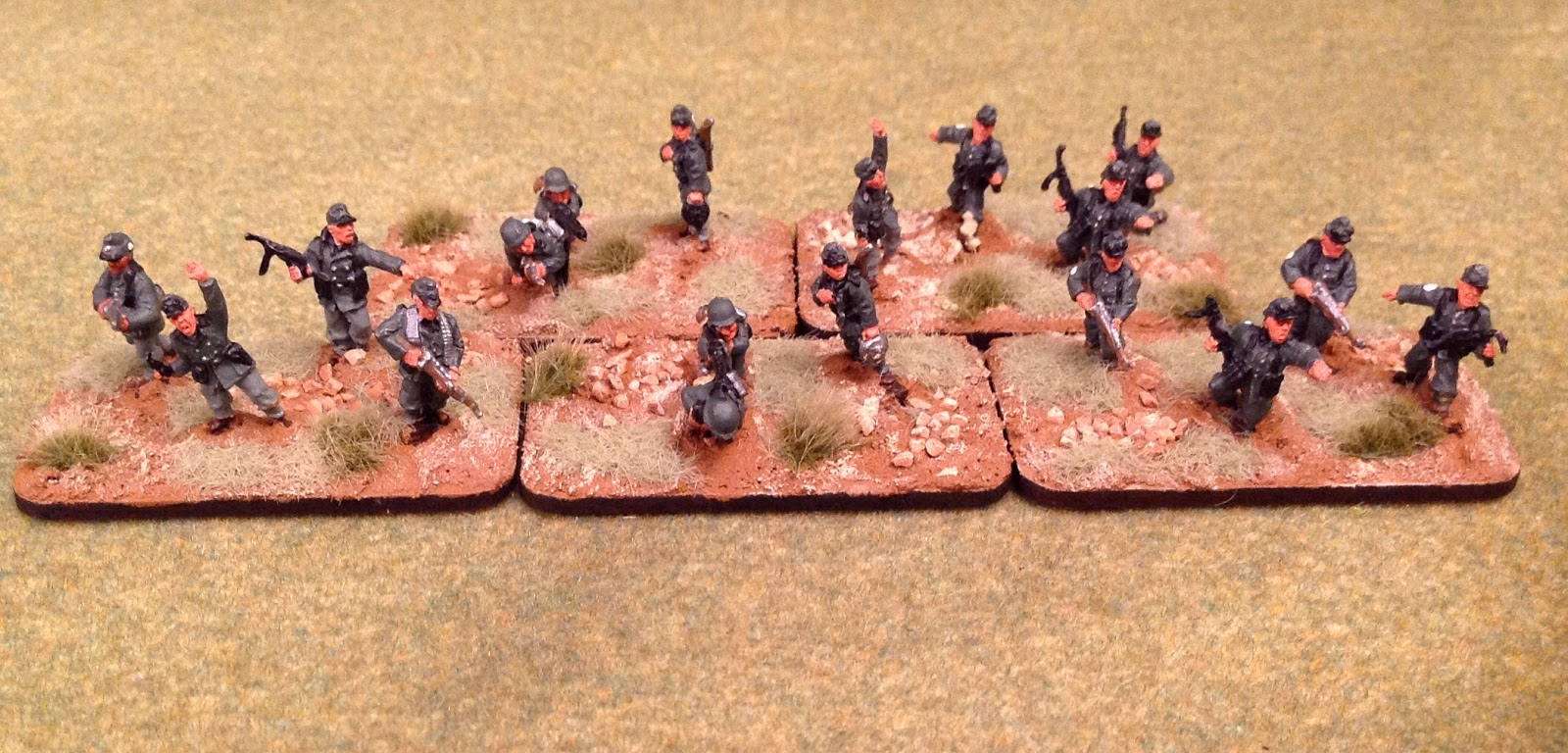
And finally, some Gebirgsjager. You can never have enough!


Sunday, 19 February 2017

Swordpoint

Swordpoint is Gripping Beast's new big battle rules for the ancient and medieval period. This is a pretty crowded space, but one chased by many WAB gamers looking for a replacement.

You certainly get a very nice rule book, with the production values you would expect from Gripping Beast. Plenty of eye candy, but not overly gratuitous.


Units are made up of variable numbers of bases. Typically 4 figures to a base for foot, 2 for cavalry and 2 for skirmishers. The 4 to a base (in two ranks, 40mm x 40mm) for foot is a bit irritating for us ex-wabbers who usually start with 3 to base on a 60mm frontage. However, as a typical unit will have six bases it's not a huge problem and doesn't require rebasing. There are a number of army lists in the main rulebook to get you going and the first separate book is for the Dark Ages. The standard army is 1000 points and that means around 150-200 figures a side on a 6' x 4' table. The profiles for each base are much simpler than many rules with factors for defence and cohesion only.

The first innovative mechanism is Momentum Points. You start with five and can gain more as a result of successful combat and shooting. You can then spend them to give an edge in combat or to grab the initiative when you really need it. Moves are generally simultaneous, rather than 'I go, you go', although there are exceptions.

The phasing is also unusual. After the initial admin phase you shoot before movement and combat. This means that shooting can soften up your opponent before charging in. However, because you don't remove figures unless a whole base is killed, this means long range shooting is rarely effective. Shooting is fairly conventional, hitting on 4's +/- modifiers, and then saving depending on armour, shields etc. Shooters don't get the value of shields if they are firing, which I like. The use of percentages to calculate if you have to test, requires more mathematical agility than I would prefer on a Sunday afternoon, but it's not that tricky.

Movement is pretty conventional, although there is an interesting mechanic limiting manoeuvres. It's important to get the order of events right, but otherwise it's all fairly normal.

Combat is also fairly conventional, with hits and saves as per many rule sets. You have to lose badly to be routed quickly, so melee can be prolonged. There is an interesting mechanism to encourage armies to fight in line of battle, by allowing defeated units to dissipate their casualties to supporting units in the line. The maths of this is a bit more than I can be bothered with, but it does mean that armies fight as you would expect ancient armies to do, and it reflects Dark Age scrums very well. It also encourages the formation of big units with depth, as these are pretty tough to budge. Being pushed back is damaging, but not necessarily a disaster you can't recover from. Commanders add dice to the melees they join, but they don't overpower the game as they did in WAB.

There are special rules covering all the obvious ancient troop types and tactics.

There is a useful discussion with the authors on the Meeples podcast(182), although the usual health warning, allow plenty of time, there is little script discipline on this podcast. They can ramble on for hours! Gripping Beast are supporting the rules with a range of materials.

Is this the holy grail of a replacement for WAB? Clash of Empires remains the closest match for me, but it doesn't seem to have taken off. Swordpoint offers a few interesting mechanisms, and few irritating ones as well. However, I can't say it grabbed me with the same level of enthusiasm as Lion Rampant, albeit for smaller games. For the occasions when I have the time to set up a big battle, I suspect Hail Caesar will remain my first choice.

In fairness, playing either side of watching Fulham getting knocked out of the FA Cup, may have affected my judgement! So I will play them again.

On to the tabletop. My test game was Christians and Moors in Spain. The army of Al-Andalus triumphed.


Tuesday, 14 February 2017

Flodden revisited

Sunday was an opportunity to play once again with Scott's superb 10mm collection of forces for the Battle of Flodden 1513 - or as it should have been named, Branxton. The battle was actually fought below the village of Branxton. Flodden Hill is some way off to the north.

Anyway, the battle was fought in Northumberland on 9 September 1513 between a Scottish army led by King James IV and an English army led by the Earl of Surrey. It was the largest battle ever fought between the two kingdoms and resulted in a major defeat for the Scots and the death of King James.

We first refought this battle, with the same figures, almost a year ago at the Scottish Battlefield Trust Open Day. On Sunday we had another go at Scott's place using his nice new Cigar Box battle cloth.

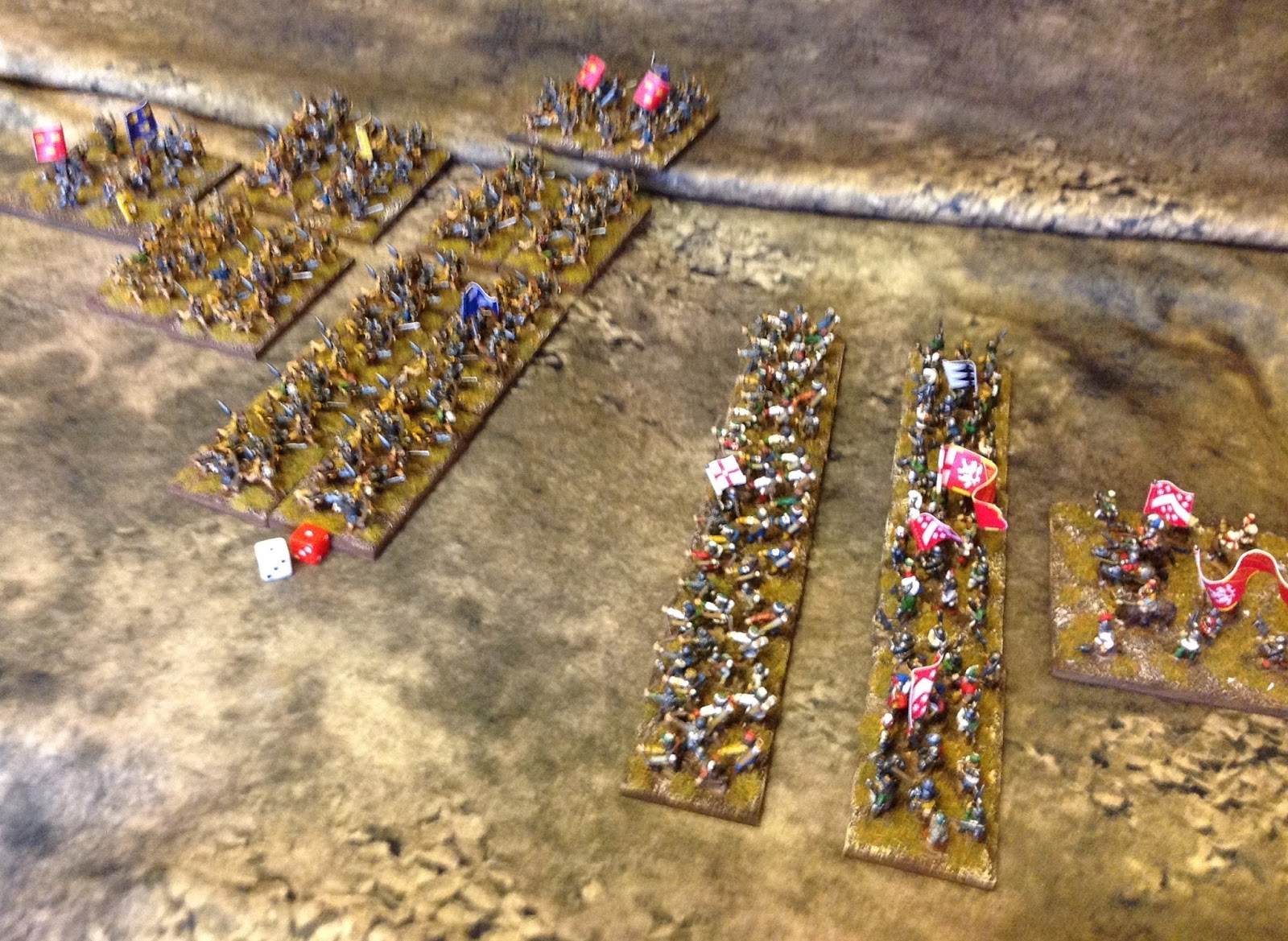
As usual, too much chat and not enough gaming, meant we didn't finish the game (its an age thing). However, as per the real battle, the Scots defeated the Cheshire levies and on the other flank, Surrey saw off the highlanders. Bizarrely, King James didn't move the whole battle, content to watch his guns blast away, too little effect.

Some photos to enjoy.


Sunday, 5 February 2017

Barbary Pirates: 15th-17th Centuries

The latest Osprey Elite covers the history of the Barbary pirates. Written by Angus Konstam, who has written extensively on the subject of pirates and is an Edinburgh based wargamer as well. If that's not enough, it is lavishly illustrated by Gerry Embleton.


Angus gives us the historical background that explains why the Barbary coast of North Africa became a haven for pirates. He also helpfully takes us through the various descriptions of pirates - Buccaneers, Privateers, Corsairs etc. Most of what became the Barbary States, were under loose Ottoman control and as a consequence the Corsair fleets fought with the Ottomans on many occasions.

Outwith periods of declared war, their operations were commercial. Raiding for goods and slaves that were handled, in accordance with clearly set out rules, in the Barbary ports. Angus explains who the pirates were, including large numbers of renegades - many from Britain. I hadn't appreciated that the fighting crews included significant numbers of Janissaries.

While the Galiot was the archetypal Corsair ship, they also used the larger galleys as well as a range of smaller ships. These are described and illustrated.

This is an excellent introduction to the subject. There are a number of more detailed histories, covered in the bibliography, but few are so well illustrated.

I am currently playing the small battle renaissance rules 'Pikeman's Lament'. So this book was all the inspiration I needed to get the Barbary pirates onto the table. The mission is a raid by the pirates to capture slaves from an inland village in Spain. On their way back to the coast, the pirates are intercepted by a local garrison.

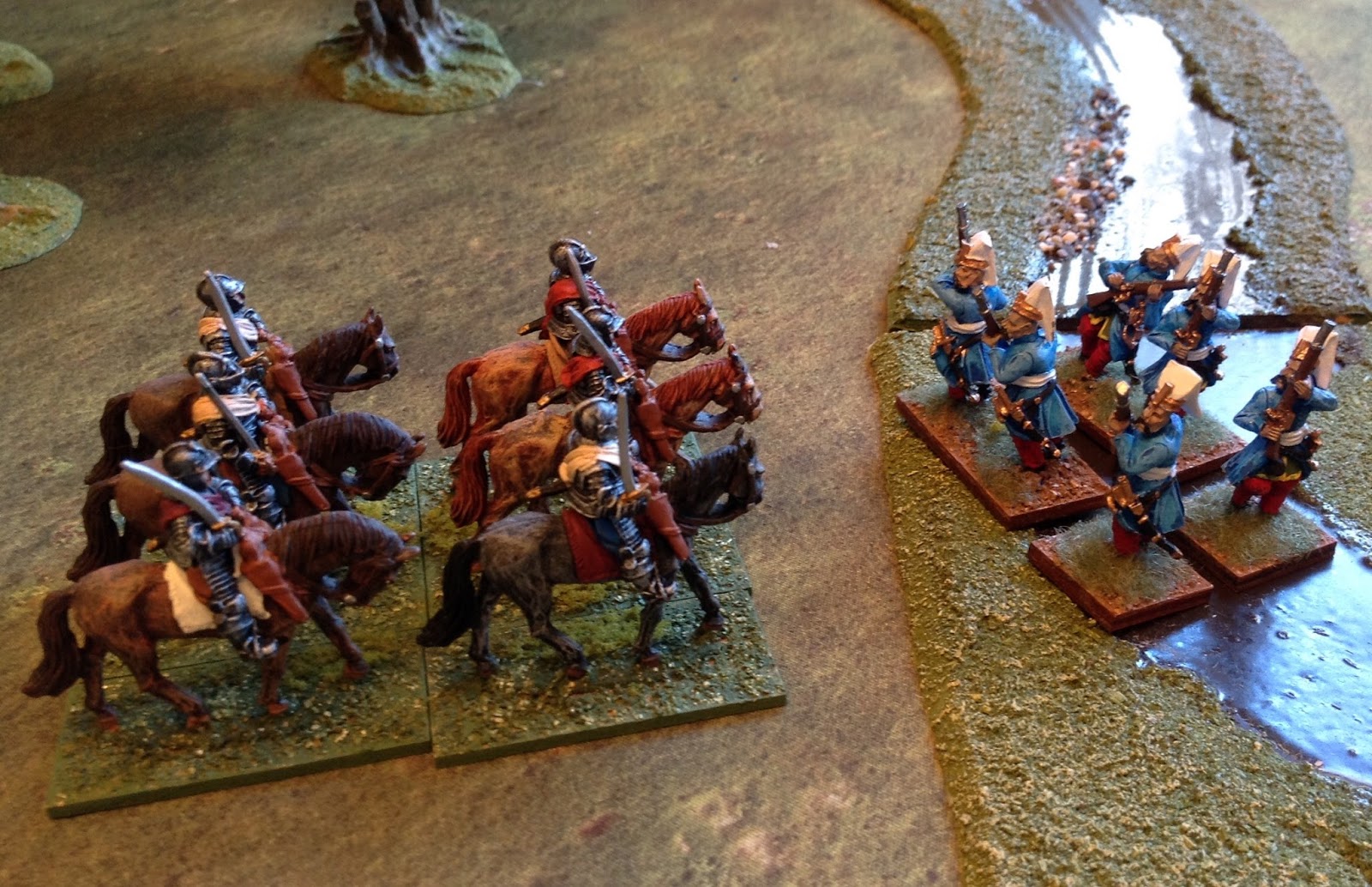
The pirates have two units of Janissaries (I used the Forlorn Hope category for these) and three units of pirates (using Clansman). The Spanish have a unit of trotters and mounted arquebusiers, plus two shot and one pike. A priest is attached to the pikemen. The Spanish won comfortably and the slaves liberated.


Saturday, 4 February 2017

Historically Inevitable? Turning points of the Russian revolution

This year is the centenary of the Russian revolution of 1917, so we can expect a fair few volumes on the subject. My first dabble has been Historically Inevitable?, edited by Tony Brenton.

There has been a broad sway of opinion amongst historians, not just in the old Soviet Union, that the revolution was inevitable. A rotten, autocratic Tsarist regime was replaced by the Bolsheviks, whose ideals were corrupted by Stalin. Others argue that the Tsarist regime was being modernised and liberalism would have been the outcome had the Bolsheviks not seized power.


The essays in this book, by leading historians of the period, look at key moments in the period and asks them to describe the background and the events, before engaging in a bit of 'what if?' history.

The events include the role of Rasputin in trying to dissuade the Tsar from entering the war, as he had done in the earlier Balkan war. Better known, is the role of the Germans in facilitating Lenin's return to Russia, in the famous sealed train. It is also argued that Lenin's personality and drive was crucial to the revolution, and so when he was stopped by police in Petrograd, but not recognised, an opportunity was lost. Similarly, there was a failed assassination attempt by Fanny Kaplan (or possibly not) that very nearly ended Lenin's life.

Other events include the earlier 1913 assassination of the reforming Prime Minister, Pyotr Stolypin. As an 'authoritarian moderniser' he might have been able to make the necessary economic reforms. Interestingly, Stolypin is much admired by the current Russian President, Vladimir Putin.

In the military sphere another chapter looks at the Civil War and the role of Admiral Kolchak. The original opposition was much more broadly based than the subsequent right-wing 'White' forces.

The value of 'counterfactual history' is controversial, but I think it works in the way it's done in this book. The historical events are properly narrated and the 'what ifs?' are narrowly drawn.

Monday, 30 January 2017

The Pikeman's Lament

The Pikeman's Lament is the new pike and shot variant to Daniel Mersey's popular Lion Rampant rules. I love these rules, so I was very keen to get my hands on a copy, for a period that has always been a favourite.

The format is very similar to Lion Rampant so I will focus on the differences. You command a company rather than a retinue, but the scale is the same. These are often called skirmish rules, but they are really small battles with 40-60 figures a side. Officers have a background as well as traits and these can change as part of the campaign system. You start as an Ensign and can end up as a Colonel. Of course death and dishonour stalks any battlefield, so your officer can still be killed with a lucky blow, although there is now a recovery table after each game. Officers can still issue challenges to a duel - personally I am not convinced this is right at this scale of battle and period, but you can ignore it if you want.

Unit profiles are very similar with morale and stamina replacing courage and armour, albeit with similar functions. Unit types cover all the obvious western European renaissance types. Gallopers and Trotters for the horse, plus Dragoons, which can be adapted for light horse as they have the skirmish and evade moves and similar factors to the mounted yeoman in Lion Rampant. Foot units are pike and shot, not in mixed units as I read somewhere. Commanded Shot perform the skirmishing role and we have Forlorn Hope for more aggressive shot, with the ferocious rule and an upgrade to aggressive which cancels shooting, but makes them more effective in combat. There are Clansman units as well which are cheaper and slightly less effective, and Clubmen who are cheap rabble. Shot are encouraged to hold their fire with a first shot salvo benefit.

There are no obvious units to cover all the eastern European and further afield units. However, while the descriptors may seem a bit strange, I can see how you could fit them all in. My beloved Ottomans will still get on the table!

There is also a nice twist to spend the last couple of points by having agitators or priests to boost morale tests. Artillery is formed as regimental guns, appropriate for this scale of battle, but with the option of an upgrade to longer range field guns.

The order of action is largely unchanged with rally, wild charge and then normal activations. There is a new blunder type rule if you roll double 1 or double 6. The first leads to cowardly actions and the latter heroic ones. Shooting, combat and morale are similar, albeit with different weaponry.

Instead of scenarios, you get missions. These encourage specialist forces, like all cavalry and dragoons, to fight what look like some interesting games. Finally you get a few sample forces, just to start you off.

And so, onto the tabletop. I picked a Polish and a Swedish company. They fought a series of wars in the early 17th century, before the Thirty Years War kicked off. Some photos below. The Swede's succeeded in capturing the village, but not without serious loss. The game flowed well and was every bit as good as Lion Rampant. If you like those rules you will enjoy The Pikeman's Lament.


After first moves.


Pancerni v Dragoons


Finns storm into the Winged Hussars


Polish Haiduk foot


The Polish officer's last stand.


Sunday, 15 January 2017

Roman Legionary AD 284-337

This is not so much a new Osprey as me catching up. Warrior 175 by Ross Cowan takes the story of the Roman legionary up to the age of Diocletian and Constantine the Great.

This was a period of great turbulence for the Empire, not least because of the religious conversion of the state from Diocletian's pagan persecution of Christian soldiers (they had to perform a sacrifice), to Constantine's Christianity. The conversion was inevitably gradual and Constantine was fairly tolerant for a period, even devising a special parade for pagan soldiers.

This period marks the climax of the traditional legionary system and the organisation into cohorts and centuries would be recognisable to a Roman of an earlier period. What started to change was the organisation of legions, dividing them up into detachments, leading to the frontier units (Limitanei) and the elite field army units (Comitatenses). While infantry remained the backbone of the army, cavalry was becoming more important.

The book explains how legionaries were recruited, trained and equipped. Then we get chapters on the organisation of the legions and some examples of campaigns. Specific soldiers are used to illustrate the system, showing that they certainly travelled a lot - at least in the field army.

This encouraged me to dust down my late Roman figures, more accurately Arthurian in my case. A number of years ago we had a fun WAB 'Age of Arthur' campaign at the club. I used my current favourite set of rules, 'Lion Rampant' for the game, with grateful thanks to David Sullivan for his work on taking the rules back to this period. I see Gripping Beast are also bringing out a supplement for this period next month.

I chose the Carpi as the opponents. There is some disagreement about the ethnic basis for this tribe, but if not a Dacian tribe, they are very similar. They resided in the eastern parts of modern Romania and fought a series of wars against the Romans during this period. Constantine defeated them in 316-17 and they were resettled into the Empire.

The scenario involved a legionary unit defending a village where there is a rather robust religious conversion going on. The Carpi attack the village and the remaining units in the Roman force come to the rescue.

In the game, while the legionaries did get pushed back, the Carpi movement dice were pretty bad and a series of piecemeal attacks were repulsed. Rome triumphant again!


And here is the army list for two 24 point 'retinues'


Saturday, 14 January 2017

The Serpent Sword

My latest fiction read has been The Serpent Sword by Matthew Harffy - the first in his Bernicia Chronicles.

The setting is Dark Ages Bernicia, an Anglo-Saxon kingdom that roughly covered Northumbria and south-west Scotland in the 6th and 7th centuries, before it merged with its southern neighbour Deira to become Northumbria.

Our hero is Beobrand, a young farmer who follows his warrior brother to Bernicia, only to find he has been murdered. With some minimal training, he joins the army of King Edwin, only to be present at the disastrous defeat at Hatfield Chase, to Cadwallon of Gwynedd. Escaping the battle, his wounds are patched up at a monastery, before he joins a small group of warriors who roam the countryside.

He then leaves the group and joins the army of the new king, Edwin. I won't spoil the outcome, which as you would expect ends with not one, but two, climatic battles. There is a sub-plot regarding his brother's murderer and a bit of romance as well.

This is everything you would expect from historical fiction. It's very much in the Cornwell mode and has some similarities with the Kingdom series, although earlier in time. We even revisit Bebbanburg.

I found the earlier parts of the book a little slow going, but by the end it was hard to put down. There are four more in the series so far and are very reasonably priced on the Kindle. I have the next one downloaded already.

For the wargamer, the battles are small scale, best suited to large skirmish rules like Saga, or the adaptations of Lion Rampant.


Saturday, 7 January 2017

The Caucasus 1942-43

The best bit about returning to work is a lunchtime spending my book tokens on real books in a proper bookshop. The first read of my significant haul is the Osprey Campaign 281 - The Caucasus 1942-43 by Robert Forczyk.

Germany faced a number of strategic options for its 1942 offensive on the Eastern front. The generals favoured another go at Moscow, but Hitler understood the economic imperative to capture oilfields to keep the economy and his army going. It's one of the ironies of WW2 that Hitler's invasion of the USSR was only possible because of oil stocks sourced from the USSR.

Oil in the USSR meant a swing to the south and the Caucasus. A decision reinforced by the allied occupation of Iran, creating a vital supply line of US and British war material to the USSR. The German plan was to protect the flanks with a subsidiary offensive towards the Don River and Stalingrad, while Army Group A commanded by List attacked the Caucasus. The spearhead of the attack was 1. Panzerarmee commanded by von Kleist.

The Russians, commanded by the old civil war cavalry commander Budyonny, had a patchwork of units, many hugely understrength, with limited tanks. He would fight a largely defensive campaign, cut off from the main supply lines to the north.

The German attack fell far short of the planned blitzkrieg, with too many targets and key units were withdrawn before the campaign was completed. They took most of the North Caucasus, but the campaign ground to a halt in the mountains. More importantly, the damage to the few oil wells the German's captured meant very little oil was made available.

The book is in the normal Osprey campaign format. Pen pictures of the commanders, the opposing forces and an Orbat. This is followed by a narrative of the campaign with excellent maps and lavishly illustrated. The colour plates by Steve Noon are particularly good.

For wargamers this is a very interesting campaign. The North Caucasus is largely plain, albeit with many rivers that the German engineers had to find ways across. Railway lines were important for supply. Then the mountains, which are some of the highest in Europe, a huge challenge even for the Gebirgsjager and their Romanian counterparts.

Troop types are also very varied. Tanks are mostly early war types, largely PkwIII for the Germans. Mostly T26 light tanks for the Russian's, supplemented by Lend Lease. The M3, Valentine and Matilda tanks made up nearly half the Russian tank strength.

German forces relied heavily on combined arms battlegroups that work well on the tabletop. Two mountain divisions as well a Romanian mountain troops and cavalry. They also made extensive use of Brandenburger's for infiltration and raiding - often working with local Chechen insurgents. There was air and naval support, but this became patchy later in the campaign as units were redeployed northwards.

The Russians have lots of interesting units as well. Armoured trains, cavalry and naval rifle brigades, supplement the traditional rifle divisions and NKVD security units. They also had patchy support from naval and air forces.

Overall, this is an interesting campaign with the opportunity to use a variety of equipment and troop types in contrasting terrain. This book is an excellent starting point.


Russian 45mm ATGs from my 15mm figures


Wednesday, 4 January 2017

Conan and Dragon Rampant

The last painting session of the holidays included some more character figures from the Conan board game. These include Conan himself, the wizard Hadrathus, Thak, Skuthus priest of Set and of course a princess for Conan to rescue - over and over again!


For the final game of the holidays I used Dragon Rampant rules. Conan with Hadrathus and his bodyguard, supported by Aquilonian archers, spearmen and mercenary light horse - are off to rescue the Princess, a captive of Skuthus in the ruined tower. Skutus has his giant snake and a band of demons. Two 24pt armies in total.

The archers force a wild charge from the demons, who are weakened by bow fire from horse and foot bows. Bolts of long range fire from Skuthus were not enough to support the demons. Then the snake slithered out of the woods and forced back the spearmen, who were eventually saved by Conan himself. With his forces routed, Skuthus slinks away to fight another day, and the princess is rescued.


Dragon Rampant are a great set of rules for a quick game. Highly recommended.