Welcome to my blog!

News from a wargamer with a special interest in the military history of the Balkans. It mainly covers my current reading and wargaming projects. For more detail you can visit the web sites I edit - Balkan Military History and Glasgow & District Wargaming Society. Or follow me on Twitter @Balkan_Dave
or on Mastodon @balkandave@mastodon.scot, or Threads @davewatson1683

Saturday, 13 August 2016

Sharp Practice 2 - Peninsular War

My second game of Sharp Practice 2 was in traditional Sharp territory - the Peninsular War.

Two 70 point armies. The 'French' were actually mostly Polish, Italian and Irish troops against a British force. Both sides had three leaders.

This is the tabletop after the deployment moves, British on the right.


The first clash was a cavalry battle between Polish Lancers and British Light Dragoons. The Brits won, but next move got canistered by the Polish artillery and fled.


The main Polish advance is met by skirmishing rifles and controlled volleys from the British line with artillery support. They didn't get very far.


On the left flank the Italians advanced through a wood and gave the Rifles and Highlanders a hard time. Score draw this one by the time the French morale had collapsed.


Good game, but now I am beginning to get a grasp of the rules, I need a better QRF. Too much flicking through pages.

Wednesday, 10 August 2016

1914 Serbia Must Die

I am not a huge fan of board wargames, but I am inevitably drawn to one covering a Balkan subject. So, I was parted with my cash at Claymore for '1914 Serbien muss sterbien (Serbia must die)'. This was the jingoistic jingle shouted throughout the Austro-Hungarian Empire at the outbreak of war.


For £36 you get a very nice map of northern Serbia and the surrounding regions (modern day Croatia and Bosnia), counters for the units at divisional level with some brigades and regiments, as well as supply and other game markers. 

The playbook offers four scenarios. An introductory scenario for the August 1914 Battle of the Macva, followed by the grand campaign and finally the Serbian counterattack over the Drina. The fourth scenario is an alternative history in which Russia does not intervene and the Empire is allowed a short punitive war with a significant numerical superiority.


Regular boardgamers will no doubt be familiar with the game mechanics of this type of game. For those who are not, it’s very hard going. The sample of play in the playbook is helpful, but you are still left with some overly complex mechanics which make for very slow play. However, I concede that it is a very good way of understanding the campaign. There is a decent bibliography, to which I would add Max Hastings' ‘Catastrophe: Europe Goes to War’, for a sense of the chaotic Austrian advance. I summarise the opening shots here, with some pictures of tabletop models.

I would have bought this game just for the map and counters - using them for a campaign that fights the battles on the tabletop. Otherwise, it’s one for the specialist boardgamers and a headache for everyone else.


Monday, 8 August 2016

Battle of Evesham 1265

Heading back from a trip to my Mum’s we stopped off at Evesham, site of the decisive battle of the Second Baron’s War on 4 August 1265.


After the Battle of Lewes in 1264, Simon de Montfort held King Henry III and was the effective ruler of England. However, Henry’s son Edward escaped and gathered an army that challenged Montfort at Evesham.

Edward and the Royalists took position on the high ground just north of the town. Montfort was probably outnumbered two to one, so he decided to concentrate his forces hoping to drive a wedge through the centre of the Royalist line. However, the attack lost momentum and the flanks of the royal army closed in on Montfort's troops, massacring them.

Most of the baronial rebels were killed on the battlefield rather than taken prisoner and ransomed, setting a precedent that reached its conclusion in the Wars of the Roses. Montfort and one of his sons died fighting and King Henry was rescued.

The war petered out with a negotiated settlement that allowed rebel barons to buy their property back.

The battlefield is largely farmland and woods today and is marked by a battlefield trail and information boards, as well as an obelisk and a tower. The town has a small museum with a room dedicated to the battle, next to a largely ruined abbey. It also has a very well stocked model soldier shop!


I haven't gamed the battle, but we did a display game that featured Montfort's equally ferocious dad, another Simon, at the Battle of Muret 1213. For further reading I would recommend John Sadler's book on the Second Barons' War.


One of the monuments


An information board at the battlewell site


Looking down from the Royalist position

Saturday, 6 August 2016

Claymore 2016

It was the Claymore show in Edinburgh today. A good collection of traders and a balance between display and participation games.

We did a participation game, a lot more effort than our more usual display format, but worth it. We had a steady flow of gamers for our 28mm game, Pancho Villa and the Gold Train. The outcome was two all, so the scenario was at least balanced. Very pleased to be in the Gym Hall as the Atrium can get very hot.


I only had time for one tour around the other games and traders, but these are the games that caught my eye.

Another nice Bolt Action game with good scenery.


The buildings in this game, Littleness Designs I think, were very nice.


The Falkirk club's massive Boxer Rebellion game.


ECW battle of York in 1644.


First time I have seen Cannae done in a way that shows off Hannibal's double envelopment so well.


This sc-fi game wins the prize for busiest table!


Custer's last stand always makes a good participation game


SAGA showing off their forthcoming battle rules, Swordpoint.


The Lardies on a similar mission with Sharp Practice


Kirriemuir with another big ancients game, Gaugamela.


Arnhem from the Aberdeen folks.


Spearhead Tobruk from Glasgow Tradeston.


And finally, League of Augsburg.


Numbers seemed pretty good and thanks to the South East Scotland club for putting the show on.


Monday, 1 August 2016

Crimea - A History

My holiday non-fiction reading has been Neil Kent's, 'Crimea - A History'.

For Brits at least, our understanding of the Crimea goes little further than the Crimean War. Battlefields such as Alma, Inkerman and Sevastopol in the peninsular, appear as street names in just about every city in the UK - not to mention the Balaclava helmets that many of us still wore as kids in winter.


This year the Crimea hit the headlines again, with the Russian 'invasion' of the Crimea and its de-facto separation from Ukraine. Today the ethnic majority is most certainly Russian, the excuse for Putin's invasion, but it has not always been so.

The Greeks were one of the earliest to colonise the Crimea, followed by invasions from the Scythian's, Huns, Mongols and others. The Tartars were vital allies/subjects of the Ottoman Empire and spearheaded most of their assaults on Christian Europe. Russia used the Cossacks, primarily as a buffer against the Tartars, although even then there were significant Armenian and Jewish populations. It was only in the Soviet period that the Tartars were ethnically cleansed from the region and large numbers of Russians moved in. It was Khrushchev who gifted Crimea to the Ukraine in 1954.

Neil Kent has written a concise and very readable history of the region. Well worth a read.


Sunday, 31 July 2016

Pancho Villa and the Gold Train

Less than a week to go before Claymore and it's time to test the game. Well a cut down version.

The scenario puts the participants in command of a force of Villistas on the outskirts of a small town in Northern Mexico. The locals say a train carrying a valuable cargo, thought to be gold bullion, has derailed in the town. A small force of Federales have arrived to defend it before a repair team and reinforcements arrive.

So, time is of the essence, the Villistas can't hang around bombarding the town they need to find the bast way into the town with the least risk. Or perhaps the traditional Pancho Villa frontal charge is the best tactic!


The Federales sandbag the town perimeter.


Advancing Villistas making best use of cover, while another squad works it way around the flank


The Villistas launch an air attack - and miss! Throwing 75mm shells out of the cockpit is a tricky exercise!

The rules are a cut down version of Bolt Action and work well for the period. Simple to grasp, with just enough command uncertainty to keep the game interesting.

On the painting front another unit of Villista cavalry is being based. That just leaves a few odds and sods for the 'traditional' eve of show painting. The nice new battle mat is from the Tiny Wargames range - rubber backed 'Arid'.


Monday, 25 July 2016

Aircraft in the Mexican Revolution

The use of aircraft was one of a number of military innovations in the Mexican revolution.

Soon after the revolution broke out, US based exhibition pilots were persuaded to use their aircraft in reconnaissance roles, including, the soon to become famous Frenchman, Roland Garros. The first serious application of airpower was by the Huerta regime, who sent 31 officers to France in 1913 and ordered 20 new Bleriot monoplanes.

Pancho Villa's army used a variety of obsolete types including three Wright Model Bs and two other Wright types. Needless to say models of these are a bit of a challenge and even if they exist, I certainly didn't fancy building them - all those struts! So the compromise is a 1/72 scale die cast model of the Wright Flyer, from the Postage Stamp range.


A Villista innovation was a mobile aerodrome train. It could carry planes on flat cars, together with workshop vans and coaches for ground crew and pilots. They also used planes as bombers, throwing 75mm shells with fins to the ground. I doubt this was particularly effective, but too good not to use in our game!

Finally, some more conventional weaponry for the Federales, in the form of a 75mm gun. I don't think they will need AA guns!


Saturday, 23 July 2016

Pancho Villa - man and myth

The start of my summer break is an opportunity to finish the Pancho Villa project. More a gallop to the finish line for Claymore, rather than the leisurely stroll I had planned.

The latest additions are the commanders. I have used the Old Glory personality pack, but I have painted them as generic command figures. 

First up is of course Pancho Villa. “Pancho Villa,” people whispered at the beginning of the 20th century, "can march 100 miles without stopping, live 100 days without food, go 100 nights without sleep, and kill 100 men without remorse."

Was he a revolutionary or just a bandit? Probably a bit of both, but I will give him the benefit of the doubt and plump for mostly revolutionary. In his best revolutionary rhetoric he said:

“My sole ambition is to rid Mexico of the class that has oppressed her and given the people a chance to know what real liberty means. And if I could bring that about today by giving up my life, I would do it gladly.”

He was born around 1878, as Doroteo Arango Arámbula, into abject poverty in Rancho de la Coyotada, an insignificant village of no more than six houses, inside the hacienda of Santa Isabel de Berros, in the state of Durango. Mexico at the time was a hugely unequal country with large landowners supported by an almost feudal peasant class. Foreign companies dominated the economy. While the stories vary, he probably killed his sister's potential rapist and fled to the mountains where he became a successful bandit leader - adopting the name Pancho Villa.

He was persuaded by a supporter of Madero to join the revolution. Madero became president but was later killed in a coup that brought Huerta to power. During this period Villa organised his Division of the North, which by 1914 had grown to 50,000 men. By December 1914, allied with Zapata, they entered Mexico City and installed their own president. 

The subsequent Carranza government repeatedly defeated him on open battles and Villa was forced to return to his northern mountains. He lost the support of the USA, which led to the famous raid on Columbus, New Mexico in 1916 - the last successful invasion of the USA. The subsequent punitive expedition failed to capture Villa. 

In 1920 Carranza was killed bringing another Huerta (Adolf) to power. He agreed that Villa could retire to a farm with his remaining men. The Mexican Revolution was over. However, in 1923 he was assassinated in his local town of Parral, probably on the orders of the new President Obregon, because he thought Villa was planning a political return.

Like all popular heroes, Pancho Villa continues to live in hundreds of corridos, songs, books, movies, legends and even ghost stories about him. The truth is more prosaic, but everyone likes a good story!

Of course, every good story needs a bad guy. So here is my wicked Federales commander.


For further reading a good short history is, Pancho Villa: The Life and Legacy of the Famous Mexican Revolutionary by Gustavo Vázquez Lozano. The American journalist John Reed wrote a book about his time in Mexico, Insurgent Mexico, that included his time with Villa. It's a bit of a ramble, but does give a real flavour of the period. Both are available very cheaply as e-books.


Wednesday, 20 July 2016

The Birdcage

My latest reading has been Clive Aslet's novel 'The Birdcage'. Perhaps not my usual genre, but I was drawn to it because it takes place in Salonika during World War One. The Birdcage was the name given to the armed camp surrounding the city that served as a base for allied troops.

The novel is a bit of a curates egg. There are a number of plots and characters, few of which seem to join up into a theme. However, it does give an authentic flavour of what the polyglot city was like during this period. We have a spy theme, the women's hospital, a balloon unit and all the daily routines. Possibly the best chapters deal with the Serbian battles in the mountains, north of Salonika.

For those familiar with this period of the Macedonian Campaign, the history doesn't seem quite right. It deals with the Serbian offensive, but not the British and French advance out of the Birdcage. I suppose this is the novelists licence, but needless to say, I found it irritating. Especially when the author has obviously done a lot of research in memoirs, letters etc.

I wouldn't recommend it, but if your interested in this period, it is worth a quick read.


Saturday, 2 July 2016

Mexican Revolution and trains

I have always had a soft spot for trains, so an opportunity to mix them in with wargaming is too good to miss. Our GDWS participation game at Claymore this year revolves around a derailed gold train that the Villistas have to capture.

Railroads played an important role in the Mexican Revolution. They were vital to logistics and much of the fighting took place close to the lines. Trains with sandbagged flat cars would move ahead of the freight trains and cavalry would provide flank guards. 

Federal armies were particularly tied to railroads and they could be outmanoeuvred by more mobile opponents. However, in 1914, Pancho Villa moved his whole 16,000 strong Division del Norte south by rail. He also had a well provisioned hospital train that could deal with 1400 casualties. 

I am on a bit of a roll with the painting with 90mins a night allocated to the task. So, the latest addition is another squad of Federales. These are from the Old Glory range.


Then a squad of Villistas, again from Old Glory, this time in the US brown khaki that many wore.


And finally the box car that holds the gold. After much searching I found a reasonably priced O Gauge US van that looks close enough to the pictures I have. A bit of dry brushing and there it is. I am sure there will be a train spotter at the show who will tell me there is a rivet out of place!


Thursday, 30 June 2016

Prince Rupert - The Last Cavalier

My latest reading has been Charles Spencer's biography of Prince Rupert.

I had a vague understanding of Prince Rupert's early years, having read Frank Kitson's biography. Although I note that was 18 years ago, so a new version is justified. His father's disasterous involvement in the Thirty Years War and the loss of the family lands, led Rupert into a military career from an early age. While he learned the basics, he also ended up a prisoner of the Emperor for three years.


The outbreak of the English Civil War found Rupert with his uncle King Charles. Although this wasn't a forgone conclusion - his older brother declared for Parliament in recognition of their support for the Palatine cause on the continent. Rupert became the Royalist General of Horse and his tactics, derived mainly from those of Gustavus Adolphus, gave the cavaliers an edge in the early battles. It was the discipline of Cromwell's Ironsides that turned the tide, most notably at Rupert's greatest failure, the Battle of Marston Moor.

The author made a deliberate decision only to use a third of the book on the Civil War period. This means we get an extensive description of the post-war period that I knew nothing about and was ignored by Kitson. Rupert became a admiral and commanded a flotilla, in what were little more than piratical operations to fund the Royalist cause in exile. They took him around Europe and the West Indies.

On the restoration of Charles II, Rupert was again given a naval role and fought in all three of the Anglo-Dutch Wars. He also established the Hudson Bay Company and he was the Constable of Windsor Castle, responsible for several of the halls we can see today. His interest in science and medicine was legendary.

If you are looking for a study of Prince Rupert's role in the Civil War, this isn't it. Instead we have a much more rounded picture of an exceptional character. Really good read.


Wednesday, 22 June 2016

More Villistas

Back from my Balkan travels and it's time to get down to some serious painting. When a show is months away, you think, plenty of time to paint up the armies. But then time moves on and before you know it the lead mountain is as high as ever and Claymore is less than two months away.

So, first off Pancho needs his bodyguard, the Dorados or 'Golden Ones'. He had three squadrons of 100 men each in this unit. Famed for their wild cavalry charges, they had a rifle, two pistols and two horses each. These are from the Outpost Miniatures  range.


Then some more foot figures. These are irregulars attached to Villa's, Division del Norte. They are mostly from the Foundry range. A little early for this conflict, but they look a suitably villainous bunch!


Sunday, 12 June 2016

A Land Divided

My holiday. fiction read has been K.M.Ashman's 'A Land Divided' the first in the 'Blood of Kings' series about early medieval Wales.


The setting is post-Norman Conquest in 1081. Wales is divided into a number of Kingdoms, frequently at war with each other and the Normans based in the border marches. 

The focus of the book is an attempt by Gruffydd, in alliance with Rhys ap Tewdwr, to recover the throne of Gwynedd held by Trahern. With the aid of largely mercenary forces hired in Ireland he defeats Trahern and two armies allied with him,  Caradog ap Gruffydd of Gwent (South East Wales) and Meilyr ap Rhiwallon of Powys, (Mid Wales) at the battle of Mynydd Carn. The Welsh alliance is funded by the Normans.

There are several sub-plots, with a range of strong characters. Strong battle scenes, treachery etc. All you would expect from good historical fiction. And an unexpected twist at the end that I won't spoil.

This is a period I knew little about and offers an alternative set of scenarios for Norman armies. I will read more in this series.


Thursday, 9 June 2016

Greece: The Decade of War

My holiday non-fiction read was appropriately, as I was in the country, 'Greece, The Decade of War' by David Brewer. This is a new book by the author of a very good study of the Greek War of Independence, 'The Flame of Freedom'.


In this volume he covers the period from Mussolini's occupation of Albania in 1939, to the end of civil war in 1949.

The Italian and German invasions are covered briefly, with the focus during the war years on the period of occupation. This is the right balance as there are several good books on the battle for Greece, but less on what happened during the occupation itself. The chapters cover the various resistance movements and support from SOE, as well as the impact of occupation on the people of Greece. These were tough years, accompanied by food shortages and savage reprisals for acts of resistance.

The communist ELAS were the most effective resistance movement, although as elsewhere in the Balkans, they had one eye on the end of the war. The final chapters of the book cover the civil war that started when the Germans withdrew. The attempts to broker a peace agreement that failed, leading to a shooting war. ELAS was always heavily outnumbered and probably made a strategic mistake when they moved from a guerrilla to conventional war plan. Stalin showed no interest in a communist takeover and eventually the loss of safe bases in Yugoslavia, Albania and Bulgaria sealed the defeat of ELAS.

This is a very readable and well written study of the whole period. Recommended.


Tuesday, 7 June 2016

Ancient Macedonia

No visit to Macedonia would be complete without a visit to the key sites of the Kingdom of Macedonia.

Let's start with the capital Pella. The site is still being excavated, but you can get a real feel for the scale and prosperity of this city. I did wonder why it was so far from the sea, but all is explained when you see how much the coastline has changed over the years - it was actually only 20km from the coast.

The palace was on top of a slight hill and would have dominated the city. The Agora is huge and reflects the trades that worked in the city. The mosaic's are also impressive.The new museum has a wide range of artefacts found during the excavation and is very well laid out. There are only a few military items, other than large case of helmets and swords found in graves. 


Next up is Dion, the temple city that the Macedonian kings visited before setting out on campaign. Alexander came here before his Persian campaign. It is sited close to Mount Olympus.

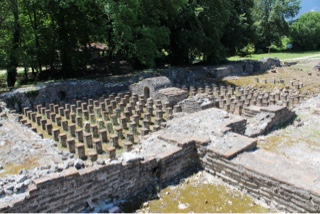
This is another big site, so allow some time to walk around it. The Romans also developed the site so it has Roman and later Byzantine additions.


Then the important port city of Pydna. Sadly not a lot to see here, other than some later Byzantine additions. The modern harbour may not be based on the original. Some of city is now under the nearby railway and motorway.


Pydna gives its name to 2 battles between Macedon and Rome in 168 BC and 148BC, although the former is the more important as the Roman victory ended the Antigonid line of Macedonian kings and confirmed the Roman conquest of Greece. The later battle was more of an uprising. 

The site of the battle is not really known, but the best guess is somewhere near the village of Nea Ephessos, so here is a photograph of the terrain taken from that village. The Roman army commanded by Paullus had elephants in this battle, which I always think is a very un-Roman weapon. The Romans won by withdrawing, or being forced back, over rough ground that broke up the cohesion of the phalanx. This allowed the legionaries to get inside and use their swords. The mystery is the ineffectiveness of the Macedonian cavalry. It is speculated that as nobles they were disaffected from King Perseus's populist policies.


Finally, even Thessaloniki hasn't forgotten the great man. There is a huge statue of Alexander on the sea front.