Welcome to my blog!

News from a wargamer with a special interest in the military history of the Balkans. It mainly covers my current reading and wargaming projects. For more detail you can visit the web sites I edit - Balkan Military History and Glasgow & District Wargaming Society. Or follow me on Twitter @Balkan_Dave
or on Mastodon @balkandave@mastodon.scot, or Threads @davewatson1683

Monday, 27 January 2014

Dynasties on the Danube

This was the title of our big game at the GDWS double header this weekend. Early 18th Century using around 600, 28mm figures and Black Powder rules.

The scenario was based in 1719. Austria, Russia and Poland have come together in a new Holy Alliance to expel the Ottomans from the Balkans. They mobilise in Belgrade and advance south. The Ottomans are ready for them and block the route. Let battle commence.

A Croat Brigade is the Austrian advance guard and they seek to expel an Ottoman advance guard from a village that controls one of the river crossings. However, they get bogged down giving the main Ottoman army time to deploy. The Russians arrive on the Ottoman right and force the river against a Wallachian Brigade and the Ottoman right wing cavalry. The Tartars arrive next to harass the Russians, but are sent packing by the somewhat tardy arrival of the Polish army. Meanwhile the Austrian army is largely destroyed by the Ottoman left and centre. Score draw to the Ottomans.

Very enjoyable game, three players a side on Saturday and two a side on Sunday. As always with Black Powder, lots of fun!

The full table, with the Ottomans at far left facing the Austrians. Russians in foreground trying to force the river.


The Russian army


Russian Grenadiers lead the bridge assault 


Ottoman centre with the Janissaries and artillery and left wing cavalry


Austrians attacking the village.


Wednesday, 15 January 2014

National Archives - First World War 100

A news item on the BBC the other morning caught my eye describing how the National Archives are putting war diaries on the web as part of their First World War 100 project. If you haven't had a chance to delve here I can highly recommend it.

The war diaries are themselves interesting as hand written records of the daily actions of units in the front line. The idea is to get us to do the classification and many people have clearly already been taking part.

There is a much more on the site including access to a lot of other documents. I was searching for materials on the Salonica campaign and came across this wonderful memo from the First Sea Lord, Jellicoe telling the War Cabinet, in gloriously pompous tones, of the need to withdraw troops in May 1917. Somehow the typewriter gives the words more feeling than seeing them reproduced in a book. You can almost hear Jellicoe dictating them to a secretary.


There are also General Milne's (He commanded the British Army) regular reports of his and the allies actions to the War Office.

There are also podcasts and film clips. I particularly liked this one of Franco's attack on Barcelona in 1939. The artillery far from being spaced out in WW2 style is firing from a column formation.


The National Archives are certainly providing a great resource.


Monday, 13 January 2014

Dacian Wars

I got one of my recent projects onto the tabletop yesterday at the club - Dacian Wars.

Two 300 point Hail Caesar armies organised into two divisions on either side. I haven't played a lot of Hail Caesar recently, so it was good to get back to the system that I think works really well for ancient battles. Unlike FoG and some other systems you rarely get individual units charging around the table, or even some of the Napoleonic style manoeuvring. You do what I suspect actual ancient commanders did. Devise your battle plan, hope your subordinates stick to it and possibly intervene personally with a reserve or at a critical moment.

Hail Caesar rules mechanisms largely force that with the proximity rule in particular. There is still a fun element with the order system that delivers the uncertainty of subordinates not doing what you want.

In this game, the Roman left division charged across the table while his left flank blundered and almost marched off the table. Sadly for my Dacian's, they recovered before I could take advantage, largely because one of my units blundered as well. The key with any warrior army like the Dacian's is to burst through in the first round. Fighting against tough veteran legionaires you are going to come unstuck if it becomes a slugging match, and so it proved.

Good game and gets me in the mood to start the research into the Bannockburn project, not to mention the growing pile of metal Scots spearmen!


Sunday, 5 January 2014

Malaya 1942

Last game of the holidays before returning to work tomorrow.

First outing for my new 28mm British and Japanese forces for the Malayan campaign of 1942. These are 28mm figures - Japanese are Warlord and the Brits are Perry's. The rules are Bolt Action.

By no means a finished project, but enough for a good game. The Japanese right wing crossed the stream and captured the village as the tank and the other infantry section pinned the Brits down on the road. I do like the special Banzai rule. It doesn't give the Japanese any 'supermen' close combat factors, it just keeps them fighting until virtually wiped out.


Thursday, 2 January 2014

Nomonhan Incident

I have at last managed to get two 1500 point Flames of War armies on the tabletop for the Nomonham Incident.

In 1932, the Japanese occupied Manchuria, giving them a 3000 mile frontier with the Soviet Union. Between 1931 and 1939 there were many border clashes, the largest in May 1939 at Nomonham. The Japanese eventually engaged two divisions with supporting army units, totalling some 30,000 men. The Soviet counterattack, led by Marshall Zhukov, involved 77,000 troops including two rifle divisions and two tank brigades.

The title 'incident' implies a mere skirmish. However, the Japanese admitted to 17,000 casualties and the Soviets 16,000, as well as 196 tanks and 133 armoured cars. That's a battle at any time in history. Strategically, it encouraged the Japanese to look south for the next stage in their expansion and the Pacific War was the consequence.

For those interested in giving this a go, I have reviewed a couple of books and the Flames of War supplement 'Rising Sun' is excellent. It also covers the Finnish War.

A few photos from my tabletop clash. Waves of Russian tanks and infantry attack both sides of a small village. If it looks unbalanced, that's because the Japanese are all veteran, while the Russians are conscripts. The Russian steamroller won through on this occasion.


The models are from the Battlefront, Peter Pig and Plastic Soldier ranges. You will find a number of reviews of these figures in posts throughout last year.

A late addition was my xmas painting of these two very nice Battlefront Russian 122mm howitzers.


Wednesday, 1 January 2014

Happy New Year!

A lot of stories about liver disease in today's Scottish media that I didn't appreciate after last night's excess, but a break in the rain meant I got out for a walk and cleared my head. It's been a good holiday break with some reading, gaming and painting done. Of course this means that I may get too over optimistic about what can be achieved in 2014!

Firstly, the projects.

As always some finishing off to do:
  • The Nomonham project is almost complete. I based two Russian 122mm guns this morning and that gives me all I need. There is still a box of Japanese infantry that needs attention at some stage as the Japanese will need some reinforcements.
  • Malaya 1942 - still needs some heavy weapons, particularly for the Brits, and an order has been dispatched to Warlord for these.
  • Yugoslavia WW2 - just needs some Italian heavy weapons, again en route from Warlord.
Then some new projects:
  • Chinese for the Sino-Japanese War. The Eureka figures are superb, if ridiculously pricey.
  • Scots for Bannockburn. The anniversary is the big event in Scotland and I suspect you won't be able to move for display games at Scottish shows this year. I have been collecting spearmen from several ranges, although not entirely happy with any of them.
On the subject of display games, a few other members have stepped up this year with projects, so my focus is something related to Bannockburn. The challenge will be to find a different angle.

The other big anniversary is of course the outbreak of WW1. As it kicked off in the Balkans, I may do something Austrian and Serbian at one of the shows. I certainly plan to highlight this part of the war and may even add a figure or two to my collection. Credit to Max Hastings, who has given this more coverage than it usually gets in his book 'Catastrophe', my current reading.

On reading, I am still working my way through the reading pile I purchased at Hay-on-Wye, but there is so much good new stuff coming out I may still be looking at it next year.

I have highlighted a few other anniversaries in the month's update on Balkan Military History. Hard to believe I have been editing this website for 17 years! Chaldiran is one that particularly caught my eye as an interesting action. Plus the Ottoman/Venetian war of 1714, when the Turks recaptured the Peloponnese.

Well, all that should keep me busy. All the best for 2014 and good luck with your own projects.


Tuesday, 31 December 2013

The Pagan Lord

Second on my holiday reading list has been Bernard Cornwell’s latest epic, ‘The Pagan Lord’.


This is the latest in the Warrior Chronicles, telling the story of Uthred, the pagan warlord, who was brought up by the Danes, but fights for the Saxons. This is the seventh instalment in the series and covers the period after Alfred’s death up to the historical battle of Teotanheale in 910. The Danes are still pressing the Saxon kingdoms and Uthred is as usual in trouble with the church he despises. He is banished, tries to capture his birth right fortress at Bebbenburg, and when that fails, comes back to save the Saxon’s yet again.

If this all sounds a bit familiar, it does have to be said that the formula is getting a bit worn. A bit like Uthred himself, who is getting on a bit. You might think, time to ride off to Valhalla with sword in hand and you would probably be right.


However, the problem with this critique is that it is still a great yarn. Absolutely compelling reading that you just can’t put down. Cornwell is simply the master storyteller and while the formula is getting a bit repetitive, there is enough of a gap between titles for the reader to recover. Bring on the finale!

Monday, 30 December 2013

Chain of Command

I played my first game of Chain of Command at the club yesterday, the WW2 platoon level skirmish game by Two Fat Lardies.

We played a VBCW scenario, with three sections of my Red Clydesiders supported by a T26 and an armoured car, against a similar force of Covenanters.


The spotting phase is innovative, with markers patrolling in 12” moves until they contact an enemy patrol within 12”. That locks them in place and converts into jumping off points for a rifle section. You have four markers that have to keep within 12”, so that constrains your ability to start too far into the table. In most cases it will probably result in a standard deployment, but it doesn’t take long and makes you think about the terrain and how best to exploit it with deployment.

The game places a great emphasis on leadership. The command dice roll at the start of each phase makes all activations and these allow leaders to move, fire or rally troops. Senior leaders are the most important as they have multiple activations for troops within 4”. You also collect command points that can be used to interrupt during your opponent’s phase.

Shooting effectiveness is based on the training of the enemy troops like FoW. The ranges are long as this is a skirmish game.

We had a fun game, but I have a few reservations. Like a lot of TFL games the movement is very random. Troops can sit around doing nothing for a long time and I am just not convinced about this. Units faltering by events like being fired on I can understand, but just sitting around when you have clear orders from the outset, simply doesn’t feel right. It is also possible for one side to have two consecutive phases, which is a very big hit.

A number of the mechanisms are unduly complex, even allowing for our first game learning. There are unnecessary stages and detail that I am not convinced adds anything to the play or the ‘realism’. When you get to armour effects there are many outcomes that you need to write down to remember. I found this irritating, slows the game down and visually unattractive.


In summary, some nice ideas and I don’t have a problem with the leadership focus. However, it’s too random, unnecessarily complex in places with some turgid mechanisms.  I’m afraid it wont tease me away from Bolt Action.

Saturday, 28 December 2013

Militargrenze using Muskets and Tomahawk rules

I did promise myself some gaming over the holidays and I got to a project inspired by my first game with the excellent Musket and Tomahawk (M&T) rules.

At the time it occured to me that this would work just as well on the military border between Croatia and Bosnia/Serbia, known in Austrian as the Militargrenze.

I have written a short article on Balkan Military History explaining the military structures on both sides of the border. Then I converted the main troop types into M&T classifications.

I have now fought three short games around a Grenzer village being attacked by Ottoman forces. The rules work really well and provide interesting and quick games.

Here we have a unit of Azebs and another of Gonullu trying to work their way around the back of the village. However, they are repulsed by the sturdy Genzer.


The Janissaries did little better in the frontal attack.


Just as the Grenzer though it was all over with the Ottomans in flight. The mighty Rasputin (our cat) arrived on the scene!


But of course, with name like Rasputin he has to be an Orthodox Christian, so he decided to play with the fleeing Azebs!


Whatever the M&T classification - he wins!

Thursday, 26 December 2013

To Conquer or to Die!

My holiday reading starts with, ‘Conquer or Die! Wellington’s Veterans and the Liberation of the New World’ by Ben Hughes.

Simon Bolivar’s campaigns to liberate the northern states of South America are fairly well known. Popularised, for wargamers at least, by John Fletcher’s ‘Liberators!’ booklets and range of figures. He is also the author of a recently published Osprey essential histories book on the wars of liberation.


However, this book focuses on the 6,000 or so British volunteers who served, largely with distinction, in the republican armies of Venezuela and Columbia between 1817 and 1820. In the main, they were Napoleonic wars veterans who volunteered to fight in South America. It tells the story of these wars through their eyes and by any standard it is a remarkable story. One of great courage, much misery and endurance, coupled with incompetence and farce. Nonetheless, they made a significant contribution to the republican victory, one that is only partially recognised, even today.

My wargaming of this period has focussed on the other great Liberator, San Martin, who led the Argentine armies across the Andes to liberate Chile and then Peru, where he joined up with Simon Bolivar. There is more on this at my website and GDWS did a number of display games with the converted figures in 28mm during 2007. Wargames Illustrated published a feature article on these games in August 2007.

I would also recommend reading Robert Harvey’s ‘Liberators’ and John Lynch ‘Simon Bolivar – A Life’. He did another book on San Martin.


Orinoco Miniatures have just brought out a range of figures in 28mm for the period, starting with the British Legion. They look very good together with the first Columbian and Spanish foot. I suspect I will give in when the distinctive Llanero cavalry arrive. Flags of War have also started a range of flags.


Wednesday, 25 December 2013

Type 95 Ha Go tank

Merry Christmas to everyone. Hope you got all the toys you wanted! Given my huge pile of metal I asked for some restraint from Santa, but it just means more book tokens.

In the words of the song I could say, 'all I want for Christmas is a Ha Go tank', but not quite true as I finished painting it yesterday. Now all my Brits need for xmas is a 2pdr anti-tank gun, otherwise they are in serious trouble!


This is the Warlord 28mm model. Very nice with one complaint. Do the people who design these kits every assemble them? If they did they surely would not expect a long piece of metal (gun barrel) to stay in place with a pathetically small lug hole. Barely pin sized on this model. Much swearing and super glue later I got there, but a bit of thought guys ....

Have a good holiday.

Sunday, 22 December 2013

Malayan Campaign Brits

Two more units of Brits for my Bolt Action Malaya project. These are Perry plastics as several units got diverted to Singapore.


And a Type 92 70mm infantry gun for the Japanese.


Sunday, 15 December 2013

Japanese reinforcements

Some more 28mm Japanese for the Malaya campaign. Again these are Warlord, based for Bolt Action rules. If I can finish off the Brits by Xmas, I might even get a game over the holidays!


Wednesday, 4 December 2013

Japanese in 28mm

First of the Warlord Japanese off the bench.

These are from the Warlord metal box and few extras. Probably a few too many kneeling and crawling figures for my taste in the box. I would expect to see Japanese charging across the board!


Friday, 15 November 2013

Jungle soldier

The WW2 Far East project is back on track with some more reading on the Malayan campaign.

This time a compelling story about the 'stay behind' units and one Freddy Spencer Chapman. He spent over three years behind Japanese lines, mostly with Chinese communist guerillas. All the more remarkable given that he was more famous pre-war for his expeditions in the Arctic.

Brian Moynahan has written a gripping narrative of his story, 'Jungle Soldier'. He draws heavily on Chapman's own account in, 'The Jungle is Neutral' (1949). It was only half way through Moynahan's book that I remembered that I had a second hand copy of this tome in my reading pile.

Not a wasted purchase because Chapman wrote his account during the Malayan Emergency and therefore missed out some important details. Also frankly, Moynahan is the better writer and gives a wider perspective. I won't summarise the story because that would ruin what is an excellent read and a credit to a remarkable story of endurance.

One of the more interesting points for me is hinted at in the title of the book. The Japanese were far from being the expert jungle fighters they were portrayed as being at the time. Chapman shows how their jungle craft was limited and had the stay behind parties been better equipped and supported, could have done even more damage.

More progress on the figure front as well. These are the first of the 28mm Malayan project using Bolt Action. Perry 8th Army plastics work well for this project because several units earmarked for the desert were sent to Singapore. The issue of tropical uniforms convinced the troops that the desert was the destination. After arriving only to be captured by the Japanese, most would have wished the original plan had held up!


Tuesday, 12 November 2013

China's War with Japan

My Far East project has taken a bit of a detour into the Sino-Japanese conflict, which of course began before WW2. My latest reading is Rana Mitter's 'China's War with Japan', a book I discovered through a History Magazine Extra podcast. I can recommend these if you haven't tried them yet.


China's contribution to the defeat of Japan in WW2 is probably not fully appreciated, at least in the West. China continued fighting for eight years when it could have surrendered. They tied down half a million Japanese troops that could have been deployed elsewhere in the Pacific, most notably in an invasion of India. China paid a heavy price, with some 14 to 20 million dead.

This is a broad narrative history that takes us from the, almost accidental, outbreak of war in 1937 to the unexpected capitulation in 1945. It is a complex tale that focuses on the political history of the period because in practice there were three China's at play. The Nationalists, communists and the collaborationist governments. The outside actors, most notably the Americans and Russians, play an important role as well.

The military historian will be frustrated by the way the author brushes over the detail of major campaigns. However, the political context is important here, more so than many other campaigns, so this is definitely required reading.

Monday, 4 November 2013

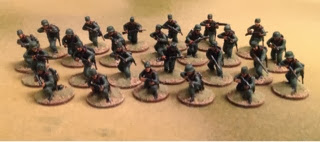
Handschar in 28mm

The latest additions to my Bolt Action 28mm Balkan WW2 project are the Handschar. Or properly, the 13th Waffen Mountain Division of the SS Handschar (1st Croatian). 

This was a Waffen SS unit recruited mostly from Bosnian Muslims. They joined up primarily to secure their communities from the depredations of the Croatian Ustashi. By 1943 over 100,000 Bosnian Muslims had been killed and 250,000 had become refugees. Himmler had a somewhat romantic view of Islam and the fighting reputation of Bosnians, based on their record in WW1. The Bosnians had a generally positive view of the Austro-Hungarian Empire, which meant they were inclined to welcome the Germans.

They spent most of the war fighting Tito's partisans in a series of operations that had limited success. As the Russians poured through the Balkans they mostly drifted home. Those who stayed to the bitter end either died in action or were executed for war crimes. Not a happy story, but they are an important and distinctive unit in partisan warfare of the period.

The models are Warlord Germans with Handschar heads that be bought separately. There are plenty of pictures of these troops in George Lepre's 1997 book, 'Himmler's Bosnian Division: The Waffen-SS Handschar Division 1943–1945'. Plus the Osprey titles on the period.