Welcome to my blog!

News from a wargamer with a special interest in the military history of the Balkans. It mainly covers my current reading and wargaming projects. For more detail you can visit the web sites I edit - Balkan Military History and Glasgow & District Wargaming Society. Or follow me on Twitter @Balkan_Dave
or on Mastodon @balkandave@mastodon.scot, or Threads @davewatson1683

Saturday, 11 April 2020

Fortress Budapest on the table

Having painted all the exotic Soviet units for Fortress Budapest it was time to buckle down and do the standard ones.

First off a rifle squad. These are from the North Star range with plenty of character - they even give you names for each figure.


Then some support units - MMG and medium mortar from Warlord.


The HQ units including the feared Commissar. Did they really wear medals on the battlefield?


And finally a scout squad. Warlord again and very nice figures they are.


This gives me nearly 1300 points for a Bolt Action game. Time to take on the Hungarians.

I set up the table longways and a pal deployed the Hungarians via Zoom. In the first move, the Soviets made good progress on the right flank, capturing the wood after a close assault with a Hungarian rifle squad. The Hungarians responded by advancing the Turan II over the bridge and bringing the German reinforcements up in their carrier.


The second move was a bit of a disaster for the Soviets. The SU100 shot at the Csaba armoured car and missed. The Turan II got a lucky hit and knocked out the SU100 - that's 300pts down the can.

Both sides came grinding to a halt in the next move when the FOO's brought some devastating off-table artillery fire down on the far too bunched units. For example, a roadblock on the bridge forced the Germans to de-bus.


The Russians did work their way around the right flank but were too weak to cope with the counter-attack.


The left flank attack was shot up, so game over. Budapest is safe for another day!

Zoom works very well for a 28mm game. The figures are big enough to see, even from a helicopter view.

Friday, 10 April 2020

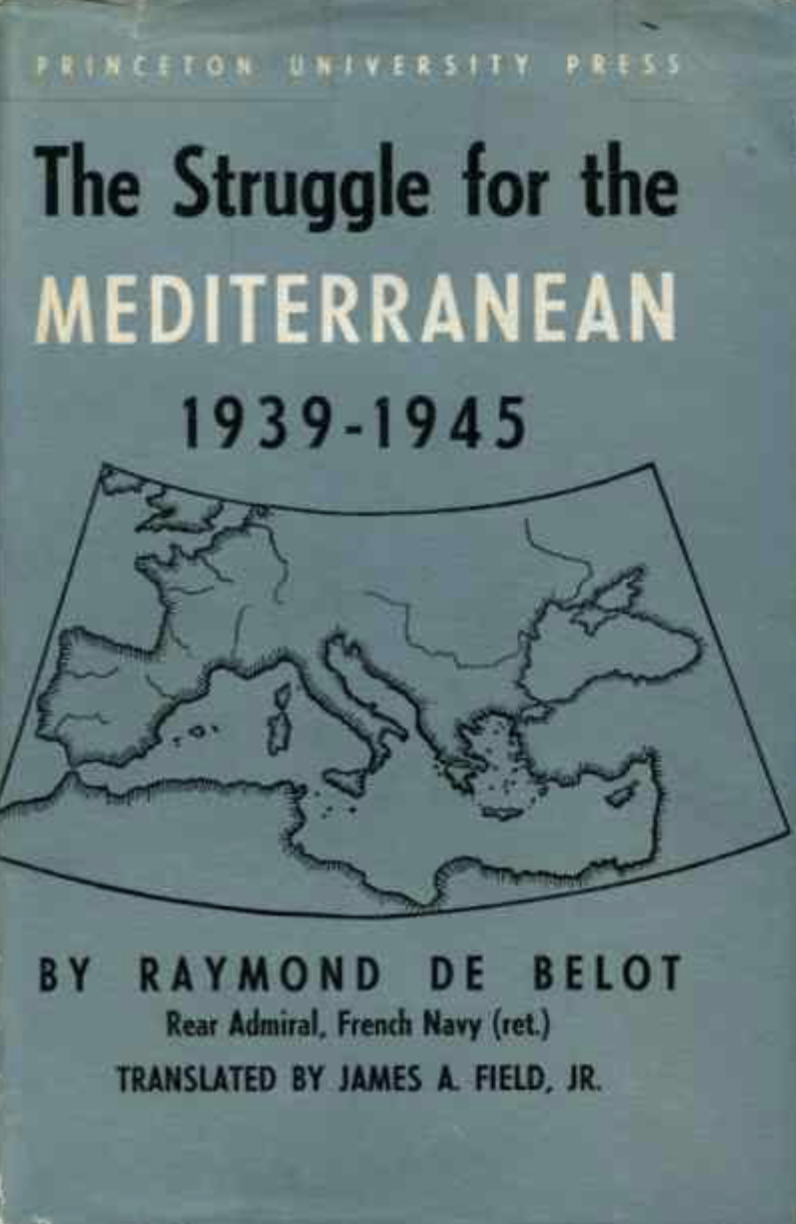
The Struggle for the Mediterranean 1939-45

More Second World War strategy reading for me in lockdown. This book was written not long after the war (1951) by Raymond De Belot, a Rear Admiral in the French Navy.


The author reminds us of the role of the Mediterranean in conflicts throughout the centuries before outlining its strategic position in the Second World War. As a British strategist put it; "Who holds the Mediterranean, holds the world". He then outlines the main powers and their position prior to the conflict. As an Admiral, his focus is understandably on naval warfare, but the land campaigns are not ignored.

The campaign narrative offers little that is new, although some snippets were new to me. For example, Mussolini's sudden decision to enter the war left one-third of the Italian merchant marine in foreign ports. 218 much-needed ships that were effectively lost.

The importance of Italy's lack of raw materials is not always well understood. This meant relying on Germany, which itself was struggling. As a consequence the expansion of Italian armed forces during the war was minimal. The lack of oil in particular often meant that the Italian navy could not leave its bases. On 8 March 1943 Mussolini wrote to Hitler; "Our tragedy is that we are forced to fight a people's war with arms left over from 1914-18". Rather late to recognise that he had attempted the role of a first-class power with a third-rate industrial base!

Italy also had no real wartime strategy. The author makes an interesting comparison with Japan, which had similar raw material challenges, but did have a clear strategy. Japan was ready, Italy was not. Japan had a bold plan, well thought out and precise; Italy did not.

The author discusses all the big strategic decisions. Why the Germans didn't finish off the allies in the Middle East before turning on Russia. The British/USA strategic tussle over the 'soft underbelly' approach favoured by Churchill. He implies sympathy for General Marshall's position, arguing that the Balkans are just as defensible as Italy, unlike the plains of North-West Europe. As for a push from Italy into Austria, he quotes Marshall as saying; "In Europe's innumerable wars no vigorously opposed crossing of the Alps had ever been successfully executed."

However, he also reminds us that the Germans were expecting an invasion of the Balkan peninsula. He quotes Doenitz saying after Salerno: "The enemy's next strategic moves will evidently be directed against the Balkans."

The author argues that had the allies invaded the Balkans rather than France, the Russians would have simply moved North well beyond the Elbe. This would have resulted in a similar post-war position.

This is an interesting take on the subject and well worth a read.


Tuesday, 7 April 2020

Churchill - Military genius or menace?

This is Stephen Napier's study of Churchill at war. It is a strategic look at the actions and decisions taken at various stages in the Second World War. Any study of Churchill is controversial as supporters and critics often fall into the Hero or Villain camps of the recent debate. History is rarely so black and white.


Churchill was of course absolutely right about the threat Hitler posed to the world order as he articulated during his wilderness years. He was on weaker ground when expressing his views on modern warfare. For example, he derided the future of tanks and believed that modern warships had little to fear from aerial attack.

His personal style of leadership certainly streamlined the cumbersome leadership structure both civilian and military. His Private Secretary, John Colville, commented on the great loyalty he engendered from Service Ministers and his drive and initiative but said he also meddled.  Alan Brooke as Chief of the Imperial General Staffs was blunter, he said; "Winston made matters almost impossible, temperamental like a film star and peevish like a spoilt child."

Later in the war when Churchill's health was suffering, and his drinking getting heavier, Brooke's diary gives an indication of his frustration in relation to strategy in the Far East; "I am honestly getting very doubtful about his balance of mind and it just gives me the cold shivers. I don't know where we are going as regards our strategy and I just cannot get him to face the true facts."

While it is true that Churchill's flood of ideas and diversions frustrated many, he usually gave way when push came to shove with military leaders. It is also the case that he was often one of the few contributors of fresh ideas, even if most were not practical.

The book has plenty on my own area of interest - Britain's Balkan strategy. Churchill was a strong advocate of the indirect approach, the 'soft underbelly' of Europe. A common complaint of Brooke was that Churchill often advocated a diversion of forces. The failed Kos and Leros campaigns are probably the best example of this, but Churchill was also in favour of Operation Jupiter in Norway well into 1944.

The Americans were particularly concerned that his Meditterenean strategy shifted resources from the invasion of France and the Soviets pointed to how few German divisions were diverted from the Eastern Front to Italy. On this Churchill was supported by Brooke, but others argue that the war could have been over a year earlier had Overlord happened in 1943.

I hadn't appreciated the strength of Churchill's reservations about Overlord. So much so that Marshall (US Chief of Staff) threatened that if the British wanted to ditch Overlord in favour of operations in the Balkans, the USA should switch resources to the Pacific.

In the end, I think Brooke had it right when he said; "Without him England was lost for a certainty, with him England has been on the verge of disaster time and again.... Never have I admired and disliked a man simultaneously to the same extent."

Whatever your view of Churchill this is a very good history of the strategic decisions taken during WW2. Well worth a read.

Sunday, 5 April 2020

Constantinople AD 717-18

The latest Osprey publication in the Campaign series covers the less well known Arab siege of Constantinople in AD 717-18, written by Si Sheppard. As an aside, I would like to pay credit to Osprey for their weekly free e-books and the Frostgrave promotion, all of which are helping folk get through the current lockdown. Other military publishers have also offered a range of discounted publications. Thanks, and well done!

This book follows the usual Campaign format. A lengthy chapter on the background to the siege including the previous attempt by the Avars to capture the city in AD 626. Constantinople is built in a strong defensive position, and the fortifications reinforce those strengths. 


The Arab Jihad burst into the Middle East in AD 626, defeating the Sasanians and the Byzantines, before capturing the great cities of the region. They advanced along the North African coast and captured Carthage. Initially reluctant to create naval forces, later Arab commanders recognised the necessity and attacked the major islands including Cyprus.

By 651, with the Sasanians dealt with, the Arab commander Muawiya prepared for a major campaign against the Byzantines in Anatolia, supported by a massive fleet. As you would expect in this series, this is graphically explained with excellent maps. However, a major storm wrecked much of the Arab fleet as it approached the Dardanelles, and the Arabs withdrew to Syria.

A Muslim civil war gave the Byzantines another break before major raids started again. The Byzantines responded with attacks of their own but were put under pressure in the Balkans when the Slavs laid siege to Thessaloniki in 676. An alliance with the Mardaites from near Antioch helped push the Arabs into a 30-year truce, to enable the Umayyad dynasty to consolidate its power. Not without another round of internal conflict.

By the turn of the century, the Arabs were back conducting annual raids into Anatolia. Meanwhile, the Byzantines engaged in further internal conflict. They did achieve an end to the conflict with the Bulgars which brought peace to the Balkans and time to strengthen the defences of Constantinople for the siege.

The next chapter covers the opposing commanders. Leo III for the Byzantines, who had had an extraordinary progress to power. In 12 years, he rose from being a Syrian peasant refugee to the purple. For the Arabs, Maslama b. ‘Abd al-Malik was the son of the Umayyad caliph. He was an experienced commander with many successes, although he failed at Constantinople largely due to poor planning. In particular, dealing with the Bulgars and countering the destructive effect of Greek fire. He also appears to have believed that Leo would betray the city.

We then get an outline of the opposing forces and their plans. The achievements of the Arabs have been understated in western history, despite their immense and long-lasting conquests. The Islamic faith had bound together the warring tribes and created professional armies maintained by the state. They understood the importance of logistics, although they would normally avoid sieges, preferring to fight in the open.

The Byzantines of this period haven’t had a much better press than the Arabs. By the siege they had lost many of the richest provinces, weakening the field armies. The Thematic system was designed to shield the borders until the field armies arrived. They also had a system of garrison stations and fortified outposts. In Constantinople, these garrisons consisted of a wide variety of professional and militia units. The naval superweapon was Greek Fire, which like napalm clung to everything it burned and could not be doused by water. Colour plates by Graham Turner illustrate how this worked in some detail. 

The siege began with the Arabs cutting off the city by digging a trench around the walls and counter defences against the Bulgar threat from the rear. The city’s weakness was an attack from the sea, but Arab fleets were defeated by Greek fire. 

The winter weather and poor provisions, much of which was lost to a Byzantine ploy, took their toll on the Arab army. Relief fleets suffered from mass desertion of their largely Christian crews, and the blockade was lifted. This meant the Arabs became the besieged and the Caliph ordered Maslama to abandon the siege. The army was heavily defeated by the Bulgars and the survivors harassed by the Byzantines as they withdrew through Anatolia.

Bulgars attacking Arab units - 15mm figures

The aftermath of the siege brought a Byzantine recovery, but this was squandered by internal revolts and the Arab cause recovered. However, after several defeats, the Umayyads were replaced by the Abbasid dynasty.

As Maslama cast one last glance at the walls of Constantinople on 15 August 718, he may have had a Hadith, ascribed to Muhammad by ‘Abd Allāh b. Muhayrīz, in mind: ‘Persia is [only a matter of] one or two thrusts and no Persia will ever be after that,’ the Prophet foretold. But the heirs of Rome ‘are people of sea and rock; whenever a generation passes, another replaces it. Alas, they are your associates to the end of time.’

The book ends with some interesting what-ifs. It will irritate some historians, but enjoyed by others. Overall, an excellent study of the siege and its context.

Friday, 3 April 2020

Rangers of Shadow Deep

As we are in lockdown I thought I would try a game designed for solo play, rather than adapt a standard ruleset. I was listening to Henry Hyde's interview with Joeseph McCullough, which reminded me that his Rangers of Shadow Deep is designed for solo play.


There is a new fancy bound edition of this game just out, but I settled for a downloadable PDF of the original version. This is a skirmish game in a fantasy setting. You play the part of a Ranger who has basic abilities with a set of fairly standard statistics - move, fight, shoot, armour, will and health. You strengthen the basics and then add heroic abilities and skills. These all give exceptional actions or bonuses in combat.

You can then add companions like archers, barbarians and men-at-arms, or something more exotic like a conjurer. These are all recorded on a ranger sheet and you are ready to go.

The game is scenario, or mission, led. There are several in the book to get you started. They outline the tabletop and the creatures you will face. Creatures have their own bestiary and include a range of typical fantasy enemies.

Each activation allows two actions, typically a movement and fight or shoot. The Ranger goes first, although he can take some companions with him/her.

In my test game, the elven ranger had a couple of archers and a barbarian, who looks remarkably like Conan! Their task is to get across a bridge guarded by what they call Gnolls (I used Orcs) and a Shadow Knight.


The solo mechanism sets out a series of automatic reactions for creatures. So, when the Ranger shoots and kills a Gnoll, the others in line of sight spot him and generally attack. There is a simple flow chart of options. These are supplemented by event cards, playing cards and a table that describes actions for each scenario depending on the card drawn. It works very well.

Shooting and combat are pretty straightforward. You add the relevant stat to a D20, both sides roll, and the loser deducts his/her armour from the winning roll to calculate damage. As with this author's other popular ruleset, Frostgrave, this is a problem for me. D20 is a massive variable.

In this game, Conan just about survived his first round of fighting with a Gnoll.


And then killed his opponent in the second round with a huge difference in the roll.


Anyway, the Ranger comfortably beat the Shadow Knight and off our merry band went to the bridge.


There is a campaign system, which links the missions and allows a decent narrative to develop.

The rules could have done with a playsheet, accepting there is probably one on a forum somewhere. With all the add on rules, it required a lot of going back and forth. But regular play would probably reduce that. The solo mechanisms work, but I am not convinced by the combat mechanisms. For this level of game I prefer Open Combat, but I might pinch the solo mechanisms and use the scenarios.


Wednesday, 1 April 2020

Solo medieval Balkans campaign

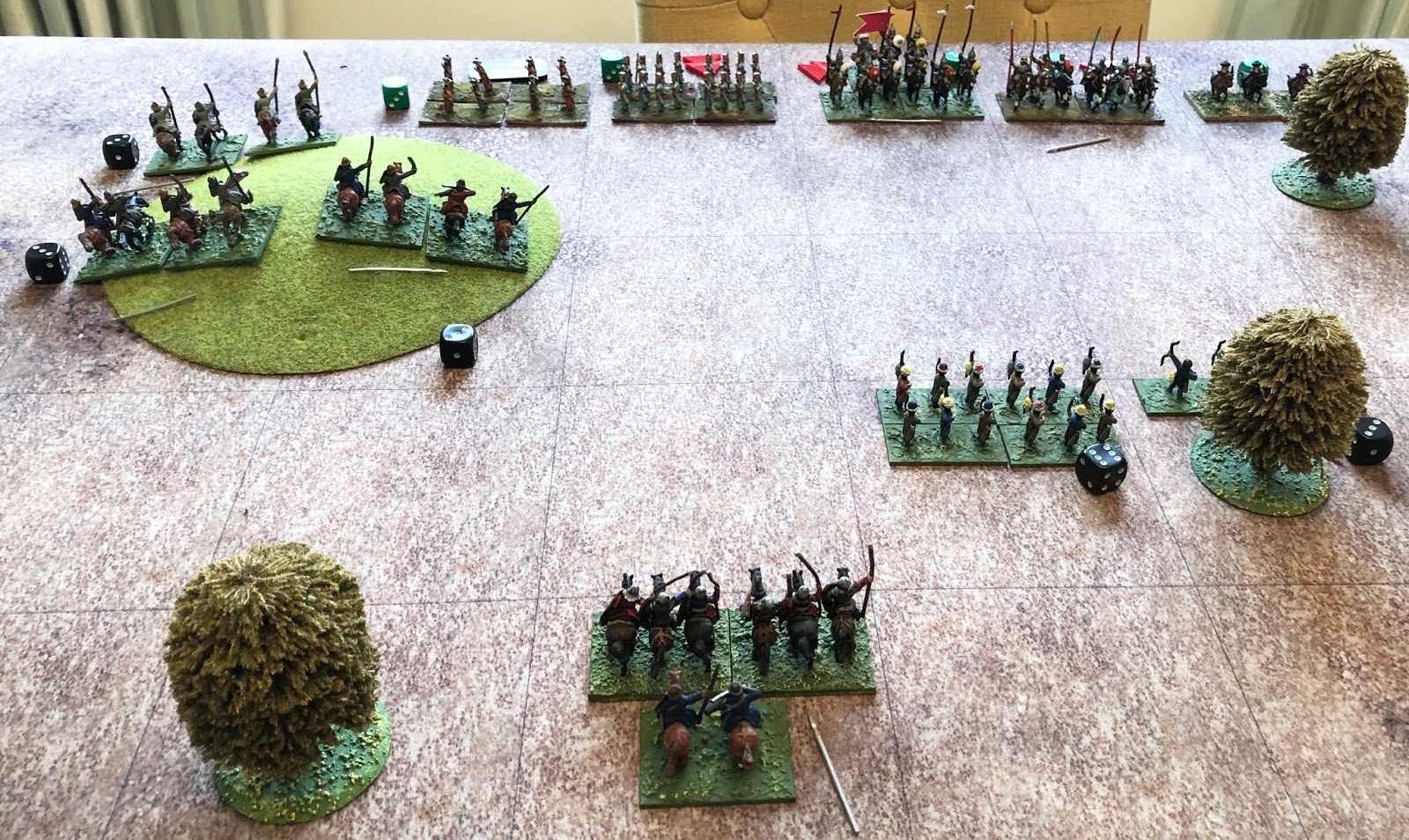
Having helped write the new To the Strongest! army lists for the medieval Balkans, I thought lockdown was a good opportunity to play with them. I used 15mm figures and the standard 130pt armies as I only have a temporary narrow table. The mat is custom made 100mm squares from Deep Cut.

I almost made a disastrous error when ordering this mat. I typed 10mm instead of 10cm. Fortunately Deep Cut send you a sample photo before printing, and I noticed a large number of squares!

TtS! is a good game for playing solo. If you use historical setups there are relatively few decisions that have to be made. The cards are still important. I usually physically move to the phasing side to give me the right perspective.

I used the Ottomans in each game because while they were aggressive strategically, on the battlefield they were tactically defensive. Generally trying to draw enemies onto the Janissaries and countering with the cavalry wings. Again, very suitable for solo play.

The first game was against the Serbs. The Serbian army is one of my favourite medieval armies. They suit my aggressive wargame style. I am not much of a sit on the baseline sort of player.


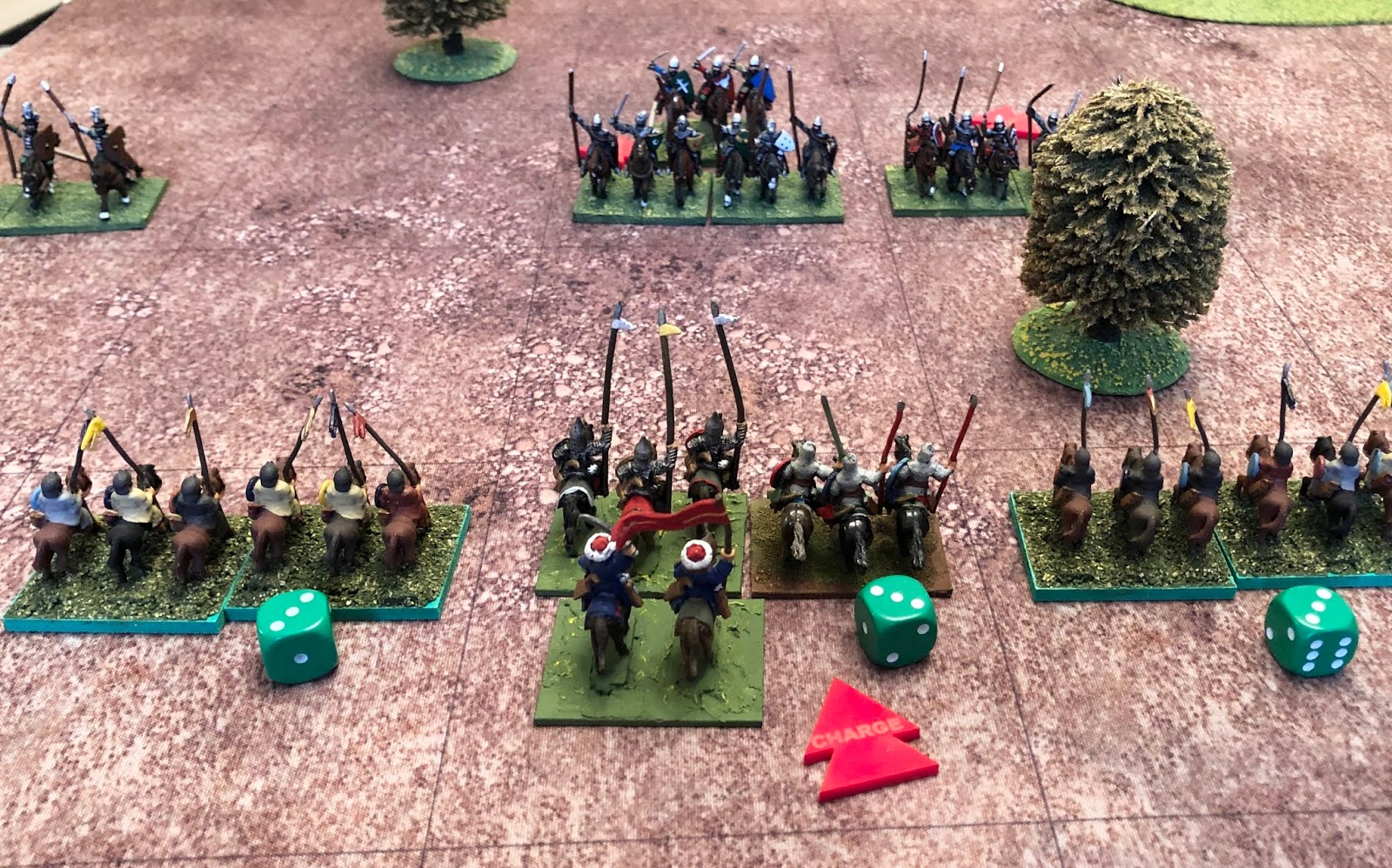
If you are not familiar with TtS here is my review. The D6 by units is ammo supply and the red charge markers designate heroes. They can be used once to redraw a 'to hit' card.


Sadly, the Serbs hurtled across the table but got shot up before they could bring their knights into combat. If you can disorder them by shooting before combat they need and 8+ in melee rather than a 6+.

Next up was the Wallachians, led by Vlad the Impaler.


The Wallachian infantry pinned the Ottoman centre, without breaking through.


Meanwhile, the Wallachian cavalry smashed through both Ottoman wings. Game over.


A grim end for many Ottomans! Vlad earning his name!


Finally, The Albanians had a go at the Ottomans, led by Skanderbeg.


TtS! doesn't have an official cut down game like ADLG with its 100pt version. I was playing this game with a pal on Zoom. Playing with video conferencing is slower than normal so I devised 50pt armies, using the minima and halving everything. You have one command, instead of the normal three or four.

In the first move, Skanderbeg drew a 2 for the group move, which gave plenty of scope for more moves and the Albanians flew across the table. The light horse peppered the Ottoman flanks.


However, this is where the ammo rules come in because they then had to charge the Janissaries, who are tough to beat, even when the Albanians got around the flanks. Victory to the Ottomans.


 The cut-down game took around 40 minutes once we got started, very suitable for a video conferencing game. If anyone fancies a go drop me a line, all you need is a microphone and camera on your device. Zoom works on PC/Mac, laptop and phones.


Sunday, 29 March 2020

Midnight at the Pera Palace

The Pera Palace Hotel in the modern Beyoglu district of Istanbul is the rather loose link in Charles King's story of Istanbul between the two world wars.


At the end of WW1, the Ottoman Empire had been defeated and dismembered. Istanbul became a melting pot far removed from the rest of the country. Russian emigres from Bolsheviks made up a growing part of the population together with the peoples of many nations and races. Non-Muslims were the mainstay of Istanbul’s economy and culture. They were its barkeepers and bankers, its brothel owners and restaurateurs, its exporters and hoteliers. As late as 1922, Greeks still owned 1,169 of 1,413 restaurants in the city, compared with 97 owned by Muslim Turks, 57 by Armenians, and 44 by Russians. As King says:

"In the process, the former Ottoman capital came to reflect both the best and the worst of what the West had to offer: its optimism and its obsessive ideologies, human rights and the overbearing state, the desire to escape the past and the drive to erase it altogether. When visitors complained that the old Istanbul seemed to be slipping away, what they meant was that Istanbul was coming to look more and more like them."

During the allied occupation after WW1, the future President of the Republic, Mustafa Kemal, stayed in the hotel sounding out the British for a job. He left after six months to greater things and left behind a chaotic administration. A situation the British governor was only to please to extricate himself from.

The Turkish Republic that emerged from the war with Greece was a nationalist state bent on modernisation. The capital was moved to Ankara, dress regulations changed and even the calendar and clocks were brought into line with Europe. Those Greeks and Armenians not covered by the population exchanges had their properties seized, including the Pera Palace Hotel. These intentionally reduced the visibility of minorities.

Ernest Hemingway had worried about what would happen to Istanbul’s nightlife once the Muslims took over the city. He had no cause to worry as Istanbul's nightlife became famous across Europe with new bars, clubs and restaurants opening daily. Not to mention the easy availability of illicit drugs and brothels. There were 175 brothels in the city and somewhere between 3,000 (police estimate) and 40,000 (British estimate) prostitutes. In 1930 the government banned new brothels and gradually introduced regulation, but didn't bar them.

Music (particularly jazz), films and other forms of culture also developed in the inter-war years. Women not only abandoned the veil but increasingly played a role in commercial, cultural and civic life. However, political life was quickly closed down as the Kemalist government became as dictatorial as Italy, Germany and the Soviet Union. There were 18 uprisings before WW2, all put down with great violence as Turkishness became the new state doctrine.

Before and during WW2 Istanbul again became a centre of intrigue as Turkey attempted to remain neutral. “You could almost throw a stone out of the window of any leading hotel and hit an agent,” recalled an American official about wartime Istanbul. The hotel was even damaged by a suitcase bomb, probably aimed at British embassy staff who had left Bulgaria. SOE had a base in Istanbul and later the American OSS did the same. By 1944 whenever a group of Americans came through the door of a club the band would play, “Boo Boo Baby I’m a Spy".

Official policy tacked with the winds of war. Istanbul again became the destination for refugees. Initially, German Jews strengthened the teaching staff of universities, but later the government resisted waves of Jewish refugees from eastern Europe, many seeking a route to Palestine. This led to tragedy, including the sinking of the Struma with nearly 800 passengers on board. In all, from 1942 to 1945, a total of 13,101 Jews went via Turkey to Palestine and other destinations.

Even today the Pera Palace Hotel uses its amazing history in its marketing, although glossing over the visit of Joseph Goebbels! More recently Istanbul has shown its independent streak in local elections and it remains different from much of the country.

This book is the story of how Istanbul became a modern city and tells us much about Turkish history at the same time. Well worth a read.


Wednesday, 25 March 2020

Romanian Army of WW2

With impeccable timing, lockdown happened in the midst of decorators working in our house. I am now explaining to my beloved why my paintbrushes are a little on the small side for the lounge wall! Even worse, we sold off the old dining table in anticipation of a replacement, so I am without a wargames table for the moment.

Putting the house into shape even temporarily has taken some time. However, my Operation Budapest project is still grinding on, and I am procrastinating by still not getting stuck into those Russian riflemen. However, I have finished a squad of Romanian infantry, fighting for the Soviets during the campaign.

These are from the Great Escape Games range that I picked up at the York show last month. Really glad now that I made the effort to attend that show!

Romania was the third largest Axis power in WW2 - by 1944 they had 1.2 million men under arms. However, the army had structural problems, not least the social gulf between officers and men, a weak corps of NCOs, poor education standards, limited state mechanisation, and a brutal disciplinary system. Added to this were poor training, equipment and leadership.

Germany was unable to plug all of these gaps, or always keep the peace between Hungary and Romania. When Romania switched sides in August 1944, little assistance was provided by the Allies either. Artillery, anti-tank guns and tanks were typically obsolete and lighter than their counterparts.

The models are fairly large with good detail. Most have the 'Dutch' helmet, and I have kept a few with caps back for a planned Turkish WW2 project. The Romanian cap is similar and nobody does Turks. There was a lot of flash, which is surprising for a new range and I assume new moulds. There is little more irritating than finding bits you have missed when painting the detail.

Anyway, at least another 'Soviet' unit done. Now I must tackle those riflemen - although I did buy some Hungarian Hussars at York........


Monday, 23 March 2020

Where the Eagle Landed

This book by Peter Haining describes the measures taken in 1940 to resist a possible invasion of eastern England. In particular, it deals with a number of rumours and speculation that German units actually landed in East Anglia.


This book was written in 2004, although topical this year in the 80th anniversary of the Fall of France and planned Operation Sea Lion invasion of Britain. The GDWS display game planned for the Falkirk Carronade show in May was based on a 'Dad's Army' scenario. Sadly, that show has had to be cancelled, but the game may make an appearance at a show later in the year - events permitting!

The first half of this book is an overview of Operation Sea Lion and the measures taken to thwart it. There is a focus on some of the less orthodox plans including the work of the Department of Miscellaneous Weapon Development (DMWD) - nicknamed the Department of Miscellaneous Wheezers and Dodgers. This department received many bizarre inventions. I liked the story about the proposed ballon mounted death ray to be fired at landing craft, presented in great detail by the proposer. The only bit missing was the death ray itself. When asked, the proposer gave a knowing wink and said, "Oh, there is no need to worry about that. The Admiralty has access to secret archives and there are bound to be several death rays there. Just take your choice."

The second half deals with various stories that have been written about alleged incursions on the coast of East Anglia. These range from parachutists, to burned corpses, to weapons testing and more. Most are almost certainly untrue. The legend of a small hamlet called Shingle Street is the centre for a number of these stories as it was evacuated.

The author concludes that one incident is true. The water off the coast of East Anglia was known as E-boat Alley, due to the success in the early war period of German Schnellboots. It seems likely that S21, commanded by Leutnant zur See Bernd Klug made a landing at Sizewell on the night of 28 July 1940. They had a picnic on the beach and beat a hasty retreat when spotted by a Motor Gun Boat. I walked along these beaches during a work visit to Sizewell nuclear power station some years ago, so I can just picture the scene.

E-boats during a game of Cruel Seas.
 This apparently means they deserve the footnote in history as the eagles who achieved what no other German managed during WW2. They landed on English soil. If you think this is a bit thin to base a book on, you may well be right.

In fairness, the research is entertaining, including a Chief of Staffs memo on the possibility of Hitler tunnelling under the Channel. I seem to recall that Napoleon had a similar plan. However, my favourite is the claim by the leader of Britain's witches that they helped halt the invasion. In 1940, covens of witches conducted ceremonies around the coast, projecting a cone of power directed at Hitler's brain with the message 'You cannot cross the sea" and similar. So there you have it!

I wouldn't put this book on the top of your reading list, but if you're looking for a bit of background colour for 1940 games, it's worth a read.

One of my favourite models of an improvised 1940 AFV.

Friday, 20 March 2020

Mediterranean Strategy in WW2

The Mediterranean strategy during WW2 has been the subject of some controversy, both during and after the war. In this concise book, Sir Michael Howard takes us through the various stages and analyses the differences between British support for striking the 'soft underbelly' of Europe as against the American preference for decisive action in North-West Europe.

Sir Michael sadly passed away last November, arguably the greatest military historian of his generation. This book shows why he was so respected.

The tabs give away how useful I found this book.
The book is based on a series of lectures he gave in 1966. He also had some practical experience of this theatre of war, having landed at Salerno as an infantry platoon commander in September 1943.

The controversy between the different strategies was stoked by Sir Arthur Bryant's volumes on the war, which drew from Lord Alanbrooke's papers. Subsequent evidence played down the differences and by 1963 the American scholar Richard Leighton concluded: "We now know .... that responsible British leaders never advocated an Allied invasion of the Balkan peninsula and that the Balkans versus Western Europe controversy referred to by many post-war writers is a myth."

A 'myth' might be somewhat overdoing it. As Howard shows, from 1940 to at least early 1944, Churchill and a number of British commanders did favour a more aggressive strategy in the Meditteranean. The Washington conference in December 1941, which set the allied strategy, included a reference to a tightening of the ring around Germany including the possibility of using Turkey to access the Balkans.

In 1943, British planners were reluctant to withdraw divisions from the Meditteranean for use in North-West Europe and made the case for exploiting an invasion of Italy into the Balkans through a Dalmatian bridgehead. There were active discussions with Turkey, although their prevarication indicated that this may not be fruitful. Churchill, as late as July 1943 was making the case for the Mediterranean to take precedence over Overlord.

In a practical sense, real and deception operations did draw many more German divisions into the Mediterranean, as Hitler was more concerned about losing the Balkan mineral resources than Italy. By the end of 1943, there were 25 divisions in Italy and a further 20 in the Balkans.

Despite Alan Brooke's diary notes, Howard argues that the Americans had at no point insisted on abandoning the Mediterranean, they simply favoured the agreed plan of focusing on North-West Europe. Even General Alexander commanding British troops in Italy pointed to the difficulties of attacking Germany from the south. Howard argues that the rivers and mountain passes, including the so-called Ljubljana Gap, were formidable obstacles, which would be defended by the Germans all the way.

It is undeniable that there were differences in approach between the allies on this issue. The Americans struggled at times to hold the British to the agreed strategy, while British caution about a precipitate attack over the channel was well-founded. Howard concludes that an effective case has still to be made out that there could have been any more rapid or economical way of winning the war.


Thursday, 19 March 2020

Napoleon's Guard

As normal life is being disrupted, one plus is my reading pile may take a bit of a dent. Napoleon's Guard is the second book in Griff Hosker's Napoleonic Horseman series.


Our hero, now Captain Robbie MacGregor, is now in Egypt and his Chasseurs a Cheval regiment takes part in most of the early actions including the Battle of the Pyramids. I built up wargame armies for this campaign some years ago for a series of GDWS display games. I remember at one show Charles Grant telling the story of how he acquired pyramids at a garden centre, having been dragged out to a visit by his wife!


The regiment then marches north into Palestine and the siege of Jaffa, Acre and the battle of Mount Tabor. After retreating from Palestine, Napoleon defeats the Ottomans at Aboukir, with our hero taking part in the very unusual cavalry charge over the fortifications.

Our hero is then sent on a diplomatic escapade to Naples, where he meets Nelson and negotiates Bonaparte's exit from Egypt. This is based on a doubtful rumour that the British connived to get Napoleon back in France. If true, a decision much regretted afterwards!

The Chasseurs stayed behind in Egypt where our hero is present at the assassination of General Kleber in Cairo. Some treachery results in his regiment being destroyed, but of course, he escapes. Eventually getting away from Egypt and ending up in London. A visit to his ancestral home in Scotland was less than successful and he returns to London.

This book ends with his enlistment in the 11th Light Dragoons, on the understanding that he will mostly be employed on spy missions for the head of British intelligence. I fear that the 'Napoleonic Horseman' theme has somewhat lost its way here. Still a good read, but I will leave the series here to move onto new subjects.

Battle of Mount Tabor


Wednesday, 18 March 2020

Zulu!

The COVID-19 crisis should have one silver lining - the reduction in lead piles. One of my larger ones is bags of 10mm Zulus inspired by my visit to the battlefields last September. I came across 'Zulu Dawn' on Netflix or Prime last week as a final inspiration.

I am one of those wargame painters who avoids the standard units in favour of painting the unusual ones. Sadly, few options for this with the Zulus. In fairness, painting 10mm Zulus is not a complex or time-consuming job. I was tempted to just prime them black, but settled for Dan Mersey's advice and went for a dark brown undercoat followed by a black wash.

These are three married units with mainly white shields and head rings.


Then three unmarried units with mainly black shields.


I have now painted six units and a command stand. Enough for a game of The Men Who Would be Kings. However, I will need at least this amount again for Black Powder and a match with the numbers of British troops already battle-ready.

The lead pile still looms large!

Tuesday, 17 March 2020

The First Victory

A book selling pal sold me this book with the line 'you are a sucker for an obscure campaign'. How true! This is Andrew Stewart's study of the East African Campaign during the Second World War.


The conflict was overshadowed by the Greek campaign and Rommel's arrival in the western desert. The troops and their commanders also get less credit than they deserve because of Churchill's irrational dislike of the CinC Archibald Wavell.

The campaign did not start well, with the Italians occupying British Somaliland, an isolated colony with only a small garrison compared to the massive 300,000 Italian army in Ethiopia.

The response was the gradual build-up of troops in Kenya and Sudan. They came from many parts of the Empire including South Africa, Nigeria, India and Kenya itself. The 'gradual' build-up was always likely to irritate Churchill, who viewed campaigns from the perspective of a small scale map.

Wavell, on the other hand, understood the region and the importance of supply to units fighting over huge areas of rugged terrain. Water was crucial and when Churchill asked Wavell, 'When the hell is Cunningham going to get moving towards Kismayu?' The answer should have been, as soon as the South African engineers strike water at Hagadera en route. Each man needed a gallon of water a day.

Cunningham's southern front advance was an outstanding achievement. His troops advanced more than 1,700 miles from the Kenyan frontier to the Ethiopian capital, occupying some 360,000 square miles and capturing more than 50,000 prisoners, all for the loss of 135 men killed. In comparison, it had taken Marshall Badoglio seven months to advance 425 miles in 1936, against ill-equipped Abyssinian forces.

The northern front advance from Sudan was also impressive. The distances were smaller but the Italians were defending mountainous terrain. Wavell ordered the deployment of irregular forces to distract the Italians. These included Wingate, who went on to make his name in Burma. Slim was another commander who fought in this campaign. His 10th Indian Infantry Brigade faced what was probably the last cavalry charge faced by British troops in any war. The battles around Keren were particularly challenging, but victory was achieved, aided by a squadron of Matilda tanks.

The Matilda in 28mm - my favourite WW2 tank
Logistics were important for supplying the irregular forces. Wingate's forces had 15,000 camels, although only 54 survived the campaign.

This campaign was an important boost to morale across the British Empire. Mussolini lost an empire as well as 300,000 troops, 325 aircraft, 23 ships and many tanks and artillery. Wavell's strategy was a triumph of improvisation, offensive spirit and the imaginative use of limited resources. As the author concludes 'Never have so many been defeated by so few'.


Sunday, 8 March 2020

Anglo-Zulu War British

First units for the Anglo-Zulu War project are ready for the table. All models are from the Pendraken range in 10mm.

First up British regulars. Three units using Black Powder and four-plus when using The Men Who Would be Kings. Plus a command stand.


Then some artillery.


Regular British cavalry


And finally, Natal Carabineers.


Still some auxiliaries to do, before facing that large pile of metal Zulus. I am beginning to understand how the defenders of Rourke's Drift felt!

I have also finished reading Daniel Mersey's useful wargamers guide to the war. The Osprey's give you all the uniform details, but this book has some useful ideas for gaming the period.


Friday, 6 March 2020

Chasseur à cheval

Having finished the 1812 series, I needed some new bedtime historical fiction reading. Sticking to the Napoleonic theme, I went for Griff Hosker's Napoleonic Horseman series. The first book is Chasseur à cheval. Historical fiction about the French army is rare, although I recall enjoying Richard Howard's series of books based on a French dragoon.


Our hero is Robbie Macgregor. Born in France, his great-grandfather left Scotland with Bonnie Prince Charlie after the failed 1745 rebellion. The family did not prosper in exile and his mother was taken in by the Count de Breteuil as his mistress. Robbie was the result and he grew up on the Count's estate.

The revolution resulted in the Count's execution and Robbie's mentor on the estate decided to rejoin his old regiment the 17th Chasseur a Cheval. Robbie went with him and also joined up. The regiment took part in some of the early campaigns of the revolutionary wars, including the storming of a Dutch fleet frozen on the Texel. Unlikely though this sounds, it did actually happen.

After the campaign in the low countries, our hero catches the eye of Napoleon Bonaparte and he ends up participating in several special missions and the Italian Campaign. While all a bit unlikely, it none the less makes a more interesting story than the routine war of patrols and outposts that was the actual lot of light cavalry in the French army.

The first book ends with the capture of Malta in preparation for the Egyptian campaign.

The book is written in the first person, which I found a little odd at first. At times it feels a little stilted, but you get used to it. The storyline has plenty of action and the revolutionary wars make a good setting. Hosker is an excellent and prolific writer, who rarely disappoints.

I don't have armies of the revolutionary wars, with the exception of the Egyptian campaign. The 17th regiment did actually exist, but only for a year and there are seven books in the series! So the author is using this unit a bit like Bernard Cornwell's South Essex regiment. Here are some of my 28mm French Chasseurs of the period.


Wednesday, 4 March 2020

Red Wind over the Balkans

This is a new study, by Kaloyan Matev, of the Soviet offensive south of the Danube between September and October 1944. The sister of the better-known offensive into Romania and Hungary to the north.

This campaign had two distinct phases. The first was the invasion of Bulgaria - really just an occupation as the Bulgarian armed forces did not resist. It is often forgotten that Bulgaria never actually declared war on the Soviet Union and its forces only participated in the occupation of Yugoslavia and parts of Greece. Bulgaria's historic concern was more with the massed Turkish divisions in Thrace than with Russia.

The second phase was the offensive over the Bulgarian border into Yugoslavia towards Belgrade. This was spearheaded by Soviet troops of the Third Ukrainian Front. The German army was withdrawing from Greece and therefore desperately needed to at least slow down the Soviets in the Balkans. The Bulgarian army was used to swing further south in offensives into modern North Macedonia and Kosovo.

The terrain in this part of Yugoslavia (modern Serbia) is mountainous, with limited road and rail communication. The Germans used their flexible battle-groups to hold the key positions and these included mountain trained troops. Soviet rifle divisions are not noted for their flexibility, with the common perception being massed frontal attacks. However, the author shows how they managed to fight effectively in terrain they were certainly not trained to operate in.

There was armoured and air support as well as artillery, which operated in challenging conditions. I was particularly impressed with the way Soviet gunners pulled their guns up the hills to outflank German positions.

For a campaign that only lasted a couple of months, you might expect a light tome. You would be very wrong! This is a monster of a book with some 650 pages and weighs a ton. I like to read in an armchair in my study, and it was something of a challenge to read this comfortably.

The reason is the immense amount of detail. We get an introduction to the Balkans prior to the Soviet offensive, including an analysis of the different armed forces. Then a detailed description of the operations and an analysis of how the armed forces, land and air, operated. Extensive tables, breakdown units and equipment in great detail. The author has accessed German, Bulgarian and Soviet archives to get a balanced picture. The book is also profusely illustrated with more than 400 photos, many never seen before, plus colour plates and maps.

If this sounds a little dry, and it can be in places, the author has inserted extracts from memoirs and diaries of the combatants.

This is perhaps not a book for the general reader, but for anyone with an interest in WW2 combat actions at the operational level, it can only be highly recommended. I will be dipping back into this book for game scenarios and other research.

Reading this book inspired me to get back to my 28mm Soviets. The latest units have been sitting on the painting table undercoated, while other projects have marched on. The figures are from Bad Squiddo and North Star. Of course, I will now have to find some Bulgarians!

Soviet female sniper team

Soviet command team

Command, SMGs and LMG team to complete the female rifle squad


Wednesday, 26 February 2020

Leaders of the Medieval Balkans

My current favourite battle rules for the ancients and medieval period are To the Strongest! authored by Simon Miller. They are played extensively at my wargame club, Glasgow and District Wargames Society, who hosted a competition last year. Simon came up for the competition, and I foolishly pointed out the absence of Balkan medieval armies in his lists. This inevitably led to an invitation to draft some. It eventually reached the top of my to-do list, and he has now published them.


The army lists can be downloaded from the TtS! website and they broadly cover the period between the sack of Constantinople in 1204 and the end of the 15th century. The earlier period covers the limited recovery of the Byzantine Empire, the Achaian Franks and the growth of the Serbian Empire – not to mention the Catalan Vengeance. Then, as the Ottomans infiltrated into Europe, the story shifts to their conquest of the Balkans culminating with the capture of Constantinople in 1453. This includes the Hungarian led defence of Europe aided by revolts in Wallachia and Albania. 

The standard text for this fascinating period of history is 'The Late Medieval Balkans' by John V.A. Fine (University of Michigan Press 1994). For wargamers, I would recommend the Warhammer Ancient Battles (WAB) supplement ‘Vlad the Impaler’, which I also assisted with.

For competition gamers, I’m afraid they are unlikely to find any super armies in the list to deploy. However, they are often a bit different from the typical western European armies you see on the tabletop. Generally, a little lighter armoured with more light troops, reflecting the terrain in the Balkans.

However, they do include some great characters. So I have written an outline of what I regard as the greatest leaders of the age in a feature article on Balkan Military History. Feel free to disagree!

My list includes:

Stefan Dusan
Murad I
Murad II
Mehmet the Conqueror
Janos Hunyadi
Vlad the Impaler
Stefan the Great
Skanderbeg
Tvrtko I

If I had to pick one, it has to be Skanderbeg. He regularly defeated the Ottomans despite being heavily outnumbered and kept together an alliance of notoriously fractious Albanian princes. The mark of a truly great leader.