Welcome to my blog!

News from a wargamer with a special interest in the military history of the Balkans. It mainly covers my current reading and wargaming projects. For more detail you can visit the web sites I edit - Balkan Military History and Glasgow & District Wargaming Society. Or follow me on Twitter @Balkan_Dave
or on Mastodon @balkandave@mastodon.scot, or Threads @davewatson1683

Saturday, 5 May 2018

What a Tanker!

What A Tanker! is the latest rule set from Too Fat Lardies and covers WW2 tank combat. This is a skirmish scale game with one to three tanks a side, more with multiple players.


You can play with any scale, although as its a skirmish game, I suspect all those 28mm tanks painted up for Bolt Action and similar rule sets will be an obvious choice. Other than quite a lot of different coloured D6, you will need some tokens, a dashboard and some chance cards all of which can be downloaded or bought from the Lardies. There are already some helpful quick reference sheets and alternative dashboards on the forum or at Boardgames Geek.

Once you have chosen your tanks, you can set up the table in accordance with the scenarios or as you want. You dice for initiative each turn, getting in that all important first shot, although with these rules it isn't that vital.

Then you activate your tank using six command dice. These enable you to drive, acquire your target, aim, shoot and reload. A six is a wild dice that can be used for anything. Very useful because not having the whole sequence of dice is very frustrating. Unless you are having a stationary firefight, in which case the acquire and aim status remains. You keep a record of all this using dice and tokens on the dashboard, ensuring a nice clean table.

I assumed the game would be over quite quickly, but at least in my early war game, it was quite difficult to land critical hits that cause permanent damage. The acquire rules do encourage manoeuvre  and cover is very important. Plenty of buildings, hills and woods makes for an interesting game.

The rules are pretty straightforward and I found I was onto the quick reference sheet after a couple of turns, only occasionally referring back to the full set. It was a fun game, something a bit different from the normal WW2 game and a new use for those tanks. No pesky infantry and ATGs to bother about!

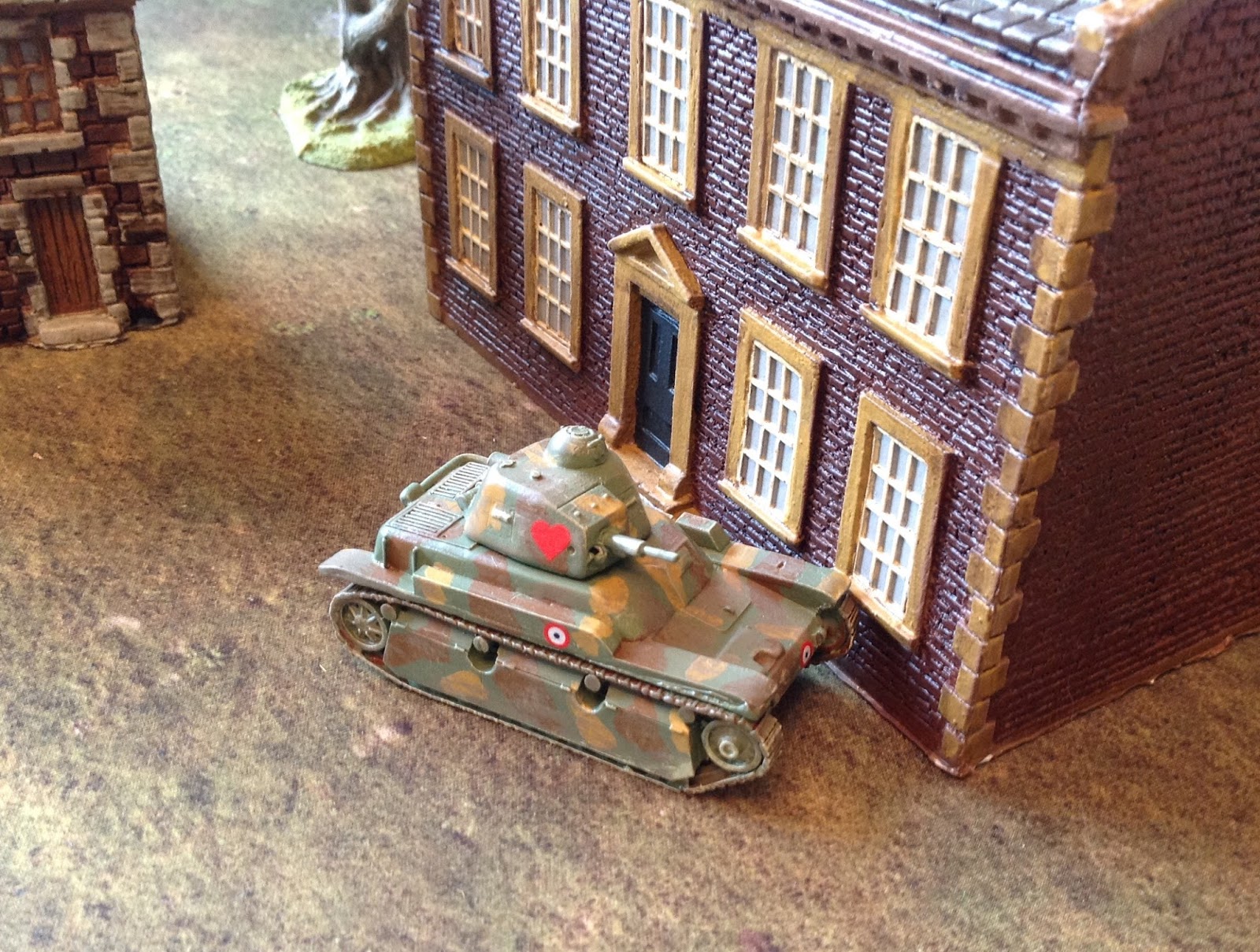
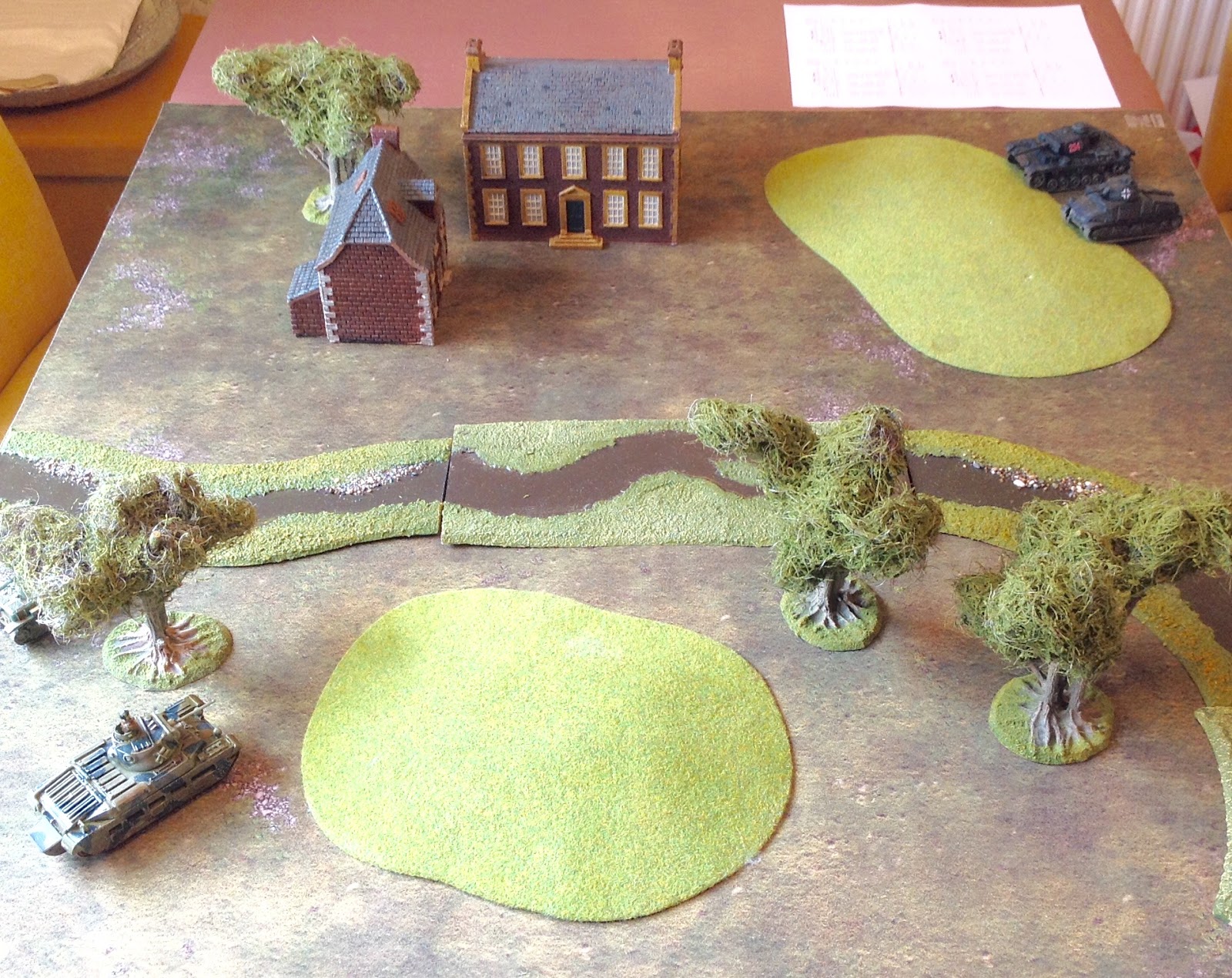
My test game involved a Matilda and an R40 taking on a Pkw III with a captured Somua.


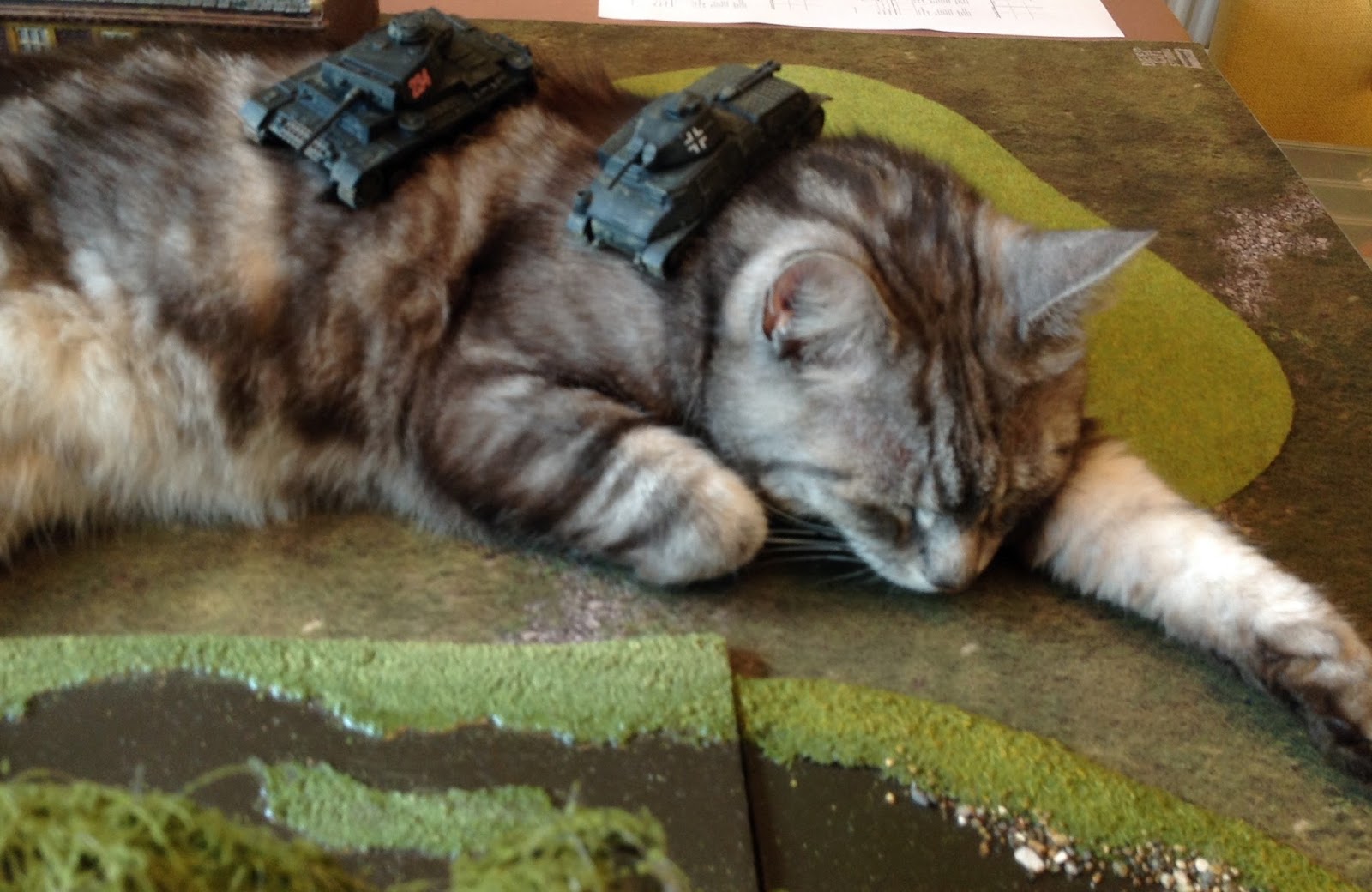
And Razzy joined in, not too enthusiastically, even when the Germans used him for a bit of cover!


Sunday, 29 April 2018

Arab siege of Constantinople

This year is the 13th centenary of the lifting of the Arab siege of Constantinople in 718. Arguably the high tide of the Arab conquest and an important turning point in the history of the Balkans and Europe. With a base at Constantinople, the Arabs could have pincered Europe from the east and from Spain in the west.

The siege began the previous year when the Caliph Maslama assembled an army of 80,000 men on land and a fleet of 800 ships with over 80,000 fighting troops aboard. The defences were too strong to assault, so he built a ditch and blockaded the city, with two fleets that aimed to block sea access.

A raid on the fleet by the Byzantines, using Greek fire kept the northern Bosphorus end of the straits clear. This meant the city was never fully invested. The winter caused heavy losses to the Arabs from disease, but come the spring, a new Egyptian fleet sailed past the city and closed the Bosphorus. A reserve army arrived with much needed reinforcements.

The Byzantine Emperor Leo sortied out again with his fleet and using a combination of fireships and Greek fire, destroyed the Egyptian fleet. On land, Terval, King of Bulgars attacked the Arabs near Adrianople, winning a major victory. The Arabs abandoned the siege and headed for home. A storm caused further losses and only a handful of ships made it home.

Wargaming the siege would be a major undertaking and pretty boring. However, there would have been plenty of skirmishes and we have the Bulgarian relief attacks. For the refight I used 15mm Bulgarian and Arab figures for a 100pt game of Art de la Guerre.


Sunday, 22 April 2018

The Bernicia Chronicles - Warrior of Woden

Warrior of Woden is the fifth and latest book in the Bernicia Chronicles by Matthew Harffy. If you have read my reviews of the earlier books you will know that I am a huge fan of this series. If you are suffering from Bernard Cornwell withdrawal symptoms, this is the series for you.


The year is AD 642 and the setting is Anglo-Saxon Britain. Our hero, flawed of course, is Beobrand. He is now an established and wealthy warlord, with his own lands and hearth guard. However, the warring kingdoms of Britain are not going to allow him to rest easy.

Penda of Mercia and his allies invade Northumbria and Beobrand is called upon to support King Oswald. There is treachery, a huge battle (Maserfelth) that rolls on for several chapters and plenty of skirmishes. Of course Beobrand survives, but not without personal loss and few scars.

The advantage of this setting for historical fiction is that we know very little about it. A couple of less than reliable primary sources and a growing, but incomplete, archeology. The author has largely used historical figures and followed as much of the historical narrative as he can. Names and places are borrowed from the same period, if not exactly as they where.

Military tactics were pretty straightforward. Some preliminary skirmishing followed by the crunch of the shieldwall. Each Lord had his own war band of warriors, reasonably well equipped with spear, sword, chain mail and shield. For the big battles they would be supplemented by the part-time militia or Fyrd - less well equipped and trained. The numbers on either side would not have been huge.

For the wargamer there are plenty of figures and rules. There is a new edition of SAGA coming out which is ideal, although I usually use Lion Rampant, or Hail Caesar for the big battles.

Welsh v Saxons

This is a great read - highly recommended.

Wednesday, 18 April 2018

Blood and Sand

Rosemary Sutcliffe is best known for her children's novels, but she has written a number of books of historical fiction. I have read Eagle of the Ninth, which is very good, so an offer to read her book 'Blood and Sand' on the Kindle (published in 1987) at a bargain price was certainly worth a look.


This book is set during the Napoleonic wars and covers the life of Thomas Keith, a Scot who was captured in Egypt at the battle of El Hamed in 1807. Instead of returning to Britain, he took service with the Ottoman governor of Egypt, Muhammed Ali. Other than his marriage, it follows pretty closely to the historical story.

And a remarkable story it is. A private soldier, Thomas rises through the ranks, training Egyptian cavalry to face a number of conflicts with the Wahabi war host of Saud Ibn Saud, in what we today know as Saudi Arabia. Essentially battling for control of the holy cities of Mecca and Medina. He ended up commanding the Arab, Egyptian and Albanian cavalry in those conflicts, after converting to Islam. He was also the governor of Medina when he died in battle.

The first half of the story is a bit slow, as Thomas adapts to his new environment and develops relationships within Egyptian society. This included the suppression of the Mamelukes. The second half has much more action, including several campaigns in Arabia that give the reader a real understanding of the challenges of campaigning in such an inhospitable climate.

This is not a great work of historical fiction, but worth a read. You might feel like abandoning it after the first few chapters, but it is worth persevering.

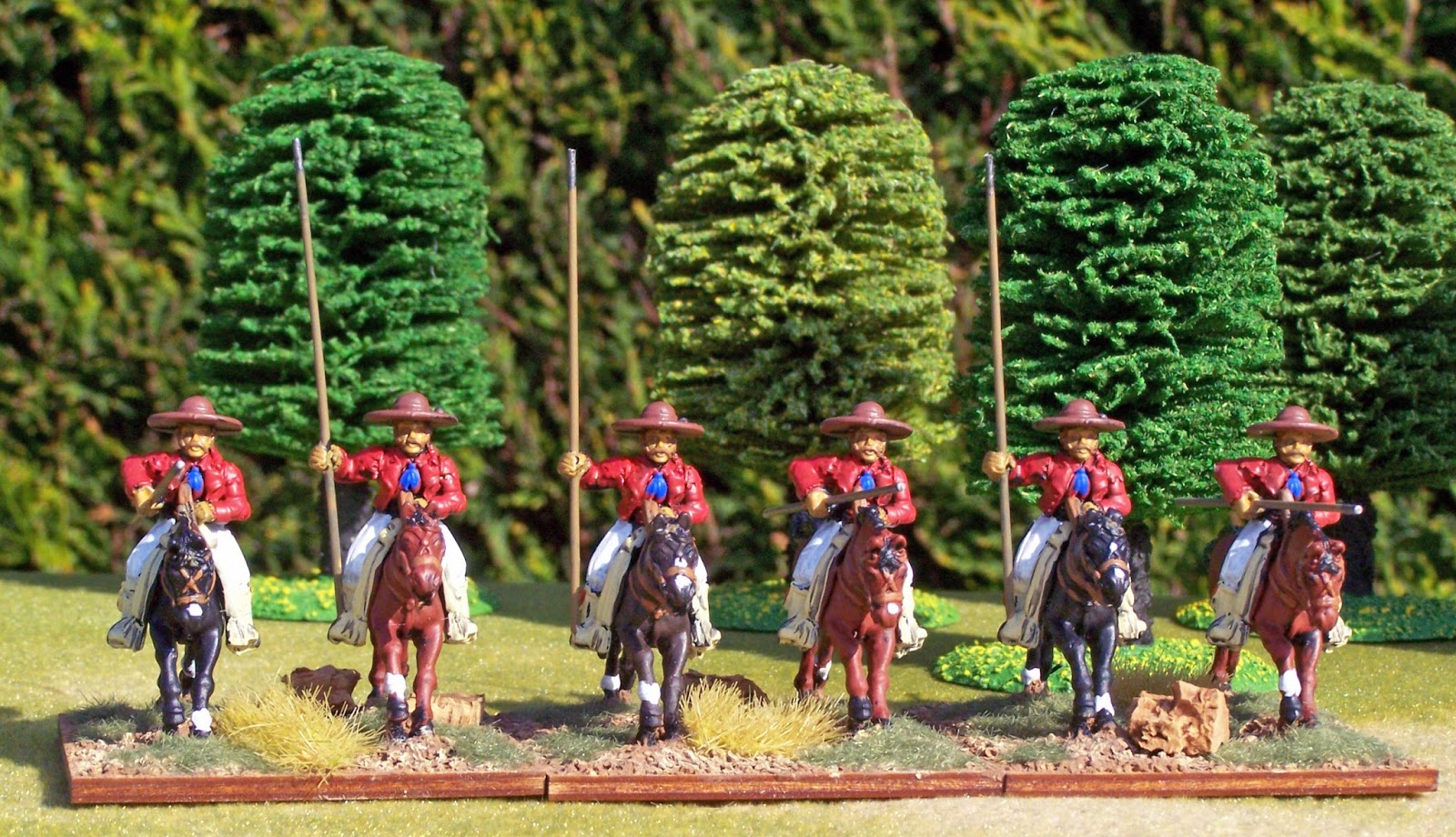
And let's have some eye candy for the wargamer. From my 28mm collection of the period.


Monday, 16 April 2018

T-90 Standard Tank - The First Tank of the New Russia.

The latest in the Osprey Vanguard series covers the primary Russian Main Battle Tank of the modern era, competently described by the master tankie, Steven Zaloga.


The T90 is a development of the T72. The author outlines the troubled development of the tank, beset by the economic problems facing Russia at the time and disagreements amongst the Russian military on the way forward. As usual with a Vanguard publication there is a detailed technical description, with plenty of photos and colour plates.

The T72 performed badly in the Gulf wars and in Chechnya, which damaged its reputation and the all important export orders. It is at least questionable if this was due to the tank or its poor deployment and crew training.

The T90 is more than a rebranding. It has all the features you would expect in a modern tank. Offensive armament including guided munitions, and defensively including reactive armour. An important export win has been the Indian army and Algeria.

The book ends with a description of its internal rivals and the many variants. This includes all the standard engineer variants, but also the unusual tank support vehicle, known as the 'Terminator', designed for the urban environment's tanks have been deployed in during recent conflicts.

Essential reading for those interested in the modern Russian army.

Saturday, 14 April 2018

The Kuban 1943 - The Wehrmacht's last stand in the Caucasus.

The Kuban campaign of 1943 is covered in the latest Osprey Campaign publication by Robert Forczyk.

After the disaster at Stalingrad, Hitler's push into the Caucasus was looking beyond hope. However, true to form, Hitler refused to abandon his objective of exploiting the old fields and ordered his armies to hold the ground they occupied. The German 17th Army did their best, but they were forced back into the Kuban bridgehead.

This book covers the efforts of this army to hold onto the bridgehead and the many offensives by Soviet armies to destroy it. In many ways it is a textbook defence of a bridgehead. The terrain was eminently suitable for the defence, enabling German forces, usually outnumbered 3:1, to hold their positions. Hitler's objective of using the Kuban as the base for a renewed offensive was never realistic and it pulled away troops that would have been better deployed in the Kursk battles. Equally, while it did tie up significant Soviet forces, they were generally not the the best equipped, particularly in terms of armour.

Unusual features of the campaign included the extensive deployment of air support by both sides and the use by the Soviets of naval infantry. They managed to establish an important bridgehead near the city of Novorossiysk, known as the Malaya Zemlya, which is today a national memorial park. In the north of the bridgehead there was extensive combat in marshland.

The German forces also included six Romanian divisions and Gebirgsjager divisions. The Soviet air forces also made use of smoke pots to mask the German artillery, a tactic I had never heard of before.

After the failure of the Kursk offensive, Hitler eventually agreed to the evacuation of the Kuban. The 17th Army conducted a masterful withdrawal and retreated over the Kerch Straits to the Crimea. The Kriegsmarine and Romanian navy played an important role in this part of the campaign.

For the wargamer this campaign offers actions that are far from the typical Russian Front scenarios and this book is all you need to recreate them. Lavishly illustrated with excellent maps.


Saturday, 7 April 2018

Battle of Maipo - April 1818


This week is the 200th anniversary of the Battle of Maipo, the decisive battle of the liberation of Chile from Spanish colonial rule.


At the beginning of the 19th century the Spanish Empire in South America consisted of three Viceroyalties; New Grenada in the north, Peru that included Chile and La Plata covering mostly modern day Argentina. These were the territories largely conquered by the conquistadores in the sixteenth century. The dislocation caused by the Peninsular War in Europe led to the establishment of local Juntas and then to the independence movements that resulted in the wars of liberation. 

The outstanding Patriot generals of the wars, accorded the title of ‘Liberator’, were Simon Bolivar who liberated the north and Jose de San Martin who led the forces from Argentina into Chile and then Peru where he joined up with Bolivar.

The key to Spanish control of South America was the most Royalist of provinces, Peru. The Patriot stronghold of La Plata sought to capture Peru by the direct route through Upper Peru (modern Bolivia). In three campaigns between 1810 and 1815 the Patriot armies were defeated by the Royalists and only the Gauchos in the Salta region stopped the Royalists from exploiting their victory into La Plata itself.

By 1815 command of the Patriot Northern Army had been handed to Jose de San Martin. He was a career soldier who had fought in the Peninsular War at both Albuera and Bailen. San Martin’s plan was to liberate Chile from Argentina and then move up the coast to Peru. He reorganised the Patriot forces, incorporating Chilean refugees led by Bernado O’Higgins, into a new Army of the Andes based at Mendoza. His plan involved crossing the Andes in January 1817, in four columns using different passes of between 3,500m and 5,100m high.


The columns united across the Andes near Chacabuco on 12 February. The Royalist army had been caught unprepared and was defeated. The Royalists fled to the port of Valparaiso, but the seven month siege went badly. San Martin with reinforcements rallied the Patriot forces at Cancha Rayada. where a desperate night attack (March 19) panicked the Patriots who fell back to Santiago. 

The decisive battle of the campaign took place just outside Santiago at Maipo on 5 April 1818. The battle opened with an ineffective artillery duel followed by an advance from by the Patriot line. The right wing routed the Royalist cavalry and captured a battery. However, the left wing was stopped and only the reserve artillery stopped the Royalist counter attack.

San Martin then ordered his mounted Cazadores to flank the Royalist left. They drove off the Royalist cavalry and crashed into the veteran Burgos Regiment. When this gave way Osorio panicked and ordered a retreat. Colonel Ordonez took over command and rallied a sizable force at Los Espejo farm that repulsed the Patriot assaults until San Martin brought up artillery support and forced the Royalist surrender.  The Royalist army was totally crushed and Chilean independence was secured. Over 1500 Royalists and 1000 Patriots were casualties in the bloodiest battle of the war.

I wrote an article for Wargames Illustrated in August 2007, outlining how I converted 28mm figures for these campaigns. Glasgow and District Wargames Society used them for a series of display games that year, covering the three main battles of the campaign. The figures can all be viewed here.

The best English language history of these wars is ‘Liberators’ by Robert Harvey. This is great narrative history and the real inspiration for starting in this period. However, converting this to the tabletop would not have been possible without  ‘Liberators: Napoleonic Wargaming in South America’ by John Fletcher.  John has a website, a Yahoo group and a range of 15mm figures.


Wednesday, 4 April 2018

The Splintered Empires - The Eastern Front 1917-21

My Easter reading has been a newish book by Prit Buttar 'The Splintered Empires'. This is a history of the Eastern Front between 1917 and 1921.

The early war campaigns, particularly Tannenberg, have received a fair degree of attention, but the same cannot be said for the later period. The centenary of the Russian revolution has also been more focused on the political and internal events, rather than the impact on the war itself. This book corrects that with a detailed account of the final campaigns of the war and its aftermath.


The author starts in 1917 and understandably focuses on the Russian army, as it gradually collapsed as a fighting force. The Tsar's unwillingness to reform quickly enough led to revolution and the road to Brest-Litovsk. While that did enable Germany to redeploy divisions to the West, they overstretched themselves with over ambitious plans to expand in the East. This meant troops had to be retained in places like the Ukraine and the Baltic states, which could have made all in difference in the 1918 offensives.

The Russian Empire was not the only one to collapse and in practice lost little of its territory, other than Finland and Poland. The German Empire and the rule of the Hohenzollerns came to an end, although perhaps the biggest collapse was the Habsburg's. This huge multi-ethnic empire split up into many parts, leaving a small Austrian state and a reduced Hungary.

The final chapters are perhaps the most interesting. They cover what Churchill called 'The Pygmy Wars'. These were the wars in Estonia, Latvia, Lithuania and Poland, that established independent states. The complex web of alliances and armies, ranging from nationalists, Bolsheviks, White Russian and Germans, went on until 1921. Even then the boundaries rarely survived future conflicts.

This is a really complex story, very well told. The politics are not ignored, but there is plenty of detail for the military historian. There are also decent maps, something often missing in other studies. Recommended.

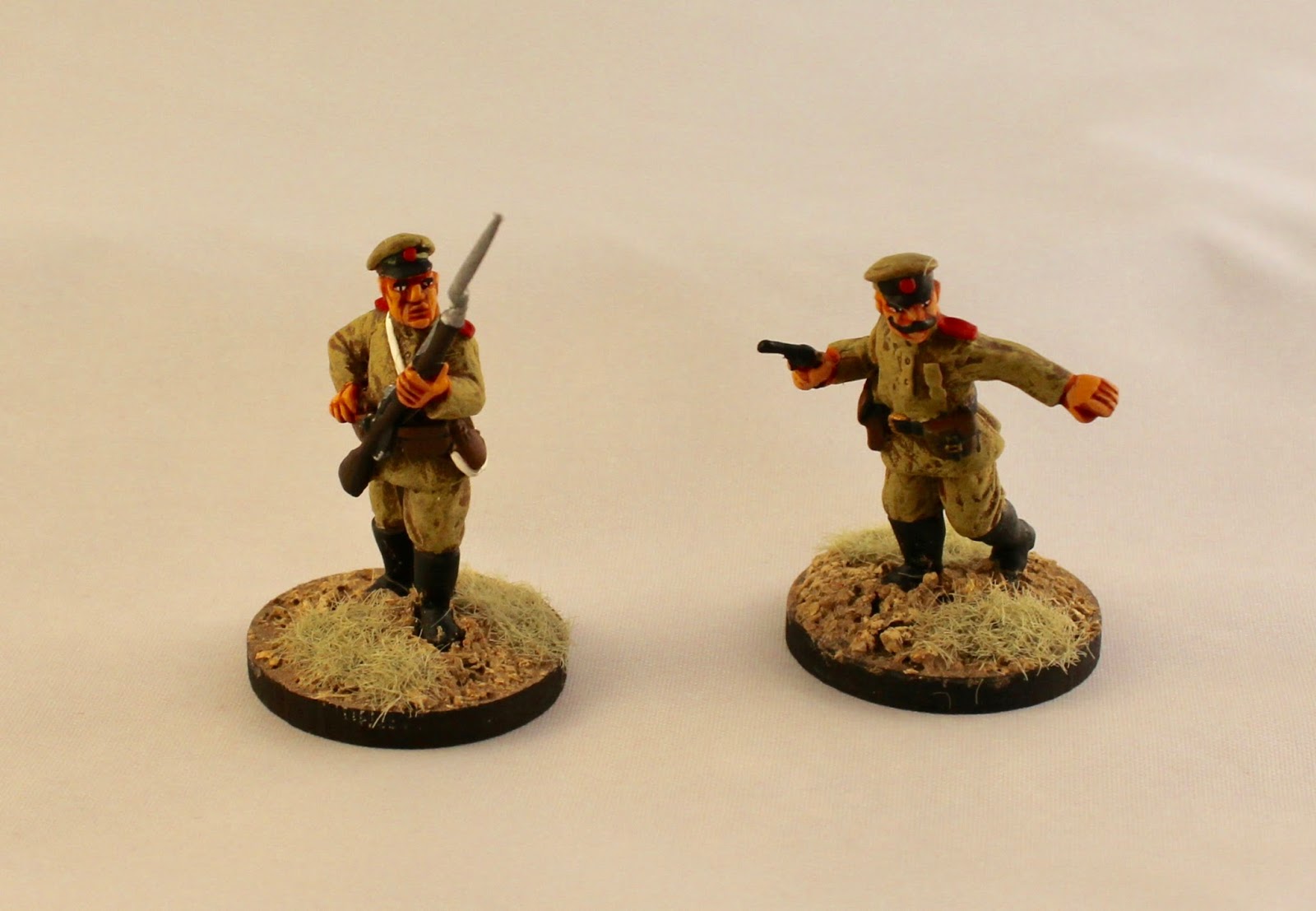
I am sorely tempted to expand my 28mm and 15mm armies of the period to the Pygmy Wars. Here are a few Russian and Austro-Hungarian 28mm figures to whet the appetite.


Sunday, 1 April 2018

French WW2 finished

It's April and at least one of my 2018 projects is finished - well until another 'must have' unit comes along!

Any Bolt action force needs a decent anti-tank gun and the French had probably the best at the start of WW2 with the 47mm Mle 1937. I used a Lorraine 37L as a tow. In practice, it was usually towed by a Laffly six wheeled truck. Both models are made by Mad Bob Miniatures (not an April fools joke!) and the crew are Warlord. This is the first time I have bought a model from this supplier. They are resin kits, just a few parts that went together well - recommended.


Wargamers always paint the bog standard units last, and I am no exception. A squad of infantry with LMG and VB launcher.


Finally, the whole army together.


Friday, 30 March 2018

The Bruces in Ireland - Battle of Faughart 1318

This year is the 700th anniversary of the culmination of the Bruce brothers invasion of Ireland that largely ended with the death of Edward Bruce at the Battle of Faughart (Dundalk) in October 1318.

After Bannockburn, Robert the Bruce opened a second front against the English by invading Ireland, which at this time was largely an English domain. Historians are divided on his motives, but it seems likely that he hoped firstly to stop Ireland being used as a jumping off point for English attacks on the west of Scotland. A grander plan was to take Ireland as part of a grand Gaelic encirclement of England through Wales. It was also a useful way of keeping his excitable Brother Edward busy, by giving him a kingdom of his own.

The invasion in 1315 initially went well. Anglo-Irish forces were defeated and in 1316 Edward was declared High King. In practice, his control of Ireland was largely based in the north with plundering raids in the south. Ireland suffered a terrible famine during these years, which severely limited the ability of armies to campaign.

In 1318, Edward made a typically reckless move south through the Moiry Pass to invade the south, without waiting for reinforcements from Scotland. Our sources for the battle are very limited and some are frankly absurd. However, it appears that Edward's modest force deployed on higher ground with his Scots in the front row and Irish troops, furnished by the de Lacys, behind. It is likely that he would have had a small number of knights and archers.

The Anglo-Irish strength would be based on heavy knights with some support from feudal spearmen and archers, hastily levied from local landowners and towns, as the attack was unexpected. They were led by John de Birmingham. The Anglo-Irish obviously had sufficient knights because they broke through the Scots and killed Edward Bruce. He was killed by John Maupas and chopped to pieces. What was left of him is buried in the graveyard at Faughart.

The economic impact of the invasion meant few mourned Edward's passing in Ireland. As the Irish compiler of the Annals of Loch Ce puts it:

"Edward Bruce, the destroyer of all Erin in general, both English and Gael... no better deed for the men of all Erin was performed since the beginning of the world.... for theft and famine destruction of men occurred throughout Erin at this time."

For further reading, I would recommend Sean Duffy (Editor) 'Robert the Bruce's Irish Wars'. This is a series of essays by different writers and includes a translation of primary sources. For a fictional account, there is Nigel Tranter's 'The Price of the King's Peace' (1971) - excellent as always.

I used L'Art de la Guerre rules for the refight in 15mm. A pretty straightforward game, reflecting the uncomplicated tactics of the period. It was a 100 point a side game and the Scots won. The bowmen didn't soften up the spearmen enough and the knights struggled up the hill to breakthrough. Of course, as in most historical battles, the real armies were not equal!


Wednesday, 28 March 2018

Battle of the Medak Pocket 1993

Having the week off before Easter, my usual routine is to walk in the morning accompanied by my iPod and suitable podcasts. This morning's menu included the History Network's 'Battle of the Medak Pocket 1993' written by the Canadian historian David Borys. 

This isn't a Balkan battle I recalled, which isn't surprising because the Canadian Government to this day denies its existence. This is despite a Canadian unit, 2nd Battalion Princess Patricia's Canadian Light Infantry Battle Group (2PPCLI BG), being awarded the Commander-in-Chief Unit Commendation for its actions in the Medak Pocket, the first Canadian unit ever presented this unit commendation. In Canadian military circles it is described as the largest engagement involving Canadian troops since in the Korean War.

Medak is a small village, not far from Gospic in the Lika region of Croatia. In 1991 the Bosnian Serbs, with Yugoslav army support, captured the area and then ethnically cleansed the area of Croats. In 1993 the Croatian army was pushing back the Serbs and the line was held near Medak, when a ceasefire was agreed.

The Canadian Battle Group supported by French mechanised units was tasked by UNPROFOR to act as a buffer. However, when they advanced into former Serbian positions they came under artillery fire from the Croatian army. During the night the Croats sought to outflank the position, but were repulsed by the UN Battle Group. Four Canadians were wounded and the Croats suffered around 27 casualties.

The following day, the Canadian commander held a press conference in front of Croat positions, after which the Croatian forces began to withdraw to the agreed positions. In the meantime they engaged in their own ethnic cleansing of the Serb population. Their commanders were later indicted for war crimes.

The causes of the action are disputed, but there is little doubt that relations between the Croatian forces and the Canadians were not cordial. The Croatian forces did not deploy their M-84 tanks, either to avoid escalation, or over concerns about losing them to reasonably well equipped Canadian ATMs.

I have visited the region, which includes the Uskok town of Senj and the former military border town of Otocac. Most people by-pass the area on the fast E71 road to the coast at Zadar.  I didn't get as far south as Medak, although hills and woods are my memory, and apparently the area remains largely depopulated.

For wargamers, it makes a small skirmish game with unusual opponents.

The Canadians were equipped with M-113 armoured personnel carriers and carried a mix of  .50 caliber machine guns, C6 medium machine guns, C7 assault rifles, C9 light machine guns, and 84 mm Carl Gustav RCL's. The attached Heavy Weapons Support Company brought 81 mm mortars and a specially fitted APC armed with anti-tank guided missiles. The French forces had VAB APCs.

The Croatian forces were a mix of units armed with former JNA weapons. They had significant artillery support  and M-84 tanks (Yugoslav version of the T-72), although these were not deployed in the action, but could be for the refight.


Mig 21 and one of the many improvised APCs at the Croatian Homeland War Museum

So, on to the tabletop. I used my 1/300 figures for the skirmish. A larger scale would be better.


Monday, 26 March 2018

For King and Parliament

'For King and Parliament' is a new set of rules for the 'English' Civil War period, adapted by Simon Miller and Andrew Bentnall from Simon's 'To the Strongest' ancient and medieval rules.

If you have played 'To the Strongest', you will quickly pick up these rules as they use many of the same mechanisms. The key features are the use of a grid, obviating the need for measurements. They also use playing cards instead of dice.

The main changes are to the shooting and melee rules, which are a bit more complex, to reflect the importance of firepower and the different tactical approaches to melee.

You can use any scale and even within scales there are a range of options which allow players to use existing armies and basing - always a plus. There is a points system and a couple of army lists, with more to come. These could easily be tweaked for other renaissance armies, and no doubt will be once the forum is going strong. You can also play quite small games, up to multi-player games.

Some folk don't like the use of playing cards on aesthetic grounds. I have a couple of small packs that came from posh xmas crackers, but you can use chits if it really bothers you. Some heretics are apparently even using D10s!

The grid is another criticism. I have a lovely Deep Cut mouse mat with 100mm squares, which as you can see from the photos, barely shows. As an alternative you can just put dots on the corners. The real advantage of the grid system is the speed of play and the absence of measurement squabbles. Mine also doubles up as a mat for the Rommel WW2 rules.

My test game used 100 point Royalist and Parliamentary armies of the mid-war period in 15mm. I am not a regular TtheS player, but I quickly picked up the mechanisms again. The one irritating omission is a quick reference sheet. Flicking backwards and forwards on my iPad is not ideal and it meant I kept missing some of the factors, particularly in the activation phase.

Other than that, the game flowed well and felt like an ECW game. I will stick to Pikeman's Lament for skirmish games and Pike & Shotte for the big battles in 28mm. However, this is a good in-between game for my 15mm figures that can easily be finished in an evening.

Some photos from my game, starting with the set up.


First turn with the cards showing.


The dreaded ace, that brings that brigade to a grinding halt.


The Royalists are powering through on the left flank and making good progress on the right as well. The question is, can they be rallied before pursuing away. Nice rule system for this.


Finally, a breakthrough in the centre and so King Charles lives to fight another day. The dice are ammo markers. I am not convinced this level of complexity is required, but it works well for horse melee.


Saturday, 24 March 2018

The Black Sea - an historical journey

'Black Sea' by Neal Ascherson is about that large inland sea, which has had a huge influence on the history of Europe and beyond. It was first published in 1995 and it has been sitting on my to read shelf since I picked up a second hand copy a couple of years ago.


The book focuses on the northern coast of the Black Sea which includes the early Greek colonies and their interaction with the nomads of the steppes. These include the Scythians (the subject of a brilliant recent British Museum exhibition), followed by the Sarmatians, Goths, Khazars, Huns, Mongols and Turks. Cities have come and gone, often lost in the numerous conflicts that have passed through the region.

The Balkan coast, most familiar to British tourists, gets little attention and the same applies to the Turkish coast. The Russian and Georgian coasts on the other hand are covered - probably the right balance as the recent conflicts in Abkhazia will be less familiar to western readers.

This is more a history book than a travelogue, although there are elements of both. The author does stray somewhat from his subject, drifting geographically as a particular story takes him off at a tangent. He also doesn't avoid the geology of the Black Sea and the shocking man made pollution, from the great rivers that pour into the sea.

The story of an American jellyfish, the Mnemiopsis, which probably arrived in the water ballast of a freighter, is particularly shocking. Between 1987 and 1988 it consumed almost the entire zooplankton population of the Black Sea and the Sea of Azov, wrecking the Black Sea ecosystem. Growing to 700 million tons of translucent jelly that has no natural predator.

I would have preferred a bit more structure to the book that does rather lose its way in places. However, it is elegantly written and covers bits of history that deserve greater attention.


Monday, 19 March 2018

A Genius for War: The German Army and General Staff, 1807-1945

If you are a wargamer who thinks German troops should always get a bonus, then this may be the book for you. Trevor Dupuy is the author of 'A Genius for War: The German Army and general Staff, 1807-1945' and he sets out the arguments for the exceptional military excellence of the German military.

He came to the subject by looking at the amazing recovery from defeat the German military managed in WW2. He argues that German units had a 30% combat superiority per man over the British and Americans at the time of the Salerno landing, and this had only dwindled to 20% by mid-1944. As he refined the model it showed that German soldiers inflicted three casualties on the Allies for every two they incurred. He also noticed that board game firms like Avalon Hill had given similar weightings to achieve reasonably faithful outcomes.

When applying this model, in less detail, to WW1 he found a similar 20% combat effectiveness. When he discussed these findings with veterans, they tended to confirm the findings.

This book is essentially about explaining why this combat superiority existed. He argues that it isn't anything inherently superior about Germans. Instead it is the institutionalising of military excellence that accounts for the difference. For example, Germans fighting outwith the military system in the American Civil War did not have a similar combat superiority.

He points out that the international reputation for military excellence didn't start until the mid-Eighteenth-century and not really until the nineteenth century. This means that the answer doesn't lie with the men, but in the structure of the German military establishment. He argues:

"The fundamental explanation of German combat ability and of the quality of German military power as demonstrated in two world wars, lay in the organisation and operation of the Prussian/German General Staff."

The author therefore takes us through the development of the German military system. The focus is on the general staff system, which although it had its failings, did produce many more outstanding generals than its contemporaries. It was the only significant military professional development that was not matched by other countries. This system not only produced good generals, but it also encouraged individual initiative at all levels. This is illustrated by Prince Frederick Charles statement to a blundering Major during the Franco-Prussian War who claimed he was following orders, he said:

"His majesty made you a major because he believed that you would know when NOT to obey his orders."

Of course this system broke down with Hitler, who ignored this dictum, contributing to some of Germany's worst defeats. They were not geniuses because they made no mistakes - they just made fewer than their opponents.

The author makes a convincing and well argued case for his thesis. Recommended reading, particularly for wargamers.


Saturday, 17 March 2018

Joseph Brant and his World

My recent Canadian trip was for a conference in the City of Burlington, Ontario. The Main Street was named after a Captain Joseph Brant, which I assumed was a Canadian or British military officer. However, the story is actually much more interesting.

Joseph Brant was a Mohawk (Kanien'kehake) leader who lived in what is now over the border in New York State. So he was what I was brought up to describe as a Red Indian; these days correctly known as First Peoples and First Nations. As a wargamer my collection also includes what most firms describe as Iroquois. This turns out to be a derisive French word that means "the killer people". The proper name for the Six Nations is Haudenosaunee.

A bit more research led me to a local bookshop and a book written by James Paxton, 'Joseph Brant and his World'. He sets out the North America that Joseph Brant was born into in 1743. This was a period of almost continuous warfare, starting with the War of Austrian Succession (1744-48), and the Seven Years War (1754-60) in which the British colonies contested North America with the French. The Six Nations, including the Mohawks, mostly fought with the British, and Brant aged only 15 fought in several campaigns, including the siege of Fort Niagara and the fall of Montreal.

Fort Niagara
Brant received a British education that included a spell in Scotland and developed his connections across the territories, often in the employment of the Indian Department. He fought in Pontiac's War (1763-65) and while that fizzled out, the land disputes continued.

He gradually took on a leadership role, with his wife Molly, and persuaded the Six Nations to support the British in the American Revolution. This ended badly for Brant and his peoples, who were scattered, with many ending up in Canada.  It was during this war that he was given a commission as a Captain and took part in a number of raids and other actions.

His post-war life in Canada is of less interest to the military historian, but involved many disputes over land for the First Nations of Canada. These are still live political issues to this day. Joseph Brant died in 1807. His son fought for the British at Queenstown Heights in 1813 and the role of the Six Nations is recognised on the battlefield site.


Tuesday, 13 March 2018

Dust Upon the Sea - raiding in the Aegean

'Dust Upon the Sea' is the wartime memoir of W.E. Benyon-Tinker, an army officer seconded to a naval special service flotilla operating in the Aegean during 1943-45. It was published in 1947 and I found it lurking in the corner of a second-hand bookshop in Inverness. There are a few copies knocking around internet suppliers, although at prices significantly higher than I paid, or frankly would have paid.


The Levant Schooner Flotilla consisted primarily of caiques. These are small Greek sailing vessels, aided by a small engine, that rarely managed to get above eight knots. Based in Beirut they were essentially a taxi service for raiding forces provided by LRDG and SBS detachments, used to attack German garrisons on the Aegean Islands.

The author describes a number of his trips as the war developed, before the Germans abandoned the islands as the Russians entered the Balkans and threatened their lines of communication. As a signals and intelligence officer, the author was in the position of neither playing an active role in handling of the boats or the raids themselves. This means the narrative is a bit of a travelogue, not uninteresting, but it does get a bit tedious at times.

There are other books that cover the strategy and combat better, including the memoirs of Michael Woodbine Parish in 'Aegean Adventures'. However, one of the books real strengths are his extensive collection of wartime photographs.

I can't say I would recommend this. As the author candidly admits, he isn't a writer, but it might inspire a game or two based on an island raid. And it just so happens I have some figures that might just do the job!